Waikiki Wedding and Bing Crosby, 1936.

A FITTING HAWAIIAN SOUGHT

FOR WORKING ON HAWAIIAN STORY FOR A MOVIE

HOLLYWOOD, Sept. 1.—Mr. Bing Crosby will be landing in Honolulu next Thursday aboard the steamship Lurline, one of those who are writing the script of a movie called “Waikiki Wedding.” The news was heard from his studio that on this trip he is searching for a very famous woman in ancient Hawaiian hula, that understands the hand motion and the foot movements, as in ancient Hawaiian history; the hula of Hawaii that made it famous and was seen as one of the things that were taught to all women of Hawaii during those days. Also they are on the search for famous young musicians of Hawaii nei that know the proper mele for the hula foot movements of women, who know the string instruments and drums of the Hawaiians, and are not just handsome to look at, but true to the history that is written about: the ti-leaf whistle, the kilu drum, the puhenehene flute, the jew’s harp and bamboo ukeke. Continue reading

Helen H. Roberts, ethnomusicologist, collecting mele from across the islands, 1923.

SOMETHING WORTHWHILE HELPING

In this past Legislative session, $5,000 was set aside for the cost to prepare a book of “Ancient Hawaiian Music”. This endeavor has been given to Kamehameha School, and they are now utilizing this to preserve the “old mele olioli” of Hawaii nei. Miss Helen H. Roberts has been sent by the Trustees of the Kamehameha School to go amongst the Hawaiians and to search out ancient mele of Hawaii nei.

She is accompanied by a phonograph [ponotalapa (ipu malama olelo)], and is looking to have people chant ancient mele into the phonograph and to record and save it for generations to come. Not only mele olioli are being sought after, but also wanted are mele hula hoaeae of the Hawaiians. Many years from now the people who know these old mele will be gone, but these mele olioli and mele hoaeae will become something to look back to the history of the Hawaiian Lahui.

This will be something that will look for where the Hawaiians came from, whereas also being sought are mele of other Polynesians while comparing these ancient mele with the ancient mele of Hawaii.

This is something that the old people who are fluent for instance in the old mele hoaeae of Hawaii nei should assist in.

This is not being done for monetary profit, but to seek the ancient things of the beloved Kupuna of this Lahui; and for all Hawaiians who have pride in the fame of their Lahui, there is no reason for them to withhold these ancient things of the Kupuna and to go to the grave without leaving these blessings for those coming after them. We ask Rev. W. M. Kalaiwaa and Rev. William Kamau of the Kohala districts to support this great endeavor for the acclaim of the Hawaiian Lahui. We are also helping to move this project along with what little we have, being that this will help to perpetuate the great Moolelo of the Hawaiian People.

[The opening to the book “Ancient Hawaiian Music” reads:

A survey of ancient Hawaiian music was conducted, 1923–24, by Miss Helen H. Roberts under the auspices of the Hawaiian Folk-Lore Commission represented by John R. Galt, chairman; Edna J. Hill, secretary; Mrs. Emma Ahuena Taylor, Hawaiian member. In cooperation with the Commission, manuscripts resulting from the survey are published by Bernice P. Bishop Museum.]

(Hoku o Hawaii, 12/6/1923, p. 2)

HE HANA MAIKAI E KOKUA IA

Ka Hoku o Hawaii, Buke XVII, Helu 28, Aoao 2. Dekemaba 6, 1923.
Hula in Hanapepe, 1863.

[Found under: “NA MEA HOU O HAWAII NEI.”]

Hula in Hanapepe.—We hear from S. Papiohuli of Hanapepe, Kauai, that the people of this place are turning to the Hawaiian hula, and all of the men and women of the area are doing that idle activity; therefore, we are dismayed at this resurgence of this encouragement of indolence in that place.

(Kuokoa, 8/29/1863, p. 2)

Hula ma Hanapepe.

Ka Nupepa Kuokoa, Buke II, Helu 35, Aoao 2. Augate 29, 1863.


The appearance of the lost hale of Lohiau in Haena, 1892.

THAT AMAZING STONE BUILDING

Some people from Kilauea, Kauai, when they heard that that ancient stone house of Lohiau in Haena was dug up by the sea and visible, they went immediately on Sunday, the 4th of this month to witness one of the famous ancient places of Kauai. However, they were dumbfounded that the stone structure was reburied by the sea after being visible for but a short week.

The kamaaina of Haena pointed out where they saw that relic, however, none of them was willing to attempt to dig it up again. Because they saw that it was a massive rock, and its size was fantastic, and that it would be a feat for them to re-raise that rock; this would only be possible with a huge amount of people, and that is why they thought that; or perhaps, that this was a magical occurrence, and just as its appearance was wondrous, so too was its disappearance.

[It is unfortunate that there are no digital images of this important newspaper available online yet.]

(Hawaii Holomua, 12/15/1892, p.2)

KELA HALE POHAKU KAMAHA'O.

Hawaii Holomua, Buke III, Helu 120, Aoao 2. Dekemaba 15, 1892.

Hawaiian boys headed to China to play music, 1916.

[Found under: “LOCAL AND GENERAL”]

Five Hawaiian musicians will leave Honolulu May 26 in the steamer China for Shanghai, China, to fill a lengthy engagement at the Carleton Cafe in that city. They are Robert Akeo, William Smith, Valentine Kawai, John Nieper and Joseph K. Kauila.

(Honolulu Star-Bulletin, 5/9/1916, p. 3)

Five Hawaiian musicians...

Honolulu Star-Bulletin, Volume XXIII, Number 7511, Page 3. May 9, 1916.

Hawaiians singing in far away China, 1917.

THERE IS GREAT DELIGHT IN HAWAIIAN MUSIC IN CHINA.

In a letter written by Robert Akeo, a Hawaiian boy who travelled to Shanghai, China, with his companions to sing under contract, it is seen that there is much admiration for Hawaiian music in China, because their contract to play there was over long ago, and yet, they are constantly being asked to satisfy the desires of those people for Hawaiian music and hula.

It seems in order to fulfill the wishes of Shanghai’s people for hula, one of the boys was made into a woman by putting on women’s clothing, and he would dance with one of his fellow boys, while the rest of them play music, and they sing and dance at the same time.

There are some thousands of people in Shanghai who have no knowledge of Honolulu, but after hearing the singing voices, and seeing the act of those young ones, the desire to come visit Honolulu and see the Paradise of the Pacific grew within them.

(Kuokoa, 2/2/1917, p. 8)

NUI KA HIALAAIIA O NA MELE HAWAII MA KINA.

Ka Nupepa Kuokoa, Buke LV, Helu 5, Aoao 8. Feberuari 2, 1917.

Newspapers, Mary Robins, mele, and connections, 1919.

HE HULA NO E. E. ROBINS.

Kaulana mai nei o Honolulu Harbor,
O ka ipukukui malamalama,
He nani no oe ua ikeia,
A na manu e pohai nei;
Ku mai o Robins me ka hiehie,
He ui ninau ia Henry Au,
E uleu kaua a e pono ai,
I loaa ka makana mailuna mai,
Hoike piha oe i kou ike,
Noii nowelo a ke akamai;
O ka paia keleawe e hulali ana,
Opuu kaimana alohilohi;
Ua hana noeau ia e Palanai,
Ke pipi’o nei e ke anuenue;
O ka pipiio no ia Honolulu Harbor,
A welo e ka hae helu ekahi.
Lohe aku Kaleponi he aina nani,
Ua kau ka hoku i waenakonu.
O ka pine kohu ana ko umauma,
E owaka e ka nani i Kilauea,
Ka moena weleweka ka moena ia,
Opuu kaimana kau umauma;
Imua kaua a lanakila,
Ke Akua mau loa kou kokua;
Hea aku au e o mai oe,
E o e Robins i kou inoa.

Hakuia e
MRS. MARY ROBINS. Continue reading

Hula, mele, and tradition, 1928.

IN SEARCH OF HULA, OLIOLI HOAEAE, AND HAWAIIAN SONGS

There are some people here trying to find once more the hula, chants, and songs of old Hawaii.

Some people believe that it would be good to perpetuate the hula and olioli hoaeae of the the old. Some believe strongly that it is a waste of time or that type of endeavor would be old fashioned [olopaikini].

Some people think that it is very good for Hawaiian things to be fostered, and they are attempting to put an end to improper things like the kind of hula olapa of some people done in public. Continue reading

Charles Auld, Hula, and Hawaiian Civic Club of Hilo, 1941.

Hawaiian Civic Club

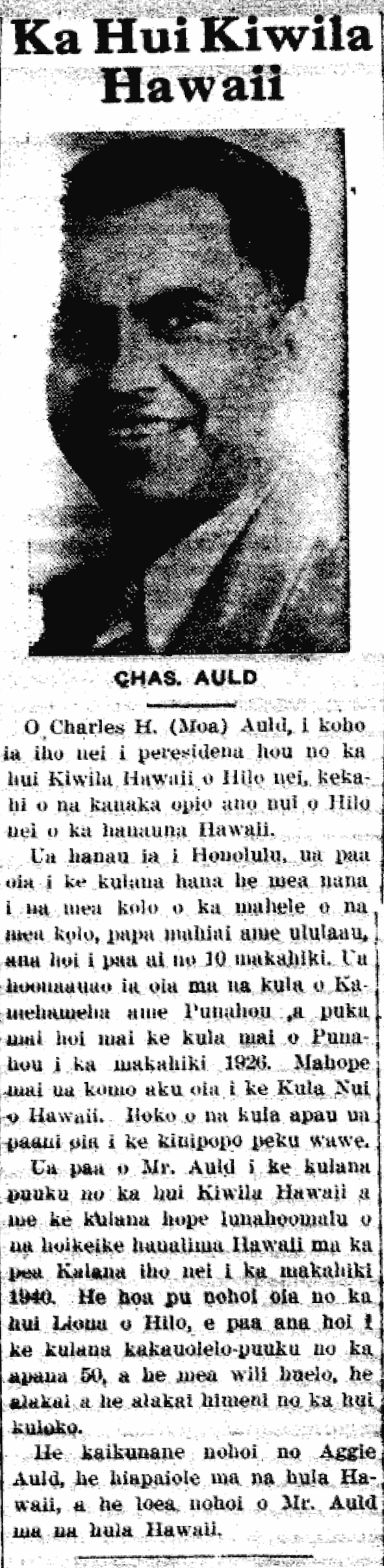
CHAS. AULD

Charles H. (Moa) Auld has been chosen as the new president of the Hawaiian Civic Club [hui Kiwila Hawaii] of Hilo nei, one of the important youths here in Hilo of Hawaiian ancestry.

He was born in Honolulu, and was employed as an inspector of insects in the insects division of the department of agriculture and forestry [papa mahiai ame ululaau], in which he was employed for 10 years. He was educated at the Kamehameha Schools and at Punahou, and he graduated from Punahou in 1926. Thereafter he attended the University of Hawaii. In each of these schools he played football [kinipopo peku wawae].

He is a brother also of Aggie Auld, and expert in Hawaiian hula, and Mr. Auld himself is adept at it as well.

(Hoku o Hawaii, 3/19/1941, p. 1)

Ka Hui Kiwila Hawaii

Ka Hoku o Hawaii, Volume XXXV, Number 47, Aoao 1. Malaki 19, 1941.

David Bray and hula in Hilo, 1933.

The hula troupe of David Bray

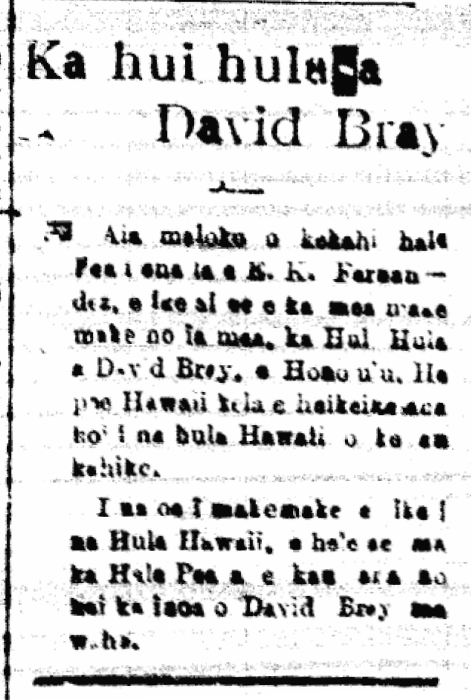
In a tent owned by E. K. Fernandez, you, who are interested in such things, will see the Hula Troupe of David Bray, of Honolulu. He is a Hawaiian showing Hawaiian hula of ancient times.

Should you desire to see Hawaiian Hula, go to the Tent and the name David Bray will be posted outside.

(Hoku o Hawaii, 7/4/1933, p. 2)

Ka hui hula a David Bray

Ka Hoku o Hawaii, Buke XXVII, Helu 5, Aoao 3. Iulai 4, 1933.