Keeaumoku’s ahuula, Eheukani, 1903.

FEATHER GARMENTS

106. A cloak said to have been destroyed in the conflagration caused accidentally in the attempt of the Board of Health to stamp out the bubonic plague in the Chinese quarter of Honolulu. At the time when the claims for losses caused by this great fire were presented to the Commission appointed for the purpose, my assistant, Mr. Allen M. Walcott, obtained from the claimant, Peleioholani, a carpenter by trade, the following particulars: The cloak was called “Eheukani” and was made in the time of Keeaumoku (the father of Kaahumanu) and finished shortly before the battle of Mokuohai (July, 1782) between Kamehameha and Kiwalaó. Keeaumoku’s wife gave it to Peleioholani’s grandmother. Principally mamo* feathers with a small crescent of red iiwi in each upper corner; between the shoulders a round spot of black oo feathers, from which a line of red iiwi led down to a trifle below the middle of the cloak. The cords at the neck were of human hair, an unusual thing. It must be remembered that the design (Fig. 16) as well as the following measurements are from the description given to Mr. Walcott by Peleioholani and are of course only approximate. They are worth recording as differing from any robes described. Length, about 4 feet 9 inches; neck measurment about 2 feet; circumference at bottom about 5 feet 8 inches. It is a matter of tradition that 27,000 birds were captured to furnish the feathers for this cloak. In the left side were seven spear holes that were never patched, and about which were blood stains. Keeaumoku was severely wounded in this battle, and it was rather a fancy with the old chiefs to retain the honorable scars in the ahuula, as in the cloak given by Kamehameha to Vancouver to be taken to England for King George.

*Probably oo, for a genuine mamo ahuula was devoid of any adulteration by other colored feathers. It should be stated that Peleioholani’s claim to be the owner of this cloak was disputed and it was said to have been taken from the palace years ago; but from what I have seen of the observation of natives whose duty it was to care for the royal robes, I do not believe one of them could describe the pattern of the cloaks he or she had seen for years.

[And a note on the note by Brigham. I am not sure the oo instead of mamo feathers comment should be considered true when even the great mamo feather ahuula of Kamehameha Paiea has red iiwi feathers within it…]

(Brigham, William T. Additional Notes on Hawaiian Featherwork. Honolulu: Bishop Museum Press, 1903. pp. 15–16.)
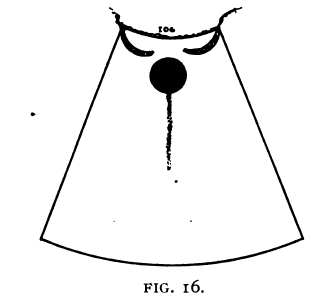
"Eheukani"

Brigham, William T. Additional Notes on Hawaiian Featherwork. Honolulu: Bishop Museum Press, 1903. p. 17.

Duke runs for reelection as sheriff of the city and county of Honolulu, 1936.

Duke Kahanamoku Asks Sheriff Re-election On Basis of Present Record

Kahanamoku, scion of one of the few remaining full-blooded Hawaiian families in the islands, was responsible for returning the sheriff’s office, for the first 25 years of city and county government always held by a Democrat, to the Democratic fold after it had lapsed momentarily into the hands of the Republicans with results that are too well known and too well remembered by every resident of Hawaii to repeat here.

Perhaps the most famous living exponent of the Hawaiian race is Duke P. Kahanamoku, who first spread the name of the Territory over the newspapers and magazines of the world by his swimming prowess and is now seeking re-election as sheriff of the city and county of Honolulu on the Democratic ticket.

For Sheriff

DUKE P. KAHANAMOKU

The Duke first took the world by storm when, and absolutely unknown, he went to the quadrennial Olympic games as one of the American team and made a clean sweep of all the swimming events in which he was entered, establishing several world’s records that stood for many years. He repeated this performance in the following Olympic games and ruled supreme in acquatic affairs until his voluntary retirement from active competition.

On his return to Hawaii the gratitude of the citizens of the Territory was expressed in the form of a public fund which was used to provide a residence for the Kahanamoku family.

The Duke declares in his speeches that he carries on the duties of sheriff of the city and county in the clean and sportsmanlike manner which distinguished his athletic career.

Despite inadequate appropriations provided for the greatly needed new construction at the city and county jail, which is under the jurisdiction of the sheriff’s office, Kahanamoku has established an efficient record in the conduct of this institution—a record on which he is asking renomination at re-election.

“I am a man of few words,” the Duke declares. “When I was representing Hawaii against the best swimmers in the world, I never predicted that I would win any particular race—but I think I won my share. It is the same with the present race for the sheriff’s office.”

[Duke seems to have followed in the footsteps of his father. Duke P. Kahanamoku’s father, Duke K. Kahanamoku served in various positions in the police department, ultimately reaching the rank of captain.]

(Alakai o Hawaii, 9/24/1936, p. 1)

Duke Kahanamoku Asks Sheriff Re-election On Basis of Present Record

The Hawaii Democrat, Volume 9, Number 24, Page 1. September 24, 1936.

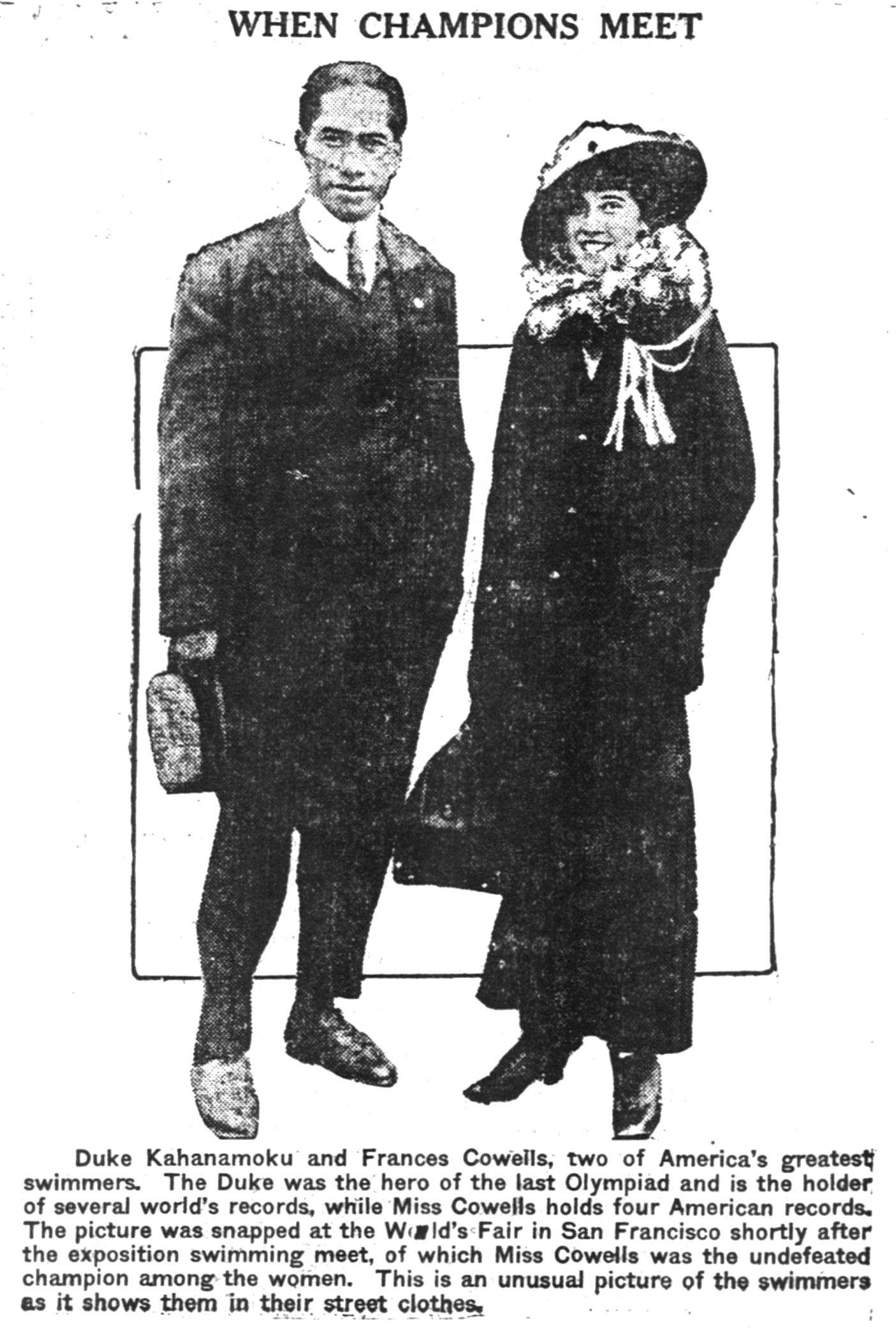
Champions, Duke Kahanamoku and Frances Cowells, 1915.

WHEN CHAMPIONS MEET

Duke Kahanamoku and Frances Cowells, two of America’s greatest swimmers. The Duke was the hero of the last Olympiad and is the holder of several world’s records, while Miss Cowells holds four American records. The picture was snapped at the World’s Fair in San Francisco shortly after the exposition swimming meet, of which Miss Cowells was the undefeated champion among the women. This is an unusual picture of the swimmers as it shows them in their street clothes.

(Day Book, 8/11/1915,  p. 24)

WHEN CHAMPIONS MEET

The Day Book, Volume 4, Number 268, Page 24. August 11, 1915.

Duke has a hard name to pronounce… 1918.

WHEN IT COMES TO A SWIMMING RACE, Duke Kahanamoku is as hard to beat as his name is to pronounce, and then some. Experts say this world’s champion is the last word of perfection in sprint swimming.

(Evening Public Ledger, 8/24/1918, p. 20)

WHEN IT COMES TO A SWIMMING RACE...

Evening Public Ledger and The Evening Telegraph, Volume IV, Number 294, Page 20. August 24, 1918.

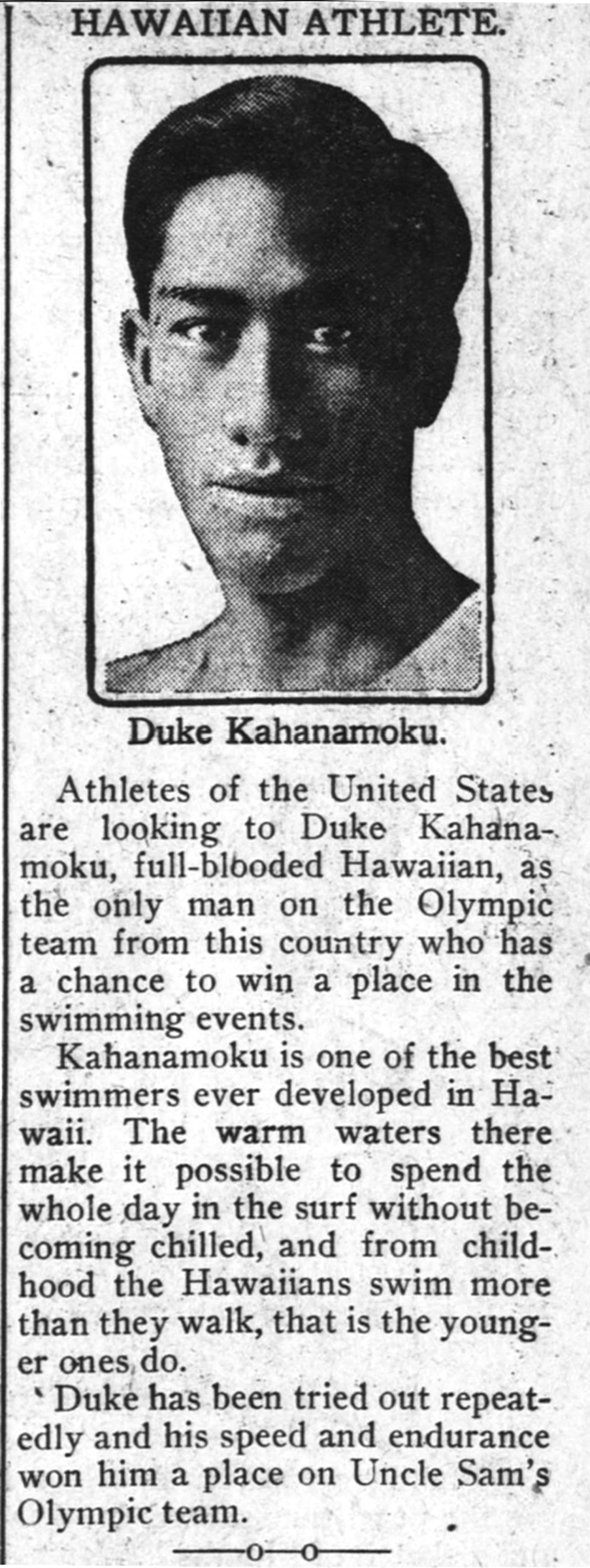
Duke on the American Olympic Team, 1912.

HAWAIIAN ATHLETE.

Duke Kahanamoku.

Athletes of the United States are looking to Duke Kahanamoku, full-blooded Hawaiian, as the only man on the Olympic team from this country who has a chance to win a place in the swimming events.

Kahanamoku is one of the best swimmers ever developed in Hawaii. The warm waters there make it possible to spend the whole day in the surf without becoming chilled, and from childhood the Hawaiians swim more than they walk, that is the younger ones do.

Duke has been tried out repeatedly and his speed and endurance won him a place on Uncle Sam’s Olympic team.

(Day Book, 7/3/1912, p. 29)

HAWAIIAN ATHLETE.

The Day Book, Volume 1, Number 240, Page 29. July 3, 1912.

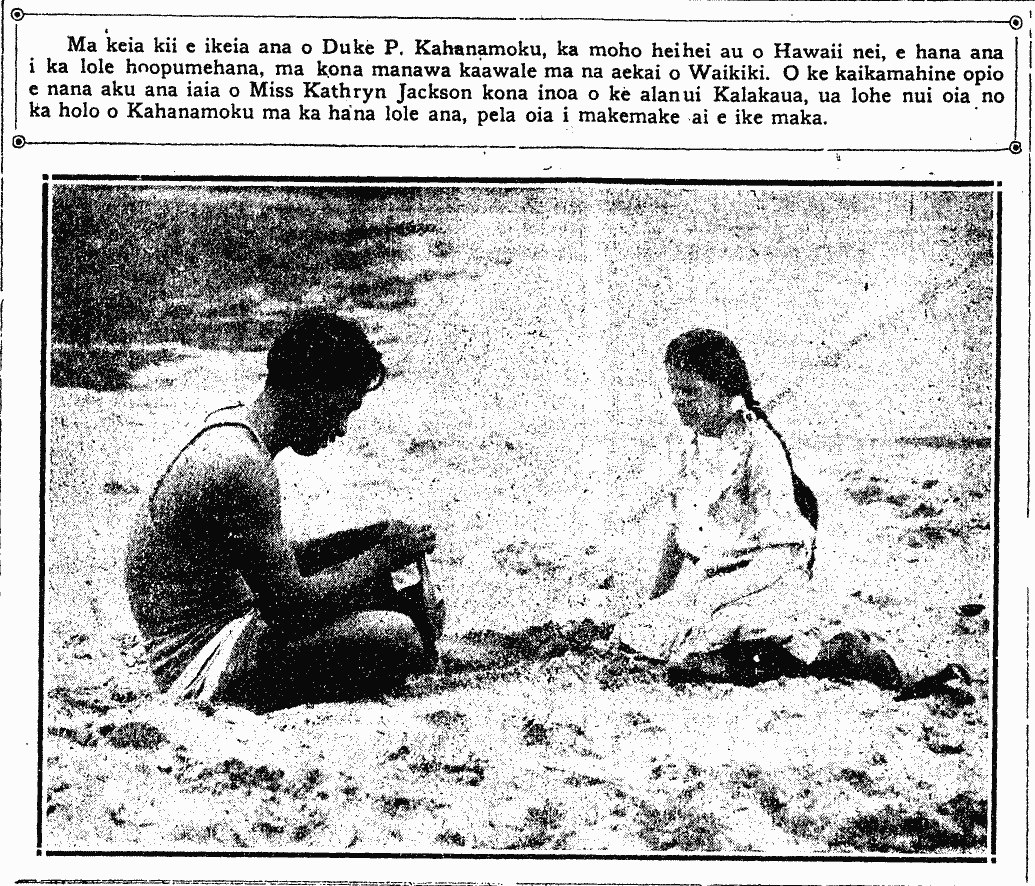
Duke donating time to make warm clothing, 1918.

In this picture is seen Duke P. Kahanamoku, the swimming champion of Hawaii nei making warm clothing in his spare time on the shore of Waikiki. The young girl watching him is named Miss Kathryn Jackson of Kalakaua Avenue who heard much of Kahanamoku going to make clothes, and she thus wanted to see it for herself.

(Kuokoa, 4/5/1918, p.1)

Ma keia kii e ikeia ana o Duke P. Kahanamoku...

Ka Nupepa Kuokoa, Buke LVI, Helu 14, Aoao 1. Aperila 5, 1918.

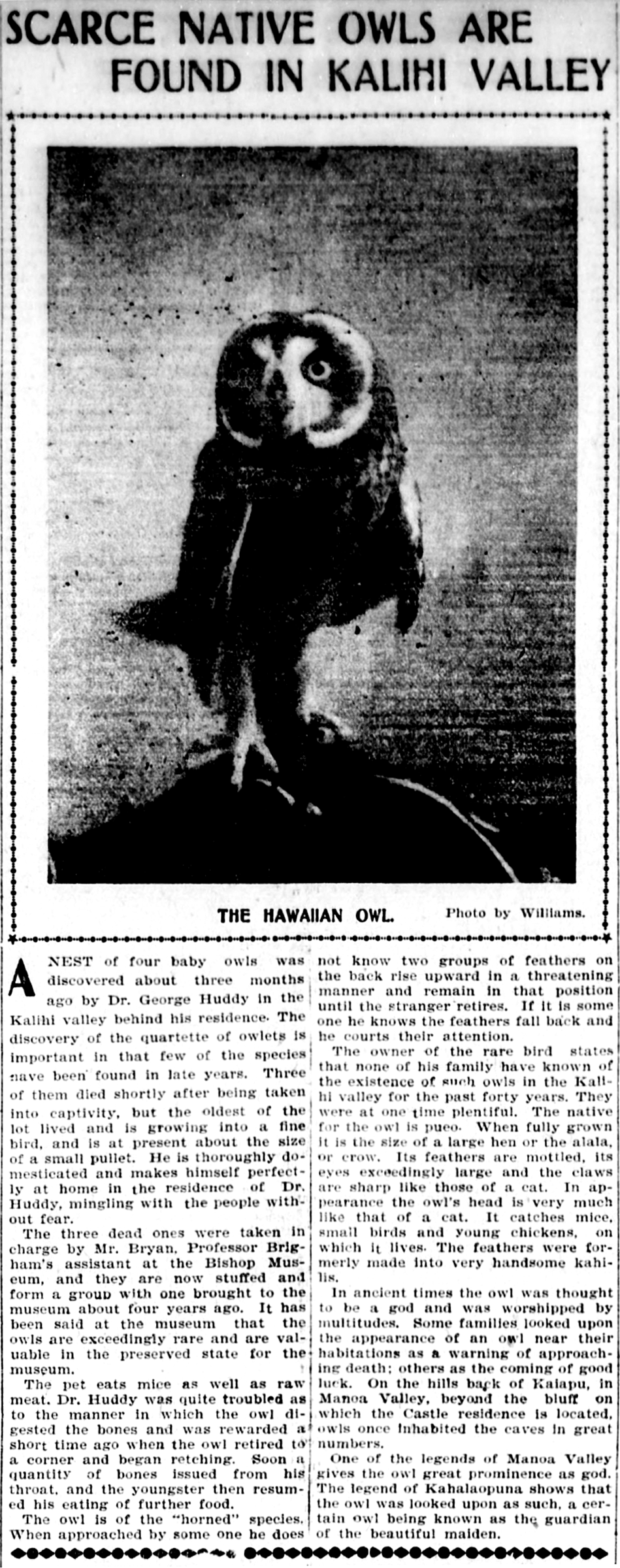
Pueo found in Kalihi, 1902.

SCARCE NATIVE OWLS ARE FOUND IN KALIHI VALLEY

THE HAWAIIAN OWL.  Photo by Williams.

A NEST of four baby owls was discovered about three months ago by Dr. George Huddy in the Kalihi valley behind his residence. The discovery of the quartette of owlets is important in that few of the species have been found in late years. Three of them died shortly after being taken into captivity, but the oldest of the lot lived and is growing into a fine bird, and is at present about the size of a small pullet. He is thoroughly domesticated and makes himself perfectly at home in the residence of Dr. Huddy, mingling with the people without fear.

The three dead ones were taken in charge by Mr. Bryan, Professor Brigham’s assistant at the Bishop Museum, and they are now stuffed and form a group with one brought to the museum about four years ago. It has been said at the museum that the owls are exceedingly rare and are valuable in the preserved state for the museum.

The pet eats mice as well as raw meat. Dr. Huddy was quite troubled as to the manner in which the owl digested the bones and was rewarded a short time ago when the owl retired to a corner and began retching. Soon a quantity of bones issued from his throat, and the youngster then resumed his eating of further food.

The owl is of the “horned” species. When approached by some one he does not know two groups of feathers on the back rise upward in a threatening manner and remain in that position until the stranger retires. If it is some one he knows the feathers fall back and he courts their attention.

The owner of the rare bird states that none of his family have known of the existence of such owls in the Kalihi valley for the past forty years. They were at one time plentiful. The native for the owl is pueo. When fully grown it is the size of a large hen or the alala, or crow. Its feathers are mottled, its eyes exceedingly large and the claws are sharp like those of a cat. In appearance the owl’s head is very much like that of a cat. It catches mice, small birds and young chickens, on which it lives. The feathers were formerly made into very handsome kahilis.

In ancient times the owl was thought to be a god and was worshipped by multitudes. Some families looked upon the appearance of an owl near their habitation as a warning of approaching death; others as the coming of good luck. On the hills back of Kalapu, in Manoa Valley, beyond the bluff on which the Castle residence is located, owls once inhabited the caves in great numbers.

One of the legends of Manoa Valley gives the owl great prominence as god. The legend of Kahalaopuna shows that the owl was looked upon as such, a certain owl being known as the guardian of the beautiful maiden.

[Does anyone know of kahili made with pueo feathers?]

(Hawaiian Gazette, 2/11/1902, p. 5)

SCARCE NATIVE OWLS ARE FOUND IN KALIHI VALLEY

Hawaiian Gazette, Volume XXXVII, Number 12, Page 5. February 11, 1902.


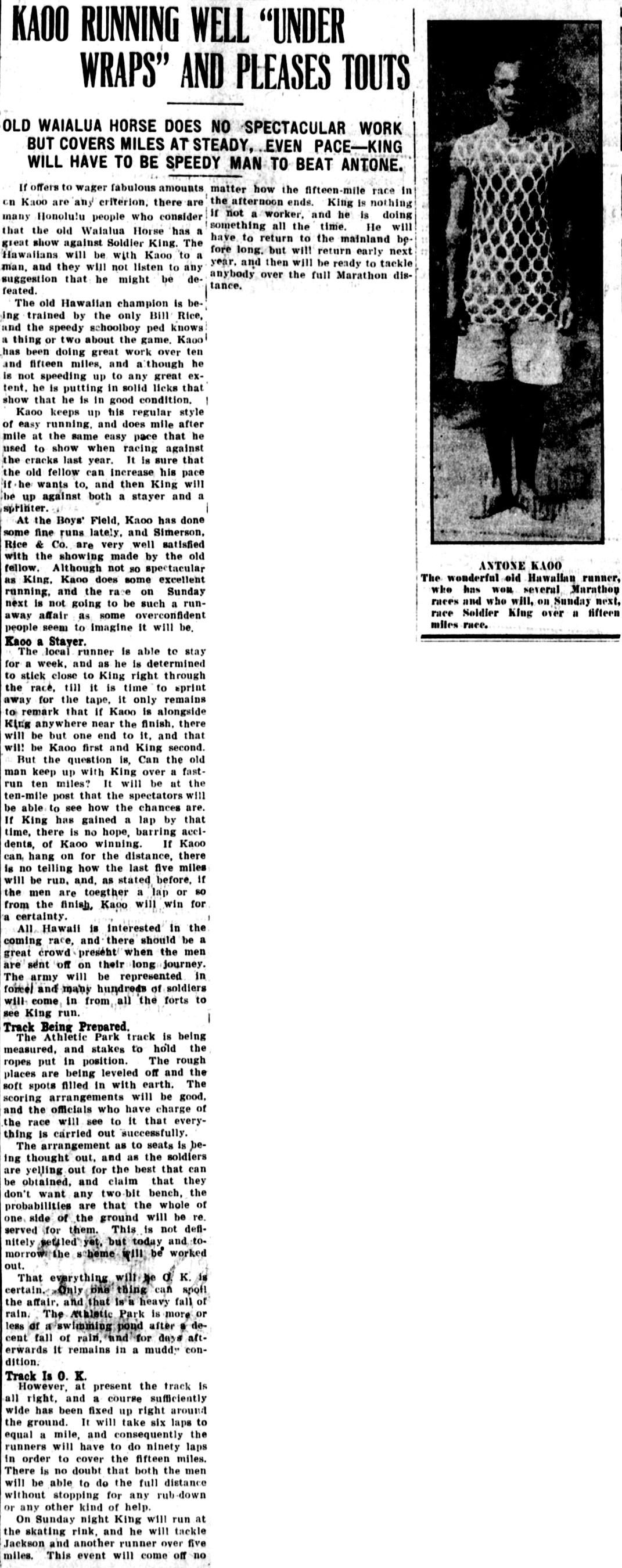
Antone Kaoo, the hula teacher and kukini, 1910.

KAOO RUNNING WELL “UNDER WRAPS” AND PLEASES TOUTS

OLD WAIALUA HORSE DOES NO SPECTACULAR WORK BUT COVERS MILES AT STEADY, EVEN PACE—KING WILL HAVE TO BE SPEEDY MAN TO BEAT ANTONE.

If offers to wager fabulous amounts on Kaoo are any criterion, there are many Honolulu people who consider that the old Waialua Horse has a great show against Soldier King. The Hawaiians will be with Kaoo to a man, and they will not listen to any suggestion that he might be defeated.

The old Hawaiian champion is being trained by the only Bill Rice, and the speedy schoolboy ped knows a thing or two about the game. Kaoo has been doing a great work over ten and fifteen miles, and although he is not speeding up to any great extent, he is putting in solid licks that show that he is in good condition.

Kaoo keeps up his regular style of easy running, and does mile after mile at the same easy pace that he used to show when racing against the cracks last year. It is sure that the old fellow can increase his pace if he wants to, and then King will be up against both a stayer and a sprinter.

At the Boys’ Field, Kaoo has done some fine runs lately, and Simerson, Rice & Co. are very well satisfied with the showing made by the old fellow. Although not so spectacular as King, Kaoo does some excellent running, and the race on Sunday next is not going to be such a runaway affair as some overconfident people seem to imagine it will be.

Kaoo a Stayer.

The local runner is able to stay for a week, and as he is determined to stick close to King right through the race, till it is time to sprint away for the tape, it only remains to remark that if Kaoo is alongside King anywhere near the finish, there will be but one end to it, and that will be Kaoo first and King second.

But the question is, Can the old man keep up with King over a fast-run ten miles? It will be at the ten-mile post that the spectators will be able to see how the chances are. If King has gained a lap by that time, there is no hope, barring accidents, of Kaoo winning. If Kaoo can hang on for the distance, there is no telling how the last five miles will be run, and, as stated before, if the men are together a lap or so from the finish, Kaoo will win for a certainty.

All Hawaii is interested in the coming race, and there should be a great crowd present when the men are sent off on their long journey. The army will be represented in force and many hundreds of soldiers will come in from all the forts to see King run.

Track Being Prepared.

The Athletic Park track is being measured, and stakes to hold the ropes put in position. The rough places are being leveled off and the soft spots filled in with earth. The scoring arrangements will be good, and the officials who have charge of the race will see to it that everything is carried out successfully.

The arrangement as to seats is being thought out, and as the soldiers are yelling out for the best that can be obtained, and claim that they don’t want any two-bit bench, the probabilities are that the whole of one side of the ground will be reserved for them. This is not definitely settled yet, but today and tomorrow the scheme will be worked out.

That everything will be O. K. is certain. Only one thing can spoil the affair, and that is a heavy fall of rain. The Athletic Park is more or less a swimming pond after a decent fall of rain, and for days afterwards it remains in a muddy condition.

Track is O. K.

However, at present the track is all right, and a course sufficiently wide has been fixed up right around the ground. It will take six laps to equal a mile, and consequently the runners will have to do ninety laps in order to cover the fifteen miles. There is no doubt that both the men will be able to do the full distance without stopping for any rub-down or any other kind of help.

On Sunday night King will run at the skating ring, and he will tackle Jackson and another runner over five miles. This event will come off no matter how the fifteen-mile race in the afternoon ends. King is nothing if not a worker, and he is doing something all the time. He will have to return to the mainland before long, but will return early next year, and then will be ready to tackle anybody over the full Marathon distance.

ANTONE KAOO

The wonderful old Hawaiian runner, who has won several Marathon races and who will, on Sunday next, race Soldier King over a fifteen miles race.

(Hawaiian Gazette, 10/27/1910, p. 10)

KAOO RUNNING WELL "UNDER WRAPS" AND PLEASES TOUTS

Evening Bulletin, Number 4760, Page 10. October 27, 1910.