On this day, perhaps it is appropriate to remember further indignity faced by the Queen, 1901.

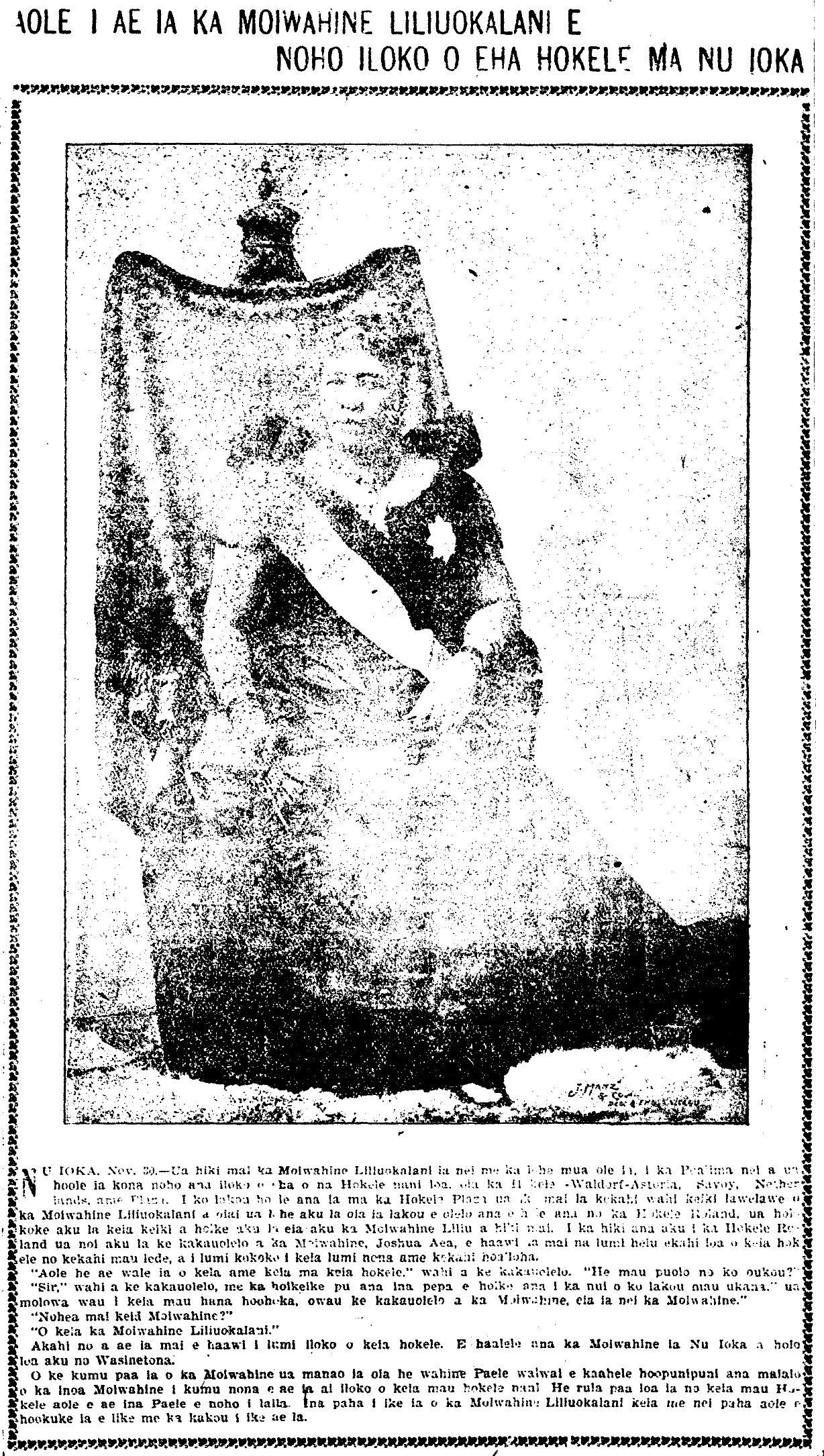
Queen Liliuokalani was Refused Stay at Four Hotels in New York.

New York. Nov. 30.—Queen Liliuokalani arrived here last Friday unannounced, and she was refused stay at four posh hotels: The Waldorf-Astoria, Savoy, Netherlands, and Plaza. After being refused by the Plaza, one of the Queen’s servants saw this and and being that he heard them saying they were headed to the Hotel Roland, he went at once and announced that the Queen would be arriving. When Joshua Aea, her secretary, asked for their best room for some ladies, and for a room nearby for him and his friends.

“Not just anyone is allowed admittance here to this hotel,” said the hotel staff [“kakauolelo” seems to be a misprint]. “Do you have baggage?”

“Sir,” the secretary said while showing a list of their baggage, “I have had enough of all of these frustrations; I am the secretary of the Queen; the Queen is here.”

“Where is this Queen from?”

“This is the Queen Liliuokalani.

Only then was a room in the hotel given. The Queen will be leaving New York for Washington.

The reason  the Queen was barred was that she was thought to be a rich Black [Paele] woman going around trying to pass as a Queen, so that she would be allowed to stay at these beautiful hotels. All of those hotels have a policy not to allow Blacks to stay there. Perhaps if they knew she was the Queen, perhaps she would not have been driven off as we have seen above.

(Kuokoa, 12/13/1901, p. 1)

AOLE I AE IA KA MOIWAHNE LILIUOKALANI E NOHO ILOKO O EHA HOKELE MA NU IOKA

Ka Nupepa Kuokoa, Buke XXXIX, Helu 24, Aoao 1. Dekemaba 13, 1901.

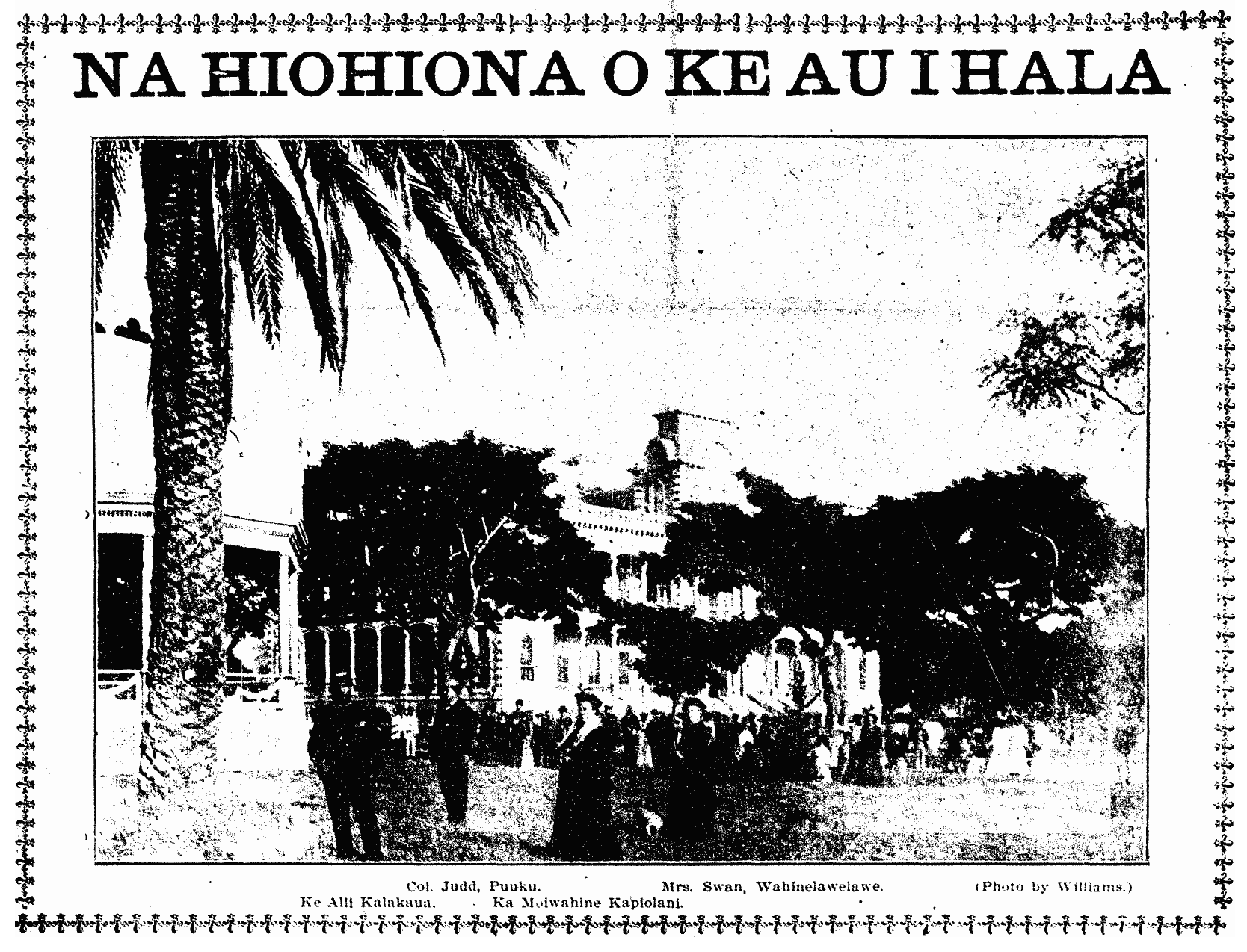
King Kalakaua and Queen Kapiolani and Iolani Palace, 1903.

IMAGES FROM DAYS GONE BY

Col. Judd, Chamberlain [Puuku]         Mrs. Swan, Chambermaid [Wahinelawelawe.]         (Photo by Williams.)

King Kalakaua                                Queen Kapiolani

(Kuokoa, 4/17/1903, p. 1)

NA HIOHIONA O KE AU I HALA

Ka Nupepa Kuokoa, Buke XLI, Helu 16, Aoao 1. Aperila 17, 1903.

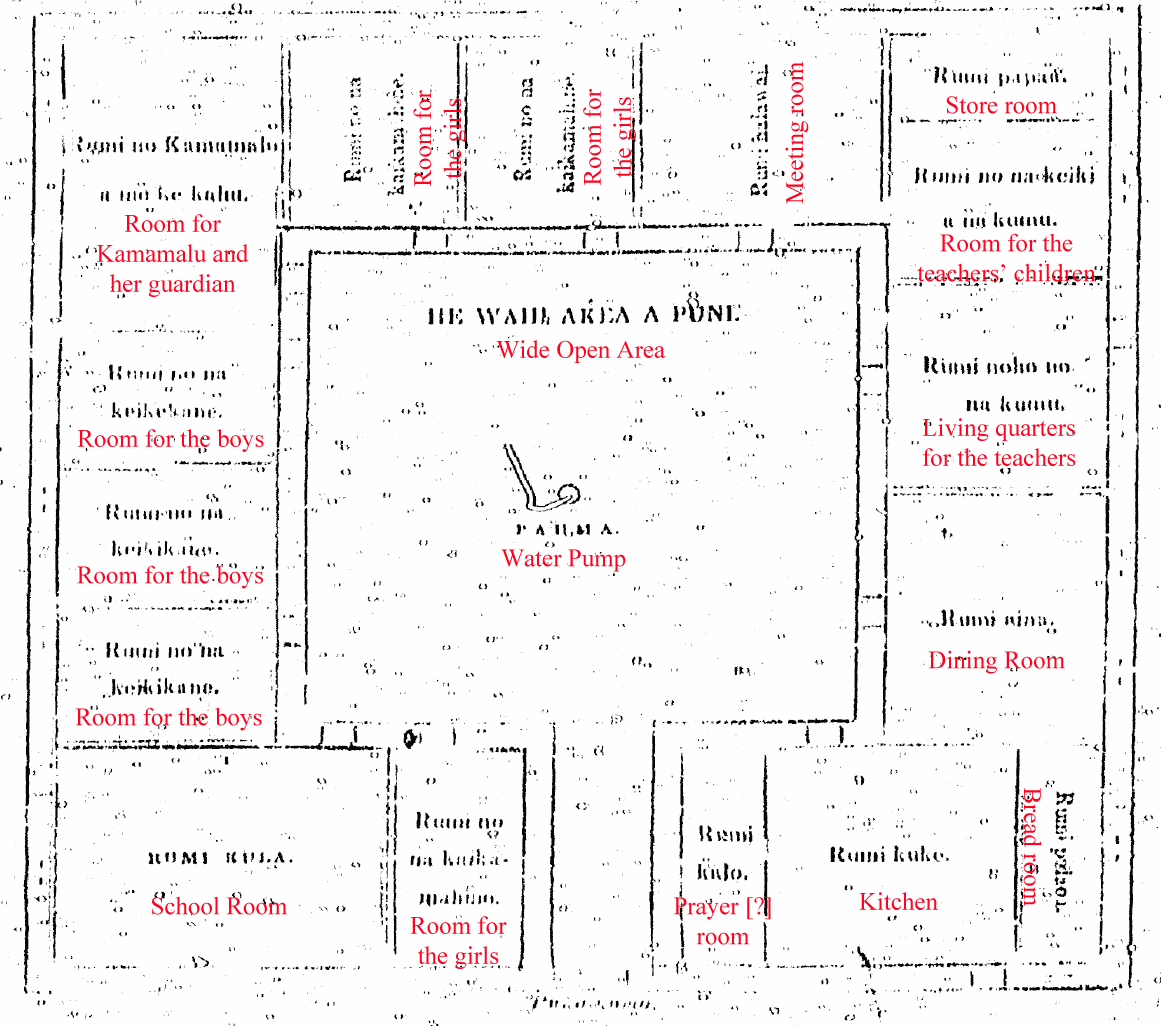
Chiefs’ Children’s School, 1841.

Chiefs' Children's School Diagram

Ka Nonanona, Buke 1, Pepa 2, Aoao 5. Iulai 20, 1841.

THE CHIEFS’ CHILDREN’S SCHOOL.

This is the schoolhouse for the children of the alii, in Honolulu, Oahu, upland of the stone house of Kekauluohi. This schoolhouse was built by the alii in the year of our Lord 1839. They are the ones who paid for the costs, not the missionaries. The costs were perhaps two thousand dollars, and the cost was well worth this fine building. The alii paid out the money and the missionaries hired the haole and Hawaiians who did the labor. Above, you will see what this building is like. The length is the same as the width. It is 76 feet long, and so is its width. It is made with adobe, and its walls are about ten feet tall, and its thickness is two feet. The partitions are made of adobe as well and are one foot thick. The thatching of this building is actual pili grass. Look at the illustration above, the entrance is made clear, as are the other doors, and the…

(Nonanona, 7/20/1841, p. 5)

KA HALE KULA ALII.

Ka Nonanona, Buke 1, Pepa 2, Aoao 5. Iulai 20, 1841.

…windows; clear also are the rooms for the teachers and the students.

There is an open space in the middle of the building; it is six feet wide and so too is the length; there is a water pump within it. Maniania [Manienie] grass grows there, so it is a nice place to play as well as to sit. There is a small lanai and a stone wall surrounding this wide area, which is a place to go when it is raining or when the sun is hot. The outside of the entire building is covered with mortar [poho]. Poho is not great; it will just fall off, and it soon loses its integrity. The inside of the building is covered with plaster [puna], and it is very good and sturdy; the children cannot make the plaster fall easily. The rooms are plastered all around and on top, and there is a fine floor below.

The building is appropriate for what we are using it for.

There are perhaps many who have heard of this schoolhouse but who have not seen it. Therefore, the instructors thought to put a description in this paper, as well as what is being done in this schoolhouse in later issues of the newspaper.

By me, Cooke.

[Maybe if the Hawaiian-Language Newspapers like this one are rescanned clearly, the image of the schoolhouse would indeed be clear and we could see the doors, windows, and rooms.

I was not sure if “Rumi kalo” could refer to a “Taro room”. And it seems that at the center on the bottom of the diagram is “Puka komo” for “Entrance”.]

(Nonanona, 7/20/1841, p. 6)

ani; i akaka no hoi...

Ka Nonanona, Buke 1, Pepa 2, Aoao 6. Iulai 20, 1841.

Hauoli Makahiki Hou! 1906 / 2014.

Wishing you all a very happy 2014. This calendar is fashioned after the one given by the newspaper Aloha Aina in 1906 to its readers. It features a picture of the typesetters and the paperboys of the newspaper taken on December 30, 1905. Please feel free to save it onto your desktop and print it out and put it up on your wall or give it away to someone who you think will appreciate it!

I hope that with next year will come more exciting stories from the past which will encourage people to at least consider why the Hawaiian-Language Newspapers are important to us today and tomorrow. Perhaps it will encourage the individuals, agencies, and organizations who can benefit from the knowledge that the many, many kupuna thought important enough to entrust to the safekeeping of the pages of the Newspapers, to think about funding the rescanning as well as the conservation of the Newspapers, so that the information contained in them can be easily accessed by those of today and the generations to come…

2014 CALENDAR

2014 ALEMANAKA

Remembrance, 1918.

A PARCEL OF TEARS OF LOVE.

KAOWAKAOKALANI KEAMUAMUKU.

Gone, no more, is that royal descendant of the land—Kaoakaokalani Keamuamuku (f)—a scion of Liloa, King of Hawaii, with Akahiakuleana (f); Umi a Liloa (m) joined with Kapukini (f), begot Keliiokaloa (m), joined with Makuahineopalaka (f), begot Kukailani (m), joined with Kaohukiokalani (f), begot Makakaualii (m), joined with Kaakanaoao (f), begot Pueopokii (f), joined with Kalanikaaoao (m), begot Lonoikamakahiki (m), joined with Kailuapea, Kailuakea (f), begot Hookuiniaumakaokalani (m), joined with Kahoowaha (f), begot Kainahopukahi (m), joined with Kauopuaikanuumealani (f), begot Luukia (f), joined with Kauhiaimokuakama (m), begot Ikawahi (f), joined with Ihikolopana (m), begot Kaleimakalii (f), joined with Keakealani (m), begot Keawekuikaai (m), joined with Kihawahine (f), begot Kaaloaikanoa (f), joined with Umihulumakaokalani (m), begot Palena (m), Paia (m), Luahine (m), joined with Hikuikekualono (f), begot three sons, one daughter, Kahaopulani (f), the one who raised Kamehameha I, King of the Hawaiian Archipelago, Kahaopulani (f) joined with Kioula (m), begot Kuakane (f), the one fed on the same milk as Kamehameha I. Kuakane (f) joined with Kamoeau (m), begot Akimakaokalauhue (f), joined with Kamalanaikuaheahe (m), begot Kapiimoku (f), joined with Kekahili (m), begot Kaoakaokalani Keamuanuku (f).

……..

[This is an interesting death announcement for the picture (if the newspapers were rescanned clearly, it would surely be a much better picture), for the genealogy and who appears in it, and also the mele at the end.

Note the reference to the kahu hanai of Kamehameha I here being not Naeole, but Kahaopulani.]

(Kuokoa, 10/4/1918, p. 2)

HE PUOLO WAIMAKA NA KE ALOHA.

Ka Nupepa Kuokoa, Buke LVI, Helu Helu 40, Aoao 2. Okatoba 4, 1918.

More on Hattie L. S. Reinhardt and politics, 1944.

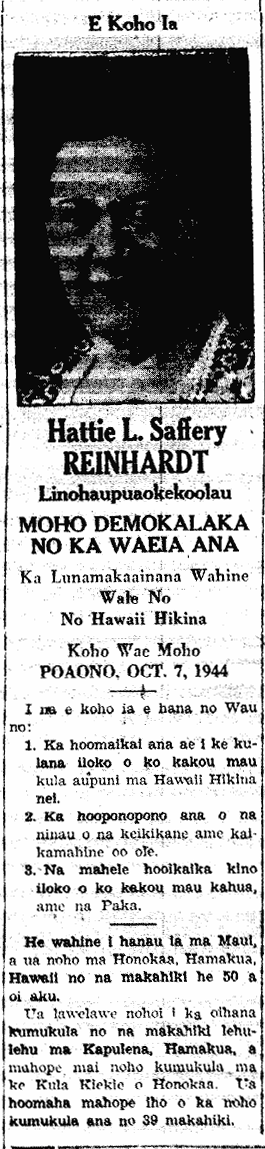
Vote For

Hattie L. Saffery
REINHARDT
Linohaupuaokekoolau

DEMOCRATIC CANDIDATE
FOR ELECTION

The Only
Woman Representative
For East Hawaii

Election
SATURDAY, OCT. 7, 1944

Should I be elected I will work for:

1. Benefit the state of our public schools here in East Hawaii.

2. Deal with the obstacles of girls and boys who have not yet reached adulthood.

3. Physical education in our Parks and grounds.

This is a woman born on Maui, and lived in Honokaa, Hamakua, Hawaii for over 50 years.

She had the occupation of school teacher for many years at Kapulena, Hamakua, and after that, she served as a teacher at Honokaa High School. She retired after teaching for 39 years.

(Hoku o Hawaii, 9/27/1944, p. 2)

E Koho Ia Hattie L. Saffery

Ka Hoku o Hawaii, Volume XXXIX, Number 23, Aoao 2. Sepatemaba 27, 1944.

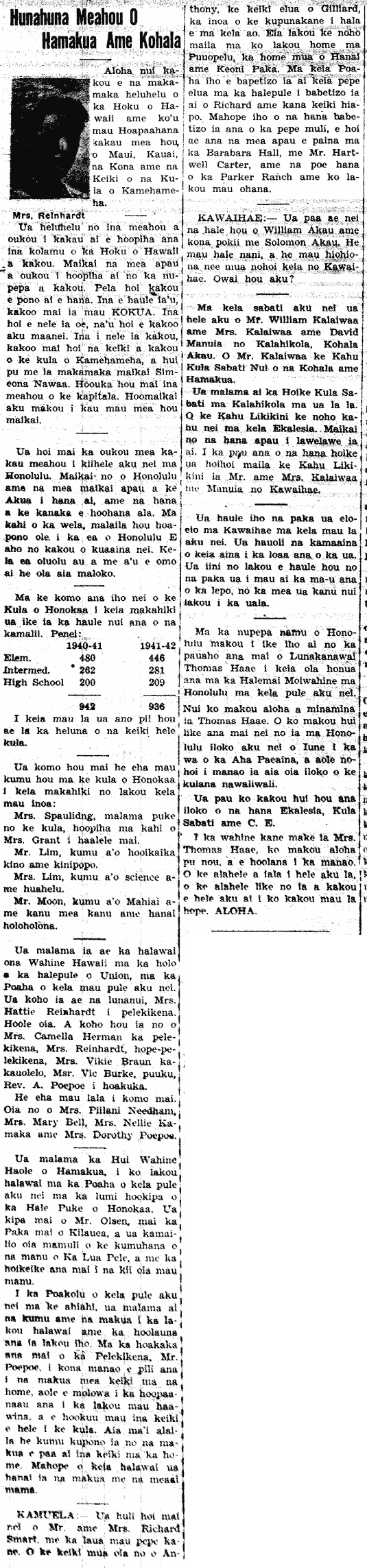
Hattie Linohaupuaokekoolau Saffery Reinhardt, correspondent for Hamakua and Kohala, 1941.

Bits of News from Hamakua and Kohala

Aloha nui kakou, readers of the Hoku o Hawaii and my fellow news writers from Maui, Kauai, the two Kona [North and South], and the Children of Kamehameha Schools.

I’ve read the news you all have written filling the columns of our Hoku o Hawaii. All that you all have written to fill our newspaper have been fine. That is the way we should do it. Should I be put aside, I will support those who KOKUA. Should you not have material, I will give aid here. If we all are without, our children from the Kamehameha School will give support, along with that good friend, Simeona Nawaa. Do send more news from the capitol. We give appreciation for your choice news.

Your news writer has returned from her wandering in Honolulu. Honolulu is great, along with all the great many things God has created, as well as all that man is carrying out. Where it is hot, that is what I don’t like, the air of Honolulu. We in the countryside are better off. With this cool air which you and I breathe; there is life there within.

With the recent start of Honokaa School this year, there has been seen a severe drop in the number of children. Like this:

1940–41 1941–42
Elem.    480    446
Intermed.    262    281
High School    200    209
 ———  ———
   942    936

These past days, the number of children attending school has rebounded.

Four new teachers came to Honokaa School this year, their names being:

Mrs. Spaulding, librarian for the school; taking the place of Mrs. Grant who left.

Mr. Lim, fitness teacher and baseball.

Mrs. Lim, science and math teacher.

Mr. Moon, Farming and Agriculture and Animal husbandry teacher.

The Hawaiian Women’s meeting was held in the hall of the Union Church several Thursdays ago. The officers were selected; Mrs. Hattie Reinhardt as president. She refused. Reselected was Mrs. Camella Herman as president; Mrs. Reinhardt as vice president; Mrs. Vikie Braun as secretary; Mrs. Vic Burke as treasurer; and Rev. A. Poepoe as adviser.

Four members joined. They being Mrs. Piilani Needham, Mrs. Mary Bell, Mrs. Nellie Kamaka and Mrs. Dorothy Poepoe.

The Haole Women’s Board of Hamakua held their meeting last Thursday in the lobby of the Honokaa Library. Mr. Olsen paid a visit, from the Kilauea Park, and he talked on the subject of the birds of the Volcanic Crater, while showing pictures of the birds.

On the Wednesday of last week, in the evening, the teachers and parents held their meeting and introduced themselves. In the introduction by the President, Mr. Poepoe, pertaining to his thoughts on parents at home, was the idea that they should not be lax in the children’s studies, and that they should let them always go to school. If the child is sick, that is a proper reason for the parents to keep the child at home. After the meeting, the parents were fed a snack.

KAMUELA:—Mr. and Mrs. Richard Smart returned along with their baby boy. The first child is Anthony, the second is Gilliard, named for the grandfather who has gone to the other world. They are living at their home in Puuopelu, at the previous residence of Hanai and Keoni Paka [Hannah and John Parker]. This coming Thursday, the second baby will be baptized at the church where Richard and his first child were baptized. After the baptism of the youngest child, everyone will return to eat at Barabara hall, with Mr. Hartwell Carter and the workers of Parker Ranch and their families.

KAWAIHAE:—The new homes of William Akau and his younger brother, Solomon Akau, have been completed. They are beautiful houses, and it is a sign of progress for Kawaihae. Now who else?

This past sabbath, Mr. William Kalaiwaa and Mrs. Kalaiwaa and David Manuia  went to Kalahikiola in North Kohala. Mr. Kalaiwaa is the head Kahu of the Sunday Schools of two Kohala [North Kohala and South Kohala] and Hamakua.

On that day, they were holding the Sunday School Hoike at Kalahikiola. Pastor Likikini presides as kahu of the Church. Everything that took place was fine. After the hoike was through, Pastor Likikini took Mr. and Mrs. Kalaiwaa and Manuia back to Kawaihae.

Drenching raindrops fell at Kawaihae these past days. The kamaaina of this area were glad to receive rain. They hope the rain will fall again so that the soil remains damp, for they have planted much sweet potato.

We saw in the English newspaper of Honolulu that Judge Thomas Haae grew weary of this life at the Queen’s Hospital in Honolulu last week. We have great aloha and regret for Thomas Haae. We met up with him in Honolulu in June during the [church] Island-wide Convention, and it was not known that he was in weak condition.

We will no longer meet at the Church, Sunday School, and C. E. events.

To the widow, Mrs. Thomas Haae, to you goes our aloha, and let your thoughts be lightened. The path that he has taken is the same path that we shall take on our last days. ALOHA.

[Mrs. Reinhardt was the news correspondent for Hamakua and Kohala to the newspaper Hoku o Hawaii.]

(Hoku o Hawaii, 10/15/1941, p. 1)
Hunahuna Meahou O Hamakua Ame Kohala

Ka Hoku o Hawaii, Volume XXXVI, Number 25, Page 1. Okatoba 15, 1941.

Molokai correspondent, Ruby Apiki Bright, 1939.

NEWS ITEMS FROM MOLOKAI

INTRODUCTION

We, the managers of the newspaper Hoku o Hawaii, are blessed through receiving some news items from the Homestead lands of Molokai, the land which the Alii Kuhio put much effort into for the Hawaiians. This is received through the correspondence of the mother, Mrs. Ruby Apiki Bright.

Lot 2, Hoolehua

Sept. 5, 1839

To my dear patient Hoku:

Here is some baggage for the deck of our pride, should it be kindly allowed some free space. On this past 26th of August, the Catholics of Kaunakakai held a silver jubilee in commemoration of the building of their church, St. Sophia, and there was a fair, and the activities that day went well. They gave the name of that well-to-do mother of the Island of Hina [Molokai] to their church, that being Mrs. Sophie Judd Cooke—the open-hearted mother who spread forth her helping hands for its furnishing and building in the year 1914.

The Calvinists held a Bazaar for their benefit, selling all sorts of things on this past 2nd of this month. Everything was lovely.

……..

[Ruby Apiki Bright started her regular column reporting on news from Molokai on this day, September, 20, 1939, in Hoku o Hawaii. I hope some day soon, these papers will be rescanned again clearly so they are easily read!]

(Hoku o Hawaii, 9/20/1939, p. 1)

HUNAHUNA MEA HOU O MOLOKAI

Ka Hoku o Hawaii, Volume XXXIV, Number 21, Page 1. Sepatemaba 20, 1939.

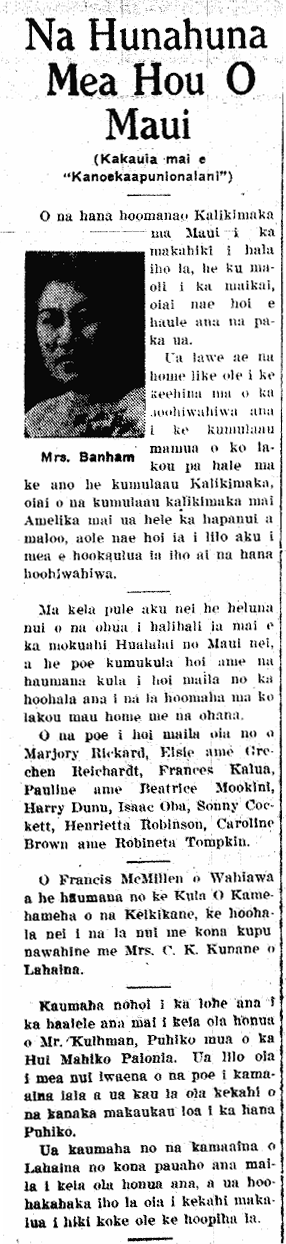
Maui news columnist, Kanoekaapunionalani Banham, 1940.

Bits of Maui News

(Written by “Kanoekaapunionalani”)

Mrs. Banham

The Christmas celebration on Maui last year was very nice, even if the rain was falling.

Every household took steps [to celebrate] by decorating the tree in their front yard as a Christmas tree, being that a majority of the christmas trees from America were dried up; but this did not hold up their festivities.

Last week there were a huge number of passengers carried here to Maui by the steamer Hualalani, and there were teachers and students who returned to spend their vacation at home with their families.

Those who came back are Marjory Rickard, Elsie and Grechen Reichardt, Frances Kalua, Pauline and Beatrice Mookini, Harry Dunn, Issac Oha [Oba?], Sonny Cockett, Henrietta Robinson, Caroline Brown and Robineta Tompkin.

Francis McMillen of Wahiawa, a student of the Kamehameha School for Boys, is spending his grandmother, Mrs. C. K. Kunane of Lahaina.

It is sad to hear of the passing from this world of Mr. Kulhman, the first Cane Burner [Puhiko] of the Pioneer Mill Company [Hui Mahiko Paionia]. He became important amongst the kamaaina, and he was one of the most skilled at Burning Cane.

The locals of Lahaina are saddened at his passing, and he has left a hole that cannot be soon filled.

[Lahainaluna School dorm matron Alice Kanoekaapunionalani Kunane Banham had a regular column in the Hilo newspaper, Hoku o Hawaii, where she reported all sorts of Maui news of the day.]

(Hoku o Hawaii, 1/3/1940, p. 1)

Na Hunahuna Mea Hou O Maui

Ka Hoku o Hawaii, Volume XXXIV, Number 36, Page 1. Ianuari 3, 1940.