Offense, Judgement, and Remorse, 1862.

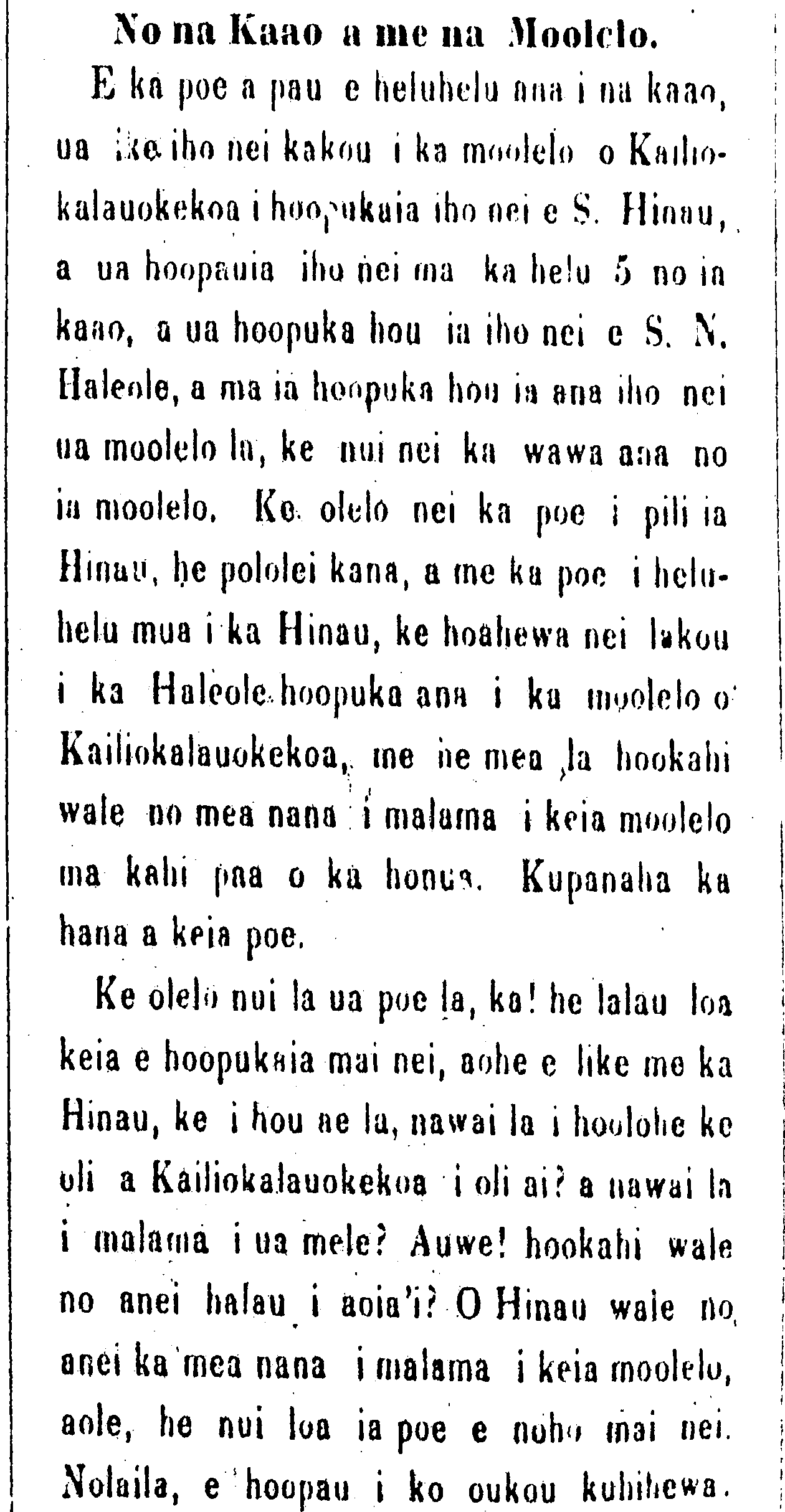
The Tale of the Elepaio and the Water Gourd.

One day, a man named Piiwai went up the mountains to fetch drinking water, for the water of that area was located in the mountains, that being at Kahului, Kona, Hawaii. From one side to the other of that area in Kona, there was water by the ocean, but brackish water, and was not pleasant to drink, and the cool and very refreshing water to drink was in the uplands in the mountains; it is still this way these days, that they go into the mountains to fetch water.

When he made his ascent until this spring, he scooped in his water gourd [huewai] until it was filled with water, and he made his way back until a hill where he rested. He put down his huewai and stood it upright and went elsewhere.

At that time, a bird flew down, an Elepaio, and alighted on the spout of the huewai of that man, and the bird pecked at the huewai of the man until all the water flowed out; the man returned to where the huewai stood and the bird flew away and perched.

But the man saw the bird fly away, yet he did not imagine that his huewai was pecked on by the bird. He grabbed it and lifted it up, and it felt lighter; the man looked at it and saw that there was a hole; he figured that the bird pecked at it until making a hole; his anger at the bird boiled over and said to himself, “Ha! You are one very mischievous bird; I will kill you.”

The man grabbed a rock, and threw it at the bird, hitting it, but it did not die. The bird flew away; it flew away so that its many fellow birds could judge this stoning by the man.

When it flew away in search of the birds, after flying for a while, he first spotted Pueo, the owl; he flew by Pueo and called out like this:

“O Pueo, O Pueo,”

Pueo heard this call from Elepaio; Pueo turned and poised aloft and gently, Pueo inquired like this:

“O Elepaio, O Elepaio, What is it that you want of me?”

Elepaio told of what he did to the huewai of the man in a chanting song [olioli], like this:

“I was hit, By the rock, Of a man.”

Pueo asked Elepaio,

“Who was at fault.” Elepaio responded in chant:

“I was at fault, For pecking,
The huewai, Of the man.”

Pueo said in chant:

“Let it be judged, By the many birds, Among us.”

Elepaio went in search; he flew for a while and saw Io, the hawk, soaring atop the gentle winds, and Elepaio called out:

“O Io, O Io,”

Io turned toward him and asked, “What do you want of me?”

Elepaio answered:

“I was hit, By the Rock. Of a man.”

Io questioned, “Who was at fault?” Elepaio responded:

“I was at fault, For pecking,
The huewai of the man.”

Io said, just as did Pueo,

“Let it be judged, By the many birds, Among us.”

Elepaio took off flying and spotted Amakihi, and Elepaio called out:

“O Amakihi, O Amakihi.”

Amakihi turned and asked, “What is it that you want of me?” Elepaio said,

“I was hit, By the rock, Of a man.”

Amakihi questioned in a chanting song, “Who was at fault?” Elepaio answered:

“I was at fault, For pecking,
At the huewai, Of the man.”

At which point, the head of the Amakihi shook, and he raised his head and looked at Elepaio and said in a chant:

“O Elepaio, O Elepaio, You are indeed at fault,
For pecking at, The huewai, Of the man.
And if you die, It is just, For you are a trouble maker.”

When Elepaio heard these feelings of Amakihi, he grew angry, and he chanted this to Amakihi:

“There it stands, That Amakihi, [Kau pono ka ia, Kela Amakihi,]
Sour tail feathers, Horribly rank, [Pupua awaawa, He hohono pakui,]
If you were to broil it, The sauce would smell, [Ke pulehu aku, He hauna e ke kai,]
There is no meat to begin with.” [Io ole e ka mole,]

Elepaio was through talking with Amakihi and flew away; when he flew away Elepaio was very sad that Amakihi saw his guilt, so he flew away with a heavy heart.

But he was not through with his search for the many birds like he decided. He flew on and Elepaio spotted Iiwimakapolena, the yellow-eyed iiwi, and he called out to it as with the other birds previously.

Iiwi responded just as did Amakihi, that he was at fault. This was the end of his being judged by the many birds, and Elepaio was saddened, and he was truly remorseful in his guilt.  S. W. K.

Kamakela, Honolulu, May 12, 1862.

[It is interesting to compare this 1862 telling with the one put out by Kamehameha Schools Press in 2008 and these bilingual animated videos on Oiwi TV.]

(Hoku o ka Pakipika, 5/15/1862, p. 1)

He Kaao no ka Manu Elepaio.

Ka Hoku o ka Pakipika, Buke I, Helu 34, Aoao 1. Mei 15, 1862.
Alika, South Kona, 1886.

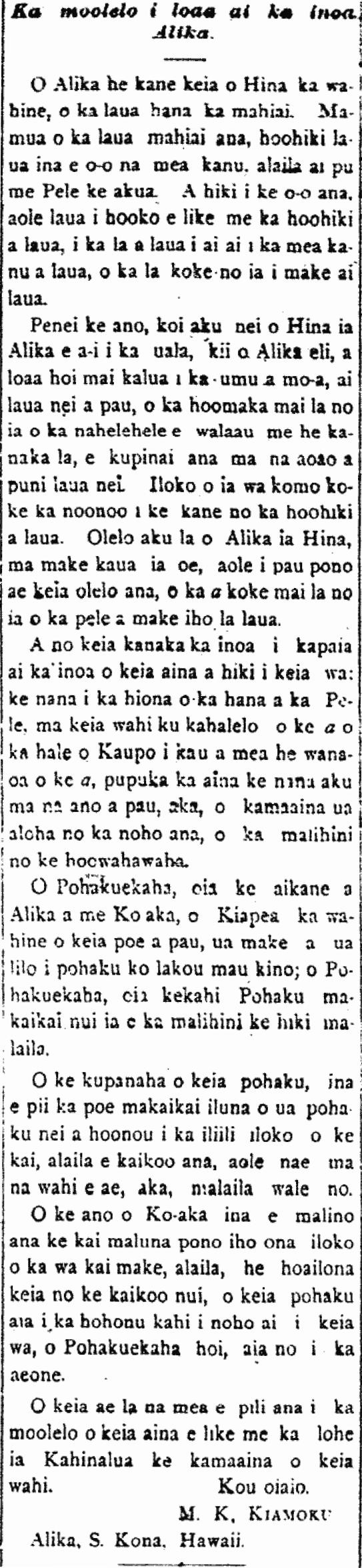
The story of how Alika was named.

Alika was a man and Hina was his wahine, and their occupation was farming. Before they would begin farming, they would vow that should their crops mature, they would consume it along with Pele, the god. But when the crops reached maturity, the two of them didn’t carry out their promise, and the day that they ate of their crops, that was when they soon died.

This is how it happened: Hina urged Alika to eat sweet potato, and so Alika went to dig up some, and after finding some, he baked it in the umu¹ until done and then they ate it all; then the forest began to speak as if it were a man, echoing all about them. During which time, the man soon thought of their vow. Alika said to Hina, “We will die because of you,” and before he was done speaking, lava soon flamed forth and they perished.

And it is for this man that this land is called by that name until this day; if you look at the aftermath of the lava, in this area, the burnt homes of Kaupo stand jagged because of the spreading flames²; the land is horrid in appearance in every way; but the kamaaina love it here, and it is only the malihini who disparage it.

Pohakuekaha was the aikane of Alika and Ko-aka; Kiapea was the woman of all of them; they died and their bodies transformed into rocks; Pohakuekaha is a stone that is visited often by malihini who are in the area.

The amazing thing about this rock is that if the visitor climbs atop of the rock and throws pebbles into the sea, the sea will turn rough, but not in any other area, just right there.

As for Ko-aka, if the sea is calm right above it, during low tide, this is a sign that will be rough seas; this rock is now located in down in the deep, while Pohakuekaha is on the sand.

These things above deal with the story of this land as was heard by Kahinalua, the kamaaina of this place.

Yours truly,

M. K. KIAMOKU

Alika, S. Kona, Hawaii.

¹Umu is another word for imu, the underground oven (as in the name, Kaumualii).

²I am not sure if this is a reference to the actual place called Kaupo in South Kona, or to the famous saying “Kū ke ʻā i ka hale o Kaupō” from the story of Pāmano…

(Kuokoa, 8/7/1886, p. 3)

Ka moolelo i loaa ai ka inoa Alika.

Ka Nupepa Kuokoa, Buke XXV, Helu 32, Aoao 3. Augate 7, 1886.

Book of the story of Leinaala, 1891.

[Found under: “Hawaii News.”]

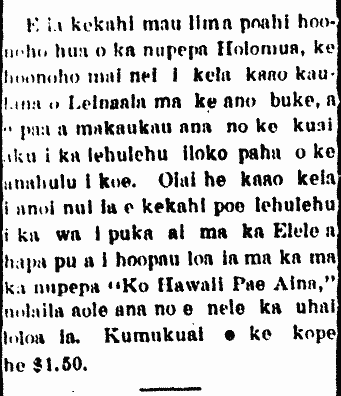
There are some typesetters of the [Hawaii] Holomua Newspaper setting type of that famous kaao, Leinaala, as a book; it will be ready and for sale to the public perhaps within ten days [anahulu]. Being that this was a story that was beloved by many people when it was published half in the “Elele” and finished in the newspaper “Ko Hawaii Pae Aina,” it will certainly be much sought after. The cost per copy is $1.50.

[Does anyone know of any library where this book might be found?]

(Kuokoa, 8/29/1891, p. 3)

E ia kekahi mau lima poahi hoonoho hua...

Ka Nupepa Kuokoa, Buke XXX, Helu 35, Aoao 3. Augate 29, 1891.

Kapihe and his prophecy. 1862.

The Story of Kapihe.

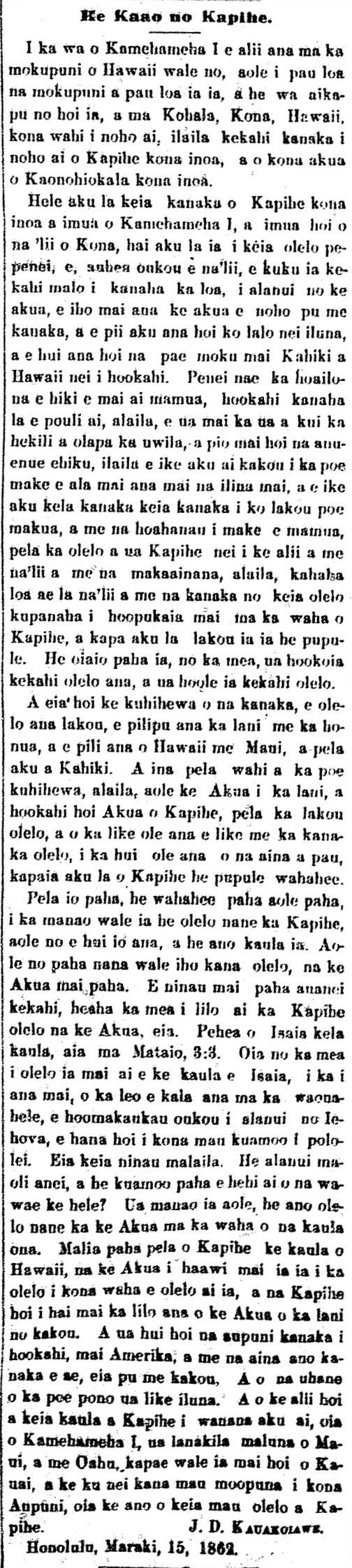
When Kamehameha I was ruler over only Hawaii Island, and not all of the islands were his, and while the eating kapu was still enforced, and while he was living in Kohala, Kona, Hawaii, it was there that a certain man lived named Kapihe, and his god was called Kaonohiokala.

This man named Kapihe went before Kamehameha I and before the alii of Kona, and he said these words, “Listen, O Chiefs, a malo will stand, forty in length, as a path for the god; the god will come down and live with man, and what is down here will rise up above, and the archipelago from Kahiki* all the way to Hawaii will be joined as one. This is the sign that will come before this: there will be forty days of darkness and then rain will fall and thunder will crash and lightning will flash and seven rainbows will arch; there we will see the dead rise from the graves and all people will see their parents and hoa hanau [siblings, cousins] who died earlier.” And that is what Kapihe said to the King, alii, and makaainana. The chiefs and commoners were astounded at these shocking words spoken by Kapihe, and they called him crazy. This perhaps is the truth, for some of his predictions came true and others were denied.

This is how people are mistaken, they say, the heavens and earth will come together, and Hawaii and Maui will join together, and so too with Kahiki. And if that is the case, according to the mistaken ones, then God is not in heaven, and there is but one God, and that is Kapihe; that is what they said, and because all of the lands did not merge together as the they were saying, Kapihe was called a lying, crazed person.

Perhaps that is so, perhaps he was a liar, and perhaps not; it might be thought that Kapihe’s was a riddle and the land would not literally join together, and that he was a prophet. Perhaps his words were not his alone, but from God. Someone might ask, how did Kapihe’s words come from God, and here is the answer. What of Isaiah, that prophet, in Matthew 3:3? For this is what was spoken by the prophet Isaiah, ‘The voice of the one crying in the wilderness: ‘Prepare ye the way of Jehovah, make his paths straight.'” Here is the question there. Is it a real road, and is it a path that will be tread on by feet? It is believed not, but that it was a riddle from God through the mouth of his prophet. Maybe so too it was of Kapihe, the prophet of Hawaii; God gave the words for his mouth to speak, and Kapihe spoke what God of the heavens gave to us. And the nations of man joined as one, from America, and the other inhabited lands, they are here together with us. And the souls of the righteous are the same up above. The alii of whom Kapihe predicted was Kamehameha I, who was victorious over Maui and Oahu, and Kauai was left, and his grandchildren now rule over his Kingdom. This is the nature of Kapihe’s words. J. D. Kauakoiawe

Honolulu, March 15, 1862.

*Kahiki usually refers to foreign lands.

(Hoku o ka Pakipika, 3/20/1862, p. 1)

Ke Kaao no Kapihe.

Ka Hoku o ka Pakipika, Buke I, Helu 26, Aoao 1. Maraki 20, 1862.

The magazine “Ke Au Hou.” 1912.

[Found under, “Local News”]

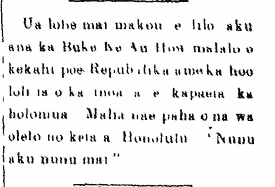
We have heard that the Book, “Ke Au Hou,” will be taken over by some Republicans and its name will change to “Ka Holomua.” Perhaps that is just gossip here in Honolulu: groaning this way and that.

[See Papakilo Database for online issues: “Ke Au Hou” and “Hawaii Holomua”. I am not sure what changes were made with the name change, but the heads of the paper seem to stay the same: John H. Wise, Gulstan K. Poepoe, and Daniel K. Hoolapa…

These publications are more like literary magazines than newspapers. There are many more extant issues of “Hawaii Holomua” neither microfilmed nor available online to this day!]

(Kuokoa Home Rula, 2/16/1912, p. 2)

Ua lohe mai makou...

Kuokoa Home Rula, Buke X, Helu 7, Aoao 2. Feberuari 16, 1912.

Six blind men and an elephant, 1867.

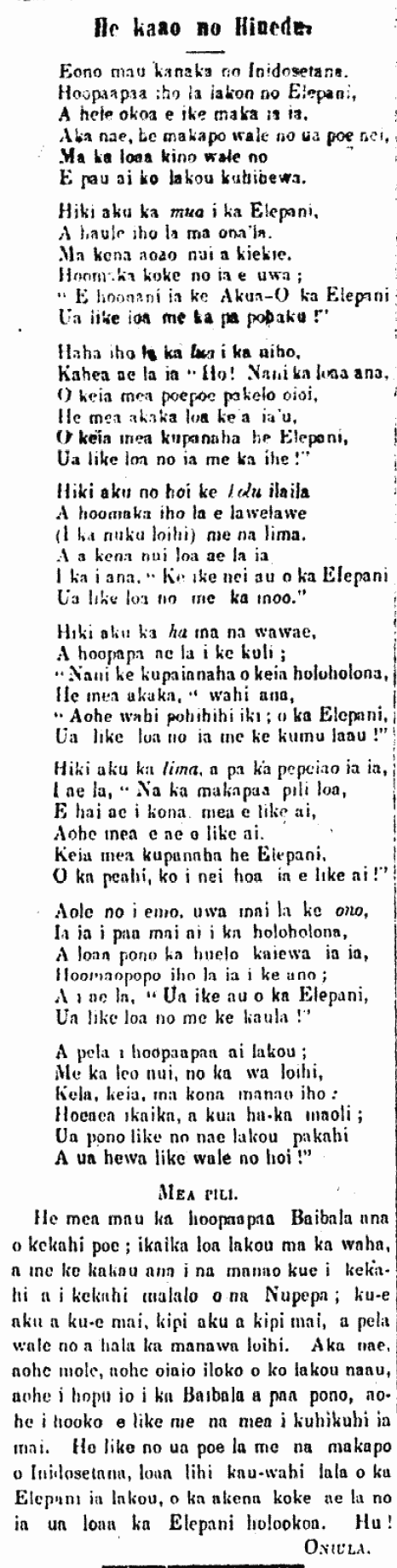
A TALE FROM HINDU.

[The story of the blind men who feel different parts of an elephant and give their varied impressions of what an elephant is, comes from India. But it was adapted into the poem “The Blind Men and the Elephant” by American, John Godfrey Saxe. This poem is then interpreted into Hawaiian in 1867 by Oniula, who submits many translations of foreign tales. The Saxe version can be found readily online…]

. . .

How it is related.

Some people constantly argue over the Bible; they are very outspoken, and write forcefully in the Newspapers, contradicting this person or that; arguing back and forth, conspiring back and forth, over long periods of time. However, there is no basis, no truth in their hearts; they don’t grasp the Bible firmly; they don’t do as they say. Those people are like the blind men of Indostan; they know just a small appendage of the Elephant, and then they boast that they know the whole Elephant. Hu!

Oniula.

(Kuokoa, 2/2/1867, p. 4)

He kaao no Hinedu.

Ka Nupepa Kuokoa, Buke VI, Helu 5, Aoao 4. Feberuari 2, 1867.

More on traditional stories, and variation within, 1862.

About Kaao and Moolelo.

O Readers of kaao, we have seen the story of Kailiokalauokekoa that was published by S. Hinau, and it was just completed with the 5th installment [this series, “He Moolelo no Kailiokalauokekoa,” probably started on 10/24/1861 (which is missing) and S. Hinau closes his telling on 12/5/1861]; S. N. Haleole has just started that story again [which begins with genealogy, on 12/12/1861, restarts with installment 6 on 12/19/1861, and probably ended with installment 10, on 1/30/1862 (which sadly is also missing)], and with that retelling of the story, there has been quite the uproar. Those who are with Hinau say that his is correct, and those that read Hinau’s first fault Haleole’s publishing of Kailiokalauokekoa, as if there is but one person who retained this story on this solid earth. The actions of these people are unbelievable.

Those people go on and on saying, “oh please! this series is so misguided and not like Hinau’s”; further more, “Who has heard those oli which were chanted by Kailiokalauokekoa? and who kept those mele?” Auwe! Is there only one school where it was taught? Is it only Hinau who has kept this story? No, there are many people today. So stop with your unfounded ideas.

(Hoku o ka Pakipika, 1/16/1862)

No na Kaao a me na Moolelo.

Ka Hoku o ka Pakipika, Buke 1, Helu 17, Aoao 4. Ianuari 16, 1862.

On traditional stories and finishing properly what you begin, 1862.

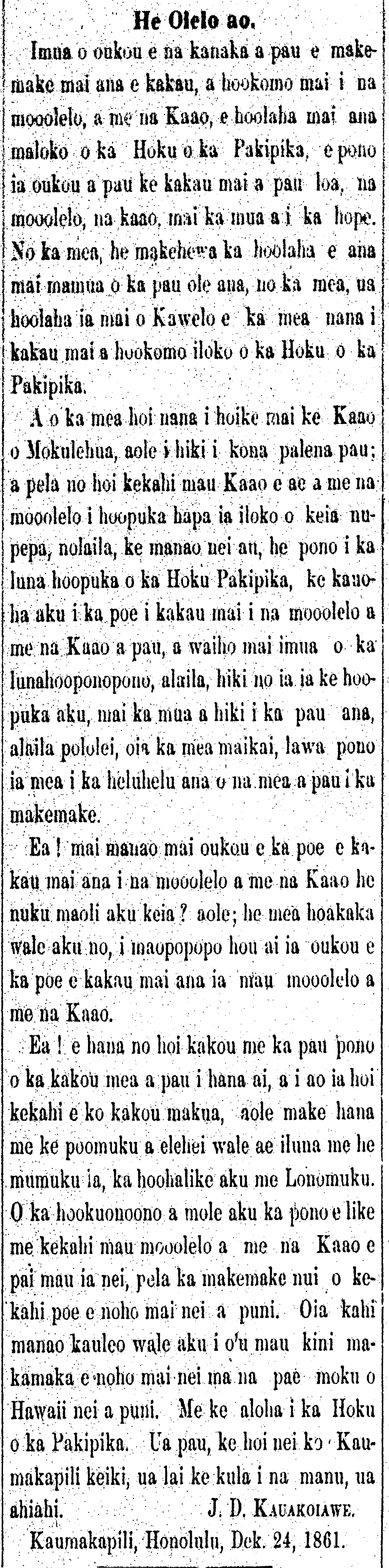
Words of Advice.

Before you, all those who want to write and publish stories (mooolelo and kaao) in the Hoku o ka Pakipika: you must all write the whole story from the beginning all the way until the end. Because it will be a waste of time to start printing before it is completed, as Kawelo by the person who submitted it, was printed in the Hoku o ka Pakipika [“Mooolelo no Kawelo” by S. K. Kawailiula from 9/26/1861 to 12/5/1861—5 helu total].

And as for the person who submitted the story of Mokulehua, he did not get to the end [“He wahi Kaao no Mokulehua” begins on 11/28/1861, and in the Helu 2 (12/5/1861), there is a note from the editor at the bottom, “Send in more of the story of Mokulehua; make it quick lest the Hoku o ka Pakipika give you a kick.” Helu 3 in the next issue (12/12/1861) is very short, and there is a long hiatus until well after this letter is published. It finally reappears as “He Moolelo no Mokulehua on 3/13/1862 to 3/27/1862, 6 Helu in total, by B. K. H.**.]; and so too of some other kaao and mooolelo that were published partially in this newspaper; therefore, i feel that it is necessary for the editor of the Hoku o ka Pakipika to require that those who write in mooolelo and kaao to complete it and then to put it before the editor, and then it can be printed from beginning to end, and it is right and good, and everyone who reads it will be satisfied.

Now then! all you people who write in mooolelo and kaao, don’t take this as a critique; no, it is just clarification, so that you all know.

Now then! let’s all finish everything we start properly, as some of us were taught by our parents: don’t do things leaving off the beginning, cutting off the top like a maimed one, imitating Lonomuku. What is necessary is to make it well-rooted, as are some of the mooolelo and kaao that are being published, and that is what what people all over really want. This is just encouragement to all my friends living throughout these Hawaiian islands. With aloha to the Hoku o ka Pakipika. I am done, Kaumakapili’s child returns, as the fields are tranquil with birds and it is eventide.  J. D. KAUAKOIAWE.

Kaumakapili, Honolulu, Dec. 24, 1861.

(Hoku o ka Pakipika, 1/2/1862, p. 4)

He Olelo ao.

Ka Hoku o ka Pakipika, Buke 1, Helu 15, Aoao 4. Ianuari 2, 1862.

Laieikawai, 1888.

In 1888, “Ka Moolelo o Laieikawai, a o ka mea i kapa ia Kawahineikaliula [The Story of Laieikawai, the one that was called The Woman of the Twilight],” was edited and republished by Sol. Meheula and Jas. Henry Bolster, “For the benefit and the progress of the new generations of the Hawaiian People.”

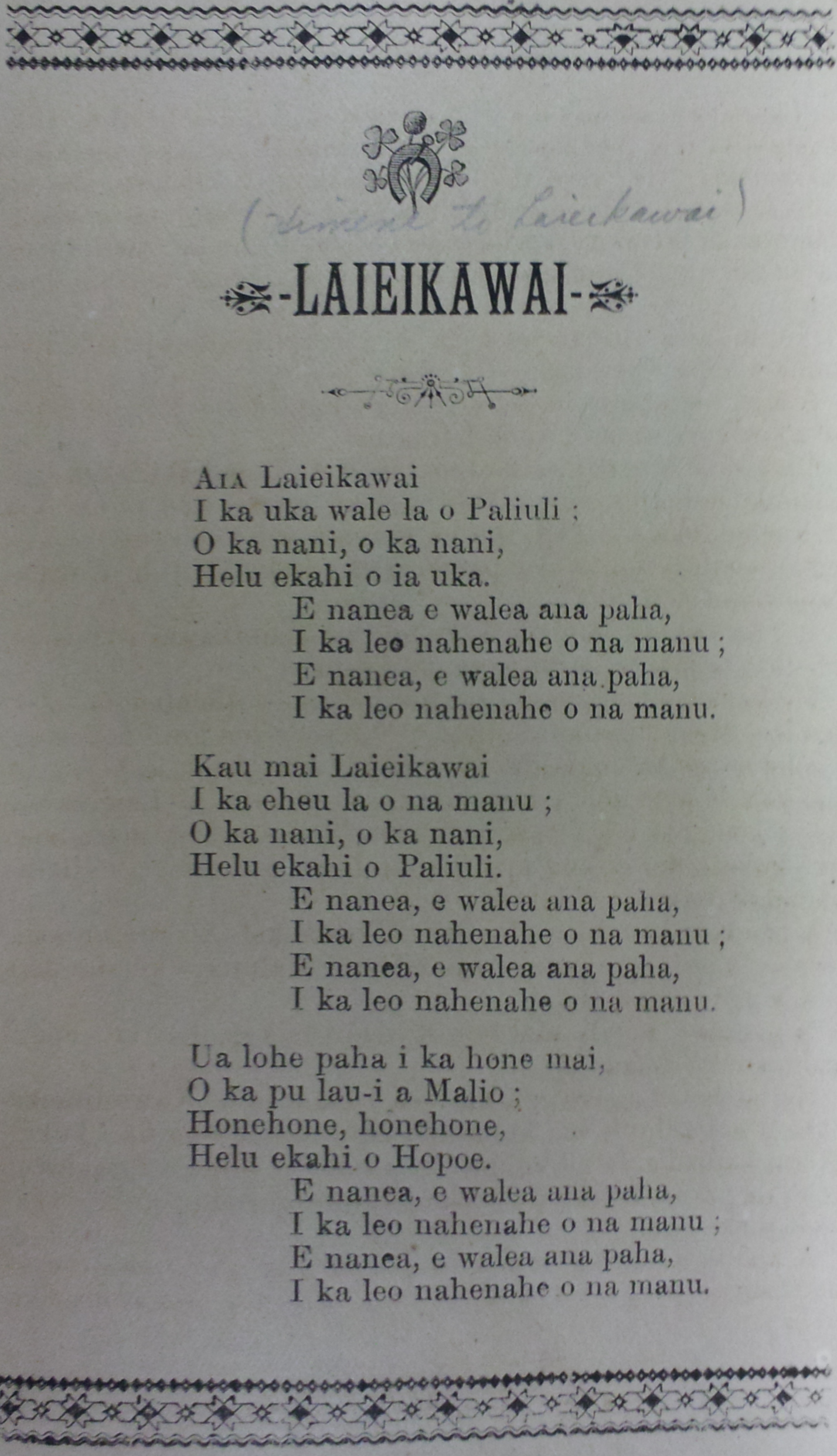
On page 131 of this book appears this mele called “Laieikawai” which may look familiar to many of you.

Laieikawai

"Ka Moolelo o Laieikawai: a o ka mea i kapa ia Kawahineikaliula," Sol. Meheula & Jas. Henry Bolster, ed., Honolulu: Papa Pai Mahu "Bulletin," 1888. p. 131 (Courtesy of Bernice Pauahi Bishop Museum)