Runaways from Kalawao, 1875.

Escaped from Kalawao.—During the night of this past Monday, a skiff landed at Kakaako with three escapees from Kalawao. Their names are Kimo Kamai, Anoho, and Naakaakai. Kimo was captured by the Officers soon after he came ashore; however, his two companions ran and disappeared. Kimo said of himself and his companions:¹

“We left Kalaupapa aboard the skiff in the evening of Sunday, at the hour of 10 p. m., with a sail, and at 6 a. m., in the morning of Monday, we landed at Hanauma, and left there this past evening, that being the evening of this Monday, and from there landed at Kakaako that night at 1:30 a. m., and from there I was caught and detained by the Officer, while Anoho and Naakaakai escaped until the present. There was no big reason for us coming; we spoke for a number of days about coming, and on the evening mentioned above, we set sail. There is no difficulties in the way of life, but we really wanted to come here and hide in the mountains of Oahu nei. KIMO KAMAI.

One of the Patients who escaped.”

¹It is interesting the word here used for companion was “kokoolua” instead of “kokookolu”.

(Lahui Hawaii, 7/29/1875, p. 3)
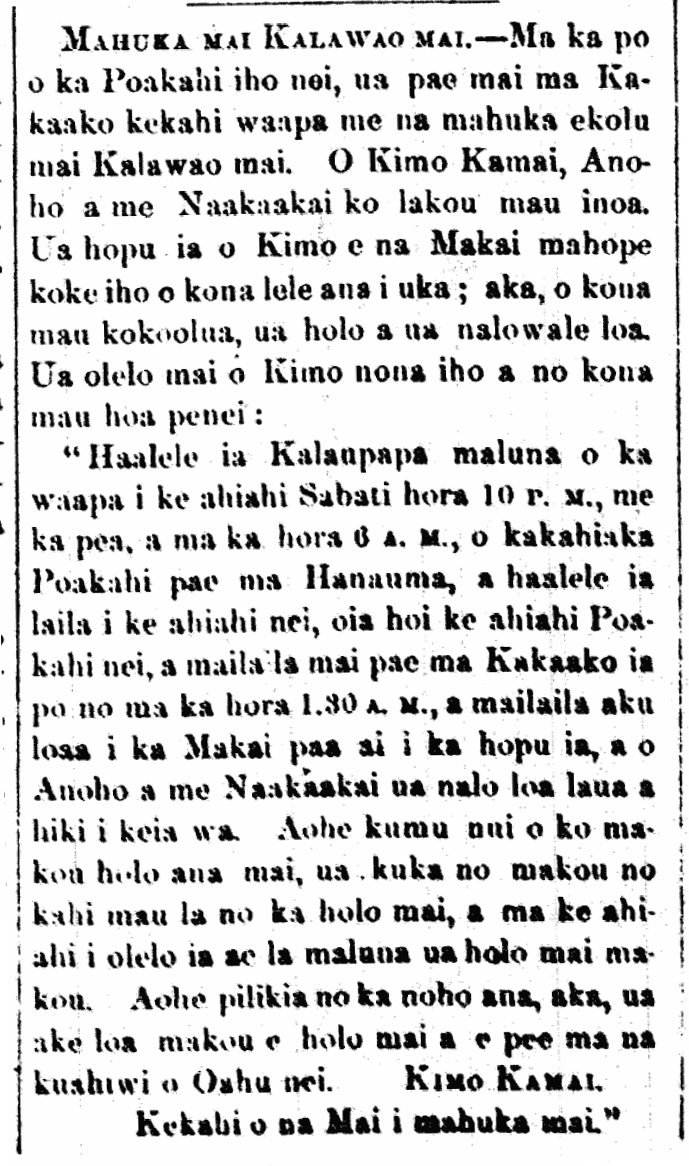
Mahuka mai Kalawao mai.

Ka Lahui Hawaii, Buke I, Helu 31, Aoao 3. Iulai 29, 1875.
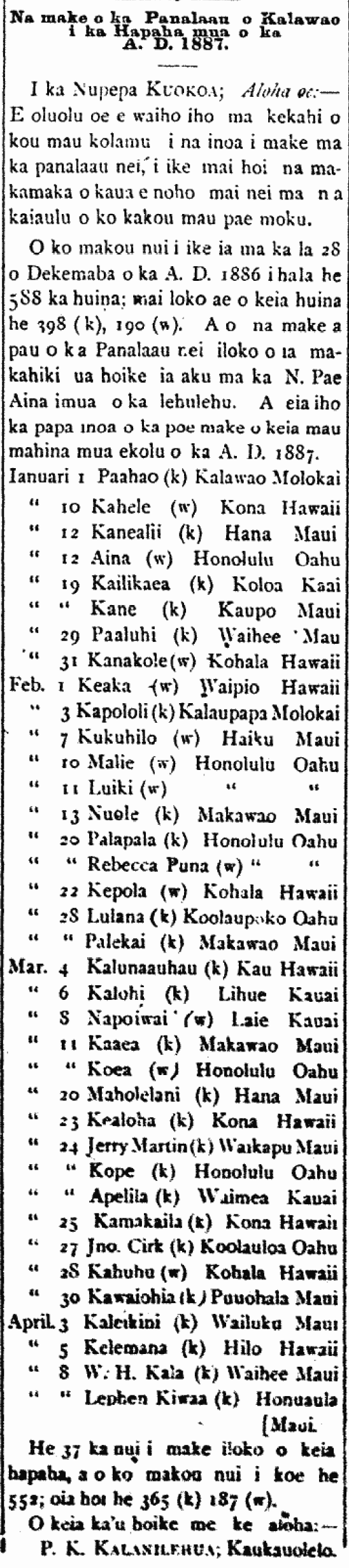
More deaths in Kalawao, 1887.

The deaths in the Colony of Kalawao in the first Quarter of the year 1887 A. D.

To the Kuokoa Newspaper; Aloha oe:—Please put in one of your columns the names of those who died in this colony, so that our friends living in the neighborhoods of our archipelago may see.

The numbers of us known on the 28th of December of the past year 1886 A. D. were 588 total; of this, 398 were males and 190 were females. And the total deaths in this Colony during that year were shown before the public in the Newspaper Pae Aina [Ko Hawaii Pae Aina]. And here below is the list of people who died in the first three months of 1887 A. D.

January 1, Paahao (m) Kalawao, Molokai

” 10, Kahele (f) Kona, Hawaii

” 12 Kanealii (m) Hana, Maui

” 12 Aina (f) Honolulu, Oahu

” 19 Kailikaea (m) Koloa, Kauai

” ” Kane (m) Kaupo, Maui

” 29 Paaluhi (m) Waihee, Maui

” 31 Kanakole (f) Kohala, Hawaii

Feb. 1 Keaka (f) Waipio, Hawaii

” 3 Kapololi (m) Kalaupapa, Molokai

” 7 Kukuhilo (f) Haiku, Maui

” 10 Malie (f) Honolulu, Oahu

” 11 Luiki (f) ” “

” 13 Nuole (m) Makawao, Maui

” 20 Palapala (m) Honolulu, Oahu

” ” Rebecca Puna (f) ” “

” 22 Kepola (f) Kohala, Hawaii

” 28 Lulana (m) Koolaupoko, Oahu

” ” Palekai (m) Makawao, Maui

Mar. 4 Kalunaauhau (m) Kau, Hawaii

” 6 Kalohi (m) Lihue, Kauai

” 8 Napoiwai (f) Laie, Kauai

” 11 Kaaea (m) Makawao, Maui

” ” Koea (f) Honolulu, Oahu

” 20 Maholelani (m) Hana, Maui

” 23 Kealoha (m) Kona, Hawaii

” 24 Jerry Martin (m) Waikapu, Maui

” ” Kope (m) Honolulu, Oahu

” ” Apelila (m) Waimea, Kauai

” 25 Kamakaila (m) Kona, Hawaii

” 27 John Cirk (m) Koolauloa, Oahu

” 28 Kahuhu (f) Kohala, Hawaii

” 30 Kawaiohia (m) Puuohala, Maui

April 3 Kaleikini (m) Wailuku, Maui

” 5 Kelemana (m) Hilo, Hawaii

” 8 W. H. Kala (m) Waihee, Maui

” ” Lephen Kiwaa (m) Honuaula, Maui.

There were 37 deaths in this quarter, and the number of us remaining are 552; that being 365 males and 187 females.

This is my report, with aloha:—

P. K. Kalanilehua; Secretary.

(Kuokoa, 5/14/1887, p. 3)

Na make o ka Panalaau o Kalawao i ka Hapaha mua o ka A. D. 1887.

Ka Nupepa Kuokoa, Buke XXVI, Helu 20, Aoao 3. Mei 14, 1887.

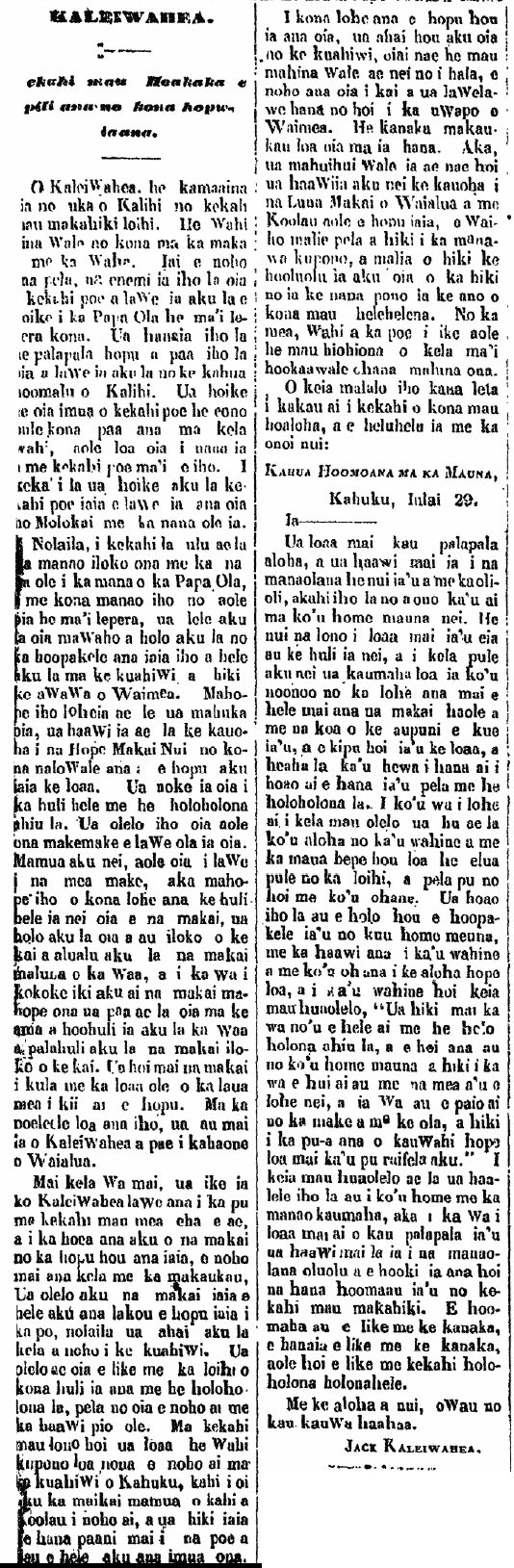
Jack Kaleiwahea falsely accused? 1893.

KALEIWAHEA.

Some Explanations pertaining to his arrest.

Kaleiwahea has been a kamaaina of the uplands of Kalihi for many years. He has some blemishes by his eyes and mouth. While he was living this way, he was made an adversary by some people and they went to the Board of Health as witnesses saying he had leprosy. A warrant was issued for his arrest and he was captured and taken to the quarantine station of Kalihi. He told some people that he was confined there for six weeks without being examined, along with some other patients. One day some people told him that he was going to be taken to Molokai without being examined.

Therefore, one day a thought grew within him without considering the power of the Board of Health, and thinking of his own accord that he did not have leprosy, he escaped and ran away to free himself and went to the mountains, until the valley of Waimea. Later it was heard that he fled, and the order was given to the Deputy Sheriffs in response to his escape, to capture him if found. He was constantly hunted like a wild animal. He said that he didn’t want to be taken alive. Previously, he did not carry weapons, but after he heard that he was being hunted by the officers, he ran and swam in the ocean, while being chased by officers aboard a canoe, and when the officers were close behind, he grabbed on to the outrigger float [ama] and flipped the canoe, and the officers were thrown into the ocean. The two officers returned to shore without the object of their chase. When it became dark, Kaleiwahea came to shore at Waialua.

From that time, Kaleiwahea was seen carrying a rifle and other weapons, and when the officers came to arrest him once more, he was prepared. The officers told him that they’d come at night to capture him, so he fled to live in the mountains. He said that as long as he was hunted like an animal, he’d not give up. According to some news received, he was living in a very good area in the mountains of Kahuku, where it was better than where Koolau¹ was living, and he could toy with all who appeared before him.

When he heard that he was to be captured again, he fled to the mountains, even if just a few months ago he was living by the sea and working at the dock of Waimea. He was very skilled at that kind of work. But he surmised that the order was given to the District Sheriffs of Waialua and Koolau, not to arrest him, but to let him be until the time was right, then maybe he could be assuaged and his appearance could be looked at. Because according to the people who knew, there were no signs of that disease that separates families [leprosy] upon him.

This below is the letter he wrote to one of his friends, and let it be read with great relish [? onoi nui]:

Camping Place in the Mountains

Kahuku, July 29,

To _______

I received your letter of aloha, and it gave me much hope and happiness, and for the first time, I’ve have an appetite here in my mountain home. I’ve received a lot of news that I’m being hunted after, and last week I was greatly saddened upon hearing that the haole police were coming along with the government troops to go against me, and that they’d shoot me if they can; what is the wrong I have committed that I should be treated that way like an animal? When I heard this, aloha welled up within me for my wife and our newborn baby of two weeks, as well as for my family.  I attempted to go once again and escape my mountain home and give my wife and family my last aloha; and to my wife i said, “The time has come for me to go like a wild animal and return to my mountain home, until i meet with those of which I hear, and it will be then that I fight for life or death, until the very last puffs of smoke from my rifle.” With these words above, I left my home depressed, but when I received your letter to me, it gave me good hope that there will be end to the years of persecution. I shall rest like a man, and my deed done as a man, and not like a beast running through the forest.

With much aloha, me, your humble servant,

Jack Kaleiwahea.

¹The famous one written of in “Ka Moolelo Oiaio o Kaluaikoolau” or “The True Story of Kaluaikoolau,” which is available from the Kauai Historical Society, or a bookstore near you!

[I wish the digital images of this paper were better. This article is even cut off on the left, so I had to guess at many of the words… It is definitely time to rescan the Hawaiian-Language Newspapers!]

(Lei Momi, 8/5/1893, p. 5)

KALEIWAHEA.

Ka Lei Momi Oili Pule, Buke I, Helu 1, Aoao 5. Augate 5, 1893.

Queen Kapiolani’s visit to the leprosy colony, 1884.

While the entire report should be read because it is all so telling, I think many will find “Report of Her Majesty Queen Kapiolani’s visit to Molokai, by H. R. H. Princess Liliuokalani, July, 1884.” found in the Appendix to the Report on Leprosy of the President of the Board of Health to the Legislative Assembly of 1886, pp. iii–xvii, very interesting for many reasons.

Mistreatment of leprosy patients and why we need to reshoot the Hawaiian-Language Newspapers, 1886.

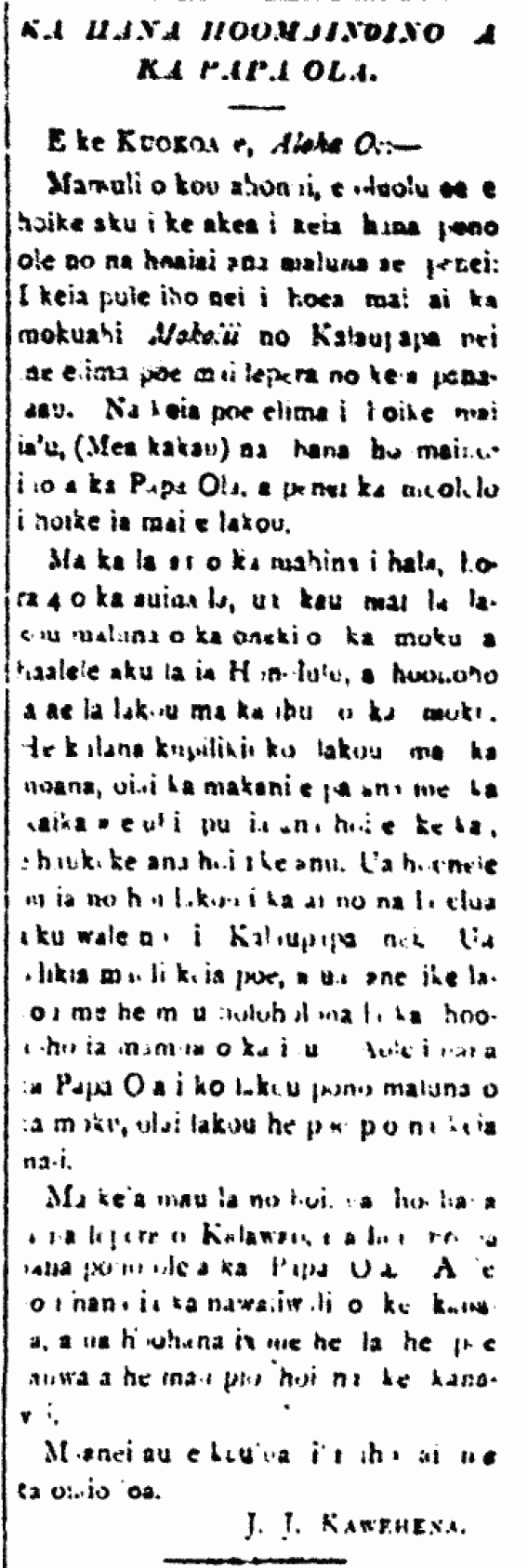
ABUSE BY THE BOARD OF HEALTH.

O Kuokoa, Aloha Oe:—

Please be so patient as to show this improper behavior to clarify the above, thus: This past week the steamship Makalii arrived here in Kalapapa with five leprosy patients for this colony. These five people told me (the Writer) about the cruelty done by the Board of Health, and this is the story told by them.

On the 21st of the past month, at 4 in the afternoon, stepped onto the deck of the ship and left Honolulu, and they were placed at the bow of the ship. They were in distress while at sea due to the winds that were blowing strongly and they were covered by the sea and shivered in the cold. They were not give food for two days and then landed here in Kalaupapa. They were in desperate shape, and were treated like animals being placed at the bow. The Board of Health did not look after their well-being even if they ?????

These days, the leprosy patients of Kalawao are made to work ?????? mistreated by the Board of Health. They don’t consider the weak state of the people and are worked like slaves and they are prisoners of the law.

Here, I ????? with sincerity.

J. J. Kawehena.

[I know i keep saying that the Hawaiian-Language Newspapers need to be reshot again so that we can have the clearest images possible, but i can’t help it. Here is a perfect example. I am guessing at a good deal of the content, and where i couldn’t, i left as “????” Once the papers deteriorate and crumble away, there is no way we can get these histories.]

(Kuokoa, 7/3/1886, p. 1)

KA HANA HOOMAINOINO A KA PAPA OLA.

Ka Nupepa Kuokoa, Buke XXV, Helu 27, Aoao 1. Iulai 3, 1886.

Anonymous accusations against a Catholic priest in Kalawao, 1874.

The deeds of the Catholic teacher in Kalawao.

We are printing below the deeds of a certain Catholic priest amongst the leprosy patients in Kalawao:

1. Clothes—The clothes donated by the brethren of Honolulu for the needy leprosy patients of Kalawao, that is what the Catholic teacher is using to lure the people of the Evangelical faith [hoomana Euanelio] to join the Catholic religion. While he goes around doing his converting, and when they hear him they convert, but should they be steadfast, the teacher will say, “Should you join the Catholic faith, I will give you the clothing and things that you lack, should you desire.” By this action, some agree to join; there have been many converted over the clothes. This is the cunning way [kumu hinu ?] of the Catholic priest.

2. Wooden staff—The Catholic teacher constantly carries a staff in his hand, and it is with this that he converts people to his faith. This is what he does. For that person or persons who are resolute against being converted over clothes, they are struck by the cane of the Catholic teacher. This is what he does with the cane, and he converts them.

3. The church house—The church in Kalaupapa is of the Catholics.¹ He uses this church to convert some people to his religion. This is basically what he does. When the church was completed in Kalaupapa, the Catholic teacher when to the houses to convert people; the Catholic teacher said, “What is your faith.” “I’m a Calvinist [Kalawina],” that being a Protestant of the Evangelist faith, said the person in response. “That is a faith without any church,” said the Catholic teacher.”We are fine without a church; we hear that our kahu is coming and will hold services at the homes of brethren, and if we are in good health, we will attend the services,” he answered. “That’s no good, for here is our church, you all should come in, and then I’ll give you people clothes, and things you need, should you all desire,” replied the Catholic teacher. With this and everything else said in that conversation, some people converted, and some others remained steadfast behind the truth of the Gospel.

4. The cemetery.—The cemetery of the Catholics recently constructed here in Kalawao is one of the things used by that Catholic teacher and the Catholic disciples to convert people to their side. This Catholic teacher saw that the people were troubled with dead bodies left out, eaten up by pigs; and he was intent on converting the people to his belief, and therefore, he ordered Honolulu to send over several bundles of pine lumber; it arrived recently and is now standing here in Kalawao like a net to catch stupid fish who stray and are caught. So too is this graveyard; there are two faiths who come in, and they are left until the day they rise; who will they be for?

5. Extreme Unction [Ukione].—This act, Extreme Unction, is one of the most heinous acts which the Catholic teacher is doing here in Kalawo, and we all agree that this is akin to thievery. This is what he does. For those who don’t convert over clothes, or the rod, or the church, or the cemetery, he practices Extreme Unction on them. When the Catholic teacher sees or hears of a that a patient has grown weak, one that is from another faith, he goes to them constantly to urge them, and because the patient grows weary, he submits, whereupon the Catholic teacher performs the Extreme Unction; and when the patient recovers, he protests this improper deed of the Catholic teacher; this happens often; some people protest, and other mistakenly submit. From what we’ve seen, the Catholic teacher by these actions is like a yellow-eyed cat spying on its enemy, the mouse. And we believe that these actions of the Catholic teacher are not right in his sacred and faithful position.

Here is another new important thing we are witnessing. On the night of the 22nd of Dec. of the year 1873, at maybe 10 o’clock of that night, Kaiakoili (m) died, he was a brethren of the church of Kawaiahao, and he contracted leprosy and lived here in Kalawao, and was a member of the Siloama Church, and this was his faith until the day he died. However, on the night shown above, during his last hours, he was Baptized [Babetema ia] by Kulia (f), who is a disciple of the Catholic faith, but he was Baptized when he was dead.

Leprosy Patient.

¹St. Philomena Church

(Kuokoa, 1/17/1874, p. 1)

Na hana a ke kumu Pope ma Kalawao.

Ka Nupepa Kuokoa, Buke XIII, Helu 3, Aoao 1. Ianuari 17, 1874.

John James Kawehena passes away in Kalawao, 1887.

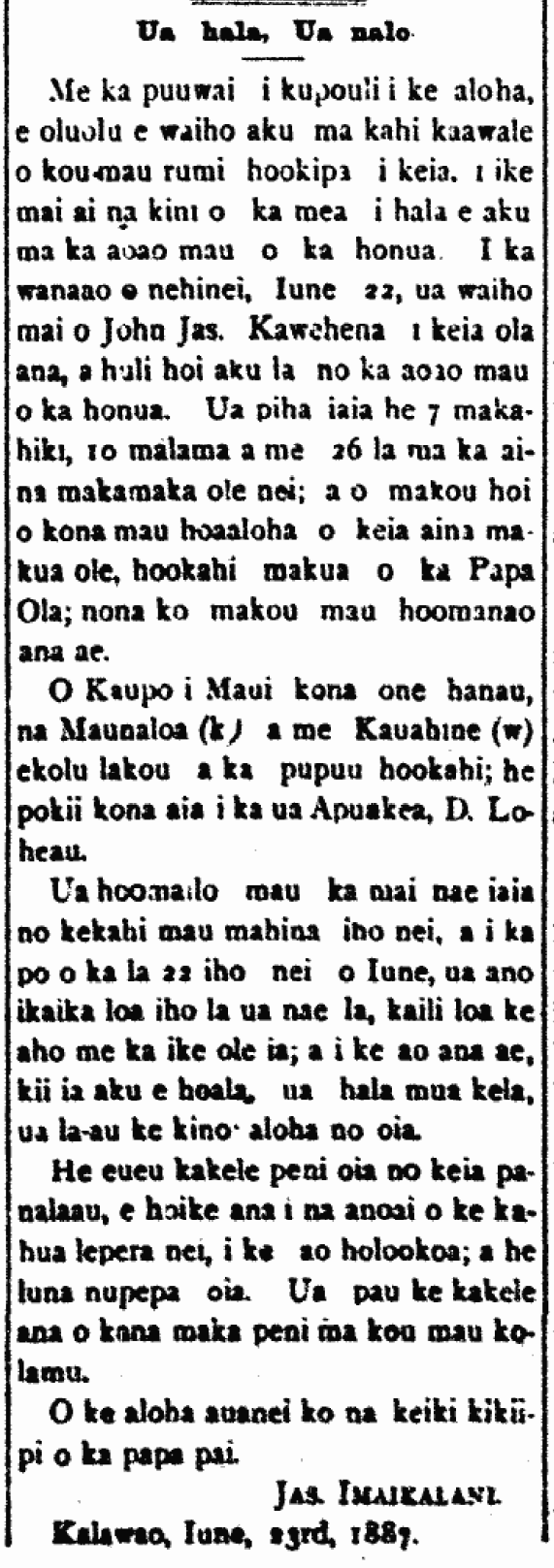
He has Passed on; He has Gone

With a heart darkened by sadness, I ask you to kindly leave me a space in your pages¹ for this, so that the many people of the one who has passed on to death will know. At dawn of yesterday, June 22, John James Kawehena left this life, and returned to the everlasting side of the earth. He spent 7 years, 10 months, and 26 days in this forsaken land; and as for us, his friends of this land without parents save one, the Board of Health [Papa Ola], for him is our remembrance.

His land of birth was Kaupo on Maui; his parents were Maunaloa (m) and Kauahine (f), and the three of them lived together; he has a younger sibling in the Apuakea rain,² D. Loheau.

He was growing thin with shortness of breath for these past months, and in the night of the 22nd of this past June, the shortness of breath grew worse and his breath was unbeknownst to us snatched away for good; and the next morning, we went to wake him but he was already gone and his body was stiff; much aloha for him.

He was an active writer for this colony, reporting the news of this land of leprosy patience to the whole world; and he was one of the heads of a newspaper. His writings will no longer appear in your columns.

Aloha to the [kikiipi ?] boys of the press.

JAMES IMAIKALANI.

Kalawao, June 23rd, 1887.

¹Literally a parlor or a room to greet people

²Famous in Koolaupoko on Oahu

[Although the information from Kalaupapa and Kalawao were not usually included in the regular Vital Statistics column, they were often printed in the other columns of the Hawaiian-Language Newspapers!]

(Kuokoa, 7/9/1887, p. 3)

Ua hala, Ua nalo

Ka Nupepa Kuokoa, Buke XXVI, Helu 28, Aoao 3. Iulai 9, 1887.

Poi made from wheat flour in Kalawao and Kalaupapa, 1879.

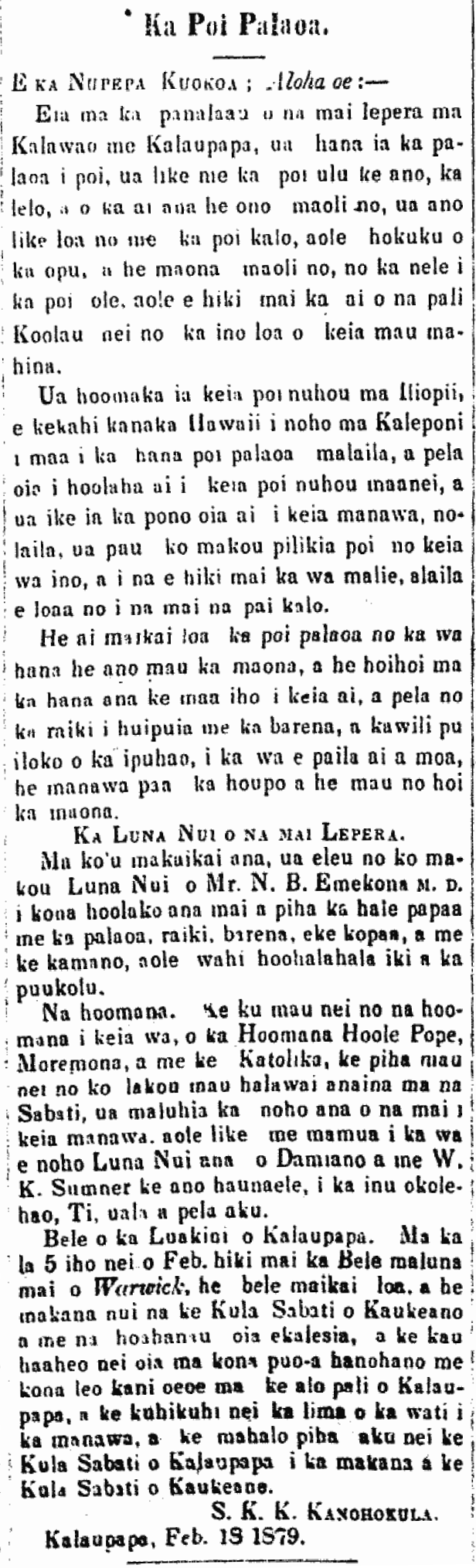
Poi Palaoa.

O Kuokoa Newspaper; Aloha oe:—

Here in the colony of the leprosy patients in Kalawao and Kalaupapa, flour is used to make poi [poi palaoa]; it is similar to poi made of breadfruit [poi ulu] in the yellow color, and it is truly delicious; it is a lot like taro poi [poi kalo]: your stomach doesn’t get sore, and you become full indeed; we have no poi because the taro won’t arrive to these Koolau cliffs because of the terrible weather during these months.

This new poi began at Iliopii, by a Hawaiian who lived in California who was used to making it there, and that is how he spread this new poi here; and the benefits of this poi is now known, and therefore, our poi problems are over during this stormy period, and should calm weather return, the patients will get their paʻi ʻai¹ [pai kalo].

Poi palaoa is very appropriate when working because you stay full, and it is fun to make when you get used to it, and so too with rice mixed with crackers and stirred up in a pot; when it boils and is cooked, it is time for to fill the stomach, and you will be always full.

The Superintendent of the Leprosy Patients.

In my observations, our Superintendent, Mr. N. B. Emerson [Emekona], M. D. is quick with filling the storehouse [hale papaa] with flour [palaoa], rice [raiki], crackers [barena], bags of sugar [eke kopaa], and salmon [kamano]; there is nothing to complain of Kapuukolu.²

Worship. Worship always happens now: Protestants [Hoole Pope], Mormons [Moremona], and Catholics [Katolika]; their meetings on Sundays are always full; life of the patients is peaceful now, not like before when Damien [Damiano] and when W. K. Sumner were Superintendent; there were uprisings from drinking okolehao and other alcoholic drinks made of ti, sweet potato [uala], and so forth.

Bell of the Church of Kalaupapa. On the 5th of Feb., the Bell arrived on the Warwick; a very fine bell which was a gift from the Sunday School of Kaukeano and the brethren of that church; and now it hangs proudly in its honored steeple with its ringing voice in the cliff faces of Kalaupapa, and it points out the movement of the hands of the clock, and the Sunday School of Kalaupapa fully appreciates the gift of the Sunday School of Kaukeano.

S. K. K. Kanohokula.

Kalaupapa, Feb. 18, 1879.

¹Although i tend not to use ʻokina and kahakō, i marked “pai ai” here for added clarity.

²Kapuukolu is a place on Kauai, figuratively used to represent abundance of good food.

(Kuokoa, 3/15/1879, p. 2)

Ka Poi Palaoa.

Ka Nupepa Kuokoa, Buke XVIII, Helu 11, Aoao 2. Maraki 15, 1879.

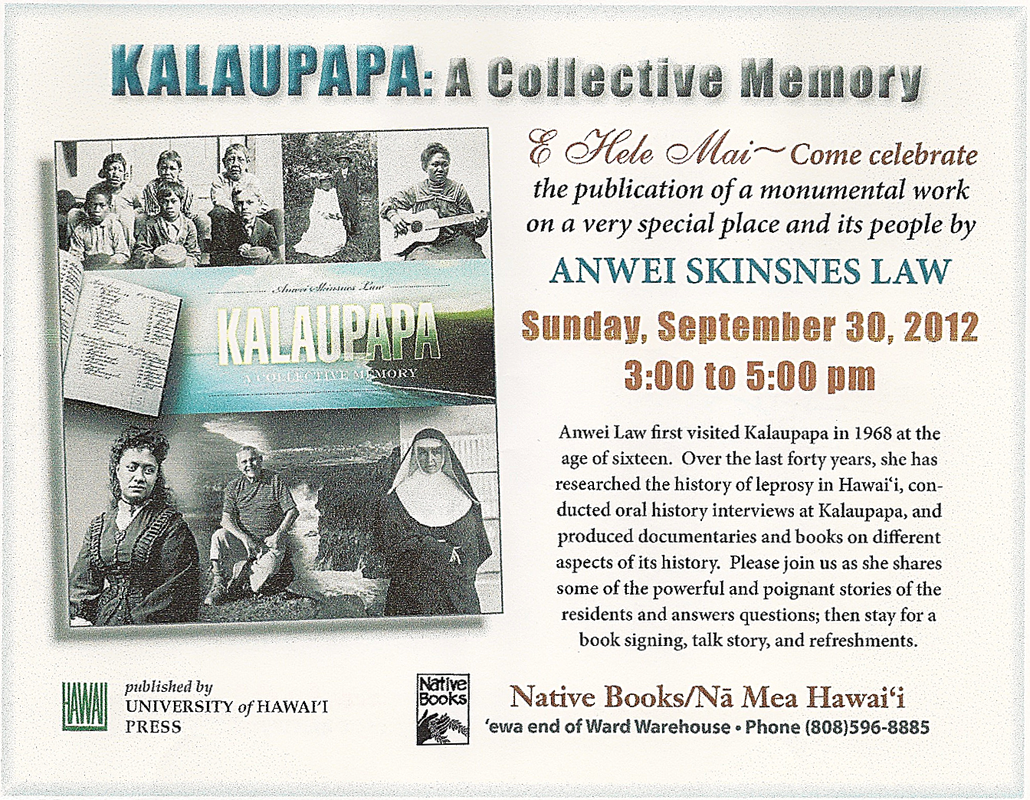
Post Brown Bag: “The People of Kalaupapa as Active Participants in Their Own History.” 2012.

Much appreciation goes out to all the good people at the Center for Biographical Research at UHM! And to Anwei Skinsnes Law and Henry Law for their presentation today!! I came out of it feeling upbeat, and excited that there are people out there looking at Hawaiian-Language source material for a window into the past (outside of the University).

I encourage people to go check out the talk, questions and answers, and book signing put on by Native Books from 3 to 5 in the afternoon this Sunday.

Kalaupapa: A Collective Memory

Kalaupapa: A Collective Memory

Nelson P. Watson’s son dies at Kalaupapa, 1924.

AN EXPRESSION OF LOVE FOR MY DEAR CHILD MANLEY DEDRICK WASTON.

Mr. Solomon Hanohano, Editor of the Newspaper Kuokoa, Aloha oe:—Please be so kind as to insert in some vacant space of your paper, so that the family, intimates, and friends may know that my dearly beloved child, Manley Dedrick Waston has left this life.
He was ill for just a few days, when on the 28th of Friday in the month of this past May at dawn, he grew weary of this life in Kalaupapa, Molokai.
He was born in Kahana, Koolauloa, Oahu on the 27th of December 1906, therefore, he made 17 years, 4 months, and 5 days.
Within one year or so of life after he was born…

MANLEY DEDRICK WATSON

…his mother left him and his two sisters, Lillian and Emma Waston.
From the loins of mine and my wife, there were 4 children: 2 were taken away, and 2 girls are left living. So he was burdened by me without a wife for almost 14 years.
He was separated from me because of the “disease which separates families” [mai hookaawale ohana]. Alas for my grief for my dearly beloved child! My burden that I bear alone; who’d be without aloha; he is with me wherever I go.
Aloha to that blossom who began to bloom but faded soon after!
O Kalaupapa, you all will never see the youthful face of my son again, passing before your faces; I sit with grief and sadness, but I find solace in the Lord Jesus, for he is sleeping in the Lord Jesus, for I know that one day I will be with him again in this body, in that life, and we will kiss, with all of my children, and their mother, after that great terrifying day of Jehovah.
I am grateful for all those who attended his funeral and for all their assistance.
Sincerely,
Nelson P. Watson,
Colburn Street, Honolulu.

(Kuokoa, 6/5/1924, p. 6)

HE HOALOHALOHA NO KUU KEIKI MANLEY DEDRICK WASTON.
Ka Nupepa Kuokoa, Buke LXIII, Helu 23, Aoao 6. Iune 5, 1924.