Wise Sayings of the people of old. 1922.

PROVERBS.

In order for us to hold on to all of the olelo noeau and all of the ingenious deeds of the Hawaiian people, we very much want everyone to assist the Bishop Museum in their collecting and explaining of wise and witty sayings known amongst this race.

So that this endeavor will move forward, whenever an ancient olelo noeau comes to mind, or perhaps a riddle, do write it down and send it to the museum; and if not to there, send it directly to the Kuokoa with clarification of its hidden meaning or deep wit.

Here are some olelo noeau sent from the museum to this newspaper:

Uhiuhi lau mamane, kahe ka wai o Kapapala.

Hookahi no hawa’e, lauhue Kona.

Kau ke poo i ka uluna, o Welehu ka malama.

Aohe hana a Kauhikoa, ua kau ka waa i ke aki.

Haehae ka manu, ke aleale nei ka wai.

E aho hoi ka make i ke kaua, he nui na moepuu.

Nakeke na iwi o Hua i ka la.

Uliuli kai pali o Kahikinui, kolo mai ka ohu la he ino.

Ua komo ka i’a i ka makaha, ua puni i ka nae.

Kulia i ka nuu, i ka paepae kapu o Liloa.

Aohe loea i ka wae opae.

Hoi hou ka paakai i Waimea.

Aohe u’i hele wale o Kohala.

Wehea iho maluna o Hihimanu.

E ike ia kaua hoa kanaka, o kipa hewa ke aloha i ka ilio; he ilio hoi ia, e, he kanaka hoi au, a!

Ka poe unaunahi hee o Kula.

Hilinai Puna, kalele ia Kau.

Hihi Kaunoa, hihi Mana; aloha wale ia laau makua ole.

Kiilili pua hau o Kalena.

Maemae i ke kai ka pua o ka hala.

Maewa wale i ka pali o Kahiwa. Niniu Puna i ke ala.

Nui pumaia, ohaka oloko.

Eleelepi ka waha o kanaka.

He wa ulu keia o ka hoi.

Ua le’a kaina a ka la’i, ua malie.

Make ke kalo, ola i ka naio.

Aia i kula i ka alaalapuloa.

E hoomanao i ka lua o ka ohiki.

Ako Nuuanu i ka hale halauloa a ka makani; ako Manoa i ka hale a ka ehu.

Na manu kolea kau ahua.

[And presumably from the responses came the publication we all know today as “‘Ōlelo No‘eau: Hawaiian Proverbs and Poetical Sayings”. If you don’t have a copy, this is a must have…]

(Kuokoa, 9/21/1922, p. 2)

NA OLELO NOEAU.

Ka Nupepa Kuokoa, Buke LXI, Helu 38, Aoao 2. Sepatemaba 21, 1922.

Woah. This is some story! Hawaiian living abroad comes home to visit… after 38 years. 1915.

THAT HAWAIIAN RETURNS TO SEE HIS HOMELAND ONCE MORE.

JOHN BELL WILSON

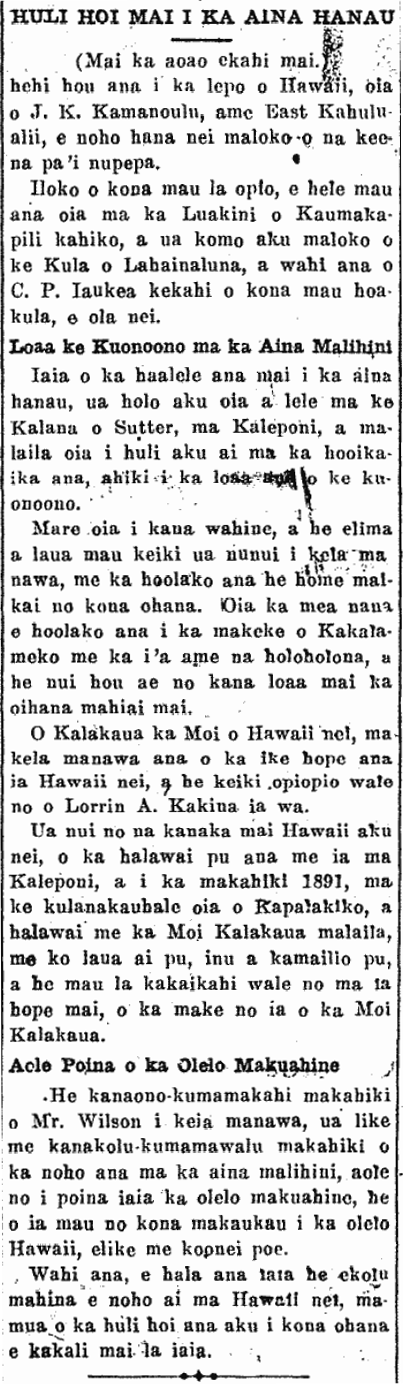
After leaving Honolulu thirty-eight years ago, that Hawaiian, John Bell Wilson is his name, returned to see once again his family and homeland while he was still in good health, on the steamship Matsonia this past Wednesday, filled with shock at how the places he was familiar with in his childhood had changed.

John Bell Wilson left Honolulu nei when he was a youngster of twenty-three years in age on a sailboat, because there were few steamships in his day, but it was upon a beautiful steamship that he returned to see the land of his birth and his friends, as he was shocked at the change of Honolulu from an almost nothing town which he left to a beautiful town which one admires.

His eyes met up with new sights of Honolulu and ethnicities which were unfamiliar to him; and as he travelled here and there, there were no friends who he knew in his youth, except for but a few who were still living which he met up with, those friends who he went around with in those days gone by.

Heard of the Death of His Mother

When John Bell Wilson returned to see his homeland, he had one big thing on his mind, that was meeting affectionately with his mother, who he thought was still living, but she was not, and this left him heartbroken.

Mr. Wilson was depressed at the death of his mother, being that from the time he left this land until his return, he did not write his mother; and when he asked his friends when he landed ashore about his mother, this was when he was told she had passed long ago to the other side, three years ago.

He went immediately to find the grave where his mother was laid to rest, and he planned to build a memorial to her, as a show of remembrance from a thoughtless child for his beloved mother.

Not Recognizing Honolulu

According to the words of Mr. Wilson after he saw the scenery unfamiliar to him, he could not recall the old Honolulu, because the town had changed so much from when he left, however he did have recollections of the major streets of town.

When he travelled about looking here and there, those scenes were not familiar to him, except for just a few people who went around with him and played with him in the days of his childhood. The small children he left behind were now very elderly and some of them had white hair.

Some of the familiar people who he saw on the first day he

(See page four.)

(Kuokoa, 2/5/1915, p. 1)

HULI HOI MAI IA KANAKA HAWAII E IKE HOU I KA AINA HANAU

Ka Nupepa Kuokoa, Buke LIII, Helu 6, Aoao 1. Feberuari 5, 1915.

RETURNED TO THE HOMELAND

(From page one.)

stepped once again on the soil of Hawaii, were J. K. Kamanoulu and East Kahulualii who work at the newspaper printing office.

In the days of his childhood, he went often to the old Kaumakapili Church, and he was enrolled at Lahainaluna School, and according to him, C. P. Iaukea is one of his friends who is still living.

Became Wealthy in a Foreign Land

When he left the land of his birth, he got off at Sutter County, California, and there he sought very hard until he became well off.

He married his wife, and they currently have five grown children, and he provided a good home for his family. He is the one who supplies the market of Sacramento with fish and meat, and he also makes profits from the farming industry.

Kalakaua was the King of Hawaii nei at the time he last saw Hawaii, and Lorrin A. Thurston was but a child.

There are many people from Hawaii who have met up with him in California, and in the year 1891, in the town of San Francisco, he met with King Kalakaua there, and they dined together, drank and talked, and just a few days after that was when King Kalakaua died.

Did Not Forget His Mother Tongue

Mr. Wilson is now sixty-one years old, so he was living thirty-eight years abroad, and he has not forgotten his native language, he is still fluent in Hawaiian, just as the people here are.

According to him, he will spend three months staying in Hawaii before returning to his family who await him.

(Kuokoa 2/5/1915, p. 4)

HULI HOI MAI I KA AINA HANAU

Ka Nupepa Kuokoa, Buke LIII, Helu 6, Aoao 4. Feberuari 5, 1915.

A view of the current state and the future of Hawaii, 1916.

What is to Become of Hawaii?

(Written for the Puuhonua.)

As time goes on, the Hawaiian People move backwards.

Why is this?

First. Because they are not united. Because of the lack of aloha for their own. Because they do not support each other. Because they do not help one another.

Second. Because of greed. Because of wastefulness. Because of the love of alcohol. Because of not being thrifty. For their not thinking of and neglecting  God.

It is clear that the Hawaiian people are shoved up against a wall; as the malihini white-skinned people come in droves to this land, so are the Hawaiians People pushed against a wall, they are new, but already they have settled themselves in; there are only but a few years left, you can count them on your fingers; the Hawaiians will have no Power in Government of their beloved land which God bestowed upon them.

Therefore, now is the time to stand firm, to think, and to come together, to give aloha to your own people, to be courageous, to economize, to be vigilant, to help each other, to go down on bended knee and ask God to free us from that whirlpool of naught, and to bring us to state of plenty.

Just as King Kauikeaouli proclaimed to the Hawaiian Nation, about kneeling down on bended knee and praising the Glorious Name of the Lord of hosts, to restore the Sovereignty of the Land (the Flag), that was stripped away by George Paulette, and what came about was that the flag was returned without ever being troubled again by Great Britain; so too with this.

For there is no time left to dally; we’ve lost our independence, we have no Power for Governmental Reform, as a result of our neglect, waste, and so forth; and our beloved Mother Tongue will be lost for all times. Hawaiians are being selected for positions under the Government.

Therefore, if you possess some aloha, some affection, some sentiment for the lifestyle of our People, now is the time; let us join in thought, in cooperation, like one great rope made of many strands, until we are able to pull massive things, like huge islands; that is what we need to do in these ongoing times.

ALOHA LAHUI [Love for the People].
Honolulu, July 5, 1916.

(Puuhonua, 7/7/1916, p. 4)

E Aha ia Ana Hawaii?

Ka Puuhonua, Buke III, Helu 25, Aoao 4. Iulai 7, 1916.

Place name list, 1883.

Here is the beginning of a list of place names found in  Saturday Press.

It is introduced like this:

“DICTIONARY OF HAWAIIAN LOCALITIES.

“[The names given below are Hawaiian geographical names—towns, districts, estates, mountains, valleys, bays, rivers, etc., which English readers are likely to come across in historical or newspaper reading. Translations are given when a satisfactory English rendering is possible. This dictionary will be continued as complete as possible.]”

(Saturday Press, 8/11/1883, p. 4)

More from Orramel Gulick, 1871.

LETTER FROM JAPAN.—Number [2].

Ke Alaula: Aloha oe:

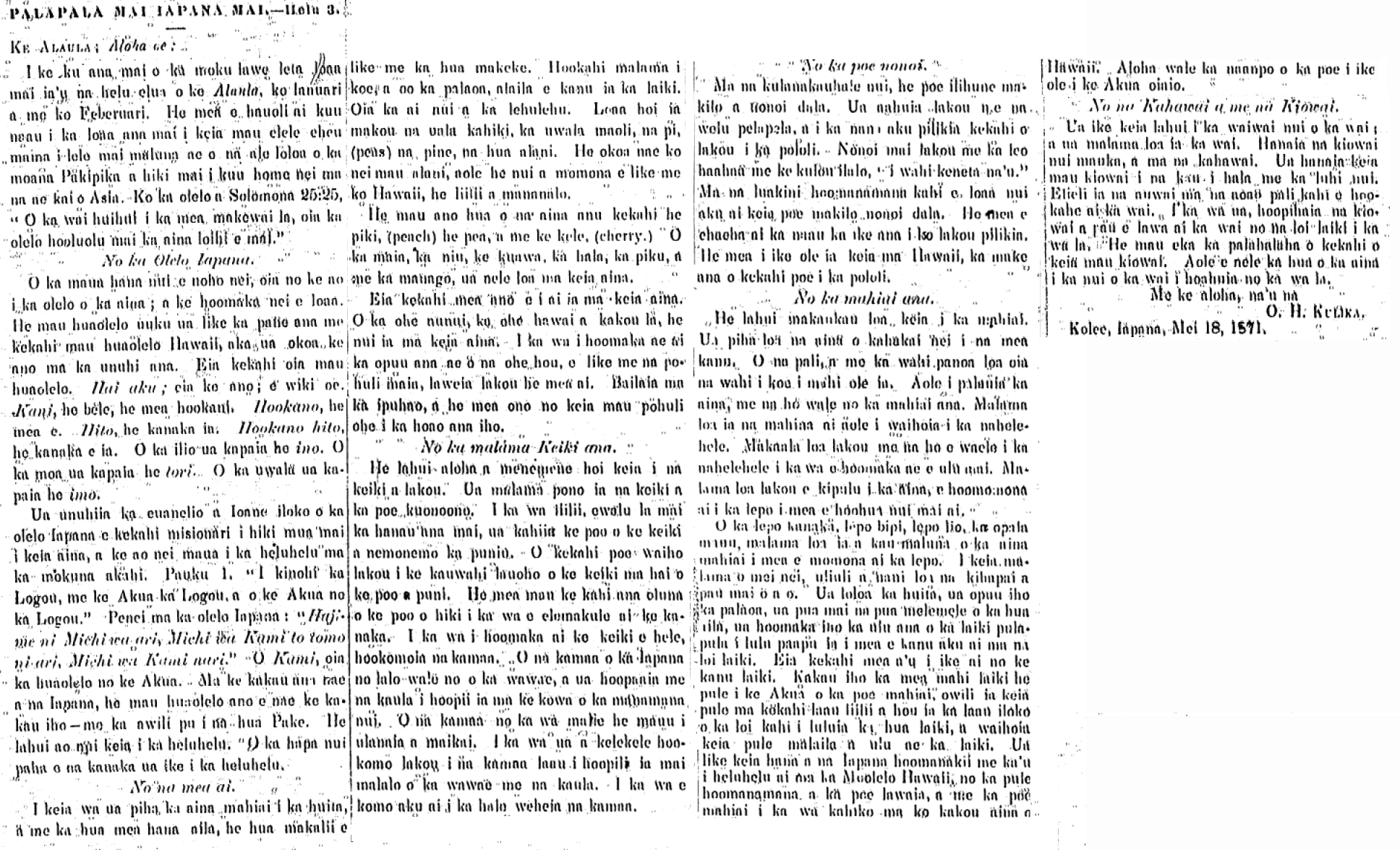
When the postal ship arrived, I received two issues of Ke Alaula, January’s and February’s. It made my heart happy, receiving these quick-winged messengers who flew above the great waves of the Pacific Ocean and reaching my home here on the shores of Asia. According to the words of Proverbs 25:25, “Like cold water to a weary soul is good news from a distant land.”

About the Japanese Language.

Our great task at hand is learning the language of this land; and we have begun. Some of the short words, the pronunciation is the same as in Hawaiian, but the translation is different. Here are some of those words. Hai aku [Hayaku]; this is the meaning; hurry up. Kani [Kane], a bell, something that sounds. Hookano [Hoka no], a different thing. Hito, a person. Hookano hito, a different person. Dogs are called ino [inu]. Chickens are called tori. Sweet potato is called imo.

The Gospel of John was translated into Japanese by a missionary who came to this land before, and we are learning to read from the first chapter. Chapter 1. “In the beginning was the Word, and the Word was with God, and the Word was God.” Here it is in Japanese: “Hajime ni Michi wa ari, Michi wa Kami to tomo ni ari, Michi wa Kami nari.” When they write it however, they write in strange letters mixed with Chinese characters. The people study reading intensely. Perhaps more than half of the people can read.

About the food.

At this time, the fields are filled with wheat and oil producing fruit, which is a tiny fruit like that of the black mustard. In a month, the wheat will be mature, then rice will be planted. That is the main staple of the people. We have potatoes, sweet potatoes, peas, beans [pine?], and oranges. Their oranges are different, they are not large and sweet like those of Hawaii, they are small and bland.

They also have fruit of cold lands: peaches, pears, and cherries. Bananas, coconuts, guavas, pandanus, figs, and mangoes are not to be found here.

Here is something strange eaten here. Large bamboo, what we call ohe hawai, is found in abundance here. When the new shoots begin to sprout, like a banana sprout, they harvest it to eat. It is boiled in a pot, and this bamboo shoot is good if it is tried.

On Child rearing.

These are a people who love and are compassionate towards their children. The children of the wealthy are well taken care of. When they are little, eight days after birth, the head of the child is shaved smooth. Some leave some hair circling the edge of the child’s head. It is customary to shave the top of the head until they are elderly. When the child begins to walk, they are fitted with sandals. The sandals of the Japanese are just under the feet and are fastened with with straps going up from between the space between the big toes. The sandals used for nice days are made of finely-woven grass. On rainy and muddy days, they wear wooden sandals fastened below the feet with straps. When they enter the house, the sandals are removed.

On beggars.

In large cities, there are poor who beg for money. They are clothed in rags, and when looking at them some of them seem to be suffering from starvation. They beg with soft voices and heads bowed down, “Please may I have a few cents.” These beggars are found in large numbers at places of worship. Seeing their suffering breaks one’s heart. This is something not seen in Hawaii, someone dying of starvation.

On farming.

This is a nation very skilled at farming. The lowlands are full of plants. The places left unfarmed are the cliffs and very dry areas. The land is not plowed, but is only worked with a hoe. Farms are well cared for, and are not left to go wild. They watch vigilantly and clear weeds with their hoe, when they begin to grow. They pay much attention to fertilizing the land to fortify the soil so that much fruit is produced.

Night soil, cow feces, horse feces, and waste vegetation are kept and placed on the farmland to fertilize the soil. In this month of May, the farms as far as the eye can see are green and beautiful. The wheat is long, and the ears of wheat are forming, the yellow flowers are blossomed, the rice sprouts are beginning to be grown, sprinkled out all crowded, to be planted in the rice paddies. Here is something else I’ve seen of rice cultivation. The rice farmer writes a prayer to the God of farmers, this prayer is rolled about a small stick, and the stick is then stuck into the paddy where the rice seeds are spread, and this prayer is left there until the rice grows. This custom by the idol-worshiping Japanese is like what I read in Hawaiian History about the prayers of the fishermen and farmers of the ancient times in our land of Hawaii. How pitiful is the ignorance of those who don’t know of the true God.

On Rivers and Reservoirs.

This nation knows the great value of water, and water is well cared for. Large reservoirs are made in the uplands, and by rivers. These reservoirs were made in times past with much labor. Canals are dug on sides of cliffs where water flows. In rainy periods, the reservoirs are filled to supply water to the rice paddies on dry periods. Some of these reservoirs are acres wide. The land will not lack fruit because of the great water reserved for dry periods.

With aloha, me,

O. H. Gulick.

Kobe, Japan, May 18, 1871.

(Alaula, 7/1871, p. 16)

PALAPALA MAI IAPANA MAI.

Ke Alaula, Buke VI, Helu 4, Aoao 16. Iulai, 1871.

On the term “heiau,” 1866.

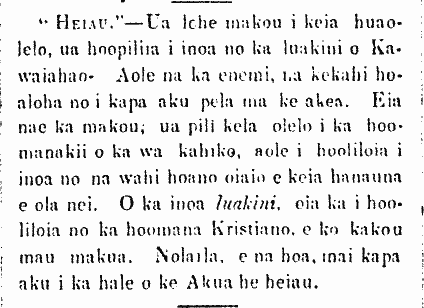
“HEIAU.”—We heard this word associated with the luakini [church] of Kawaiahao. It did not come from an “enemy,” but a friend called it that in public. But this is what we say: that word is associated with idol worship of the old days; it is not changed into a name referring to the truly sanctified places by this generation now living. The name luakini, that is what is transformed for the Christian religion by our fathers. Therefore, O Friends, do not call the house of God, a heiau.

(Kuokoa, 11/3/1866, p. 2)

"Heiau."

Nupepa Kuokoa, Buke V, Helu 44, Aoao 2. Novemaba 3, 1866.