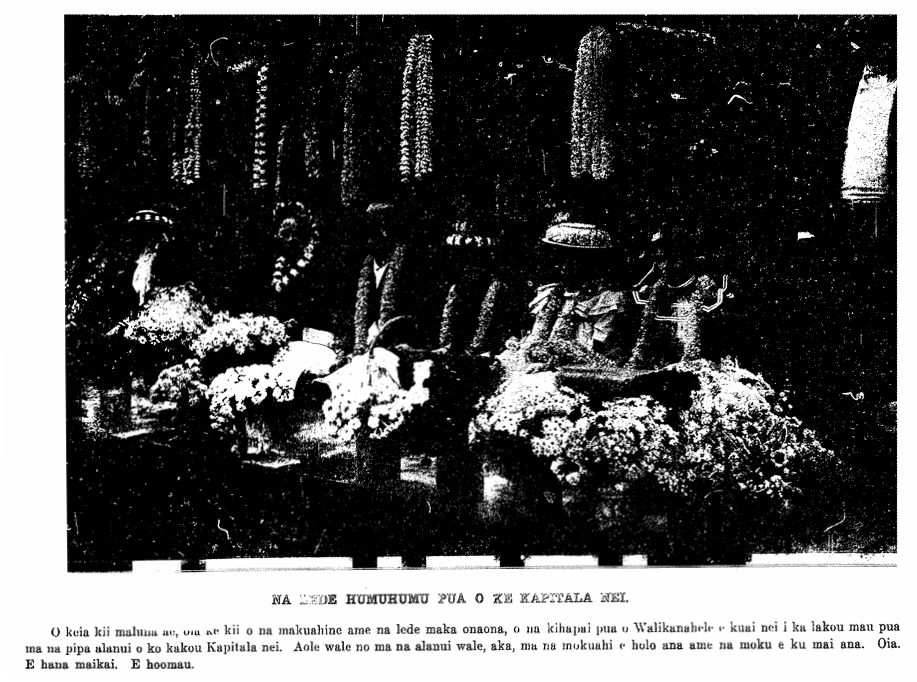
Lei makers of Honolulu, 1909.

LADY FLOWER SEWERS OF THIS CAPITAL.

The picture above is of the sweet-eyed mothers and ladies of the flower gardens of Walikanahele, selling their flowers on the street sides of our Capital. Not only on the streets, they go aboard the steamships and the ships that are docked. Yes. Do good work. Keep at it.

(Lanakila, 7/22/1909, p. 4)

NA LEDE HUMUHUMU PUA O KE KAPITALA NEI.

Ka Lanakila, Buke I, Helu 4, Aoao 4. Iulai 22, 1909.

On koa haole and uses, 1881.

[Found under: “NA HOOHIALAAI O KA MALU ULU O LELE.”]

Pertaining to the Koa [Haole] Tree—The “fruit” of this tree is a fruit that is not of interest, however the seeds are much desired. They are used to make lei for ladies, and the seed pod is thrown away; however, because of the keen investigation of the Hawaiian women, this fruit is woven into baskets, and now it is sewn into hats, which are truly fine looking; and the women are like flocks of birds as they all reach up with their hands picking the pods. The problem perhaps with these kinds of hats is that ones hair might fall out from ones head, because I remember horses; if the horses eat too much koa, their tails and manes fall out and all that is left is the kano! Perhaps however, it may be that only horses shed, and not people; Malakua folks don’t even own koa¹ hats, but they look like they are starting on the top.

¹The original reads “kou”, but it would make more sense here to be “koa”. Thank you to BK for helping me think out of the box.

[This is part of a column on news from Lahaina, written by its representative in the legislature, Samuel K. Kaihumua.

The Bernice Pauahi Bishop Museum has in their collection one of these haole koa hats. See here for further information. Thank you to MB for help with this information!]

(Ko Hawaii Pae Aina, 10/8/1881, p. 1)

No ka Laau Koa

Ko Hawaii Pae Aina, Buke IV, Helu 41, Aoao 1. Okatoba 8, 1881.

Queen Kapiolani, Mele, Maunakea, and a new site to check out, 1878/2013.

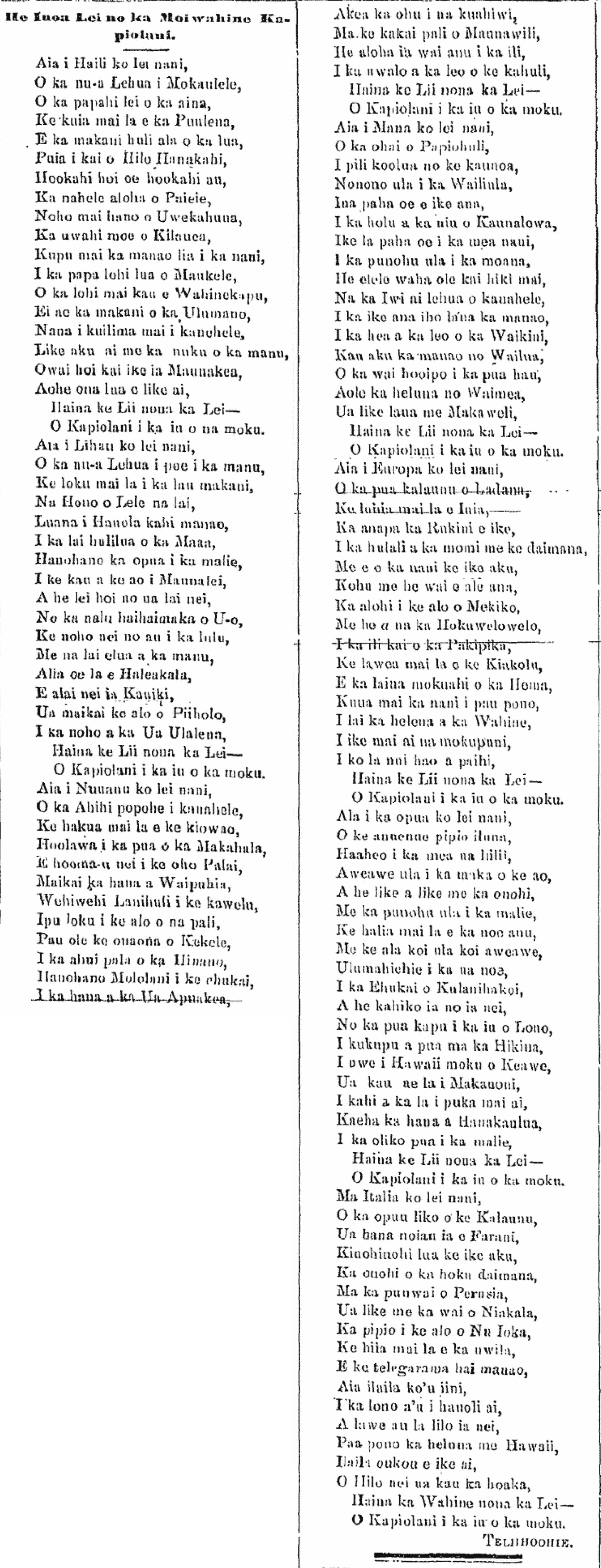
He Inoa Lei no ka Moiwahine Kapiolani.

Aia i Haili ko lei nani,
O ka nu-a Lehua i Mokaulele,
O ka papahi lei o ka aina,
Ke kuia mai la e ka Puulena,
E ka makani huli ala o ka lua,
Puia i kai o Hilo Hanakahi,
Hookahi hoi oe hookahi au,
Ka nahele aloha o Paieie,
Noho mai hano o Uwekahuna,
Ka uwahi moe o Kilauea,
Kupu mai ka manao lia i ka nani,
I ka papa lohi lua o Maukele,
O ka lohi mai kau e Wahinekapu,
Ei ae ka makani o ka Ulumano,
Nana i kuilima mai i kanehele,
Like aku ai me ka nuku o ka manu,
Owai hoi kai ike ia Maunakea,
Aohe ona lua e like ai,
Haina ke Lii nona ka Lei—
O Kapiolani i ka iu o na moku.

Aia i Lihau ko lei nani,
O ka nu-a Lehua i poe i ka manu,
Ke loku mai la i ka lau makani,
Na hono o Lele na lai,
Luana i Hauola kahi manao,
I ka lai hulilua o ka Maaa,
Hanohano ka opua i ka malie,
I ke kau a ke ao i Maunalei,
A he lei hoi no ua lai nei,
No ka nalu haihaimaka o U-o
Ke noho nei no au i ka lulu,
Me na lai elua a ka manu,
Alia oe la e Haleakala,
E alai nei ia Kauiki,
Ua maikai ke alo o Piiholo,
I ka noho a ka Ua Ulalena,
Haina ke Lii nona ka Lei—
O Kapiolani i ka iu o ka moku.

Aia i Nuuanu ko lei nani,
O ka Ahihi popohe i kanahele,
Ke hakua mai la e ke kiowao,
Hoolawa i ka pua o ka Makahala,
E hooma-u nei i ke oho Palai,
Maikai ka hana a Waipuhia,
Wehiwehi Lanihuli i ke kawelu,
Ipu loku i ke alo o na pali,
Pau ole ke onaona o Kekele,
I ka ahui pola o ka Hinano,
Hanohano Mololani i ke ehukai,
I ka hana a ka Ua Apuakea,
Akea ka ohu i na kuahiwi,
Ma ke kakai pali o Maunawili,
He aloha ia wai anu i ka ili,
I ka uwalo a ka leo o ke kahuli,
Haina ke Lii nona ka Lei—
O Kapiolani i ka iu o ka moku.

Aia i Mana ko lei nani,
O ka ohai o Papiohuli,
I pili koolua no ke kaunoa,
Nonono ula i ka Wailiula,
Ina paha oe e ike ana,
I ka holu a ka ulu o Kaunalewa,
Ike la paha oe i ka mea nani,
I ka punohu ula i ka moana,
He elele waha ole kai hiki mai,
Na ka Iwi ai lehua o kanahele,
I ka ike ana iho lana ka manao,
I ka hea a ka leo o ka Waikini,
Kau aku ka manao no Wailua,
O ka wai hooipo i ka pua hau,
Aole ka heluna no Waimea,
Ua like laua me Makaweli,
Haina ke Lii nona ka Lei—
O Kapiolani i ka iu o ka moku.

Aia i Europa ko lei nani,
O ka pua kalaunu o Ladana,
Ke luhia mai la e Inia,
Ka anapa ka Rukini e ike,
I ka hulali a ka momi me ke daimana,
Me e o ka nani ke ike aku,
Kohu me he wai e ale ana,
Ka alohi i ke alo o Mekiko,
Me he a na ka Hokuwelowelo,
I ka ili kai o ka Pakipika,
Ke lawea mai la e ke Kiakolu,
E ka laina mokuahi o ka Hema,
Kuua mai ka nai i pau pono,
I lai ka helena a ka Wahine,
I ike mai ai na mokupuni,
I ko la nui hao a paihi,
Haina ke Lii nona ka Lei—
O Kapiolani i ka iu o ka moku.

Ala i ka opua ko lei nani,
O ke anuenue pipio iluna,
Haaheo i ka mea na liilii,
Aweawe ula i ka maka o ke ao,
A he like a like me ka onohi,
Me ka punohu ula i ka malie,
Ke halia mai la e ka noe anu,
Me ke ala koi ula koi aweawe,
Ulumahiehie i ka ua noe,
I ka Ehukai o Kulanihakoi,
A he kahiko ia no ia nei,
No ka pua kapu i ka iu o Lono,
I kukupu a pua ma ka Hikina,
I uwe i Hawaii moku o Keawe,
Ua kau ae la i Makanoni,
I kahi a ka la i puka mai ai,
Kaeha ka hana a Hanakaulua,
I ka oliko pua i ka malie,
Haina ke Lii nona ka Lei—
O Kapiolani i ka iu o ka moku.

Ma Italia ko lei nani,
O ka opuu liko o ke Kalaunu,
Ua hana noiau ia e Farani,
Kinohinohi lua ke ike aku,
Ka onohi o ka hoku daimana,
Ma ka puuwai o Perusia,
Ua like me ka wai o Niakala,
Ka pipio i ke alo o Nu Ioka,
Ke hiia mai la e ka uwila,
E ke telegarama hai manao,
Aia ilaila ko’u iini,
I ka lono a’u i hauoli ai,
A lawe au la lilo ia nei,
Paa pono ka helua me Hawaii,
Ilaila oukou e ike ai,
O Hilo nei ua kau ka hoaka,
Haina ka Wahine nona ka Lei—
O Kapiolani i ka iu o ka moku.

Teliihoohie.

[I was reminded of this set of lei chants for Queen Kapiolani by a post on a relatively new site with information about Hawaii past and present. Check out the recent post on Maunakea and much more by Nanea Armstrong Wassel, right here:

http://instagram.com/naneaarmstrongwassel

This mele is also printed in the very next issue of Ko Hawaii Pae Aina, 10/12/1878, p. 4, with some variation.]

(Ko Hawaii Pae Aina, 10/5/1878, p. 4)
He Inoa Lei no ka Moiwahine Kapiolani.

Ko Hawaii Pae Aina, Buke I, Helu 40, Aoao 4. Okatoba 5, 1878.

Niihau folks visiting Kauai and a mele for the famed Niihau shell lei , 1940.

[Found under: “Bits of News from Kauai”]

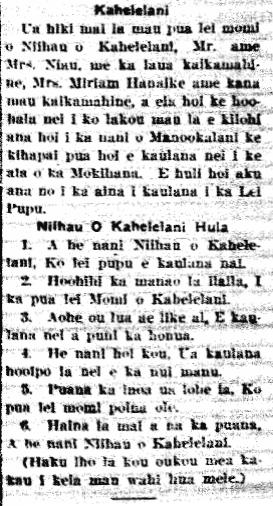
Kahelelani

Those lei blossoms, the momi of Niihau of Kahelelani, Mr. and Mrs. Niau, and their daughter Mrs. Miriam Hanaike and her daughters, have arrived, and they are spending their days gazing at the beauty of Manookalani [Kauai], the flower garden famous for the fragrance of Mokihana. They will return to the land famous for the Shell Lei [Lei Pupu].

Niihau O Kahelelani Hula

1. A he nani Niihau o Kahelelani, Ko lei pupu e kaulana nei.

2. Hoohihi ka manao la ilaila, I ka pua lei Momi o Kahelelani.

3. Aohe ou lua ae like ai, E kaulana nei a puni ka honua.

4. He nani hoi kou, Ua kaulana hooipo ia nei e ka nui manu.

5. Puana ka inoa ua lohe ia, Ko pua lei momi poina ole.

6. Haina ia mai a na ka puana, A he nani Niihau o Kahelelani.

(Your writer has composed these lines of poetry.)

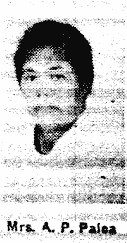
[Abbie P. Palea had a regular column in Hoku o Hawaii, writing about various happenings on Kauai. She often wrote in with poetic compositions by her own hand. Here is just one of them. Although you will find credit given to Joseph Kelly (Keʻale), at the Bishop Museum’s Niihau Shell Lei Exhibit going on now (see it while you can!), i would suggest that because there seems to be no counter claims in later newspapers to Palea’s statement, that “Niihau o Kahelelani Hula” was indeed written by her.

There is so much to be learned from the old Hawaiian-Language Newspapers!]

(Hoku o Hawaii, 8/28/1940, p. 1)

Hoku o Hawaii, Volume XXXV, Number 18, Page 1. Aukake 28, 1940.

Mrs. A. P. Palea

Kahelelani

Ka Hoku o Hawaii, Volume XXXV, Number 18, Page 1. Aukake 28, 1940.

Stunning Niihau Shell Lei Exhibit at the Bishop Museum, 2013.

Ni‘ihau Shell Lei

October 26, 2013 – January 27, 2014
Ni'ihau Shell LeiA private collection of over 60 stunning and pristine lei will be featured in “Ni‘ihau Shell Lei: Ocean Origins, Living Traditions” examines the science behind Ni‘ihau shells, as well as its manufacturing history and the master craftsman who make them.

This exhibit will be showcased in the Bishop Museum’s Long Gallery.

Mahalo to our sponsors:

  • Rapozo Kama‘aina Fund of the Hawai‘i Community Foundation
  • Hiroaki Elaine & Lawrence Kono Foundation
  • Hawaiian Malacological Society

More on Liliu’s 73rd birthday celebration, 1911.

BIRTHDAY OF LILIUOKALANI

Honolulu, Sept. 2—The commemoration of Queen Liliuokalani’s birthday was held today, and according to what the Queen said to some of her friends:

“This is my seventy-third birthday, and i am in good health; i have left behind the disturbing things of this world in which we live, and have surrounded myself with many friends.”

The Queen’s health is fine indeed, and in the morning, the Band of the County [? Royal Hawaiian Band] arrived to play while she dined on breakfast until 10 a. m. Several associations arrived to giver their congratulations to the Alii; and at 11 o’clock, the procession of haole friends to see the Alii began, and this perhaps is the grandest royal audiences of haole giving their congratulations to the Queen.

The Queen was attired in a beautiful garments fitting of her stature, and attended by the Princess Kalanianaole and Mrs. Irene Holloway and Mrs. C. P. Iaukea. The place where the Queen sat was surrounded by many different kahili, and it was her steward, the Honorable C. P. Iaukea who introduced the many strangers. The Alii, the Queen, met each one who came to visit her and she placed a kind smile upon her Royal visage. When the writer for the Hoku [this newspaper, Hoku o Hawaii] appeared before the Alii, she immediately asked, “How are the famous lehua of the land, the lehua of Hilo; are the famous blossoms of the land still beautiful?”

The Queen wore a white lehua [lehua puakea] lei from Hilo, and on her Royal countenance was happiness. On that morning of her birthday, she presented the water leaping land of Waikahalulu as a Park for the public, and it will be administered for the benefit of the people.

The Hoku o Hawaii prays for the long life of the beloved Queen of Hawaii, and although she has no throne upon to rule, hers is the throne of aloha within the hearts of her loving people. May the Queen live in God.

[Unfortunately the issues of Hoku o Hawaii from 1906 to the early part of 1917 (including this article) are not available online! The more people talk about the importance of the information in the Hawaiian-Language Newspapers and the need to rescan those newspapers clearly and make them accurately searchable, the more chance there will be funding for it!]

(Hoku o Hawaii, 9/7/1911, p. 2)

LA HANAU O LILIUOKALANI.

Ka Hoku o Hawaii, Buke 6, Helu 18, Aoao 2. Sept. 7, 1911.

More on the California Midwinter International Expo, 1894.

More Exhibits.

The Hawaiian Exposition Company will send another large shipment of exhibits to the Midwinter Fair by the Australia next Saturday. Among the things to be sent are native mats and tapa, poi boards and pounders, surf-boards, etc. Apu, the expert surf-rider from Niihau, will be among the twenty-five natives who will go up on the Australia. Mr. and Mrs. J. Ailau will take with them ten native women, who will make leis, fans and hats at the Fair.

(Hawaiian Gazette, 1/5/1894, p. 6)

More Exhibits.

Hawaiian Gazette, Volume XXIX, Number 2, Page 6. January 5, 1894.

Mild hula ku’i and California Midwinter International Exposition, 1894.

DEPARTING FRIENDS.

The S. S. Australia Carries the Hawaiian Exhibit.

The departure of the S. S. Australia for the Coast was delayed until nearly 1 o’clock on account of the late arrival at the Oceanic wharf of articles to be exhibited at the Midwinter Fair in San Francisco, which has already opened. Among the numerous exhibits to be seen on the steamer were boxes of large and small coffee plants, boxes of large and small tea trees, brought from Hamakua, two wooden tanks containing different varieties of fish, including eels, a small shark, squid and crabs. The last two species were in one tank, and it is believed there will be a circus started between them when the aquarium is shaken up. There were two monster bullocks in stalls lashed near the stern. Kapahee, the famous surf rider, with his board, his wife and son, three hula girls and four other natives comprise part of the Hawaiian exhibit. Kapahee will give exhibitions in surf riding near the Cliff House, and if the water is clear he will dive and kill fish with a spear he has taken with him. He will also ride the bullocks. The girls under the management of D. Kaahanui will dance a mild hula-kui, while the others will assist about the grounds. Mr. L. A. Thurston superintends the exhibit.

Mrs. J. K. Ailau will make a first-class exhibition of Hawaiian curios at the fair in connection with the Hawaiian exhibit. She has taken with her four young ladies to act as saleswomen.

Messrs. Samuel Parker and A. P. Peterson were passengers on the Australia for the Coast on business bent.

Mr. W. P. Boyd, U. S. Vice-Consul-General, and wife were also passengers. They have gone to spend their honeymoon in the States. Both were gaily bedecked with leis and evergreens.

Miss Kate Cornwell, H. A. Widemann, Jr., F. M. Hatch and L. A. Thurston also left.

Mrs. and Miss Gerber, with their friend Miss A. Cahill, who lately returned from the Volcano, were among the departing throng. Mrs. Gerber and daughter left for home after a short and pleasant vacation on the islands.

Nearly all the passengers were covered with Hawaii’s tropical adieu, viz., wreaths and flowers. The P. G. band played previous and up to the departing of the steamer, and the scene on the wharf was one of bustle and excitement.

(Daily Bulletin, 1/6/1894, p. 2)

DEPARTING FRIENDS.

The Daily Bulletin, Volume VII, Number 924, Page 2. January 6, 1894.

The first Kamehameha Day out in the country, continued, continued, 1872.

At Kailua, Kona.

“Here is what is new here in the land of calm. The day of Kamehameha I was celebrated grandly in Kailua; this is the biggest day I’ve witnessed. The chiefess [probably Keelikolani, governess of Hawaii Island], prepared for the activities of the day as she saw fit. The grounds of Hulihee was filled with old men and women, and the sands were packed with visitors; and this is what was reenacted from the times of Kamehameha I:

The women wore white, with lei of whale ivory [palaoa] around their necks, and bracelets of palaoa on their wrists. There were two torches lit at 12 midnight and taken to where his body lay; and there they stood until daylight, until the procession began over the sands of Niumalu until where his body was placed; there were two torches of Hopili and Makainai who carried them before the procession, and following was the chiefess, and so forth. Makanoanoa gave a speech and after it was over, the procession returned to the lanai, and Makanoanoa spoke again assisted by Hopili. The chiefess was the last to speak.”

[This is the last part of the article describing the celebration of the first Kamehameha Day in Lahaina, Wailuku, and Kailua in Kona.]

The first Kamehameha Day out in the country, 1872.

Day Commemorating Kamehameha I.

According to the news we received, the day the nation remembers Kamehameha I was preciously observed in different places of the nation, and this is good news for the very beginning of this day. Here below you will find what took place in various places, and here it is:

In Lahaina

“The activities of the day for the commemoration of Kamehameha I began at 9:12 A. M. with G. W. Pehu as the Chairman of the day’s events.”

A prayer was given by Hanunu. Chairman G. W. Pehu stood and explained to the crowd. This is the day that we were told in the announcements in our newspapers that this day is one that we are to commemorate, but not just on this day and that’s it; no, we are to continue this until the end, for he is the pillar of our world, the one who cleared away the thorny wilderness of this archipelago and made it into a fine garden, and it for him which we have pride: the wondrous one, the victor of victors, the one who shorn off the roughness  of these islands and smoothed it out making it a peaceful nation.

The one for whom we are starting off with this very first day, for whom we are celebrating for all times, with humble hearts, modesty, and aloha. He is our famed conqueror across the whole world. He is called the Napoleon of the Pacific Ocean, for his dexterity and his bravery and fearlessness; the victor of victors in battle for these 12 islands. He is the 1st of the Kamehamehas, who has gone, leaving our sacred offspring, King Kapuaiwa, Aliiolani, now living amongst us, the fifth of the Kamehamehas, one of his blossoms now appears clearly before us. And we proclaim together O Crowd gathered here at the church of Wainee, the House made by his royal ancestors who are passed on, while some of their descendants live on, along with the one who occupies the throne today.

For we now say in unison with aloha and humble hearts, May He Live! May the King Live in God!!

Therefore O People, let us keep the activities of the day well under control.

The first event. The singing of the Choir of Wainee, the hymn, “He Akua Hemolele.” There was a prayer by Hanunu, the pastor of the day. The Choir sang once more, “Ke Akua Mana Mau.”

The old ladies stood, along with the old men; some of the old men were right below the pulpit of Wainee, decked out in  layers of pa’upa’u kapa, and sang memorized songs of old. Like the Second Alphabet [Pi-a-pa-lua], sung like this: “Aha, Ahi, Aho, Ahu,” and so forth. Kenoi was the leader along with A. Makekau; this came to an end.

A. Makekau called out once more to this group of oldsters, with the Pi-a-pa-lua, exhorting in this manner:

“Don’t care after wooden idols,
Let us turn to the ever-living ruler,
It is good to glorify the ever-living God,
This, according to Iolani, the King of Hawaii.”

With this singing of the old ones, there was not a single one there who did not feel gratitude for the work done in times past. And after this was done, the makua then sang the Pi-a-pa-lua.

When the speaker, J. K. Unauna, stood, he was wearing a Large Whale Ivory Lei [Palaoa], which curved at the front like a banana of Kaea whose blossom containers [okai] are twisted. By the speech, of the speaker, the audience was immensely pleased, like a fish caught on the hook, weaving this way and that.

He spoke of the different famous feats of the Chief Kamehameha I. The audience was filled with thanks and appreciation. And, at the end of the speech of the speaker, the audience stomped their feet, like these lines of mele:

“I have nothing but praise for the beauty of Aipo,
Shuddering at the cold of Hauailiki”

[“Aole a’u mea mahalo ole i ka nani o Aipo,
E li ana ka io i ke anu o Hauailiki.”]

And when the audience calmed down, the voices of the men and women burst forth, singing the national anthem [mele lahui] composed by one of our chiefly children, Lilia K. Dominis. To witness this, it was as if the current was drawing to Alae [e ko ana ke au i Alae].

The program was over, and the audience was released, and the went to the other festivities at Keawaiki, which was teeming with people; there were so many people seen at the activities of the white ones of Lahaina nei. At the hour of 11 A. M., the games began:

First event, boat race, won by the boat of A. C. Smith. Event 2, Mule race, won by Castle Jr.’s mule. Event three, sack race, won by Arika of Kaanapali. Event 4, swimming race, won by Poepoe. Event 6, pig chase [alualu puaa], which was won by him. Event 7, tin can filled with molasses and you try to get the dollar inside using your tongue; it was miserable to watch. Won by [?Nahioihi]. Event 8, a wooden pole of 6 feet tall; the money ($2.50) atop the pole was not gotten.

[This article continues with scenes from Wailuku and Kailua, Kona. Look for the continuation at a later date. The image online is very hard to read. I can’t wait for the day when all the newspapers are rescanned clearly!]

(Au Okoa, 6/20/1872, p. 3)

La Hoomanao Kamehameha I.

Ke Au Okoa, Buke VIII, Helu 10, Aoao 3. Iune 20, 1872.