On kake and Kauikeaouli and Kalama and Kaahumanu, 1896.

[Found under: “NA WAHI PANA A KAULANA O HONOLULU, OAHU NEI, I UHIIA I KA LEPO A NALOWALE LOA HOI I KEIA AU HOU.”]

KAHALEULUHE

5.—Kahaleuluhe was where the Anglican Church stands today, and its stature is hard to picture today. This was a Royal residence during the time of Kamehameha III, the kindhearted Alii who was shown affection through words of kake, because of the fear Kalama had lest she be killed by Kaahumanu and Kinau, Continue reading

Queen Liliuokalani is arrested: her crime—having aloha for her lahui, 1895.

Mai Wakinekona a Iolani Hale.

Ia’u e nanea ana ma Wakinekona,
Pa-e ana ka leo nahenahe,
Auhea wale ana oe e Kalani,
Ei ae na hauna o ke Aupuni,
Nana e hanu mai pau i ka ikea,
Na mea nui, na mea liilii,
O ka hana ia a Waipa,
Kapena makai o ka Pi Gi,
Eia ko hewa la e Kalani,
No kou aloha i ka lahui,
Na ke kaa pio Hope Ilamuku,
I hii ia Kalani i Halealii,
Hookahi puana kou puuwai,
No ka poe i aloha i ka aina. Continue reading

Words of advice from a concerned Hawaiian, 1944.

SINGING HAWAIIAN SONGS

Editor The Advertiser:

As a Hawaiian I enjoy listening to the sweet Hawaiian music on my radio from 7:30 a.m. to midnight. But I agree with many other Hawaiians who I have heard complain about our young peoples singing nowadays. Perhaps there might be a way to help these young generation and also the future generations keep up the proper way of singing our beloved Hawaiian songs and not to murder them or change them as they are being changed by jazzing or perhaps boogle them. Why not keep them as the composer intended to express their feelings. For example the song, “Kahuahuai.” It is not a war chant. It’s a love song telling of their love for each other and how they had weathered the cold together among the fragranted ferns, etc. Continue reading

Visit to Ahuimanu College and impressions of Joseph Mokuohai Poepoe, 1873.

Ahuimanu College.

During our vacation, our pleasant diversion was a visit to the other side of the island to attend the examination of the Catholic Seminary, known as Ahuimanu College. The trip to that point takes us over celebrated Pali, the pass and precipice which afford such a noble view of the lovely landscape on the northeaster side of the island. We went in state to the Pali with a four in hand, driven by mine host of our Hotel, who is as good a whip as he is a caterer. We partook of a dejeuner upon a knoll which overlooks the enchanting view; and then descended on foot the steep stairway of the mountain. The slope would not be so very difficult if the constant winds driving through this gorge of the mountain did not compel, sometimes, gentlemen to hold on to their hats, and ladies to hats and skirts, with both hands. The cavern of the winds seems situated hereabout, and Eolus and Boreas try to crack their cheeks in blowing on every passer-by. At the foot of the Pali we found friend Doiron awaiting us with a good vehicle and a stout horse, and having also the assistance of two boys on horseback, who attached their lariats to the shafts of our buggy, to help over the hills, away we went, a merry company of six in a trap made to carry four, and at noon on the third instant we arrived at the lovely retreat of Ahuimanu.

Father Lieven, the Principal, a stout hearty gentleman, of about forty years of age, gave us a welcome; which was heightened by meeting his coadjutor Father McGinniss, a genial son of the Isle of Faith. In the course of the day, the Venerable Bishop Monseigneur Maigret, accompanied by Father Aubert of Lahaina, arrived; and subsequently we had the honor to meet for the first time Father Damien, our hero who has devoted his life to the lepers. And soon, with this intelligent, cultivated and chatty company of Reverends, we found ourselves very pleasantly at home.

Continue reading

Ikeia Kau na Wahine, he Kau ka makani, 1883.

[Found with: “KE ALII KIEKIE RUTH KEELIKOLANI: UA HALA! UA NALO!!”]

Ikeia Kau na Wahine, he Kau ka makani,
He umauma i pa ia e ka Moae,
E ka unulau, o Makounulau,
Ina aku no la i Unulau,
Ka wahine kaili pua o Paiahaa,
Hahai, alualu, puahala,
O Kamilo, pae kanaka e—— Continue reading

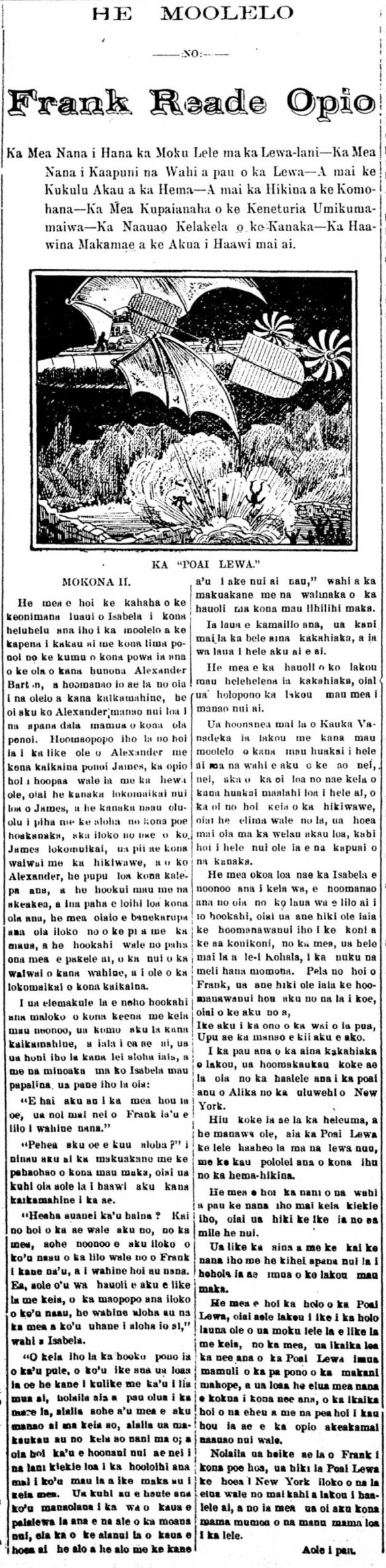
Lines of familiar mele used in stories to elicit emotion, 1895.

[Found in: “HE MOOLELO NO Frank Reade Opio”]

Ike aku i ka ono o ka wai o ia pua,
Upu ae ka manao e kii aku e ako.

[I know of the sweet nectar of that flower,
The desire wells up to go and pluck it.]

[The use of lines of well-known mele like from Thomas Linsey’s “Honesakala” above is a feature of Hawaiian storytelling. They elicit a feeling or mood to help the flow of the moolelo. This particular translation of  one of the Frank Reade Jr. stories ran in Hawaiian in the Kuokoa from 5/25/1895 to 11/9/1895 under the title “He Moolelo no Frank Reade Opio: Ka Mea Nana i Hana ka Moku Lele ma ka Lewa-lani…”]

(Kuokoa, 8/17/1895, p. 1)

Kuokoa_8_17_1895_1.png

Ka Nupepa Kuokoa, Buke XXXIV, Helu 33, Aoao 1. Augate 17, 1895.

Sigh, 2018.

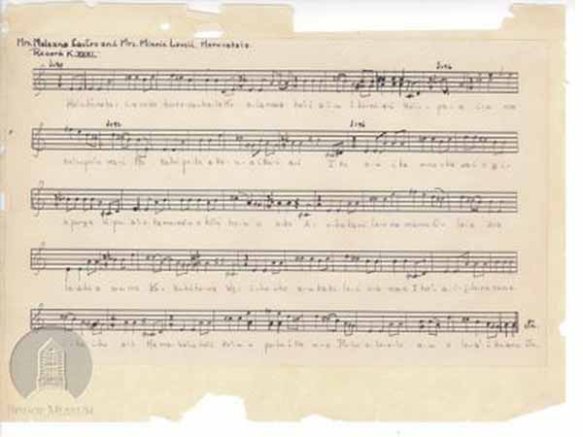
Did you see last week Monday’s post on Welo Hou? It is funny how mele written by someone from a long time ago can stir up personal memories, both good and bad. Thomas Lindsey’s “Honesakala” is timeless. Does anyone know which Thomas Lindsey this was.

Click the sheet music below to check it out:

MS_SC_Roberts_2_2_Honesakala_BMWM-1-400x300.jpg

MS SC Roberts 2.2, p. 3. “Honesakala”