LEPERS DENOUNCE WILCOX
Appeal to Voters to Elect Kuhio.
DECLARE DELEGATE NOT HAWAIIAN
Say His Act is Not That of a Friend of the People
Once more have the lepers at Kalaupapa spoken, and their voice is even stronger against Wilcox and his plans for their future than on the occasion of their resolutions which were laid before the Senatorial Commission.
The latest meeting of the lepers was held on Wednesday last at Beretania Hall, at the settlement, and the gathering was a very large one. The speakers denounced the attempts of Wilcox to transfer them bodily to the Federal government for control, and as well they refused to listen to any explanations as to his meaning when he urges such transfer. The majority of the speakers predicted a landslide for Prince Kuhio and the Republican ticket. It was said that the lepers would now begin to lay before their friends all over the islands their fears for the future in the even of the reelection of Wilcox,and would also appeal to their people to prevent such a happening.
The resolutions which were adopted and which have been sent to prominent men on other islands as well as to Honolulu, are as follows:
An appeal to the Hawaiian people from the Leper Settlement at Kalaupapa,Molokai.
To the Hawaiian people in general; listen and consider the appeal of your unfortunates.
We, your unfortunate relatives and friends living in the Settlement where sorrow and woes abound,separated from you on account of the sickness that befell us, wish to appeal to you. You all know that the man we once trusted and in whom we put our faith, and whom we elected as our Delegate to Washington, has returned evil for good to us poor unfortunates, and to the people in general by introducing a bill in Congress which calls for the transferring of the care and maintenance of the Leper Settlement to the Federal government.
Such action by the Delegate without referring the matter to us, the unfortunate lepers, is one of the most dirty, cruel and low doings of a man toward his fellow men.
You must not think that by such giving over of our care to a stranger we would be benefited. Far from it. A stranger would not be painstaking, and moreover, have no love for the unfortunate Hawaiians, and if such a bill be passed our troubles and sorrows will be greater than we can bear.
We are willing to bear our own woes, sorrows and our heavily laden burdens cheerfully, if by so doing you will be saved, but has the intention of pitting sorrows upon sorrow any traces of love of the Delegate for us? Or is it true, then, that you also have followed the acts of the Delegate and have joined with him in heaping sorrow threefold upon us?
R. W. Wilcox stated before the Senatorial Commission “that the majority of the Hawaiian people have shown their willingness to give over our care to the Federal government.”
Is there any truth in this statement? Is it also ture that there are Hawaiians besides Wilcox who wish to put us in an oven of fire and to increase our sorrows a hundredfold? We will answer and say “no.”
Has the bond of love between husband and wife, father and children, family to family, fellowman to man, been put asunder? We think it has not, and right here we denounce Wilcox and say that he is not a true Hawaiian.
We have an old saying which goes: “See to your fellowman first, then to your dog.” It is not the same with Wilcox. He has given his aloha to a dog rather than to us.
We have sent a petition signed by 750…
(PCA, 10/20/1902, p. 1)

Pacific Commercial Advertiser, Volume XXXV, Number 6303, Page 1. October 20, 1902.
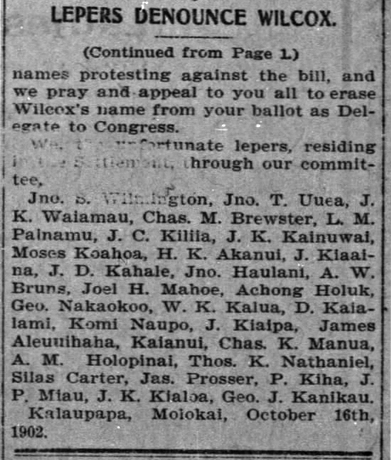
…names protesting against the bill, and we pray and appeal to you all to erase Wilcox’s name from your ballot as Delegate to Congress.
We the unfortunate lepers, residing in the Settlement, through our committee,
John S. Wilmington, John T. Unea, J. K. Waiamau, Charles M. Brewster, L. M. Painamu, J. C. Kiliia, J. K. Kainuwai, Moses Koahoa, H. K. Akanui, J. Kiaaina, J. D. Kahale, John Haulani, A. W. Bruns, Joel H. Mahoe, Achong Holuk, George Nakaokoo, W. K. Kalua, D. Kaialamni, Komi Naupo, J. Kiaipa, James Alenuihaha, Jaianui, Chalres K. Manua, A. M. Holopinai, Thomas K. Nathaniel, Silas Carter, James Prosser, P. Kiha, J. P. Miau, J. K. Kialoa, George J. Kanikau.
Kalaupapa, Molokai, October 16th, 1902.
(PCA, 10/20/1902, p. 4)
Pacific Commercial Advertiser, Volume XXXV, Number 6303, Page 4. October 20, 1902.
 nupepa