Beginnings of Mother’s Day in Hawaii nei, 1913.

MOTHER’S DAY.

It would appear that this is the third or second year perhaps here in Honolulu in which we have remembered mothers on this past Sunday; this is foreign to us, but it will maybe become something regular in the future, like the other foreign observances that have come amongst us.

While our mothers are still living is the time that they should be remembered, and not just for that day that was set aside, but we believe that we are indebted for all that our mother’s put up with for our sake, and we invite each and everyone to give in all manner their love to their mothers. Continue reading

More on Emma Nakuina, W. T. Brigham, and the Bishop Museum, 1897.

NOT COURTEOUS

Treatment of Ladies at Bishop Museum.

An Open Protest to the Trustees of the Kamehameha Schools.

MR. EDITOR:—The undersigned with three other ladies, Hawaiians of the highest respectabily, standing and position, with five little children, were sitting this morning in the shade of the Kamehameha Museum enjoying the fine showing made by the naval men drilling on the College campus. Chairs had been offered by a Kamehameha graduate, he placing them on the grass plot adjoining the Museum. After a little while, Mr. Brigham, the curator of the Museum, drove by within a few feet of us. He scowled most savagely at us. In a few minutes a Portuguese workman came to order us away from the place.

As it has invariably been the custom to throw the College grounds open to the public when any sort of a public or semi-public show is taking place within its precincts, we did not pay any attention to his orders, thinking it a piece of officiousness on the part of an ignorant person, and the man went away. After a while the man re-appeared and ordered us off again, saying he was acting by Brigham’s orders, and to use force if necessary. He took hold of the chair of the wife of a prominent official and tipped it partly over. She sprang up to avoid a fall, as did two other ladies. I, being at the very corner of the building and a little in advance of the others did not perceive the man until he had taken hold of my chair and had partly spilled me on my knee. I turned around to protest, when he grabbed my arm and pulled me out of my chair, saying “you get out of this, those are my orders from Mr. Brigham. If you don’t go yourself, I make you go. Mr. Brigham don’t allow any one to get on this grass.”

There were quite a number of carriages standing around, occupied by spectators of the drill.

The actions of the Portuguese were so rough and insulting that the attention of quite a number were attracted to our forcible ejectment. Continue reading

Emma Metcalf Nakuina affronted, 1897.

Contemptuous Act Against Women.

Being that the parading was being held in the uplands of the Kamehameha School for Boys, on the plains of Kaiwiula, Mrs. Emma Metcalf Nakuina went attended by Mrs. R. W. Maea [Mrs. Rudolph William Meyer] of Kalae, Molokai and two of her daughters, Mrs. Mutch and Mrs. Hitchcock. They went and sat in a calm and shady place at the Bishop Museum, atop a area covered with manienie grass, and the son of the one named first, F. W. Kahapula Beckley, brought them chairs. Continue reading

The Bernice Pauahi Bishop Museum, 1911.

THE MUSEUM

On the 2nd of October, the museum mauka of the Kamehameha School for Boys will be opened, and everyone will be able to tour it without payment during the time allowed.

In the museum there are many things that Hawaiians have not seen, and it is hoped that Hawaiians will see what is collected in this building.

From the time this was built at Kamehameha School until today, there have not been many Hawaiians who have come to tour, but it is important for the kamaaina to see these things before the malihini get a chance to see first of what they only have heard of before visiting Hawaii nei.

In this issue of the Kuokoa is an announcement by the trustees of the Kamehameha School explaining fully the days on which the museum will be opened to the public, along with the days that it is restricted and cannot be visited by all people.

(Kuokoa, 9/8/1911, p. 8)


KA HALE HOIKEIKE O NA MEA KAHIKO

Ka Nupepa Kuokoa, Buke XLVII, Helu 36, Aoao 8. Sepatemaba 8, 1911.

Hula, mele, and tradition, 1928.

IN SEARCH OF HULA, OLIOLI HOAEAE, AND HAWAIIAN SONGS

There are some people here trying to find once more the hula, chants, and songs of old Hawaii.

Some people believe that it would be good to perpetuate the hula and olioli hoaeae of the the old. Some believe strongly that it is a waste of time or that type of endeavor would be old fashioned [olopaikini].

Some people think that it is very good for Hawaiian things to be fostered, and they are attempting to put an end to improper things like the kind of hula olapa of some people done in public. Continue reading

Hawaiians slighted? 1914.

THE CONTEMPT FOR HAWAIIANS IS CLEAR

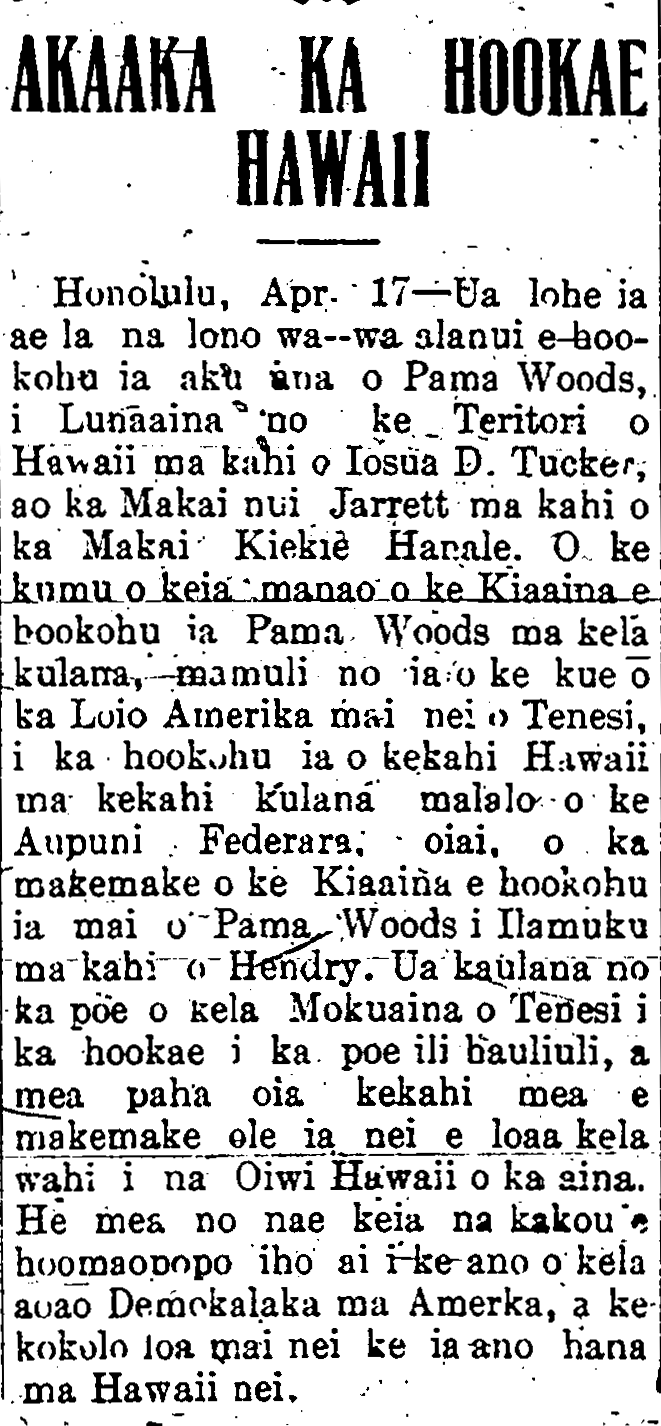
Honolulu, Apr. 17—We hear from the word that is buzzing on the streets that Palmer Woods [Pama Woods] has been selected as Land Commissioner [Lunaaina] for the Territory of Hawaii in place of Joshua D. Tucker [Iosua D. Tucker], and Sheriff Jarrett [Makai nui Jarrett] in place of High Sheriff Henry [Makai Kiekie Hanale]. The reason for this decision by the Governor to select Palmer Woods for this position was because of the objection by the United States Attorney from Tennessee to select a Hawaiian in a position under the Federal Government, although the Governor wanted to appoint Palmer Woods as Marshall [Ilamuku] in place of Hendry. The people of the state of Tennessee are infamous for their contempt of people of dark skin, and perhaps that is one reason that place does not desire Native Hawaiians. Through this we should recognize the nature of the Democrats in America, as this sort of action creeps all the way here to Hawaii nei.

[For some reason, the first 11 and a half years of Hoku o Hawaii (including the issue in which you can find this article) is not available yet online!]

(Hoku o Hawaii, 4/23/1914, p. 3)

AKAAKA KA HOOKAE HAWAII

Ka Hoku o Hawaii, Buke 8, Helu 46, Aoao 3. Aperila 23, 1914.

Papaikou School graduates, 1919.

This is a picture of the students who graduated from the school of Papaikou, Hawaii. The total number of children are eleven, but the astonishing thing is that there are no Hawaiian children amongst this crowd. From the children who graduated, eight of them are Japanese, five boys and three girls. Where are the Hawaiian children, the hope of this race to be looked to in the future? These children are prepared to enter Hilo High School in this new school year.

(Kuokoa, 8/15/1919, p. 1)

He kii keia no na haumana...

Ka Nupepa Kuokoa, Buke LVII, Helu 33, Aoao 1. Augate 15, 1919.

Let Hawaiian Language be not something just remembered in February, 1920 / 2014.

THE HAWAIIAN LANGUAGE

O Mr. Editor of the Kuokoa Newspaper, Much Aloha to you:—Please allow me a column, for the title placed above.

When I read on page 8, column 2, about the Hawaiian language, I was ecstatic about what was published by the Kuokoa Newspaper on the topic of Mr. Coelho pertaining to the Hawaiian language.

This is seen on the streets, at pleasant gatherings, at meetings, and at the homes; these are just Hawaiians that I am talking about; they just speak English.

Hear me, O My flesh and blood, My beloved people: you are known as a Hawaiian and a lahui by your language; should you lose your mother tongue, you will end up like the Negroes and the Indians; they’ve no lahui and no language.

Pio ka oe ahi,
Pau ka oe hana;
I ikeia mai no oe,
I ka wa moni o ko eke;
Nele ae kahi mea poepoe,
Pau ka pilina ma ka aoao.

You light is extinguished,
Your work has come to an end;
You are acknowledged,
When there is money in your purse;
When the round objects are gone,
You have no place by her side.

Therefore, this writer is calling out to you: do not squander your gold and silver—your mother tongue. Your language is how it is known that you are an educated and superior people, like the great nations of the world. Look at Britain, France, Italy, Germany, Japan and America. Every nation learns their own language; why? For glory, for knowledge; it is known that one is British by the language he knows. The writer of the Psalms says: “That glory may dwell in our land.” How is our nation to have glory?

By abandoning our mother tongue and speaking the language of the malihini, are we knowledgeable, skilled and prepared in that language?

Are you not the foremost, O Tiny Hawaii, by way of the mother tongue of Opukahaia who travelled to America to explain the troubled existence of his lahui, and asked with tears streaming down to send missionary parents for Hawaii nei?

Did he go to America speaking English? No; he went with his own mother tongue. And when the missionaries arrived here in Hawaii, it is through the Hawaiian language that you received education, knowledge, honor, peace, justness, prosperity, righteousness, faith, and aloha.

What nation to the north or south latitudes of the equator is in peace like that of Hawaii? None, there is not a one; it is just Hawaii!

Therefore, this writer calls out: Don’t abandon your mother tongue so that glory may always dwell in Hawaii nei. We must build Hawaiian schools, and teach Hawaiian curriculum. Not just one eye, or one hand and foot. [? Aole i hookahi wale no maka, a i hookahi wale no lima a wawae.] When the legislature meets again the representatives and senators should make a law for teaching the Hawaiian language.

I give my thanks to the Honorable H. M. Kaniho, the first one to submit this bill in his first year there. It did not pass because some of the representatives just watched and did nothing. And I give my thanks to D. M. Kupihea who continually submits this bill.

Honolulu’s people should reelect the Hon. Kupihea so that this bill will once again be submitted; and should it be passed, then both eyes will be gotten: both Hawaiian language and English; and this writer will boast in advance that glory will indeed forever dwell in our land, for all times.

This writer is not saying that we should only teach these languages, but this responsibility is yours to teach knowledge and glory for your life. To be taken up at another time!

To the typesetting boys goes my love, and my unending aloha to the Editor.

[This is probably written in response to the article, “KA OLELO HAWAII.” written by Mrs. Kikilia P. Kealoha of Kaimuki, in Kuokoa on 6/18/1920, p. 8, which in turn was a response to an article of the same title written by W. J. Coelho in the Kuokoa on 5/21/1920, p. 2.

Although we have come a far way from 1920, there is still far to go. There are still those who seem to believe that losing Hawaiian is nothing to be alarmed about.

Z. P. K. Kawaikaumaiikamakaokaopua, is another name for the great historian Z. P. K. Kalokuokamaile (as well as Z. P. K. Lionanohokuahiwi).]

(Kuokoa, 6/18/1920, p. 3)

KA OLELO HAWAII.

Ka Nupepa Kuokoa, Buke LVII, Helu 24, Aoao 3. Iune 18, 1920.

Queen Emma’s foreign travels and patriotism abroad, 1866.

Hawaiian Boy in New York.

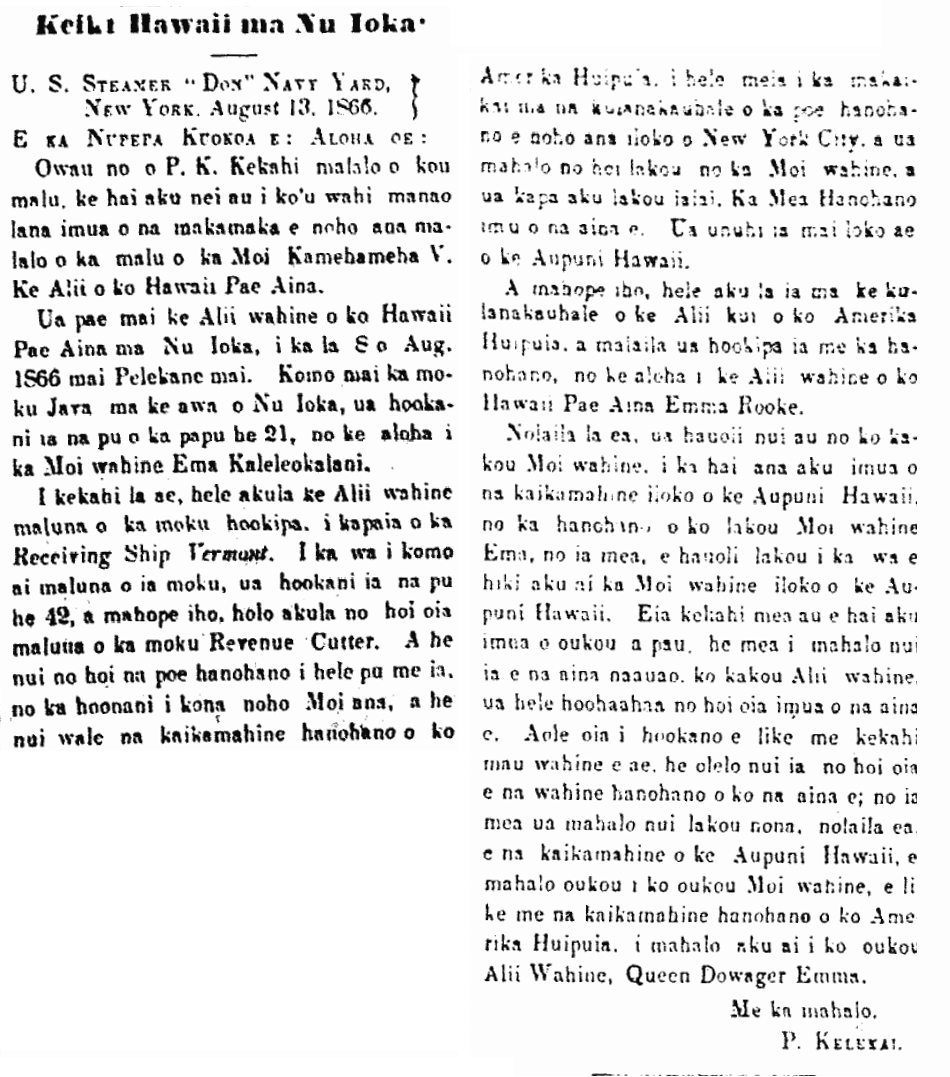
U. S. Steamer “Don” Navy Yard,

New York, August 13, 1866.

O Kuokoa Newspaper: Aloha oe:

I am P. K. Someone under your care; I am stating my hope before the friends living under the protection of King Kamehameha V, the King of the Hawaiian Islands.

The Queen of the Hawaiian Archipelago landed in New York on the 8th of August, 1866 from Britain. The ship Java entered New York harbor and a 21 gun salute was sounded at the fort, in aloha for Queen Emma Kaleleonalani.

Another day thereafter, the Queen went aboard the welcoming vessel called the Receiving Ship Vermont. When she went aboard, a 42 gun salute was sounded, and afterwards, she went aboard the Revenue Cutter ship. There were many distinguished people who went along with her to show honor to her Queenship, and there were many prominent girls of the United States of America who went touring along with her within New York City, and they felt admiration for the Queen and they called her Her Excellency before all other foreign lands [? imua o na aina e]. She was brought from the Nation of Hawaii.

Thereafter, she went to the city of the president [? alii kui] of the United States, where she was hosted with dignity for their aloha for the Queen of the Hawaiian Islands, Emma Rooke.

Therefore, I am overjoyed for our Queen, as I speak before the girls of the Nation of Hawaii about the grandeur of their Queen Emma, and because of this they should be joyful when the Queen arrives in the Hawaiian Nation. Here is another thing which I say before you all, our Queen is someone who is greatly honored by the enlightened nations, by her travelling in foreign lands with humility. She is not pretentious like some other women; she is greatly spoken of by reputable women of other nations, and they hold her in high esteem; therefore, O Girls of the Hawaiian Nation, be respectful of your Queen, like the fine girls of the United States who admire your Queen, the Queen Dowager Emma.

With appreciation,

P. Kelekai.

(Kuokoa, 10/ 13/1866, p. 3)

Keiki Hawaii ma Nu Ioka

Ka Nupepa Kuokoa, Buke V, Helu 41, Aoao 3. Okatoba 13, 1866.

Near tragedy on the way from Kauai to Niihau, 1864.

Barely survived at sea

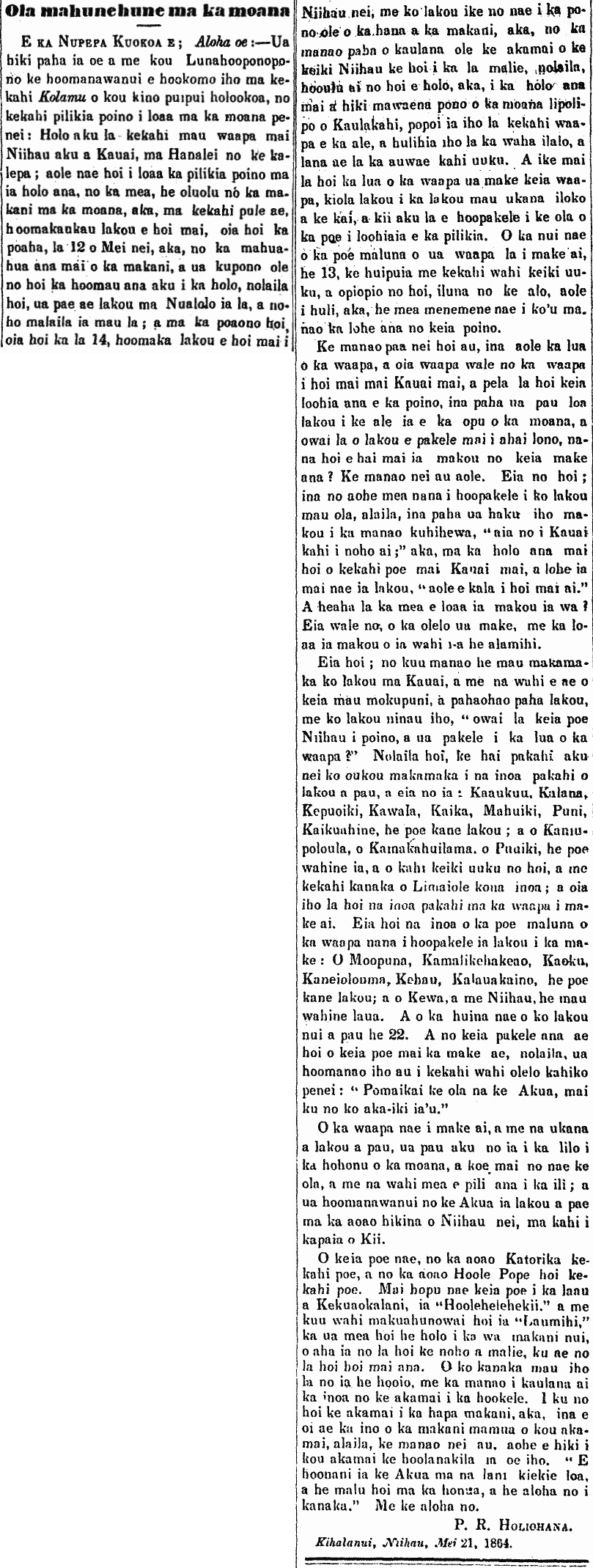
O Kuokoa Newspaper; Aloha oe:—Perhaps you and your Editor can be tolerant and include this in a Column of your entire stout body, about a crisis at sea, like this: Several skiffs left Niihau for Kauai, in Hanalei, to peddle goods; they did not face the crisis during this trip because the winds were calm on the sea, however, the next week they made ready to return, that being Thursday, the 12th of May, but because the wind was growing stronger, it wasn’t appropriate to continue the travels, therefore they landed at Nualolo that day, and stayed there for those days; and on Saturday, the 14th, they made to return here to Niihau while knowing the activity of the wind was bad; perhaps it was because they felt that the skill of the Niihau youth would not be acclaimed should they return in the calm, so they were worked up to sail, but after leaving and reaching the middle of the deep seas of Kaulakahi, one of the skiffs was pounded by a billow, and it overturned, and they were in dire straits. And when the second skiff noticed that this one had sunk, they threw their belongings into the sea and went to save the lives of the people overcome by calamity. The number of people aboard that vessel that had sunk was 13 including a small, young child who wasn’t yet crawling; I felt sorrow when I heard of this tragedy.

I strongly believe that if it wasn’t for the second skiff, and there was but just one skiff returning from Kauai, and they ran into this trouble, then they would be all gone, being swallowed by the belly of the ocean, and which of them would have escaped to be the messenger, the one to tell us of this sinking? I don’t think any one of them. And here is another thing; should none of them have lived, then we would have imagined something that was not true: “They are there living on Kauai;” but when some people from Kauai came and heard of them: “They left a long time ago.” Then what would we have then? Just this, the word that they had died, while accepting that fish, an alamihi.”¹

Here is another thing; being that I believe they have relatives on Kauai, along with other places of these islands, who are full of wonder, asking, “who are these Niihau people who were in trouble, and were they saved by the second skiff” So your friend will give each of their names, and here they are: Kaaukuu, Kalana, Kepuoiki, Kawala, Kaika, Mahuiki, Puni, and Kaikuahine, who are men; and Kamupoloula, Kamakahuilama, and Puuiki, who are women; and the small children and a man named Limaiole; those are the names of each of them in the skiff that sank. These are the names of the people aboard the skiff which saved them: Moopuna, Kamalikehakeao, Kaoku, Kaneiolouma, Kehau, and Kalauakaino, who are men; and Kewa and Niihau, who are women. The total number of them all was 22. And with this saving of these people from death, I recall an old saying: “Life is blessed through God, your snicker was almost fitting for me. [?? “Pomaikai ke ola na ke Akua, mai ku no ko aka-iki ia’u.”

As for the skiff that sunk and all of their cargo, it is all gone into the depths of the ocean, and all that was left are their lives, and what they had on; and God was patient with them and they landed on the east side of Niihau nei, in the place called Kii.

These people, some of them were of the Catholic faith, and some were Protestants. These people nearly grabbed onto the club of Kekuaokalani, “Hoolehelehekii,”² along with my father-in-law, “Laumihi,”³ as they set off in strong winds; what’s wrong with staying put until it is calm and then get up and come back. It is in man’s nature to show off, thinking that he will be famous for his prowess at sailing. You are competent facing a fraction of the wind, but should the ferocity of the wind be greater than your skill, then I believe that your intelligence would not leave you victorious. “Praise god in the high heavens, peace on earth, and good will towards men.” With aloha,

P. R. Holiohana.⁴

Kihalanui, Niihau, May 21, 1864.

¹A play on alamihi crab which can also sound like “path to repentance”.

²A play on the name “Hoolehelehekii,” meaning to be all talk.

³A play on the name “Laumihi,” perhaps meaning much remorse.

⁴P. R. Holiohana is most likely also known as P. R. Holi.

[On a related note, please don’t drive if you have been drinking. It isn’t worth the risk you are putting yourself and others on the road in.]

(Kuokoa, 6/18/1864, p. 4)

Ola mahunehune ma ka moana

Ka Nupepa Kuokoa, Buke III, Helu 25, Aoao 4. Iune 18, 1864.