Bags to ship sugar to be woven of lauhala or akaakai? 1873.

Wanted.

Here is something that is much sought after by the producers of sugar. Bags that are woven with strips [ko-ana] of bulrush [akaakai] or lauahala perhaps, to put brown sugar [ko-paa eleele] in and ship to Australia or America. The previous week, a schooner brought 15,000 bags of this type from New Zealand, and the haole traders greatly appreciated them. The length of the bags are 33 inches, and 17 inches wide. If bags like these are woven here at a reasonable price, and a thousand are made, they will be sold out in a year. Continue reading

Tourism and the revival of lauhala, 1936.

Tourist Business In Hawaii Booms As Result Of Publicity

An influx of visitors to the Hawaiian islands during the past few years has revived many of the interesting traditions and practices of Old Hawaii.

This paradox was recently pointed out by Percy A. Swift, manager of the merchandise department of American Factors, Ltd., in a discussion of Hawaii’s tourist industry.

“An interesting sidelight of the travel business here has been the way it has encouraged Island customs and activities,” he said. “The nourishing influence of tourist interest has given added impetus to the lei tradition, for example; and it has revived native sports such as surfing and outrigger canoe riding, which were on the point of dying out 15 years ago.” Continue reading

Lauhala anyone? 1916.

ANNOUNCEMENT

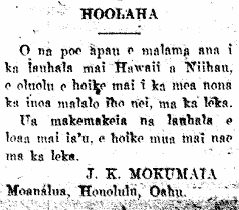
To everyone who is holding on to lauhala from Hawaii to Niihau; please tell the person whose name appears below by letter.

I want lauhala, but give me notice by letter.

J. K. MOKUMAIA

Moanalua, Honolulu, Oahu.

(Aloha Aina, 4/15/1916, p. 4)

HOOLAHA

Ke Aloha Aina, Buke XXI, Helu 27, Aoao 4. Aperila 15, 1916.

Far reaching influence of Hawaiian lauhala, 1911.

[Found in: M. McInerny, Ltd. advertisement]

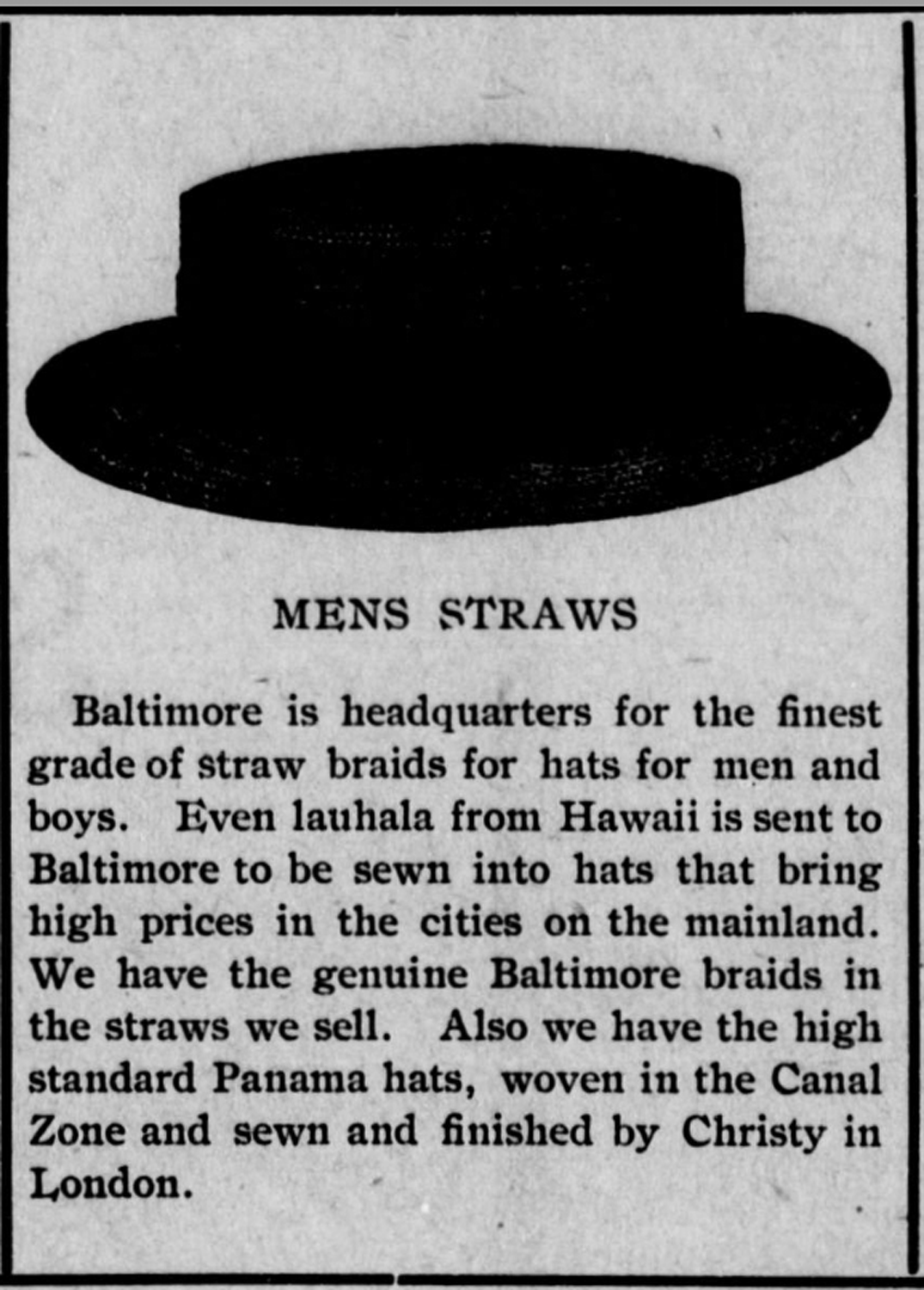
MENS STRAWS

Baltimore is headquarters for the finest grade of straw braids for hats for men and boys. Even lauhala from Hawaii is sent to Baltimore to be sewn into hats that bring high prices in the cities on the mainland. We have the genuine Baltimore braids in the straws we sell. Also we have the gigh standard Panama hats, woven in the Canal Zone and sewn and finished by Christy in London.

(Maui News, 12/2/1911, p. 7)

MENS STAWS

Maui News, Volume XVIII, Number 41, Page 7. December 2, 1911.

Hala exhibit coming to the Bishop Museum, 2015.

It seems that the Museum is having an exhibit on weaving starting the end of this week. Maybe go check it out if you are on Oahu.

The beauty and significance of hala is woven throughout our history and throughout this exhibit. In ancient times, the sails of voyaging canoes were plaited of hala, and utilitarian hala baskets and mats were commonplace. The introduction of foreign items that replaced Hawaiʻi-made mats and baskets encouraged weavers to further their creativity, leading to a distinctive and truly exquisite Hawaiian style of lau hala hats that are coveted and treasured as fine art.

Nani i ka Hala

Kou trees, 1875.

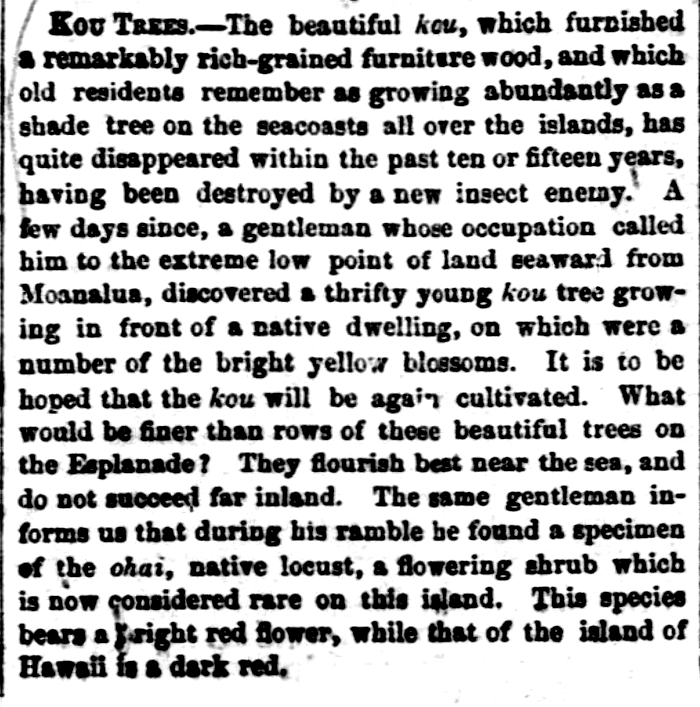
Kou Trees.—The beautiful kou, which furnished a remarkably rich-grained furniture wood, and which old residents remember as growing abundantly as shade tree on the seacoasts all over the islands, has quite disappeared within the past ten or fifteen years, having been destroyed by a new insect enemy. A few days since, a gentleman whose occupation called him to the extreme low point of land seaward from Moanalua, discovered a thrifty young kou tree, growing in front of a native dwelling, on which were a number of bright yellow blossoms. It is to be hoped that the kou will be again cultivated. What would be finer than rows of these beautiful trees on the Esplanade? They flourish best near the sea, and do not succeed far inland. The same gentleman informs us that during his ramble he found a specimen of the ohai, native locust, a flowering shrub which is now considered rare on this island. This species bears a bright red flower, while that of the island of Hawaii is a dark red.

(Pacific Commercial Advertiser, 7/10/1875, p. 3)

Kou Trees.

The Pacific Commercial Advertiser, Volume XX, Number 2, Page 3. July 10, 1875.

More on the malihini, Joseph Rock, 1916.

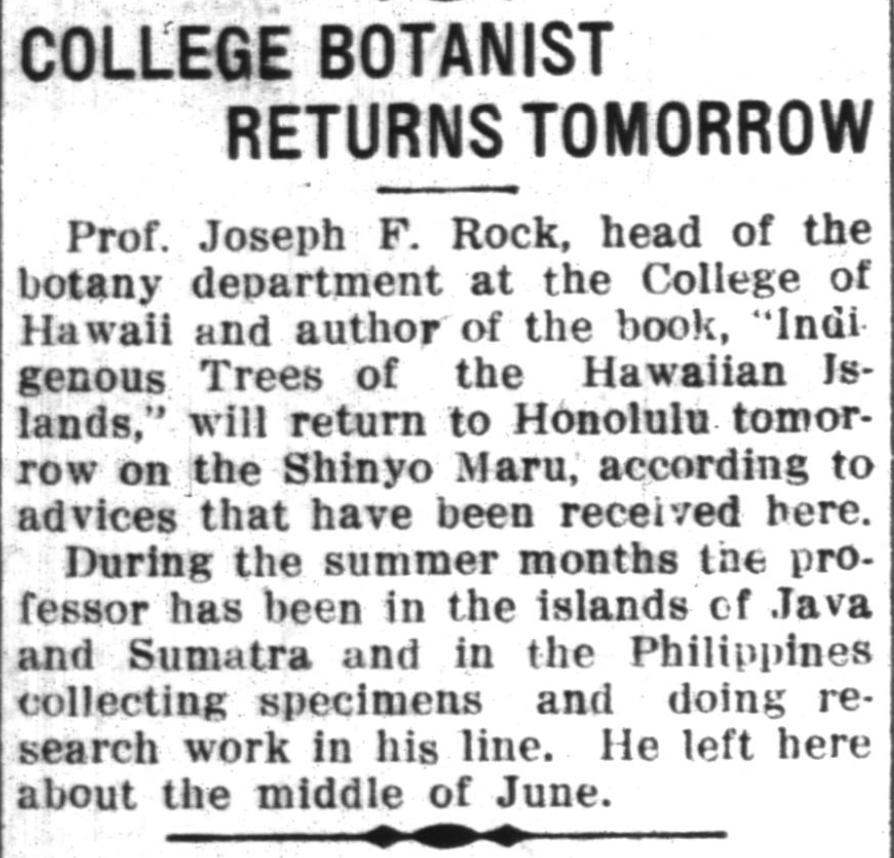
COLLEGE BOTANIST RETURNS TOMORROW

Prof. Joseph F. Rock, head of the botany department at the College of Hawaii and author of the book, “Indigenous Trees of the Hawaiian Islands,” will return to Honolulu tomorrow on the Shinyo Maru, according to advices that have been received here.

During the summer months the professor has been in the islands of Java and Sumatra and in the Philippines collecting specimens and doing research work in his line. He left here about the middle of June.

(Honolulu Star Bulletin, 9/4/1916, p. 3)

COLLEGE BOTANIST RETURNS TOMORROW

The Honolulu Star-Bulletin, Volume XXIV, Number 7612, Page 3. September 4, 1916.

Roots of koa stretch to India? 1919.

From India Comes the Koa Growing in Our Forests

A malihini by the name of Mr. Rock has been spreading in our newspapers that the Koa growing in our forests came from India and that the seeds of this tree came from India brought by birds and dispersed in Hawaii nei. Continue reading

David Kanealii and his new wife visits the home of his parents, 1918.

SEEING THE BELOVED HOME OF MY PARENTS.

O Editor of the Nupepa Kuokoa:—Please have patience for my package that I put before you, and place it upon one of the open decks of our newspaper, which will send it out so those from Hawaii Island will see it and those of Lehua Island will hear it.

On the 14th, Mrs. Napewai [Naapuwai] Kanealii and her husband D. Kanealii left this town and went to Kauai, and in the morning of the 15th, we landed in Nawiliwili, were taken by the tossing of the machine to Wainiha and were lovingly welcomed in the home of Joseph Kanealii. Continue reading

Newspapers, translation, and a mele for the Merrie Monarch, 1913 / Timeless.

You can find various translations for the beautiful song, “Kaipoleimanu” in the archives of the Bernice Pauahi Bishop Museum, online, and on liner notes. None however seems to acknowledge that Kaipoleimanu itself was a wahi pana, along with its neighboring hau of Maihi, ulu of Weli [also seen as Wehi], and hala of Mapuana.

There is a priceless church meeting report/travelogue appearing in the Kuokoa from 12/5/1913 to 2/6/1914: Ka Ike Hou ana o ke Kamahele i ka Mokupuni o Kauai [The Traveler Sees Once More the Island of Kauai], signed, Kamahele. Amongst all the fascinating information found in this report is a description of the places hearkened to in the mele Kaipoleimanu, to which the traveller is taken by his guide, the Deputy Sheriff of Hanalei, William Werner. He says: Continue reading