“Laksamana” in English by Walter Murray Gibson, 1882.

LAKSAMANA;

THE GREAT HERO of the MALAYS.

A ROMANCE.

By WALTER MURRAY GIBSON.

Introduction.

In the year 1873, whilst publishing a small bilingual sheet, the Nuhou, in the English and Hawaiian languages, I was urged by Hawaiian friends to write a story about my experience in Malaysia, and illustrative of Malay manners and customs. I published some incidents of travel in the Island of Sumatra, and as I introduced some fragments of the legendary stories of the Malays, especially in relation to the renowned hero Laksamana, of Malay romance, I was pressed and tempted to expand this subject, drawing on my imagination, as well as on the traditions of the Malays and Javanese to which I had listened, and the result was that the story of “Laksamana” was continued in the Nuhou in the Hawaiian language, in a succession of weekly issues for a space of six months, and yet when the Nuhou had terminated its career, the story like those of Scheheserade [Scheherazade of One Thousand and One Nights], was left unfinished.

When the editor of the Nuhou, and author of Laksamana, commenced the publication of the Elele Poakolu in 1880, the Hawaiians very generally expressed a wish that the story of Laksamana should be continued; for the memory of the interest that it had awakened in 1873 had not abated in Hawaiian minds, and the author resumed the story in the Elele, publishing a revised edition of the Nuhou series of Laksamana legends.

This is a story based upon legends, designed for the entertainment of young and unsophisticated minds. It is a romance of the mythic age of Malaysia and originating in the poetic invention of Asia. Laksamana, the brother of the demi-god Rama, is a hero of the great Hindoo [Hindu] poem the “Ramayana,” and in a later age appears in the Javanese epic, the “Bratayuda.” The mythic Prince of the Indian epopee gas given the name that is so prominent in Malay story, but there was, according to widespread tradition, an actual Malay hero to whom was given the name of Laksamana, as a title, as certain potentates of Europe are styled Cæsars—deriving their title from the name of the great Roman who founded imperialism. Laksamana has long been a naval title in Malaysia, being the titular designation of an admiral, or commander of a fleet of war prahus.

Laksamana the hero is frequently mentioned in Malay song and story at this day, and he appears sometimes a mythic hero working wonders and sometimes a historic personage and the hero of Malay achievements. There is no written history, or series of stories, recording in any collective form, the myths or the achievements, and the author of this story, designed for the instruction and entertainment of native Hawaiians has had no assistance in the preparation of the romance but the memory of fragmentary legends narrated to him whilst he languished in the Prison of Weltevreden, on the island of Java, and which he arranged into this Hawaiian kaao, or romantic tale, during days of peaceful toil on the island of Lanai.

This story is now presented to the English reading public, through the columns of the Advertiser, not on account of any presumed literary merit, but because it has been thought by many friends of the author that it would be interesting to those desiring the welfare of the Hawaiian People, to know what kind of literature captivated their attention, and at the same time it was thought that the romance of Laksamana, would at least interest the juvenile, if not the more matured readers of the Advertiser.

Walter Murray Gibson.

Haleaniani, April 29, 1882.

[The actual tale starts here…

It was introduced in the Nuhou, on 10/14/1873, pp. 4–5; the translation of the tale is printed from 11/4/1873 to 4/28/1874. In the Nuhou, it actually states that the story was translated from the Malay language.]

(Pacific Commercial Advertiser, 4/29/1882, p. 5)
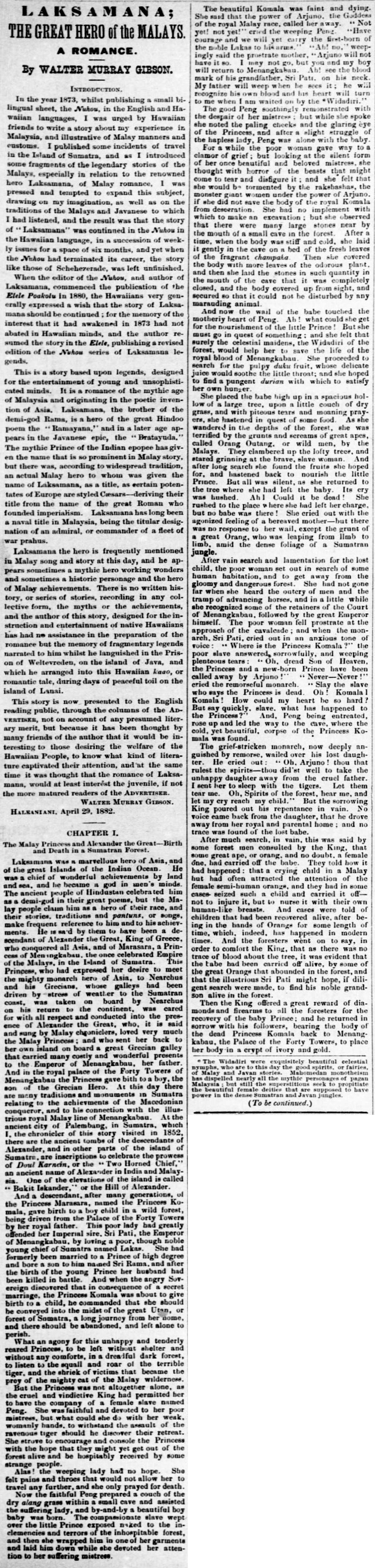
LAKSAMANA;

The Pacific Commercial Advertiser, Volume XXVI, Number 44, Page 5. April 29, 1882.
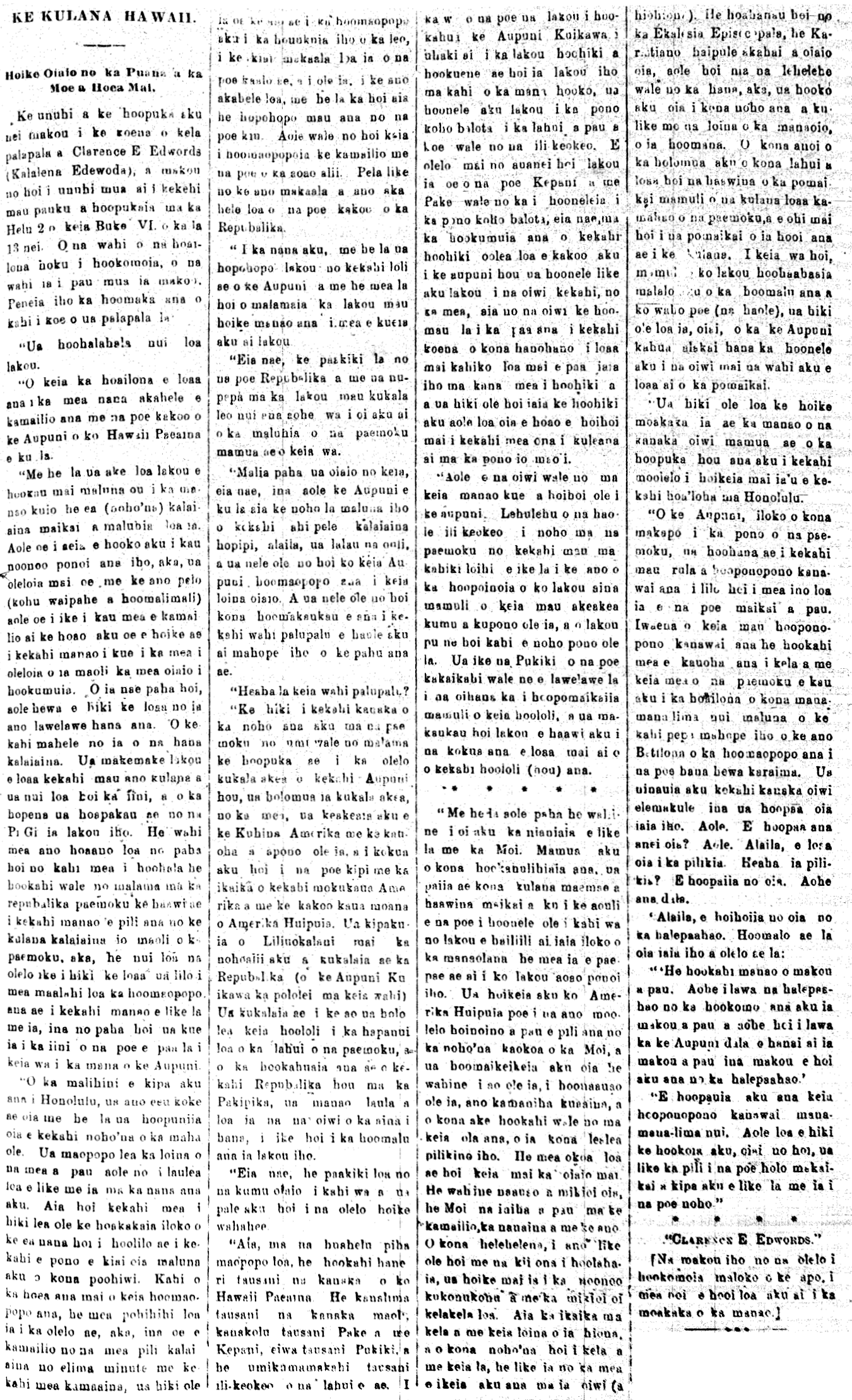
The rest of the translation of Clarence E. Edwords, 1896.

THE HAWAIIAN SITUATION.

Truthful Presentation of the Prediction that will Come True.

We are translating and printing the remainder of that letter by Clarence E. Edwords (Kalalena Edewoda), of which we translated some paragraphs earlier in the 2nd Issue of this Volume VI, on the past 13th. The places where asterisks [hoailona hoku] are inserted, were the places that we already have completed. This is how the remainder of that letter begins:

“They protest too much.

“This is the conclusion that is reached by the careful observer who talks with the adherents of the present Government [the Provisional Government] of the Hawaiian Islands.

“They seem too anxious to impress upon you the fact that it is a most serene and peaceful atmosphere (existence). You are not permitted to use your own judgement but are blandly told (as if graciously or flatteringly) that you don’t know what you are talking about when you venture to express an opinion that is contrary to what is said to be an established fact. Of course no fault can be found with such procedure. It is a part of politics. They want certain conditions to obtain and the desire is so great that by long effort to fool others the “P. G.’s” eventually fool themselves. It may seem presumptuous for one who spent but a month in the island republic to give an opinion as to the real political status of the island, but there is so much evidence obtainable that such opinion can easily be formed, even if it does happen to be against the desire of those who now hold the reins of Government.

“The stranger who visits Honolulu almost immediately feels that he is surrounded by an air of uneasiness. Things evidently are not as they seem. There is an indefinable something in the atmosphere that makes one feel as if he should be watching over his shoulder. Where the impression comes from it is difficult to say, but if you will talk politics for five minutes with any resident you cannot help but notice the lowered tone of voice, the careful watch of passers-by or the graurded manner, as if there were a constant fear of spies. Nor is this noticeable alone when talking with royalists. The adherents of the Republic are just as guarded and just as careful.

“It looks as if they feared a change of Government and as if their expressions might be treasured up against them.

“Yet the Republicans and the papers are persistent in their declarations that the islands were never more peaceful than at present.

“Perhaps this is true, but if the the present Government is not sitting over a smouldering political volcano, then the signs are wrong, and this same Government has not failed to realize this fact. Nor has it failed to prepare a soft place to light after the explosion.

“What is this soft place?

“When a man who had been a resident of the islands but ten months made the public announcement of a new Government, that announcement was successful because of the American Minister, who backed up the revolutionists with the force of an American warship and the naval support of the United States. Liliuokalani was dethroned and the Republic (the Provisional Government is the correct term here) declared. It was announced to the world that the change was satisfactory to the great majority of the people of the islands, and the establishment of a new Republic in the Pacific was generally supposed to be the work of the natives, who had learned to govern themselves.

“But facts are sometimes stubborn and refute false statements. The facts of the change of government are not what have been made public.

“There are, in round numbers, a hundred thousand people of the Sandwich Islands. Fifty thousand are natives, thirty thousand Chinese and Japanese, nine thousand Portuguese, and eleven thousand whites of other nationality. When the men who established the provisional government broke their oath of allegiance and possessed themselves of the reins, they disfranchised all the inhabitants except the whites. They will tell you that only Japanese and Chinese were disfranchised, but by the establishment of a rigid oath of allegiance to the new government, they disfranchised the natives as well, for the native still retains enough of his primitive honor to hold himself bound by his oath, and he cannot swear that he will not try to get back that which rightly belongs to him.

“The natives are not alone in their feeling of resentment at the new government. Many of the whites who have who have lived for years on the islands see how their country is being ruined by unnecessary interference, and they, too, are restive. The Portuguese have found that the change benefitted only the few who ran the machine, and they are ready to aid in bringing about a (new) change.

*      *      *      *      *

“Probably no woman has been more maligned than the queen. Before her overthrow her virtues and good qualities were extolled to the skies by those who lose no opportunity of slandering her in the hope of bolstering their own cause. The people of the United States have been told all sorts of malicious stories regarding the private life of the queen and she has been pictured as an untutored, uncultured, coarse woman, whose sole object in life was her personal pleasure. This is anything but the truth. She is a woman of education and refinement, every inch a queen in talk, appearance and manner. Her face, which the published pictures of her much belie, shows deep thought and delicate refinement. There is strength in every line of it and her everyday life is a counterpart of what it (and her features) depict. A member of the Episcopal church, she is a devout and sincere Christian, doing no lip service, but making her life conform to the tenets of the belief. Her desire is that her people may advance and profit by the wonderful resources of the islands and reap the benefits of the improvement. In their present condition of subjection to foreign (haole) domination this is impossible as it is the policy of the Government to keep all natives from places of emolument.

“The feeling of the natives could not better be illustrated than by repeating a story told me by a friend in Honolulu.

“The government in its blindness to the welfare of the islands has devised registration rules and regulations that are revolting to all decent people. Among the regulations is one requiring every person on the islands to put his thumb mark on a piece of paper after the Bertillon method of identifying criminals. An old native was asked if he had registered. No. Was he going to register? No. Then he would get into trouble. What trouble? He would be fined. He had no money. Then he would be put in jail. Drawing himself up he said:

“’We are all of one mind. There are not jails enough to hold us all and the government hasn’t money enough to feed us all if we go to jail.’

“The thumb mark regulation will be rescinded. It cannot be enforced, especially as it applies to tourists and visitors as well as residents.”

*      *      *      *      *

“Clarence E. Edwords.”

{The words in the parentheses are ours, to give more clarification to the ideas.}

(Makaainana, 7/27/1896, p. 7)

KE KULANA HAWAII.

Ka Makainana, Buke VI—-Ano Hou, Helu 4, Aoao 7. Iulai 27, 1896.

Response to Clarence E. Edwords, 1896.

THE HAWAIIAN SITUATION.

Truthful Presentation of the Prediction that will Come True.

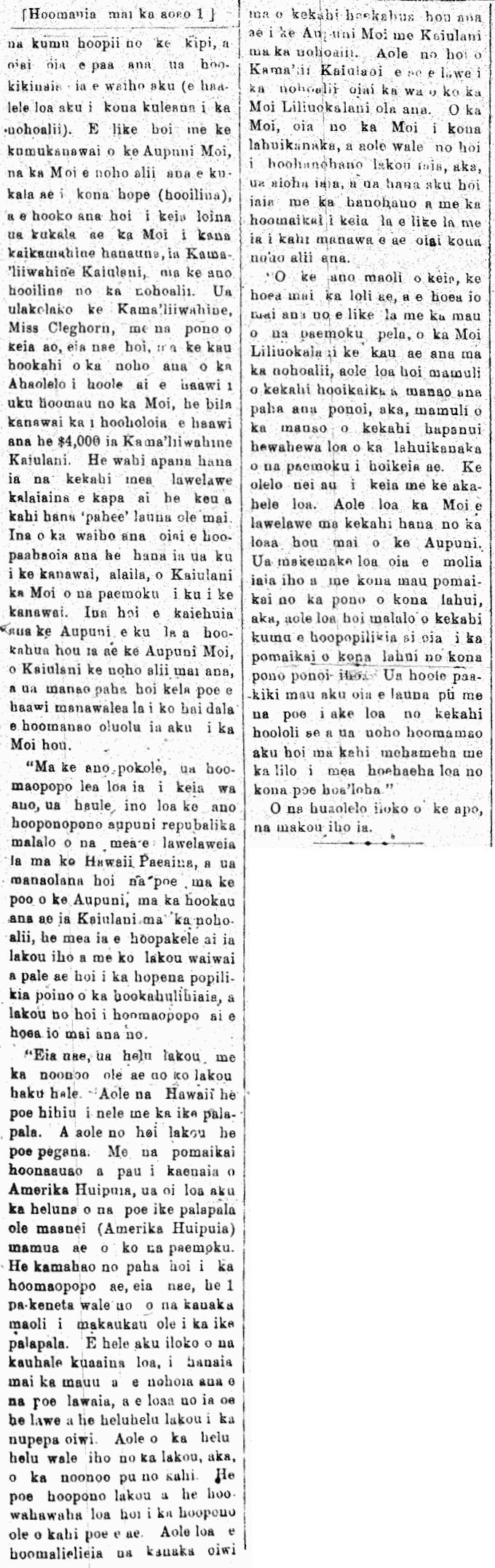
In the English language Independent newspaper of this past Saturday there was seen an letter written by Clarence E. Edwords and published in the Kansas City Journal of the Kansas County in the State of Missouri, United States of America, and it was taken from that paper and printed here. This Clarence E. Edwords is a newspaper editor and a political leader for the Republican party, and he was one of the delegates to the convention at Saint Louis [Sana Lui] to select a Presidential candidate. He recently appeared before us, and what he stated of his thoughts, he saw and heard for himself. He and his wife were welcomed into the crowd of our saintly ones, and after their [the saintly ones] tale telling [palau ana] was over, then they [Mr. and Mrs. Edwords] were shown by the friends of the lahui’s side the true situation of what was done and what is being done.

His thoughts was one of the most truthful seen for a long time pertaining to the “Hawaiian Situation” here, and under the title about was his thoughts published; and although he is an American Republican, he was brave in his announcing his true thoughts before the people of his land. Because of the extreme length of that letter, Ka Makaainana cannot translate it all, but we will take of his explanation pertaining to the

Return of the Monarch,

and we will put aside most of it for later, when there is sufficient time to translate it. This is what he said:

“The members of the present government are not as blind to the situation as they appear. When the queen was robbed of her throne and and her means of living at the same time, it would seem that common justice should have given her a pension; but the government refused to do anything of the sort. They realized, however, that they were on dangerous ground and proceeded to provide a means of safety.

“The queen was imprisoned…

(Makaainana, 7/13/1896, p. 1)

KE KULANA HAWAII.

Ka Makaainana, Buke VI—-Ano Hou, Helu 2, Aoao 1. Iulai 13,1896.

…on charges of treason, and while under duress was forced to abdicate (abandoning for good her right to the throne). According to the monarchical constitution the reigning soverign names his or her successor (heir), and following this rule the queen had named her niece Princess Kaiulani, as heir to the throne. The Princess, Miss Cleghorn, is well-off in this world’s goods, yet at the same sitting of the legislature which refused to pension the queen, a bill was passed granting to the Princess Kaiulani $4,000. It was what a politician might call a very “smooth” piece of work. If abdication under duress could be held as legal, then Kaiulani is the legal sovereign of the islands. If the present government gets ousted and the monarchy re-established, Kaiulani will rule, and those who so generously donated other people’s money expect to be graciously remembered by the new queen.

In short, it is pretty well understood just now that the republican form of government under existing conditions on the Hawaiian Islands is a failure, and the men who are now at the head of the government hope, by putting Kaiulani on the throne, to save themselves and their property and avert the disaster of overthrow, which they realize is bound to come.

But they reckon without their host. The Hawaiians are not illiterate savages. Neither are they heathens. With all the boasted educational facilities of the United States the percentage of illiteracy is much higher here (the United States of America) than on the islands. Strange as it may seem, there is but 1 percent of the natives who are illiterate. Go to the rudest hut, made of grass and occupied by fisherman, and you will find that they take and read the native paper. They not only read, but they think. They are honest and resent dishonesty in others. The natives will not be appeased by a re-establishment of the monarchy with Kaiulani on the throne. Nor would Princess Kaiulani accept the throne so long as Queen Liliuokalani is alive. The queen is still the queen to her people and they not only honor her, but love her, and treat her with as much difference and respect to-day as at any time during her reign.

 This simply means that when the change comes, and come it will as sure as the islands remain, Queen Liliuokalani will be on the throne, not through any effort of design of her own, but by the expressed will of a vast majority of the people of the islands. I say this advisedly. The queen will take no part in any attempt to recover the government. She is willing to sacrifice herself and her interests for the good of her people, but will under no consideration jeopardize the welfare of her people for her own benefit. She has persistently refused to  counsel with those who desire a change and has kept in seclusion that is painful to her friends.”

The words in parentheses [apo] are ours.

(Makaainana, 7/13/1896, p. 8)

...na kumu hoopii no ke kipi...

Ka Makaainana, Buke VI—-Ano Hou, Helu 2, Aoao 8. Iulai 13,1896.

Tameamea… 1838.

KAMEHAMEHA.

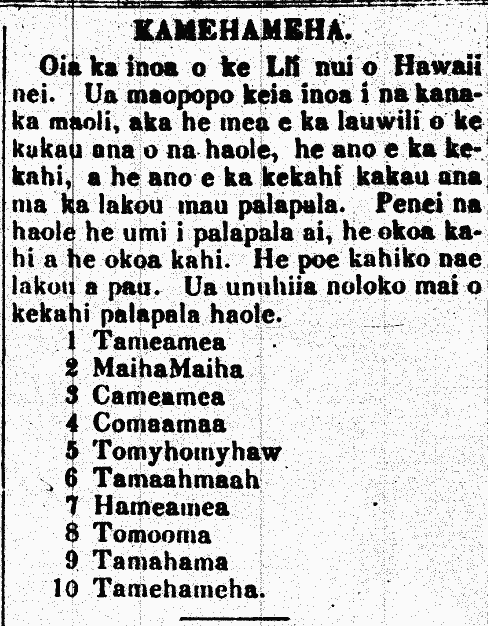
That is the name of the great Alii of Hawaii nei. This name is known by the kanaka maoli, however it is something that is misconstrued in the spelling of the haole; some people and others write it strangely in their documents. Here is how ten haole wrote it, each are different. They are all old people. These are extracted from various foreign documents.

1. Tameamea

2. MaihaMaiha

3. Cameamea

4. Comaamaa

5. Tomyhomuhaw

6. Tamaahmaah

7. Hameamea

8. Tomooma

9. Tamahama

10. Tameahmeha.

(Kumu Hawaii, 9/12/1839, p. 31)

KAMEHAMEHA.

Ke Kumu Hawaii, Buke 4, Pepa 8, Aoao 31. Sepatemaba 12, 1838.

Jules Verne’s famous story to be told, 1875.

A NEW TALE

—ABOUT THE—

STRANGE THINGS OF THE SEA.

On the 2nd of the coming October, we will begin to publish a brand new story written by the famous French Novelist, Jules Verne, called—”Twenty-Thousand Leagues Under the Sea,” which tells of the strange scenes of peoples of the sea and shipwrecks, and so forth. Continue reading

Translation of Henryk Sienkiewicz’s “Quo Vadis,” 1918.

A STORY OF THE

LADY LYGIA

AND

VINICIUS

THE PATRICIAN OF ROME

———

A STORY OF THE BATTLE

OF THE RIGHTEOUSNESS OF

CHRISTIANITY

AGAINST THE PERSECUTION OF

Emperor Nero

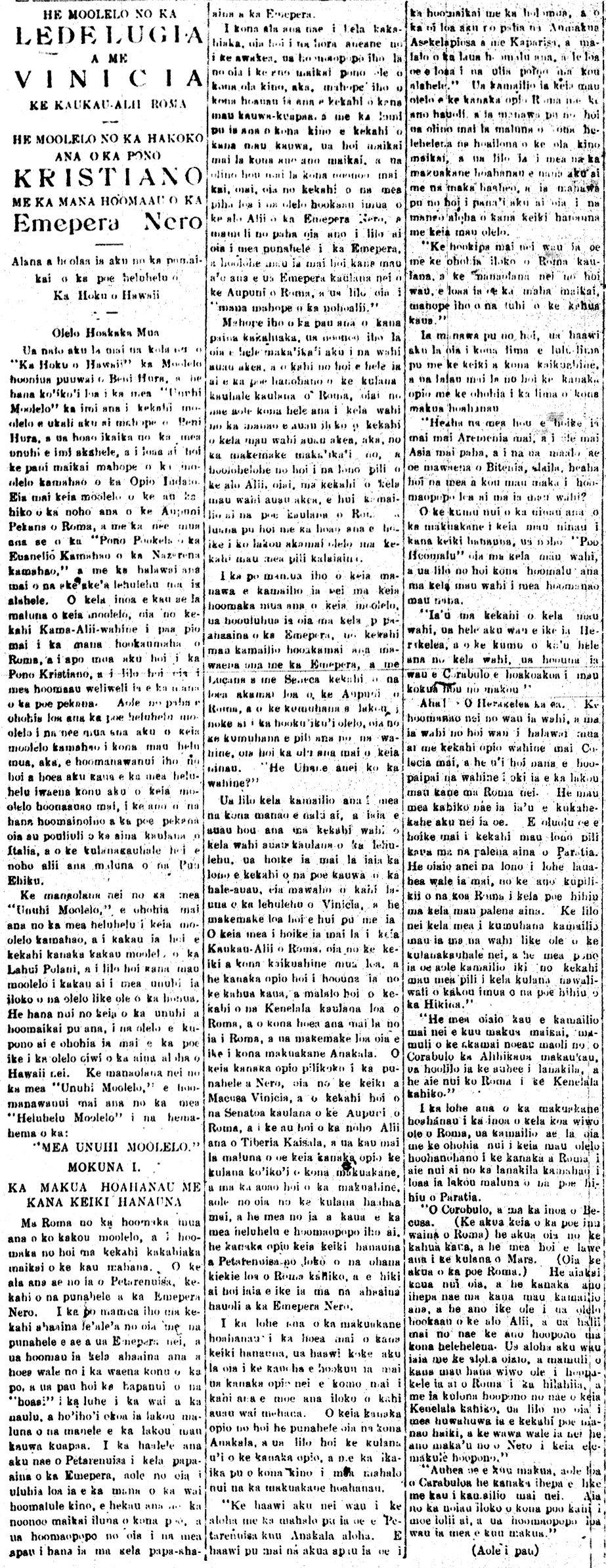
Offered and dedicated to the benefit of the readers of Ka Hoku o Hawaii.

[This is another translation of a major work found in the Hoku o Hawaii. I have no idea if this was translated from English or the original “Quo Vadis” by Henryk Sienkiewicz. It runs from 7/11/1918 to 4/10/1924!]

(Hoku o Hawaii, 7/11/1918, p. 1)

HE MOOLELO NO KA LEDE LUGIA A ME VINICIA KE KAUKAU-ALII O ROMA

Ka Hoku o Hawaii, Buke 12, Helu 6, Aoao 1. Iulai 11, 1918.


Translation of H. Rider Haggard’s, “Morning Star,” 1910.

THE HEART-STIRRING TALE

—:OF:—

THE MORNING STAR

—AND—

RAMSES HER BELOVED SWEETHEART

“The Heir of Pharoah
The Favorite of Amen-Rah
The Proud Beauty of Egypt
The Darling of Her People.”

An Old Story from Egypt.
(Translated for the Hoku o Hawaii.)

Introduction.

We are printing this famous story of the Kingdom of Egypt. And it was near the time when Moses was living in Egypt. It is a story of speaking of the religion of that ancient people, and a story of their Chiefly kapu intertwined with their Godly kapu.

We published before our readers some years ago stories of our own Alii of ancient times of our land, and Tales of Hawaii which are nearly not remembered by the  current people of these times, and through this story which we are sharing with our readers, they will see some things about that ancient people of the land in the east. It is toilsome to translate these stories for the benefit of the people who enjoy reading stories in the Hoku. And from the Hoku, we lovingly urge its readers to please remember the life of this Hoku of ours. Printing a newspaper is very costly, and its existence and progress is reliant upon its readers.

We hope that some of the subscribers of the Hoku who are delinquent in their payments to the life of the Hoku will be moved with aloha, and they will make their payment towards the life of this patient servant.

Forgive us for these words that are not related to our story, however, “Ears do not get filled up with words.” And it is our responsibility to call out with aloha to our readers who have not paid their subscription, for the good of the newspaper to print educational stories and wise discussions of this new age.

[That was the introduction by the Hoku o Hawaii newspaper to their translation of the story, “The Morning Star” by H. Rider Haggard, which was printed just earlier that year in 1910. It ran in the weekly Hoku from March 17, 1910 to February 1, 1912.

It would be a cool thing if immersion students were introduced to old translations like these. They could see what kind of vocabulary and turns of phrase that were common during the period. I realize that trying to get through a novel in this format is tiresome and tedious, and I am considering reformatting a story (in the original orthography so that students can get more practice at reading material as they were presented in the newspapers) so that it reads continuously as a book. However, I am not sure if immersion teachers or students out there think that it would be beneficial. Perhaps it is already being done.]

(Hoku o Hawaii, 3/17/1910, p. 1)

HE MOOLELO HOONIUA PUUWAI NO KA HOKU KAKAHIAKA

Ka Hoku o Hawaii, Buke IV, Helu 46, Aoao 1. Maraki 17, 1910.

William Hyde Rice’s Hawaiian Legends in English, 1923.

[From the Preface of “Hawaiian Legends by William Hyde Rice”]

The collection of Hawaiian legends of which a translation is given in the following pages represents the work of many years by William Hyde Rice of Kauai. However, it is only within the last few years that Mr. Rice has translated the legends from his Hawaiian manuscripts. He has tried to make his version as literal as possible, preserving at the same time the spirit of the original Hawaiian, its flavor, rhythm, and phrasing. He has avoided adding modern embroidery of fancy, as well as figures of speech foreign to the Hawaiian language and to its thought and expression.

….

Mr. Rice has been exceptionally well prepared for this work, as he has been familiar with the Hawaiian language from his earliest childhood. In fact until he was twenty, he never thought in English but always in Hawaiian, translating mentally into his mother tongue. In 1870 when he became a member of the House of Representatives, during the reign of Kamehameha V, Governor Paul Kanoa and S. M. Kamakau, the historian, both well-known Hawaiian scholars, gave Mr. Rice much help with his Hawaiian, especially teaching him the proper use of various complicated grammatical constructions, and explaining obscure variations in pronunciation and meaning.

The sources of the legends in this collection are varied. A number of the stories Mr. Rice remembers having heard as a child, and now rare ones were gathered in later years. Many are from more than one source, but have corresponded even in details, and almost word for word. The legend of Kamapuaa, for instance, is one of the first which Mr. Rice remembers hearing. When a boy, the places mentioned in this story were pointed out to him: the spot where the demi-god landed, where he found the hidden spring, and where he rooted up the natives’ sugar-cane and sweet potatoes. The story of “The Small Wise Boy and the Little Fool” he has also been familiar with since childhood. The places mentioned in this tale can likewise be pointed out.

Most of the legends are from Kauai sources, but a number have been gathered from the other islands of the group. Whenever Mr. Rice heard of an old Hawaiian who knew any legends, he went to him, sometimes going to several to trace a special story, as for instance, the “Jonah and the Whale” story, “Makuakaumana”, which after a long search he finally procured from Mr. Westervelt. This curious story seem to be more modern than the others of the collection. While hunting for a reliable version of this story, Mr. Rice incidentally heard the story of “Manuwahi” at Heeia from an old Hawaiian.

“The Bird Man”, “Holuamanu”, “The Destruction of Niihau’s Akua”, and “The Girl and the Mo-o”, were obtained from Mr. Francis Gay, who is one of the best living scholars of the Hawaiian language. The Niihau legend was heard from several other sources as well. Mr. Gay also gave the legends of the “Rainbow Princess” and the “Shrimp’s Eyes”; the ti plants mentioned in the latter legend can still be pointed out, growing at the mouth of a little valley near Holuamanu. The Hawaiian manuscript of part of the Menehune story was obtained from J. A. Akina, while the story of the “Rain Heiau” was told to him in 1912 by a man named Naialau, who has since died at Kalaupapa. “How Lizards Came to Molokai” and Paakaa and Ku-a-paakaa” were told Mr. Rice by a man from Hawaii named Wiu, while the Rev. S. K. Kaulili, who is still living at Koloa, Kauai, gave him the most complete version of the “Rolling Island”.

During Mr. George Carter’s term as Governor, a reception was given in his honor, at Hanalei, where Mr. Rice was much interested in the very fine oli (chanting) of an old Hawaiian, named Kaululua. From him he obtained a number of legends, including that of “Ulukaa” from corresponding versions of other already in his collection. Other legends have been lost forever on account of ill-timed ridiculing by some chance companion, for Mr. Rice has found that the old people who know the legends are very sensitive, and when they find an unsympathetic auditor, refuse to continue their stories.

[It is often just as important to read the front matter and the back matter of a book than simply heading straight to the main text itself. Many times you can learn a lot of important information.

The stories credited to W. H. Rice found in the Hoku o Hawaii are probably the ones Rice collected over the years.]

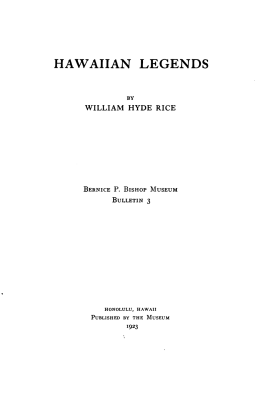
(Rice, William Hyde. “Hawaiian Legends. Bernice P. Bishop Museum Bulletin 3.” Honolulu: The Museum, 1923.)

Hawaiian Legends

Hawaiian Legends by William Hyde Rice

A mysterious story from Keaukaha, 1915.

A MYSTERIOUS RESTRAINT

Written in the English-language newspaper, Hawaii Herald of Hilo, was a truly strange story about some Hawaiian women here in Keaukaha, and here are some of what we translated.

On this past Christmas, Kawaikuhea and Elena, women who live in Keaukaha, went to pick opihi on a rocky island off of Keaukaha; they swam out for perhaps close to a hundred yards. Elena jumped into the water first and Waikuhea followed, but Waikuhea was the first to reach the rocky island and began to pick opihi, but while she was picking opihi, she heard the cry of Elena saying, “Auwe, I am dying. Aloha to [my] grandchildren.” Kawaikuhea¹ looked to where Elena was floating, and saw her floating easily upon the water. Seeing her friend floating there, Kawaikuhea spoke to Elena, “Hey you blundering woman, swim over here and I will help you”. Continue reading

Waikiki Wedding and Bing Crosby, 1936.

A FITTING HAWAIIAN SOUGHT

FOR WORKING ON HAWAIIAN STORY FOR A MOVIE

HOLLYWOOD, Sept. 1.—Mr. Bing Crosby will be landing in Honolulu next Thursday aboard the steamship Lurline, one of those who are writing the script of a movie called “Waikiki Wedding.” The news was heard from his studio that on this trip he is searching for a very famous woman in ancient Hawaiian hula, that understands the hand motion and the foot movements, as in ancient Hawaiian history; the hula of Hawaii that made it famous and was seen as one of the things that were taught to all women of Hawaii during those days. Also they are on the search for famous young musicians of Hawaii nei that know the proper mele for the hula foot movements of women, who know the string instruments and drums of the Hawaiians, and are not just handsome to look at, but true to the history that is written about: the ti-leaf whistle, the kilu drum, the puhenehene flute, the jew’s harp and bamboo ukeke. Continue reading