Mary Robins and a fun fishing story, 1918.

NEWS FROM THE LIGHT STATION OF HONOLULU HARBOR.

Please be patient with me, O Editor of the Kuokoa Newspaper, and include my little news from the day of Washington’s birthday.

At 3 p. m., we went walking around the pier of the lighthouse to check out what was new; we saw the fireworks and heard its sound, and saw an American flag with a balloon carrying this flag so beautiful to see.

After that, we spotted a huge octopus headed towards us, then it went below the pier, stayed there quietly for a minute or so, and then we saw it again beneath some big rocks; I went down to go find a place where I could stick my hands in, and when I saw it was the right time to grab the big hee, there were two things I felt at the same time, fear and regret; I pushed aside my fear and it was the feeling of regret that I concentrated on, whereupon I grabbed the head of the hee, and its tentacles latched on tightly to the rocks, and it thought it would be victorious, but it would not be triumphant over me because I had its head grasped tightly in my hands. Continue reading

Hula in Hilo, 1914.

HAWAIIAN HULA

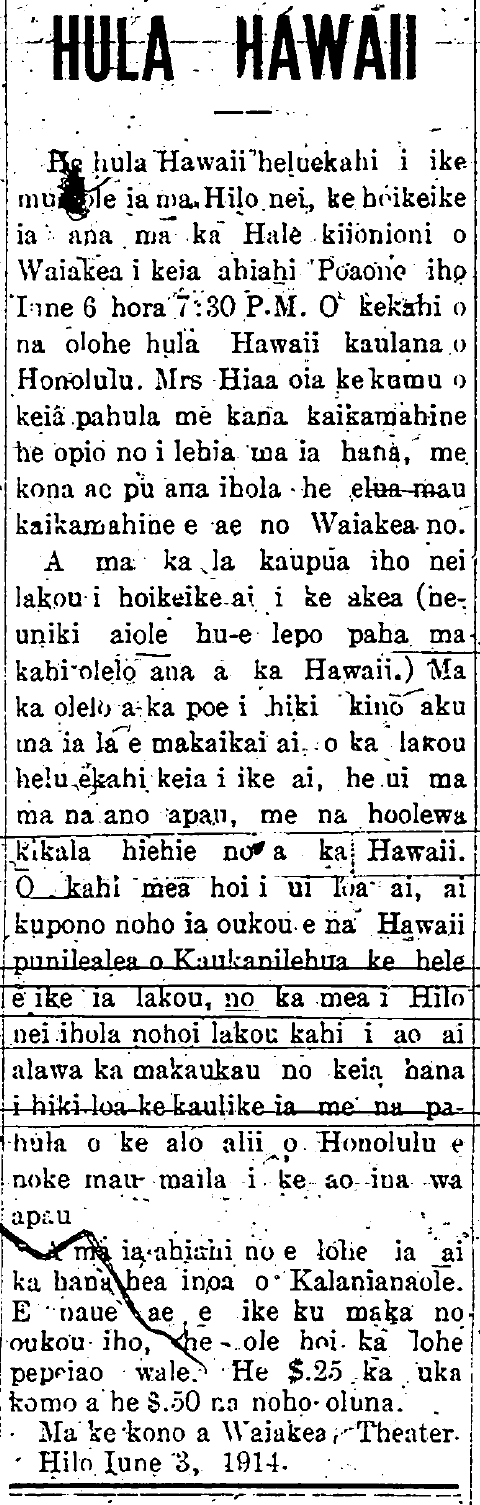
There will be first-class Hawaiian Hula which have never been seen before here in Hilo, being shown at the Waiakea Theater on the evening of this Saturday, June 6, at 7:30 P.M. One of the famous Hawaiian expert hula practitioners of Honolulu, Mrs. Hiaa, is the kumu of this hula troupe, along with her daughter, a girl that is skilled in the art; and she also has accepted two more girls from Waiakea.

And on this past Memorial Day [La Kaupua], they held a public show (called uniki or hu-e lepo perhaps in Hawaiian). According to those who were present on that day of the performance, it was the best that they had seen, and it was beautiful in all respects, with the elegant swaying of the hips of the Hawaiians. One of the most marvelous things and a reason for all of you fun-loving Hawaiians of the Kanilehua Rain to go and see them, is because they were trained until proficient in this skill right here in Hilo, and they can most definitely be compared to the troupes of the royal court of Honolulu who are continuously training.

And on that evening, you will hear the chanting of the name chant of Kalanianaole. Come down to witness for yourselves; just hearing about it is nothing. Entrance is $.25 and the upper level seats are $.50.

At the invitation of Waiakea Theater

Hilo, June 3, 1914.

(Hoku o Hawaii, 6/4/1914, p. 3)

HULA HAWAII

Ka Hoku o Hawaii, Buke 8, Helu 52, Aoao 3. Iune 4, 1914.

Another mele composed by S. M. and Pansy, 1895.

HOOHENO NO KA INUWAI.

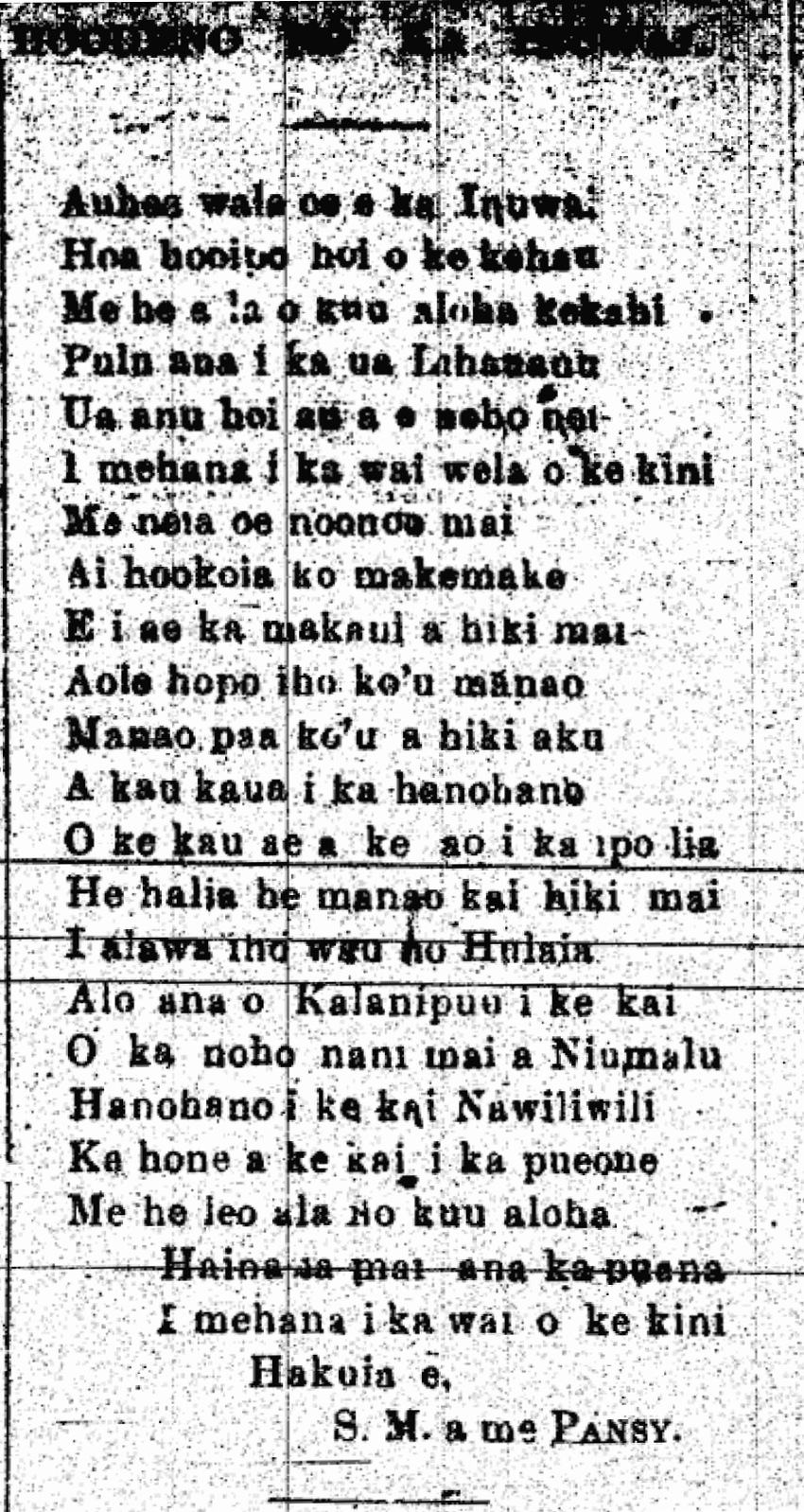
Auhea wale oe e ka Inuwai
Hoa hooipo hoi o ke kehau
Me he a la o kuu aloha kekahi
Pulu ana i ka ua Lihauanu
Ua anu hoi au a e noho nei
I mehana i ka wai wela o ke kini
Me neia oe noonoo mai
Ai hookoia ko makemake
E i ae ka makani a hiki mai
Aole hopo iho ko’u manao
Manao paa ko’u a hiki aku
A kau kaua i ka hanohano
O ke kau ae a ke ao i ka ipo lia
He halia he manao kai hiki mai
I alawa iho wau no Hulaia
Alo ana o Kalanipuu i ke kai
O ka noho nani mai a Niumalu
Hanohano i ke kai Nawiliwili
Ke hone a ke kai i ka pueone
Me he leo ala no kuu aloha

Haina ia mai ana ka puana
I mehana i ka wai o ke kini

Hakuia e,
S. M. a me Pansy.

(Leo o ka Lahui, 6/10/1895, p. 2)

HOOHENO NO KA INUWAI.

Ka Leo o ka Lahui, Buke II, Helu 1226, Aoao 2. Iune 10, 1895.

Princess Kaiulani celebrates the new year in Waimea, 1899.

New Year’s Celebration in Waimea.

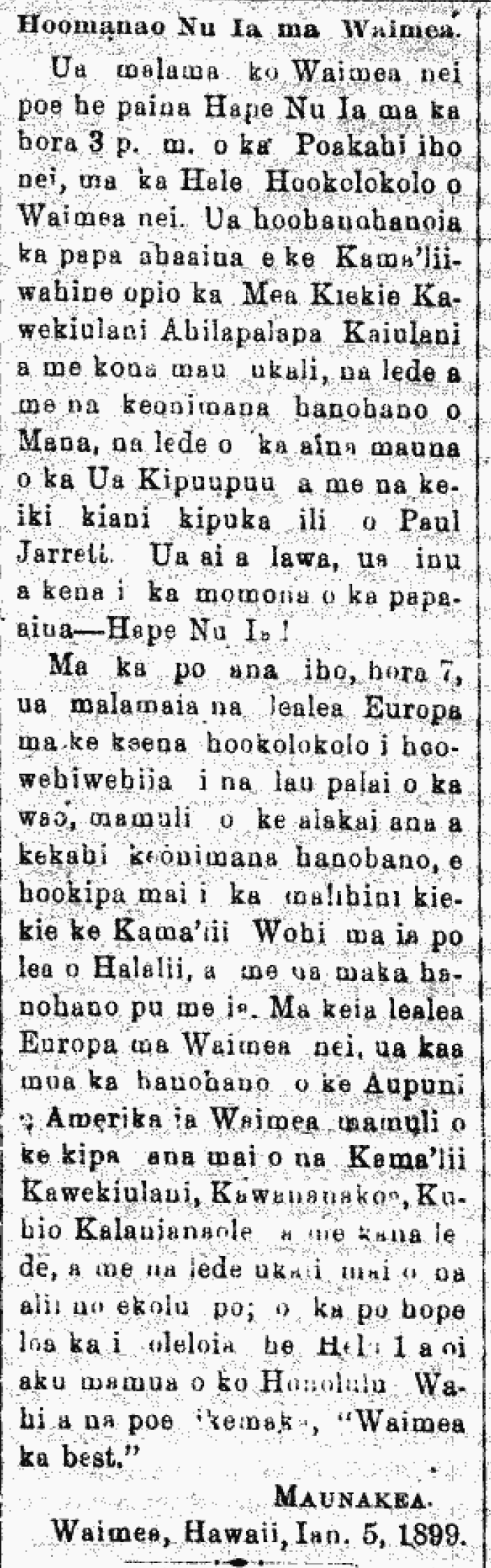
The people of Waimea held a Happy New Year party at 3 p. m. on this past Tuesday [1/3/1899], at the Courthouse here in Waimea. The table was given honor by the young Princess, Her Highness Kawekiulani Ahilapalapa Kaiulani and her entourage: the honorable ladies and gentlemen of Mana; the ladies of the mountainous land of the Kipuupuu Rain [Waimea]; and the lasso-flicking youth, Paul Jarrett. They ate until full, and drank until satiated of the delicacies of the table—Hape Nu Ia!

On the following night at 7 o’clock, European entertainment was held in the courtroom decorated with palai fronds of the forests, under the direction of an honorable gentleman giving welcome to the esteemed guest, the Wohi Princess, on that night of festivities, along with the other dignified ones accompanying her. In this European entertainment, the honor of the American Nation was paid first to Waimea, by the visit of the Young Alii Kawekiulani, Kawananakoa, Kuhio Kalanianaole, and his wife, along with the attending ladies of the alii for three nights; and it is said of the final night that it was Number 1 and better than Honolulu. According to the witnesses, “Waimea is the best.”

Maunakea.

Waimea, Hawaii, Jan. 5, 1899.

(Makaainana, 1/9/1899, p. 1)

Hoomanao Nu Ia ma Waimea.

Ka Makaainana, Buke XI—-Ano Hou, Helu 2, Aoao 1. Ianuari 9, 1899.

Mele found everywhere in the newspapers. 1899.

[Found in: “HALEIWA HOTELE: Ka Ui Mahiehie ma Waialua”]

O ka loku hala ole
A ka ua i Maili,
Ili hewa ka manao ia nei,
Ka waiho la i ka lai.

Chorus: O oe kai hui iho la,
Ka manao e puapuai la,
Ei ae o Puu-o-Hulu,
Hului no au, ua hiki no.

Nau i lahui i ka leo,
Ike i ka makani Kaieulu [Kaiaulu],
Ka makani o ka aina,
Ilaila hoola’i na manu.

[Here is another interesting mele found in a nice description of an excursion aboard the train Kaala to the newly-opened Haleiwa Hotel. It is added into the narrative by the writer as he describes passing by Puuohulu. This inserting of mele into prose is something found often in Hawaiian writing. This composition seems very reminiscent of another perhaps more famous mele still sung today.]

(Kuokoa, 8/11/1899, p. 1)

O ka loku hala oe, A ka ua i Maili...

Ka Nupepa Kuokoa, Buke XXXVIII, Helu 32, Aoao 1. Augate 11, 1899.

More on the famous paniolo of Waimea, 1908.

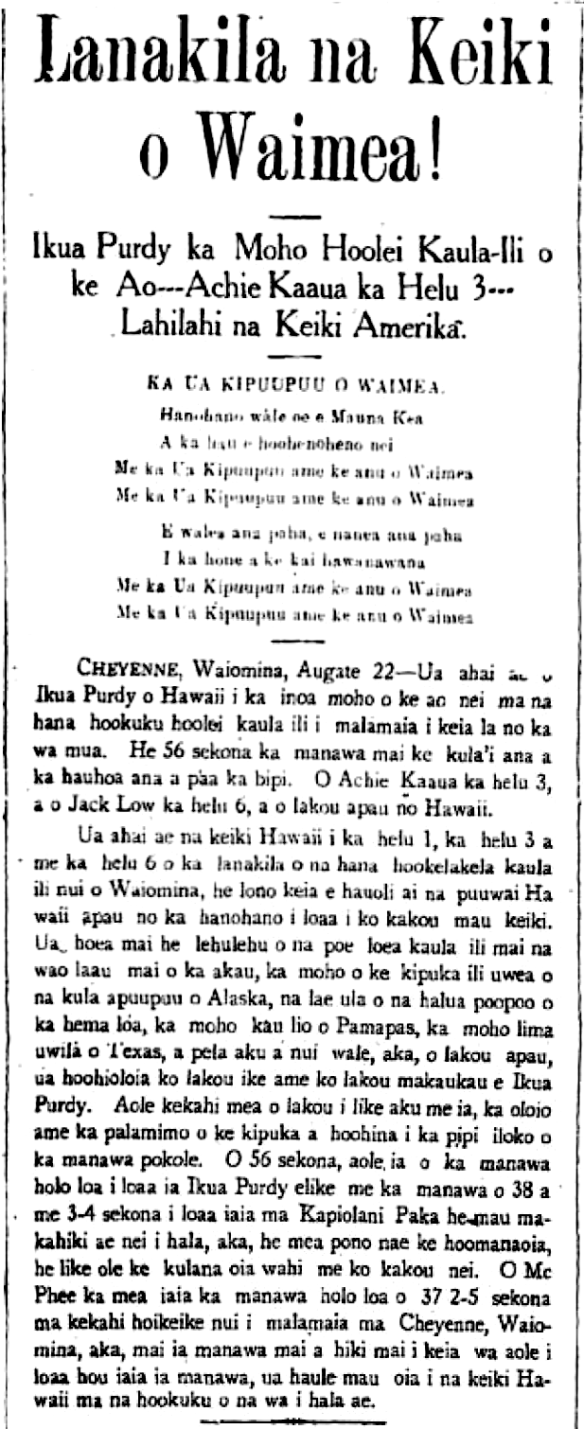
The Boys of Waimea are Victorious!

Ikua Purdy is the Champion Roper of the World—Archie Kaaua took 3rd—the American Boys are Weak¹.

KA UA KIPUUPUU O WAIMEA.

Hanohano wale no o Mauna Kea
A ka hau e hoohenoheno nei
Me ka Ua Kipuupuu ame ke anu o Waimea

E walea ana paha, e nanea ana paha
I ka hone a ke kai hawanawana
Me ka Ua Kipuupuu ame ke anu o Waimea

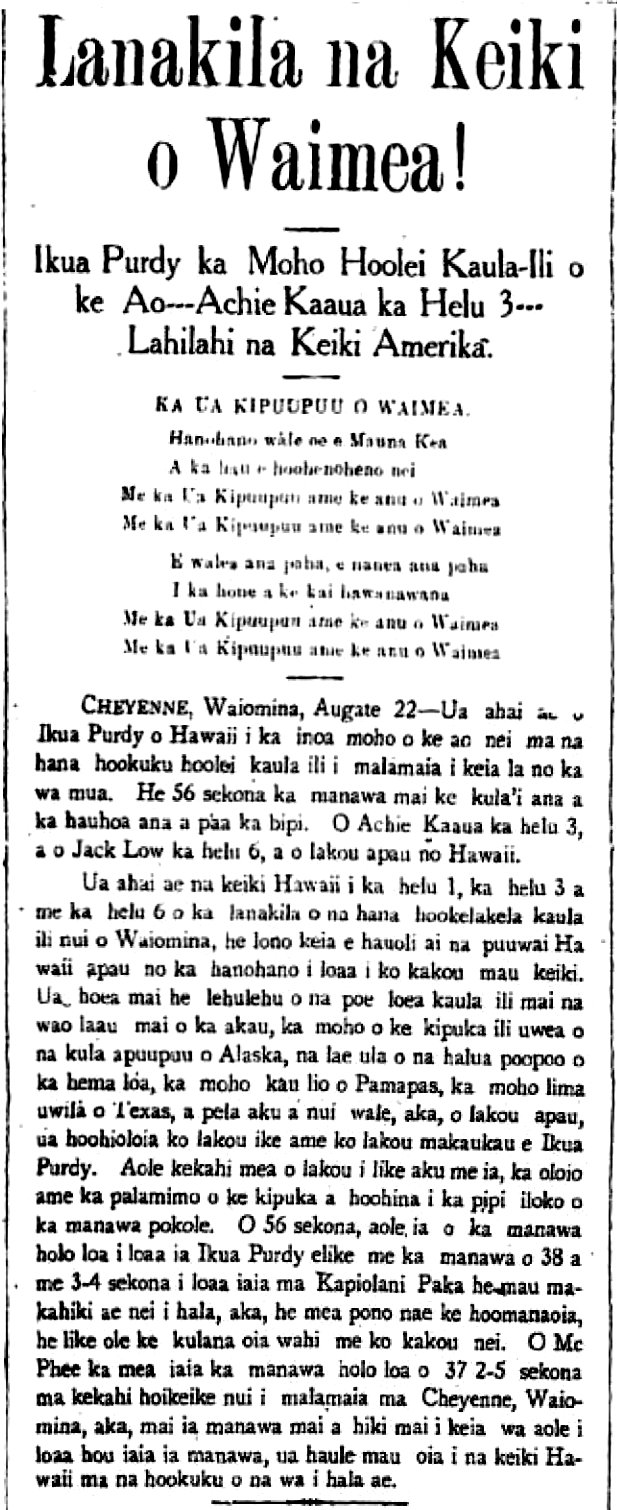
CHEYENNE, Wyoming, August 22—Ikua Purdy of Hawaii took the name of champion of the world in the roping contest held today for the first time. It took 56 seconds from the release of the steer until it was tied fast. Archie Kaaua [Achie Kaaua] took 3rd, and Jack Low took 6th, and they are all from Hawaii.

The Hawaiian boys took 1st, 3rd, and 6th places in the great contest of Wyoming; this is news which all Hawaiian hearts can be happy about, for the honor garnered by our boys. Many expert ropers showed up, from the forests of the north, the champion of the wire lasso of the rugged plains of Alaska, the experts from the furrowed lands of the far south, the champion rider of the Pampas, the lightning-handed champion of Texas, and so many more; however, all of their knowledge and preparation was overcome by Ikua Purdy. Not one of them was his match, with his swift and skilled lassoing and felling of the steer in short time. 56 seconds was not the fastest time made by Ikua Purdy like the 38 3/4 seconds he achieved at Kapiolani Park some years earlier, however, it should be kept in mind that the conditions there are not the same as ours. McPhee is the one with the fastest time, 37 2/5 seconds gotten at a big contest held in Cheyenne, Wyoming, but from that time to now, he did not make that time again; he was constantly defeated by the Hawaiian boys in contests after that.

THE KIPUUPUU RAIN OF WAIMEA.

Glorious is Mauna Kea
Graced with snow
With the Kipuupuu Rain and the cold of Waimea

Relaxing at ease
At the soft whispering sea
With the Kipuupuu Rain and the cold of Waimea

¹I’m not sure if “Lahilahi” here is referring to the American boys being “deflated”…

(Kuokoa Home Rula, 8/28/1908, p. 1)
Lanakila na Keiki o Waimea!

Kuokoa Home Rula, Buke VI, Helu 35, Aoao 1. Augate 28, 1908.

Poi calabash made by plaiting hala leaves? 1869.

[Found under: “LOCAL NEWS: Oahu.”]

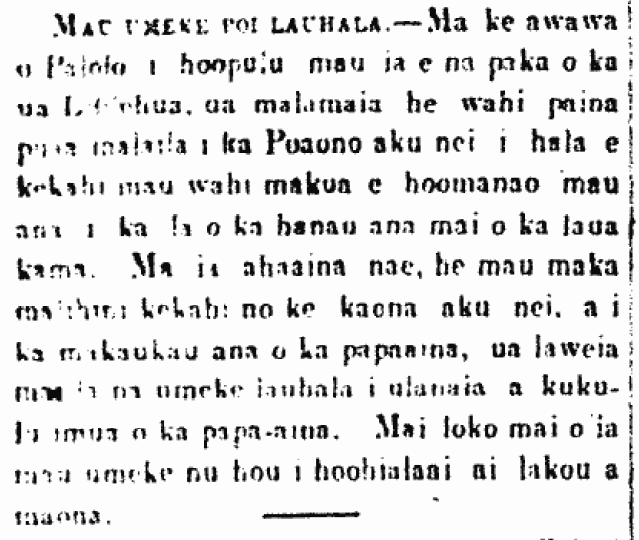
Lau Hala Poi Umeke (Calabashes).—In Palolo Valley which is ever moistened by the patter of the Lililehua rain, there was held a small feast of pig there on this past Saturday by parents who regularly celebrate the birthdays of their child. At the party, there were also present visitors from town, and when the table of food was being prepared, umeke made out of woven lau hala were brought and placed at the front of the table. From these new type of calabashes did they eat heartily until full.

[Does anyone still make these? Has anyone seen examples of these??]

(Kuokoa, 4/10/1869, p. 3)

Mau Umeke Poi Lauhala.

Ka Nupepa Kuokoa, Buke VIII, Helu 15, Aoao 3. Aperila 10, 1869.

John James Kawehena passes away in Kalawao, 1887.

He has Passed on; He has Gone

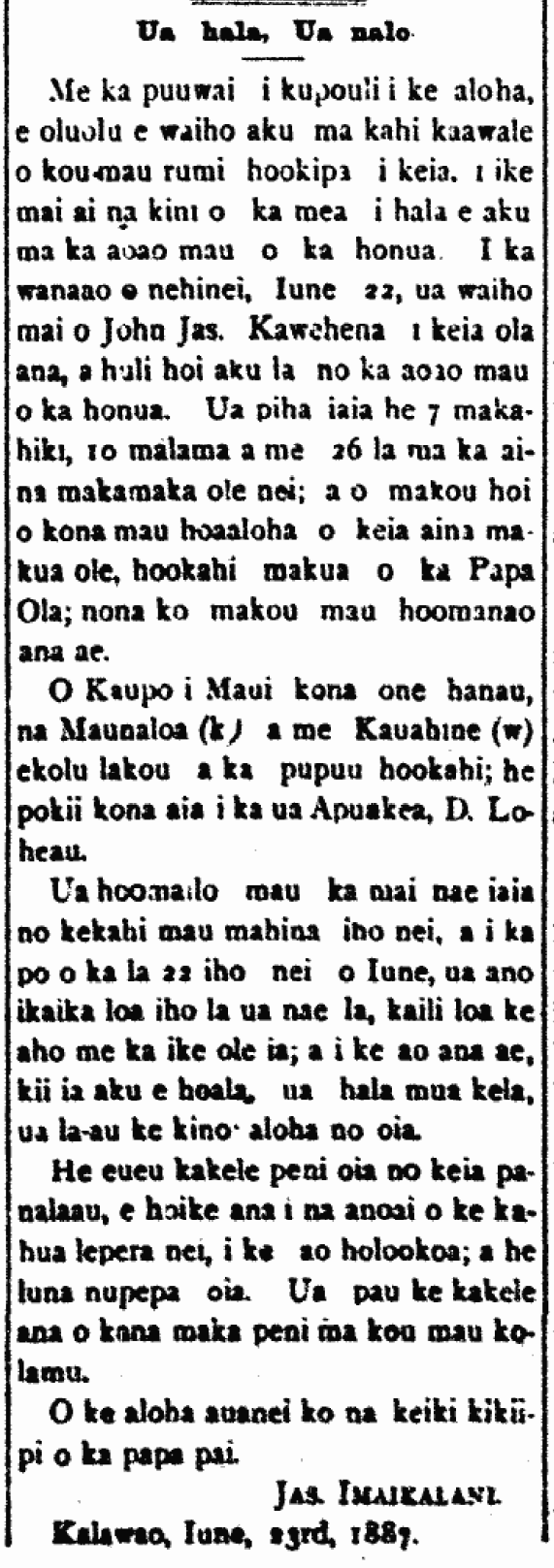
With a heart darkened by sadness, I ask you to kindly leave me a space in your pages¹ for this, so that the many people of the one who has passed on to death will know. At dawn of yesterday, June 22, John James Kawehena left this life, and returned to the everlasting side of the earth. He spent 7 years, 10 months, and 26 days in this forsaken land; and as for us, his friends of this land without parents save one, the Board of Health [Papa Ola], for him is our remembrance.

His land of birth was Kaupo on Maui; his parents were Maunaloa (m) and Kauahine (f), and the three of them lived together; he has a younger sibling in the Apuakea rain,² D. Loheau.

He was growing thin with shortness of breath for these past months, and in the night of the 22nd of this past June, the shortness of breath grew worse and his breath was unbeknownst to us snatched away for good; and the next morning, we went to wake him but he was already gone and his body was stiff; much aloha for him.

He was an active writer for this colony, reporting the news of this land of leprosy patience to the whole world; and he was one of the heads of a newspaper. His writings will no longer appear in your columns.

Aloha to the [kikiipi ?] boys of the press.

JAMES IMAIKALANI.

Kalawao, June 23rd, 1887.

¹Literally a parlor or a room to greet people

²Famous in Koolaupoko on Oahu

[Although the information from Kalaupapa and Kalawao were not usually included in the regular Vital Statistics column, they were often printed in the other columns of the Hawaiian-Language Newspapers!]

(Kuokoa, 7/9/1887, p. 3)

Ua hala, Ua nalo

Ka Nupepa Kuokoa, Buke XXVI, Helu 28, Aoao 3. Iulai 9, 1887.

Sun blocked out, 1868.

[Found under: “LOCAL NEWS: Oahu”]

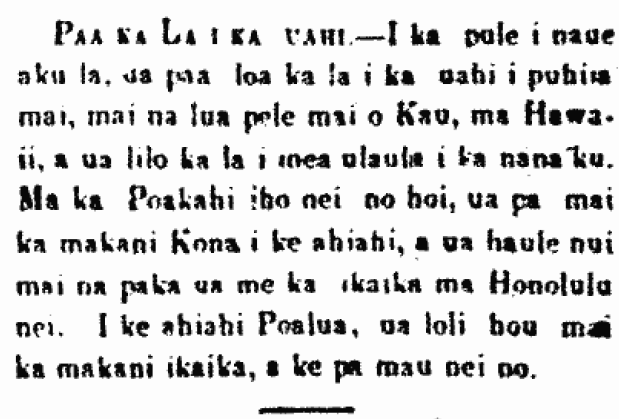
Sun Blocked by Smoke.—Last week, the sun was totally covered over by the smoke blown from the volcano of Kau on Hawaii, and the sun appeared red. On Monday, the Kona winds blew in the evening, and much heavy rains fell in Honolulu nei. On Tuesday evening, it turned into strong winds which are still blowing now.

(Kuokoa, 4/18/1868, p. 3)

Paa ka La i ka uahi.

Ka Nupepa Kuokoa, Buke VII, Helu 16, Aoao 3. Aperila 18, 1868.

Marriage announcement outside of the Vital Statistics Column, 1912.

BOUND WITH THE THREE-STRAND CORD OF TRUE LOVE

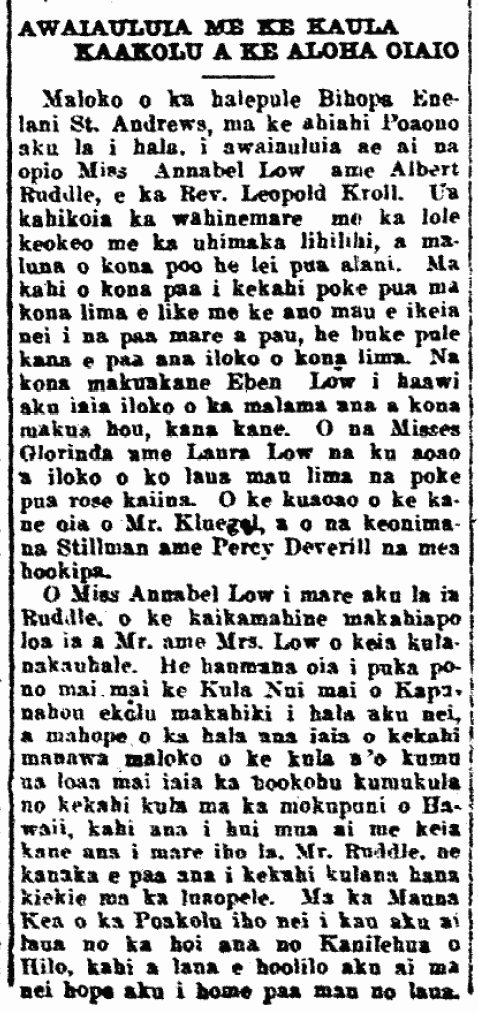
Within the Anglican Church of St. Andrew’s, on this past Saturday evening, the youths, Miss Annabel Low and Albert Ruddle were joined together by the Rev. Leopold Kroll. The bride was donned with a white dress and a sheer veil, and atop her head was a lei of orange blossoms. She held a bouquet of flowers in her hand as seen in all marriage ceremonies, and she held a book of prayers in her hand. It was her father, Eben Low, who gave her into the care of her new parent, her husband. Misses Glorinda and Laura Low were the bride’s maids, and they held in their hands, bouquets of lavender roses. The best man was Mr. Kinegal, and the gentlemen in charge of hospitality were Stillman and Percy Deverill.

Miss Annabel Low who married Ruddle is the eldest daughter of Mr. and Mrs. Low of this town. She was a student who graduated from the College of Kapunahou [Punahou] three years ago, and after some time in the teachers’ school, she was appointed as a teacher at a school on Hawaii Island, where she first met this man whom she wed, Mr. Ruddle, who is employed in a high position at the volcano. They will be returning to the Kanilehua of Hilo on Wednesday’s Mauna Kea where they will make their permanent home from here forth.

(Kuokoa, 7/12/1912, p. 6)

AWAIAULUIA ME KE KAULA KAAKOLU A KE ALOHA OIAIO

Ka Nupepa Kuokoa, Buke XLVIII, Helu 28, Aoao 6. Iulai 12, 1912.