Bubonic plague reached our shores? 1901.

THE MICE HAVE NOT DIED.

The mice given fluids from that Japanese woman said to have died from the bubonic plague [ma’i bubonika] have not died. There are just two more days left, and after they are over, and the mice do not die, it will be clear to the doctors that the bubonic plague has not come to Hawaii nei. Pray that the mice live and we are saved of that tragedy.

(Kuokoa, 4/5/1901, p. 6)
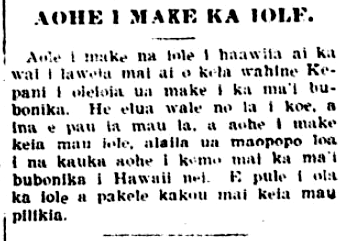
Kuokoa_4_5_1901_6.png

Ka Nupepa Kuokoa, Buke XXXIX, Helu 14, Aoao 6. Aperila 5, 1901.
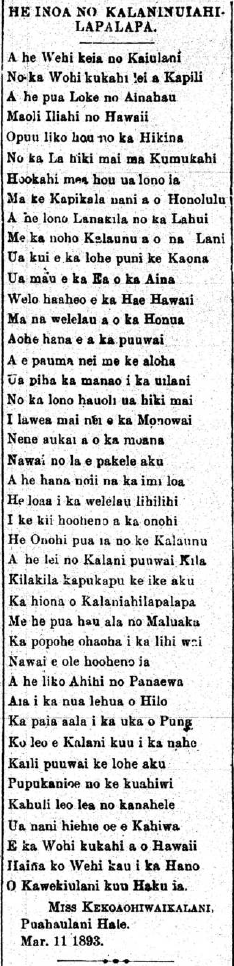
Mele inoa for Princess Kaiulani by Eleanor Kekoaohiwaikalani Prendergast, 1893.

HE INOA NO KALANINUIAHILAPALAPA.

A he Wehi keia no Kaiulani
No ka Wohi kukahi lei a Kapili
A he pua Loke no Ainahau
Maoli Iliahi no Hawaii
Opuu liko hou no ka Hikina
No ka La hiki mai ma Kumukahi
Hookahi mea hou ua lono ia
Ma ke Kapikala nani a o Honolulu
A he lono Lanakila no ka Lahui
Me ka noho Kalaunu a o na Lani
Ua kui e ka lohe puni ke Kaona
Ua mau ke Ea o ka Aina
Welo haaheo e ka Hae Hawaii
Ma na welelau a o ka Honua
Aohe hana e a ka puuwai
A e pauma nei me ke aloha
Ua piha ka manao i ka uilani
No ka lono hauoli ua hiki mai
I lawea mai nei o ka Monowai
Nene aukai a o ka moana
Nawai no la e pakele aku
A he hana noii na ka imi loa
He loaa i ka welelau lihilihi
I ke kii hooheno a ka onohi
He Onohi pua ia no ke Kalaunu
A he lei no Kalani puuwai Kila
Kilakila kapukapu ke ike aku
Ka hiona o Kalaniahilapalapa
Me he pua hau ala no Maluaka
Ka popohe ohaoha i ka lihi wai
Nawai e ole hooheno ia
A he liko Ahihi no Panaewa
Aia i ka nua lehua o Hilo
Ka paia aala i ka uka o Puna
Ko leo e Kalani kuu i ka nahe
Kaili puuwai ke lohe aku
Pupukanioe no ke kuahiwi
Kahuli leo lea no kanahele
Ua nani hiehie oe e Kahiwa
E ka Wohi kukahi a o Hawaii
Haina ko Wehi kau i ka Hano
O Kawekiulani kuu Haku ia.

Miss Kekoaohiwaikalani,
Puahaulani Hale.

Mar. 11, 1893.

(Leo o ka Lahui, 3/21/1893, p. 3)

leookalahui_3_21_1893_3

Ka Leo o ka Lahui, Buke II, Helu 666, Aoao 3. Maraki 21, 1893.

Josephine Pomaikai Luia turns one year old, 1916.

[Found under: “Nuhou Kuloko.”]

There was a table set out of all sorts of delicacies to celebrate the completion of the first year of that flower bud, Miss Josephine Pomaikai Luia, this past Sunday, October 8, 1916, at Kunawai, at the Supernatural Stone of Kawaiiki [?? Pohaku Kupua o Kawaiiki]. There were many friends and associates who went to visit; also there were some candidates who were chosen recently at the election, to eat heartily together of the rich foods of the feast. Long live the new offspring was the prayer of those who joined in the eating.

[Might anyone know what the pohaku kupua at Kawaiiki in Kunawai is?]

(Kuokoa, 10/13/1916, p. 4)

Kuokoa_10_13_1916_4.png

Ka Nupepa Kuokoa, Buke LIV, Helu 41, Aoao 4. Okatoba 13, 1916.

Soldiers playing marbles? 1867.

[Found under: “NU HOU KULOKO.”]

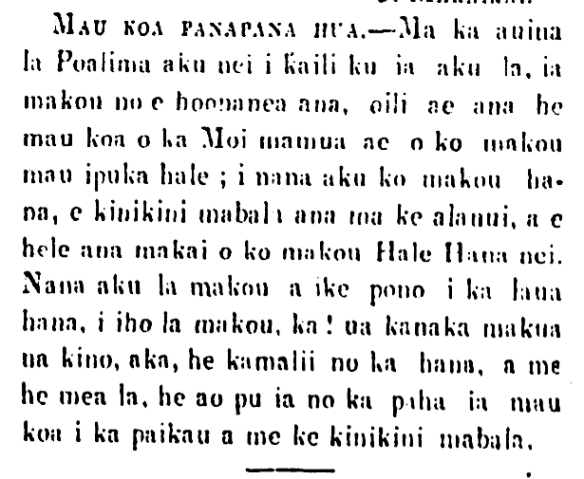
SOME SOLDIERS SHOOTING MARBLES [PANAPANA HUA].—In the afternoon this Friday past, as we were enjoying ourselves, some of the King’s soldiers appeared before the entrance of our building and we went to see; they were playing marbles on the street and going seaward of our Establishment. We looked close to see what they were doing, and we said, “Oh my, their bodies are grown up, but they do the activity of children; it would seem as if the soldiers are taught marching along with how to play marbles [kinikini mabala].

(Kuokoa, 10/26/1867, p. 2)

Kuokoa_10_26_1867_2.png

Ka Nupepa Kuokoa, Buke VI, Helu 43, Aoao 2. Okatoba 26, 1867.

Jonah Kumalae gets contract to supply 250 ukulele per month, 1915.

HIGH DEMAND FOR UKULELE.

From the news heard from San Francisco, the stringed instrument, the ukulele, is greatly desired all over America because thousands of visitors at the exposition at San Francisco saw and heard for themselves the ukulele being played.

Jonah Kumalae earlier had a contract to supply two hundred fifty ukulele a month to a company selling the musical instruments in San Francisco, but now the number has been increased to five hundred ukulele per month.

Because some people really wanted to see an ukulele being played, they requested to be taught to play that stringed instrument, and Kailimai was the one who provided instruction to some people. Continue reading

Lei of the alii, 1930.

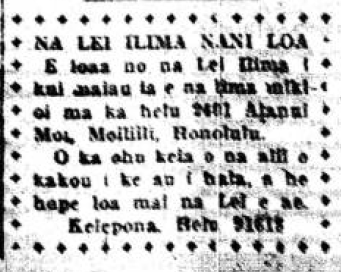
EXQUISITE ILIMA LEI

You can obtain Ilima Lei expertly sewn by skilled hands, at number 2401 King Street, Moiliili, Honolulu.

This was the adornment of our alii in times past, and the other Lei were inferior to it.

Telephone number 91618

[This was the address and phone number of the Alakai o Hawaii newspaper itself, and I assume that the lei seller was editor Jonah Kumalae, who was quite the businessman.]

(Alakai o Hawaii, 1/23/1930, p. 1)

AlakaioHawaii_6_19_1930_1.png

Ke Alakai o Hawaii, Buke II, Helu 38, Aoao 1. Ianuari 23, 1930.

Mele for the Claudine, the vessel that carried the commission of annexationists to Washington DC, 1893.

KELAUDINA SONG.

Kaulana mai nei Kelaudina
Ahailono o ka poe pakaha
Nau i lawe aku na komisina
O ke aupuni kuloko o Hawaii
Hopuhopualulu e ka hele’na
A na elele o ua aupuni nei
E ake ana e hookoia
Ka iini pakaha aina
Halawai aku nei lakou
Me kahi paele a Kalivilana Continue reading

One man’s grieving is another man’s atrocity. 1844.

Persecution. Just recently, some people here in Honolulu were persecuted for their tattooing, for their knocking out teeth, and for other foolish actions; they were led all about, here and there, by the overseer, while he made a spectacle of their offense before people. Perhaps this is a good thing; the ignorant will be shamed and the rogues will be in fear.

(Nonanona, 7/23/1844, p. 41)

Nonanona_7_23_1844_41.png

Ka Nonanona, Buke 4, Pepa 7, Aoao 41. Iulai 23, 1844.

Death of Kauhane, 1900.

THAT FAMILIAR ONE OF THE TOWN HAS PASSED ON.

At the Hospital was where the life of Kauhane left, one of the Hawaiians that was very familiar amongst the different ethnicities of this town. And this caused his friends around town to be overcome; he was a man that was very familiar as a sounder of the police whistle and an officer on street corners. And as a result of those positions, he had very many friends from the haole to the Hawaiians.

He was one of the Hawaiian boys who stepped foot on the Artic [Alika] in his youth, and he became a kamaaina of those foreign lands.

He was a Hawaiian who was greatly admired while he was travelled the seas¹ as a sailor until he became a Captain for one of the schooners of our seas. And he was one of the diligent servants…

[image] Continue reading

E nihi ka hele… 1893.

DON’T GET DISCOURAGED.

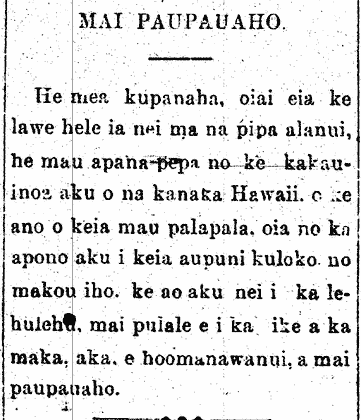
It is outrageous that pieces of paper are being carried on the sides of the streets for Hawaiians to sign; these are documents approving the provisional government [aupuni kuloko] for ourselves; we instruct the public not to let what you see excite you, but be patient and don’t get discouraged.

(Leo o ka Lahui, 1/20/1893, p. 2)

LOKL_1_20_1893_2.png

Ka Leo o ka Lahui, Buke II, Helu 626, Aoao 2. Ianuari 20, 1893.