Kamehameha IV visits Nihoa, 1857.

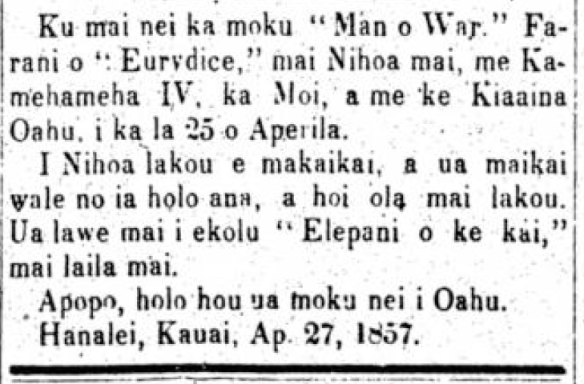
The French man of war “Eurydice” arrived from Nihoa with Kamehameha IV, the King, and the Governor of Oahu [Kekuanaoa], on the 25th of April.

They were on Nihoa touring, and the trip was fine, and they returned in good health. They brought back three “Elephants of the sea,” from there.

Tomorrow, the vessel will return to Oahu.

Hanalei, Kauai, Ap. 27, 1857.

(Hae Hawaii, 5/13/1857, p. 26)

HaeHawaii_5_13_1857_26

Ka Hae Hawaii, Buke 2, Ano Hou.—Helu 7, Aoao 26. Mei 13, 1857.

John Smith, flautist for Kamehameha III, and land rights, 1904.

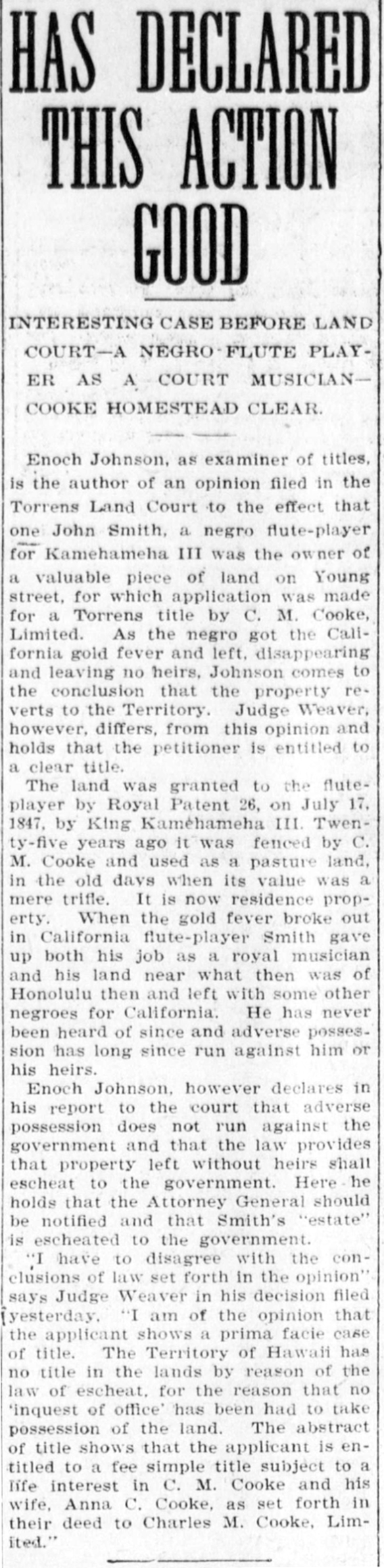
HAS DECLARED THIS ACTION GOOD

INTERESTING CASE BEFORE LAND COURT—A NEGRO FLUTE PLAYER AS A COURT MUSICAN—COOKE HOMESTEAD CLEAR.

Enoch Johnson, as examiner of titles, is the author of an opinion filed in the Torrens Land Court to the effect that one John Smith, a negro flute-player for Kamehameha III was owner of a valuable piece of land on Young street, for which application was made for a Torrens title by C. M. Cooke, Limited. As the negro got the California gold fever and left, disappearing and leaving no heirs, Johnson comes to the conclusion that the property reverts to the Territory. Judge Weaver, however, differs, from this opinion and holds that the petitioner is entitled to a clear title.

The land was granted to the flute-player by Royal Patent 26, on July 17, 1847, by King Kamehameha III. Twenty-five years ago it was used as a pasture land, in the old days when its value was a mere trifle. It is now residence property. When the gold fever broke out in California flute-player Smith gave up both his job as a royal musician and his land near what then was of Honolulu then and left with some other negroes for California. He has never been heard of since and adverse possession has long since run against him or his heirs.

Enoch Johnson, however declares in his report to the court that adverse possession does not run against the government and that the law provides that property left without heirs shall escheat to the government. Here he holds that the Attorney General should be notified and that Smith’s “estate” is escheated to the government.

“I have to disagree with the conclusions of law set forth in the opinion” says Judge Weaver in his decision filed yesterda. “I am of the opinion that the applicant shows a prima facie case of title. The Territory of Hawaii has no title in the lands by reason of the law of escheat, for the reason that no ‘inquest of office’ has been had to take possession of the land. The abstract of title shows that the applicant is entitled to a fee simple title subject to a life interest in C. M. Cooke and his wife, Anna C. Cooke, as set forth in their deed to Charles M. Cooke, Limited.”

(Hawaiian Star, 6/23/1904, p. 8)

HawaiianStar_6_23_1904_8.png

The Hawaiian Star, Volume XII, Number 3824, Page 8. June 23, 1904.

Mango jam? Sounds ono, 1936.

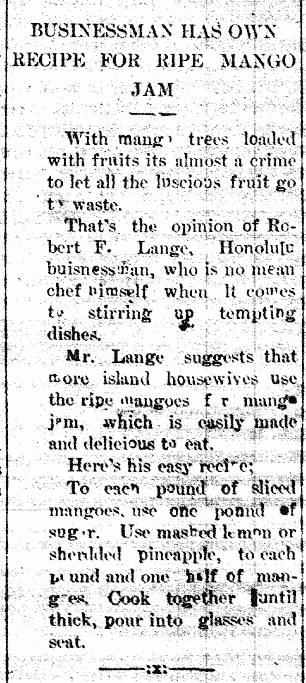
BUSINESSMAN HAS OWN RECIPE FOR RIPE MANGO JAM

With mango trees loaded with fruits its almost a crime to let all the luscious fruit go to waste.

That’s the opinion of Robert F. Lange, Honolulu businessman, who is no mean chef himself when it comes to stirring up tempting dishes.

Mr. Lange suggests that more island housewives use the ripe mangoes for making mango jam, which is easily made and delicious to eat.

Here’s his easy recipe.

To each pound of sliced mangoes, use one pound of sugar. Use mashed lemon or shredded pineapple, to each pound and one half of mangoes. Cook together until thick, pour into glases and seal.

(Hoku o Hawaii, 8/5/1936, p. 1)

HokuoHawaii_8_5_1936_1.png

Ka Hoku o Hawaii, Volume XXXI, Number 14, Aoao 1. August 5, 1936.

La Hoihoi Ea, 1895.

RESTORATION DAY OF HAWAII.

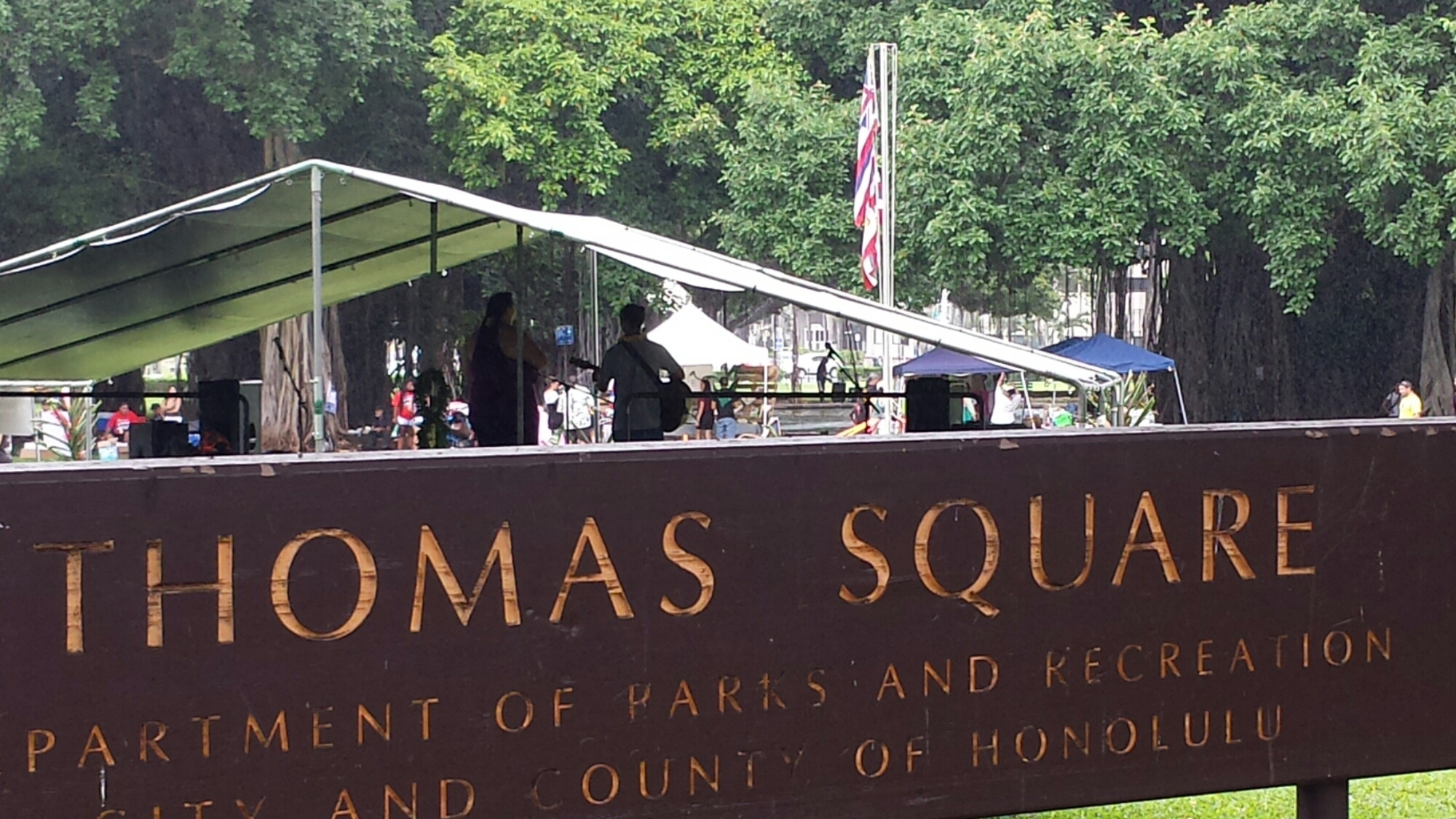
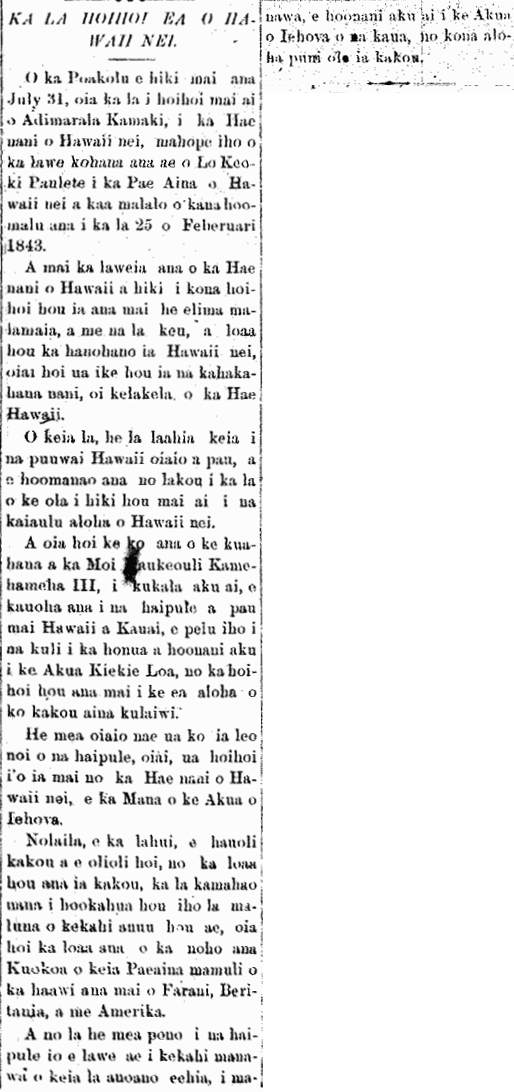
The coming Wednesday, July 31, is the day that Admiral Thomas restored the glorious Flag of Hawaii nei, after he stripped these Hawaiian Islands and took them under his power on the 25th of February 1843.

And from the taking of the beautiful Flag of Hawaii until its return was five months and some days, and the glory of Hawaii was regained, for the beautiful, magnificent stripes of the Hawaiian Flag was seen once more.

This day is a sacred day in the hearts of all true Hawaiians, and they commemorate the day that the life returned to the loving communities of Hawaii nei.

And the proclamation proclaimed by the King, Kauikeaouli Kamehameha III was fulfilled, as he commanded all the devout from Hawaii to Kauai to kneel down and give glory to God Almighty for returning the beloved sovereignty to our homeland.

It is true that the supplication of the devout was heard, for the beautiful Flag of Hawaii nei was indeed restored by the Power of God, Jehovah.

Therefore, O Lahui, let us be happy and rejoice, for gaining this glorious day which established the foundation for a new step, that being the Independence of these Islands given by France, Britain, and America.

Now all true faithful ones should take some time on this awesome and sacred day as time to glorify God, Jehovah almighty for his true love for us.

(Oiaio, 8/2/1895, p. 4)

Oiaio_8_2_1895_4.png

Ka Oiaio, Buke VII, Helu 22, Aoao 4. Augate 2, 1895.

Mele for the island chain of Papa and Wakea: a response to the Armstrong call, 1860.

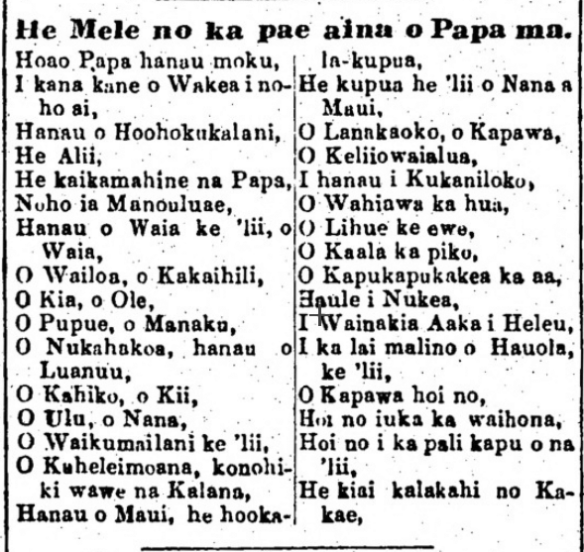
He Mele no ka pae aina o Papa ma.

Hoao Papa hanau moku,
I kana kane o Wakea i noho ai,
Hanau o Hoohokukalani,
He Alii,
He kaikamahine na Papa,
Noho ia Manouluae,
Hanau o Waia ke ’lii, o Waia,
O Wailoa, o Kakaihili,
O Kia, o Ole,
O Pupue, o Manaku,
O Nukahakoa, hanau o Luanuu,
O Kahiko, o Kii,
O Ulu, o Nana,
O Waikumailani ke ’lii,
O Kuheleimoana, konohiki wawe na Kaloana,
Hanau o Maui, he hookala-kupua,
He kupua he ’lii o Nana a Maui,
O Lanakaoko, o Kapawa,
O Keliiowaialua,
I hanau i Kukaniloko,
O Wahiawa ka hua,
O Lihue ke ewe,
O Kaala ka piko,
O Kapukapukakea ka aa,
Haule i Nukea,
I Wainakia Aaka i Heleu,
I ka lai malino o Hauola, ke ’lii,
O Kapawa hoi no,
Hoi no iuka ka waihona,
Hoi no i ka pali kapu o na ’lii,
He kiai kalakahi no Kakae,

[This is but one of the many mele submitted to the Hae Hawaii in response to the calls put out by Samuel Chapman Armstrong.]

(Hae Hawaii, 8/8/1860, p. 77)
HaeHawaii_8_8_1860_77

Ka Hae Hawaii, Buke 5, Ano Hou.—Helu 19, Aoao 77. Augate 8, 1860.

The call for information on traditional knowledge, 1860.

ANCIENT MELE.

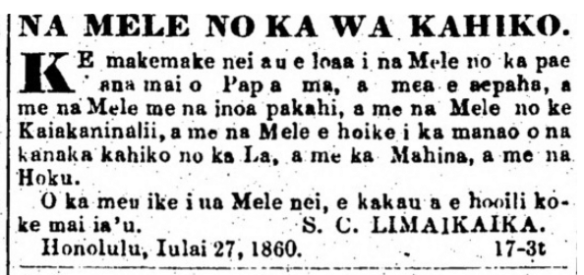
I want to obtain Mele about the arrival of Papa folks, and perhaps others, and Mele with each individual name, and Mele about the Kaiakahinalii [Great Flood], and Mele showing what the ancient people thought about the Sun, the Moon, and the Stars.

For those who know these Mele, write them down and send them to me. S. C. ARMSTRONG.

Honolulu, July 27, 1860.

[There was a broader request earlier that year. See: No na Mele!]

(Hae Hawaii, 7/25/1860, p. 71)

HaeHawaii_7_25_1860_71

Ka Hae Hawaii, Buke 5, Ano Hou.—Helu 17, Aoao 71. Iulai 25, 1860.

Things that make you go, “Hmmmm.” 1883.

[Found under: “ISLAND LOCALS: ABOUT TOWN.”]

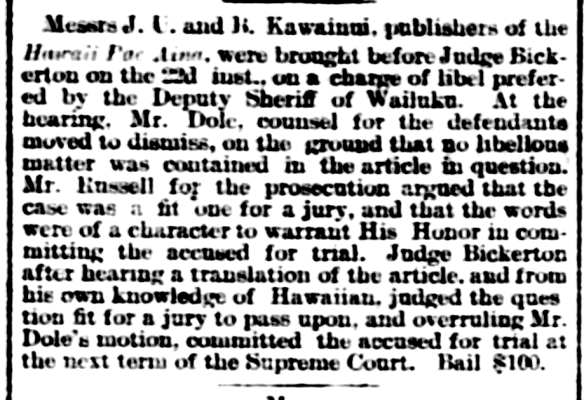
Messrs J. U. and B. Kawainui, publishers of the Hawaii Pae Aina, were brought before Judge Bickerton on the 22d inst., on a charge of libel prefered by the Deputy Sheriff of Wailuku. At the hearing, Mr. Dole, counsel for the defendants moved to dismiss, on the ground that no libellous matter was contained in the article in question. Mr. Russell for the prosecution argued that the case was a fit one for jury, and that the words were of a character to warrant His Honor in committing the accused for trial. Judge Bickerton after hearing a translation of the article, and from his own knowledge of Hawaiian, judged the question fit for a jury to pass upon, and overruling Mr. Dole’s motion, committed the accused for trial at the next term of the Supreme Court. Bail $100.

(Hawaiian Gazette, 4/25/1883, p. 3)

HawaiianGazette_4_25_1883_3.png

Hawaiian Gazette, Volume XVIII, Number 17, Page 3. April 25, 1883.