David Kaonohiokala Peleiholani Jr. passes away, 1921.

MY DEAR CHILD HAS GONE.

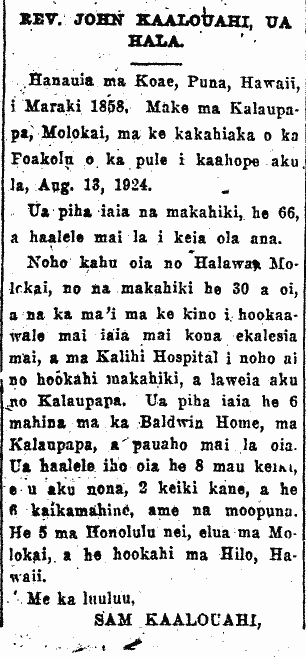
David Kaonohiokala Peleiholani

Mr. Editor of the Kuokoa, Aloha amongst us:—Please allow me once again some open space of the Pride of the Lahui, for my sad offering placed above, so that all of the family from Hawaii to Niihau will see our lei, David Kaonohi Peleiholani, shortened to D. K. Pele Jr., [left this] life in America.

In the happiness of this life and the enjoyment, one becomes dejected when you had not expected sad news would arrive.

The telegraph of Puuloa informed me, “your son, David Kaonohi Pele, died at the navy hospital in America on the 26th of February, 1921, because he had persistent pneumonia for six weeks. Auwe, my sorrow for you! Auwe what anguish!

I thought of my later days with you, my hiapo, for I saw how you help me while you were in front of me, and so too while you were sending me my monthly stipend. But here there is this crisis of yours going to the navy school, you have gone afar on the road of no return.

I am full of regret for you my travelling companion of Koloa, my child who was not a burden for me and my wife until she passed, leaving me and our children grieving for her, and here he follows in the footsteps of his beloved mama who passed on the 17th of March, 1920; aloha to you my first born!

On the 16th of September, 1920, I placed him to be educated in the naval military school aboard the U. S. S. Wyoming, and always received letters from him making me happy, while he sent along money because of his aloha for me and his one younger sibling and their hanai child, a girl.

Auwe, my pain for you, O my dear lei who went first, my companion of the Maunaloa, as we labored at the ports of Waimea, Port Allen, Koloa, Nawiliwili and Ahukini, when the ship didn’t have enough sailors; aloha to you, I turn to you but you are not there, as I prayed for you everyday; but come to find out you were to leave me.

After your letter to me in December saying that you asked that I be paid $16.00 every month, and also saying that should he die that I would receive his insurance, and those would be the benefits you will get, O Papa. Auwe as I live in darkness as my first born told me in advance of the end; but I did not imagine there would be a sad ending that would come.

From that time I didn’t get any of his letters, until there came the telegraph saying that my dear child left on that road where he would not be seen again.

My first born child was born on the 14th of Oct., 1905, at Kailua, Koolaupoko, Oahu, and passed away on the 26th of February, 1921; and he spent a full 15 years and 4 months breathing in the air of this w0rld of suffering.

Auwe for you, O Kaonohiokala, who I grieve for; and yet you are leaving me, while you are always on my mind both day and night; always coming to speak with me of my desires  of days gone by; aloha to you; no more will I call out to you; I go to comfort you but you are not there, my beloved lei.

You are no more, you are gone on the path of no return, and God has taken what is His, the spirit.

With these thoughts of aloha for my beloved son, David Kaonohi Peleiholani, I conclude here, with aloha for you, the Editor and the boys of your press.

Sincerely,

DAVID K. PELE, SR.

Poipu Home, Koloa, Kauai.

[Many long names were shortened as time went on. This is one of the things that makes historical research and genealogical research a challenge. It would be awesome if there was a public site where name variations could be easily documented and added to.

The death announcement David Kamaka Pele submits for his wife, Sarah Kaniaupio Pele appears in Kuokoa, 5/7/1920, p. 3.]

(Kuokoa, 3/11/1921, p. 3)

KUU KEIKI ALOHA UA HALA

Ka Nupepa Kuokoa, Buke LIX, Helu 10, Aoao 3. Maraki 11, 1921.

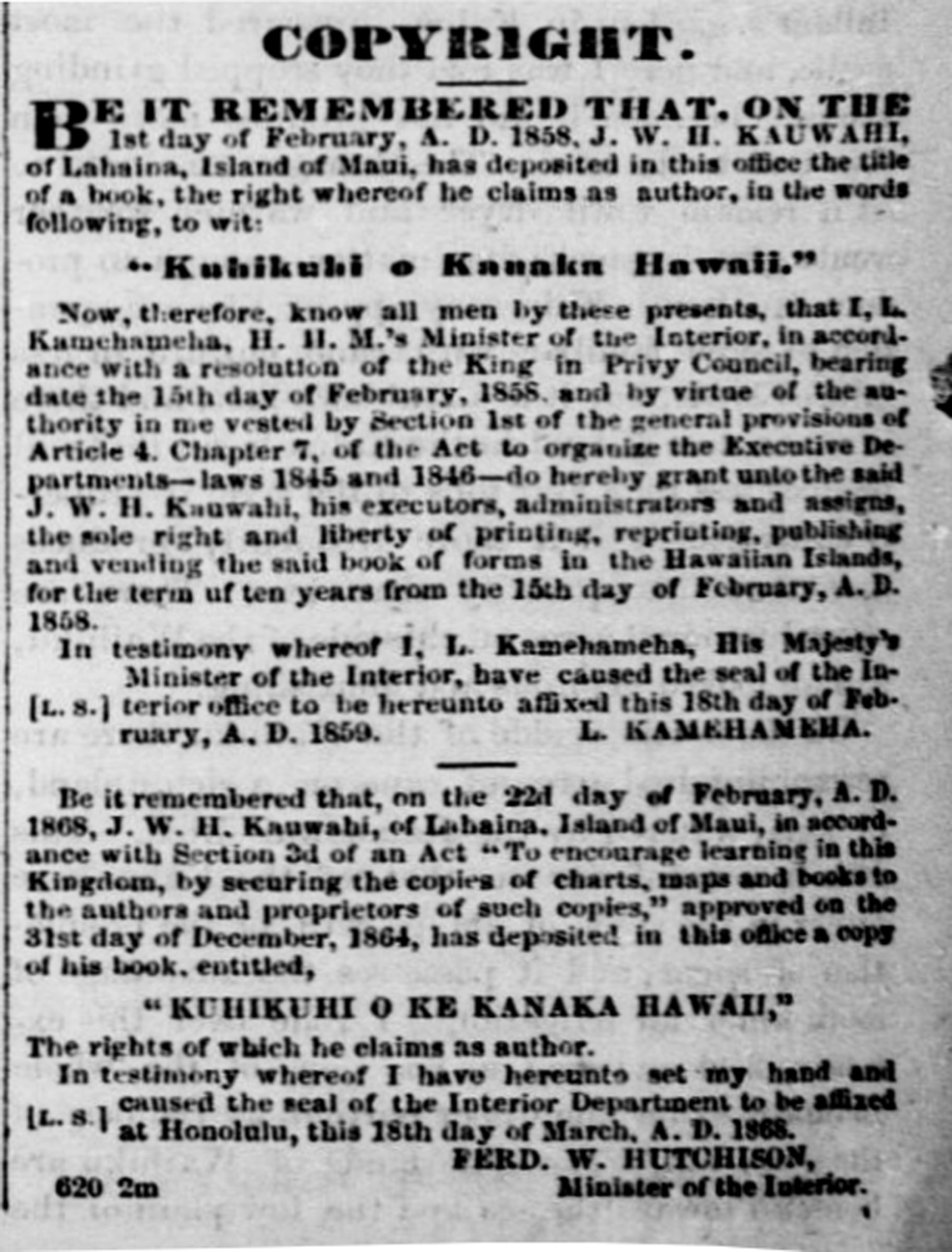
Reissue of copyright for J. W. H. Kauwahi’s “Kuhikuhi o Kanaka Hawaii,” 1868.

COPYRIGHT.

BE IT REMEMBERED THAT, ON THE 1st day of February, A. D. 1858, J. W. H. KAUWAHI, of Lahainaluna, Island of Maui, has deposited in this office the title of a book, the right whereof he claims as author, in the words following, to wit:

“Kuhikuhi o Kanaka Hawaii.”

Now, therefore, know all men by these presents, that I, L. Kamehameha, H. H. M.’s Minister of the Interior, in accordance with a resolution of the King in Privy Council, bearing date the 15th day of February, 1858, and by virtue of the authority in me vested by Section 1st of the general provisions of Article 4. Chapter 7, of the Act to organize the Executive Departments—laws 1845 and 1846—do hereby grant unto the said J. W. H. Kauwahi, his executors, administrators and assigns, the sole right and liberty of printing, reprinting, publishing and vending the said book of forms in the Hawaiian Islands, for the term of ten years from the 15th day of February, A. D. 1858.

In testimony whereof I, L. Kamehameha, His Majesty’s Minister of the Interior, have caused the seal of the Interior office to be hereunto affixed this 18th day of February, A. D. 1859.  L. KAMEHAMEHA.

Be it remembered that, on the 22d day of February, A. D. 1868, J. W. H. Kauwahi, of Lahaina, Island of Maui, in accordance with Section 3d of an Act “To encourage learning in this Kingdom, by securing the copies of charts, maps and books to the authors and proprietors of such copies,” approved on the 31st day of December, 1864, has deposited in this office a copy of his book, entitled,

“KUHIKUHI O KE KANAKA HAWAII,”

The rights of which he claims as author.

In testimony whereof I have hereunto set my hand and caused the seal of the Interior Department to be affixed at Honolulu, this 18th day of March, A. D. 1868.

FERD. W. HUTCHISON,

Minister of the Interior.

[Wow. I have personally not seen a copyright issued before in the Kingdom. I wonder how many were issued total. I came across this announcement and recalled a recent post on this publication put up by the Hawaiian Historical Society. What a coincidence.]

(Pacific Commercial Advertiser, 4/18/1868, p. 2)

COPYRIGHT.

The Pacific Commercial Advertiser, Volume XII, Number 40, Page 2. April 18, 1868.

Painting of lying in state of Queen Liliuokalani by Lionel Walden? 1917.

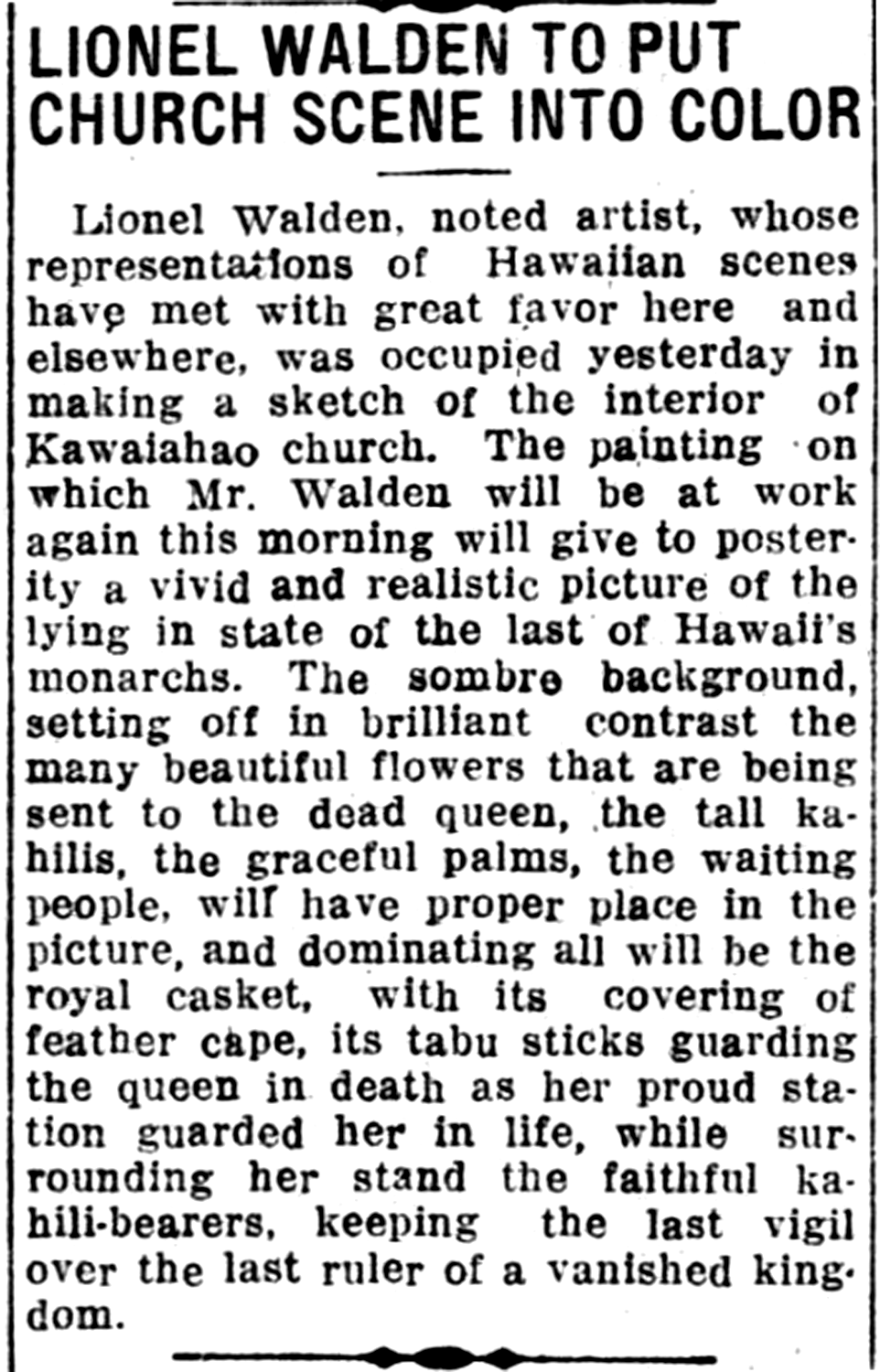
LIONEL WALDEN TO PUT CHURCH SCENE INTO COLOR

Lionel Walden, noted artist, whose representations of Hawaiian scenes met with great favor here and elsewhere, was occupied yesterday in making a sketch of the interior of Kawaiahao church. The painting on which Mr. Walden will be at work again this morning will give to posterity a vivid and realistic picture of the lying in state of the last of Hawaii’s monarchs. The somber background, setting off in brilliant contrast the many beautiful flowers that are being sent to the dead queen, the tall kahilis, the graceful palms, the waiting people, will have proper place in the picture, and dominating all will be the royal casket, with its covering of feather cape, its tabu sticks guarding the queen in death as her proud station guarded her in life, while surrounding her stand the faithful kahili-bearers, keeping the last vigil over the last ruler of a vanished kingdom.

[Wow. Does anyone know if this painting was completed and if so, where it is now?]

(Honolulu Star-Bulletin, 11/15/1917, p. 2)

LIONEL WALDEN TO PUT CHURCH SCENE INTO COLOR

Honolulu Star-Bulletin, Volume XXV, Number 7985, Page 2. November 15, 1917.

Keeaumoku’s ahuula, Eheukani, 1903.

FEATHER GARMENTS

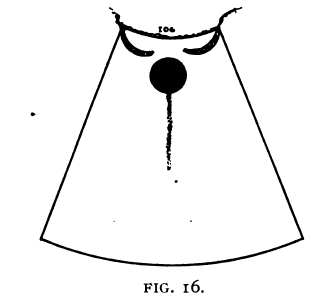
106. A cloak said to have been destroyed in the conflagration caused accidentally in the attempt of the Board of Health to stamp out the bubonic plague in the Chinese quarter of Honolulu. At the time when the claims for losses caused by this great fire were presented to the Commission appointed for the purpose, my assistant, Mr. Allen M. Walcott, obtained from the claimant, Peleioholani, a carpenter by trade, the following particulars: The cloak was called “Eheukani” and was made in the time of Keeaumoku (the father of Kaahumanu) and finished shortly before the battle of Mokuohai (July, 1782) between Kamehameha and Kiwalaó. Keeaumoku’s wife gave it to Peleioholani’s grandmother. Principally mamo* feathers with a small crescent of red iiwi in each upper corner; between the shoulders a round spot of black oo feathers, from which a line of red iiwi led down to a trifle below the middle of the cloak. The cords at the neck were of human hair, an unusual thing. It must be remembered that the design (Fig. 16) as well as the following measurements are from the description given to Mr. Walcott by Peleioholani and are of course only approximate. They are worth recording as differing from any robes described. Length, about 4 feet 9 inches; neck measurment about 2 feet; circumference at bottom about 5 feet 8 inches. It is a matter of tradition that 27,000 birds were captured to furnish the feathers for this cloak. In the left side were seven spear holes that were never patched, and about which were blood stains. Keeaumoku was severely wounded in this battle, and it was rather a fancy with the old chiefs to retain the honorable scars in the ahuula, as in the cloak given by Kamehameha to Vancouver to be taken to England for King George.

*Probably oo, for a genuine mamo ahuula was devoid of any adulteration by other colored feathers. It should be stated that Peleioholani’s claim to be the owner of this cloak was disputed and it was said to have been taken from the palace years ago; but from what I have seen of the observation of natives whose duty it was to care for the royal robes, I do not believe one of them could describe the pattern of the cloaks he or she had seen for years.

[And a note on the note by Brigham. I am not sure the oo instead of mamo feathers comment should be considered true when even the great mamo feather ahuula of Kamehameha Paiea has red iiwi feathers within it…]

(Brigham, William T. Additional Notes on Hawaiian Featherwork. Honolulu: Bishop Museum Press, 1903. pp. 15–16.)

"Eheukani"

Brigham, William T. Additional Notes on Hawaiian Featherwork. Honolulu: Bishop Museum Press, 1903. p. 17.

Peleioholani’s response to the Queen? 1902.

COMPANION OF A PRINCE

A Hawaiian Chief Who Fought in Africa.

HE TELLS A ROMANTIC TALE

Decapitated Morrocan of High Rank—Was Owner of Famous Feather Cloak.

WITHIN THREE months a stalwart Hawaiian will leave Honolulu and journey to London to attend the reunion of the survivors of one of England’s wars of conquest fought more than thirty years ago. Upon the Hawaiian’s body are the scars inflicted by sword, spear and bullets, received while he was fighting under the flag of St. George in the service of Queen Victoria upon the battlefields of Southern Africa. According to a romantic story which the Hawaiian tells, few amongst the veterans who will gather in the capital of the British nation will have more honorable records for bravery and conspicuous gallantry in the face of a dark-skinned enemy than he, and few will there be whose entire lives are so wrapped in a halo of romance. Linked with this Hawaiian’s life are those of Kings and Queens, Dukes and Admirals, Generals and Captains, and yet today he is an humble resident of the Hawaiian Islands. Continue reading

Keeaumoku ahuula destroyed in Peleioholani house fire, 1901.

Couple of years ago, I posted two articles on an insurance claim by Peleioholani after a priceless ahuula was destroyed in the great Chinatown fire of 1900. I just ran across this just now:

ROYAL FAMILY CLAIM

THE FEATHER CLOAK DESTROYED BY FIRE

Liliuokalani Will Testify—Alleged That the Cloak Was Stolen From the King’s Palace.

Queen Liliuokalani will testify before the Fire Claims Commission regarding the royal feather cloak lost in the big fire by Peleioholani.

It is said that the royal family lays claim to the ownership of the destroyed cloak. The costly article is alleged to have belonged to King Kalakaua, and been stolen from Iolani Palace many years ago.

[See: Ancient Relics Were Destroyed & Pau ka Ahuula i ke Ahi]

(Evening Bulletin, 11/2/1901, p. 1)

ROYAL FAMILY CLAIM

Evening Bulletin, Volume XI, Number 1984, Page 1. November 2, 1901.

Levi Haalelea dies, 1864.

Another Chief Dead.—The Honorable Levi Haalelea died at his residence “Holani” in Honolulu, on the 3d inst., of aneurism, aged 42 years. He was born at Lahaina in 1822, and was the son of Haalou, Governor of Molokai, under Kalaimoku. His mother was Kipa. By his marriage about 1848 to Kekauonohi, a daughter of Kamehameha I, he became a Noble, and until his death held a seat in the House of Nobles. His only brother was Haalilio, the well-known and accomplished commissioner who accompanied Mr. Richards to Europe. Some two or three years since, Haalelea married Amoe, daughter of a Chinese merchant of Hilo, who survives him. He leaves no issue, his only child, Kamalalehua, being dead. The deceased leaves a large estate comprising valuable lands all over the islands, acquired mostly by marriage with Kekauonohi. Haalelea was favorably known among foreigners as a man of character and worth, and very gentlemanly in all his intercourse with them. He was an honor to the Alii family, which has now become reduced to a mere handful in number. His funeral, we learn, will not take place for some three or four weeks.

(Pacific Commercial Advertiser, 10/8/1864, p. 2)

Another Chief Dead.

The Pacific Commercial Advertiser, Volume IX, Number 14, Page 2. October 8, 1864.

Enoch Wood Perry Jr. arrives, 1864.

An Artist.—Among the passengers by the Comet last week, was Mr. E. W. Perry, Jr., a portrait and landscape painter. A specimen of his work can be seen in the bookstore—being a portrait of Rev. Mr. Corwin. A glance at the picture is sufficient to satisfy any one that it is a perfect copy of the original, and that the person who executed it, has the skill of a true artist. Mr. Perry visits our islands to take views and paintings af our principal landscape scenery, and starts for Kilauea on Monday next in the steamer, via Kealakekua and Kau, intending to sketch the crater, Hilo and other scenery of that island worthy of being copied. We commend him to the attention of our friends wherever he may visit. While travelling through California, Mr. Perry was in company with Messrs. Williams and Bierstadt. The former will arrive here shortly. The latter having sold his fine painting of Yosemite Falls and Valley to a New York publishing house for $15,000, has gone East on business connected with the same. It was the intention of the three artists to visit our group in company. Messrs. Perry and Williams will undoubtedly succeed in taking some views that will be very valuable. Now while they are here, let us suggest that the Government secure their services to paint correct full-size portraits of the late King and His Majesty the present King, as also, perhaps, Queen Emma and Gov. Kekuanaoa, to be preserved as national property to adorn the Palace. It is so seldom genuine artists visit the islands that this opportunity should not be lost.

[Perry is the artist who painted the famous portrait of Ka Haku o Hawaii with his dog. He also seems to have painted a portrait of Levi Haalelea!

I am not sure who the Williams mentioned in the article is, but the other painter is most likely Albert Bierstadt.]

(Pacific Commercial Advertiser, 10/1/1864, p. 2)

An Artist.

The Pacific Commercial Advertiser, Volume IX, Number 14, Page 2. October 1, 1864.

Portrait of Levi Haalelea, 1864.

[Found under: “NA MEA HOU O HAWAII NEI.”]

Portrait of Haalelea.—The haole which we spoke of the other week has painted a Portrait of Levi Haalelea who has passed, and it is now in the photography studio of Chase (Keiki). It remains victorious, and has not lessened at all, as if he is still living, it is just missing his voice coming forth.

[Here is the article mentioning the artist’s name. And here is another found in the Pacific Commercial Advertiser with more data.

Does anyone know the whereabouts of this painting by famous painter Enoch Wood Perry Jr.? I would appreciate it if you all might repost this article wherever you think an answer could be found!]

(Kuokoa, 12/24/1864, p. 2)

Ke Kii o Haalelea

Ka Nupepa Kuokoa, Buke III, Helu 52, Aoao 2. Dekemaba 24, 1864.

Queen Liliuokalani’s gift to the leprosy patients, 1891.

GIFT OF ALOHA TO THE LEPROSY PATIENTS AT KALIHI.

We each all are going without a companion at our side, and no child before us or at our back, it is just our lone bodies going naked to the Colony of Kalawao, and there is no way out of it for us for there is the law of our beloved land upon our shoulders.

These red silk kerchiefs which you see on our necks, and your sums of money in our hands this day, it is a memorial for us during the days of our lives in this dejected world, until the dust of that unfamiliar land is spread upon our bodies, and this decaying body returns to the earth, and the spirit returns to God.

Therefore, may your majesty take our great thanks for you. And that is when the Queen replied:

I take your thanks with me, and you will go and you will see my children, those are your seniors living upon that great flat lands, and perhaps we will all be there, but we do not know.

This was the touching statement, and the close to the conversation with the Queen.

Here are the names of the patients taken and their place of residence.

Miss Helina Kaiwaokalani Maikai, Miss Kaehuokalani, Miss M. Kalama [? Miss M. Kalaina], they are from Honolulu; Napoliona Keawe (m), from Manoa, Oahu; Miss Mapo (f), Kahaku (m), from Waialua, Oahu; Ah Ping from Hanalei, Kauai; Henry Keku, Akoi, from Wailuku; Alualu (f), Ulunui (f) from Waikapu; Maraea Kaluna from Olowalu; Liwai Haalelea from Kukuihaele, Hawaii.

These are the patients left at the receiving station of Kalihi:

W. K. Makakoa, G. K. Kepoikai, from Waiehu, Maui; Josiah Kaina from Lihue, Kauai; William Kalani Kalua from Puako, Waimea, Hawaii.

These are the patients who have not been examined by the Doctors:

Keopuhiwa from Hana; Keoahu (f), and Huliwaa (f), and Lutiana Keliikaapuni (f), from Kaupo, Maui; and Joe, a Portuguese boy from Honolulu.

On the 17th of July, Mrs. Kaikioewa Ulukou gave gifts once again to the patients at Kalihi.

Aloha one and all.

WILLIE KALIKOKALANI.

Kalihi Hospital, July 20, 1891.

[Might anyone know how/if Liwai Haalelea and Levi Haalelea (d. 1864) are related?]

(Leo o ka Lahui, 7/29/1891, p. 2)

HE MAKANA ALOHA I NA MA'I LEPERA MA KALIHI.

Ka Leo o ka Lahui, Buke II, Helu 247, Aoao 2. Iulai 29, 1891.