More sent to the leprosy colony, 1893.

FOR THE LAND OF SUFFERING.

Forty leprosy patients were put aboard the steamer Hawaii of this past Monday, and from amongst this number, there were 6 who were apprehended under the suspicion of having leprosy.

From amongst them, some are our friends and friends of others, living here and there, who are familiar with them; John K. Unea [John T. Unea] is from the Kanilehua Rain of Hilo, T. Nakanaela is from the Kukalahale Rain of Honolulu, A. Kawaieli is from Lanai of Kaululaau. Continue reading

What’s in a name? 2014.

In the recent posts there were examples of many names and variants thereof. If you are doing any sort of research into Hawaii’s past, whether it be genealogical, political, or what have you, it is important to consider that names are complicated and people, places, and things in general can be referred to by any number of different names. It would be a great resource if some entity hosted a site that allowed for adding to a list of this sort. Just in the past few days we had:

G. K. Keawehaku = Gabriel K. Keawehaku = Gaberiela K. Keawehaku = Gabriela K. Keawehaku = Ka Anela o Mekiko

Boston (ship) = Bosetona

Inter-Island Steam Navigation Company = I. I. S. N. Co. = Hui Hooholo Mokuahi Pili Aina

Planter (ship) = Paeli

W. G. Hall (ship) = Malulani

Foster (surname) = Poka

James Robinson = Kimo o Pakaka

More from the mele aloha aina by G. K. Keawehaku, 1919.

[From the mele: “OIA ANEI? OIA NO.”]

Me he punohu ula la,
No Alenuihaha oluna ae;
Me he onohi ahiahi la,
No Alalakeiki oluna ae;
Me he ua nonoula la,
No Naeheehe oluna ae;
Me he leikoko-ula la,
No Kealaikahiki oluna ae; Continue reading

Section of a sweet mele aloha aina by Gabriel K. Keawehaku, 1919.

[From the mele: “OIA ANEI? OIA NO.”]

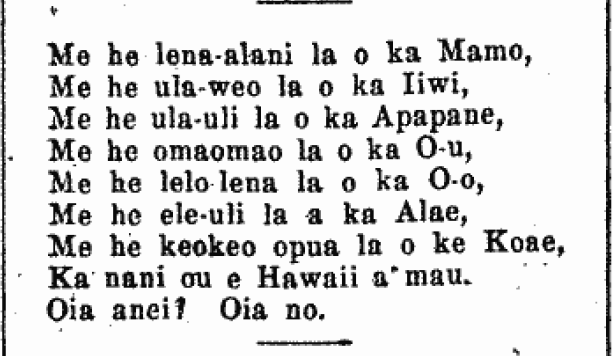
Me he lena-alani la o ka Mamo,
Me he ula-weo la o ka Iiwi,
Me he ula-uli la o ka Apapane,
Me he omaomao la o ka O-u,
Me he lelo-lena la o ka O-o,
Me he ele-uli la a ka Alae,
Me he keokeo opua la o ke Koae,
Ka nani ou e Hawaii a mau.
Oia anei? Oia no.

[This is an awesome way to think about colors!]

(Kuokoa, 9/12/1919, p. 8)

Me he lena-alani la o ka Mamo...

Ka Nupepa Kuokoa, Buke LVII, Helu 37, Aoao 8. Sepatemaba 12, 1919.

The USS Boston leaves Hawaii, 1893.

That Wicked Eel Has Left.

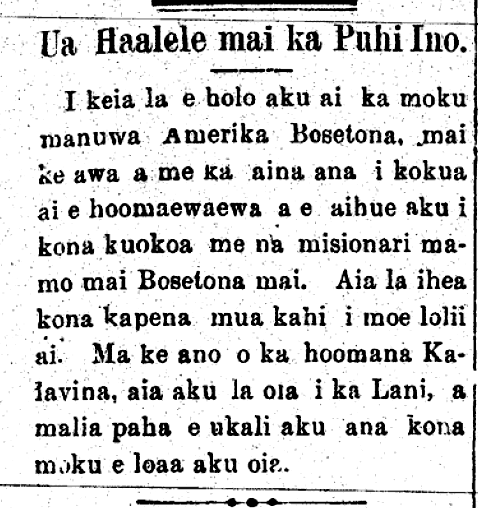
On this day, the American warship Boston left the harbor and the land of which it assisted in persecuting and stealing its independence with the missionary descendants from Boston. Where could its previous captain [Gilbert C. Wiltse] be resting? According to the Calvinists, he is in Heaven, and perhaps the ship will go to fetch him.

(Leo o ka Lahui, 9/26/1893, p. 3)

Ua Haalele mai ka Puhi Ino.

Ka Leo o ka Lahui, Buke II, Helu 777, Aoao 3. Sepatemaba 26, 1893.

Rose-colored Kalakaua stamps bought out, 1893.

[Found under: “NU HOU HAWAII.”]

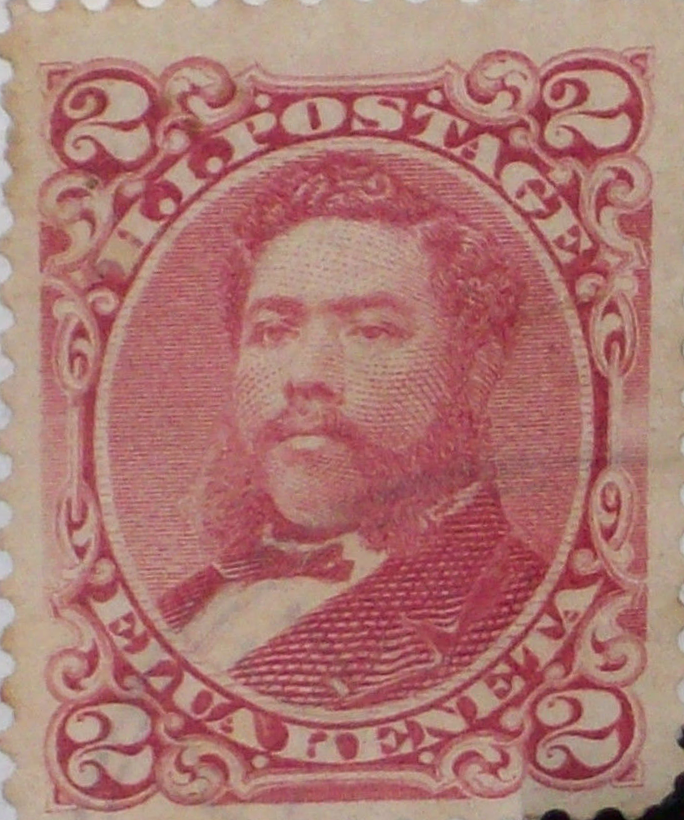
$3,000 was given by Mr. J. J. Egan to the main Post Office in Honolulu this past Saturday, purchasing all of the rose-colored Kalakaua 2 cent stamps. And Mr. Egan will invest in these stamps with the hope that he will meet with good fortune.

[I am assuming he made a killing.]

(Kuokoa, 9/23/1893, p. 3)

$3,000 i hoolilo ia...

Ka Nupepa Kuokoa, Buke XXXII, Helu 38, Aoao 3. Sepatemaba 23, 1893.

Rose-colored Kalakaua 2¢ stamp

Rose-colored Kalakaua 2¢ stamp


The Mikahala arrives in Honolulu, 1887.

THE NEW STEAMSHIP ‘MIKAHALA.’

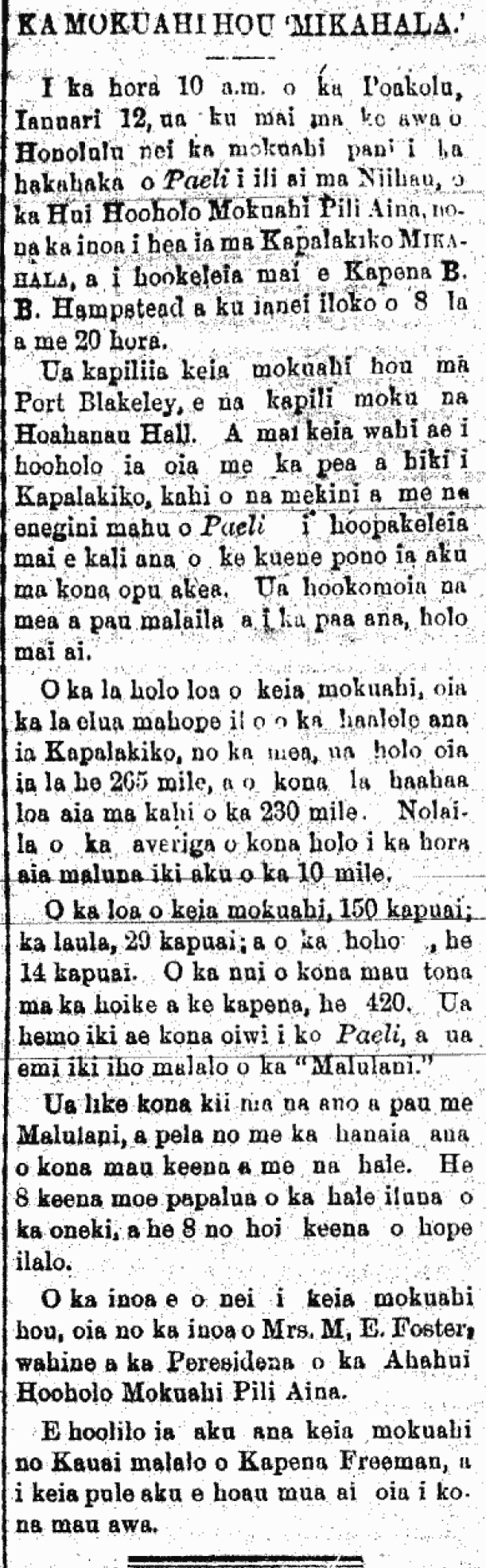
At 10 o’clock a.m. of Wednesday, January 12,  the steamer replacing the Paeli, which ran aground off Niihau, of the Inter-Island Steam Navigation Company [Hui Hooholo Mokuahi Pili Aina], named the Mikahala and captained by Captain B. B. Hampstead, arrived at Honolulu Harbor, reaching here in 8 days and 20 hours.

This new steamship was built in Port Blakely by the ship builders, the Hall Brothers. And from here, she was sent using a sail to San Francisco, where the machinery and steam engine of the Paeli was salvaged and waited to be laid out in her wide belly. Everything was installed there and when it was all complete, it set off for here.

The farthest the steamer went was on the second day after it left San Francisco, for it travelled 265 miles that day, and its shortest day was 230 miles. Therefore, its average speed was a little over 10 miles per hour.

The length of this ship is 150 feet and the width is 29 feet; its depth is 14 feet. Its tonnage according to the captain is 420. Its body is a little larger than the Paeli, and a little smaller than the Malulani.

Its design is similar in every manner with the Malulani, and so too are the rooms and the decks. There are 8 double state rooms on the upper deck, and 8 rooms below in the stern.

The name of this new steamship is the name of Mrs. M. E. Foster [Mary E. Foster], the wife of the President of the Inter-Island Steam Navigation Company.

This steamer will be set aside for Kauai under Captain Freeman, and next week, it will be sent to her ports for the first time.

[It is quite the strange coincidence that this ship named Mikahala (after the Hawaiian name of Mary E. Foster) is the same ship that ran into and sank the other ship named for her, the Mary E. Foster! See here for the article reporting the accident in 1894.]

(Ko Hawaii Pae Aina, 1/15/1887, p. 3)

KA MOKUAHI HOU ʻMIKAHALA.ʻ

Ko Hawaii Pae Aina, Buke X, Helu 3, Aoao 3. Ianuari 15, 1887.

The new steamship, the Mikahala, 1887.

The New Steamship.

This Wednesday, the new steamer of Foster [Poka] and company arrived; 8 days from San Francisco. “Mikahala” is its name, and it was named after the name of Mrs. J. Robinson, the wife of James [Kimo] of Pakaka. It is a large vessel like the Lilinoe, and it is speedy. We hear that it is headed for Kauai in the coming days. We do not know who the Captain is.

(Nupepa Elele, 1/15/1887, p. 2)

Ka Mokuahi Hou.

Ka Nupepa Elele, Buke VIII, Helu 29, Aoao 2. Ianuari 15, 1887.

Mikahala collides into the Mary E. Foster, 1894.

A SCHOONER WRECKED AT SEA.

The Steamer Mikahala Cuts Off the Stern of an Island Vessel.

THE MARY E. FOSTER OUT OF SIGHT.

The Vessels Meet At Midnight In the Channel—The Disaster Is Said to be Due to a Mates Negligence—No Lives Lost By the Unfortunate Accident.

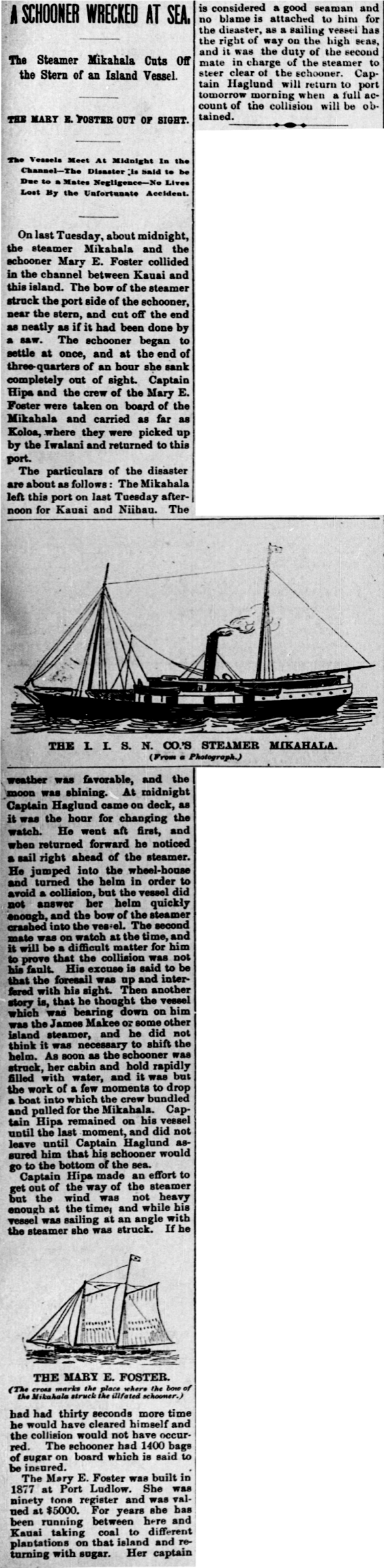
On last Tuesday, about midnight, the steamer Mikahala and the schooner Mary E. Foster collided in the channel between Kauai and this island. The bow of the steamer struck the port side of the schooner, near the stern, and cut off the end as neatly as if it had been done by a saw. The schooner began to settle at once, and at the end of three-quarters of an hour she sank completely out of sight. Captain Hipa and the crew of the Mary E. Foster were taken on board of the Mikahala and carried as far as Koloa, where they were picked up by the Iwalani and returned to this port.

The particulars of the disaster are about as follows: The Mikahala left this port for Kauai and Niihau. The…

THE I. I. S. N. CO.’s STEAMER MIKAHALA.
(From a Photograph.)

…weather was favorable, and the moon was shining. At midnight Captain Haglund came on deck, as it was the hour for changing the watch. He went aft first, and when returned forward he noticed a sail right ahead of the steamer. He jumped into the wheel-house and turned the helm in order to avoid a collision, but the vessel did not answer her helm quickly enough, and the bow of the steamer crashed into the vessel. The second mate was on watch at the time, and it will be a difficult matter for him to prove that the collision was not his fault. His excuse is said to be that the foresail was up and interfered with his sight. Then another story is, that he thought the vessel which was bearing down on him was the James Makee or some other island steamer, and he did not think it was necessary to shift the helm. As soon as the schooner was struck, her cabin and hold rapidly filled with water, and it was but the work of a few moments to drop a boat into which the crew bundled and pulled for the Mikahala. Captain Hipa remained on his vessel until the last moment, and did not leave until Captain Haglund assured him that his schooner would go to the bottom of the sea.

Captain Hipa made an effort to get out of the way of the steamer but the wind was not heavy enough at the time, and while his vessel was sailing at an angle with the steamer she was struck. If he…

THE MARY E. FOSTER.
(The cross marks the place where the bow of the Mikahala struck the illfated schooner.)

…had had thirty seconds more time he would have cleared himself and the collision would not have occurred. The schooner had 1400 bags of sugar on board which is said to be insured.

The Mary E. Foster was built in 1877 at Port Ludlow. She was ninety tons register and was valued at $5000. For years she has been running between here and Kauai taking coal to different plantations on that island and returning with sugar. Her captain is considered a good seaman and no blame is attached to him for the disaster, as a sailing vessel has the right of way on the high seas, and it was the duty of the second mate in charge of the steamer to steer clear of the schooner. Captain Haglund will return to port tomorrow morning when a full account of the collision will be obtained.

(Pacific Commercial Advertiser, 5/26/1894, p. 3)
A SCHOONER WRECKED AT SEA.

The Pacific Commercial Advertiser, Volume XIX, Number 3698, Page 3. May 26, 1894.