Peleioholani’s home is destroyed by fire, 1901.

ANCIENT RELICS

WERE DESTROYED

Valuable Feather Cloak In Peleioholani’s Fire Claim.

BELONGED TO KEEAUMOKU

THE CLAIMANT’S ANCESTOR

While Husband and Wife Were Shut Out By Quarantine the Flames Swept Away Their Home.

Claims of native Hawaiians were resumed before the Fire Claims Commission yesterday morning. Two of these were called this morning, one of which is of more than ordinary interest.

S. L. Peleioholani presents a claim for $2000 and it appears to be a perfectly straight one. The claimant is a lineal descendant of high chiefs and among his household possessions were heirlooms of great value. Indeed, it is scarcely practicable to measure their value in money, the articles having both historical and ethnological—it might be added without joking, ornithological—interest.

Of the last-named class was a feather cloak, the only one existing of its class except the famous garment of Kamehameha treasured in the British Museum. This cloak descended to Peleioholani from his great-great-grandfather, Keeaumoku, a high chief whose name is given to one of the streets of Honolulu. Evidence was presented before the Commission showing that the claimant refused $500 from Mrs. Marry Ailau, the well-known dealer and connoisseur in Hawaiian relics, several years ago. Yes, and when she sent a relative to further sound the owner on his selling figure an offer of $700 for the cloak was declined by him.

Peleioholani had also a few calabashes of high value, besides other ancient objects of native art.

Why did not Mr. Peleoholani or his wife rescue all this archaeological wealth from the advancing flames? It is an easy question and its answer is not mysterious. The husband was working at his trade of a carpenter on the Castle house, while his wife was away from home on some errand, when the rigid quarantine came down suddenly as a Pali cloud. In consequence the couple could not gain access to their home and the tempest of flame came and swept it away.

Peleioholani lost sundry articles of latter day manufacture and utility, which went to make up his claim. An item was sixty fathoms of inch and a half rope at $47, this being the price he paid for it at an auction sale. He explained that he used the hawser in connection with building and house-moving operations. Scion of a noble house as he is, Peleioholani gave the Commissioners the impression of an honorable man.

[See what was said in an article from one of the Hawaiian-Language Newspapers here.]

(Evening Bulletin, 10/15/1901, p. 1)

ANCIENT RELICS WERE DESTROYED

Evening Bulletin, Volume XI, Number 1968, Page 1. October 15, 1901.

Keelikolani’s house and valuables destroyed by fire, 1873.

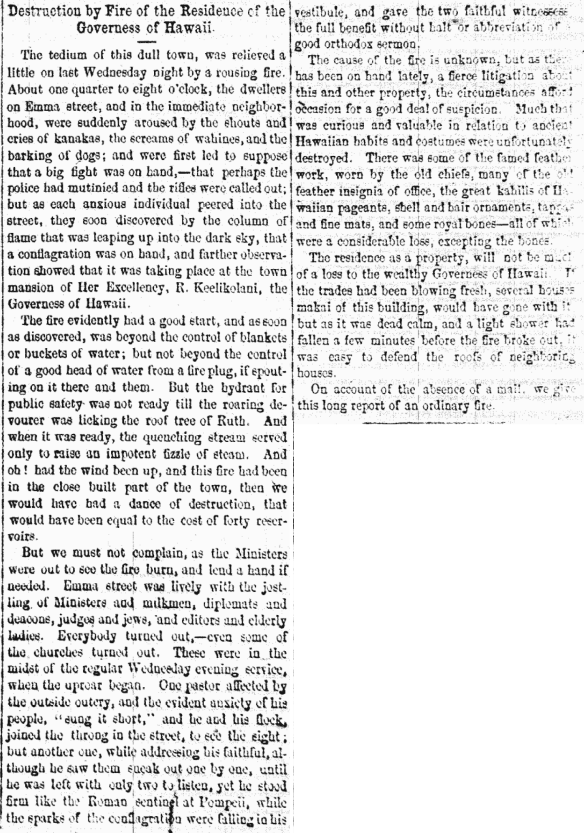
Destruction by Fire of the Residence of the Governess of Hawaii.

The tedium of this dull town, was relieved a little on last Wednesday night by a rousing fire. About one quarter to eight o’clock, the dwellers on Emma street, and in the immediate neighborhood, were suddenly aroused by the shouts and cries of kanakas, the screams of wahines, and the barking of dogs; and were first led to suppose that a big fight was on hand,—that perhaps the police had mutinied and the rifles were called out; but as each anxious individual peered into the street, they soon discovered by the column of flame that was leaping up into the dark sky, that a conflagration was on hand, and farther observation showed that it was taking place at the town mansion of Her Excellency, R. Keelikolani, the Governess of Hawaii.

The fire evidently had a good start, and as soon as discovered, was beyond the control of blankets or buckets of water; but not beyond the control of a good head of water from a fire plug, if spouting on it there and then. But the hydrant for public safety was not ready till the roaring devourer was licking the roof tree of Ruth. And when it was ready, the quenching stream served only to raise an impotent fizzle of stream. And oh! had the wind been up, and this fire had been in the close built part of the town, then we would have had a dance of destruction, that would have been equal to the cost of forty reservoirs.

But we must not complain, as the Ministers were out to see the fire burn, and lend a hand if needed. Emma street was lively with the jostling of Ministers and milkmen, diplomats and deacons, judges and jews, and editors and elderly ladies. Everybody turned out,—even some of the churches turned out. These were in the midst of the regular Wednesday evening service, when the uproar began. One pastor affected by the outside outcry, and the evident anxiety of his people, “sung it short,” and he and his flock, joined the throng in the street, to see the sight; but another one, while addressing his faithful, although he saw them speak out one by one, until he was left with only two to listen, yet he stood firm like the Roman sentinel at Pompeii, while the sparks of the conflagration were falling in his vestibule, and gave the two faithful witnesses the full benefit without halt or abbreviation of good orthodox sermon.

The cause of the fire is unknown, but as there had been on hand lately, a fierce litigation about this and other property, the circumstances afford occasion for a good deal of suspicion. Much that was curious and valuable in relation to ancient Hawaiian habits and costumes were unfortunately destroyed. There was some of the famed featherwork, worn by the old chiefs, many of the old feather insignia of office, the great kahilis of Hawaiian pageants, shell and hair ornaments, tappas and fine mats, and some royal bones—all of which were a considerable loss, excepting the bones.

The residence as a property, will not be much of a loss to the wealthy Governess of Hawaii. If the trades had been blowing fresh, several houses makai of this building, would have gone with it but as it was dead calm, and a light shower had fallen a few minutes before the fire broke out, it was easy to defend the roofs of neighboring houses.

On account of the absence of mail, we give this long report of an ordinary fire.

(Hoku o Hawaii, 1o/17/1873, p. 3)
Destruction by Fire of the Residence of the Governess of Hawaii.

Nuhou, Volume II, Number 24, Page 3. October 17, 1873.

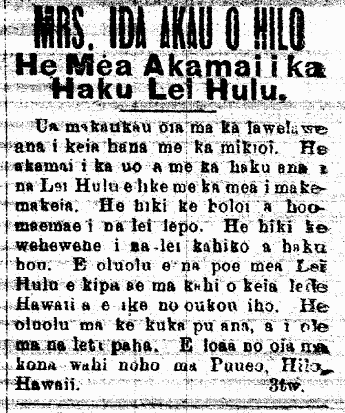
Hilo feather lei maker Ida Akau, 1901.

MRS. IDA AKAU OF HILO

A Person Skilled at Making Lei Hulu.

She is proficient at this work with fine workmanship. She is skilled at tying feathers [uo] and putting feather lei together [haku] as per one’s desires. She can clean soiled lei. She can undo old lei and remake them. Those who have Lei Hulu, pleace come and visit the place of this Hawaiian lady to see for yourselves.  Consultation by visit or by correspondence is welcomed. She can be found at her residence in Puueo, Hilo, Hawaii.

(Aloha Aina, 11/9/1901, p. 3)

MRS. IDA AKAU O HILO

Ke Aloha Aina, Buke VII, Helu 45, Aoao 3. Novemaba 9, 1901.

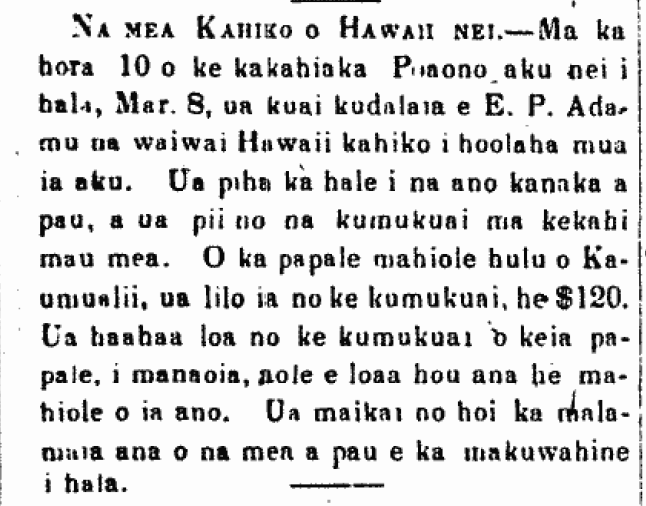
Kaumualii’s mahiole fetches a mere $120 at auction, 1873.

[Found under: “NU HOU KULOKO.”]

Antiquities of Hawaii nei.—At 10 o’clock in the morning of this past Saturday, Mar. 8, the valuables of old Hawaii which were advertised earlier were auctioned off by E. P. Adams. The house was filled with all sorts of people, and some objects went for high bids. The feather mahiole of Kaumualii went for the price of $120. This headdress went for a very low price; it is believed that never again will there be available a mahiole of that kind. The care given to all of the objects by the mother who has passed [Mrs. Whitney] was very good.

(Kuokoa, 3/22/1873, p. 3)

Na mea kahiko o Hawaii nei...

Ka Nupepa Kuokoa, Buke XII, Helu 12, Aoao 3. Maraki 22, 1873.

On Kaumualii and Kaahumanu, 1880.

[From: “Ka Moolelo o Kaahumanu”]

Kaahumanu was one of them who made a circuit of Maui, Oahu, and Kauai with Liholiho. When Kaahumanu arrived on Kauai, she took Kaumualii, the alii of Kauai, as a kane [husband] for herself. When Liholiho returned to Oahu, it was with Haakulou, the woman of Kaumualii; because Liholiho took Haakulou as a wahine [wife] for himself, along with his other wahine.

Kaahumanu lived on Kauai along with Kaumualii in the year 1822. Perhaps in the month of August.

Kaahumanu wanted to seek out Nihoa. It was the very first time that Nihoa was found, that tiny island to the North-West of Niihau. Continue reading

The beginnings of Punahou School, 1841.

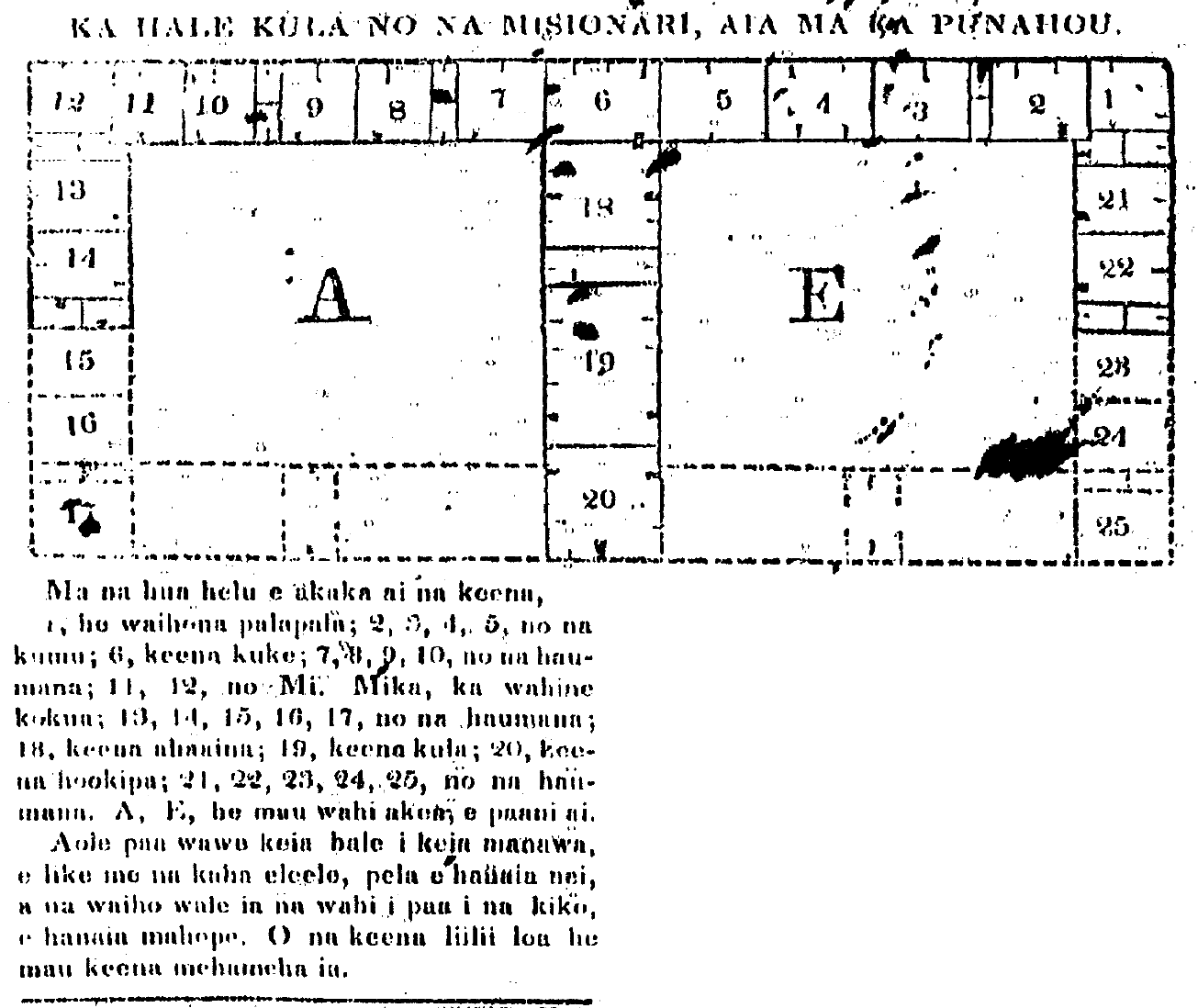
SCHOOLHOUSE FOR THE MISSIONARIES, AT KA PUNAHOU.

The rooms are explained by the numbers,

1, a library; 2, 3, 4, 5, for the teachers; 6, kitchen; 7, 8, 9, 10, for the students; 11, 12, for Mi. Mika [?] the woman helper; 13, 14, 15, 16, 17, for the students; 18, cafeteria; 19, school room; 20, room for entertaining guests; 21, 22, 23, 24, 25 for the students. A, E, wide areas to play.

This will not be completed quickly at this time; the places with solid lines are being constructed, and the areas surrounded by dashes are left to complete at a later date. The most tiny rooms are solitary rooms.

[Earlier, i posted a diagram of the layout of the Chiefs’ Children’s School. Here from about the same time is the school for missionary children at Kapunahou, the precursor to today’s Punahou School.

The school began instruction on July 11, 1842, with 5 boarders and 12 day schoolers.]

(Nonanona, 11/23/1841, p. 44)

KA HALE KULA NO NA MISIONARI, AIA MA KA PUNAHOU.

Ka Nonanona, Buke 1, Pepa 11, Aoao 44. Novemaba 23, 1841.

The name of Kaumualii’s mahiole, 1906.

[Excerpt from: “He Moolelo no Kamehameha I. Ka Na’i Aupuni Hawaii.” by Hooulumahiehie.]

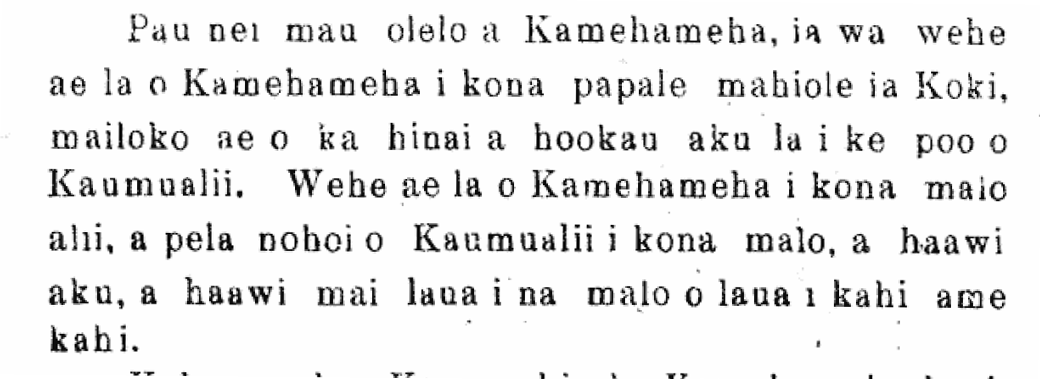
After these words of Kamehameha’s were over, he then took his mahiole, Koki, from a basket and placed it upon the head of Kaumualii. Kamehameha removed his royal malo and so too did Kaumualii remove his malo, and they exchanged them with each other.

[This account is from the meeting of Kamehameha and Kaumualii. It is just a tiny excerpt of the kind of awesome information available in the story of Kamehameha I translated by Kamaoli Kuwada, Emalani Case, and Beau Bassett, slated to come out from Kamehameha Publishing. I can’t wait.

I was informed that this priceless feathered object from the past is indeed being cared for amongst the many other antiquities at the Bernice Pauahi Bishop Museum.]

(Na’i Aupuni, 9/14/1906, p. 1)

HE MOOLELO NO KAMEHAMEHA I.

Ka Na’i Aupuni, Buke II, Helu 88, Aoao 1. Sepatemaba 14, 1906.

Kaumualii’s Mahiole, 1873.

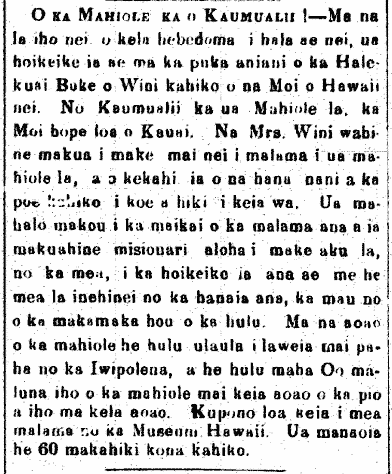
It is the Feather Helmet of Kaumualii!—During the days of this past week, displayed in the window of Whitney’s Bookstore the regalia of the Ancient Kings of Hawaii nei. The Mahiole is Kaumualii’s, the last King of Kauai. Mrs. Whitney [Wini] the elder who just passed was the one who was taking care of the mahiole, and it is one of the things remaining today of the beautiful works of the people of old. We praise the fine upkeep by the beloved missionary mother who passed, for on display, it seemed as if it was made yesterday; the feathers appeared new. On the sides of the mahiole were red feathers taken from the Iiwi polena, and feathers of the maha Oo are on top of the mahiole from this side to that of the crest. This should definitely be kept in the Hawaiian Museum. We believe that it is 60 years old.

[It is interesting to note what is not said in a similar article in English.]

(Au Okoa, 2/27/1873, p. 3)

O ka Mahiole ka o Kaumualii!

Ke Au Okoa, Buke VIII, Helu 46, Aoao 3. Feberuari 27, 1873.

More on the Hokulea, 1980.

Editorial

We should not look upon the voyage of Hokuleʻa with the thought that out ethnic pride and awareness will be re-vitalized. This type of pride we search for should emulate [emanate] from within ourselves and should be a constant part of our daily lives. We must not rely wholly upon occasional events to stir up reminders of our dignity and abilities lest we become fleeting images for display; pieces in a show case.

The importance of the upcoming voyage of Hokuleʻa lies in a different discovery: the opportunity we have to discover how our ancestors conceptualized their world, how they responded to the challenges after leaving their homelands and how they attempted to survive in this new land, today our homeland. Grasping this knowledge we too can be committed to accept the challenges before us with the same determination of our ancestors.

[Some thoughts from thirty-four years ago. How have things changed? How have things stayed the same?]

(Alahou, 2-3/1980, p. 12)

Ka ʻOlelo a Na Luna hoʻoponopono

Ke Alahou, Helu 4, Aoao 12. February/March 1980.

Kau ka pea, holo ka waa, 1980.

HOKULEʻA SAILS AGAIN

Hold on to the course! Hold on to the course! Continue On!

by Wayne Washburn, Malcolm Naea Chun and Duke Wise

In early March the Hokuleʻa will again set sail in hopes of reaching first landfall somewhere near Tahiti. Crewmen and scientists will concentrate efforts on documenting the thinking process, and methods, which may have been used by the ancient Polynesian navigators.

Without first voyage demonstration to the modern world two important findings. First, was that navigation by the stars without use of modern navigational instruments can be successfully used when travelling between Tahiti and Hawaii. Second, a Polynesian double-hulled canoe without keels or deep centerboards is able to sail to windward, and thus maintain planned course. For the present voyage celestial navigation will once again be of primary importance. Where the first voyage showed that celestial navigation was possible, the presēnt will pay particular attention to the recording of the thought process of the navigator.

Dr. Will Kyselka of the Bishop Museum Planetarium, and an assistant to the project, cited an incident involving a highly skilled non-instrument navigator from Satawal, Mau Piailug. Once caught in a storm for three days, Mau was unable to sail or use celestial markers for assistance. After the storm, though his course direction had been turned around many times, Mau miraculously found his way home to his tiny atoll of Satawal. Dr. Kyselka suggested that maybe there are maps within some of the more skilled navigators’ minds. He mentioned that pigeons are said to find their bearings in flight by being able to sense the difference magnetic fields given off by certain structures. Using the changes in magnetic fields the pigeons are able to draw a mental map and find their way home. Did the Polynesians possess this ability or something which would enable them to find Tahiti and Hawaii with regularity?

Captaining the voyage down will be Gordon Piianaia. Navigating for the trip will be Nainoa Thompson. There to assist Thompson will be Mau Piailug, the navigator from the 1976 voyage. Crew member Steve Somsen will be documenting the navigation process. This will be done by conferring with Nainoa and Mau and then orally recording it through the use of a tape recorder. Hopefully this will shed more light on the Polynesians’ navigational thought process.

The Ishka, a sailing vessel captained by Alex Jackobenko with assistance from his wife Elsa will follow some distance behind Hokuleʻa. Dr. Kyselka will be on board to study and document the route of the Hokuleʻa using modern navigational instruments and charts. On completion of the voyage the two styles of navigation will be compared for scientific value.

March has been designed for departure because it is the season that tends to favor the northeast tradewinds which are important for the first half of the voyage. Like the 1976 voyage the canoe will travel southeasterly for about 1000 miles. Once “easting” is accomplished winds blowing from the southeast will be used to rēach first landfall or Tahiti from a windward approach. This “easting” is important in that not enough movement in that direction might cause them to sail west of Tahiti and miss the islands completely. Certain safety features have been added to the canoe in order to avoid swamping problems encountered in previous inter-island trips. The gunwales and hatches have been raised to help prevent water seepage into the hulls. Also on board will be six hand pumps, a radio and flares. The radio will be used to notify the Hokuleʻa’s escort boat in case of an emergency. Certain sections of the hulls will contain inflated rubber. In the event that the hulls are accidentally smashed these will enable the canoe to remain afloat. Although non-instrumental navigation is the paramount research project of this voyage, other projects are being encouraged on a smaller scale. One of these is to fish using traditional types of fishhooks to learn how they were used. This hopefully will also provide a supplement to the crew’s diet by adding fresh fish. While conducting the fishing experiments crew members will record how the differences of fishhooks: design, material and size; the speed of the canoe; the types of fish caught and other factors affect fishing in the deep sea. These fishhooks are being faithfully copied from authentic fishhooks under the supervision of Sam Ka’ai of Kaanapali, Maui. Ancient fishhooks were made from materials such as shell, coral, turtle shell, dog and human bones and even hard woods.

In 1964, Drs. Kenneth Emory and Y. Sinoto of the Bernice Pauahi Bishop Museum, found a Tahitian one-piece fishhook at Maupiti in the Society Islands. They proposed a theory that this type of fishhook is the same as found in various sites in Hawaii. After its initial introduction they believe it became a major type used by the ancient Hawaiians, Today, other anthropologists are not as certain if Tahitian migrations caused the popularity of this fishhook, but nonetheless, the experiments conducted by crew members of the Hokuleʻa should provide some information that may help the on going research in finding common links between the ancient Hawaiian society and the Southern Polynesians.

With a crew of fourteen, the Hokuleʻa is scheduled to depart from Hilo on…

(Ke Alahou, 2-3/1980, p. 1)

Ka Waʻa Nui E Holo Ai...

Ke Alahou, Helu 4, Aoao 1. February/March 1980.

…the first favorable day after March 2.

Editor’s comment: The projects conducted by the crew of the Hokuleʻa remind us of the legend of Hema, a pan-Polynesian legend about a great super chief.

Hema was the son of Aikanaka and his wife Hinaaimalama of Hana, Maui. Hema’s wife was called Hina-polipoli and they lived at Kipahulu, East Maui. When she was pregnant with their second child, Hina craved for the eyeball of a large fish of the open, deep sea. This fish had a tail like that of the shark, Ahiale and was called Kekukaipaoa.

Hema prepared all his fishing gear and made ready the double-hulled canoe by loading enough food and water for several days. He covered his canoes with many mats, lashing them down with cords so that sea water could not seep in. When the canoe was covered securely, he hung his fishing line, Pupuwaiakolea, above the top of the poles that were between the hulls of the canoes. He put the end of the line through a knot he had tied and then he set up his cord calabash, which was called Kumaaiku. He took out the fishhook and tied the end of the fish line tightly around it fastening it to the pole.

Hema’s fishhook was not made of human bone like some of those found in the Bishop Museum, nor was it made of whale bone or turtle shell like Manaiakalani. It was made of a branch of wood whose name is not known today. The kikala or the intersection of the barbs, is found at the branch closest to the trunk of the tree. When this branch is laid flat, three other branches project from it. These branches are broken so they are short and sharp. This joint is called lehua, perhaps after the flower. The shank knob of the fishhook is called muʻo and this is where the fish line is tied. The name of Hema’s fishhook is Papalahoʻomau and still survives today as the name of the Congregational Church in Kipahulu.

It was later on in the story that Hema was blown off course and his voyage to Kahiki or Holani-ku began.

(Alahou, 2-3/1980, p. 11)

ʻelua o March.

Ke Alahou, Helu 4, Aoao 11. February/March 1980.