Lahainaluna student roster, continued, 1858.

Ka Ipu Kukui Pio Ole i ka Makani Kauaula!

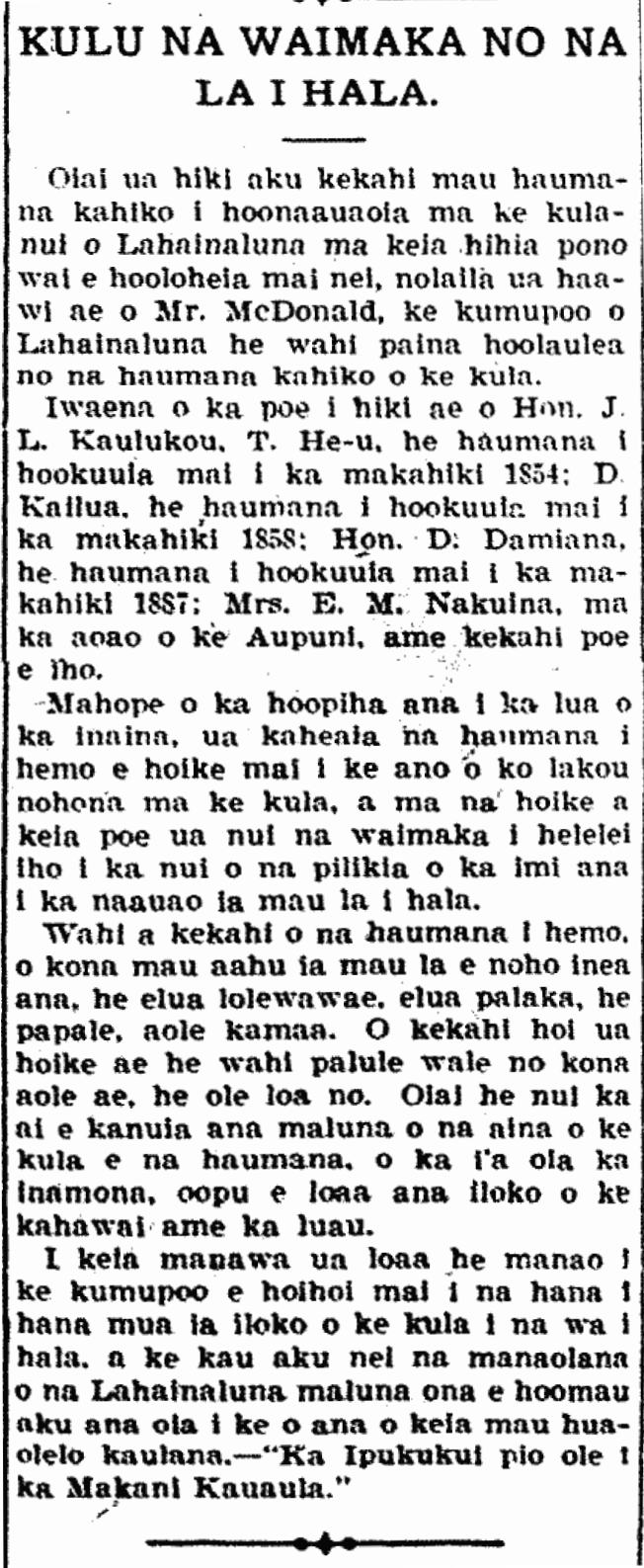
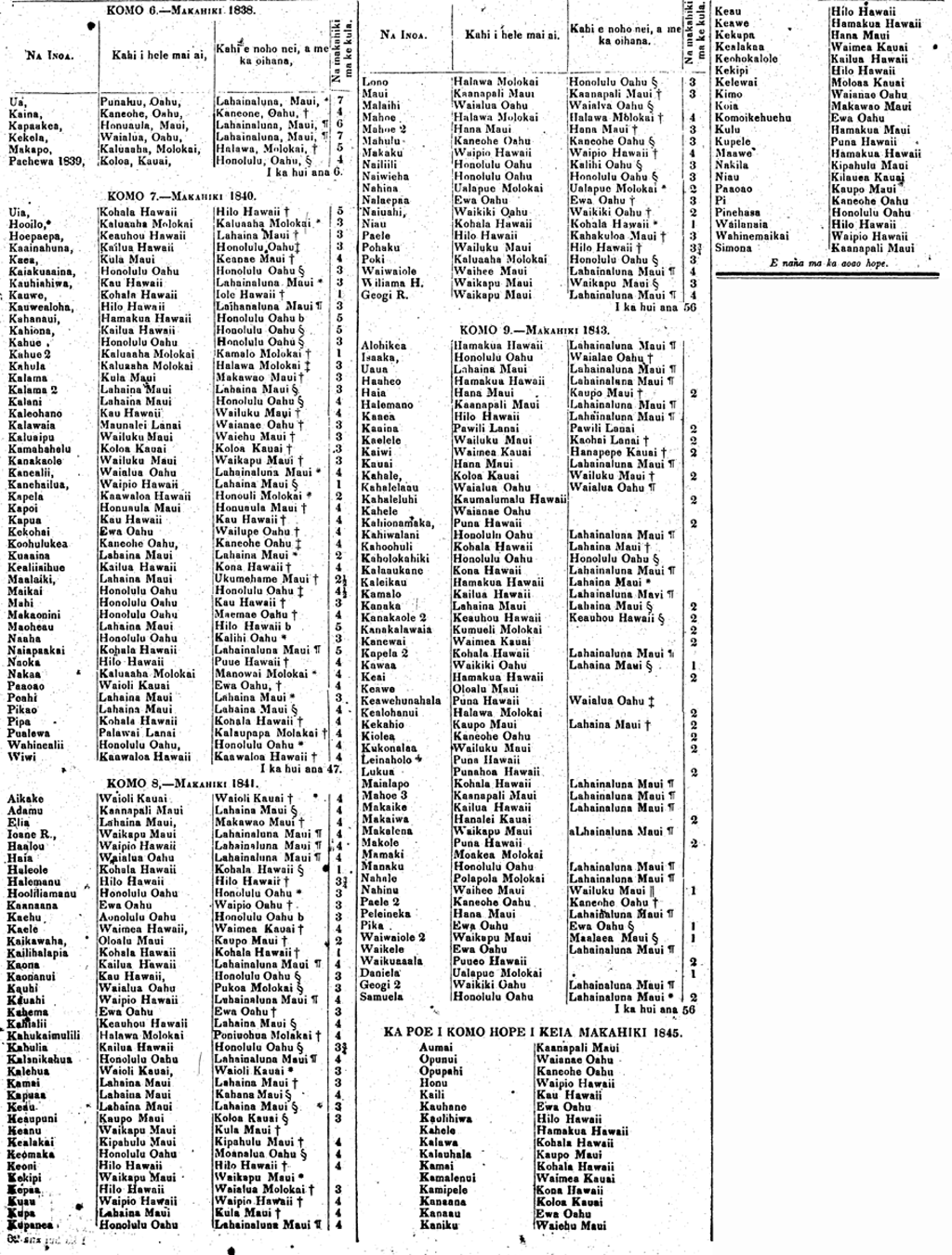
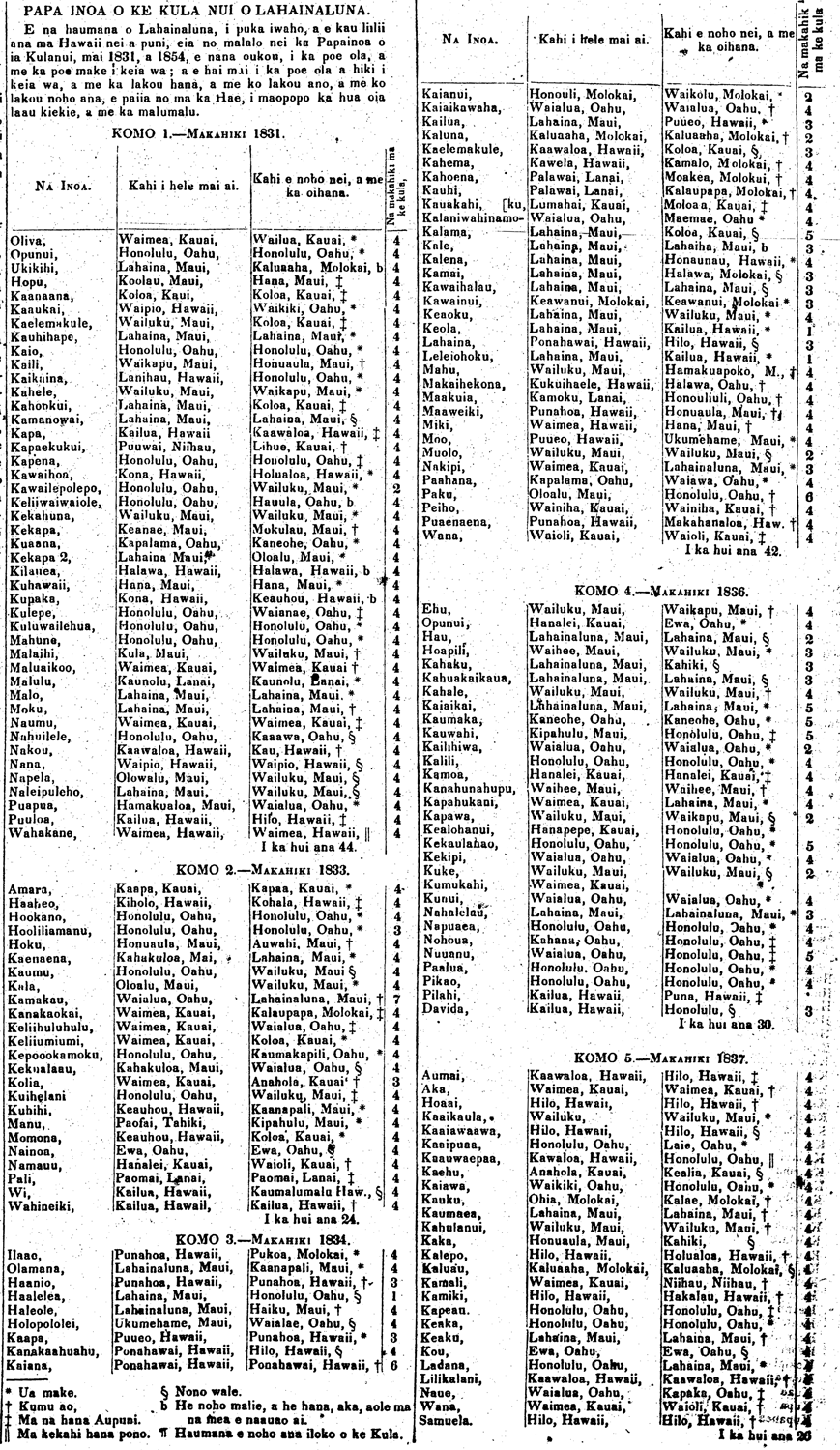
This is the continuation of the previous post, showing the students who entered Lahainaluna by year, where they came from, and where they moved to after leaving. It also shows how long they stayed, and what they were doing since leaving the school.

The lists are long, so here are the images at least:

KOMO 6.--Makahiki 1838.

Ka Hae Hawaii, Buke 3, Ano Hou.—Helu 7, Aoao 27. Mei 19, 1858.

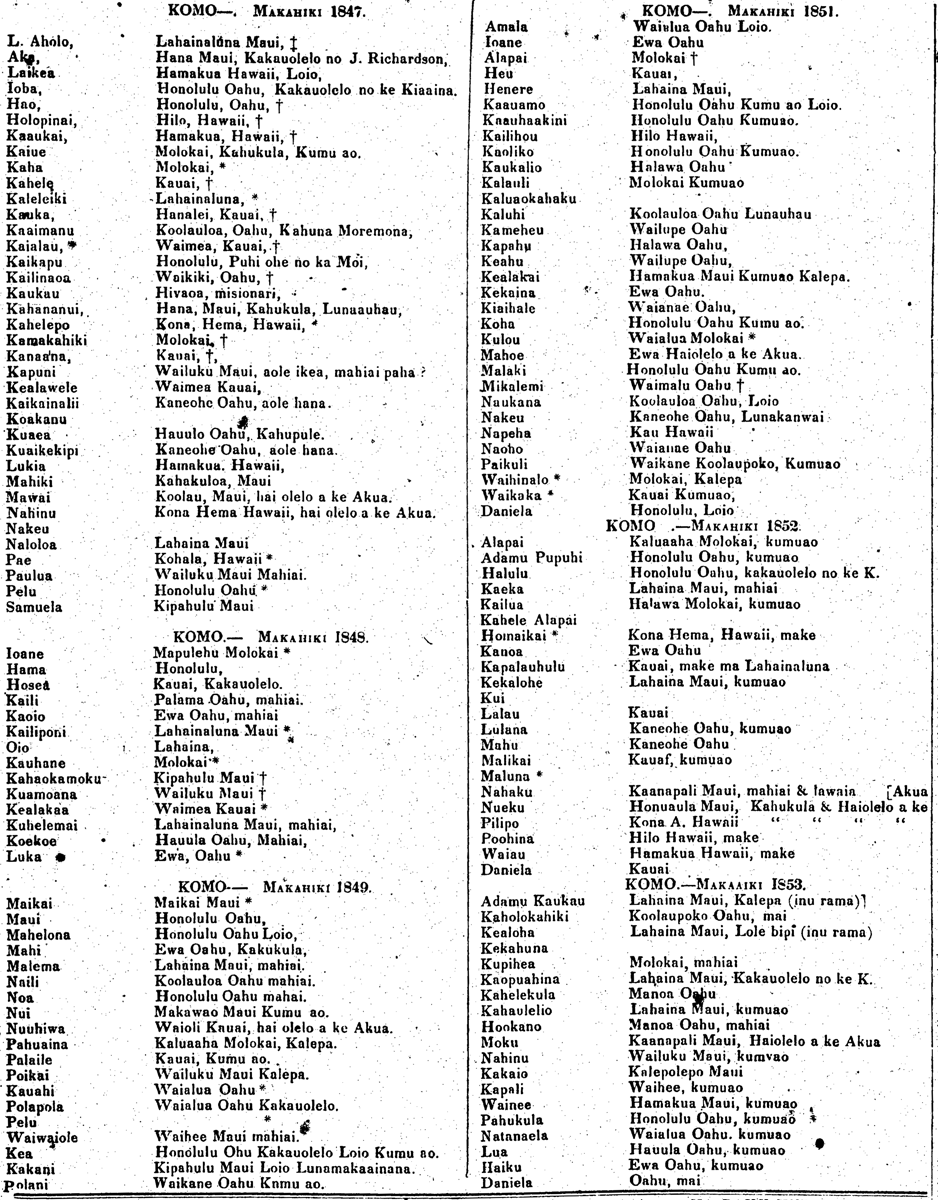
KOMO--. Makahiki 1847.

Ka Hae Hawaii, Buke 3, Ano Hou.—Helu 7, Aoao 28. Mei 19, 1858.

There are earlier rosters as well in Kumu Hawaii.

“He Papainoa no na Kahu a me na Kumu a me na Haumana o ke Kulanui o Hawaii Nei, Ma Lahainaluna i Maui.” Augate 19, 1835, p. 132.

“Ka Papainoa o na Kahu, a me na Kumu, a me na Haumana, o ke Kulanui o Hawaii nei, ma Lahainaluna i Maui. 1835.” Dekemaba 9, 1835, pp. 195–196.

“He Papainoa no na Kahu, a me na Kumu, a me na Haumana o ke Kulanui o Hawaii nei, ma Lahainaluna i Maui, 1836.” Feberuari 15, 1837, p. 76.

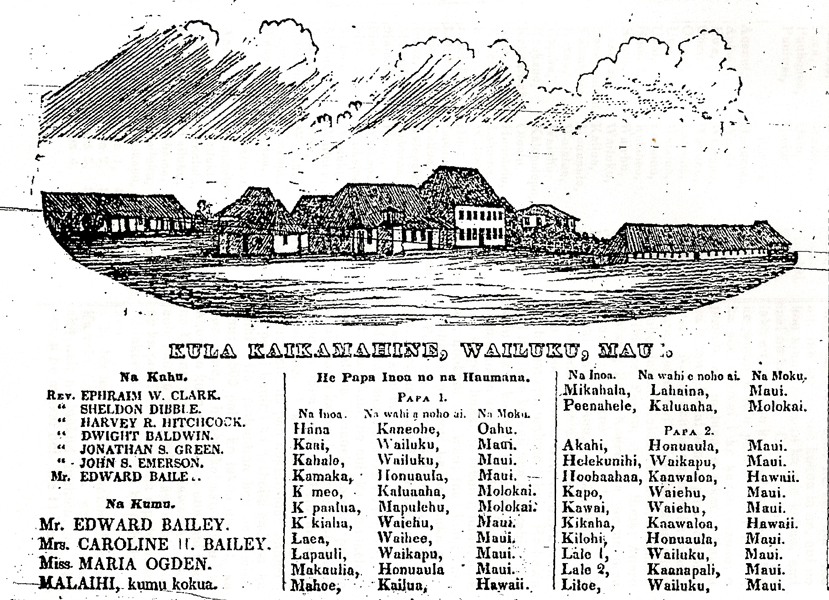
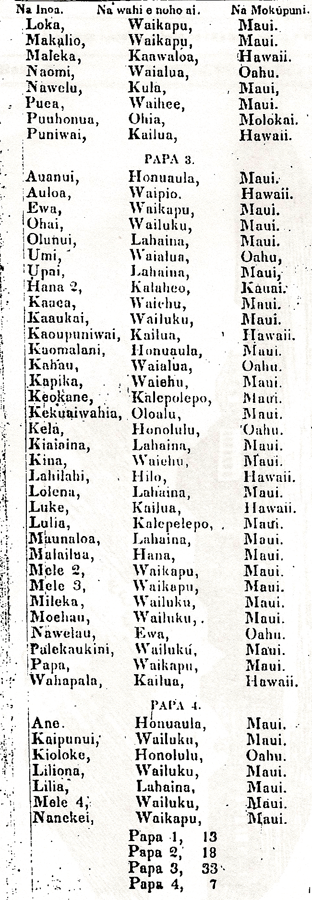
Lahainaluna School student roster, where it all started, 1858.

ROSTER OF LAHAINALUNA SCHOOL.

O Students of Lahainaluna who have graduated and scattered all over Hawaii, here below is the Roster of the College from 1831 to 1854; look and see who is living, and who is dead now, and tell us who is still living to this day and their occupation, and their nature, and how they are living; it will be printed in the Hae so that we can know of the fruit of that tall and shady tree.

CLASS 1.—The Year 1831.

Names From where they came Where they reside and their occupation Numbers of years at the school
Oliva, Waimea, Kauai, Wailua, Kauai, * 4
Opunui, Honolulu, Oahu, Honolulu, Oahu, * 4
Ukikihi, Lahaina, Maui, Kaluaaha, Molokai, b 4
Hopu, Koolau, Maui, Hana, Maui, ‡ 4
Kaanaana, Koloa, Kauai, Koloa, Kauai, ‡ 4
Kaaukai, Waipio, Hawaii, Waikiki, Oahu, * 4
Kaelemakule, Wailuku, Maui, Koloa,Kauai, ‡ 4
Kauhihape, Lahaina, Maui, Lahaina, Maui, * 4
Kaio, Honolulu, Oahu, Honolulu, Oahu, * 4
Kaili, Waikapu, Maui, Honuaula, Maui, † 4
Kaikaina, Lanihau, Hawaii, Honolulu, Oahu, * 4
Kahele, Wailuku, Maui, Waikapu, Maui, * 4
Kahookui, Lahaina, Maui, Koloa, Kauai, ‡ 4
Kamanowai, Lahaina, Maui, Lahaina, Maui, § 4
Kapa, Kailua, Hawaii, Kaawaloa, Hawaii, ‡ 4
Kapaekukui, Puuwai, Niihau, Lihue, Kauai, † 4
Kapena, Honolulu, Oahu, Honolulu, Oahu, ‡ 4
Kawaihoa, Kona, Hawaii, Holualoa, Hawaii, * 4
Kawailepolepo, Honolulu, Oahu, Wailuku, Maui, * 2
Keliiwaiwaiole, Honolulu, Oahu, Hauula, Oahu, b 4
Kekahuna, Wailuku, Maui, Wailuku, Maui, * 4
Kekapa, Keanae, Maui, Mokulau, Maui, † 4
Kuaana, Kapalama, Oahu, Kaneohe, Oahu, * 4
Kekapa 2, Lahaina, Maui, Oloalu, Maui, * 4
Kilauea, Halawa, Hawaii, Halawa, Hawaii, b 4
Kuhawaii, Hana, Maui, Hana, Maui, * 4
Kupaka, Kona, Hawaii, Keauhou, Hawaii, b 4
Kulepe, Honolulu, Oahu, Waianae, Oahu, ‡ 4
Kuluwailehua, Honolulu, Oahu, Honolulu, Oahu, * 4
Mahune, Honolulu, Oahu, Honolulu, Oahu, * 4
Malaihi, Kula, Maui, Wailuku, Maui, † 4
Maluaikoo, Waimea, Kauai, Waimea, Kauai, † 4
Malulu, Kaunolu, Lanai, Kaunolu, Lanai, * 4
Malo, Lahaina, Maui, Lahaina, Maui, * 4
Moku, Lahaina, Maui, Lahaina, Maui, † 4
Naumu, Waimea, Kauai, Waimea, Kauai, ‡ 4
Nahuilele, Honolulu, Oahu, Kaaawa, Oahu, § 4
Nakou, Kaawaloa, Hawaii, Kau, Hawaii, † 4
Nana, Waipio, Hawaii, Waipio, Hawaii, § 4
Napela, Olowalu, Maui, Wailuku, Maui, § 4
Naleipuleho, Lahaina, Maui, Wailuku, Maui, § 4
Puapua, Hamakualoa, Maui, Waialua, Oahu, * 4
Puuloa, Kailua, Hawaii, Hilo, Hawaii, ‡ 4
Wahakane, Waimea, Hawaii, Waimea, Hawaii, ‖ 4
In Total 44.

CLASS 2.—The Year 1833.

Amara, Kapaa, Kauai, Kapaa, Kauai, * 4
Haaheo, Kiholo, Hawaii, Kohala, Hawaii, ‡ 4
Hookano, Honolulu, Oahu, Honolulu, Oahu, * 4
Hooliliamanu, Honolulu, Oahu, Honolulu, Oahu, * 3
Hoku, Honuaula, Maui, Auwahi, Maui, † 4
Kaenaena, Kahakuloa, Maui, Lahaina, Maui, * 4
Kaumu, Honolulu, Oahu, Wailuku, Maui, § 4
Kala, Oloalu, Maui, Wailuku, Maui, * 4
Kamakau, Waialua, Oahu, Lahainaluna, Maui, † 7
Kanakaokai, Waimea, Kauai, Kalaupapa, Molokai, ‡ 4
Keliihuluhulu, Waimea, Kauai, Waialua, Oahu, ‡ 4
Keliiumiumi, Waimea, Kauai, Koloa, Kauai, * 4
Kepoookamoku, Honolulu, Oahu, Kaumakapili, Oahu, * 4
Kekualaau, Kahakuloa, Maui, Waialua, Oahu, § 4
Kolia, Waimea, Kauai, Anahola, Kauai, † 3
Kuihelani, Honolulu, Oahu, Wailuku, Maui, ‡ 4
Kuhihi, Keauhou, Hawaii, Kaanapali, Maui, * 4
Manu, Paofai, Tahiki, Kipahulu, Maui, * 4
Momona, Keauhou, Hawaii, Koloa, Kauai, * 2
Nainoa, Ewa, Oahu, Ewa, Oahu, § 4
Namauu, Hanalei, Kauai, Waioli, Kauai, † 4
Pali, Paomai, Lanai, Paomai, Lanai, ‡ 4
Wi, Kailua, Hawaii, Kaumalumalu, Haw., § 4
Wahineiki, Kailua, Hawaii, Kailua, Hawaii, † 4
In Total 24.

CLASS 3.—Year 1834.

Haae, Punahoa, Hawaii, Pukoa, Molokai, * 4
Olamana, Lahainaluna, Maui, Kaanapali, Maui, * 4
Haanio, Punahoa, Hawaii, Punahoa, Hawaii, † 3
Haalelea, Lahaina, Maui, Honolulu, Oahu, § 1
Haleole, Lahainaluna, Maui, Haiku, Maui, † 4
Holopololei, Ukumehame, Maui, Waialae, Oahu, § 4
Kaapa, Puueo, Hawaii, Punahoa, Hawaii, * 3
Kanakaahuahu, Ponahawai, Hawaii, Hilo, Hawaii, § 4
Kaiana, Ponahawai, Hawaii, Ponahawai, Hawaii, † 6
Kaianui, Honouli, Molokai, Waikolu, Molokai, * 2
Kaiaikawaha, Waialua, Oahu, Waialua, Oahu, † 4
Kailua, Lahaina, Maui, Puueo, Hawaii, * 3
Kaluna, Kaluaaha, Molokai, Kaluaaha, Molokai, † 2
Kaelemakule, Kaawaloa, Hawaii, Koloa, Kauai, § 3
Kahema, Kawela, Hawaii, Kamalo, Molokai, † 4
Kahoena, Palawai, Lanai, Moakea, Molokai, † 4
Kauhi, Palawai, Lanai, Kalaupapa, Molokai, † 4
Kauakahi, Lumahai, Kauai, Moloaa, Kauai, ‡ 4
Kalaniwahinamoku, Waialua, Oahu, Maemae, Oahu, * 4
Kalama, Lahaina, Maui, Koloa, Kauai, § 5
Kale, Lahaina, Maui, Lahaina, Maui, b 3
Kalena, Lahaina, Maui, Honaunau, Hawaii, * 4
Kamai, Lahaina, Maui, Halawa, Molokai, § 3
Kawaihalau, Lahaina, Maui, Lahaina, Maui, § 3
Kawainui, Keawanui, Molokai, Keawanui, Molokai, * 3
Keaoku, Lahaina, Maui, Wailuku, Maui, * 4
Keola, Lahaina, Maui, Kailua, Hawaii, * 1
Lahaina, Ponahawai, Hawaii, Hilo, Hawaii, § 3
Leleiohoku, Lahaina, Maui, Kailua, Hawaii, * 1
Mahu, Wailuku, Maui, Hamakuapoko, M., † 4
Makaihekona, Kukuihaele, Hawaii, Halawa, Oahu, † 4
Maakuia, Kamoku, Lanai, Honouliuli, Oahu, † 4
Maaweiki, Punahoa, Hawaii, Honuaula, Maui, † 4
Miki, Waimea, Hawaii, Hana, Maui, † 4
Moo, Puueo, Hawaii, Ukumehame, Maui, * 4
Muolo, Wailuku, Maui, Wailuku, Maui, § 2
Nakipi, Waimea, Kauai, Lahainaluna, Maui, * 3
Paahana, Kapalama, Oahu, Waiawa, Oahu, * 4
Paku, Oloalu, Maui, Honolulu, Oahu, † 6
Peiho, Wainiha, Kauai, Wainiha, Kauai, † 4
Puaenaena, Punahoa, Hawaii, Makahanaloa, Haw., † 4
Wana, Waioli, Kauai, Waioli, Kauai, ‡ 4
In Total 42.

CLASS 4.—Year 1836.

Ehu, Wailuku, Maui, Waikapu, Maui, † 4
Opunui, Hanalei, Kauai Ewa, Oahu, * 4
Hau, Lahainaluna, Maui, Lahaina, Maui, § 2
Hoapili, Waihee, Maui, Wailuku, Maui, * 3
Kahaku, Lahainaluna, Maui, Kahiki, § 3
Kahuakaikaua, Lahainaluna, Maui, Lahaina, Maui, § 3
Kahale, Wailuku, Maui, Wailuku, Maui, † 4
Kaiaikai, Lahainaluna, Maui, Lahaina, Maui, * 5
Kaumaka, Kaneohe, Oahu, Kaneohe, Oahu, * 5
Kauwahi, Kipahulu, Maui, Honolulu, Oahu, ‡ 5
Kailihiwa, Waialua, Oahu, Waialua, Oahu, * 2
Kalili, Honolulu, Oahu, Honolulu, Oahu, * 4
Kamoa, Hanalei, Kauai Hanalei, Kauai, ‡ 4
Kanahunahupu, Waihee, Maui, Waihee, Maui, † 4
Kapahukani, Waimea, Kauai, Lahaina, Maui, * 4
Kapawa, Wailuku, Maui, Waikapu, Maui, § 2
Kealohanui, Hanapepe, Kauai, Honolulu, Oahu, *
Kekaulahao, Honolulu, Oahu, Honolulu, Oahu, * 5
Kekipi, Waialua, Oahu, Waialua, Oahu, * 4
Kuke, Wailuku, Maui, Wailuku, Maui, § 2
Kumukahi, Waimea, Kauai,
Kunui, Waialua, Oahu, Waialua, Oahu, * 4
Nahalelau, Lahaina, Maui, Lahainaluna, Maui, * 3
Napuaea, Honolulu, Oahu, Honolulu, Oahu, * 4
Nohoua, Kahana, Oahu, Honolulu, Oahu, ‡ 4
Nuuanu, Waialua, Oahu, Honolulu, Oahu, ‡ 5
Paalua, Honolulu, Oahu, Honolulu, Oahu, * 4
Pikao, Honolulu, Oahu, Honolulu, Oahu, * 4
Pilahi, Kailua, Hawaii, Puna, Hawaii, ‡
Davida, Kailua, Hawaii, Honolulu, § 3
In Total, 30.

CLASS 5.—Year 1837.

Aumai, Kaawaloa, Hawaii, Hilo, Hawaii, ‡ 4
Aka, Waimea, Kauai, Waimea, Kauai, † 4
Hoaiai, Hilo, Hawaii, Hilo, Hawaii, † 4
Kaaikaula, Wailuku, Maui, Wailuku, Maui, * 4
Kaaipuaa, Honolulu, Oahu, Laie, Oahu, * 4
Kaauwaepaa, Kawaloa, Hawaii, Honolulu, Oahu, ‖ 4
Kaehu, Anahola, Kauai Kealia, Kauai, § 4
Kaiawa, Waikiki, Oahu, Honolulu, Oahu, * 4
Kauku, Ohia, Molokai, Kalae, Molokai, † 4
Kaumaea, Lahaina, Maui, Lahaina, Maui, † 4
Kahulanui, Wailuku, Maui, Wailuku, Maui, † 4
Kaka, Honuaula, Maui, Kahiki, § 4
Kalepo, Hilo, Hawaii, Holualoa, Hawaii, † 4
Kaluau, Kaluaaha, Molokai, Kaluaaha, Molokai, § 4
Kamali, Waimea, Kauai, Niihau, Niihau, † 4
Kamiki, Hilo, Hawaii, Hakalau, Hawaii, † 4
Kapeau, Honolulu, Oahu, Honolulu, Oahu, ‡ 4
Keaka, Honolulu, Oahu, Honolulu, Oahu, * 4
Keaku, Lahaina, Maui, Lahaina, Maui, † 4
Kou, Ewa, Oahu, Ewa, Oahu, § 4
Ladana, Honolulu, Oahu, Lahaina, Maui, * 4
Lilikalani, Kaawaloa, Hawaii, Kaawaloa, Hawaii, † 4
Naue, Waialua, Oahu, Kapaka, Oahu, ‡ 4
Wana, Waimea, Kauai, Waioli, Kauai, † 4
Samuela, Hilo, Hawaii, Hilo, Hawaii, † 4
In Total, 26.

* Dead.
† Teacher.
‡ In Government jobs.
‖ Doing worthwhile endeavors.
§ Just living [unemployed].
b Living peacefully, and working, but not at what they were educated in.
¶ Student living at the School.

[Unfortunately, the only way the entirety of Hae Hawaii can be looked at online is just as a typescript, and only at http://www.nupepa.org. It is not available at http://www.papakilodatabase. com.]

(Hae Hawaii, 5/1858, p. 26)

PAPA INOA O KE KULA NUI O LAHAINALUNA.

Ka Hae Hawaii, Buke 3, Ano Hou.—-Helu 7, Aoao 26. Mei 19, 1858.


Charles Nakao, survivor of the Aztec, writes home to Hawaii, 1917.

HAWAIIAN SURVIVOR OF AZTEC TELLS HIS STORY IN LETTER TO THE STAR-BULLETIN

A MESSAGE from a Hawaiian survivor of the steamship Aztec, sunk by a German submarine, came to the Star-Bulletin in yesterday’s mail from Brooklyn, New York.

Charles Nakao in a letter to this paper tells how some of his comrades were lost in trying to launch a lifeboat, and of the suffering of those on the wintry sea. Five Hawaiians were among those who perished, and a few weeks ago the legislature held a public memorial in their honor.

The letter says:

“Brooklyn, New York, April 26, 1917.

“Dear Sir: I, Chas. Nakao, was one of the members of the crew of the S. S. Aztec which was the first American vessel armed with two three-inch guns. Number of crew was 49, including 12 navy gunners and an officer of the U. S. S. Dolphin. We sailed from New York March 18, 1917, and were torpedoed by a submarine April 1, 1917, Sunday night, at 9:30 o’clock, off the coast of France. It was very stormy weather, the seas were about 30 feet in height and the current from English channel was running about 7 miles an hour. It were dark hail storm and were impossible to launch any lifeboat over the weather side. Seven of the crew got excited and try to launch the boat No. 2, which were on the weather side they were all smashed between the life boat and the ship side one of the boys were from Honolulu, Ekela Kaohi, the other were Chinese boy from Puna Pahoa Henry Look. No. 3 boat there were Hail Rice of Honolulu, Chas. Pumoku, Julian Makama of Honolulu, one from Tahiti Islands, John Davis. I were on board the No. 1 boat which I suppose to be the gunners’ boat. There were 19 of the crew on board. The vessel had sunk within 15 minutes it took 9 minutes because we were away from the ship side. After we were probably about 100 yards away some one gave four long blasts. Nobody knows how it happened. After four hours and a half in lifeboats on the high seas and hail storms and rain and darkness we were sighted by a French patrol boat. We had signaled to the boat with flashlights. They got full speed away from us. The second one had passed by and we lighted a torch and they came and picked us up. The temperature of the water was 40 degrees and I didn’t have any shoes or hat on. I was frozen and could hardly speak for about two hours after we got picked up. It was 1:30 o’clock in the early Monday…

Charles Nakao, survivor of the torpedoed Aztec

…morning and we had looked around for about 18 hours for the other boat. There were know sign whatsoever. So we landed at Brest, France, the American consul came and met us at the dock and over 6 hundred Frenchmen were treated fine. I got warm and were send to Brest hospital. From Brest we were send to Bourdeaux, France, about 48 hours ride train.

“We got on board the S. S. La Tourine, the French passenger boat from Bourdeaux, and we got back to New York safe.

“I remain yours truly,

CHAS. NAKAO,

Waiakea, Hilo, Hawaii.

“If any of boys’ family wants to get any information about the clothes or anything else please sent me your address and I will try my best to send it over. This is my address: Chas. Nakao, 324-32th street, Brooklyn, New York.

“P. S.—Thinking our Queen for her kindly remembrance to us boys off the ill-fated S. S. Aztec.

“Yours sincerely,

“C. N.”

[This article seems to be summarized in the Kuokoa of Iune 1, 1917, p. 5]

(Honolulu Star-Bulletin, 5/9/1917, p. 1)

HAWAIIAN SURVIVOR OF AZTEC TELLS HIS STORY IN LETTER TO THE STAR-BULLETIN

Honolulu Star-Bulletin, Volume XXIV, Number 7822, Page 1. May 9, 1917.

Hawaiian men aboard the Aztec, 1917.

Cables Names of Men Aboard Aztec

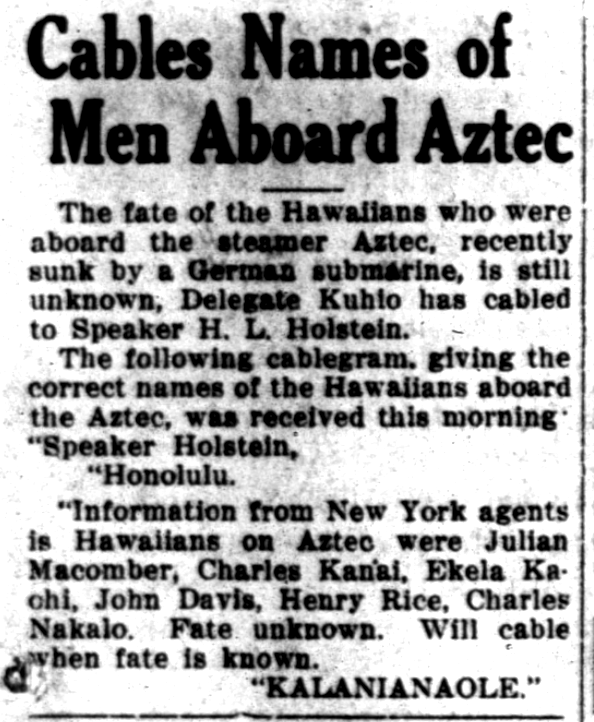
The fate of the Hawaiians who were aboard the steamer Aztec, recently sunk by a German submarine, is still unknown, Delegate Kuhio has cabled to Speaker H. L. Holstein.

The following cablegram, giving the correct names of the Hawaiians aboard the Aztec, was received this morning.

“Speaker Holstein,

“Honolulu.

“Information from New York agents is Hawaiians on Aztec were Julian Macomber, Charles Kanai, Ekela Kaohi, John Davis, Henry Rice, Charles Nakalo. Fate unkonwn. Will cable when fate is known.

“KALANIANAOLE.”

(Honolulu Star-Bulletin, 4/5/1917, p. 1)

Cables Names of Men Aboard Aztec

Honolulu Star-Bulletin, Volume XXIV, Number 7793, Page 1. April 5, 1917.

Hawaiian boys casualties of WWI, 1917.

FIVE HAWAIIAN BOYS DIED.

Washington, April 3—There are five Hawaiian boys thought to have been killed along with 16 Americans when the American steamer the Aztec was sunk. This ship was sunk outside of the seas of France by the German submarine without being given prior time for the captain and his sailors to prepare themselves on the previous Sabbath. Amongst the Americans  who are thought to have died are some sailors of the navy which the government placed aboard the ship when it left Newtown of Brest, the place of the shipwrecks of past [?? New York for Brest]. These are the first sailors of the navy to become victims of the Prussians as they attacked without giving time for them to distance themselves from the calamity of the sea placed upon them, and it is believed that Germany is at fault for breaking the pact with America by Germany starting its massacre with its submarines. This is the Brests where some of the shipwrecked of some of the skiffs landed [??] here below are the names of the Hawaiian boys:

Julian R. Masomber [Julian R. Macomber], Honolulu.

Charles Pinapolo, Honolulu.

Ekila Kaohi [Ekila Kaoki], Hawaii.

Tota Davisfi [Tato Davis], Hawaii.

H. K. Price, Hawaii. Continue reading

Nice advertisement for fishing nets and other equipment! 1902.

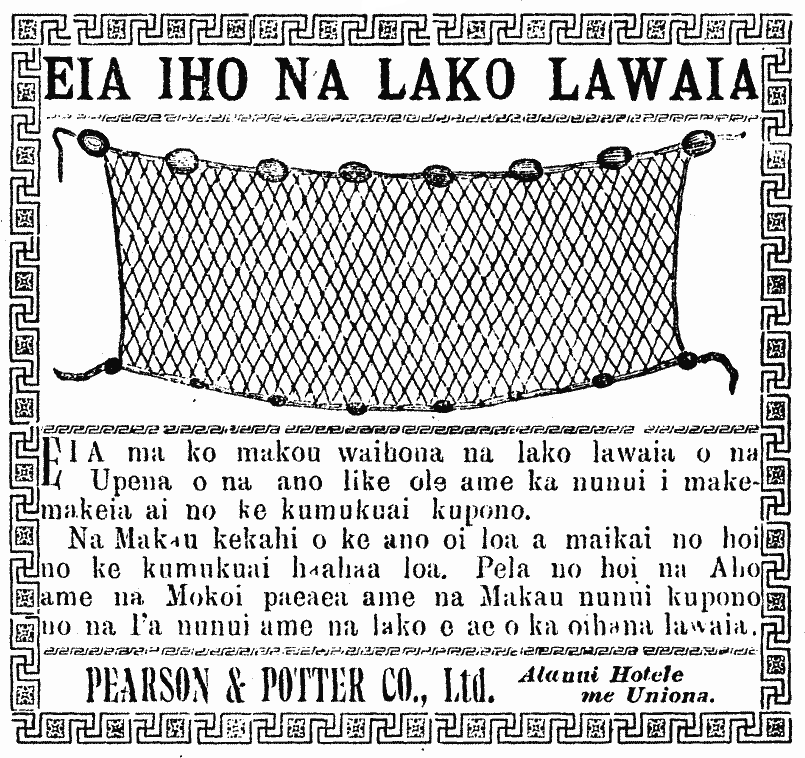
WE HAVE FISHING SUPPLIES

Here within our stock of fishing equipment are Nets [Upena] of all sorts and sizes as per your desires priced right.

We also have Hooks [Makau] which are very sharp and fine at very low prices. We also have Line [Aho] and Rods [Mokoi paeaea] and large Hooks good for large Fish as well as other fishing accessories.

PEARSON & POTTER CO., LTD.   Hotel and Union Streets.

(Kuokoa, 8/15/1902, p. 5)

EIA IHO NA LAKO LAWAIA

Ka Nupepa Kuokoa, Buke XL, Helu 33, Aoao 5. Augate 15, 1902.


“American Queen”? 1917.

QUEEN LILIUOKALANI.

Clarifications by a Newspaper Writer about Her.

(Translated)

To “Ke Ola o Hawaii,”

Appearing in the British newspaper, The Outlook, of the other week, there were a number of awe-inspiring lines about our Queen, Liliuokalani, titled: “An American Queen.” This is how it went:

Americans sometimes forget that within one of the Territories of the United States there lives a real ex-Queen who owes the loss of her crown to the activities of American missionaries.

This Queen is, of course, Liliuokalani, of Hawaii, dethroned in the revolution of 1893. She is now a frail old lady of nearly seventy-nine years, and few but her immediate household and closest friends ever have the opportunity of meeting and talking with her.

It is interesting to record that because of one of the tragedies of the present war this aged Queen has permitted for the first time an American flag to fly over her home. The news of this incident comes to us in a letter from a correspondent in Hawaii. This correspondent writes:

It was my privilege a few days ago to attend what will possibly be the last public reception she will ever give to members of the Hawaiian Senate—some of her own race, and some sons of the missionaries who were mainly responsible for her overthrow. Although they belonged to a body absolutely democratic in form and elected by vote of the people as citizens of the United States, it was most interesting and somewhat touching to note the loyalty and love shown the aged ex-Queen: almost, one could imagine, as if she were still their reigning sovereign. Continue reading

Decoration Day, 1909.

“DAY TO STREW FLOWERS”

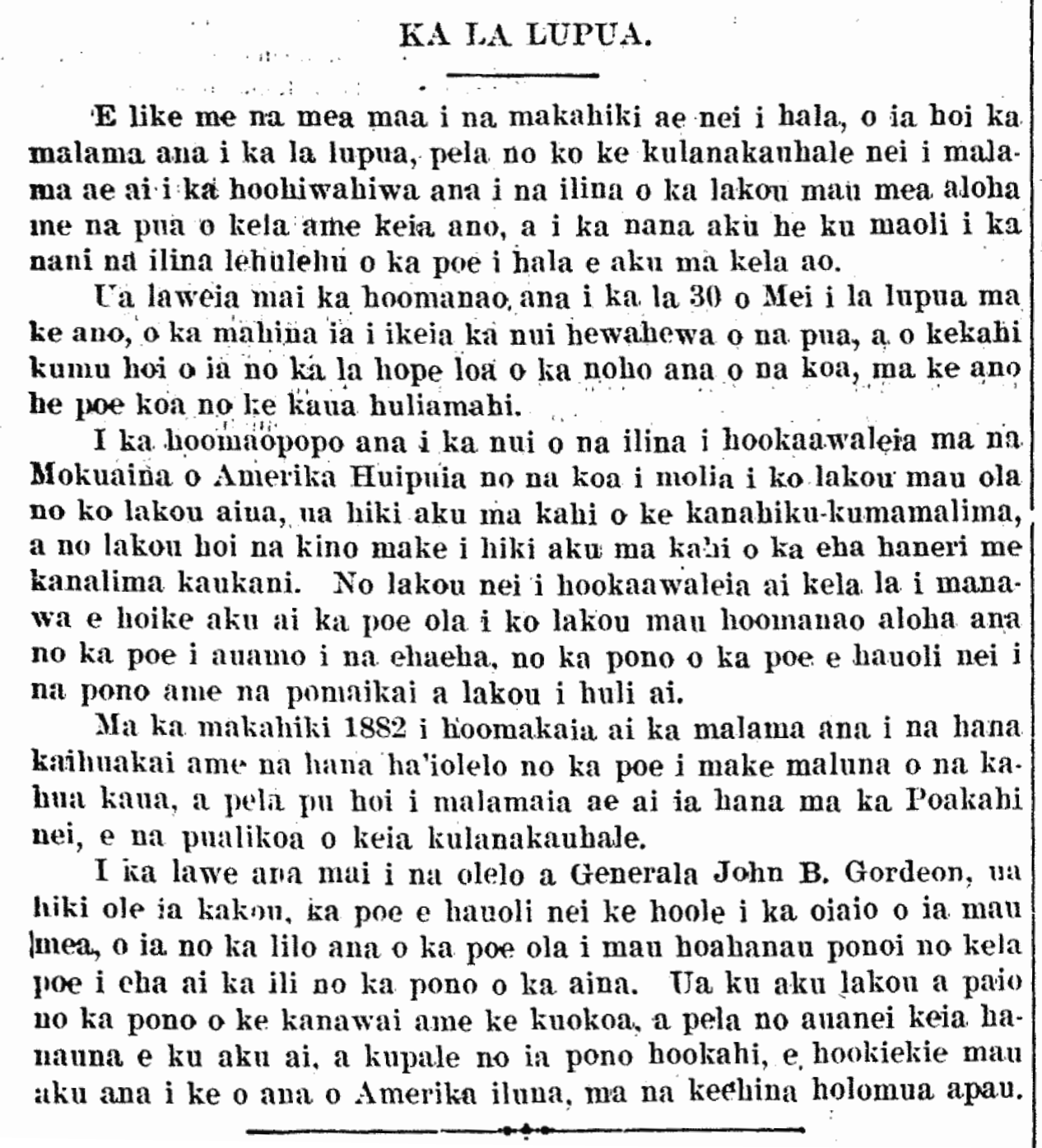
As has been the custom in previous years, that is the observation of memorial day [la lupua], the town is similarly decorating the graves of their loved ones with flowers of every type, and the cemeteries of the many who have passed are truly beautiful to see.

The 30th of May has been taken as a day to “strew flowers,” being that it is the month in which many flowers are seen, and also it is the final day the soldiers served as soldiers in the great war [kaua huliamahi].

The number of the [national] cemeteries in the different States of the United States, for the soldiers who sacrificed their lives for their land, is about seventy-seven, and within them they hold about four-hundred fifty thousand bodies. It is for them that the day is set aside; it is a time for the living to show their loving remembrances for those who bore suffering for the welfare of the people who enjoy the rights and blessings for which they sought after.

In the year 1882, the parades and speeches for those who died on the battlefields were initiated, and that is what happened this past Monday by the soldiers of this town.

Taking the words of General John B. Gordon, “It is impossible for us who are today joyful, to deny the truth of these things, that being, those who are living should be as true brothers of those people who suffered injuries for the blessings of this land. They stood and fought for the righteousness of the law and for independence, and that is how this generation then should remain and defend the very same right, continually pushing America on higher in all areas of progress.”

(Kuokoa, 6/9/1909, p. 4)

KA LA LUPUA.

Ka Nupepa Kuokoa, Buke XLVI, Helu 23, Aoao 4. Iune 9, 1909.

Kamehameha boys off to war, 1917.

Hawaii Young Men Who Have Enlisted in Navy and Will Go to Coast

Here are two youths of this city who have enlisted in the U. S. navy on board the U. S. S. Alert. On the left is Jerome Fearoi, 19 years old, a freshman student at Kamehameha School for Boys. On the right is George Woolsey, also 19, born in Honolulu, and also of the freshman class at Kamehameha, where he took the machine-shop course.

These two young men, having joined the U. S. colors, are to be ordered to the Naval Training Station at San Francisco, Cal., for a military training prior to being assigned to duty on board a war vessel.

The naval authorities here are securing enlistments in accordance with the recent notification by Secretary Daniels. Applicants for enlistment may apply at the Alert, Navajo, Naval Station in Honolulu or recruiting office at the O. R. & L. depot every morning. The hours are as follows:

Naval Station, Honolulu, between 2 p. m. and 4:30 p. m., week days, and 9 a. m. to 11:30 a. m., Sundays. U. S. S. Alert, 8 a. m. to 4 p. m. U. S. S. Navajo, 7 a. m. to 4 p. m., or at the railroad station between 6:45 a. m. and 7:25 a. m. each morning except Sunday.

(Honolulu Star-Bulletin, 4/17/1917, p. 9)

Hawaii Young Men Who Have Enlisted in Navy and Will Go to Coast

Honolulu Star-Bulletin, Volume XXIV, Number 7803, p. 9. April 17, 1917.


A day to remember, 1924.

THE “DAY TO PLACE FLOWERS” WAS OBSERVED HERE IN HONOLULU

Just as in years past where Decoration Day [La Kaupua] was observed, so too has it come again on this past Friday, as the graves in the different cemeteries were decorated, and also a parade of soldiers was held upland of the cemetery of Nuuanu, where speeches were given as well as songs, for the observances on that day.

All of the cemeteries were decorated with flowers; from Thursday night the graves were being decorated until noon of the following Friday, showing that the observation of Decoration Day is given much thought to by the people these days.

A majority of the day was spent by the people going around from graveyard to graveyard looking at the adornments of the graves, and one thing heard amongst the people making their rounds was that the flowers and lei done with great care were beautiful.

At nine thirty in the morning, the parade of the soldiers and some organizations began from within the palace grounds up to the cemetery in Nuuanu, and being that some people were occupied with prayers at other cemeteries, this parade was not given any thought to, except by those who were not participating in decorating flowers on that day.

[Memorial Day (Decoration Day), which was held on the 30th of May and is now held on the last Monday of May, can be found in the Hawaiian-Language Newspapers as La Kaupua (“day to place flowers”) or La Lupua (“day to strew flowers”).]

(Kuokoa, 6/5/1924, p. 1)

HOOMANAOIA KA LA KAUPUA MA HONOLULU NEI

Ka Nupepa Kuokoa, Buke LXIII, Helu 23, Aoao 1. Iune 5, 1924.