The pioneers of the Hawaiian Homes Lands in Kalamaula, Molokai, 1922.

Eight Ohana will Head First to the Homestead Lands at Molokai

The Hawaiian Homes Commission Chose those People who were Thought to be Appropriate for Going First to the Lands of Kalamaula, Molokai

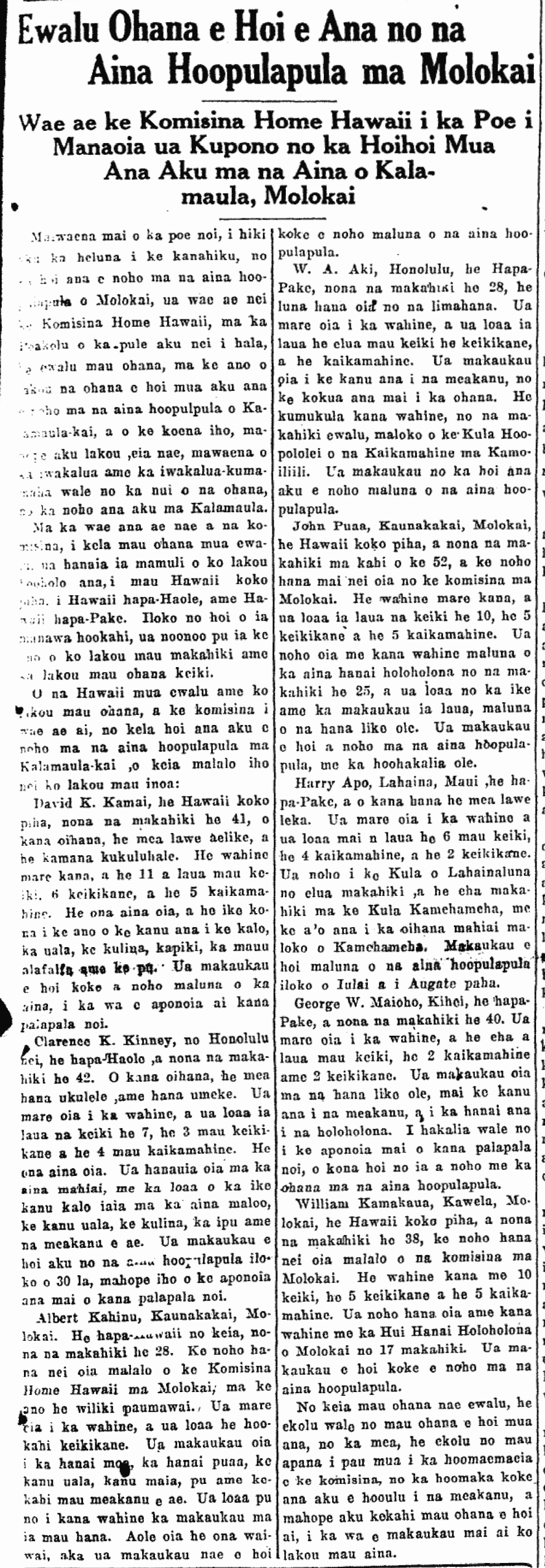
Amongst the applicants that reached seventy in number, to go back to the homestead lands of Molokai, the Commissioner of Hawaiian Homes chose  last week Wednesday, eight families as the first to go to live on the homestead lands of Kalamaula Kai, and the rest, they will go later, however, only between twenty and twenty-four families total will live at Kalamaula.

In the selection of the commission of those eight families, it was done with them choosing full-blooded Hawaiians, hapa Haole, and hapa Chinese. At the same time, considered were their ages and the children in their families.

The first eight Hawaiians and their families which were selected by the commission to go to the aina hoopulapula at Kalamaula Kai are here named below:

David K. Kamai, a full-blooded Hawaiian who is 41 years old, his occupation is a contractor and a carpenter. He has a wife and they have 11 children, 6 boys and 5 girls. He is a land owner and he has knowledge of taro cultivation, sweet potato, corn, cabbage, alfalfa grass and melons. He is prepared to go at once and live on the land when his application is approved.

Clarence K. Kinney [Clarence W. Kinney], of Honolulu nei, is a hapa Haole, and is 42 years old. His occupation is an ukulele maker and a maker of umeke. He is married, and they have 7 children, 3 boys and 4 girls. He is a land owner. He was born on farm lands, with knowledge of dry land taro cultivation, sweet potato planting, corn, melon and other crops. He is ready to go to the aina hoopulapula in thirty days after his application is approved.

Albert Kahinu, Kaunakakai, Molokai. He is a hapa Hawaii that is 28 years old. He is employed by the Hawaiian Homes Commission on Molokai as a water pump engineer. He is married and they have one son. He knows how to raise chicken and pig, and how to plant sweet potato, banana, melon, and other crops. His wife is also knowledgeable in that kind of work. He does not own property, but is prepared to go at once to live on the homestead lands.

W. A. Aki, Honolulu, is a Hapa Chinese, and is 28 years old; he is an overseer of laborers. He is married and they have two children, a son and daughter. He is knowledgeable about planting crops to assist his family. His wife has been a school teacher for eight years at the Girls’ Correctional School at Kamoiliili. They are ready to go live on the aina hoopulapula.

John Puaa, Kaunakakai, Molokai, is a full-blooded Hawaiian, and is 52 years old; he is employed by the commission at Molokai. He is married, and they have 10 children, 5 boys and 5 girls. He has lived with his wife on a ranch for 25 years, and the two are knowledgeable at various work. They are prepared to go live on homestead lands without delay.

Harry Apo, Lahaina, Maui, is a hapa Chinese, and he works as a letter carrier. He is married, and they have 6 children, 4 girls and 2 boys. He lived at Lahainaluna School for two years, and four years at Kamehameha School, learning farming at Kamehameha. He is ready to move to the aina hoopulapula in July or August perhaps.

George W. Maioho, Kihei, is a hapa Chinese, and is 40 years old. He is married, and they have four children, 2 girls and 2 boys. He is capable of all sorts of work, from planting crops to raising livestock. He will go at once after his application is approved to live on the aina hoopulapula with his family.

William Kamakaua, Kawela, Molokai, is a full-blooded Hawaiian, and is 38 years old; he is employed by the commission on Molokai. He is married with 10 children, 5 sons and 5 daughters. He worked along with his wife on Molokai Ranch for 17 years. He is prepared to live on the homestead lands.

Of these eight families, only three will go first, because only three of the lots have been so far cleared by the commission to be farmed at once, and thereafter, other families will go when their lots are ready.

[There was a nice article in this month’s Ka Wai Ola, on page 5, about a remembrance of the first settlers of the Hawaiian Homes lands at Kalamaula. Here are more families that were chosen, listed in the Kuokoa on 8/17/1922.

Here is perhaps a more detailed article on the eight found in the Kuokoa on 7/6/1922, p. 2.]

(Kuokoa, 7/6/1922, p. 1)
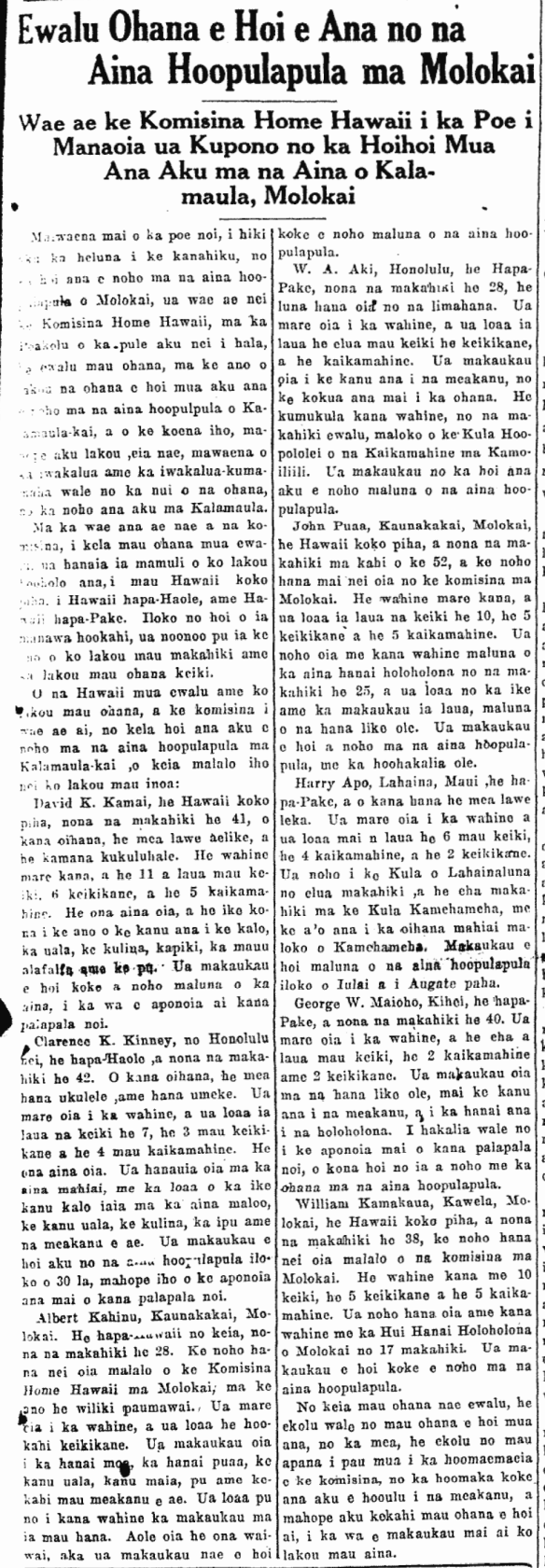
Ewalu Ohana e Hoi e Ana no na Aina Hoopulapula ma Molokai

Ka Nupepa Kuokoa, Buke LXI, Helu 27, Aoao 1. Iulai 6, 1922.

Hawaiian Language Imprints, Judd, Bell, and Murdoch, 1978.

This is a nice bibliography of Hawaiian-language material written between 1822 and 1899 compiled by Bernice Judd, Janet E. Bell, and Clare G. Murdoch in 1978. What is nice about this is that it lists where known copies at the time were located. Unfortunately, this online copy is not easily searchable like the 1869 Bibliography of the Hawaiian Islands in the last post. If you do a search, you will only be pointed to the word in the typescript, but if you want to know where it appears on the image of the original, you will only be pointed to the page where it appears. There is supposed to be another copy on Project Gutenberg, but the file seems to be corrupt. On Project Gutenberg, you would be able to do a word search against the image of the original with it highlighting the word or phrase searched for.

Hawaiian Language Imprints, 1822-1899.

Hawaiian Language Imprints, 1822-1899.

More on ’93 KS graduate, Abraham Pihi, 1898.

MY DEAR SWEETHEART HAS JUST PASSED, AND MY EMOTIONAL SUPPORT HAS BEEN TAKEN AWAY.

Mr. Editor.

Aloha oe:

Should it be satisfactory to you and your workers, here is my bundle of olive leaves that is placed above, so that our many loved ones living all the way from Haehae where the sun rises to the pleasant base of Lehua where the sun sets may see it.

My beloved has gone, my companion who I would talk with in days gone by, that is my beloved man, Mr. Aprahama Pihi, who is a native and a familiar one of the land famous for the “Kanilehua” [Hilo] and the fragrant bowers of hala of Puna, and the land of the Haao Rains [Kaʻū], that is the roots of my dear husband who left me, his companion, his wife, grieving at the side of his grave. Auwe! How dreadful. Abraham Pihi was born in Puueo, Hilo, Hawaii on the 5th of January, 1872, of E. P. Hoaai (m) and Lilia Palapala (f), and the two of them had 7 children: 5 daughters and 2 sons; and 2 of them went off in search of the footprints of their parents, and 5 remain mourning on this side: 4 girls and one boy.

He was educated at the Hilo Boarding School under the principal, Rev. W. R. Oleson [W. R. Olesona]¹. After he was done there, he entered Kamehameha School in 1893. He was at that school for 1 year, but because it was learned that he had the disease that separates families, he asked the principal, that being the Rev. W. R. Oleson, to release him. He returned to Wailuku, Maui, where his mother was living with his new father, the Rev. S. Kapu; he lived with his parents until he was taken in by the disease that separates families; he was taken from his parents and his younger siblings. He was taken away to this land of no friends in 1895. The number of years he had in this world was 24 and eleven months and 13 days, when his last breath was released. Continue reading

Kamehameha School graduation, 1893.

KAMEHAMEHA SCHOOL.

Graduating Exercises at Kawaiahao Church—List of Graduates.

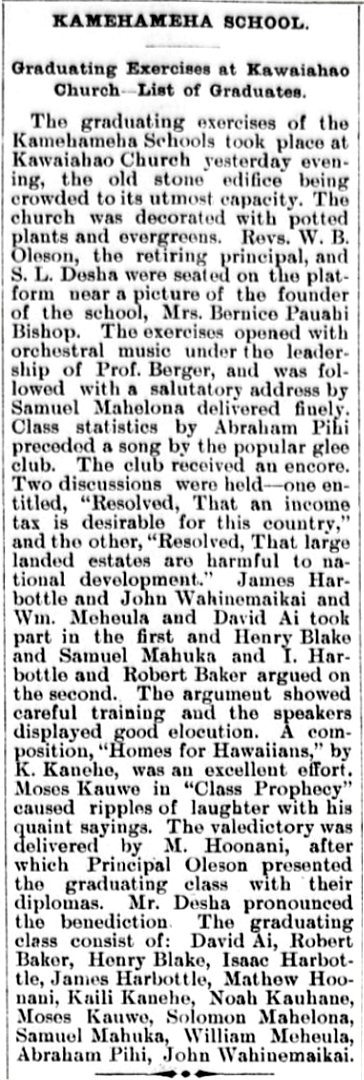
The graduating exercises of the Kamehameha Schools took place at Kawaiahao Church yesterday evening, the old stone edifice being crowded to its utmost capacity. The church was decorated with potted plants and evergreens. Revs. W. B. Oleson, the retiring principal, and S. L. Desha were seated on the platform near a picture of the founder of the school, Mrs. Bernice Pauahi Bishop. The exercises opened with orchestral music under the leadership of Prof. Berger, and was followed with a salutatory address by Samuel Mahelona delivered finely. Class statistics by Abraham Pihi preceded a song by the popular glee club. The club received an encore. Two discussions were held—one entitled, “Resolved, That an income tax is desirable for this country.” and the other, “Resolved, That large landed estates are harmful to national development.” James Harbottle and John Wahinemaikai and William Meheula and David Ai took part in the first and Henry Blake and Samuel Mahuka and I. Harbottle and Robert Baker argued on the second. The argument showed careful training and the speakers displayed good elocution. A composition, “Homes for Hawaiians,” by K. Kanehe, was an excellent effort. Moses Kauwe in “Class Prophecy” caused ripples of laughter with his quaint sayings. The valedictory was delivered by M. Hoonani, after which Principal Oleson presented the graduating class with their diplomas. Mr. Desha pronounced the benediction. The graduating class consist of: David Ai, Robert Baker, Henry Blake, Isaac Harbottle, James Harbottle, Matthew Hoonani, Kaili Kanehe, Noah Kauhane, Mose Kauwe, Solomon Mahelona, Samuel Mahuka, William Meheula, Abraham Pihi, John Wahinemaikai.

[Here is a picture of the class of 1893 found on the Kamehameha Schools Archives page. Some names given on the Archives page are not the same as found here.

Here is perhaps a more detailed article on the graduation appearing in the Hawaiian Gazette.

Yet another article in the Pacific Commercial Advertiser.

And this as well.

Also, see this touching follow up post on one of the graduates, Abraham Pihi!]

(Daily Bulletin, 6/16/1893, p. 3)

KAMEHAMEHA SCHOOL.

The Daily Bulletin, Volume V, Number 754, Page 3. June 16, 1893.

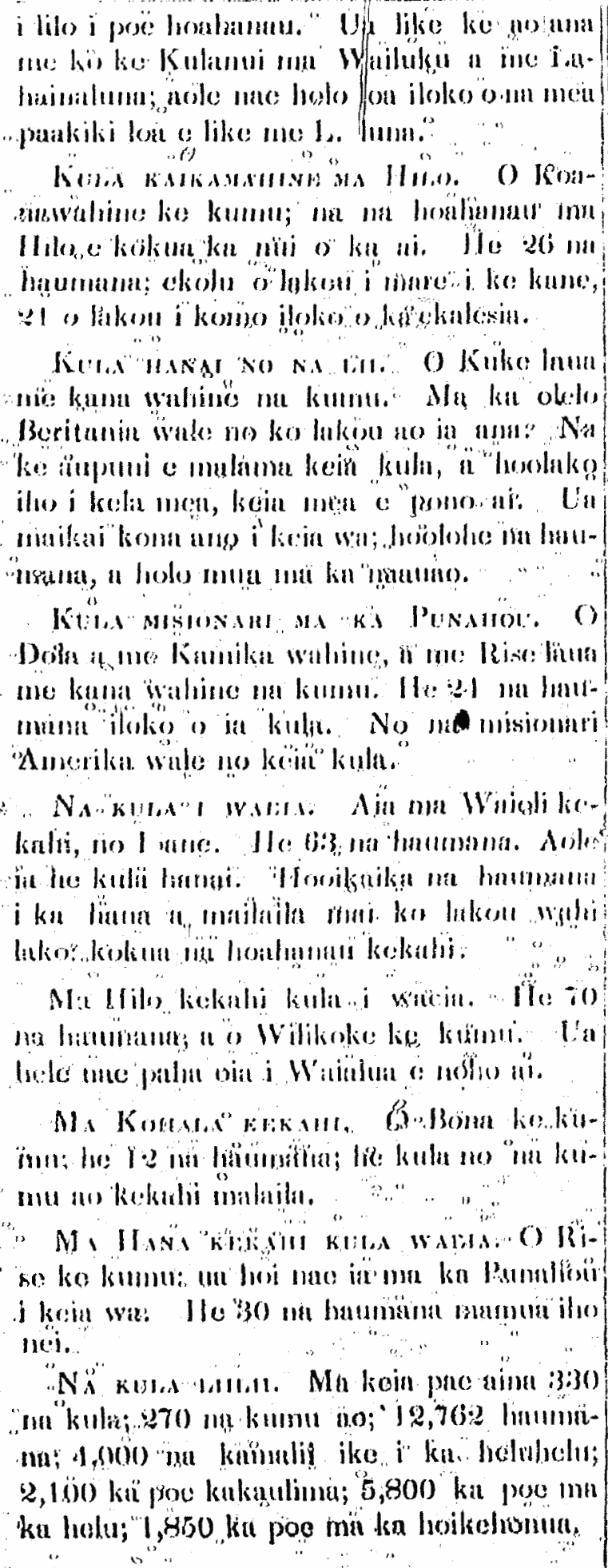
Schools in Hawaii nei, 1844.

[Found under: “KA AHAOLELO MISIONARI.”]

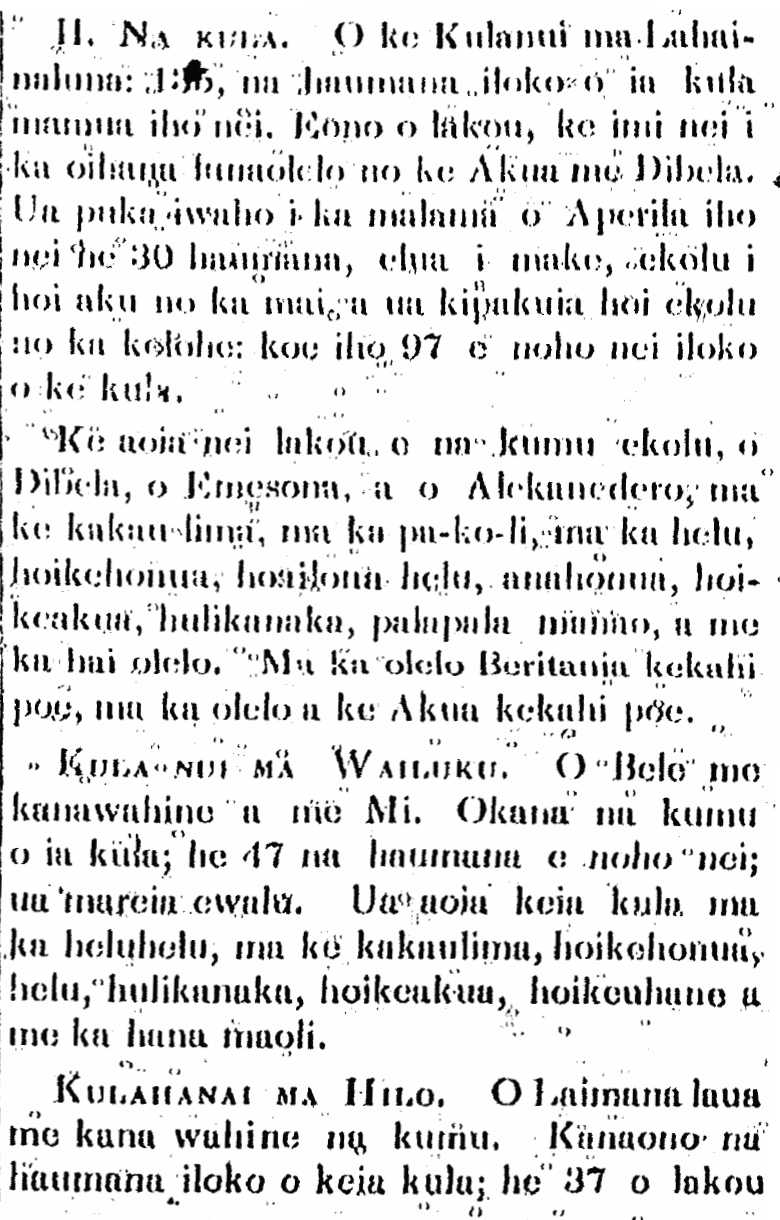
II. The Schools. Lahainaluna College: there were 135 students enrolled in the school just recently. Six of them are studying the apostles of God with Dibela [Dibble]. In April, 30 students graduated, four died, three went home because of illness, and three were expelled for rule violations; that leaves 97 remaining at the school.

They are being taught by three teachers, Dibble, Emesona [Emerson], and Alekanedero [Alexander], in penmanship, in music, math, geography, algebra, surveying, theology, philosophy, composition, and speech. Some study in English, others study in the word of God.

College at Wailuku. The teachers at the school are Bele me kana wahine [Mr. and Mrs. Bailey] and Mi. Okana [Miss Ogden]; there are 47 students living there and eight are married. At the school is taught reading, penmanship, geography, math, philosophy, theology, spirituality and actual work.

Boarding School at Hilo. Laimana laua me kana wahine [Lyman and his wife] are the teachers. There are sixty students at the school; 37 of them have become members in the church. The instruction is like that of the Colleges at Wailuku and Lahainaluna; however they are not progressing far in the difficult subjects like at Lahainaluna.

Girls’ School at Hilo. Koanawahine [Mrs. Coan] is the teacher; most of the food is donated by the church members in Hilo. There are 26 students; there of them are married to husbands, 21 of them have joined the church.

Boarding School of the Alii. Kuke laua me kana wahine [Cooke and his wife] are the teachers. They are instructed only in the English language. The government sponsors this school, and supplies all necessities. It is doing well currently: the students are obedient and are progressing in their knowledge.

Missionary School at Punahou. Dola [Dole] and Kamika wahine [Mrs. Smith] and Rise laua me kana wahine [Rice and wife] are the teachers. There are 24 students at the school. This school is solely for the American missionaries.

Select Schools. There is one in Waioli under Ioane [Johnson]. There are 63 students. It is not a boarding school. The students put effort into working, and it is from this that they get their supplies, and the church members give assistance as well.

In Hilo is another select school. There are 70 students, and Wilikoke [Wilcox] is the teacher. But he might have gone to Waialua to live.

In Kohala is another. Bona [Bond] is the teacher; there are 12 students; there is schooling for teachers there also.

There is a select school at Hana. Rice was the teacher, but he has returned to Punahou now. There were recently 30 students.

Small Schools. In these Islands there are 330 schools; 270 teachers; 12,762 students; 4,000 children can read, 2,100 can write; 5,800 can do math; 1,850 know geography.

[The state of the schools in Hawaii nei was part of what was discussed at a missionary conference held in 1844. This description starts with “II.” because i left the first part of the discussion out which was “I. Pertaining to the Church“.
It would be very helpful if there was online a “comprehensive” list of all variant names for people, like these for many of the missionaries which was published in the Elele Hawaii in 1848.]

(Nonanona, 7/9/1844, pp. 35–36.)

II. Na Kula.

Ka Nonanona, Buke 4, Pepa 6, Aoao 35. Iulai 9, 1844.

Ma Hilo...

Ka Nonanona, Buke 4, Pepa 6, Aoao 36. Iulai 9, 1844.

Opening of Punahou School, 1842.

THE SCHOOL AT KA PUNAHOU.

On the 11th of this July, this school began; there were 5 boarders and 12 day schoolers. Its work is currently progressing well.

On the 12th of July, Emerson folks left for Lahainaluna to live.

(Nonanona, 7/19/1842, p. 16)

KE KULA MA KA PUNAHOU.

Ka Nonanona, Buke 2, Pepa 4, Aoao 16. Iulai 19, 1842.

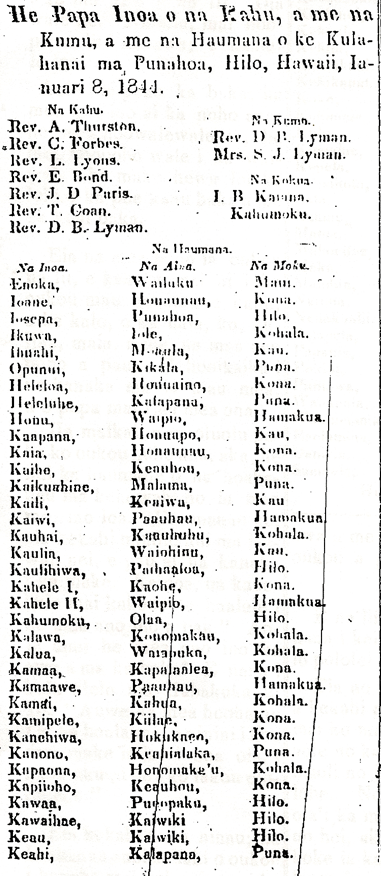
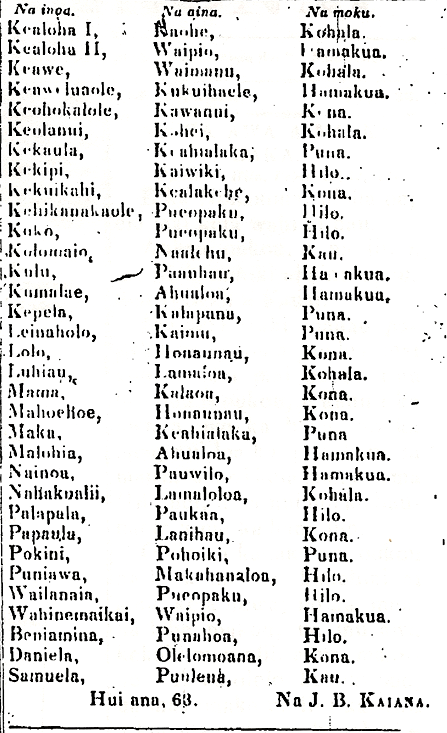
Hilo Boarding School student roster, 1844.

A Roster of the Administrators, Teachers, and Students of the Boarding School at Punahoa, Hilo, Hawaii, January 8, 1844.

Administrators Teachers
Rev. A. Thurston Rev. D. B. Lyman.
Rev. c. Forbes. Mrs. S. J. Lyman.
Rev. L. Lyons.
Rev. E. Bond. Assistants.
Rev. J. D. Paris. I. B. Kaiana.
Rev. T. Coan. Kahumoku.
Rev. D. B. Lyman.

 Students

Names. Aina. Moku.
Enoka, Wailuku, Maui.
Ioane, Honaunau, Kona.
Iosepa, Punahoa, Hilo.
Ikuwa, Iole, Kohala.
Ihuahi, Moaula, Kau.
Opunui, Kikala, Puna.
Heleloa, Honuaino, Kona.
Heleluhe, Kalapana, Puna.
Honu, Waipio, Hamakua.
Kaapana, Honuapo, Kau.
Kaia, Honaunau, Kona.
Kaihe, Keauhou, Kona.
Kaikuahine, Malama, Puna.
Kaili, Keaiwa, Kau.
Kaiwi, Paauhau, Hamakua.
Kauhai, Kaauhuhu, Kohala.
Kaulia, Waiohinu, Kau.
Kaulihiwa, Paihaaloa, Hilo.
Kahele 1, Kaohe, Kona.
Kahele 2, Waipio, Hamakua.
Kahumoku, Olaa, Hilo.
Kalawa, Konomakau, Kohala.
Kalua, Waiapuka, Kohala.
Kamaa, Kapalaalea, Kona.
Kamaawe, Paauhau, Hamakua.
Kamai, Kahua, Kohala.
Kamipele, Kiilae, Kona.
Kanehiwa, Hokukaeo, Kona.
Kanono, Keahialaka, Puna.
Kapaona, Honomaka’u, Kohala.
Kapiioho, Keauhou, Kona.
Kawaa, Pueopaku, Hilo.
Kawaihae, Kaiwiki, Hilo.
Keau, Kaiwiki, Hilo.
Keahi, Kalapana, Puna.
Kealoha 1, Kaohe, Kohala.
Kealoha 2, Waipio, Hamakua.
Keawe, Waimanu, Kohala.
Keaweluaole, Kukuihaele, Hamakua.
Keohokalole, Kawanui, Kona.
Keolanui, Kahei, Kohala.
Kekaula, Keahialaka, Puna.
Kekipi, Kaiwiki, Hilo.
Kekuikahi, Kealakehe, Kona.
Keliikanakaole, Pueopaku, Hilo.
Koko, Pueopaku, Hilo.
Kolomaio, Naalehu, Kau.
Kulu, Paauhau, Hamakua.
Kumalae, Ahualoa, Hamakua.
Kepela, Kalapana, Puna.
Leinaholo, Kaimu, Puna.
Lolo, Honaunau, Kona.
Luhiau, Lamaloa, Kohala.
Mama, Kalaoa, Kona.
Mahoehoe, Honaunau, Kona.
Maka, Keahialaka, Puna.
Malohia, Ahualoa, Hamakua.
Nainoa, Pauwilo, Hamakua.
Nahakualii, Lamaloloa, Kohala.
Palapala, Paukaa, Hilo.
Papaula, Lanihau, Kona.
Pakini, Pohoiki, Puna.
Puniawa, Makahanaloa, Hilo.
Wailanaia, Pueopaku, Hilo.
Wahinemaikai, Waipio, Hamakua.
Beniamina, Punahoa, Hilo.
Daniela, Olelomoana, Kona.
Samuela, Puulena, Kau.

In Total, 63.

By J. B. Kaiana.

(Nonanona, 3/19/1844, pp. 113–114.)

He Papa Inoa o na Kahu...

Ka Nonanona, Buke 3, Pepa 22, Aoao 113. Maraki 19, 1844.

Na inoa. Na aina. Na moku.

Ka Nonanona, Buke 3, Pepa 22, Aoao 114. Maraki 19, 1844.

Wailuku Girls’ School student roster, 1842.

GIRLS’ SCHOOL, WAILUKU, MAUI.

The Administrators.

Rev. EPHRAIM W. CLARK.
” SHELDON DIBBLE.
” HARVEY R. HITCHCOCK.
” DWIGHT BALDWIN.
” JONATHAN S. GREEN.
” JOHN S. EMERSON.
Mr. EDWARD BAILEY.

The Instructors.

Mr. EDWARD BAILEY.
Mrs. CAROLINE H. BAILEY.
Miss MARIA OGDEN.
MALAIHI, teacher assistant.

Student Roster.

Class 1.

Names Where they live Island
Hana Kaneohe, Oahu.
Kaai, Wailuku, Maui.
Kahale, Wailuku, Maui.
Kamaka, Honuaula, Maui.
K meo, Kaluaaha, Molokai.
K paalua, Mapulehu, Molokai.
K kiaha, Waiehu, Maui.
Laea, Waihee, Maui.
Lapauli, Waikapu, Maui.
Makaulia, Honuaula, Maui.
Mahoe, Kailua, Hawaii.
Mikahala, Lahaina, Maui.
Peenahele, Kaluaaha, Molokai.

Class 2.

Names Where they live Island
Akahi, Honuaula, Maui.
Helekunihi, Waikapu, Maui.
Hoohaahaa, Kaawaloa, Hawaii.
Kapo, Waiehu, Maui.
Kawai, Waiehu, Maui.
Kikaha, Kaawaloa, Hawaii.
Kilohi, Honuaula, Maui.
Lale 1, Wailuku, Maui.
Lale 2, Kaanapali, Maui.
Liloe, Wailuku, Maui.
Loka, Waikapu, Maui.
Makalio, Waikapu, Maui.
Maleka, Kaawaloa, Hawaii.
Naomi, Waialua, Oahu.
Nawelu, Kula, Maui.
Puea, Waihee, Maui.
Puuhonua, Ohia, Molokai.
Puniwai, Kailua, Hawaii.

Class 3.

Auanui, Honuaula, Maui.
Auloa, Waipio, Hawaii.
Ewa, Waikapu, Maui.
Ohai, Wailuku, Maui.
Olunui, Lahaina, Maui.
Umi, Waialua, Oahu,
Upai, Lahaina, Maui.
Hana 2, Kalaheo, Kauai.
Kaaea, Waiehu, Maui.
Kaaukai, Wailuku, Maui.
Kaoupuniwai, Kailua, Hawaii.
Kaomalani, Honuaula, Maui.
Kahau, Waialua, Oahu.
Kapika, Waiehu, Maui.
Keokane, Kalepolepo, Maui.
Kekuaiwahia, Oloalu, Maui.
Kela, Honolulu, Oahu.
Kiaiaina, Lahaina, Maui.
Kina, Waiehu, Maui.
Lahilahi, Hilo, Hawaii.
Lolena, Lahaina, Maui.
Luke, Kailua, Hawaii.
Lulia, Kalepolepo, Maui.
Maunaloa, Lahaina, Maui.
Malailua, Hana, Maui.
Mele 2, Waikapu, Maui.
Mele 3, Waikapu, Maui.
Mileka, Wailuku, Maui.
Moehau, Wailuku, Maui.
Nawelau, Ewa, Oahu.
Palekaukini, Wailuku, Maui.
Papa, Waikapu, Maui.
Wahapala, Kailua, Hawaii.

 Class 4.

Ane, Honuaula, Maui.
Kaipunui, Wailuku, Maui.
Kioloke, Honolulu, Oahu.
Liliona, Wailuku, Maui.
Lilia, Lahaina, Maui.
Mele 4, Wailuku, Maui.
Nanekei, Waikapu, Maui.

Class 1, 13
Class 2, 18
Class 3, 33
Class 4, 7

(Nonanona, 12/20/1842, pp. 73–74.)

KULA KAIKAMAHINE, WAILUKU, MAUI.

Ka Nonanona, Buke 2, Pepa 15, Aoao 73. Dekemaba 20, 1842.

Na Inoa...

Ka Nonanona, Buke 2, Pepa 15, Aoao 74. Dekemaba 20, 1842.

Looking back at their time spent at Lahainaluna, 1904.

TEARS SHED FOR THE DAYS GONE BY.

Being that some of the old students educated at Lahainaluna College are involved in this water rights case, Mr. McDonald, the principal of Lahainaluna, gave a small party for the old students of the school.

Amongst those who attended were the Hon. J. L. Kaulukou, T. He-u, students who graduated in 1854; D. Kailua, a student who gradutated in 1858; Hon. D. Damiana, a student who graduated in 1857; Mrs. E. M. Nakuina, from the side of the Government; and some other people.

After the stomachs were filled, the graduates were called up to talk about their life at the school, and as a result of the words of these people, much tears were shed because of the great troubles faced in search of education in those days gone by.

According to one of the graduates, his clothes in those days of hardship was just two pants, two palaka, a hat, and no shoes. Another said that he had just one shirt and no other, none at all. Being that there was much food planted on the school property by the students, fish was the relish, the oopu that were caught in the rivers, and the luau.

Currently, the principal is thinking about going back to the work done in the schools in days past, those of Lahainaluna have placed their hope upon him, that he will have this famous saying go on.—”Ka ipukukui pio ole i ka Makani Kauaula.”¹

¹The famous epithet for Lahainaluna School: “The light not extinguished by the Kauaula winds.”

(Kuokoa, 5/13/1904, p. 5)

KULU NA WAIMAKA NO NA LA I HALA.

Ka Nupepa Kuokoa, Buke XLII, Helu 20, Aoao 5. Mei 13, 1904.