G. W. Kahiolo / G. W. Poepoe, feminist of his day, 1864.

The Value of Girls

SEEKING KNOWLEDGE EARNESTLY.

O Kuokoa Newspaper; Aloha oe.—We see the words placed proudly above, “the value of girls seeking knowledge earnestly.”

Teaching girls knowledge is something not important for Hawaiian parents, who say, “When boys are educated, they can go on to Lahainaluna, and return and find a job and get riches.” But educating girls is a waste of their parents efforts, and so forth.

Come now! look at this that makes clear the truth of the words above. The Law was passed that boys would be segregated in separate schools where possible, and men teachers would be selected for the boy students, and women teachers for the girl students.

And the Principal of our District, J. S. Low, has put this into practice, selecting women teachers in this past September, as per his Announcement: D. Kaholua (f), as teacher for Kapalama; Emaria Kalauli (f), teacher for Kawaiahao; and so forth; the number of female teachers in our District is six; they have reaped the wealth from their seeking education.

However, the majority of women teachers are from Molokai; they are intelligent and educated, they were taught well by Mr. Hitchcock [Hikikoke] and Mr. Dwight [Duaika], the teachers of Molokai.

What about you all, indifferent ones, skeptics, and the foolish? Stop this; put effort into education; the Law has allowed knowledgeable women to become Teachers, like these women that we see these days.

G. W. Kahiolo.

(Kuokoa, 1/16/1864, p. 3)
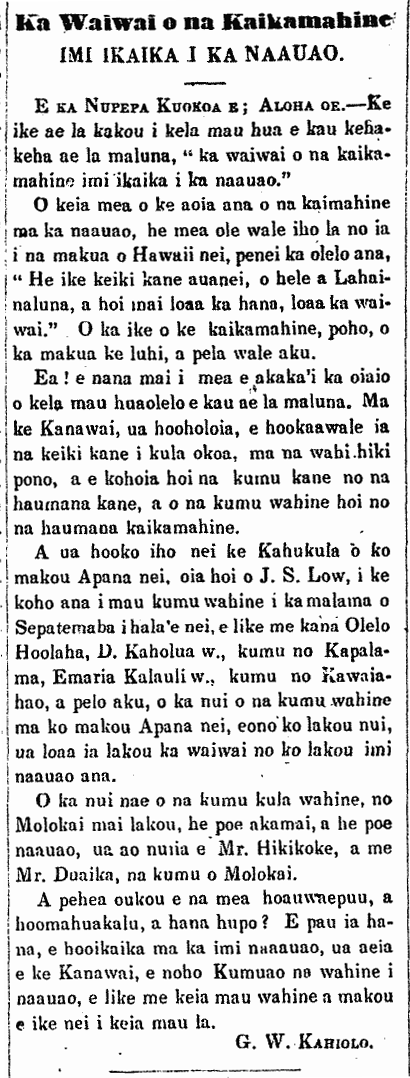
Ka Waiwai o na Kaikamahine

Ka Nupepa Kuokoa, Buke III, Helu 4, Aoao 3. Ianuari 16, 1864.
G. W. Kahiolo is G. W. Poepoe, the father of Joseph Mokuohai Poepoe, 1861.

Death announcements are not only death announcements, they are often histories and genealogical records and more!

From the last post for instance, we discover G. W. Kahiolo, the mysterious writer who is known as the writer of a few newspaper articles and most widely known for the story of Kamapuaa, is G. W. Poepoe, and therefore the father of not only Ben Poepoe, but also the father of Joseph Mokuohai Poepoe, the great historian, translator, newspaper editor, lawyer, politician, &c., &c…

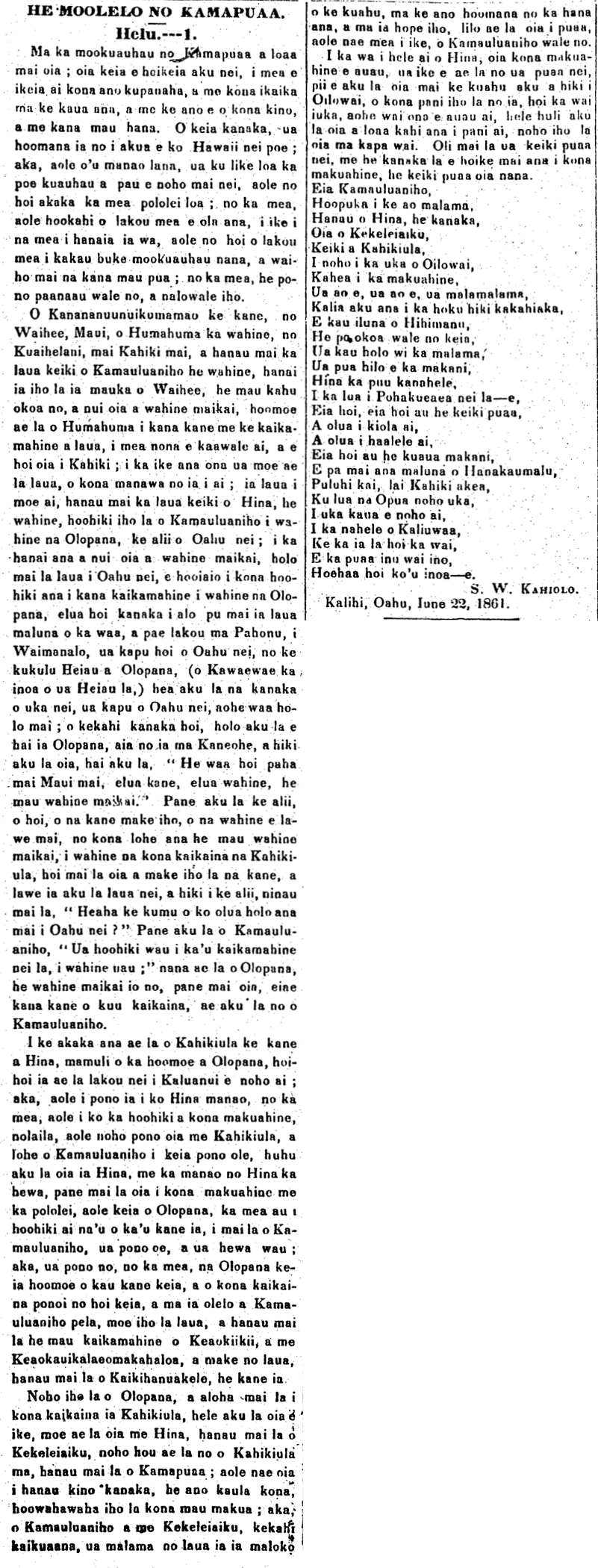
Story of Kamapuaa by G. W. Kahiolo, 1861.

HE MOOLELO NO KAMAPUAA.

Helu.—1.

Ma ka mookuauhau no Kamapuaa a loaa mai oia; oia keia e hoikeia aku nei, i mea e ikeia ai kona ano kupanaha, a me kona ikaika ma ke kaua ana, a me ke ano e o kona kino, a me kana mau hana. O keia kanaka, ua hoomana ia no i akua e ko Hawaii nei poe; aka, aole o’u manao lana, ua ku like loa ka poe kuauhau a pau e noho mai nei, aole no hoi akaka ka mea pololei loa; no ka mea, aole hookahi o lakou mea e ola ana, i ike i na mea i hanaia ia wa, aole no hoi o lakou mea i kakau buke mookuauhau nana, a waiho mai na kana mau pua; no ka mea, he pono paanaau wale no, a nalowale iho.

….

[This is the opening of the Kamapuaa story by G. W. Kahiolo [aka G. W. Poepoe]. It ran as a serial in the newspaper Hae Hawaii from 6/26 to 9/25/1861. This story was translated by Esther T. Mookini and Erin C. Neizmen with the assistance of David Tom, and put out by the University of Hawaii at Manoa Hawaiian Studies Program in 1978. In it, they say of Kahiolo:

The author G. W. Kahiolo, is not known otherwise to us. For other materials written by him, see Kukini ‘Aha’ilono, edited by Rubellite K. Johnson, Topgallant Publishing Col., Ltd., Honolulu, 1976: page 150, “Inoa o na Laau,” a list of names of plants, and pages 187–188, “He Mele no ka Nupepa Kuokoa,” a song in celebration of the start of the Hawaiian language newspaper, Ka Nupepa Kuokoa. We were unable to find any biographical material on him. However, because Ka Hae Hawaii was the official organ of the Department of Instruction (Mookini 9), Kahiolo may have been a Protestant educator as his tale is given a prominent place in the layout of the paper.]

(Hae Hawaii, 6/26/1861, p. 52)

HE MOOLELO NO KAMAPUAA.

Ka Hae Hawaii, Buke 6, Ano Hou—Helu 13, Aoao 52. Iune 26, 1861.

On the death of Beniamina Kaiminaauao Poepoe, and so much more, 1909.

BENIAMINA KAIMINAAUAO POEPOE HAS DEPARTED THIS LIFE.

In the afternoon of this Monday, July 11, the life of Beniamina Kaiminaauao Poepoe returned once more to He who first gave him to us in the year 1898. He was forty-one years old when he passed. He was born in Waipio, Hamakua, Hawaii, and that is his Aina where he was raised until he was older. He was fetched by their older brother [Joseph Mokuohai Poepoe], that being the current editor of this newspaper, to go live with him in North Kohala, Hawaii; and Beniamina lived with him while being instructed in the English Language. Later he came to Oahu nei. He lived in Laie and married a woman there. They had children, but only two of their daughters are still living. His wife passed to the other side first, and he was left with their daughters, and his older sibling, and his younger brother, Gulstan Kiliona Poepoe, one of the Owners of the News magazine, “Ka Lanakila,” which is now in publication. He was an Elder [Lunakahiko] of the Church of Jesus Christ of Latter-Day Saints [ka Ekalesia o Iesu Karisto o na Poe Hoano o na La Hope nei]. He was a candidate in the Labor Party [Aoao Limahana] for representative of the Fifth District, in the past year. His field of expertise is engineering.

And while he was working in that position on one of the water pumps of the Kahuku plantation, an accident befell him when he fell off from the pump house which he climbed on, and he broke the bones of his left leg. Continue reading

Farming in Hawaii, 1913.

ENCOURAGING SMALL FARMER.

Beginning January 5, The Advertiser will publish a weekly list of wholesale prices for Island produce in Honolulu markets while A. T. Longley, superintendent of the home markets division of the Hawaii Experiment Station will also supply a weekly market letter for publication. The marketing division was authorized by the last legislature, an appropriation having been made for the purpose.

Dr. E. V. Wilcox has been a close student of cooperative marketing organizations for the last twenty years. He stated to The Advertiser Saturday that there are ten times as many cooperative marketing organizations in the United States as in England and Germany combined, although there is very little American literature on the subject. One Southern farmer’s organization that both sells produce and purchases machinery, fertilizers, seed and supplies for its members includes over three million farmers and planters. California, Oregon, Idaho, Washington, Utah and Colorado have their fruit marketing organizations. In the Central States the farmers have to together on their corn, wheat and oat crops as well on the scores of minor products usually associated in the Hawaiian public mind with “small farming.” There are cooperative societies in New York and New England; in Kentucky, Tennessee and the Carolinas they united in the marketing of tobacco, early truck crops, peach and berry crops; and in the Gulf States they are almost a controlling factor in cotton.

The prime objects of farmer’s cooperative unions are, continuity of supply, an honest and uniform pack, and standardization of grades. The idea is to put the growing, packing and marketing of farm produce on a business basis.

Continue reading

Devastating earthquake and tsunami, 1868.

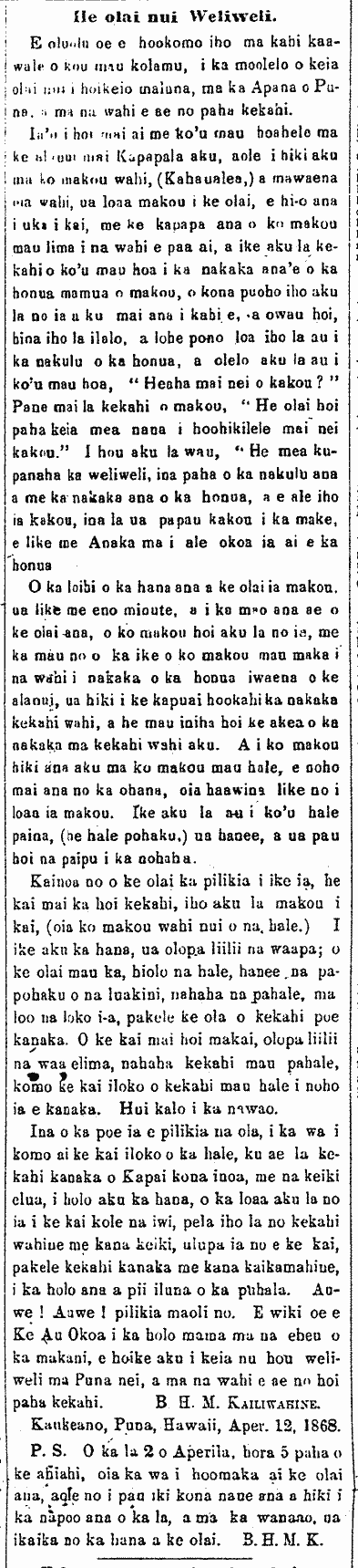
Terrifyingly Powerful Earthquake

Please place this in some open area of your columns; the story of this huge earthquake mentioned above, in the District of Puna, and perhaps other places as well.

When I turned back with my travel companions on the road from Kapapala, we didn’t reach our home (Kahaualea), but between those places we were met with an earthquake, leaning this way and that as we groped around for something solid to hold on to, and one of my friends saw the ground before us splitting open, whereupon he cried out and stood elsewhere; as for me, I tipped over and heard up close the rumbling of the earth, and I said to my companions, “What is happening to us?” One of us answered, “Maybe this is an earthquake that is causing us this fright.” I then said, “How awesomely frightening; if the ground rumbles and splits open and we are swallowed up, then we are all dead, just like the Anak [Anaka] people who were swallowed in the earth.

The length of the earthquake upon us was like six minute, and when it was over, we headed back while constantly seeing at the places where the earth split open in the road; some were the size of a man’s foot, and were several inches wide at some places. And when we reached out houses, the ohana was there who experienced the same thing. I saw our eating house [hale paina] (a stone building) which collapsed; and the dishes were all broken.

It was as if the damage seen was from the earthquake, but it also came from the sea; we went down to the shore (where much of our houses were). When we looked, we saw the boats were smashed in little pieces, and inland, the earthquake made houses topple, the stone walls of the church collapse, house fences fall, fish ponds dry up; some survived. Toward the sea, five canoes were splintered, some house fences fell, and the water entered some houses where people lived. It was all messed up.

For those whose lives were in danger, when the water entered their houses, a man named Kapai got up with his two children and ran out, but they were taken by the sea and died, so too with some women and their children, they were beaten by the sea; some people with their daughter escaped by running and climbing a hala tree. Auwe! Auwe! in dire straits. Make haste O Ke Au Okoa, speed on the wings of the wind to report of this frightening news here in Puna and perhaps elsewhere as well. B. H. M. Kailiwahine.

Kaukeano, Puna, Hawaii, April 12, 1868.

P. S. It was on the 2nd of April, at maybe 5 in the evening that the tremors began, and it did not let up at all until the setting of the sun, and at dawn, the earthquakes were strong. B. H. M. K.

(Au Okoa, 4/16/1868, p. 3)

He olai nui Weliweli.

Ke Au Okoa, Buke III, Helu 52, Aoao 3. Aperila 16, 1868.

Hawaiian-language versus English historical documents, 2014 and beyond.

When researching anything relating to Hawaii nei, it goes without saying that it is imperative that we look at the Hawaiian-language documents left by the people of old. However, it is important to look at all the other documents available to us written in other languages as well.

The three different articles covering the 100th birthday celebration of Kauikeaouli recently posted is a simple case in point. Each of the three supply information not provided by the other two. Continue reading

Aperila Fulu! 1902.

Pertaining to the First Day of Aperila

IT IS A DAY OF SHARED MISCHIEF AND CALLED “APRIL FOOL” BY THE HAOLE.

The first day of April is a day of mischief for the haole; a day to lie back and forth in jest, a day to shock, and a day when everyone devises ways to deceive or to leave you dumbfounded. In Honolulu you can see the joyful celebration of this day.

In the morning, some people who remembered to cause mischief woke up early and shouted, “The house is on fire.” When those who were living with him heard this, and who forgot that this was the first of April, they got up and grabbed their fine clothes and ran out to escape from the disaster. When they got outside, they asked at once where the fire was, and the answer they received was, “April fool to you.”

Continue reading

Mary Mahiai, the original story, in English, 1901.

ROMANTIC HISTORY OF MARY MAHIAI

PROBABLY the most interesting woman in all Hawaii is the white-haired old wahine of four-score and ten, or thereabouts, who answers to the name of Mary Mahiai.

Last week an intricate land case came up in Judge Gear’s court and Mary Mahiai was summoned to appear as a witness, her testimony being relied upon to establish the validity of certain patents to extensive and valuable lands, the ancient boundaries of which were in dispute.

The old lady scorned the services of the interpreter on the witness stand and proceeded with her own story in good English astonishing the court and silencing the lawyers as, with Hawaiian freedom of gesture and animated features, she related the details of a most remarkable career.

It developed that she was born on the Island of Kauai before the coming of the first missionary, the arrival of Rev. Hiram Bingham being distinctly within her memory; at the age of seven years, little Mahiai, whose name (meaning “Working in the taro”) had been given her by her mother, went out in a rowboat with her uncle and five other men, starting for Molokai, to “go look see.” A storm came up and the boat was driven out of sight of land, its occupants having no food or drink with them, and suffering terribly from the pangs of hunger and thirst: for ten days and nights they drifted, becoming crazed and unable to cry out, and at last, when all hopes had been abandoned, and it was certain that the frail boat would go to pieces before the end of another day, a sail appeared upon the horizon and the faint outcries and feeble signals of the seven unfortunates attracted the attention of a sailor on board the ship, which was a sailing vessel bound for China. The six men and the little girl were taken on board and treated kindly. When the little girl was able to be about she was given the task of taking care of the captain’s little daughter, and the men were put to work on the ship; the vessel put in at Ladrone Islands, and by their own desire, the five men who had set out with little Mahiai and her uncle, were put ashore. It was afterwards learned that they were eaten by cannibals. Continue reading