Wakeke Ululani Heleluhe passes away, 1921.

QUEEN LILIU’S TRAVEL COMPANION DIES.

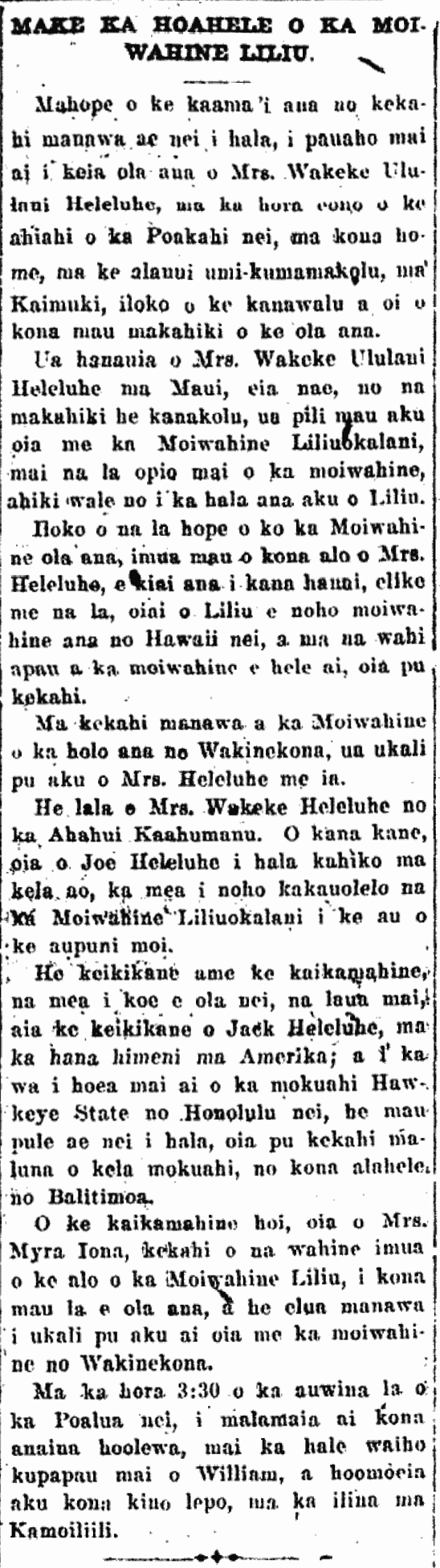
After being ill for some time, Mrs. Wakeke Ululani grew weary of this life, at six in the evening of this past Monday [11/21/1921], at her home on 13th Avenue in Kaimuki, being eighty or so years old.

Mrs. Wakeke Ululani Heleluhe was born on Maui, however, for thirty years, she was a companion to Queen Liliuokalani, from the Queen’s young days, until Liliu passed on.

In the last days of the Queen’s life, Mrs. Heleluhe was constantly before her, watching over her care, just as the days when Liliu was reigning as monarch of Hawaii nei, and everywhere that the Queen went, she went as well.

Once when the Queen went to Washington, Mrs. Heleluhe was in her retinue.

Mrs. Wakeke Heleluhe was a member of the Kaahumanu Society [Ahahui Kaahumanu]. Her husband, Joe Heleluhe, who passed long ago, was the Queen’s secretary during her reign.

Surviving her is a son and daughter of theirs; the son, Jack Heleluhe, is working in America singing, and when the steamship Hawkeye State arrived in Honolulu some weeks ago, he was one of the people on the ship, on his way to Baltimore.

As for the daughter, Mrs. Myra Iona, she is one of the women who attended Queen Liliu while she was living, and she went along twice with the Queen to Washington.

At 3:30 in the afternoon of this past Tuesday, her funeral was held, from William’s Mortuary her earthly body was laid to rest at the cemetery in Kamoiliili.

[The Queen writes of her stay in Washington D. C. in 1897:

“In the early part of May it became necessary for my companion, Mrs. Kia Nahaolelua, to return to Honolulu. Three months was the length of time I had expected to be absent when I asked her to accompany me; but five months had passed away, and her husband and large family of children needed her. So I sent her to San Francisco under the charge of Captain Palmer, where he was to meet Mrs. Joseph Heleluhe, and conduct her to Washington.”

The Mrs. Joseph Heleluhe sent for here is Wakeke Ululani Heleluhe.]

(Kuokoa, 11/25/1921, p. 4)

MAKE KA HOAHELE O KA MOIWAHINE LILIU.

Ka Nupepa Kuokoa, Buke LIX, Helu 47, Aoao 4. Novemaba 25, 1921.

Another Nawahi painting! 1877.

[Found under: “Na Nu Hou Kuloko.”]

The artist Joseph Nawahi was commissioned to accompany the Editor of the Kuokoa to paint the Lava at the seaside of Keei, and to send it to the Bookstore of Whitney.

[With the two paintings mentioned in the previous post, this makes at least three on the subject of lava done by Nawahi in 1877: one in Hilo, one at the volcano, and the last at Keei. None of them are known today! Anyone have any ideas?]

(Kuokoa, 3/10/1877, p. 2)

Ua kauohaia ke kaha kii...

Ka Nupepa Kuokoa, Buke XVI, Helu 10, Aoao 2. Maraki 10, 1877.

Two paintings by Joseph Nawahi, 1877.

[Found under: “NA ANOAI.”]

When it was made known that Lava was erupting once again, along with it came the painting done by our good friend, the Hon. J. Nawahi; seen is the fiery red from Hilo, lighting up the walls of the heavens; and that painting can be seen in Whitney’s [bookstore] window. But this past Thursday, our famous seer artist did a painting of the fires of that woman of the pit, with the many Hiiaka aumakua igniting that fiery hot imu. Perhaps this is what some of our readers are saying; “the lava has reignited because of the aumakua;” that is ignorant. See this painting right outside of the printing office of the Pacific Commercial Advertiser [Kalepa].

[After that Antique Roadshow episode in 2007, nearly everyone knows about that painting of Hilo done by Joseph Nawahi now hanging up at Kamehameha Schools. I believe that these two however are not known today. Anyone have any ideas?]

(Lahui Hawaii, 2/22/1877, p. 3)

I ka wa i hoike ia mai ai...

Ka Lahui Hawaii, Buke III, Helu 8, Aoao 3. Feberuari 22, 1877.

A mele by Joseph Nawahi for his wife Emma Aima, 1936.

A HAWAIIAN MELE.

Some day later, we were asked at our Hoku publishing office, of the songs which were sung at the funeral of Mrs. Aima Nawahi on the last Sunday of this past year. The mele sung on that day were famous songs in “Leo Hoonani a me Hoku Ao Nani.”¹ They were not all shown and there were others, like “Mai Kuu Kaumaha Luuluu a Po,” and the young girls of Haili sang those songs with beautiful lyrics.

There were also hymns sung by some girls who were close to Aunty Aima, and they were sung with such sweetness. The mele sung by the Kaahumanu Society was this one. “Ma ko Iesu mau lima,” and some others as well.

The main reason that this question was asked, was because of the great admiration for the hymns composed by the devout in years gone by. There is someone writing down some old mele in a book to be distributed, and these hymns are wanted by this person writing down Hawaiian mele as something new for him. Another admired mele sung at the funeral of Mrs. Nawahi was that mele composed by Mr. Nawahi before their marriage. Here are the lines of that mele that are recalled partially, and recalled at that time.

Nana aku iluna
He star e alohi ana
Ua like me sweet rose
Me Fairy Puakoolau.

Hui
Aheahe mai ke kehau of the twilight
Pa mai ke ala onaona oia of my dear
Please wau e kiss i ke ala oia pua
And not Forgetting the sweet Lei Lehua

Hoi iho au e moe
Hiki ana o sweet rose
E naue ae kaua
I kuu home iuiu.

This is a mele that was sung all the time by the women of those days, and the lyrics are beautiful. There are many other lovely mele by Hawaiians that we remember, but when it is thought to sing it, we totally forget the words.

¹Leo Hoonani a me Hoku Ao Nani. Honolulu: Ka Papa Hawaii, 1902.

[This mele is printed earlier in Hoku o Hawaii on 1/3/1936 and the article itself is a reprint from 1/7/1936.]

(Hoku o Hawaii, 1/15/1936, p. 3)

HE MELE HAWAII

Ka Hoku o Hawaii, Buke XXVII, Helu 29, Aoao 3. Ianuari 15, 1936.

Joseph Nawahi, born on this day in 1842, was not only a patritot, but a beautiful singer to boot, 1875.

Relating to Kaumakapili Church.

In the announcement of the sweet-voiced Oo birds of Maemae, Mrs. Emma Dillingham [Ema Dilinahama] and Miss Nelly Judd [Nele Judd], those who love music (both English and Hawaiian) as well as those who love helping and donating to the troubled kingdom of the Lord in some way. There will be held a Grand Concert at Kaumakapili on the night of the 23rd of this month, for the difficulties of Kaumakapili Church. There are four chosen by the Leadership of Kaumakapili as a committee to prepare mele to excite the heart and to whet the appetite. Mr. Kiha, the leader of the Kaumakapili Choir is one of them, and the son of the Kanilehua rain, the sweet-voiced bird of Haili (Joseph Kahooluhi) is another, who will only be singing solos; those singing were chosen carefully from amongst the beautiful-voiced Oo birds of Kaupea. His songs will be mixed in amongst theirs, “So that the hala will be sectioned in with the lehua; wonderful is Hilo, Hilo Hanakahi.”

[We all know that Joseph Kahooluhi Nawahiokalaniopuu was one of the great patriots of all times, and we even know about his fine painting skills, but did you know that he composed mele and that he had a sweet singing voice? The newspapers are like treasure boxes filled with all sorts of pearls.]

(Lahui Hawaii, 12/16/1875, p. 2)

No ka Ekalesia o Kaumakapili.

Ka Lahui Hawaii, Buke I, Helu 51, Aoao 2. Dekemaba 16, 1875.

Chiefs’ Children’s School, 1841.

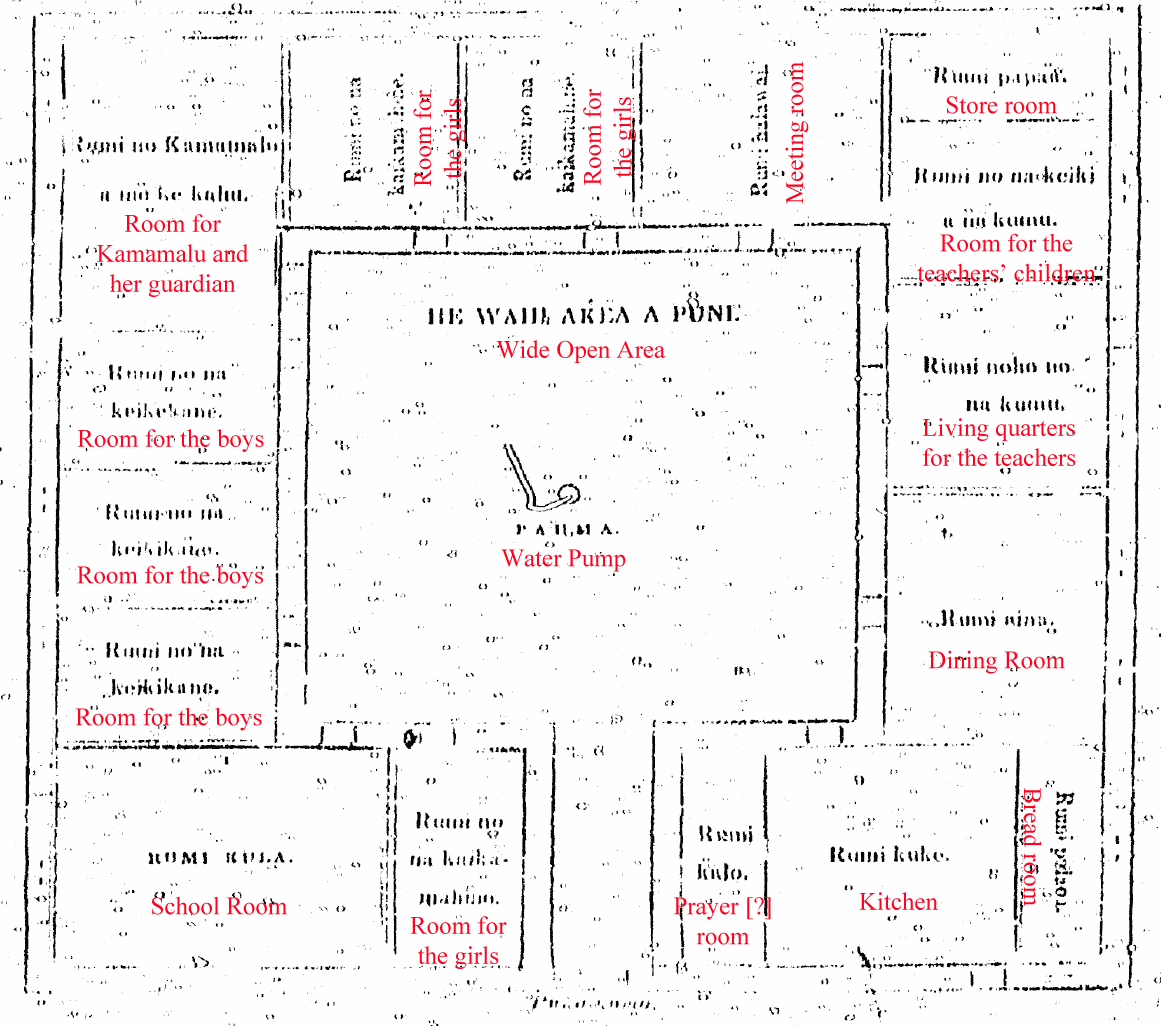
Chiefs' Children's School Diagram

Ka Nonanona, Buke 1, Pepa 2, Aoao 5. Iulai 20, 1841.

THE CHIEFS’ CHILDREN’S SCHOOL.

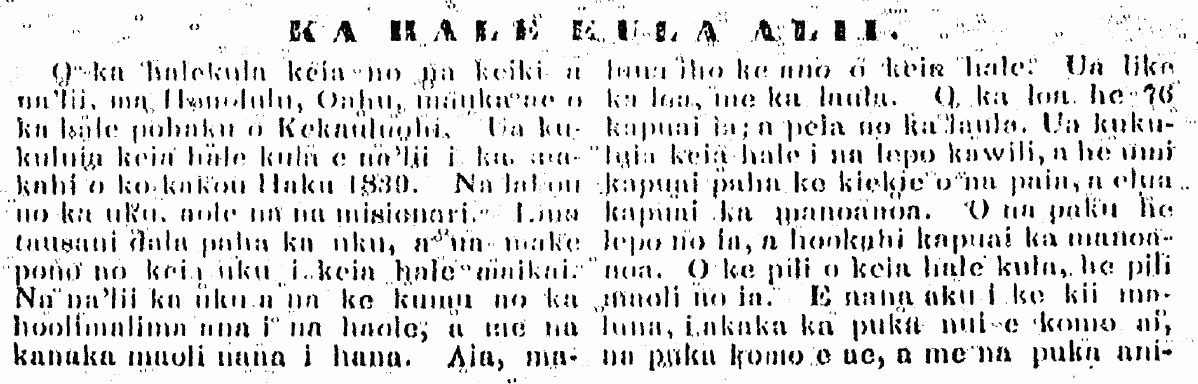
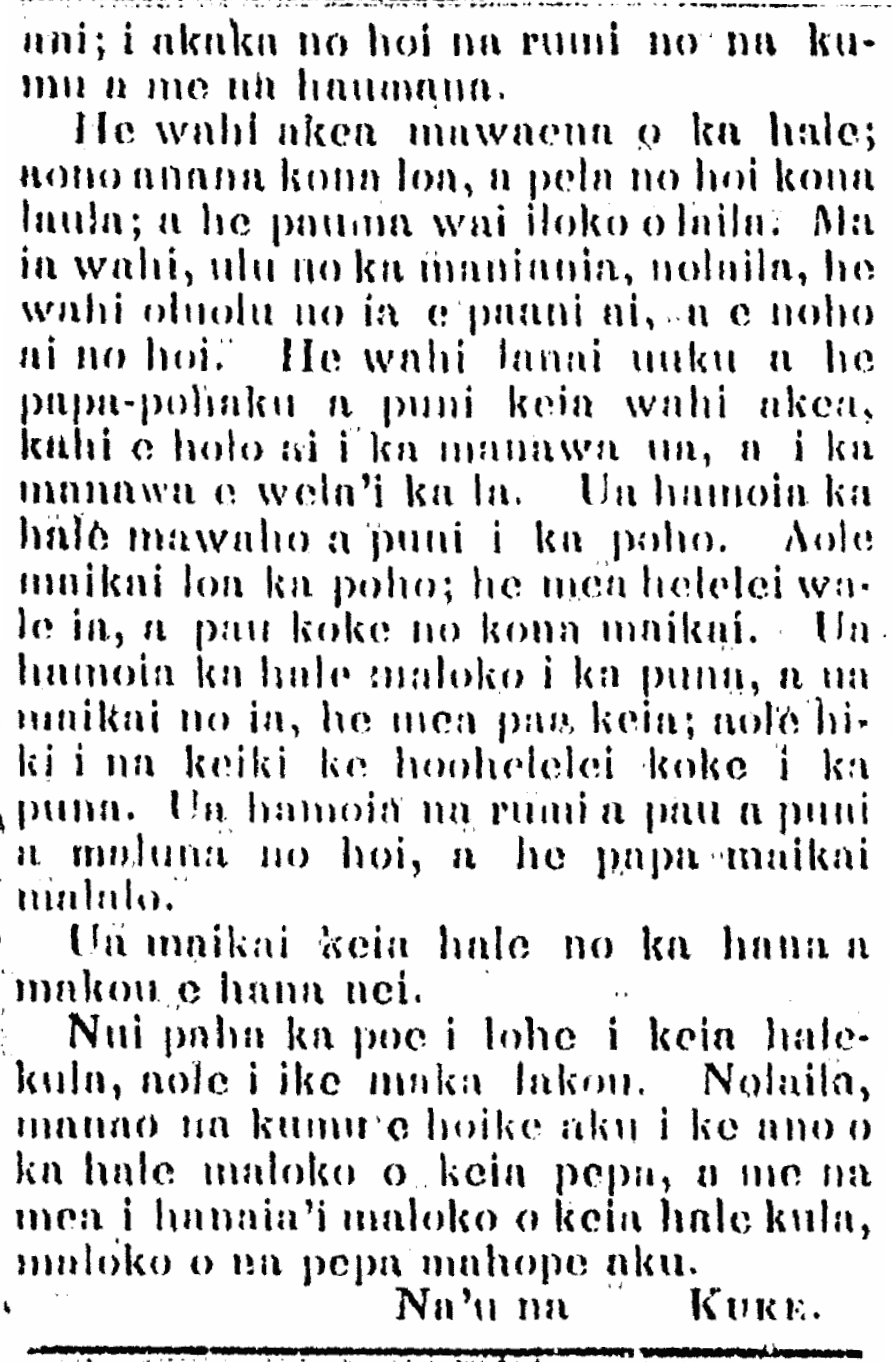
This is the schoolhouse for the children of the alii, in Honolulu, Oahu, upland of the stone house of Kekauluohi. This schoolhouse was built by the alii in the year of our Lord 1839. They are the ones who paid for the costs, not the missionaries. The costs were perhaps two thousand dollars, and the cost was well worth this fine building. The alii paid out the money and the missionaries hired the haole and Hawaiians who did the labor. Above, you will see what this building is like. The length is the same as the width. It is 76 feet long, and so is its width. It is made with adobe, and its walls are about ten feet tall, and its thickness is two feet. The partitions are made of adobe as well and are one foot thick. The thatching of this building is actual pili grass. Look at the illustration above, the entrance is made clear, as are the other doors, and the…

(Nonanona, 7/20/1841, p. 5)

KA HALE KULA ALII.

Ka Nonanona, Buke 1, Pepa 2, Aoao 5. Iulai 20, 1841.

…windows; clear also are the rooms for the teachers and the students.

There is an open space in the middle of the building; it is six feet wide and so too is the length; there is a water pump within it. Maniania [Manienie] grass grows there, so it is a nice place to play as well as to sit. There is a small lanai and a stone wall surrounding this wide area, which is a place to go when it is raining or when the sun is hot. The outside of the entire building is covered with mortar [poho]. Poho is not great; it will just fall off, and it soon loses its integrity. The inside of the building is covered with plaster [puna], and it is very good and sturdy; the children cannot make the plaster fall easily. The rooms are plastered all around and on top, and there is a fine floor below.

The building is appropriate for what we are using it for.

There are perhaps many who have heard of this schoolhouse but who have not seen it. Therefore, the instructors thought to put a description in this paper, as well as what is being done in this schoolhouse in later issues of the newspaper.

By me, Cooke.

[Maybe if the Hawaiian-Language Newspapers like this one are rescanned clearly, the image of the schoolhouse would indeed be clear and we could see the doors, windows, and rooms.

I was not sure if “Rumi kalo” could refer to a “Taro room”. And it seems that at the center on the bottom of the diagram is “Puka komo” for “Entrance”.]

(Nonanona, 7/20/1841, p. 6)

ani; i akaka no hoi...

Ka Nonanona, Buke 1, Pepa 2, Aoao 6. Iulai 20, 1841.

The Chiefs’ Children’s School and its beginnings. 1844.

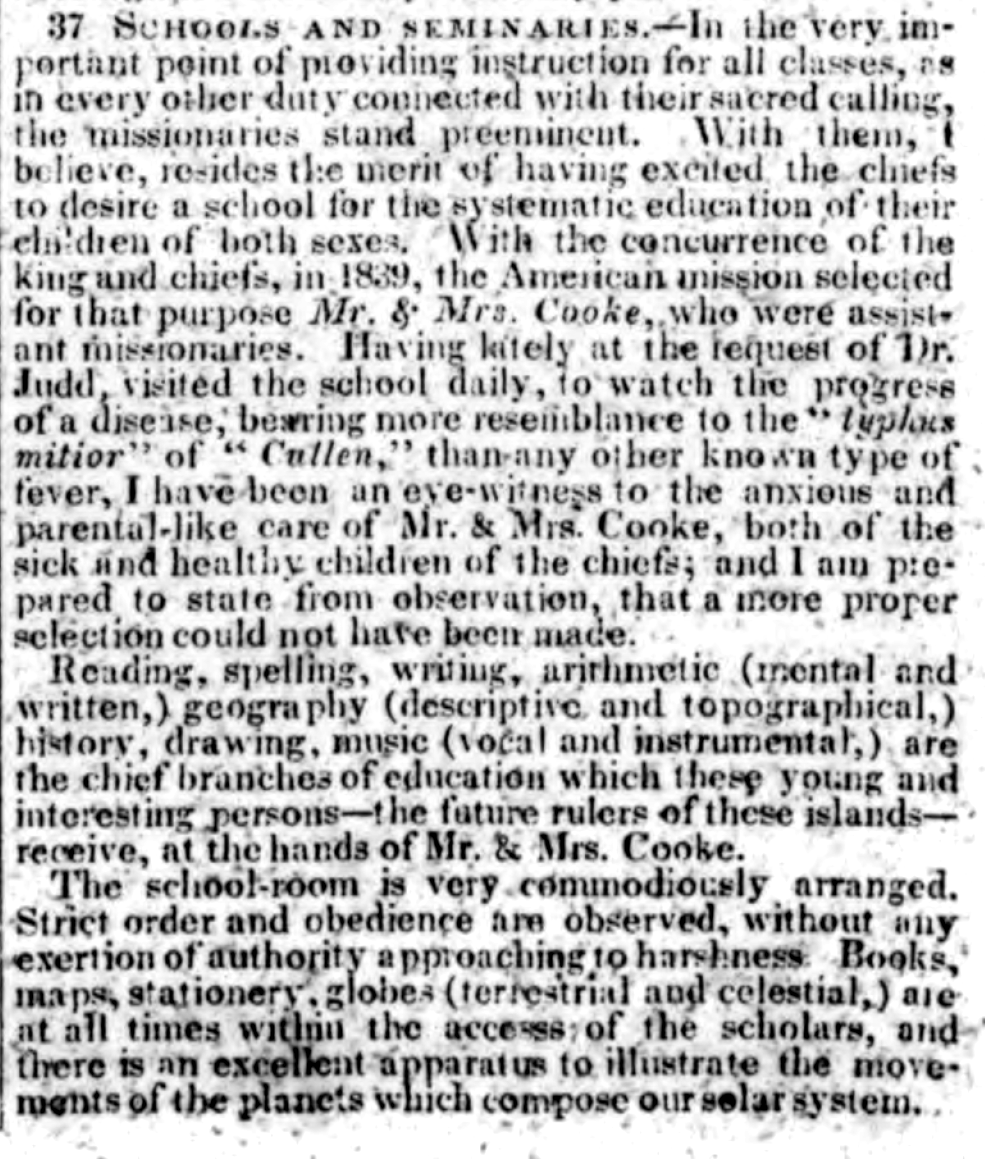
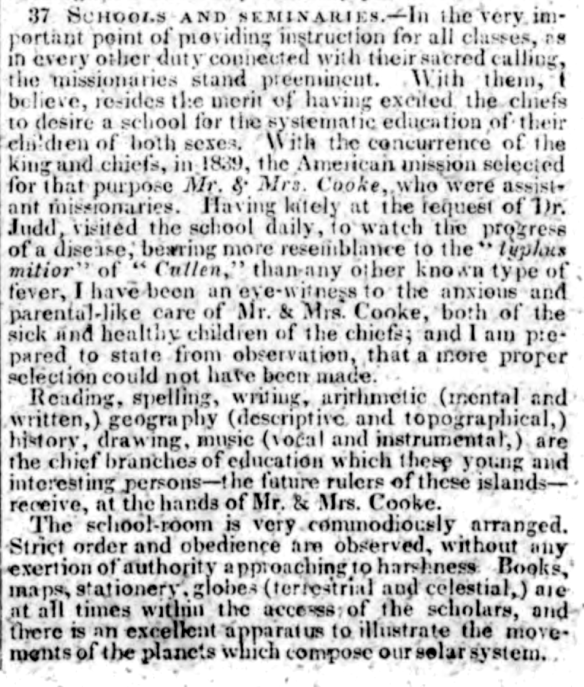
Schools and Seminaries.—In the very important point of providing instruction for all classes, as in every other duty connected with their sacred calling, the missionaries stand prominent. With them, I believe, resides the merit of having excited the chiefs to desire a school for the systematic education of their children of both sexes. With the concurrence of the king and chiefs, in 1839, the American mission selected for that purpose Mr. & Mrs. Cooke, who were assistant missionaries. Having lately at the request of Dr. Judd, visited the school daily, to watch the progress of a disease, bearing more resemblance to the “typhus mitior” of “Cullen,” than any other known types of fever, I have been an eye-witness to the anxious and parental-like care of Mr. & Mrs. Cooke, both of the sick and healthy children of the chiefs; and I am prepared to state from observation, that a more proper selection could not have been made.

The school-room is very commodiously arranged. Strict order and obedience are observed, without any exertion of authority approaching to harshness. Books, maps, stationery, gloves (terrestrial and celestial,) are at all times within the access of the scholars, and there is an excellent apparatus to illustrate the movements of the planets which compose our solar system.

(Friend, August 1, 1844, p. 35)
37. Schools and Seminaries.

The Friend, Volume II, Number VIII, Page 35. August 1, 1844.

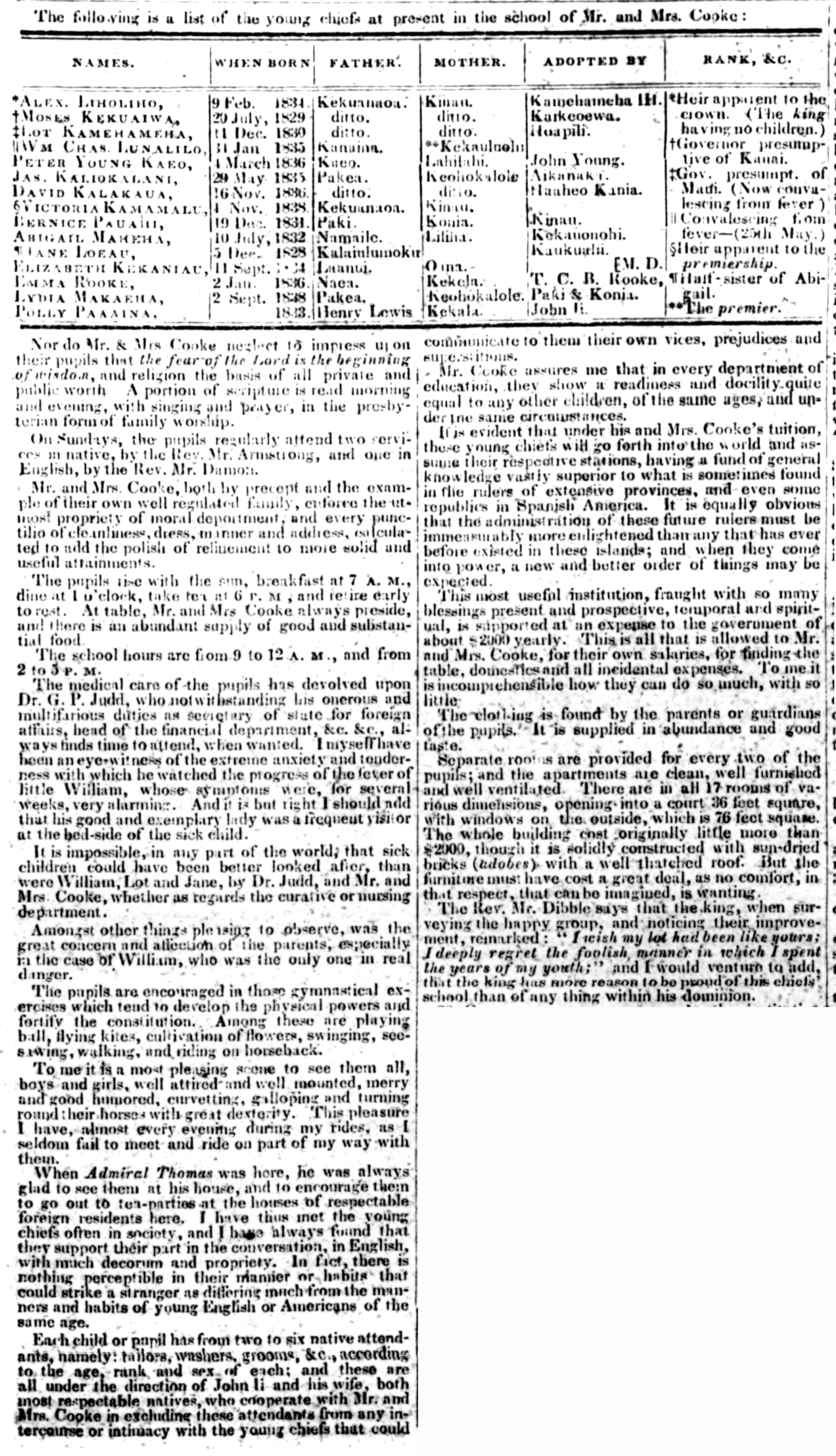
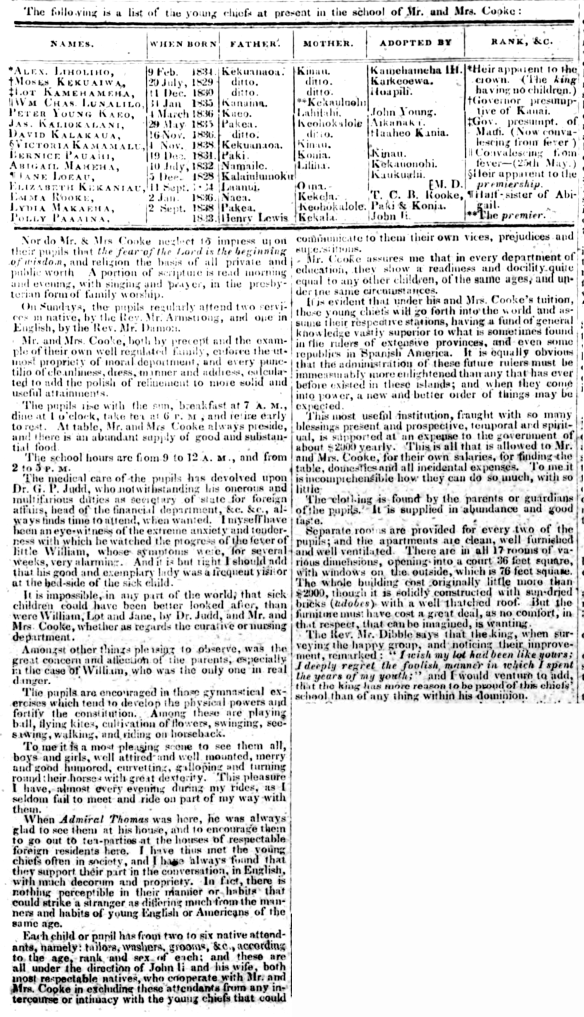
The following is a list of the young chiefs at present in the school of Mr. and Mrs. Cooke:

NAMES. WHEN BORN FATHER MOTHER ADOPTED BY
*Alexander Liholiho, 9 Feb. 1834. Kekuanaoa. Kinau. Kamehameha III.
†Moses Kekuaiwa, 20 July 1829. ditto. ditto. Kaieoewa [Kaikioewa].
‡Lot Kamehameha, 11 Dec. 1830. ditto. ditto. Hoapili.
‖William Charles Lunalilo, 31 Jan. 1835. Kanaina. **Kekauluohi.
Peter Young Kaeo, 4 March 1836. Kaeo. Lahilahi. John Young.
James Kaliokalani, 29 May 1835. Pakea [Kapaakea]. Keohokalole. Aikanaka.
David Kalakaua, 16 Nov. 1836. ditto. ditto. Haaheo Kania [Kaniu].
§Victoria Kamamalu, 4 Nov. 1838. Kekuanaoa. Kinau.
Bernice Pauahi, 19 Dec. 1831. Paki. Konia. Kinau.
Abigail [Lanihau] Maheha, 10 July 1832. Namaile. Liliha. Kekauonohi.
¶Jane Loeau, 5 Dec. 1828. Kalaiulumoku [Kalaniulumoku] [Liliha.] Kaukualii.
Elizabeth Kekaniau [Kekaaniau], 11  Sept. 1834. Laanui. Oana.
Emma Rooke, 2 Jan. 1836. Naea. Kekela. T. C. B. Rooke, M. D.
Lydia Makaeha [Kamakaeha], 2 Sept. 1838. Pakea [Kapaakea]. Keohokalole. Paki & Konia.
Polly Paaaina, 1833. Henry Lewis. Kekala [Kekela]. John Ii.

*Heir apparent to the crown. (The king having no children.)
†Governor presumptive of Kauai.
‡Gov. presumpt. of maui. (Now convalescing from fever.)
‖Convalescing from fever—(25th May.)
§Heir apparent to the premiership.
¶Half-sister of Abigail.
**The premier.

Nor do Mr. & Mrs. Cooke neglect to impress upon their pupils that the fear of the Lord is the beginning of wisdom, and religion the basis of all private and public worth. A portion of scripture is read morning and evening, with singing and prayer, in the presbyterian form of family worship.

On Sundays, the pupils regularly attend two services in native, by the Rev. Mr. Armstrong, and one in English, by the Rev. Mr. Damon.

Mr. and Mrs. Cooke, both by precept and the example of their own well regulated family, enforce the utmost propriety of moral deportment, and every punctilio of cleanliness, dress, manner and address, calculated to add the polish of refinement to more solid and useful attainments.

The pupils rise with the sun, breakfast at 7 A. M., dine at 1 o’clock, take tea at 6 P. M., and retire early to rest. At table, Mr. and Mrs. Cooke always preside, and there is an abundant supply of good and substantial food.¹

The school hours are from 9 to 12 A. M., and from 2 to 5 P. M.

The medical care of the pupils has devolved upon Dr. G. P. Judd, who not withstanding his onerous and multifarious duties as secretary of state for foreign affairs, head of the financial department, &c., &c., always finds time to attend, when wanted. i myself have been an eye-witness of the extreme anxiety and tenderness with which he watched the progress of the fever of little William, whose symptoms were, for several weeks, very alarming. And it is but right I should add that his good and exemplary lady was a frequent visitor at the bed-side of the sick child.

It is impossible, in any part of the world, that sick children could have been better looked after, than were William, Lot and Jane, by Dr. Judd, and Mr. and Mrs. Cooke, whether as regards the curative or nursing department.

Amongst other things pleasing to observe, was the great concern and affection of the parents, especially in the case of William, who was the only one in real danger.

The pupils are encouraged in the gymnastical exercises which tend to develop the physical powers and fortify the constitution. Among these are playing ball, flying kites, cultivation of flowers, swinging, see-sawing, walking, and riding on horseback.

To me it is a most pleasing scene to see them all, boys and girls, well attired and well mounted, merry and good humored, curvetting, galloping and turning round their horses with great dexterity. This pleasure I have, almost every evening during my rides, as I seldom fail to meet and ride on part of my way with them.

When Admiral Thomas was here, he was always glad to see them at his house, and to encourage them to go out to tea-parties at the houses of respectable foreign residents here. I have thus met the young chiefs often in society, and I have always found that they support their part in the conversation, in English, with much decorum and propriety. In fact, there is nothing perceptible in their manner or habits that could strike a stranger as differing much from the manners and habits of young English or Americans of the same age.

Each child or pupil has from two to six native attendants, namely: tailors, washers, grooms, &c., according to the age, rank and sex of each; and these are all under the direction of John Ii and his wife, both most respectable natives, who cooperate with Mr. and Mrs. Cooke in excluding these attendants from any intercourse of intimacy with the young chiefs that could communicate to them their own vices, prejudices and superstitions.

Mr. Cooke assures me that in every department of education, they show a readiness and docility quite equal to any other children, of the same ages, and under the same circumstances.

If is evident that under his and Mrs. Cooke’s tuition, these young chiefs will go forth into the world and assume their respective stations, having a fund of general knowledge vastly superior to what is sometimes found in the riders of extensive provinces, and even some republics in Spanish America. It is equally obvious that the administration of these future rulers must be immeasurably more enlightened than any that has ever before existed in these islands; and when they come into power, a new and better order of things may be expected.

This most useful institution, fraught with so many blessings present and prospective, temporal and spiritual, is supported at an expense to the government of about $2000 yearly. This is all that is allowed to Mr. and Mrs. Cooke, for their own salaries, for finding the table, domestics and all incidental expenses. To me it is incomprehensible how they can do so much, with so little.

The clothing is found by the parents or guardians of the pupils. It is supplied in abundance and good taste.

Separate rooms are provided for every two of the pupils; and the apartments are clean, well furnished and well ventilated. There are in all 17 rooms of various dimensions, opening into a court 36 feet square, with windows on the outside, which is 76 feet square. The whole building cost originally little more than $2000, though it is solidly constructed with sun-dried bricks (adobes) with a well thatched roof. But the furniture must have cost a great deal, as no comfort, in that respect, that can be imagined, is wanting.

The Rev. Mr. Dibble says that the king, when surveying the happy group, and noticing their improvement, remarked: “I wish my lot had been like yours; I deeply regret the foolish manner in which I spent the years of my youth;” and I would venture to add, that the king has more reason to be proud of this chiefs’ school than of any thing within his dominion.

(Friend, August 1, 1844, p. 36)
The following is a list...

The Friend, Volume II, Number VIII, Page 36. August 1, 1844.

¹This comment about the abundance of food reminded me of something Liliuokalani said in Hawaii’s Story by Hawaii’s Queen. “…our instructors were especially particular to teach us the proper use of the English language; but when I recall the instances in which we were sent hungry to bed, it seems to me that they failed to remember that we were growing children. A thick slice of bread covered with molasses was usually the sole article of our supper, and we were sometimes ingenious, if not over honest, in our search for food: if we could beg something of the cook it was the easier way; but if not, anything eatable left within our reach was surely confiscated. As a last resort, we were not above searching the gardens for any esculent root or leaf, which (having inherited the art of igniting a fire from the friction of sticks), we could cook and consume without the knowledge of our preceptors.”

Speaking of Hawaii’s Story by Hawaii’s Queen, i was expecting the new much-awaited edition to be available already, but hopefully it will be out in bookstores soon! I am thinking of putting up related articles like this one (mostly from the Hawaiian-Language Newspapers) to perhaps give a fuller picture of topics covered in the Queen’s book.

[This is written by Robert Crichton Wyllie, and is found in a very enlightening treatise describing many aspects of life in Honolulu in the 1840s. “NOTE On the Shipping, Trade, Agriculture, Climate, Diseases, Religious Institutions, Civil and Social Conditions, Mercantile and Financial Policy of the Sandwich or Hawaiian Islands, viewed in relation to other groups of islands, and to the natural and acquired advantages of the Sandwich or Hawaiian Islands.” Friend, June 1–September 24, 1844.]

King Kalakaua returns from trip around the world, 1881 / 1912.

KE KAENA A KA MOI KALAKAUA

Ua kaahele au maluna o ka ilihonua me na moana,
A Inia mamao, a me Kina kaulana;
Hoea i na aekai o Aferika, a me na palena o Europa,
A halawai me ka ikaika o na aina apau,
A ia’u i ku ai ma ka aoao o na Poo Aupuni,
Ka poe mana maluna o ka lakou, me ka hiehie Alii;
Hoomaopopo iho la au i ka ukuiki, a nawaliwali o ko’u,
Me ko’u Nohoalii hookahua ia maluna o kahi puu Pele,
A ma kahi he miliona i hooko i ka keia mau Moi,
He mau tausani wale iho no malalo o ko’u mau malu;
Aka, ke upu nei loko, na’u ke Kaena hiki,
Aia he mau nani maloko o na poai o ko’u mau aekai—
I oi aku ka makamae i ka o’u mau hoa Moi,
Aohe o’u kumu hopo maloko o ko’u Aupuni,
He hiki ke hui me ko’u lahui, me ka weli ole,
Aohe makau no’u iho, me ke kiai pilipaa ole ia,
A na’u ke Kaena, he momi i hoounaia mailuna mai na’u—
Eia me A’u ke Aloha pilipaa o Ko’u Lahuikanaka.

[See an English translation for this mele.]

(Au Hou, 2/14/1912, p. 25)

KE KAENA A KA MOI KALAKAUA

Ke Au Hou, Buke 3, Helu 6, Aoao 25. Feberuari 14, 1912.