Another sweet song for Liliuokalani, 1897.

MAKALAPUA.

O Makalapua ulumahiehie,
O ka lei o Kamakaeha,
No Kamakaeha ka lei o na Liawahine,
No na wahine kihene pua.

Hui:—E lei ho–i e Liliulani e,
E lei ho–i e Liliulani e.

Haihai pua Kamani pauku pua Ki-ki,
I lei hoowehi no ka wahine,
I walea ai i ka waokele,
Iuka o Omaonahele.

Lei Kaala i ka ua a ka Naulu,
Hoolue ihola ilalo o Haleauau,
Ka ua lei kakooula i ke pili,
I pili ia e ka mauu nene me ke kupukupu.

Lei aku i na hala o Kekele,
Na hala moe ipo o Malailua,
Ua maewa wale i ke oho o ke Kawelu,
Ka lei Kamakahala a ka ua i Waahila.

[Another well known mele for Queen Liliuokalani found within the pages of the Hawaiian-Language Newspapers.]

(Aloha Aina, 1/16/1897, p. 7)

MAKALAPUA

Ke Aloha Aina, Buke III, Helu 3, Aoao 7. Ianuari 16, 1897.

Why Crown Lands are not public lands, 1909.

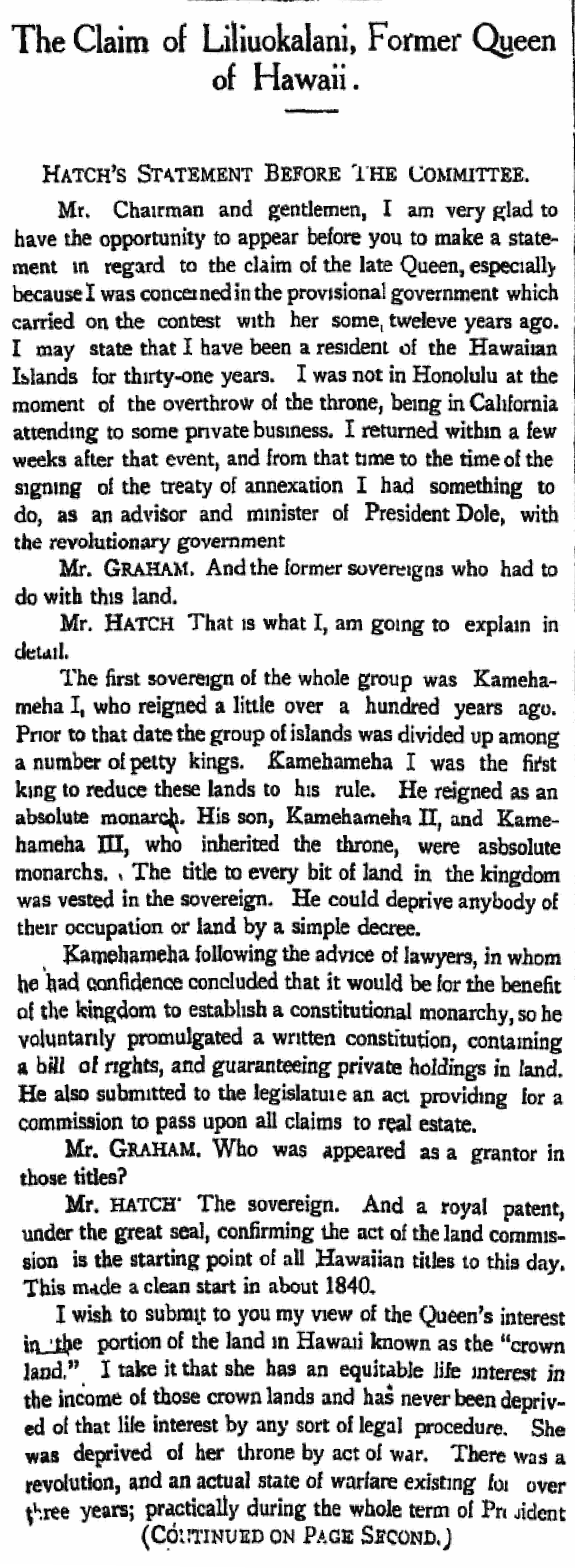
The Claim of Liliuokalani, Former Queen of Hawaii.

HATCH’S STATEMENT BEFORE THE COMMITTEE.

Mr. Chairman and gentlemen, I am very glad to have the opportunity to appear before you to make a statement in regard to the claim of the late Queen, especially because I was concerned in the provisional government which carried on the contest with her some twelve years ago. I may state that I have been a resident of the Hawaiian Islands for thirty-one years. I was not in Honolulu at the moment of the overthrow of the throne, being in California attending to some private business. I returned within a few weeks after that event, and from that time to the time of the signing of the treaty of annexation I had something to do, as an advisor and minister of President Dole, with the revolutionary government.

Mr. Graham. And the former sovereigns who had to do with this land.

Mr. Hatch. That is what I, am going to explain in detail.

The first sovereign of the whole group was Kamehameha I, who reigned a little over a hundred years ago. Prior to that date the group of islands was divided up among a number of petty kings. Kamehameha I was the first king to reduce these lands to his rule. He reigned as an absolute monarch. His son, Kamehameha II, and Kamehameha III, who inherited the throne, were absolute monarchs. The title to every bit of land in the kingdom was vested in the sovereign. He could deprive anybody of their occupation or land by a simple decree.

Kamehameha following the advice of lawyers, in whom he had confidence concluded that it would be for the benefit of the kingdom to establish a constitutional monarchy, so he voluntarily promulgated a written constitution, containing a bill of rights, and guaranteeing private holdings in land. He also submitted to the legislature an act providing for a commission to pass upon all claims to real estate.

Mr. Graham. Who was appeared as a grantor in those titles?

Mr. Hatch. The sovereign. And a royal patent under the great seal, confirming the act of the land commission is the starting point of all Hawaiian titles to this day. This made a clean start in about 1840.

I wish to submit to you my view of the Queen’s interest in the portion of the land in Hawaii known as the “crown land.” I take it that she has an equitable life interest in the income of those crown lands and has never been deprived of that life interest by any sort of legal procedure. She was deprived of her throne by act of war. There was a revolution, and an actual state of warfare existing for over three years; practically during the whole term of President…

(Kuokoa Home Rula, 5/21/1909, p. 1)
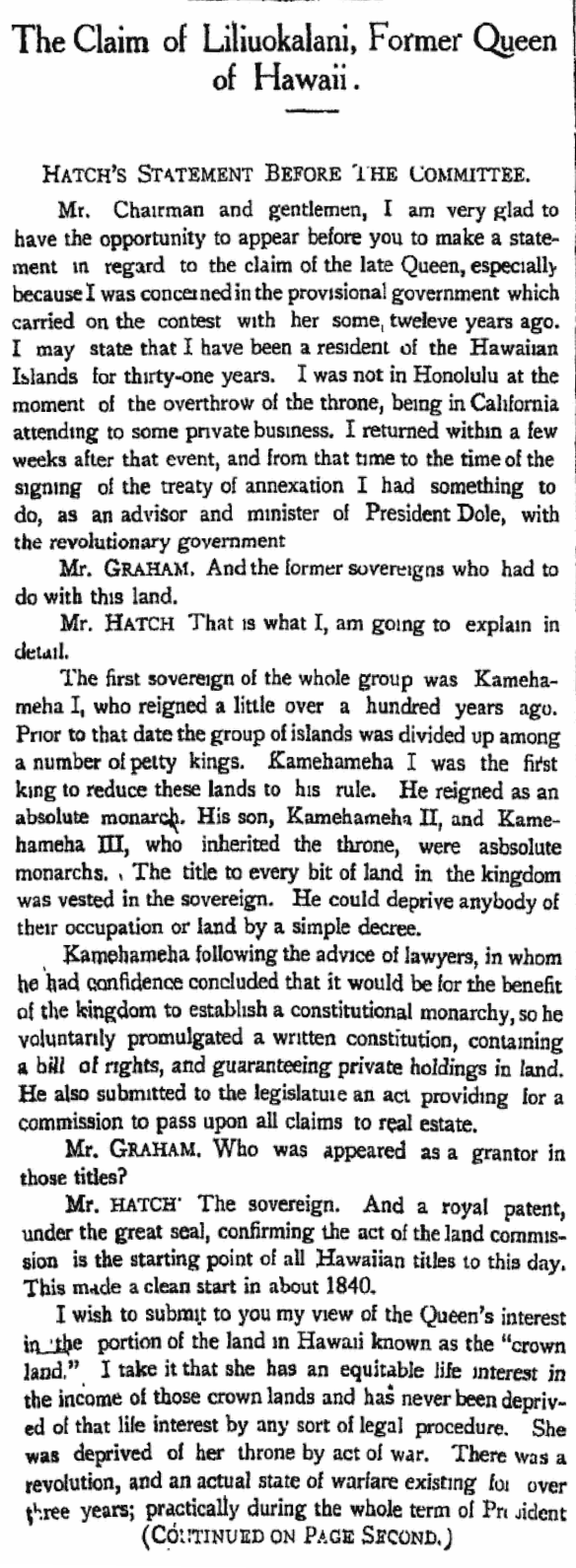
The Claim of Liliuokalani, Former Queen of Hawaii.

Kuokoa Home Rula, Buke VII, Helu 21, Aoao 1. Mei 21, 1909.

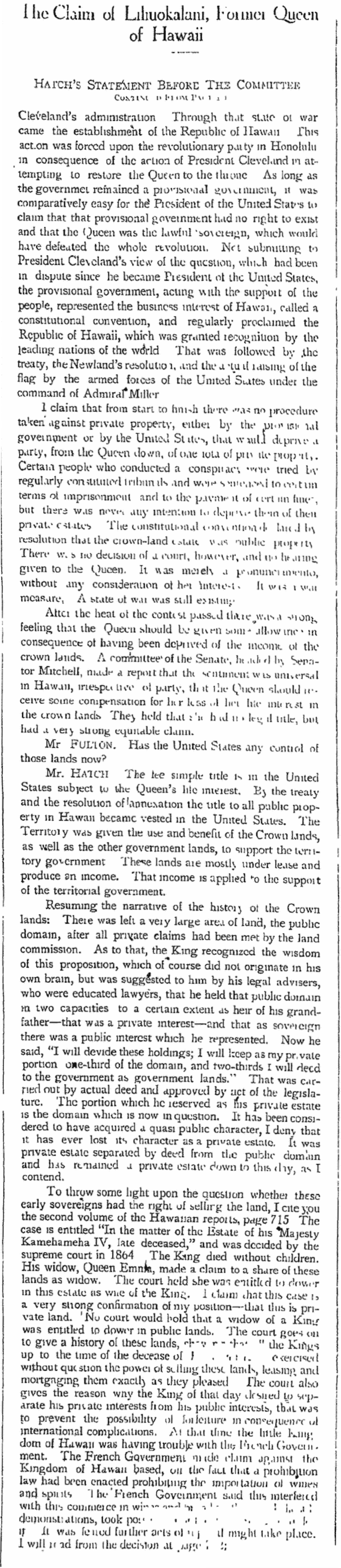
…Cleveland’s administration. Through that state of war came the establishment of the Republic of Hawaii. This action was forced upon the revolutionary party in Honolulu in consequence of the action of President Cleveland in attempting to restore the Queen to the throne. As long as the government remained a provisional government, it was comparatively easy for the President of the United States to claim that the provisional government had no right to exist and that the Queen was the lawful sovereign, which would have defeated the whole revolution. Not submitting to President Cleveland’s view of the question, which had been in dispute since he became President of the United States, the provisional government, acting with the support of the people, represented the business interest of Hawaii, called a constitutional convention, and regularly proclaimed the Republic of Hawaii, which was granted recognition by the leading nations of the world. That was followed by the treaty, the Newland’s resolution, and the actual raising of the flag by the armed forces of the United States under the command of Admiral Miller.

I claim that from start of finish there was no procedure taken against private property, either by the provisional government or by the United States, that would deprive a party, from the Queen down, of one iota of private property. Certain people who conducted a conspiracy were tried by regularly constituted tribunals and were sentenced to [unclear] but there was never any intention to deprived them of their private estates. The constitutional convention declared by resolution that the crown-land estate was public property. There was no decision of a court, however, and no hearing given to the Queen. It was merely a [unclear] without any consideration of her interests. It was a [unclear] measure. A state of war was still existing.

After the heat of the contest passed there was a strong feeling that the Queen should be given some allowance in consequence of having been deprived of the income of the crown lands. A committee of the Senate, headed by Senator Mitchell, made a report that the sentiment was universal in Hawaii, irrespective of party, that the Queen should received some compensation for her loss of her life interest in the crown lands. They held that she had no legal title, but had a very strong equitable claim.

Mr. Fulton. Has the United States any control of those lands now?

Mr. Hatch. The fee simple title is in the United States subject to the Queen’s life interest. By the treaty and the resolution of annexation the title to all public property in Hawaii became vested in the United States. The Territory was given the use and benefit of the Crown lands, as well as the other government lands, to support the territory government. These lands are mostly under lease and produce an income. That income is applied to the support of the territorial government.

Resuming the narrative of the history of the Crown lands: There was left a very large area of land, the public domain, after all private claims had been met by the land commission. As to that, the King recognized the wisdom of this proposition, which of course did not originate in his own brain, but was suggested to him by his legal advisers, who were educated lawyers, that he held that public domain in two capacities to a certain extent as heir of his grandfather—that was a private interest—and that as a sovereign there was a public interest which he represented. Now he said, “I will divide these holdings; I will keep as my private portion one0third of the domain, and two-thirds I will deed to the government as government lands.” That was carried out by actual deed and approved by net of the legislature. The portion which he reserved as his private estate is the domain which is now in question. It has been considered to have acquired a quasi public character, I deny that it has ever lost its character as a private estate. It was and has remained a private estate down to this day, as I contend.

To throw some light upon the question whether these early sovereigns had the right of selling the land, I cite you the second volume of the Hawaiian reports, page 715. The case is entitled “In the matter of the Estate of his Majesty Kamehameha IV, late deceased,” and was decided by the supreme court in 1864. The King died without children. His widow, Queen Emma, made a claim to a share of these lands as a widow. The court held she was entitled to dower in this estate as wife of the King. I claim that this case is a very strong confirmation of m position—that this is private land. No court would hold that a widow of a King was entitled to dower in public lands. The court goes on to give a history of these lands, [partially unclear from here on down].

[This is also translated and printed in Hawaiian in Kuokoa Home Rula. “KOI A LILIUOKALANI, MOIWAHINE MUA O HAWAII.”

Although this document should be easily found elsewhere, there are other stories in newspapers like Kuokoa Home Rula that are not legible online. They need to be rescanned clearly, so that they can be read as they were written, for what good is information if it cannot be read?]

(Kuokoa Home Rula, 5/21/1909, p. 2)
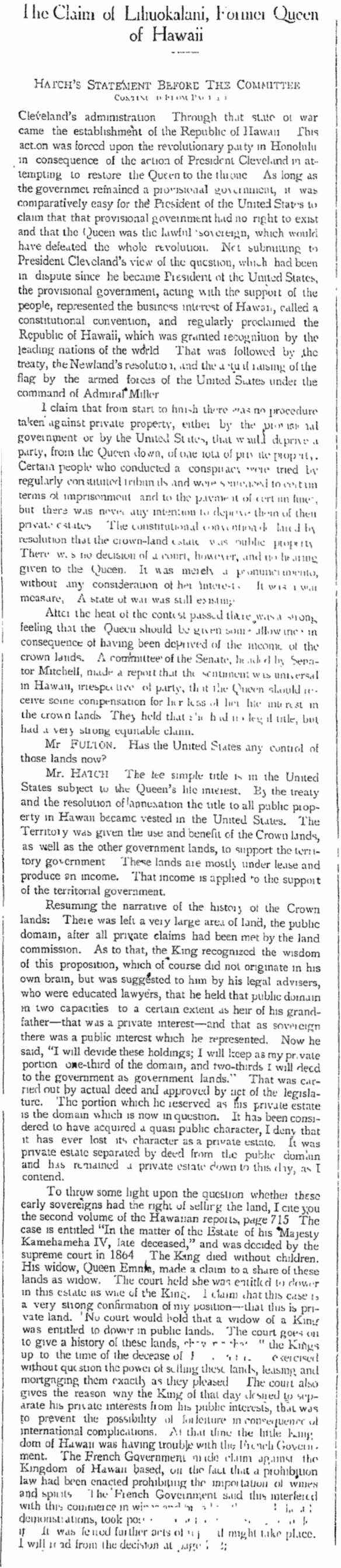
The Claim of Liliuokalani, Former Queen of Hawaii

Kuokoa Home Rula, Buke VII, Helu 21, Aoao 2. Mei 21, 1909.
More familiar mele, with English translation, 1909.

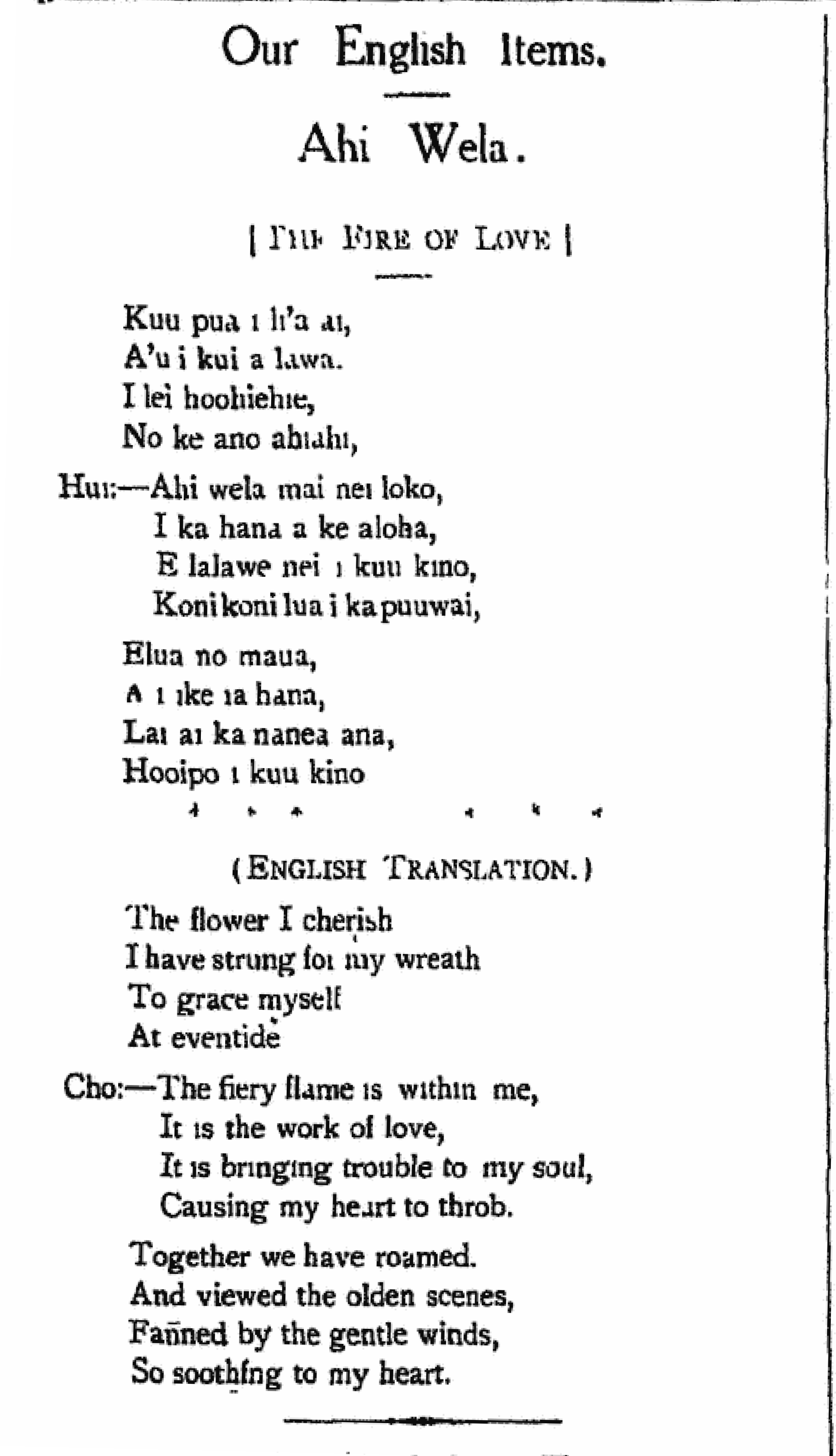
Our English Items.

Ahi Wela.

[THE FIRE OF LOVE]

Kuu pua i li’a ai,
A’u i kui a lawa,
I lei hoohiehie,
No ke ano ahiahi,

Hui:—Ahi wela mai nei loko,
I ka hana a ke aloha,
E lalawe nei i kuu kino,
Konikoni lua i ka puuwai,

Elua no maua,
A i ike ia hana,
Lai ai ka nanea ana,
Hooipo i kuu kino.

(English Translation.)

The flower I cherish
I have strung for my wreat
To grace myself
At eventide

Cho:—The fiery flame is within me,
It is the work of love,
It is bringing trouble to my soul,
Causing my heart to throb.

Together we have roamed,
And viewed the olden scenes,
Fanned by the gentle winds,
So soothing to my heart.

(Kuokoa Home Rula, 5/21/1909, p. 1)

Our English Items.

Kuokoa Home Rula, Bukke VII, helu 21, Aoao 1. Mei 21, 1909.

Beginnings of the Bishop Museum, 1888.

[Found under: “This and That.”]

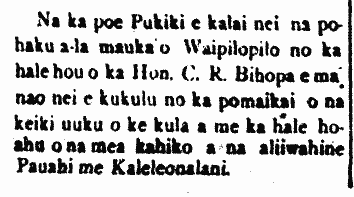
The Portuguese are hewing a-la stone in the uplands of Waipilopilo for the new structure that the Hon. C. R. Bishop is considering building for the benefit of the young children of the school and a place to house the antiques of the royal women Pauahi and Kaleleonalani.

(Kuokoa, 6/2/1888, p. 3)

Na ka poe Pukiki...

Ka Nupepa Kuokoa, Buke XXVII, Helu 22, Aoao 3. Iune 2, 1888.

New Hawaiian Language Textbook, 1939.

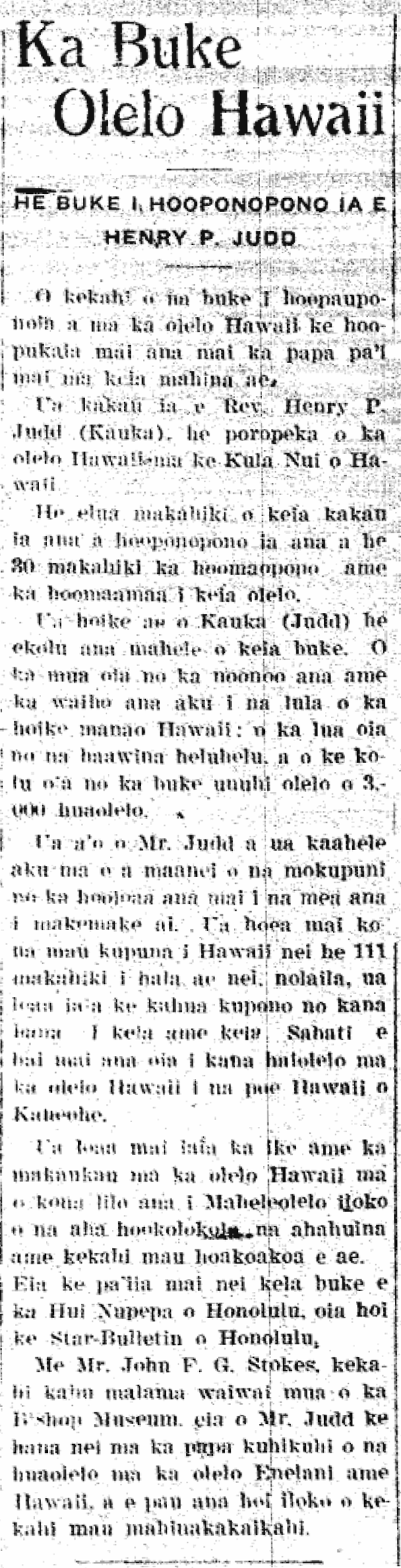
Hawaiian Language Book

A BOOK EDITED BY HENRY P. JUDD

A book completed in the Hawaiian language is being published by the press next month.

It was written by Rev. Henry P. Judd (Kauka), a professor of the Hawaiian language at the University of Hawaii.

The writing and editing took two years, and it was 30 years of learning and practicing of the language.

Kauka (Judd) says there are three sections to this book. The first part is the studying and the giving of rules of Hawaiian expression; the second is reading lessons; and the third is the translation of 3,000 words.

Mr. Judd has taught and travelled here and there in the islands obtaining what he was after. His kupuna came to Hawaii nei 111 years ago, and therefore, he has the appropriate place for his work. Every Sunday, he gives his sermons in Hawaiian to Hawaiians in Kaneohe.

He gained his knowledge and proficiency in the Hawaiian language through his becoming a translator [Maheleolelo] in the courts, the [Evangelical] Conferences, and other gatherings.

This book is being published by the Newspaper Company of Honolulu, that is the Star-Bulletin of Honolulu.

With Mr. John F. G. Stokes, one of the first trustees of the Bishop Museum, Mr. Judd is now in the process of making a word list in English and Hawaiian, which will be completed in a few months.

[This is referring to the book: Judd, Henry P. The Hawaiian language. Honolulu: Honolulu Star-Bulletin, Ltd., 1939.]

(Hoku o Hawaii, 7/26/1939, p. 1)

Ka Buke Olelo Hawaii

Ka Hoku o Hawaii, Volume XXXIV, Number 13, Aoao 1. Iulai 26, 1939.

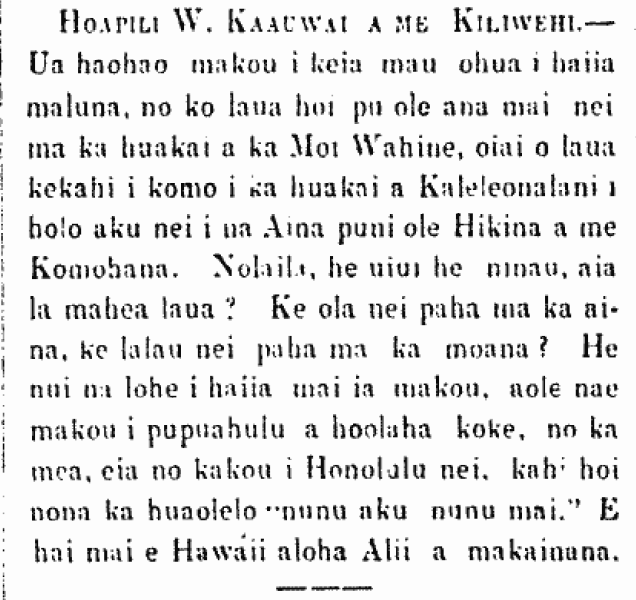
From the suite of Queen Emma, Hoapili Kaauwai and Kiliwehi, 1866.

Hoapili W. Kaauwai and Kiliwehi.—We are curious about the attendants mentioned above, because they have not returned from the trip of the Queen, whereas they were two who joined in on the journey of Kaleleonalani when she set off for the continents of the East and the West. Therefore we question and ask, where are those two? Maybe they are staying on land or gone astray at sea? We hear a lot of stories, yet we will not lose our head and spread them at once, because here we are in Honolulu where it is said, “speculate this way, speculate that way”.¹ Tell us, O Alii and makaainana loving Hawaii.

¹”Nunu aku, nunu mai” perhaps is a variant of “Nune aku, nune mai”, and is a saying associated with busy Honolulu. Is there anyone with more information on this saying?

[There is much written about the happenings between Hoapili and Kiliwehi.]

(Kuokoa, 10/27/1866, p. 2)

Hoapili W. Kaauwai a me Kiliwehi.

Ka Nupepa Kuokoa, Buke V, Helu 43, Aoao 2. Okatoba 27, 1866.

Queen Emma returns to Hawaii, 1866.

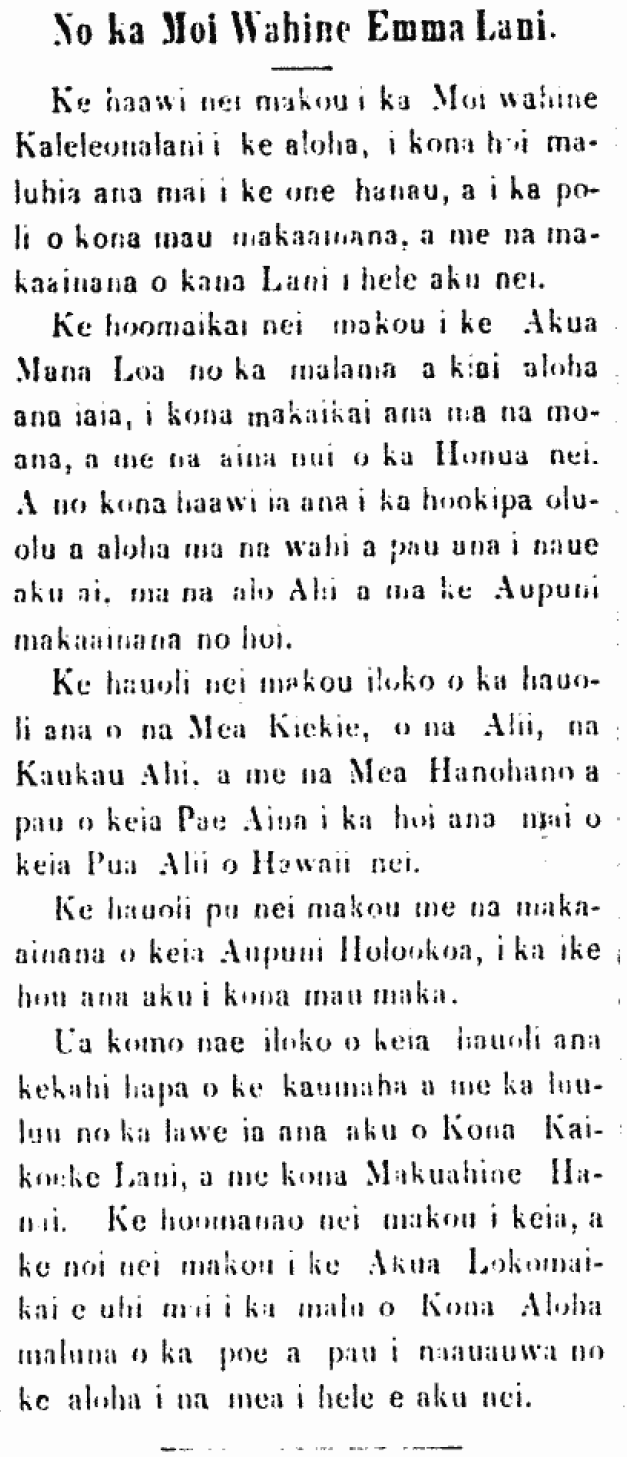
About Queen Emma Lani.

We extend aloha to Queen Kaleleonalani with her safe return to her birth sands, and to the bosoms of her makaainana and the makaainana of her Chief one who has departed.

We give our thanks to Almighty God for lovingly watching over and guiding her, on her voyage over the ocean and the great lands of the Earth. And for the giving of kind and loving receptions in all places she went, in Royal courts as well as amongst the commoners.

We are pleased with the joy of their Highnesses, the Alii, the Kaukau Alii, and all of the Honorable ones of this Archipelago at the return of this Royal Descendant of Hawaii nei.

We are pleased as well along with all the makaainana of the Entire Nation, at seeing once again her face.

Along with this joy is also some sadness and grief for the taking of Her Royal Sister-in-Law [Kaikoeke Lani],¹ and her Foster Mother [Makuahine Hanai].² We remember this, and we ask of the Benevolent God to envelope in the protection of His Aloha, all who are grieving because of their aloha for those who have departed.

¹Victoria Kalohelani Kamamalu Kaahumanu (11/1/1838–5/29/1866)

²Grace Kamaikui Ruka [Rooke] (1808–7/24/1866)

(Kuokoa, 10/27/1866, p. 2)

No ka Moi Wahine Emma Lani.

Ka Nupepa Kuokoa, Buke V, Helu 43, Aoao 2. Okatoba 27, 1866.

Another stone kanoa, 1900.

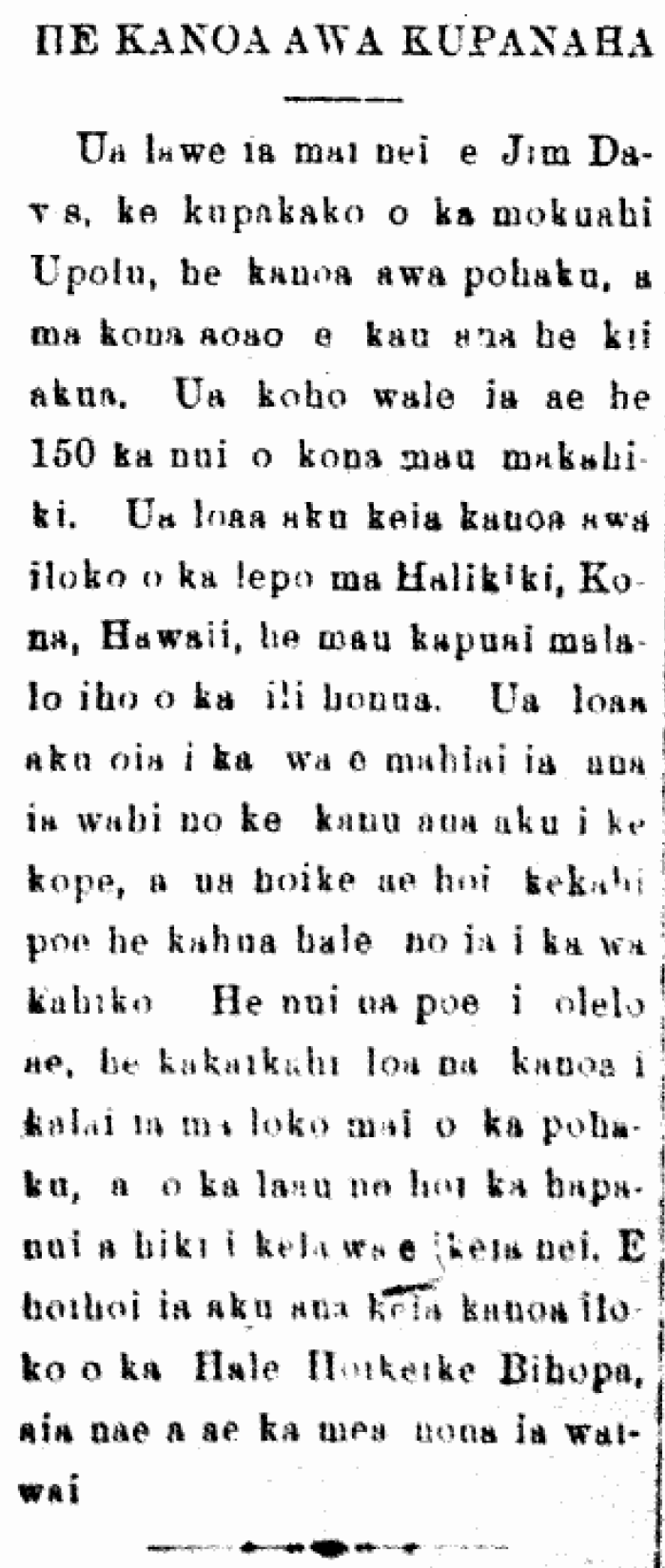
AN AMAZING AWA BOWL.

Brought over by Jim Davis, the supercargo [kupakako] of the steamer Upolu, was a stone awa bowl that has a god image [kii akua] on its side. It is estimated to be 150 years old. This kanoa was found in the earth of Halikiki, Kona, Hawaii, a few feet underground. It was found when the land was being worked to plant coffee, and some people said there was a house foundation there in the olden days. There are many who say that a kanoa carved out of stone is very rare, and that most seen to this day are made from wood. This kanoa will be taken to the Bishop Museum after the one who it belongs to gives his consent.

[There was also this story on a stone kanoa at the Museum. And this did not i hear make its way to the Bishop Museum…]

(Aloha Aina, 6/9/1900, p. 6)

HE KANOA AWA KUPANAHA

Ke Aloha Aina, Buke VI, Helu 23, Aoao 6. Iune 9, 1900.

More on Queen Emma, Leleonalani, 1866.

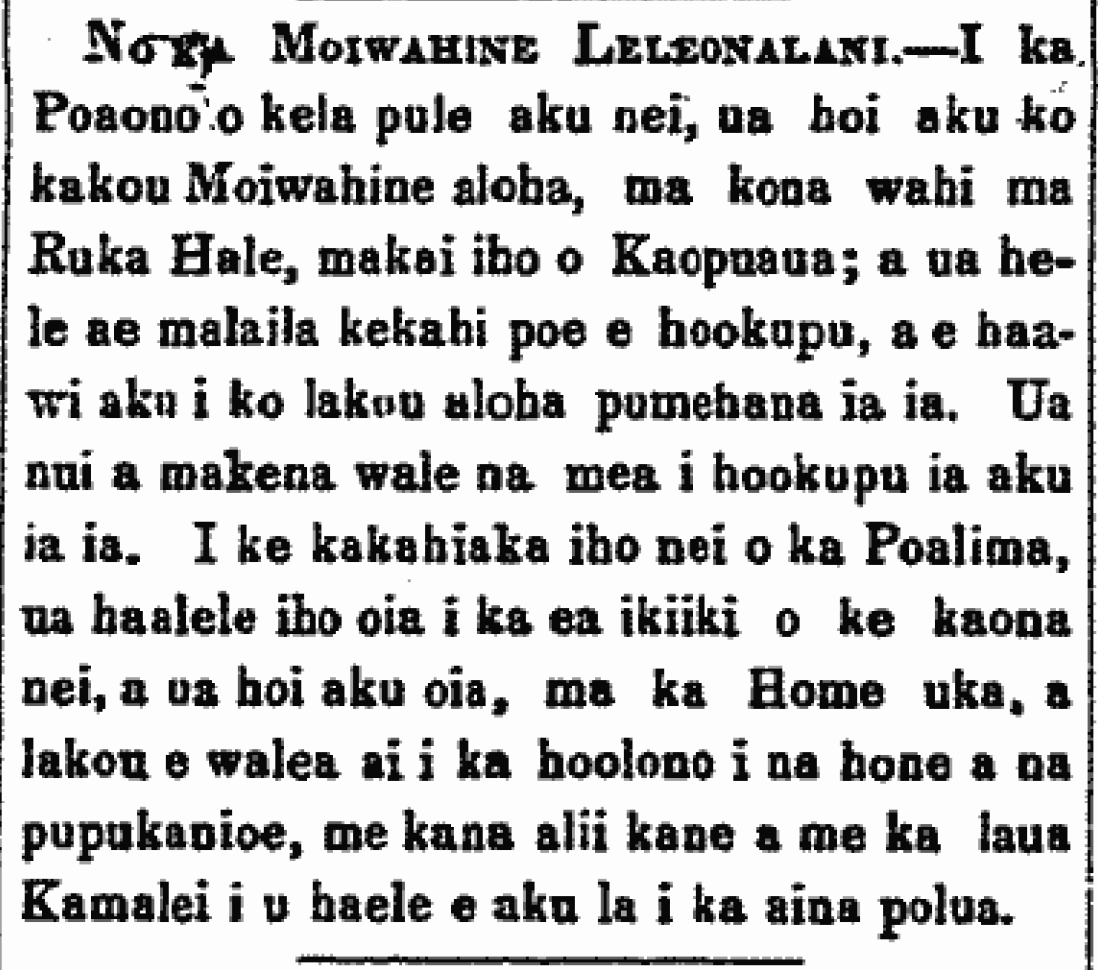
Pertaining to Queen Leleonalani.—This past Saturday, our beloved Queen returned to her residence Rooke House, seaside of Kaopuaua; and there many people went to give gifts [hookupu], and give their warm aloha to her. There was great and numerous hookupu given to her. This past Friday, she left the stifling air of town and returned to her Home in the uplands [Hanaiakamalama], where they relaxed to the sweet call of the singing snails [pupukanioe], and her royal husband and their beloved child who left for the dark lands.

[Here is another example where the initial “Ka” or “Ke” in a distinctive name is left off. Whereas Queen Emma is usually known as “Kaleleonalani,” here she is called “Leleonalani.” This works just as long as there is no confusion as to what or who is being referred to.

Kaumualii = Umualii, Kawaiahao = Waiahao, Kamoiliili = Moiliili, &c., &c., &c.]

(Au Okoa, 11/5/1866, p. 2)

No ka Moiwahine Leleonalani.

Ke Au Okoa, Buke II, Helu 29, Aoao 2. Novemaba 5, 1866.

Queen Emma affronted, 1866.

We Do Not Approve.

As we read the words which President Johnson spoke at his audience with Queen Emma, we nearly ridicule them. Were he instead the greatly beloved Abraham Lincoln, were it perhaps during his time, then the words would have been splendid. He was a very humble man, whereas this President is arrogant. It is unfortunate that it was him, and that he is the head of the Nation which we love. Here are his good for nothing words:—

“I offer you my esteem as you enter the Nation’s capital, for a people of 30,000,000” [He knows that Hawaii is a tiny Nation, and is boasting of America’s greatness.] “It is not because you are Royalty that I give you my regard, but because you are a woman who has looked out for the interest of your people.” [What is wrong with showing aloha in her Royal status?] “I can say that in our country, we are all royalty, we are all Kings and Queens. Therefore, when you speak to one of our people, you are speaking Monarch to Monarch.” [Queen Emma is aware of how America is; what purpose does it serve to speak those words in a welcoming address? You’d imagine that he would have words of aloha for Hawaii. America couldn’t be more against their President [? Oi ole kue ko Amerika i ko lakou Peresidena].

[Johnson’s speech as quoted in Memphis, Tennessee’s Public Ledger of August 24, 1866, is as follows:

“I am most happy to renew to your Majesty the assurances of profound regard and esteem made to you by the Acting Secretary of State, and it affords me pleasure to offer you a cordial welcome to the capital of these United States, the seat of government for over thirty millions of people. And in according you this earnest welcome, permit me to assure you that it is not because you bear the title of Queen; it is induced solely by the prestige that has preceded you, that has assured us of your virtues as a woman, and especially of your efforts in the cause of Christianity, civilization and education among the people of your country. It is more on that account than of the rank or appellation that you bear. If I were disposed to be facetious on this occasion, I might say that while none of the people of these United States wear crowns, while no man is acknowledged as a king and no woman as a queen, yet while you are here in these United States, you will have none but queens to associate with.”]

(Kuokoa, 10/27/1866, p. 3)

Makemake ole.

Ka Nupepa Kuokoa, Buke V, Helu 43, Aoao 3. Okatoba 27, 1866.