La Hoihoi Ea, 1912.

DAY NOT TO BE FORGOTTEN BY TRUE HAWAIIANS.

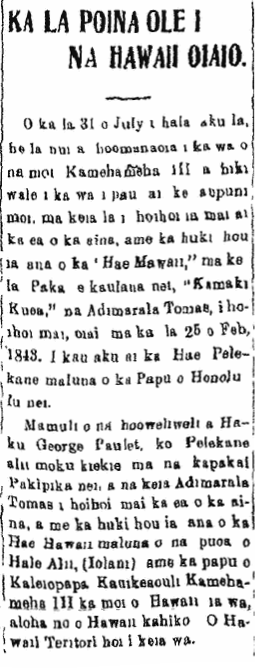
The past 31st of July was a great day celebrated in days of the monarchs, from Kamehameha III all the way until the end of the monarchy; on this day sovereignty was restored and the Hawaiian Flag was raised at that famous park, “Thomas Square,” by Admiral Thomas [Adimarala Tomas], who did the restoration, being that on the 25th of February, 1843, the British Flag was raised over the Fort of Honolulu.

As a result of the threats by Lord George Paulet; Britain’s high officer on the Pacific Ocean, it was Admiral Thomas who restored the sovereignty of the land, and re-raised the Hawaiian Flag on the flag staffs at the Palace (Iolani) and the fort of Kaleiopapa Kauikeaouli Kamehameha III, the king of Hawaii at the time; Aloha to Hawaii of old, which is the Territory of Hawaii now.

(Kuokoa Home Rula, 8/1/1912, p. 1)

KA LA POINA OLE I NA HAWAII OIAIO.

Kuokoa Home Rula, Buke X, Helu 31, Aoao 1. Augate 1, 1912.

Even more from Ka Nonanona, August 8, 1843.

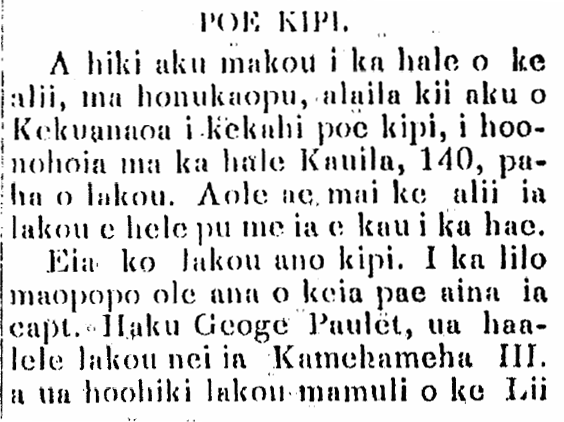
TRAITORS.

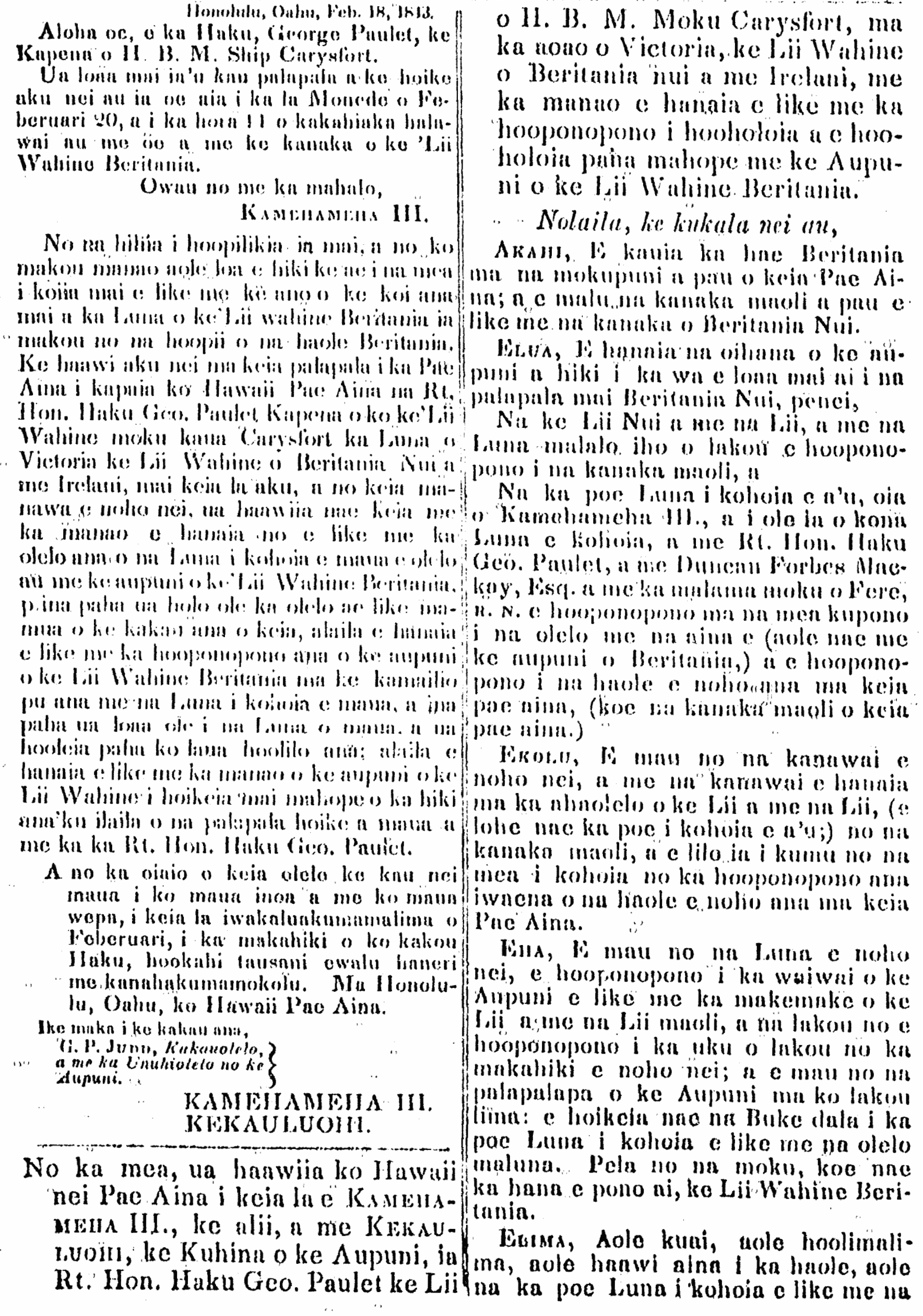
When we reached the residence of the king, at Honukaopu [Honokaupu ?], Kekuanaoa fetched some traitors who were kept at Hale Kauila; perhaps there were 140 of them. The king did not allow them to accompany him to raise the flag.

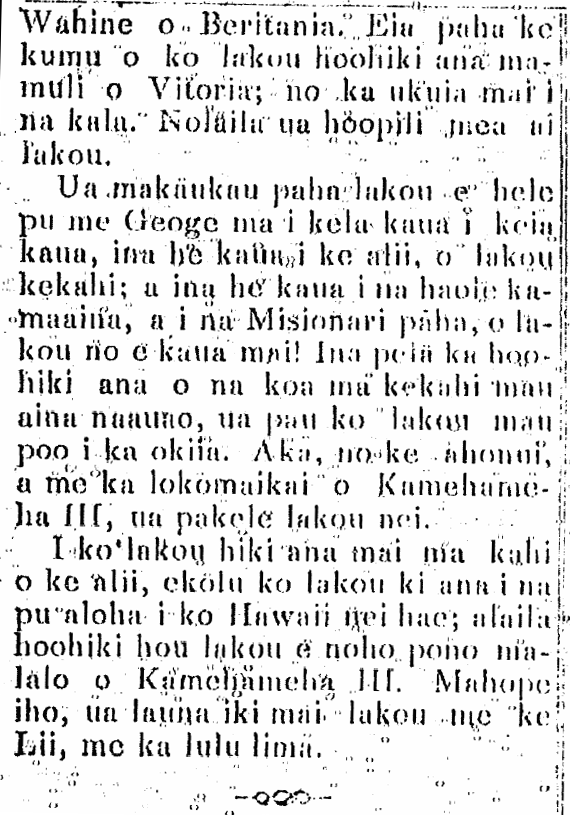
This is the nature of their treason. When this archipelago was not clearly under Capt. Lord George Paulet, they left Kamehameha III, and they swore allegiance to the Queen of Britain. This is probably the reason they swore allegiance to Victoria; because they were paid money. They therefore curried his favor [hoopilimeaai].

They were probably prepared to go with George to this war and that; if he warred against the king, so too would they; and if he went to war against the local haole or the Missionaries, they would fight as well! If soldiers of enlightened lands took an oath in this fashion, their heads would fall. But because of the patience and goodness of Kamehameha III, they were saved.

When they came in the presence of the king, they gave a three gun salute to Hawaii’s flag; and they swore once again to live obediently beneath Kamehameha III. After that, they spent time with the King, and shook hands.

(Nonanona, 8/8/1843, pp. 25 & 26.)

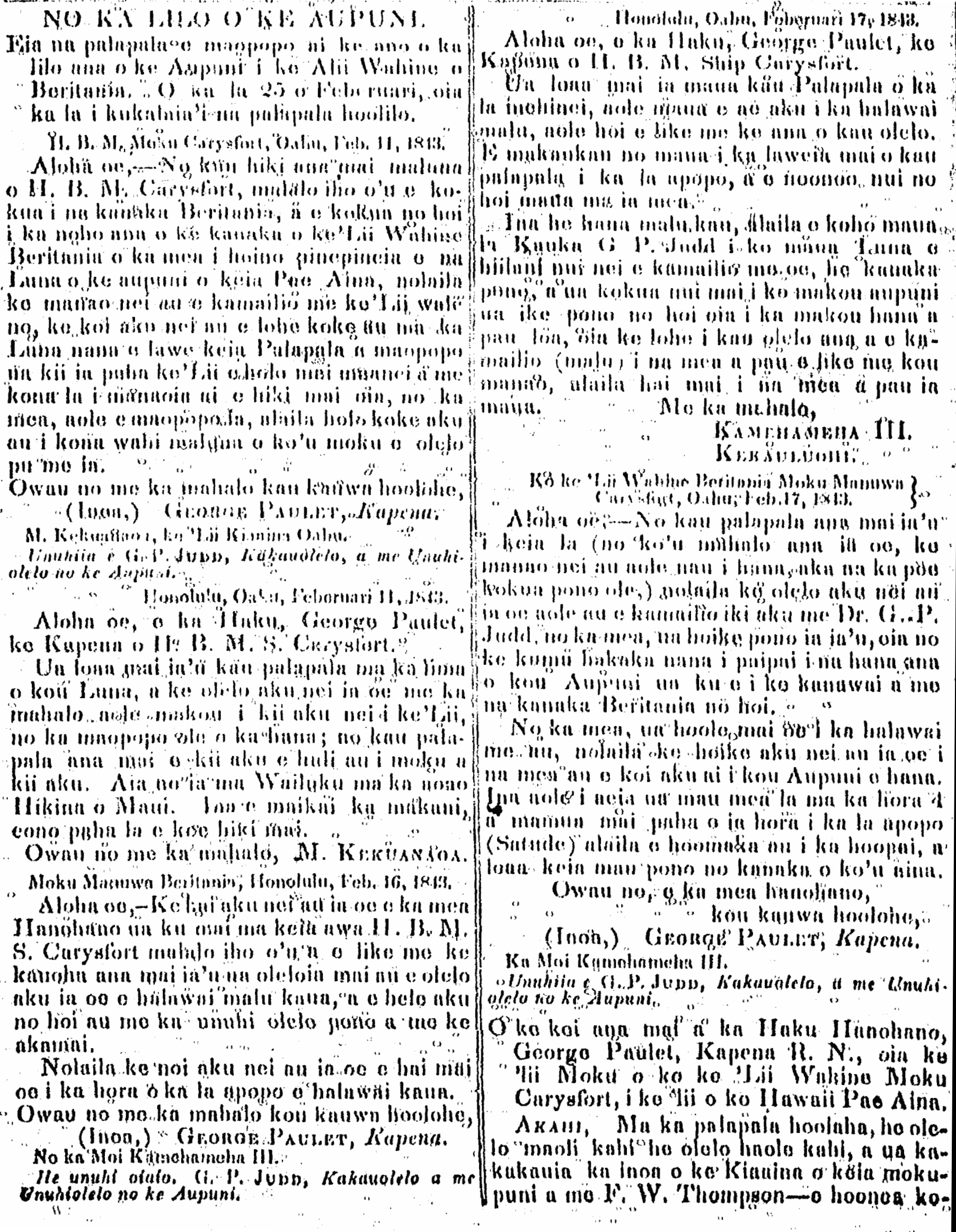
POE KIPI.

Ka Nonanona, Buke 3, Pepa 6, Aoao 25. Augate 8, 1843.

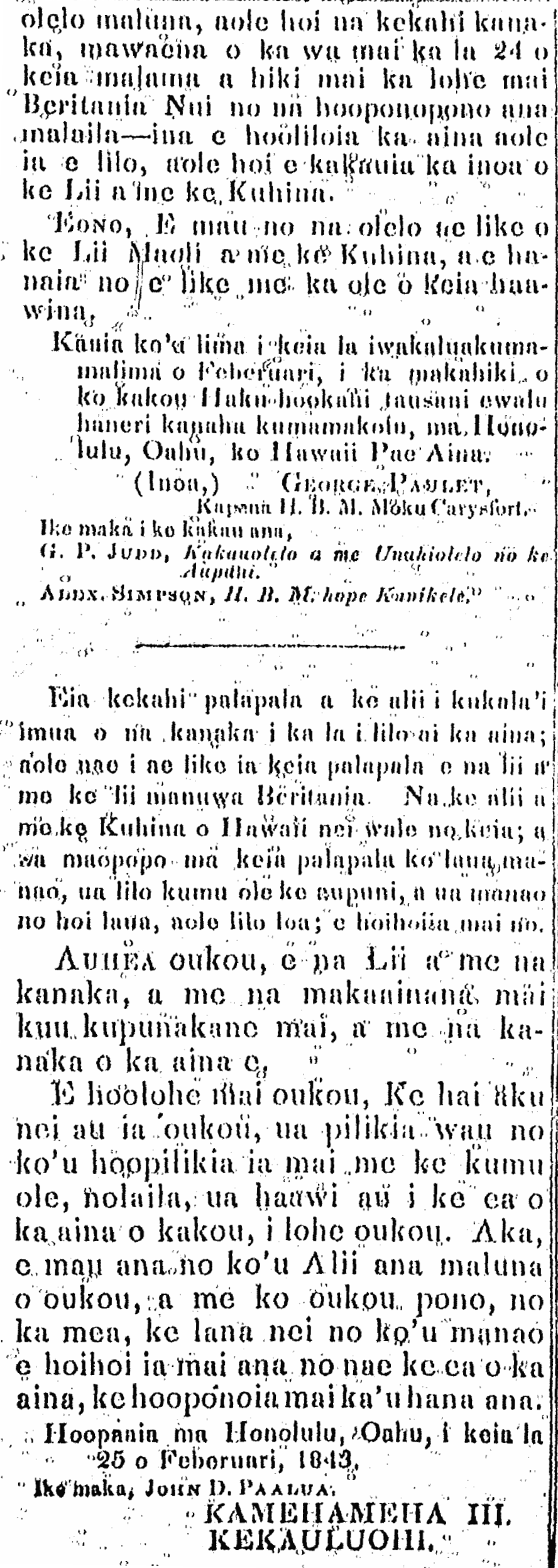
Wahine o Beritania...

Ka Nonanona, Buke 3, Pepa 6, Aoao 26. Augate 8, 1843.

More from Ka Nonanona, August 8, 1843.

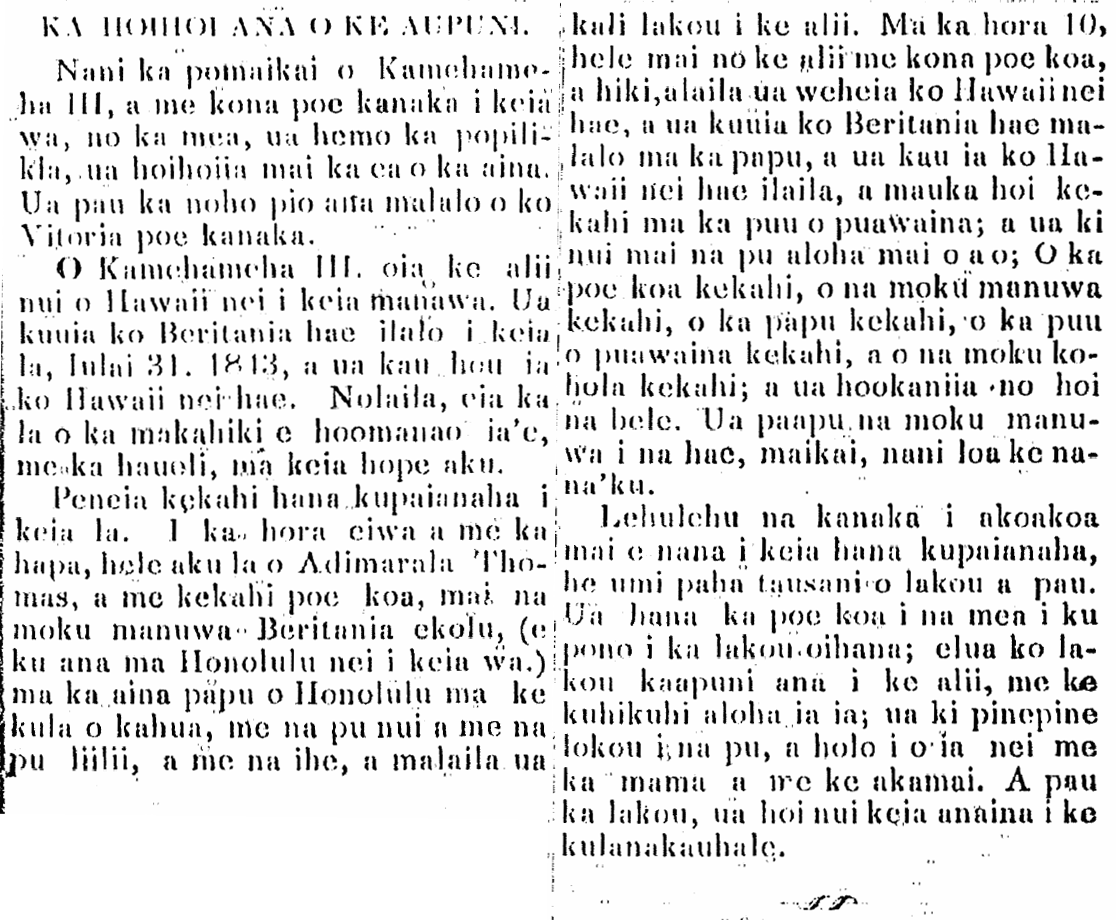
THE RESTORATION OF THE KINGDOM.

How great are the blessings of Kamehameha III and his subjects now, for the difficulties have subsided and the sovereignty of the land has been restored. No more is the living as subjects under the men of Victoria.

Kamehameha III is now the monarch of Hawaii nei. The British flag has been taken down on this day, July 31, 1843, and Hawaii’s flag has been raised once more. Therefore, this will be the day of the year that will be commemorated with joy from here forth.

Here is an awesome event that happened today. At half past eight, Admiral Thomas went along with some sailors, from the three British ships (anchored at Honolulu now) to the fort of Honolulu at Kulaokahua, with large and small firearms, and spears, and there he awaited the king. At 10 o’clock, the king went with his soldiers, and arrived; the Hawaiian flag was unfurled, the British flag was taken down from the fort, and there the Hawaiian flag was raised, and so too in uplands, on the hill of Puawaina [Punchbowl]; many guns were shot off in salute all over: The soldiers did it, the warships as well, the forts as well, and the hill of Puawaina as well, and the whaling ships as well; and the bells were rung. The warships were festooned with flags; it was a fine and beautiful sight to see.

There were many people gathered to witness this amazing event, perhaps there were ten thousand in total. The soldiers carried out their duties well; they circled the king twice, while saluting him; they shot off their guns many times and marched here and there quickly and smartly. And when they were done, the crowd all returned to town.

(Nonanona, 8/8/1843, p. 25)

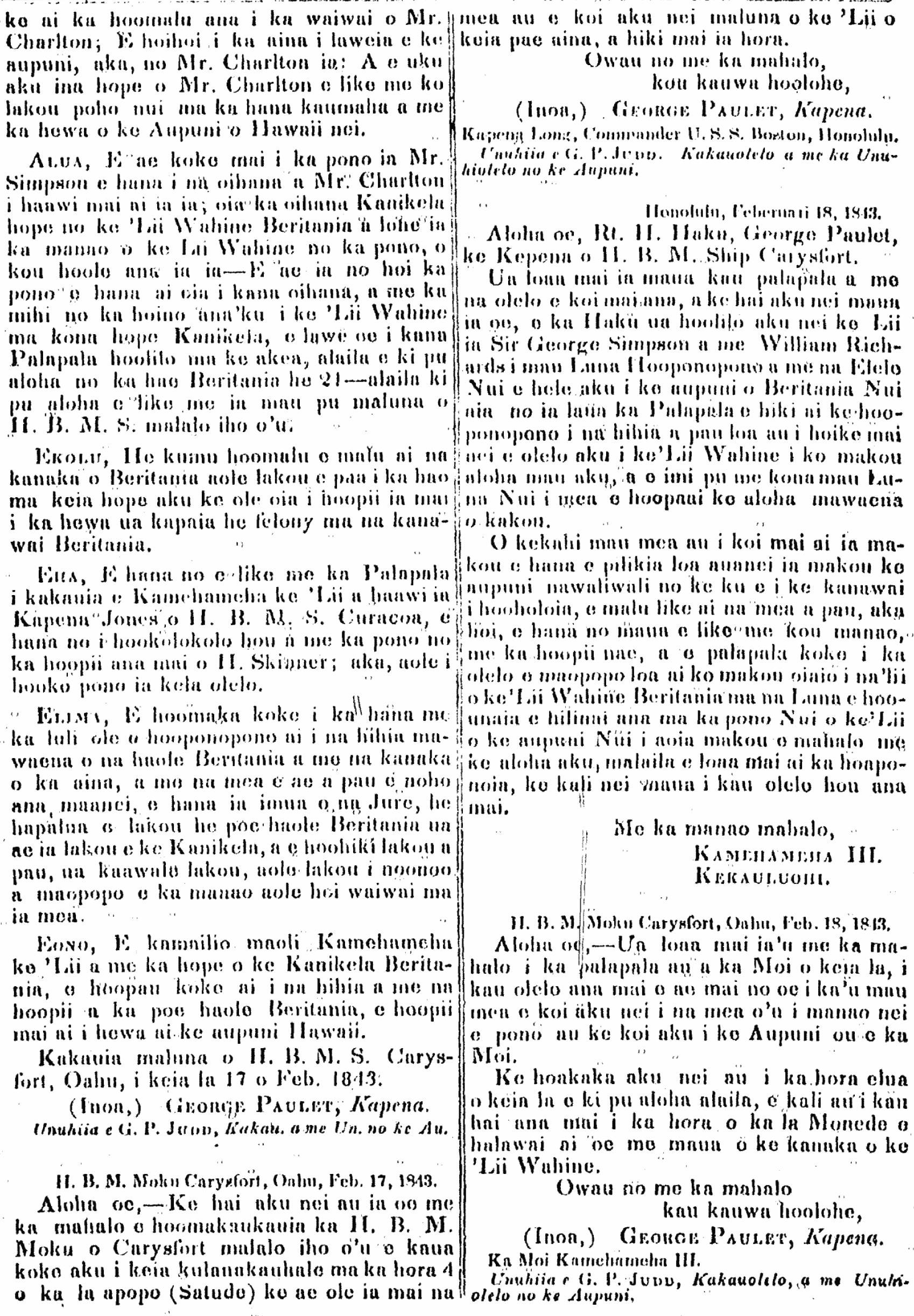
KA HOIHOI ANA O KE AUPUNI.

Ka Nonanona, Buke 3, Pepa 6, Aoao 25. Augate 8, 1843.

The first newspaper article printed following July 31, 1843.

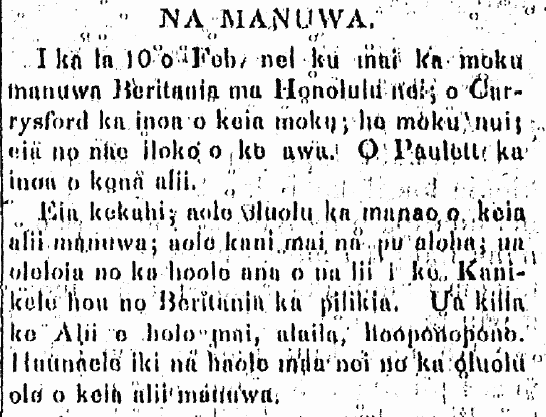
BATTLESHIP.

On the 26th of July, the British Warship named Dublin arrived. Rear Admiral Thomas is the Captain. He is the officer in charge of all of the British warships in the Pacific Ocean.

When he received documents pertaining to Capt. Lord George Paulet aboard Victoria’s ship, and he heard clearly that the British flag was raised over these islands, he came quickly to restore the government to Kamehameha III. How fine is his aloha for the king, isn’t it! and for the citizens as well.

(Nonanona, 8/8/1843, p. 25)

MOKU MANUWA.

Ka Nonanona, Buke 3, Pepa 6, Aoao 25. Augate 8, 1843.

Recipes brought to you by Royal Baking Powder, 1920.

Royal Baking Powder Biscuits

There is nothing to compare for breakfast, lunch, or tea; it is easy to make with the help of

ROYAL

Baking Powder

ABSOLUTELY PURE

Here is the recipe for Royal Baking Powder Biscuits—famous around the world—clip this out and try them. But use Royal Baking Powder. Cheap substitutes won’t do. Only by using Royal, will you see the proper results which made Royal famous around the world.

Biscuits [Palaoa Liilii]

2 cups flour
4 teaspoons Royal Baking Powder
1/2 teaspoon salt
2 tablespoons shortening
3/4 cup milk or half milk and half water

Sift together flour, baking powder and salt, add shortening and rub in very lightly; add liquid slowly; roll or pat on floured board to about one inch in thickness (handle as little as possible); cut with biscuit cutter. Bake in hot oven 15 to 20 minutes.

Here is a fine recipe for Cheese Biscuits:

Cheese Biscuits [Palaoa Waiupaa]

1-1/2 cups flour
2 teaspoons Royal Baking Powder
1/4 teaspoon salt
1 teaspoon shortening
6 tablespoons grated cheese
5/8 cup milk

Sift together flour, baking powder and salt; add shortening and cheese; mix in lightly; add milk slowly, just enough to hold dough together. Roll out on floured board about 1/2-inch thick; cut with biscuit cutter. Bake in hot oven 12 to 15 minutes.

Level off all measurements.

In many of the recipes, there are a lot of eggs; you will however get fine results if you lessen the eggs by half and add one teaspoon of Royal Baking Powder in place of each egg left out.

Write for the Free Recipe Book. A recipe book that is economical with eggs and other expensive material will be sent by mailbag at no cost. Write to

Royal Baking Powder Co., 135 William St., New York, U. S. A.

[These recipes were part of a series of ads in the Kuokoa (and in papers across the United States as well). It is a good way to get cooking descriptions in Hawaiian!

The English for the main parts of the recipes came from “The New Royal Cookbook” put out by the Royal Baking Powder Company in 1920 (which is the cookbook mentioned in this ad which they are giving away free if you mail away for it). It is provided online by Project Gutenberg!]

(Kuokoa, 3/12/1920, p. 3)

Palaoa Liilii Royal Baking Powder

Ka Nupepa Kuokoa, Buke LVIII, Helu 11, Aoao 3. Maraki 12, 1920.

Hawaiian Opera, 1925.

Glee Club of Charles E. King

This is a scene from the Opera “Prince of Hawaii” presented at the Liberty Theater on the night of Monday last, continuing its performance until the night of Saturday, May 9. Mr. C. E. King put together this Opera, and there are only talented singers who perform the songs.

There was much lauding of the performance of Monday night, and for that reason, Liberty Theater has been full every night since–not just for the beautiful appearance of the singers, but also because of the beauty of their singing.

The proceeds of this opera will go to funding the education of Hawaiian children; for a scholarship set up by the Hawaiian Civic Club.

[I’m not much into opera, but I still would like to have witnessed this first hand!]

(Kuokoa 5/7/1925, p.1)

Ka Hui Himeni a Chas. E. King

Ka Nupepa Kuokoa, Buke LXIV, Helu 19, Aoao 1. Mei 7, 1925.

More plays! 1925.

TABLEAU OF PELE AND LOHIAU

This play was shown at Waikiki Park on this past Saturday, and will be shown again on this Satrday night. From the left to the right—Alice Malahea, Lydia Holt, William Smith, Abbie Lincoln.

[This is another i wish i could have seen! This is a repost from the abandoned Hoolaupai Facebook page of times past. I like the format of http://nupepa-hawaii.com because it is very easily searched!]

(Kuokoa, 5/21/1925, p. 5)

KE TABALO O PELE AME LOHIAU

Ka Nupepa Kuokoa, Buke LXIV, Helu 21, Aoao 5. Mei 21, 1925.

This must have been some show, 1912.

PAGEANT AT HEEIA, KOOLAUPOKO.

With the arrival of the night of the 3rd of August, 1912, a Pageant will be performed at Heeia, Koolaupoko, beginning at 7:30. Here are the scenes that will be shown, and it will be beautiful.

FIRST TABLEAU.

1. Kiwalao.

2. Kamehameha.

3. Kahekili.

4. Kauikeaouli.

5. Kalakaua and the warship Kaimiloa.

6. Kamehameha and Kaahumanu.

7. Battle of Kamehameha at Napoopoo along with the war fleet of canoes.

8. Kalakaua and the hapa haole hula ku’i.

SECOND TABLEAU.

9. The crater of Pele.

Aloha Oe. Hawaii Ponoi.

Western Dancing [Hulahula].

Entrance, 50 cents a ticket, and 25 for children.

This masterful undertaking will be lead by H. M. Kaniho.

(Aloha Aina, 7/27/1912, p. 4)

HOIKEIKE TABALO MA HEEIA, KOOLAUPOKO.

Ke Aloha Aina, Buke XVII, Helu 30, Aoao 4. Iulai 27, 1912.


Olympics, Duke Kahanamoku and the King of Sweden, 1912.

THE KING OF SWEDEN AND DUKE KAHANAMOKU OF HAWAII.

July 10—The news spread around the world of the standing of the Hawaiian boy, Duke Kahanamoku. There were thousands gathered in the capital of Sweden, wanting to catch a glimpse of the hero of Hawaii.

Those days became one of joyfulness because Duke captured the title, champion of the world. Duke was taken by the Committee in the vicinity of where the main Committee was announcing the finishers and their times in which they swam.

Gathered there as well was the King, Queen, and the Heads of State of other Nations, when the winner was announced along with his time. The skies were filled with cheers. And it is said that the voices ringing out in the skies were like the roar of thunder. At this time, the hand of the King was seen waving to the Duke of Hawaii, as he was standing all alone as is the general case with the Hawaiian People, a humble Lahui; and so of this Hawaiian, who hesitated to go and meet with a famed King of the world, but the King kept waving him forth, but at this time, the King stood and said, “I am happy to meet you, the one who dwarfed the swimming records of the world. And then right there after, the King introduced Duke Kahanamoku to the Queen who sat near by who had smiles for the dark-faced [maka poniponi] boy of Hawaii, and he thanked them for this honor granted him, humbly and unpretentiously.

(Hoku o Hawaii, 9/18/1912, p. 2)

KA MOI O SUEDENA AME DUKE KAHANAMOKU O HAWAII

Ka Hoku o Hawaii, Buke 7, Helu 7, Aoao 2. Iulai 18, 1912.

It is best to be truthful and just admit when you are wrong before you dig yourself into a bigger hole. 1912.

LOSE YOUR HEAD, DIE; LOSE YOUR FEET, LIVE.

The statements placed above are from a couple of men in the olden days of Hawaii nei, and this is the story:

There were two men, and one day, the two of them climbed up the mountain to cut house thatching [aho hale] which was a regular thing in those days of ours. They cut thatch until evening, and their work for the day was over, and they went to somewhere suitable and started a fire to warm themselves and prepared their meal for that night, and after they were done eating, they were about to sleep.  One of them lay down with his head to the fire and his feet away, while the other slept with his feet toward the fire and his head away; and when the one who had his feet toward the fire noticed his friend with his head toward the fire, he spoke the words placed above, saying:

E, what say you my friend, LOSE YOUR HEAD, DIE; LOSE YOUR FEET, LIVE, so why don’t you move your head away from the fire and move your feet close to it; and when the one whose head was close to the fire heard this, he replied:

LOSE YOUR FEET, DIE, for if you lose your feet to the fire, then where are your feet to go back home with to see the faces of your wife and children; therefore, because of the different choices made by the two men, they stuck to their decisions and both fell asleep; in the middle of the night, the first man smelled the smell of burning hair, and thus being startled, he saw his friend whose head was on fire; at this, he got up and made ready to head back to the home of their families and as the first man neared their houses, he turned back and saw his companion running behind him with his head on fire, the first man knew that this was a spook [uhane lapu] and not a live person, and as this first one entered the house the spook passed by the house, going around with his head still on fire; the first man told their story from beginning to end, while telling those in his household that his friend died because of his stubbornness, for he warned him to move his head away from the fire and yet he did not listen [much less heed]. So pigheaded.

This story is perhaps similar to people of these times; they stick their heads [hou poo] into stubborn ideas that are caused by false pride [uilani kuhihewa] and the results of this mistaken pride is what we have seen above.

(Hoku o Hawaii, 7/25/1912, p. 3)

PAU POO MAKE, PAU WAWAE OLA

Ka Hoku o Hawaii, Buke 7, Helu 8, Aoao 3. Iulai 25, 1912.