The birthday of Pauahi, 1901.

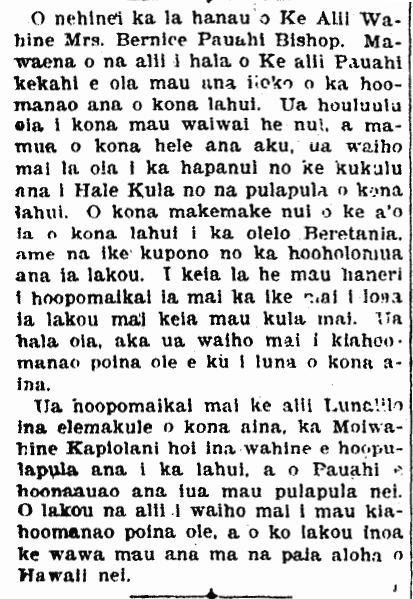
Yesterday was the birthday of The Chiefess Mrs. Bernice Pauahi Bishop. Amongst the alii who passed on, Ke alii Pauahi is one who lives on in the minds of her lahui. She accumulated her great wealth and before her passing, she left most of it to build a School for the children of her people. Her strong desire was that her lahui be taught English and the proper knowledge for them to progress. Today there has been hundreds who have benefited from the knowledge they gained from these schools. She has gone on but left an unforgettable monument standing upon her land.

Lunalilo blessed the old people of his aina; Queen Kapiolani, the women who are increasing the race; Pauahi, educates those children. Those are the alii who left enduring monuments; and their names shall forever reverberate against the beloved walls of Hawaii nei.

(Kuokoa, 12/20/1901, p. 2)

O nehinei ka la hanau o Ke Alii Wahine Mrs. Bernice Pauahi Bishop...

Ka Nupepa Kuokoa, Buke XXXIX, Helu 25, Aoao 2. Dekemaba 20, 1901.

Birthday of Mrs. A. Pauahi Bishop, 1869.

[Found under: “NU HOU KULOKO: Oahu.”]

Birthday of the Alii Pauahi.—On the 20th of December, a party was held at Koholaloa, to celebrate the birthday of one of our young chiefs, that being the Honorable Mrs. A. Pauahi Bishop, recognizing her reaching thirty-eight years old. This past 19th was a Sunday and was her actual birthday, but because it fell on a Sunday, it was not observed. It was left until the following Monday. The lanai where the party was held was honored by the arrival of the Governess of Hawaii [Keelikolani], the Hon. Mrs. L. Kamakaeha, Mrs. L. Kaaniau [Kekaaniau], and the other dignitary women of this town. Later that night, the chiefess whose birthday it was was entertained at her home, relying on Pauli, Malo, Kapoli, and Wakeki, who sang some name songs for that alii. They were appreciated for their singing.

(Kuokoa, 12/25/1869, p. 2)

La Hanau o Pauahi Alii.

Ka Nupepa Kuokoa, Buke VIII, Helu 51, Aoao 2. Dekemaba 25, 1869.

Death of Abner Kuhooheiheipahu Paki, 1855.

The death of A. Paki, on the 13th of this June.

The chief A. Paki. He appears in the genealogy of the Chiefs of this Nation, from ancient times, and he is a high Chief of this land descended from Haloa, that being the one father of the children living in this world, and the father of our people.

Part of his genealogy is taken from the High Chiefs of the land, and he is part of Kamehameha’s, and he is part of Kiwalao’s, and he is a hereditary chief of a single line from ancient times; and he was a father who rescued from trouble his people of this nation from Hawaii to Kauai.

His accomplishments during his life. When he promised to stop drinking and to become a Christian, from that time on he did not drink alcohol again until the day he died.

He was a Chief who was steadfast in his work for the nation, and he was an Alii who would be furious when he heard his deceased child being spoken ill of, as well as of his children who survive him.

From what I have seen of this Alii while he was alive. In the year 1837, he began his governmental work, and at one point he was appointed Chief Justice [L. K. Kiekie] of the country, and at another point he served as Governor, and another time he was included in the Privy Council, and still another time he was the steward for his child, this during his lifetime. Continue reading

Theresa Owana Wilcox Belliveau and the Estate of Pauahi and Liliuokalani, 1918.

FIGHTING OVER THE ESTATE OF PAUAHI

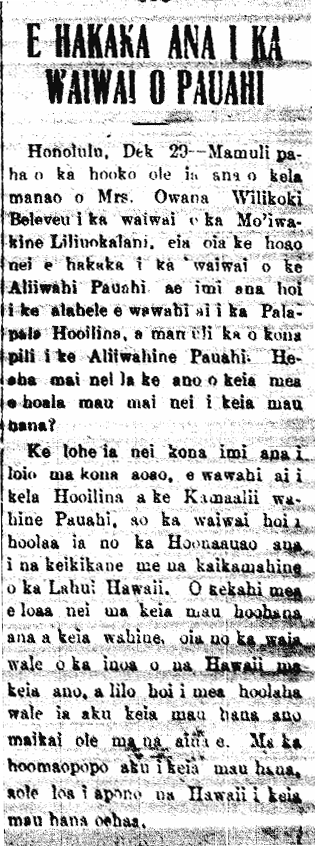
Honolulu, Dec. 29—Perhaps it is because the desires of Mrs. Owana Wilcox Beleveu [Belliveau] were not appeased over the estate of Queen Liliuokalani that here she is fighting over the estate of the Aliiwahine Pauahi and she is trying to find a way to break the Will, as if she is related to Chiefess Pauahi. What does she expect by starting all of this?

It is heard that she is looking for an attorney on her side to break the Will of Princess Pauahi, and the money to be dedicated to Educate the boys and girls of the Hawaiian Lahui. Something that will result through this action by this woman is the dishonor to the name of Hawaiians, and this improper action will be something reported in other lands. When they find out about  this, Hawaiians will definitely not approve of this deceitful act.

(Aloha Aina, 1/3/1918, p. 2)

E HAKAKA ANA I KA WAIWAI O PAUAHI

Ka Hoku o Hawaii, Buke 12, Helu 32, Aoao 2. Ianuari 3, 1918.

King Lunalilo passes, 1874.

THE DEATH OF LUNALILO

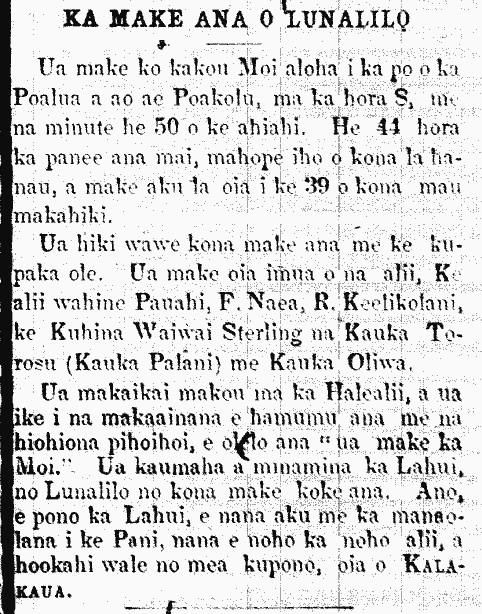
Our beloved King died from the night of Tuesday to the day of Wednesday [February 3, 1874], at 8 o’clock and 50 minutes in the evening. 44 hours went by after his birthday, and he died at 39 years old.

His death was quick without a struggle. He died before the alii, Ke alii Pauahai, F. Naea, R. Keelikolani, the Minister of Finance Sterling, Dr. Trousseau (Kauka Palani), and Dr. Oliver.

We visited the Palace and saw the makaainana murmuring about with worried faces, saying, “The King is dead.” The Lahui are sad and grieve over the quick passing of Lunalilo. The Lahui must at once look with hope to his Replacement, the one who will occupy the throne, and there is but one who is fitting, that is Kalakaua.

(Nuhou Hawaii, 2/10/1874, p. 3)

KA MAKE ANA O LUNALILO.

Ka Nuhou Hawaii, Buke I, Helu 15, Aoao 3. Feberuari 10, 1874.

A birthday, a name song, and never knowing where you will find information, 1891.

[Found in the story: “He Moolelo Kaao No Kamapuaa.”]

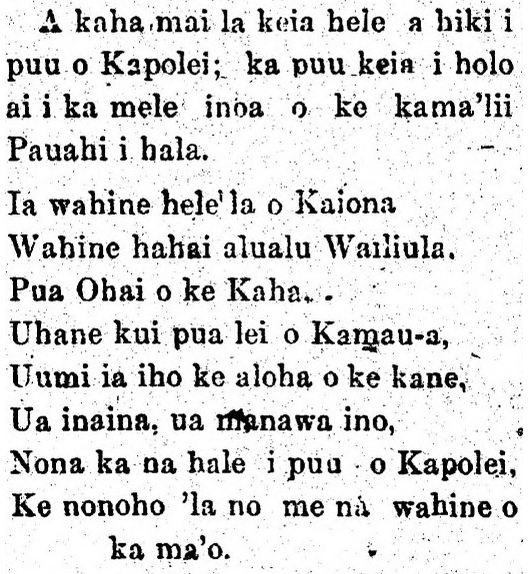
Ia wahine hele la o Kaiona,
Wahine hahai alualu Wailiula,
Pua Ohai o ke Kaha,
Uhane kui pua lei o Kamau-a,
Uumi ia iho ke aloha o ke kane,
Ua inaina, ua manawa ino,
Nona ka na hale i puu o Kapolei,
Ke nonoho ‘la no me na wahine o ka ma’o.

[On her 183rd birthday, here is a mele inoa for the princess found in of all places, a story about Kamapuaa. There is a scene where Kamapuaa is coming upon Puu o Kapolei, and the writer interjects: this is the hill about which goes the mele inoa for the deceased princess Pauahi. You never know where you can find information, you just have to look…]

(Leo o ka Lahui, 7/1/1891, p. 4)

He Moolelo Kaao No Kamapuaa.

Ka Leo o ka Lahui, Buke II, Helu 227, Aoao 4. Iulai 1, 1891.

More on Emma Nakuina, W. T. Brigham, and the Bishop Museum, 1897.

NOT COURTEOUS

Treatment of Ladies at Bishop Museum.

An Open Protest to the Trustees of the Kamehameha Schools.

MR. EDITOR:—The undersigned with three other ladies, Hawaiians of the highest respectabily, standing and position, with five little children, were sitting this morning in the shade of the Kamehameha Museum enjoying the fine showing made by the naval men drilling on the College campus. Chairs had been offered by a Kamehameha graduate, he placing them on the grass plot adjoining the Museum. After a little while, Mr. Brigham, the curator of the Museum, drove by within a few feet of us. He scowled most savagely at us. In a few minutes a Portuguese workman came to order us away from the place.

As it has invariably been the custom to throw the College grounds open to the public when any sort of a public or semi-public show is taking place within its precincts, we did not pay any attention to his orders, thinking it a piece of officiousness on the part of an ignorant person, and the man went away. After a while the man re-appeared and ordered us off again, saying he was acting by Brigham’s orders, and to use force if necessary. He took hold of the chair of the wife of a prominent official and tipped it partly over. She sprang up to avoid a fall, as did two other ladies. I, being at the very corner of the building and a little in advance of the others did not perceive the man until he had taken hold of my chair and had partly spilled me on my knee. I turned around to protest, when he grabbed my arm and pulled me out of my chair, saying “you get out of this, those are my orders from Mr. Brigham. If you don’t go yourself, I make you go. Mr. Brigham don’t allow any one to get on this grass.”

There were quite a number of carriages standing around, occupied by spectators of the drill.

The actions of the Portuguese were so rough and insulting that the attention of quite a number were attracted to our forcible ejectment. Continue reading

Queen’s Hospital trustees and the Bishop Museum, 1886.

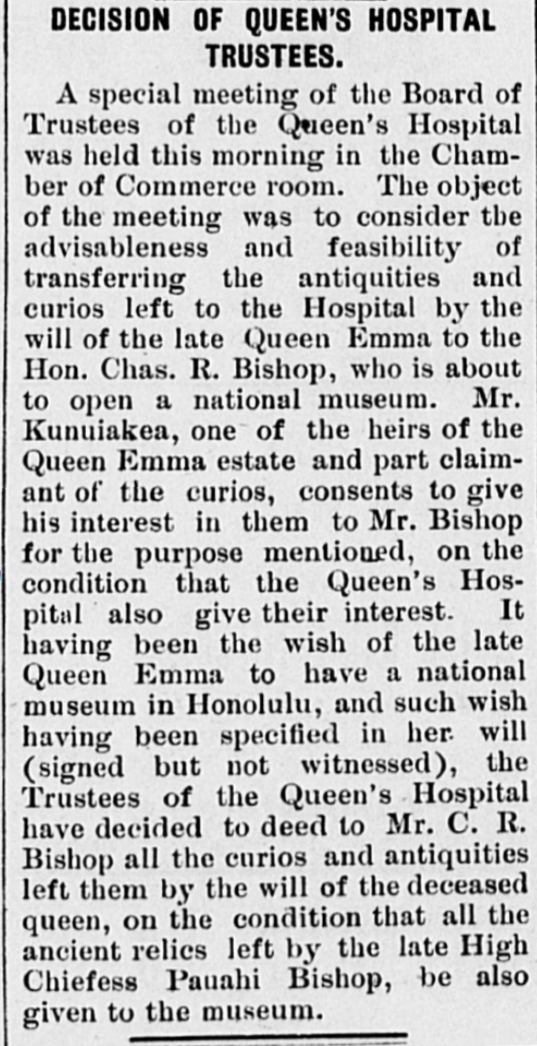
DECISION OF QUEEN’S HOSPITAL TRUSTEES.

 A special meeting of the Board of Trustees of the Queen’s Hospital was held this morning in the Chamber of Commerce room. The object of the meeting was to consider the advisableness and feasibility of transferring the antiquities and curios left to the Hospital by the will of the late Queen Emma to the Hon. Chas. R. Bishop, who is about to open a national museum. Mr. Kunuiakea, one of the heirs of the Queen Emma estate and part claimant of the curios, consents to give his interest in them to Mr. Bishop for the purpose mentioned, on the condition that the Queen’s Hospital also give their interest. It having been the wish of the late Queen Emma to have a national museum in Honolulu, and such wish having been specified in her will (signed but not witnessed), the Trustees of the Queen’s Hospital have decided to deed to Mr. C. R. Bishop all the curios and antiquities left them by the will of the deceased queen, on the condition that all the ancient relics left by the late High Chiefess Pauahi Bishop, be also given to the museum.

(Daily Herald, 9/16/1886, p. 3)

DECISION OF QUEEN'S HOSPITAL TRUSTEES.

The Daily Bulletin, Volume IX, Number 1432, Page 3. September 15, 1886.

Beginnings of the Bernice Pauahi Bishop Museum, 1886.

Museum of Antiquities.

A special meeting of the Board of Trustees of the Queen’s Hospital was held yesterday. It was called to consider the question of conveying the Hawaiian antiquities and curios, devised to the Trustees by the will of the late Queen Emma, to the Hon. C. R. Bishop for a projected public museum. Mr. Bishop had sometime ago formed the purpose of founding a museum of Hawaiian antiquities, with the collection of his late consort, Princess Bernice Pauahi Bishop, as the nucleus. Continue reading