Here is the amendment to the marriage law passed in 1888.

MOKUNA LXIX.

HE KANAWAI

E hoololi ai i ka Pauku 2 o ka Mokuna LVI o ke Kanawai Hoopai Karaima, a e hoopau loa ai i na Pauku 3, 4 a me 5 o ia Mokuna, me na hoololi a pau i ua Mokuna nei.

E hooholoia e ka Moi a me ka Ahaolelo o ko Hawaii Paeaina.

Pauku 1. E hoololi ia a ma keia ke hoololi ia nei ka Pauku 2 o ka Mokuna LVI o ke Kanawai Hoopai Karaima, a penei e heluhelu ia ai:

“Pauku 2. E ninaninau ia, e hoolohe ia, a e hooholo ia e ka Lunakanawai no ia hihia, a ina he mea hiki e hoopau ia ka noho kue ana o laua; aka, ina aole hiki e hoopau ia ko laua kue ana, e hoopau wale ia no ka hoopii. Ina e hoopau wale ia kekahi hoopii, e hooholo ka Lunakanawai e hookaa ia na koina e like me ka mea ana i manao ai oia ka pono.”

Pauku 2. Ma keia ke hoopau loa ia nei na Pauku 3, 4 a me 5 o ka Mokuna i olelo ia  a me kekahi a me na hoololi o ia Mokuna i olelo ia.

Apono ia i keia la 10 o Sepatemaba, M. H. 1888.

KALAKAUA REX.

Na ka Moi:

L. A. Thurston,

Kuhina Kalaiaina.

(NA KANAWAI O KA MOI KALAKAUA I, Ke Alii o Ko Hawaii Paeaina, i Kau ia e ka Hale Ahaolelo Kau Kanawai, i ke Kau o 1888, p. 171.)

CHAPTER LXIX.

AN ACT

To amend Section 2 of Chapter LVI. of the Penal Code and Repeal Sections 3, 4 and 5 of said Chapter with all Amendments thereto.

Be it Enacted by the Kind and the Legislature of the Hawaiian Kingdom:

Section 1. That Section 2 of Chapter LVI. of the Penal Code be and is hereby amended so as to read as follows:

“Section 2. Said Justice shall examine into, hear and determine the complaint and shall secure if practicable, a reconciliation between the parties; but if no reconciliation can be effected, the complaint shall be dismissed. In case of such dismissal the Justice shall adjudge the costs to be paid as in his opinion justice shall demand.”

Section 2. Sections 3, 4 and 5 of said Chapter and any and all amendments thereof be and are hereby repealed.

Approved this tenth day of September, A. S. 1888.

KALAKAUA REX.

By the King:

L. A. Thurston.

Minister of the Interior.
(Laws of His Majesty Kalakaua, King of the Hawaiian Islands: Passed by the Legislative Assembly at its Session 1888, pp. 157–158.)

Queen Kapiolani’s visit to the leprosy colony, 1884.

While the entire report should be read because it is all so telling, I think many will find “Report of Her Majesty Queen Kapiolani’s visit to Molokai, by H. R. H. Princess Liliuokalani, July, 1884.” found in the Appendix to the Report on Leprosy of the President of the Board of Health to the Legislative Assembly of 1886, pp. iii–xvii, very interesting for many reasons.

More from Dr. Dwight Baldwin on the state of leprosy in Hawaii, 1865.

After reading the previous article in the Kuokoa signed D. Baldwin, read this statement from the same man dated just seven days after the article appeared, which is quoted on pp. 16–17 of “LEPROSY IN HAWAII: A Supplement to the Report of the President of the Board of Health,” 1886. Also, I just noticed that the original English of the Kuokoa article is shown, along with the places where portions were edited out (marked by asterisks) on pp. 15–16.

From Dr. D. Baldwin, Lahaina, April 20th, 1865.

“We have a foul and dangerous disease among us, and must, therefore, not quiet the fears of the public beyond what the truth will bear. The native population are not too much alarmed. In this region the healthy are often seen mingling with the leprous, which thing ought not so to be. In some of the extracts (of my letter in the Kuokoa) which you made, I have expressed myself strongly in favor of the curability of our Hawaiian leprosy, because I wished to turn the attention of natives from their ignorant and dangerous practitioners to foreign physicians. By extracting the paragraphs which utter this opinion, and omitting others, you make me seem to speak more confidently of future success in curing this disease than I intended to do; and therefore, I wish to add a few remarks by way of explanation; and,

“1. * * * The cases I was able to report are sufficient, I think, to encourage us to persevere in efforts to cure the frightful malady, and to banish it from the land. They should lead natives to look to those for help who alone can be supposed to have any means of combating so fearful a disease. They may be permanent cures, or the disease may break out more unmanageable than ever. Similar cures reported in other countries should encourage us.

“2. While I write thus hopefully, I am aware that men of the highest medical talent have studied the disease of leprosy, and they have sought for remedies, and many of them have pronounced it utterly incurable. It is certainly not a little staggering to our hopes in this matter, that while eminent physicians have bestowed so much attention, for many hundred years, and while the very remedies I have now been using have been used for ages in Asia and elsewhere, still there is a widespread belief that leprosy is an incurable disease. But there are authorities on the other side. An English medical dictionary has the finest descrip- I have ever met with of leprosy of the middle ages, which spread over Europe. The author says, recent cases may be cured. An eminent French physician says he has seen a multitude of cases of this disease treated without a single failure to cure. There is no way of accounting for such opposite opinions of great men, only by supposing that they are speaking of different species of the disease. * * * *

“As your China correspondent well observes (Feb. 25), we have now only a mild form of leprosy. But, it will, doubtless, in time assume more terrible features. Indeed, we have already had, in this place, some horrible cases. The disease has been considered in all countries, contagious. It has been so in Lahaina, though it does not appear in a new subject till a long time after exposure to its infection; and we have the proof of it in several families. We are beginning to have a crop of leprous young children.”

[It is important to read the information read by Hawaiians in the Hawaiian-Language Newspapers, but it is also important to read the English documents for a wider perspective on what happened historically.]

Biography of Henry Opukahaia, 1865–1866.

Here is one of a number of times where the Hawaiian-Language Newspapers run the biography of Heneri Opukahaia. This is a translation of the book, “MEMOIR OF HENRY OBOOKIAH, A NATIVE OF THE SANDWICH ISLANDS, WHO DIED AT CORNWALL, CONNECTICUT, FEBRUARY 17, 1818, AGED 26.” by Rev. E. W. Dwight. The story runs in the Kuokoa from 9/9/1865 until 3/24/1866.

This is not the same text as the book published later in Hawaiian in 1867 in New York: “KA MOOLELO O HENERI OPUKAHAIA, UA HANAUIA MA HAWAII, M. H. 1787, A UA MAKE MA AMERIKA, FEBERUARI 17, 1818. OIA KA HUA MUA O HAWAII NEI.” The published book is based on the same English story, but is edited for errors, and includes further information gathered by Rev. S. W. Papaula in Kealakekua. That being said, most books in Hawaiian were first printed as a serial in the newspapers first, and then published as a book.

It opens this way:

The Story of Henry
Opukahaia

NUMBER 1.

HIS STORY PRIOR TO HIS
ARRIVAL IN AMERICA.

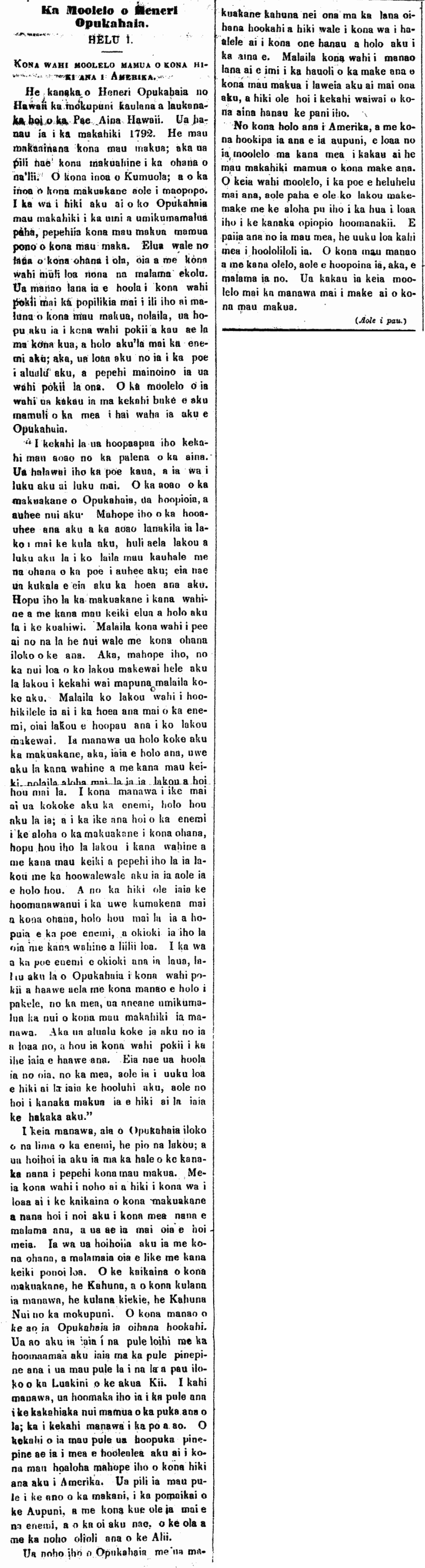
Heneri Opukahaia is from Hawaii, the famous and densely populated island of the Hawaiian Archipelago. He was born in the year 1792. His parents were makaainana, however, his mother was connected to chiefly circles. Her name was Kumuola, and the name of his father is not known. When Opukahaia reached the age of perhaps ten or twelve, his parents were killed before his eyes. There were but two in his family that survived, he and his youngest sibling who was three months old. He hoped to save his young sibling from the tragedy which befell upon his parents, so he grabbed his little sibling and placed it upon his back and ran from the enemy; however, he was found by those chasing after them, and the younger sibling was cruelly killed. That telling of that account is written in another book according to what was told by Opukahaia…

[If you are in or around Hilo this Monday, consider checking out the talk by Deborah Liʻikapeka Lee on Opukahaia at the Lyman Museum. For more information see the Lyman Museum page.]

(Kuokoa, 9/9/1865, p. 2)

Ka Moolelo o Heneri Opukahaia.

Ka Nupepa Kuokoa, Buke IV, Helu 36, Aoao 2. Sepatemaba 9, 1865.

The Progressive News, 1914.

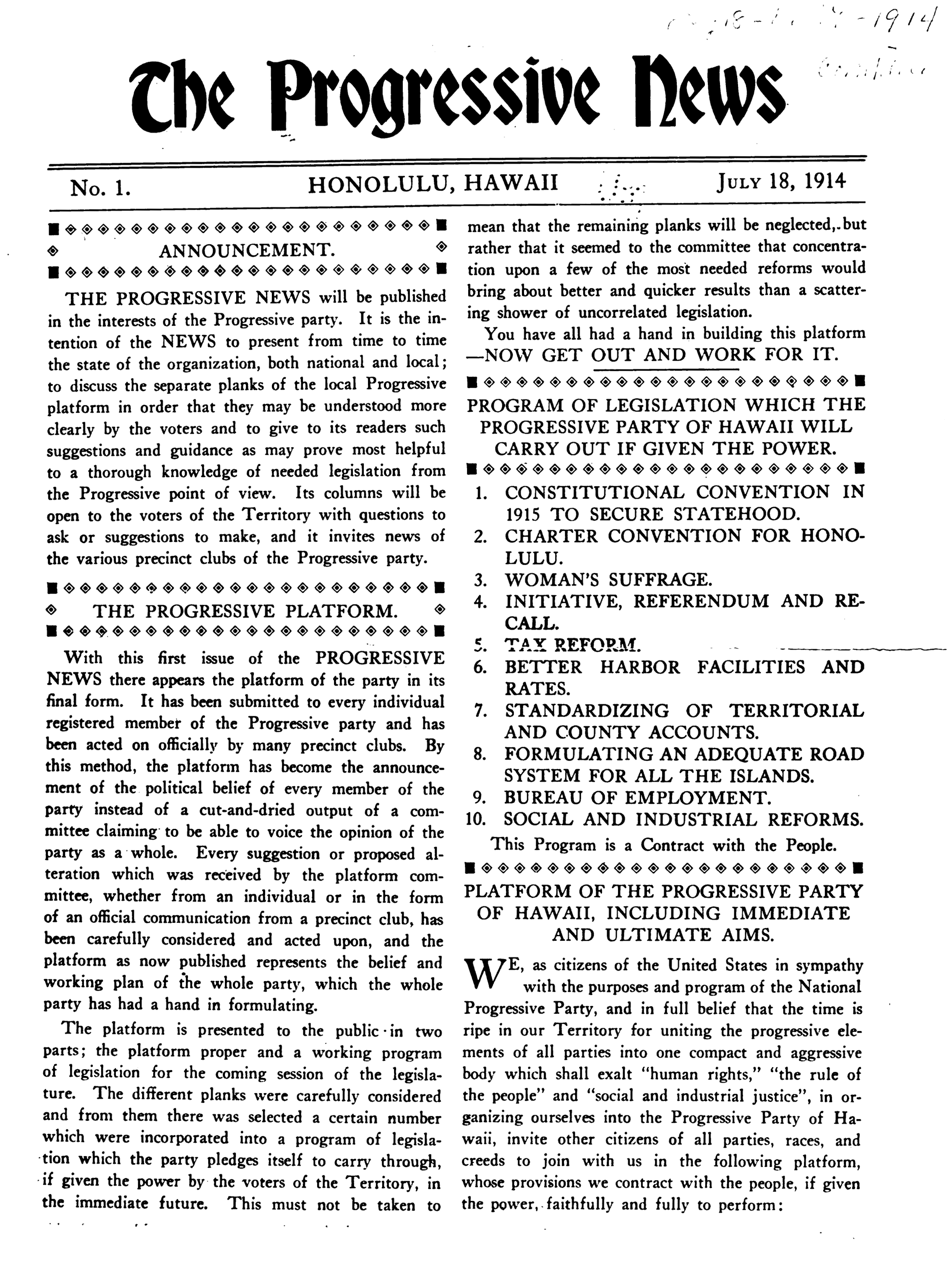
[Other than Chronicling America, you can also find newspapers from Hawaii on Google Books. Here below for instance is an image of the first page of the first issue of “The Progressive News”; Publisher: Howard M. Ballou, Editor: Francis J. Green, and Assistant Editor: John Uilani Joseph.  It is printed partially in English and in Hawaiian.

There is also the Hawaiian-Language Newspaper, “Ka Holomua: The Progressive” printed during the same time period; Owner and Editor: Gulstan K. Poepoe; Owner and Business Manager: John N. Keola; and Owner and Publisher: Samuel Kanio.]

The Progressive News

The Progressive News, Number 1, Page 1. July 18, 1914.

Correspondences between Paulet and the Hawaiian Government. 1843.

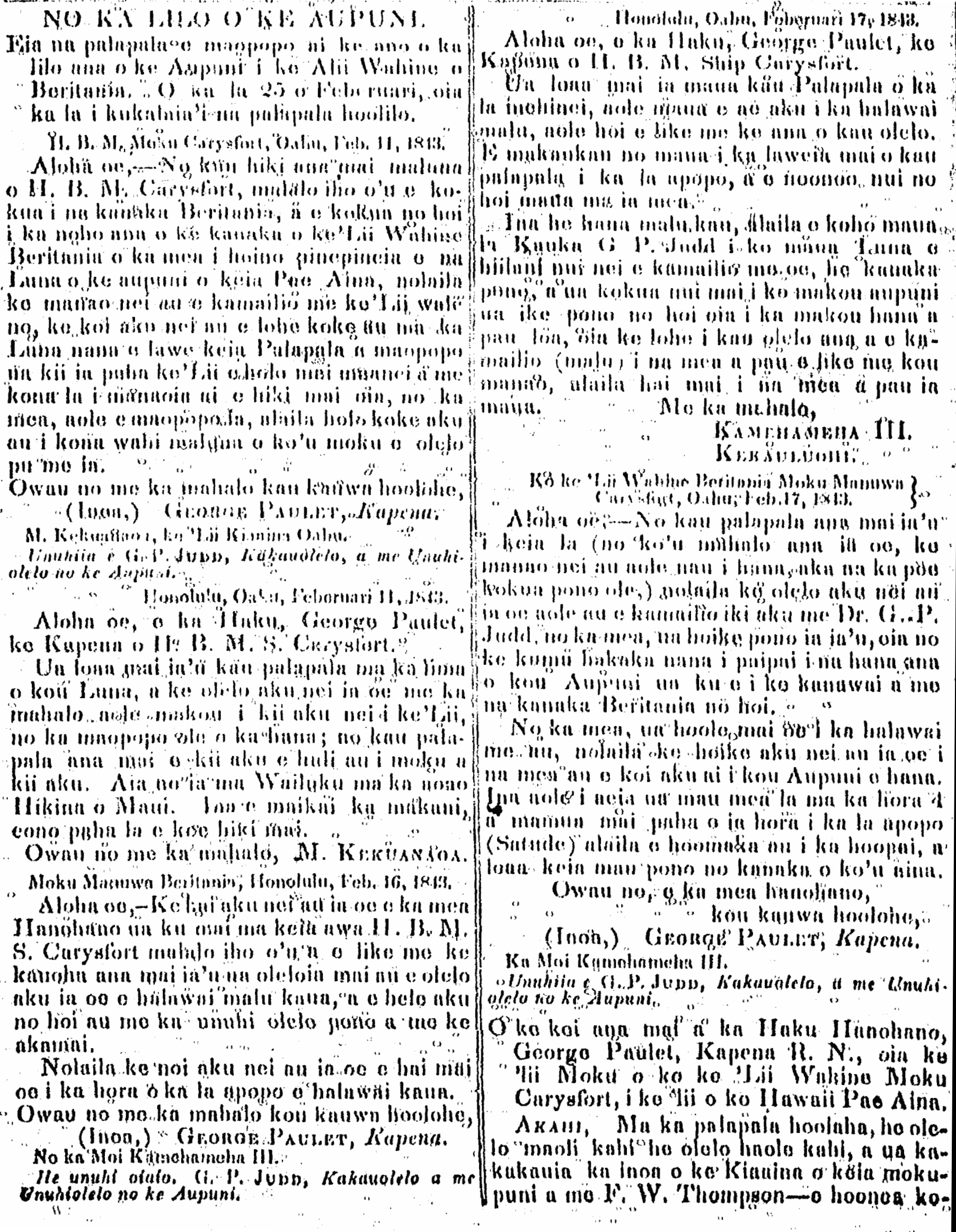
ON THE LOSS OF THE KINGDOM.

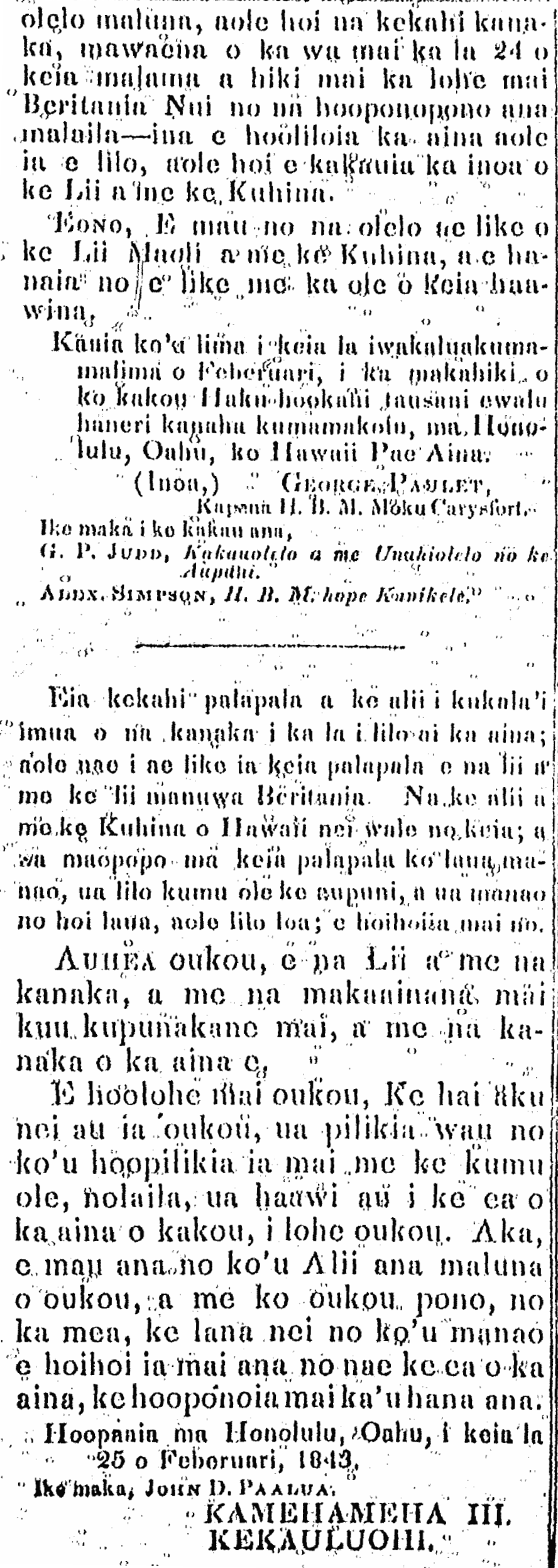
Here are the documents illuminating how the Kingdom was lost to the Queen of Britain. The 25th of February was the day the cession was proclaimed.

[See on Google Books: British and Foreign State Papers, starting on page 1023. These correspondences were translated from English into Hawaiian, and from Hawaiian into English by Gerrit Parmele Judd (Kauka), the Secretary and Translator of the Kingdom.]

(Nonanona, 3/7/1843, pp. 97–100.)

NO KA LILO O KE AUPUNI.

Ka Nonanona, Buke 2, Pepa 20, Aoao 97. Maraki 7, 1843.

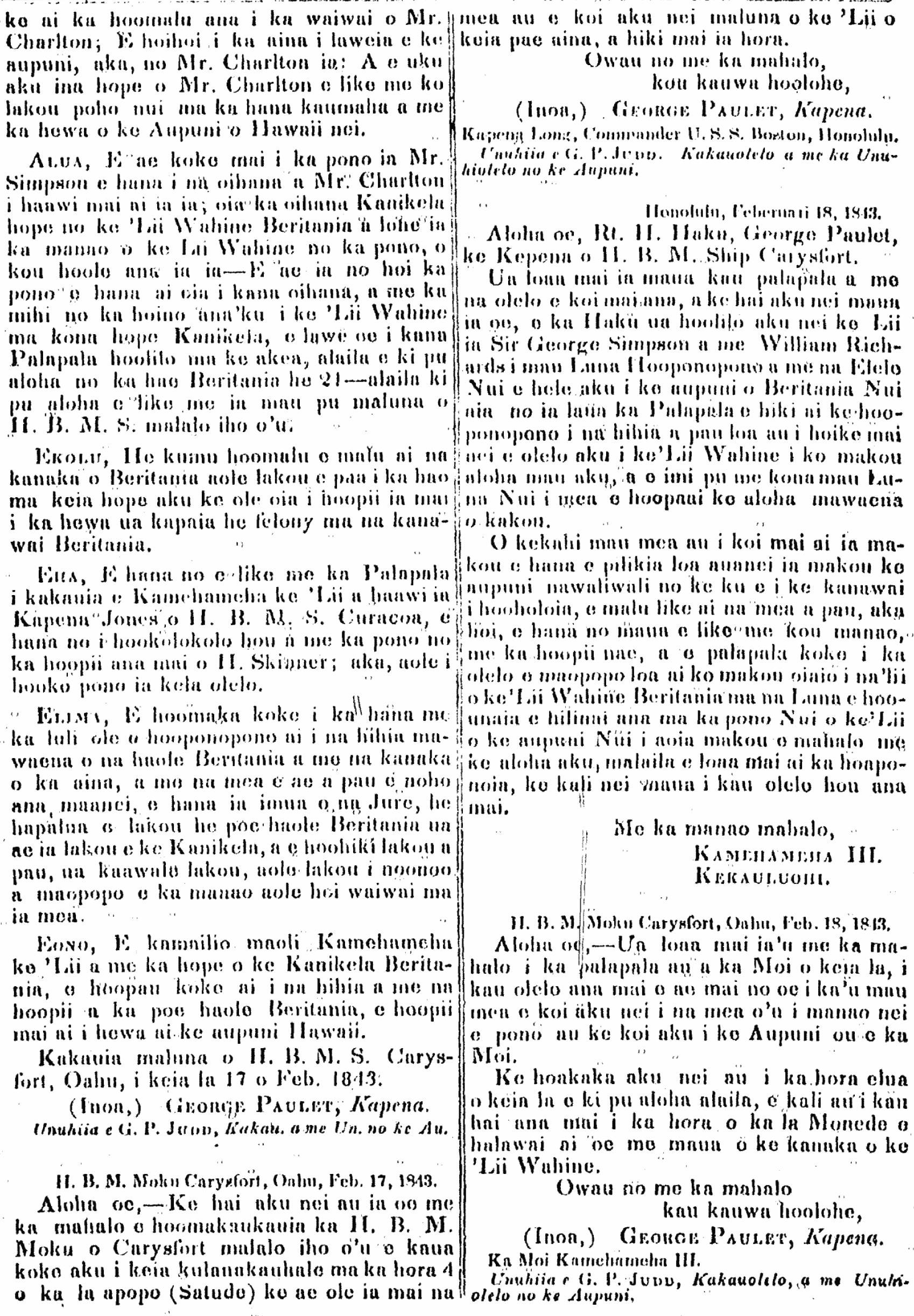
ke ai ka hoomalu ana...

Ka Nonanona, Buke 2, Pepa 20, Aoao 98. Maraki 7, 1843.

Honolulu, Oahu, Feb. 18, 1843.

Ka Nonanona, Buke 2, Pepa 20, Aoao 99. Maraki 7, 1843.

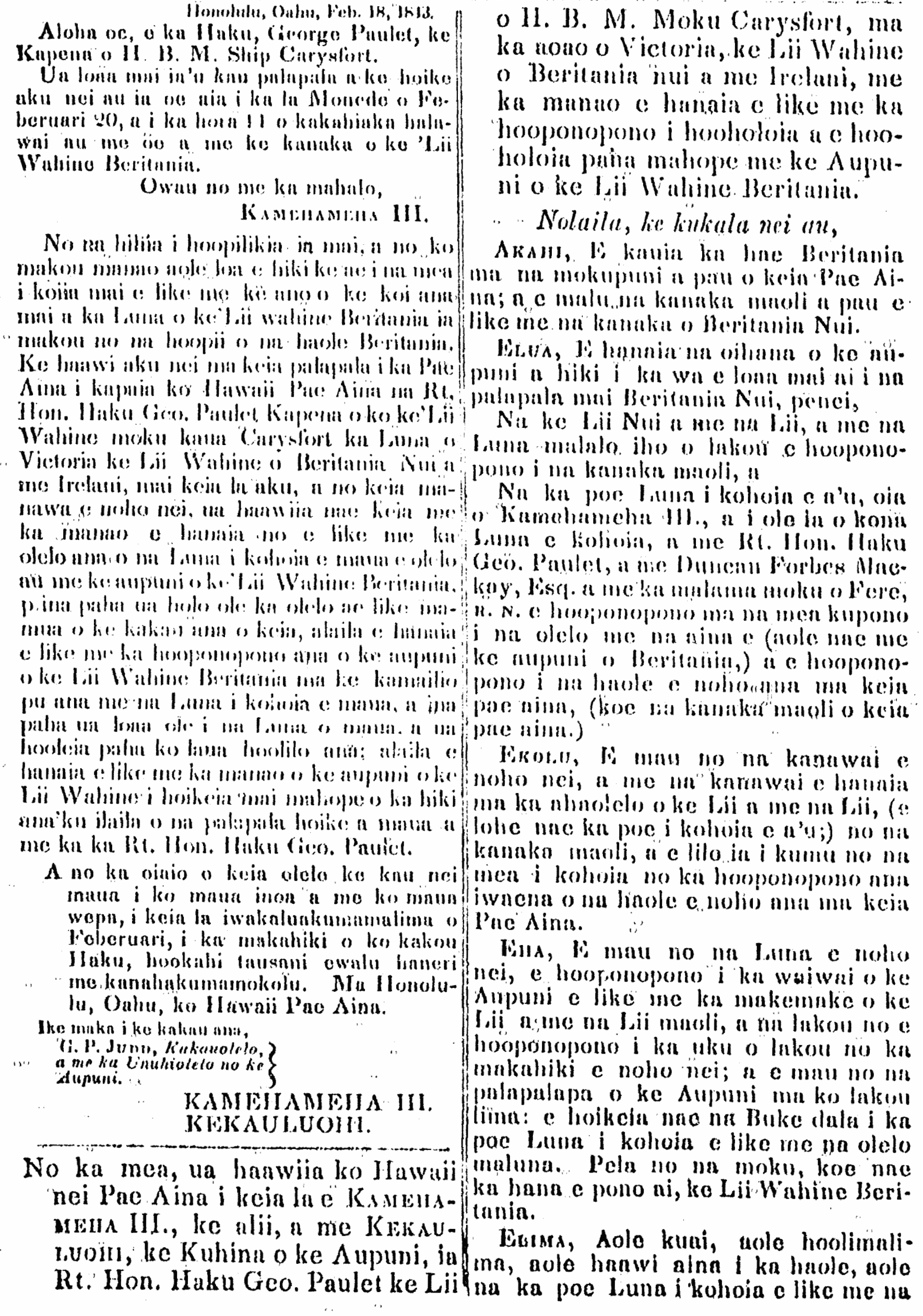
olelo maluna, aole hoi na kekahi kanaka...

Ka Nonanona, Buke 2, Pepa 20, Aoao 100. Maraki 7, 1843.