Timoteo Haalilio, 1845.

SOME THINGS PERTAINING TO HAALILIO.

Koolau, Oahu, was where he was born; his parents were prominent people. His father died when he was a youth, and thereafter his mother (that being Eseka who is still living) became Governor of Molokai. When he was 8 years old, he joined the family of the King, Kamehameha III, and lived with them. They were at Hilo at this time. When he was 13, Haalilio entered the school of Bingham [Binamu] in Honolulu, and he studied English and…

(Elele, 4/25/1845, p. 13)

Elele_4_25_1845_13.png

Ka Elele, Buke I, Pepa 2, Aoao 13, Aperila 25, 1845.

Continue reading

John Smith, flautist for Kamehameha III, and land rights, 1904.

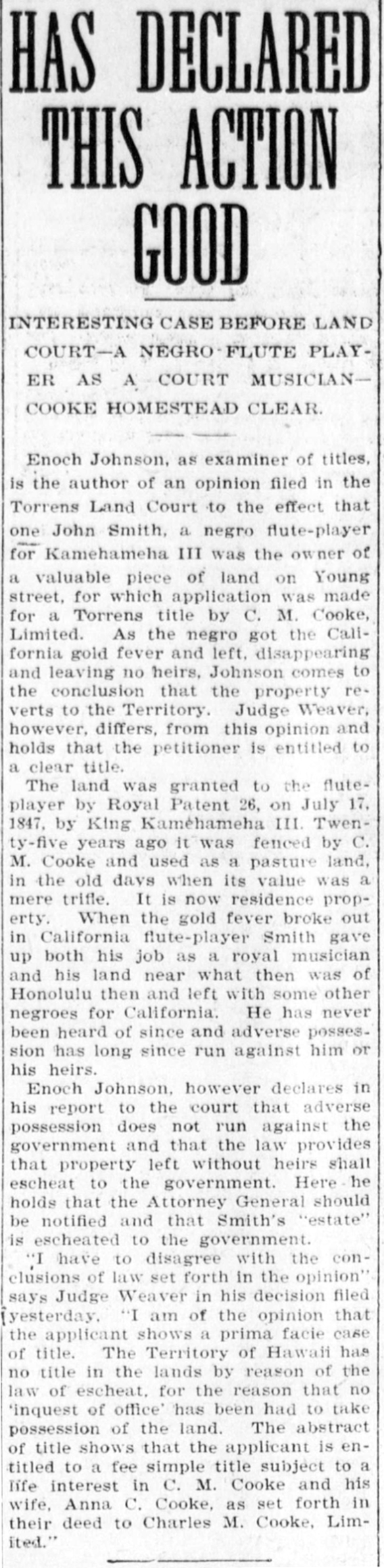
HAS DECLARED THIS ACTION GOOD

INTERESTING CASE BEFORE LAND COURT—A NEGRO FLUTE PLAYER AS A COURT MUSICAN—COOKE HOMESTEAD CLEAR.

Enoch Johnson, as examiner of titles, is the author of an opinion filed in the Torrens Land Court to the effect that one John Smith, a negro flute-player for Kamehameha III was owner of a valuable piece of land on Young street, for which application was made for a Torrens title by C. M. Cooke, Limited. As the negro got the California gold fever and left, disappearing and leaving no heirs, Johnson comes to the conclusion that the property reverts to the Territory. Judge Weaver, however, differs, from this opinion and holds that the petitioner is entitled to a clear title.

The land was granted to the flute-player by Royal Patent 26, on July 17, 1847, by King Kamehameha III. Twenty-five years ago it was used as a pasture land, in the old days when its value was a mere trifle. It is now residence property. When the gold fever broke out in California flute-player Smith gave up both his job as a royal musician and his land near what then was of Honolulu then and left with some other negroes for California. He has never been heard of since and adverse possession has long since run against him or his heirs.

Enoch Johnson, however declares in his report to the court that adverse possession does not run against the government and that the law provides that property left without heirs shall escheat to the government. Here he holds that the Attorney General should be notified and that Smith’s “estate” is escheated to the government.

“I have to disagree with the conclusions of law set forth in the opinion” says Judge Weaver in his decision filed yesterda. “I am of the opinion that the applicant shows a prima facie case of title. The Territory of Hawaii has no title in the lands by reason of the law of escheat, for the reason that no ‘inquest of office’ has been had to take possession of the land. The abstract of title shows that the applicant is entitled to a fee simple title subject to a life interest in C. M. Cooke and his wife, Anna C. Cooke, as set forth in their deed to Charles M. Cooke, Limited.”

(Hawaiian Star, 6/23/1904, p. 8)

HawaiianStar_6_23_1904_8.png

The Hawaiian Star, Volume XII, Number 3824, Page 8. June 23, 1904.

Birthday of King Kamehameha III, 1846.

By the Government.

AGREEMENT BY THE PRIVY COUNCIL.

At the meeting of the Privy Council [Poe Kukakuka Malu], on the 27th of February 1846, this was agreed to.

The birthday of the King will be commemorated on the coming 17th of March; the flag of the land will be flown at all of the forts from the morning until nightfall; and at noon the fort at Honolulu and all the forts in Hawaii nei will fire their guns. The Hawaiian flag will be flown from all of the ships of this Archipelago, and we believe that it will be good for the Governors and others to throw parties as they see fit, but with propriety and honor, loyal to the King of this independent Nation.

(Elele, 3/3/1846, p. 183)

Elele_3_3_1846_183.png

Ka Elele, Buke I, Pepa 24, Aoao 183. Maraki 3, 1846.

American sailors are taught Hawaiian history, 1925.

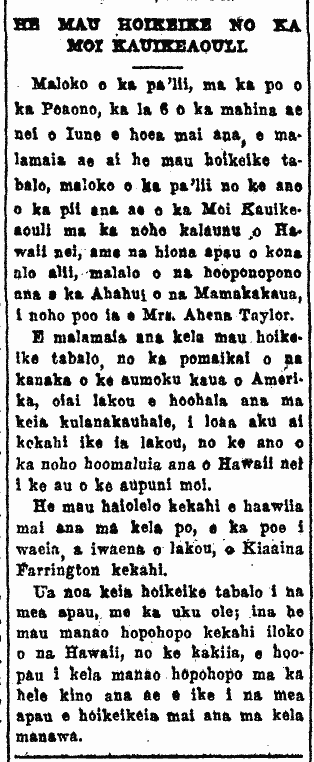
PLAYS ABOUT KING KAUIKEAOULI.

In the grounds of the palace on the night of Saturday, the 6th of this coming June, there will be pageants put on in the palace grounds pertaining to the rise of King Kauikeaouli  to the throne of Hawaii nei along with the appearance of his entire royal court; this will be arranged by the Mamakakaua Society headed by Mrs. Ahuena Taylor.

The pageant will be held for the benefit of the men of the fleet of American warships while they are spending time in this town, so that they obtain some knowledge of the nature of the governing of Hawaii nei i the time of the kingdom.

There will also be speeches presented that night by selected people, and amongst them is Governor Farrington.

This performance will be open to all, without charge; and if there are concerns amongst the Hawaiians that they will be charged, put an end to your worries by going down and witness everything that will be shown at that time.

(Kuokoa, 5/28/1925, p. 2)

Kuokoa_5_28_1925_2

Ka Nupepa Kuokoa, Buke LXIV, Helu 22, Aoao 2. Mei 28, 1925.

Clarification from the Commissioners to Quiet Land Titles, 1846.

TO ALL CLAIMANTS OF LAND IN THE HAWAIIAN ISLANDS.

The undersigned have been appointed by His Majesty the king, a board of commissioners to investigate and confirm or reject all claims to land arising previously to the 10th day of December, 1845. Patents in fee simple [alodio], or leases for terms of years, will be issued to those entitled to the same, upon the report which we are authorized to make, by the testimony to be presented to us.

The board holds it stated meetings weekly at Hale Kauila in Honolulu, to hear the parties or their counsel, in defense of their claims; and is prepared, every day, to receive in writing, the claims and evidences of title which parties may have to offer, at Hale Kauila, in Honolulu, between the hours of nine in the morning and three in the afternoon. Continue reading

Land Commissioners, 1846.

PAY HEED!

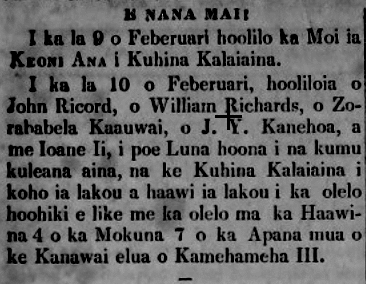
On the 9th of February, the King appointed Keoni Ana as Minister of the Interior [Kuhina Kalaiaina].

On the 10th of February, John Ricord, William Richards, Zorababela Kaauwai, J. Y. Kanehoa, and Ioane Ii were appointed Commissioners to settle land claims [Luna hoona i na kumu kuleana aina]; the Minister of Interior selected them and gave them an oath as per what is prescribed in Article 4 of Chapter 7 of Part One of the Second Act of Kamehameha III.

[O ka hoohiki, oia no:

Ke hoohiki nei kela mea keia mea o makou, e imi pono me ka paewaewa old i na kumu kuleana aina a na kanaka i hoopii mai nei no ke Aupuni o ko Hawaii pae aina, a e hooholo makou i ka olelo pono no ua kuleana la, ke kumu kuleana, ka loihi o ke kuleana, a me ka nui o ka aina, e like hoi me ka olelo iloko o ka Haawina eha o ka Mokuna ehiku o ka Apana m ua o ke Kanawai i kapaia, ‘He Kanawai hoonohonoho i na hana i haawiia i na Kuhina o ko Hawaii Pae Aina,’ i hooholoia ma Honolulu i keia la _____ o _____, 18_____.

Imua o’u _____ _____, ke Kuhina Kalaiaina.

The oath reads:

We and each of us do solemnly swear that we will carefully and impartially investigate all claims to land submitted to us by private parties against the government of the Hawaiian Islands; and that we will equitably adjudge upon the title, tenure, duration and quantity thereof, according to the terms of article fourth of the seventh chapter of the first part of an act entitled “An act to organize the executive departments of the Hawaiian Islands,” passed at Honolulu, _____ day of _____, 18____.

Subscribed and sworn to, this _____ day of _____, 18_____.

Before me, _____ _____,

Minister of the Interior.]

(Elele Hawaii, 3/3/1846, p. 184)

EleleHawaii_3_3_1846_184.png

Ka Elele Hawaii, Buke I, Pepa 24, Aoao 184. Maraki 3, 1846.

Kinau, Kaahumanu II, dies, 1839.

DIED.

KAAHUMANU II.

In Honolulu, on the 4th of April.

She became sick from the 30th of March, early in the morning; it was a paralysis. She was numb in her left hand and leg, and on the 31st, she fell into a sleep: This was a sleep where the paralysis on  her left side subsided, but her slumbering grew, until the 2nd of April when her fellow brethren could not wake her.

On the fourth, Kamehameha III, the King, arrived although he was sick, enduring this for his love for his “mother” [makuahine]. The King landed early in the morning, and at miday, at half past 12, that is when she died, without seeing the King.

Everyone is in mourning, and cry with aloha, because their alii has died, the one that was greatly loved. But on the fifth, the crying was ceased because of the illness of the King; talking loudly is not good.

(Kumu Hawaii, 4/10/1839, p. 92)

MAKE.

Ke Kumu Hawaii, Buke 4, Pepa 23, Aoao 92. Aperila 10, 1839.

20th birthday of Prince Leleiohoku, 1875.

Birthday of the Heir Apparent.

On this coming Sunday, the 10th of January, that is the birthday of Prince W. P. Leleiohoku, and it will be the twentieth year of his life. He was born on the 10th of January, 1855, on the day of the funeral of King Kauikeaouli, and for that reason he was named Kalahoolewa. From what we hear, that day will be celebrated as a holiday [la kulaia]; however, because it falls on the Sabbath, the celebration will be postponed until Monday, that being the 11th of January of this year; and this will be the first time that his birthday will be widely celebrated, as we respectfully give commemoration to the Heir Apparent in place of his Elder Brother Monarch who has left for foreign lands. With feelings of hope, we wish that the holiday will be celebrated all over the nation suitably.

(Lahui Hawaii, 1/1/1875, p. 2)

La Hanau o ka Hooilina Moi.

Ka Lahui Hawaii, Buke I, Helu 1, Aoao 2. Ianuari 1, 1875.

O ko’u aupuni, he aupuni palapala ko’u, 1837.

From the Salem Gazette.

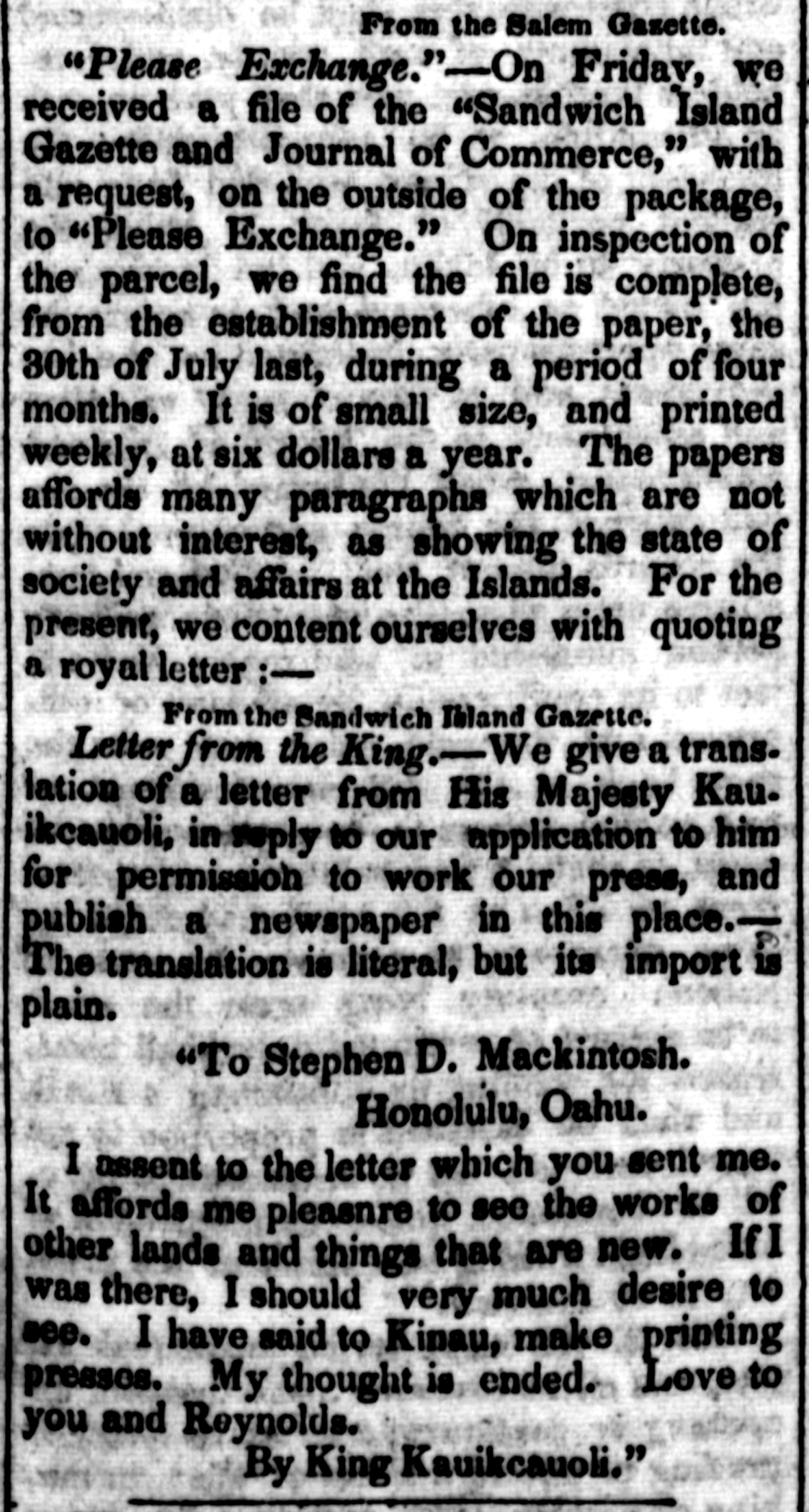
Please Exchange.”—On Friday, we received a file of the “Sandwich Island Gazette and Journal of Commerce,” with a request, on the outside of the package, to “Please Exchange.” On inspection of the parcel, we find the file is complete, from the establishment of the paper, the 30th of July last, during a period of four months. It is of small size, and printed weekly, at six dollars a year. The papers affords many paragraphs which are not without interest, as showing the state of society and affairs at the Islands. For the present, we content ourselves with quoting a royal letter:—

From the Sandwich Island Gazette.

Letter from the King.—We give a translation of a letter from His Majesty Kauikeauoli [Kauikeaouli], in reply to our application to him for permission to work our press, and publish a newspaper in this place.—The translation is literal, but its import is plain.

“To Stephen D. Mackintosh.

Honolulu, Oahu.

I assent to the letter which you sent me. It affords me pleasure to see the works of other lands and things that are new. If I was there, I should very much desire to see. I have said to Kinau, make printing presses. My thought is ended. Love to you and Reynolds.

By King Kauikeauoli.”

[This was a pretty exciting find. Kamehameha III proclaimed that his kingdom would be a kingdom of reading and writing. And indeed it was. Kamehameha III encourages the printing of newspapers, and here he writes, “If I was there…” because it seems he was in Kailua, Hawaii at the time, while the newspaper was to be printed in Honolulu. Unfortunately, The Sandwich Island Gazette and Journal of Commerce which ran from 7/30/1836 to 7/27/1839 is not available online at Chronicling America as of yet.

For more on this first English newspaper in Hawaii nei, see “Hawaii’s first English Newspaper and Its Editor,” by Helen P. Hoyt, appearing in the Annual Report of the Hawaiian Historical Society in 1954.]

(Constantine Republican, 5/31/1837, p. 2)
From the Salem Gazette.

Constantine Republican, Volume I, Number 48, page 2. May 31, 1837.