Tarzan ad, 1919.

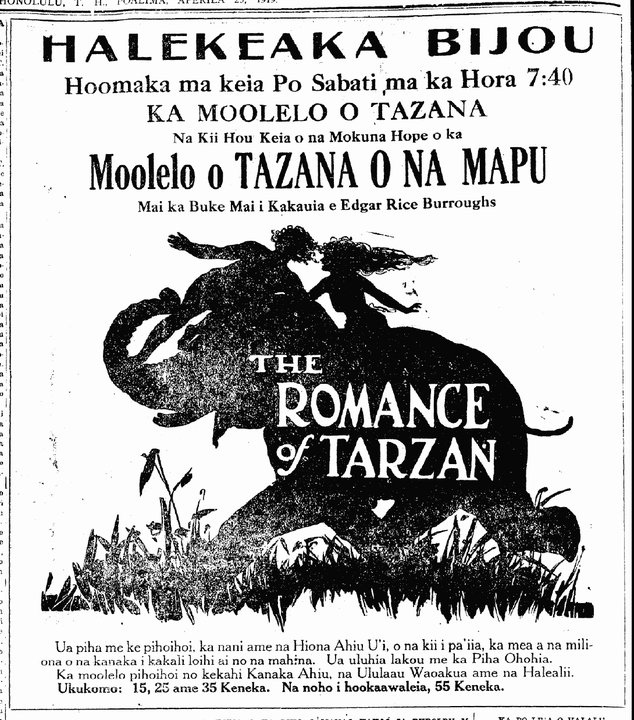
BIJOU THEATRE

Starting this Sunday Night at 7:40

THE STORY OF TARZAN

These are Pictures From the Last Chapters of the

Story of TARZAN OF THE APES

From the Book by Edgar Rice Burroughs

THE ROMANCE OF TARZAN

Filled with excitement, magnificence, and Wild Beauty; the images taken are what millions of people have been awaiting for months. They are overcome with total fascination.

The thrilling story of a Primitive Man, Jungle Wilds, and Palaces.

Entrance fee: 15, 25, and 35 Cents. Reserved seating: 55 Cents.

[Chronicling America does not have any Honolulu papers up yet for this year, so here is a similar ad printed in The Garden Island, 5/27/1919, p. 3.]

(Kuokoa 4/25/1919, p. 2)

HALEKEAKA BIJOU

Ka Nupepa Kuokoa, Buke LVII, Helu 17, Aoao 2. Aperila 25, 1919.

Tarzan in the Hawaiian-Language Newspapers, 1917–1931.

Just as the previous “Tarzan of the Apes” advertisement said, Kuokoa was running a Tarzan story while the movie was playing! Tarzan stories were apparently very popular as they were translated in the papers for many, many years.

Kuokoa

“He Moolelo no Tazana, a i ole, Ka Hiena o na Ululaau Anoano o na Kapakai o Aferika” 11/30/1917–5/10/1918 (Tarzan of the Apes),

5/10/1918–11/8/1918 (Return of Tarzan)

11/8/1918–3/7/1919 (The Beasts of Tarzan)

“He Moolelo no Keaka Tazana: Ka Weli o na Ululaau Mehameha o Aferika a o ka Hoaloha o na Holoholona Ahiu” 11/7/1919–5/21/1920 (The Son of Tarzan)

“He Moolelo no Tazana a i ole, Ka Hiena o na Ululaau Anoano o na Kapakai o Aferika. Mahele II” 5/21/1920–10/8/1920 (Tarzan and the Jewels of Opar)

Hoku o Hawaii

“He Moolelo no Tarzan me ka Liona Gula” 3/22/1923–9/11/1924 (Tarzan and the Golden Lion)

“He Moolelo no Tarzan: Ke Alii o na Mabu ao ka Mea Laka Ole” 9/18/1924–3/1/1927 (Tarzan the Untamed)

3/8/1927–6/18/1929 (Tarzan the Terrible)

6/25/1929–12/22/1931 (Return of Tarzan) [Retranslated]

Ola o Hawaii

[Unfortunately, this publication is not online. I need to check for dates and title.]

Tarzan and Chaplin! 1919.

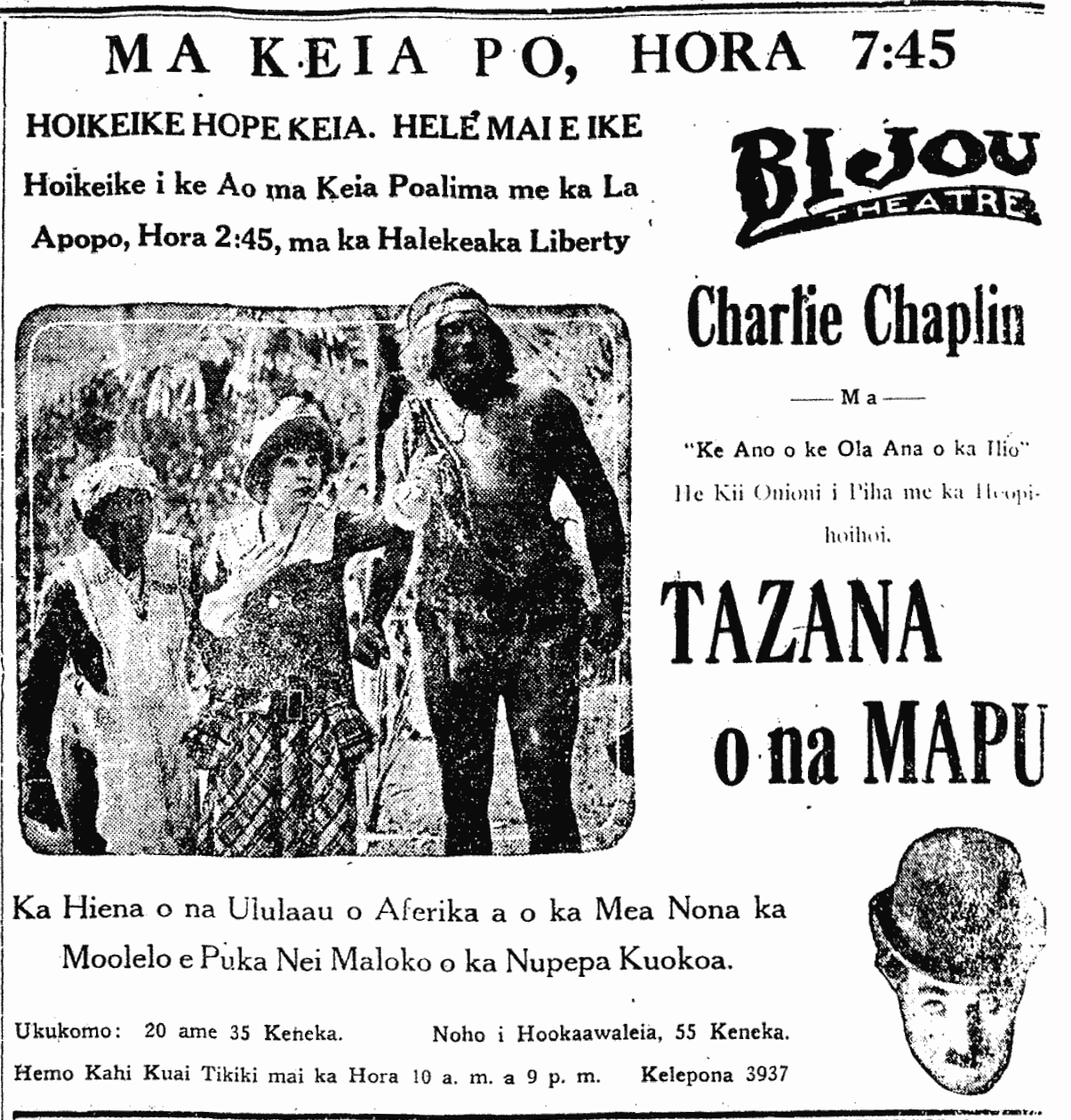
TONIGHT, 7:45

THIS IS THE LAST SHOW, COME WATCH

Shown at Day on This Friday and Tomorrow,

2:45, at Liberty Theater

BIJOU THEATRE

Charlie Chaplin

—In—

“A Dog’s Life” [“Ke Ano o ke Ola Ana o ka Ilio”]

A Movie Full of Excitement.

TARZAN of the APES [TAZANA o na MAPU]

The Hyena of the Jungle of Africa and the One Whose Story is Being Run in the Kuokoa Newspaper.

Entrance: 20 and 35 Cents. Reserved Seats [Noho i Hookaawaleia], 55 Cents.

Ticket Box Open from the Hours of 10 a. m. to 9 p. m. Telephone 3937

[It is interesting to see that this ad is in Hawaiian, when the movies themselves were in English.]

(Kuokoa, 1/17/1919, p. 2)

MA KEIA PO, HORA 7:45

Ka Nupepa Kuokoa, Buke LVII, Helu 3, Aoao 2. Ianuari 17, 1919.

Letter in a bottle, 1906.

A BOTTLE WAS FOUND WITH A LETTER.

Jose A. de Sa wrote a letter to Governor Carter from Lihue, Kauai, telling that he found a bottle with a paper of the United States hydrographics office [oihana kahakii]. He found the bottle and its contents at the landing of Hanamaulu.

The letter stated that this bottle was let out by N. P. Parker, the captain of the clipper Lahaina, on the 6th of June, 1906, at the latitude 13 deg. 20 min. North and longitude 147.08 West, after 143 days since the ship Lahaina left Iqueque [Ikuekue], Peru, and heading for Honolulu.

“We have a good wind, and everything is fine,” with which the Captain ended his message.

(Kuokoa, 10/26/1906, p. 1)

LOAA HE OMOLE ME KA LETA.

Ka Nupepa Kuokoa, Buke XLV, Helu 43, Aoao 1. Okatoba 26, 1906.

Hawaiians at the Alaska-Yukon-Pacific Exposition, 1909.

Check out this picture and more from the Hawaii delegation at the 1909 Alaska-Yukon-Pacific Exposition, online at the University of Washington Digital Collections site!

http://content.lib.washington.edu/cdm4/item_viewer.php?CISOROOT=%2Fayp&CISOPTR=538&DMSCALE=100&DMWIDTH=802&DMHEIGHT=623.4296875&DMMODE=viewer&DMFULL=1&DMX=0&DMY=0&DMTEXT=%2520hawaii&DMTHUMB=0&REC=12&DMROTATE=0&x=801&y=314

Hawaiian officials, hostesses, and musicians in front of the Hawaii Building, Alaska Yukon Pacific Exposition, Seattle, August 5, 1909.

How much do we know about how it was back then… 1909.

THE WORLD IS STILL IN THE DARK ABOUT HAWAII.

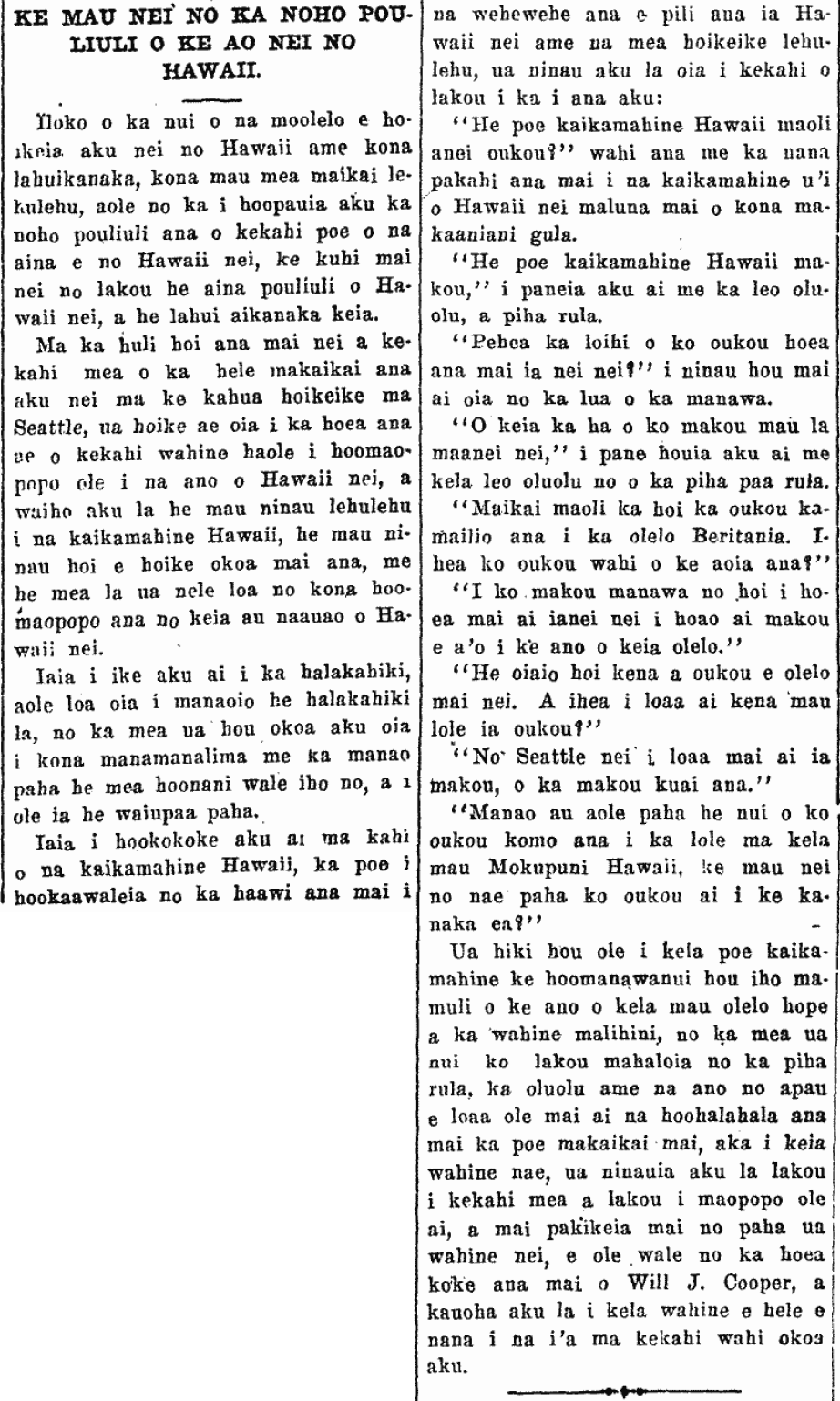
Although there has been so many stories heard talking about Hawaii and its people and its many wonderful things, in no way has the ignorance of some people in foreign lands about Hawaii been cleared; they assume Hawaii is an uneducated land and that we are cannibals.

On the return of someone who went to visit the fair in Seattle [Alaska-Yukon-Pacific Exposition], he spoke about the arrival of a haole woman who didn’t know about the conditions of Hawaii; and she put before the Hawaiian girls a great number of questions—questions which made it plain that she had no clue about this era of education here in Hawaii.

When she saw a pineapple, she didn’t believe that it was real, because she poked at it with her finger, perhaps thinking that it was just some decoration, or perhaps butter [butter sculpture seems to have been popular at the time].

When she approached the area where the Hawaiian girls were stationed to talk about Hawaii nei as well as to give various performances, she asked one of them:

“Are you all real Hawaiian girls?” she asked while peering at each one of the beautiful Hawaiian girls over her gold-rimmed glasses.

“We are all Hawaiian girls,” she was answered kindly and very politely.

“How long has it been since your arrival here?” She asked next.

“This is our fourth day here,” she was answered again, with a pleasant voice and decorum.

“Your English is quite good. Where did you all learn it?”

“Upon our arrival here, we tried learning this language.”

“Is that so. And where did you all get your clothes?”

“We got it here in Seattle; we purchased it.”

“I thought that maybe you all don’t much wear clothes in the Hawaiian Islands; but you all still are cannibals, right?”

These girls could not endure this any longer after those last words of that malihini woman; they were very well appreciated for their etiquette, pleasantness, and their entire conduct which would receive no criticism from the visitors; however, with this woman, they were asked questions that they could not fathom, and that woman perhaps was close to being railed at were it not for the arrival of Will J. Cooper who advised the woman to go and look at the fish located in a different area.

(Kuokoa, 8/27/1909, p. 6)
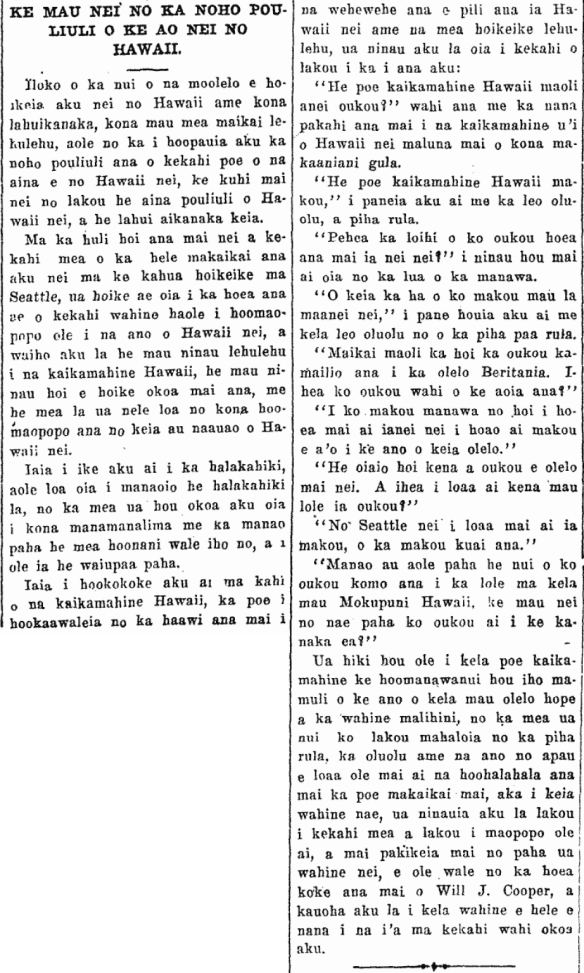
KE MAU NEI NO KA NOHO POULIULI O KE AO NO HAWAII.

Ka Nupepa Kuokoa, Buke XLVI, Helu 35, AoAo 6. Augate 27, 1909.

Vital Statistics, 1910.

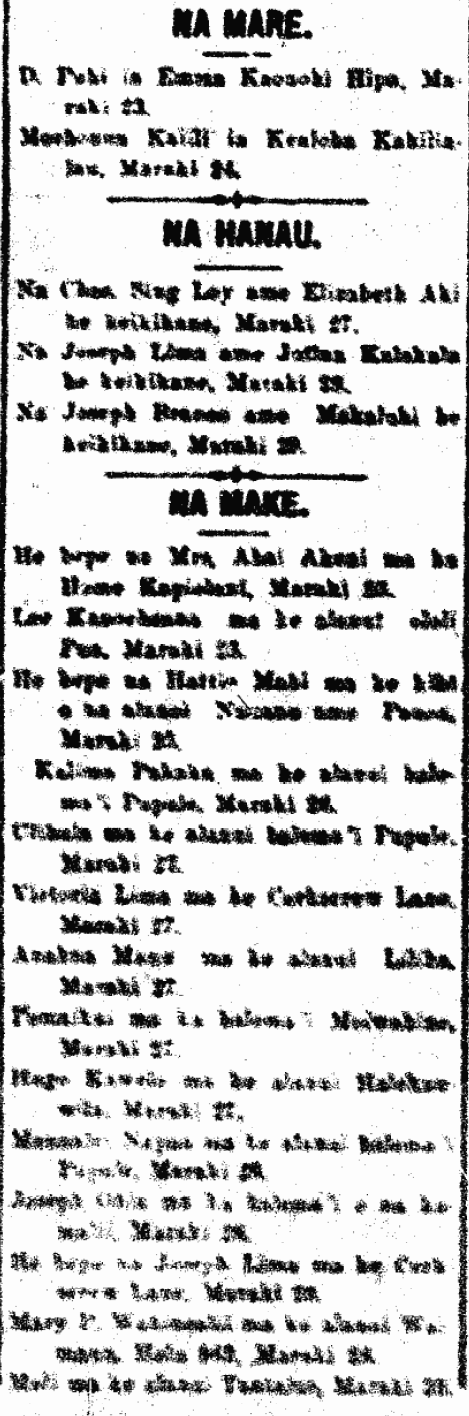
MARRIAGES.

D. Puhi to Emma Kaonohi Hipa, March 23.
Moehonua Kalili to Kealoha Kahilialau, March 24.

BIRTHS.

To Charles Sing Loy and Elizabeth Aki, a son, March 27.
To Joseph Lima and Julian Kalakala, a son, March 28.
To Joseph Branco and Makaluhi, a son, March 29.

DEATHS.

A baby of Mrs. Ahai Akoni, at Kapiolani Home, March 25.
Loe Kanoeheana on Pua Lane, March 25.
A baby of Hattie Mahi on the corner of Nuuanu and Pauoa Streets, March 25.
Kalima Pakaka on the street of the Insane Asylum, March 26.
Ulihala on the street of the Insane Asylum, March 27.
Victoria Lima on Corkscrew Lane, March 27.
Anahua Manu on Liliha Street, March 27.
Pomaikai at Queen’s Hospital, March 27.
Hugo Kawelo on Halekauwila Street, March 27.
Maunalei Napua on the street of the Insane Asylum, March 28.
Joseph Ohia at the children’s hospital, March 28.
A baby of Joseph Lima on Corkscrew Lane, March 28.
Mary P. Wahinealii on Waimanu Street, Number 983, March 28.
Moli on Tantalus Street, March 30.

[Here is another column from a page that is illegible online and on microfilm.]

(Kuokoa, 4/1/1910, p. 8)

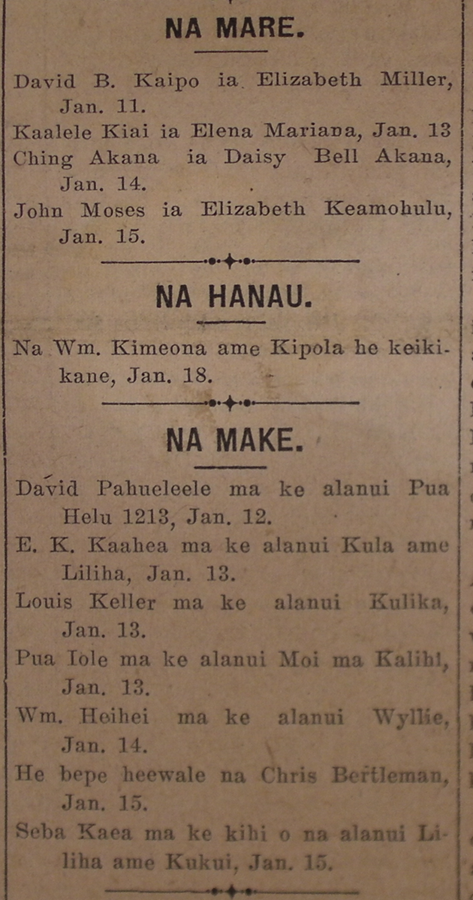
NA MARE. / NA HANAU. / NA MAKE.

Ka Nupepa Kuokoa, Buke XLVII, Helu 13, Aoao 8. Aperila 1, 1910.

For comparison, here is what the online image looks like (and the microfilm is not much better):

MARE. / HANAU. / MAKE.

Ka Nupepa Kuokoa, Buke XLVII, Helu 13, Aoao 8. Aperila 1, 1910.

Vital Statistics, 1910.

MARRIAGES.

David B. Kaipo to Elizabeth Miller, Jan. 11.
Kaalele Kiai to Elena Mariana, Jan. 13.
Ching Akana to Daisy Bell Akana, Jan. 14.
John Moses to Elizabeth Keamohulu, Jan. 15.

BIRTHS.

To William Kimeona and Kipola, a son, Jan. 18.

DEATHS.

David Pahueleele on Pua Street, Number 1213, jan. 12.
E. K. Kaahea on School Street and Liliha, Jan. 13.
Louis Keller on Gulick Street, Jan. 13.
Pua Iole on King Street in Kalihi, Jan. 13.
William Heihei on Wyllie Street, Jan. 14.
A miscarriage of Chris Bertleman [Bertlemann ?], Jan. 15.
Seba Kaea at the corner of Liliha and Kukui Streets, Jan. 15.

[There are no images online for Kuokoa 1/21/1919, pp. 5–8. This is probably because the images on the microfilm itself are blurry. I needed to open this issue from the original anyway for something else, so while i was there i figured it would be worthwhile to put take an image of this as well.

What a great thing if one day soon all of the newspapers were reshot this clearly!]

(Kuokoa, 1/21/1910, p. 5)

MARE. / HANAU. / MAKE.

Ka Nupepa Kuokoa, Buke XLVII, Helu 3, Aoao 5. Ianuari 21, 1910.

Be good to your parents while you can! 1911.

DESPERATELY WANTING TO HEAR FROM HIS BIRTH MOTHER

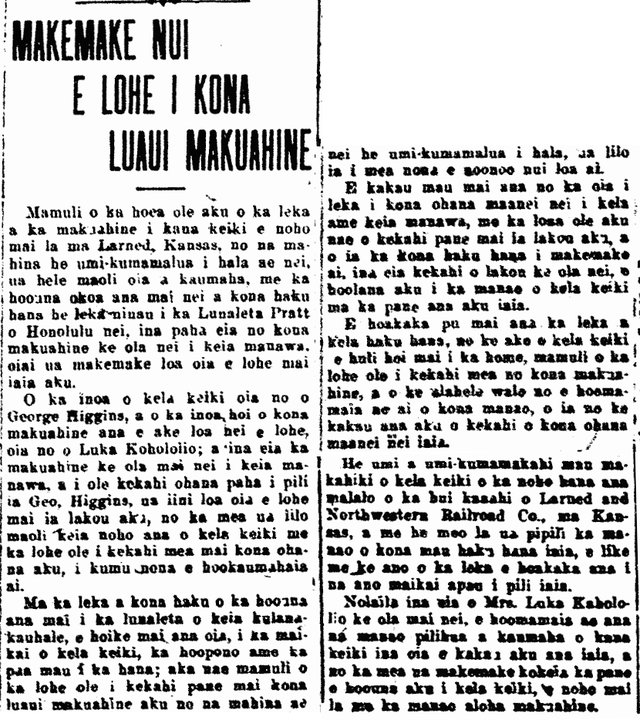
Because there arrived no letter from a mother to her child living in Larned, Kansas, over the past 12 months, this man has become very dejected. And his boss personally just sent a letter to Post Master Pratt of Honolulu nei, asking if perhaps his mother is living, because the man really wants to hear from her.

The name of this youth is George Higgins, and the name of his mother, from whom he desperately wants to hear from is Luka Kohololio [Kahololio]; and if the mother is still living, or any other relatives of Geo. Higgins, he would like terribly to hear from them, for living without word from his family has put him in depression.

In the letter sent by his boss to the the post master of this town, he speaks of the upright nature of the youth, and his good work ethic; however, because he has heard nothing from his birth mother for the past 12 months, it is something that he is constantly concerned about.

He keeps writing letter to his family here, without any response; therefore, his boss hopes that if there is any of them here still living, that they would brighten his disposition by responding.

The letter by his boss goes on to describe that the boy wants to go back home because of the lack of news from his mother. And the only means to take this load off of him is for one of his family here to write.

This boy was working for the Larned and Northwestern Railroad Co. in Kansas for some 10 or 11 years. And it seems that his boss is quite taken with him, as was shown in the letter expounding on all of his good traits.

Therefore, should Mrs. Luka Kahololio be alive, it would lessen the grief and sadness of her child should she write to him, and it is hoped that a speedy reply be sent to this boy living with thoughts of aloha for his mother.

(Kuokoa, 6/30/1911, pp. 1 & 4)

MAKEMAKE NUI E LOHE I KONA LUAUI MAKUAHINE

Ka Nupepa Kuokoa, Buke XLVII, Helu 26, Aoao 1 & 4. Iune 30, 1911.

Pond atop Punchbowl? 1902.

Mysterious Pond.

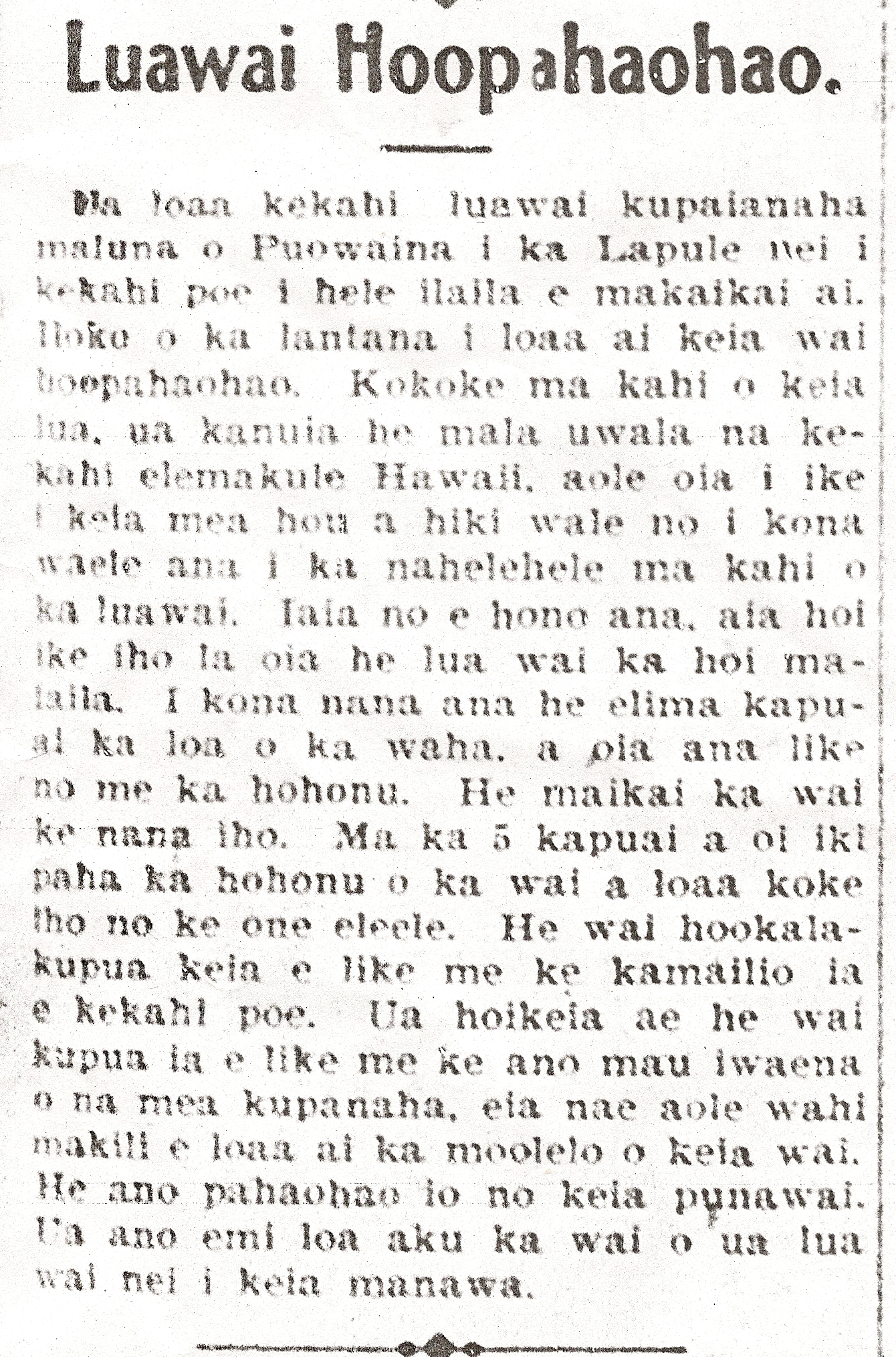
An amazing pond was found atop Puowaina by  some people who visited there; they found this amazing waters among lantana plants. Close to this pond was planted a patch of sweet potatoes by an old Hawaiian man; he did not know of this new thing until he was weeding near the pond. While he was working [hono ana ?], to his surprise, he saw this pond their. When he looked at it, its mouth was five feet long, and so too of the depth. The water is five feet or more then you reach black sand. According to what some people say, this is magical waters. It is said to be kupua water, like what is common among amazing things, but there is no trace of the story of this water. It is truly a mysterious spring. The water in the pond these days has somewhat receded.

(Kuokoa, 6/27/1902, p. 5)

Luawai Hoopahaohao.

Ka Nupepa Kuokoa, Buke XL, Helu 26, Aoao 5, Iune 27, 1902.

The above image was taken directly from the microfilm. Here for comparison is the same article as it appears online:

Luawai Hoopahaohao.

Ka Nupepa Kuokoa, Buke XL, Helu 26, Aoao 5. Iune 27, 1902.