Thomas McCants Stewart passes on, 1923.

The black Lawyer, McCant Stewart has passed on

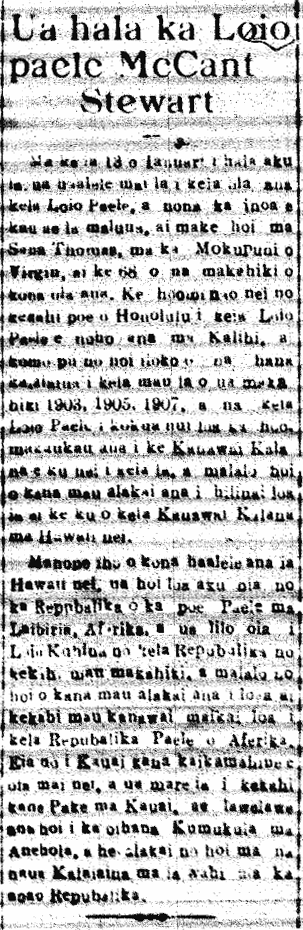
On the 13th of January, the Black Lawyer left behind this life, the one whose name is placed above; and he died at Saint Thomas, in the Virgin Islands, at 68 years of age. Some people of Honolulu are remembering him, this Black Lawyer who resided in Kalihi, and participated in politics in those days of they years of 1903, 1905, 1907, and it was this Black Lawyer who contributed greatly to the County Law as it now stands today, and it was due to his greatly trusted guidance that the County Law stands here in Hawaii.

After he left Hawaii nei, he went to the Republic of the Blacks in Liberia, Africa, and he became the Attorney-General for that Republic for a number of years, and under his leadership, that Black Republic of Africa gained some very fine laws. His daughter is currently living on Kauai, and she has married a Chinese man on Kauai, and she is employed as a School teacher at Anehola, and is a leader in politics in that area of the Republican party.

[If you want know more about this fascinating man, drop your plans for Friday night, February 5, 2016. There will be a presentation done by Dr. Albert Broussard, professor in the Department of History at Texas A&M University. It will be from 5:30 to 7:00 p. m. at Aliiolani Hale. Click here for more!]

(Hoku o Hawaii, 2/22/1923, p. 2)
HokuoHawaii_2_22_1923_2

Ka Hoku o Hawaii, Buke XVI, Helu 39, Aoao 2. Feberuari 22, 1923.
Hypocrites? 1893.

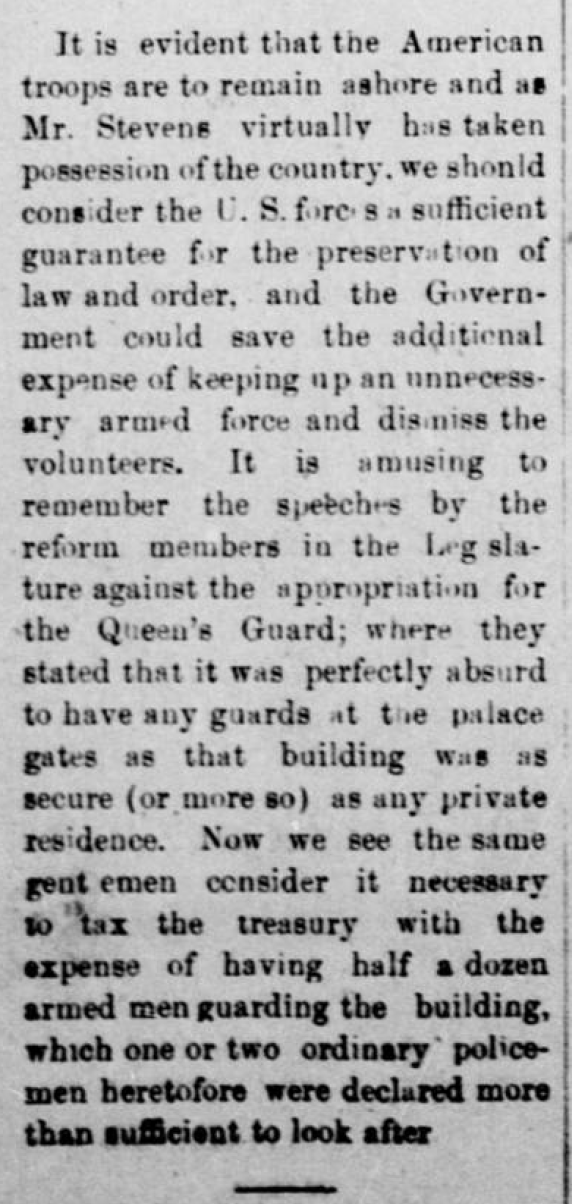
It is evident that the American troops are to remain ashore and as Mr. Stevens virtually has taken possession of the country, we should consider the U. S. forces a sufficient guarantee for the preservation of law and order, and the Government could save the additional expense of keeping up an unnecessary armed force and dismiss the volunteers. It is amusing to remember the speeches by the reform members in the Legislature against the appropriation for the Queen’s Guard; where they stated that it was perfectly absurd to have any guards at the palace gates as that building was as secure (or more so) as any private residence. Now we see the same gentlemen consider it necessary to tax the treasury with the expense of having half a dozen armed men guarding the building, which one or two ordinary policemen heretofore were declared more than sufficient to look after.

(Hawaii Holomua, 1/20/1893, p. 4)

HawaiiHolomua_1_20_1893_4

Hawaii Holomua, Buke III, Helu 143, Aoao 4. Ianuari 20, 1893.

The Prayer of the Lahui, 1893.

KA PULE A KA LAHUI HAWAII.

E—Iehova Sabaota
O—na kaua,—ke Kahikolu
L—aahia Hemolele,
A—lana ia no ko ke ao nei.
O—ka makou pule e maliu mai—
K—a puuhonua o makou nei,
A—lakai, hoopakele, nana mai,
L—awe aku i na popilikia
A—hoolilo i mea ole.
N—inini mai i Kou Hemolele,
I—ola ai makou ma Ou ‘la.
L—alau mai Kou aloha
I—hilinai manawalea,
L—aahia makamae
I—ko makou Lei Ali’aimoku.
U—hi Iaia me Kou mana,
O—ka palekana a lanakila;
N—a Kou nani e hoomohala,
A—mao ae na pilihua.
M—a Ou la—e ka Haku,
O—ko ke ao nei a pau,
K—a makou e pule nei,
U—hane Hemolele Kahikolu.

[E Ola o Kalani Liliuonamoku]

—–

E—Iehova Sabaota, Continue reading

Ship passenger list, 1893.

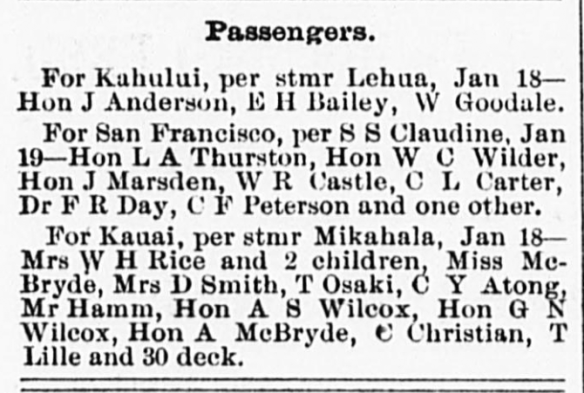
Passengers.

For Kahului, per stmr Lehua, Jan 18—Hon J Anderson, E H Bailey,W Goodale.

For San Francisco, per S S Claudine, Jan 19—Hon L A Thurston, Hon W C Wilder, Hon J Marsden, W R Castle, C L Carter, Dr F R Day, C F Peterson and one other.

For Kauai, per stmr Mikahala, Jan 18—Mrs W H Rice and 2 children, Miss McBryde, Mrs D Smith, T Osaki, C Y Atong, Mr Hamm, Hon A S Wilcox, Hon G N Wilcox, Hon A McBryde, C Christian, T Lille and 30 deck.

(Daily Bulletin, 1/19/1893, p. 3)

DailyBulletin_1_19_1893_3

The Daily Bulletin, Volume  V, Number 628, Page 3. January 19, 1893.

The Claudine leaves for San Francisco, 1893.

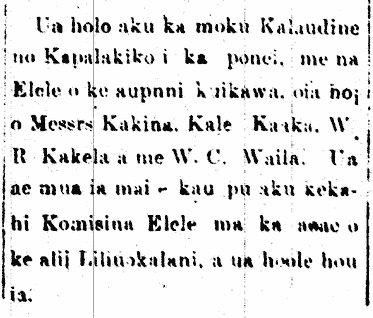
The ship Claudine [Kalaudine] left for San Francisco last night, with the Representatives of the provisional government, they being Messrs Thurston [Kakina], Charles Clark [Kale Kaaka], W. R. Castle [W. R. Kakela], and W. C. Wilder [W. C. Waila]. The Representing Commissioner for the side of the alii Liliuokalani was previously given permission to go along, but  he was denied once again.

(Leo o ka Lahui, 1/19/1893, p. 2)

LOKL_1_19_1893_2

Ka Leo o ka Lahui, Buke II, Helu 625, Aoao 2. Ianuari 19, 1893.

Hawaii Holomua, January 18, 1893.

ALOHA

Liliuokalanionamoku.

THE POWER OF THE GOVERNMENT HAS BEEN USURPED!

The Protest Proclamation of the Queen!

“My dear homeland,
It is for thee that I sing.”¹

This past Tuesday, the 17th of January, 1893, will seemingly be notorious forever in our land of birth, for it is the day that a new Nation in the form of a provisional government under thirteen haole was proclaimed.

GUARDS POSTED.

On Monday night, was when many places in town were put under the watch of armed soldiers from the American warship Boston, and on the following Tuesday morning, they were seen going around, and the members of the Honolulu Rifles began to join in and surrounded several places with their weapons, and the appearance of town was terrifying.

NEWS OF THE OVERTHROW.

In the early morning, the rumor was spread on the sides of the streets of town, saying that there is craving to overthrow the kingdom and to make a new government. This news flew on the tips of the winds and reached the countryside, and because of that, the citizens of the Queen gathered in great numbers in the streets, and the greatest number was in the groups in and outside of the Palace Grounds; and right outside Kalakaua Hale there were thousands of people standing and waiting, prepared for orders, should there be orders.

DISCUSSION

At this time, the people were in a state of astonishment, going around the sides of the streets and standing here and there in crowds, discussing and responding. This conditions continue while the peaceful state is preserved, except for the seeing of the soldiers with their guns.

GUN FIRE.

But between the hours of 2 and 3 in the afternoon, the people were shocked at the news spread that Leialoha, an government police officer, was shot and and hit by a haole, while he was carrying out his duties under the power of the law of the land. A disturbance soon started, and it was feared that there would be a riot, but as is our usual nature, we were patient, and held back our ire.

In a short time, Leialoha arrived at the Station [Halewai] held on this side and that with helping  hands, and it was realized that he had actually been shot right in front of his chest below the joint of the collarbone. Immediately he was transported to the Queen’s Hospital.

HIS CONDITION. Continue reading

More on the landing of the Boston, 1893.

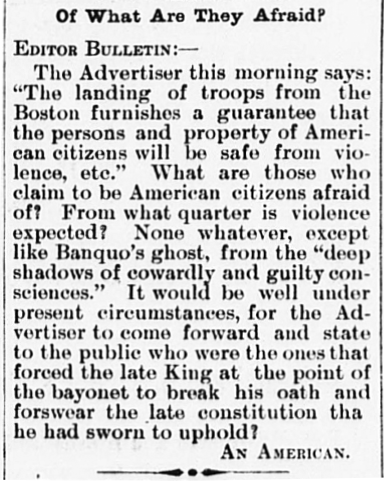
Of What Are They Afraid?

Editor Bulletin:—

The Advertiser this morning says: “The landing of the troops from the Boston furnishes a guarantee that the persons and property of American citizens will be safe from violence, etc.” What are those who claim to be American citizens afraid of? From what quarter is violence expected? None whatever, except like Banquo’s ghost,¹ from the “deep shadows of cowardly and guilty consciences.” It would be well under present circumstances, for the Advertiser to come forward and state to the public who were the ones that forced the late King at the point of the bayonet to break his oath and forswear the late constitution that he had sworn to uphold?

An American.

¹Reference to Shakespeare’s Macbeth.

(Daily Bulletin, 1/17/1893, p. 3)

DailyBulletin_1_17_1893_3

The Daily Bulletin, Volume V, Number 626, Page 3. January 17, 1893.


Invasion, 1893.

The American Troops Landed.

Without knowledge of the Government, and with agreement from the American Minister [Stevens] not to land the troops from the warship while the Government is prepared to keep peace; the American Minister nonetheless ordered the troops of the Boston to be  put in service. This would appear as if it is an attack, and should the government [provisional government] listen to the truth of these actions by its official, this will be something that it will condemn.

(Leo o ka Lahui, 1/17/1893, p. 2)

LeookaLahui_1_17_1893_2

Ka Leo o ka Lahui, Buke II, Helu 624, Aoao 2. Ianuari 17, 1893.

For all of you hula people, 1865.

[Found under: “Na mea hou o Maui Hikina.”]

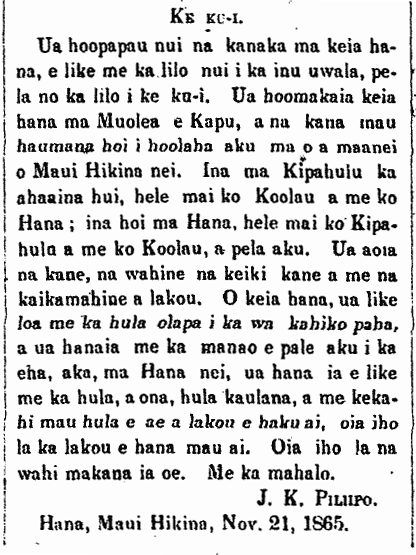
The Ku-i.

All the people are doing it, just as they are totally caught up in drinking [fermented] sweet potato, so too are they engrossed in the ku-i. This activity began at Muolea by Kapu, and it was his students who spread it all over here in East Maui. If there is a party in Kipahulu, the people from Koolau and from Hana come; if it is in Hana, people from Kipahulu and from Koolau come, and so forth. Their husbands, wives, sons and daughters are taught. This is perhaps very similar to the hula olapa in the olden days, and they are done believing it will ward off pain, but here in Hana, it is done like hula, the famous hula as well as some hula that they composed themselves, and that is what they are constantly doing. Those are my gifts to you. [That being the reporting of this story as well as the other stories that preceded it.] With thanks.

J. K. Pilipo.

Hana, East Maui, Nov. 21, 1865.

(Kuokoa, 12/9/1865, p. 3)

Kuokoa_12_9_1865_3

Ka Nupepa Kuokoa, Buke IV, Helu 49, Aoao 3. Dekemaba 9, 1865.