Unknown's avatar

About nupepa

Just another place that posts random articles from the Hawaiian Newspapers! It would be awesome if this should become a space where open discussions happen on all topics written about in those papers!! And please note that these are definitely not polished translations, but are just drafts!!! [This blog is not affiliated with any organization and receives no funding. Statements made here should in now way be seen as a reflection on other organizations or people. All errors in interpretation are my own.]

Turtle caught at Laupahoehoe, 1928.

Large Turtle Caught

Laupahoehoe, July 26—Some days ago, there was person who said he was lucky and caught a big ulua at the same place. As for this, these men, whose names are Bill Maikui, a worker for the railway; Lopaka Mae; Akoni Jarda and Ned Rice; spoke about their luck in catching a large honu.

One day Bill Maikui noticed a big honu swimming by beneath the cliffs upon which they live. He fastened meat upon his fishing line and threw it down the cliff; perhaps this cliff is not very high. When he threw over his fishing line, the flippers [ekekeu] of that turtle soon was entangled in the line; and being that the honu was huge indeed, he called his friends to go down and secure a heavy line and pull it up to where he lives. It was with great difficulty that they pulled up this honu caught in the fishing line  up the cliff where Maikui lives. Continue reading

Eight feet eel? 1909.

GREAT EEL AT THE MARKET

One of the largest uha or white eels that has ever been seen in Honolulu was on view at the fishmarket yesterday morning.

The eel was about eight feet in length and weighed thirty-five pounds. It was as thick as a man’s leg in the middle. Continue reading

Joe Kauwila captures shark in Hana, 1903.

TOWED UNDER WATER BY SHARK

UNUSUAL EXPERIENCE OF NATIVE SAILOR ON THE CLAUDINE WHILE AT HANA.

It is not often that any one is towed under water by a shark and lives to tell the tale, but this is precisely what happened last Thursday to Joe Kauwila a native sailor aboard the steamer Claudine. Not only did he survive the experience, but at last accounts he was shoving a truck at the Wilder wharf today helping to load the steamer Claudine with freight.

On Thursday at Hana while the Claudine was in the port, the sailors heard that a dead horse had been moored near one of the buoys, for the purpose of attracting a shark. A big shovel nose shark about 12 feet in length, came circling in the vicinity of the horse. Captain Parker took a boat crew and went over by the buoy. J. Welch a man from the shore, shot at the shark with a rifle and struck the shark in the head and evidently stunned it. The idea of Captain Parker and the men in the boat was to get a line on the shark and haul it aboard. There were two young natives in the boat one of them Joe Kauwila. Joe is about 18 years of age and the other man about 20.

The shark could be seen a few yards away lying on its back. Some thought the shark had been killed. The natives talked of going over with the line.

“I think he no make,” ejaculated one of the men.

“Oh! I think he make, all right,” declared Joe. “Any how, plenty more kanakas. I try get line on him.” Joe hauled off his shirt, seized the line and started swimming toward the shark. He caught hold of the shark’s tail and began to put the line over the tail. The instant that the shark felt the boy catch hold of its tail, the shark sprang into sudden life, and started to swim. Joe held onto the shark’s tail though. Down went the shark intending evidently to dive under the boat. Continue reading

Shark fin, sea cucumber and tree ear trade, 1864.

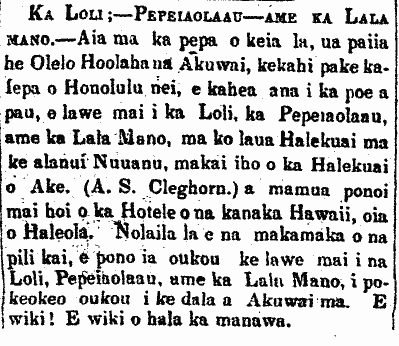
Sea Cucumber [Loli];—Tree Ear [Pepeiaolaau]—and Shark Fin [Lala Mano.]—In today’s newspaper, there is printed an Advertisement by Akuwai, one of the Chinese merchants of Honolulu nei, calling for all people to bring in Loli, Pepeiaolaau, and Lala Mano, to their Shop on Nuuanu Street, makai sdie of the store of A. S. Cleghorn [Ake], and right in front of the Hawaiian hotel, that being Haleola. Therefore O Friends near the sea, you should all go and bring in Sea Cucumber, Tree Ear, and Shark Fin, so that you get rich off of the money of Akuwai and company. Be quick! Be quick, lest you be too late.

(Kuokoa, 4/23/1864, p. 2)

Kuokoa_4_23_1864_2

Ka Nupepa Kuokoa, Buke III, Helu 17, Aoao 2. Aperila 23, 1864.

Iwi found on the future site of the First National Bank, 1924.

HUMAN BONES AND A POI POUNDER FOUND.

While the site was being dug, where the First National Bank [Banako First National] will be built in the future, at King and Bishop streets, there was found human bones and a poi pounder in the earth, but as to how those bones and poi pounder got there, that is something unclear being asked today.

At about seven or eight feet, these things were found by workers digging the dirt in the earth, at the area where the old fire station stood during the time of King Kalakaua. Continue reading

The National Anthem and Patriotism, 1893.

PATRIOTISM.

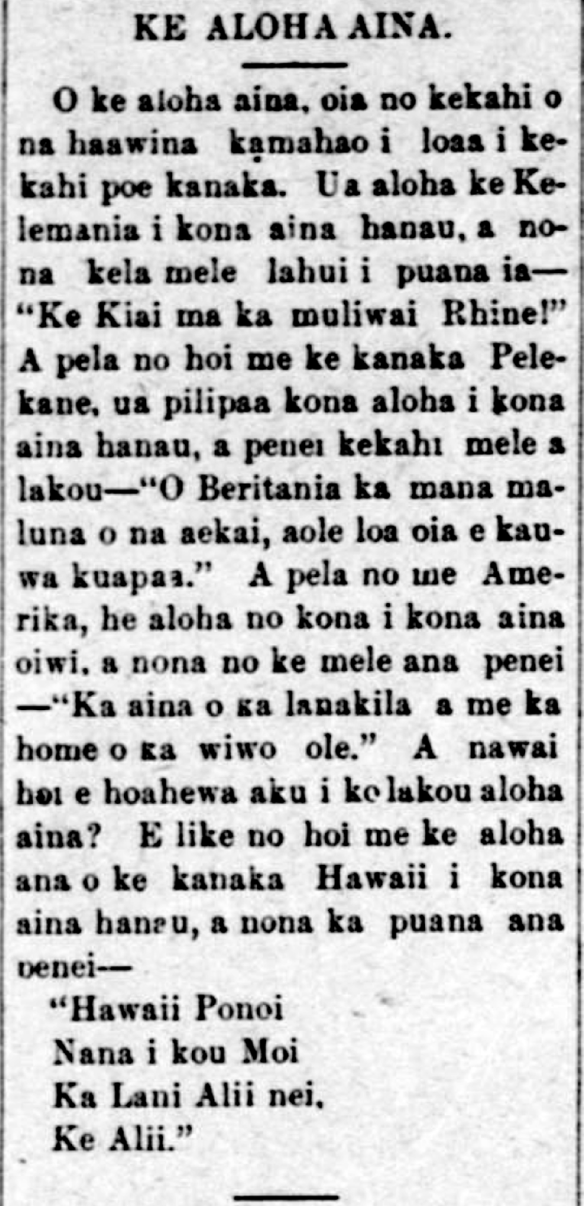
Aloha aina is a wonderful gift held by people. The German loves his land of birth, and for it is the national anthem sung—”Die Wacht am Rhein” [“Ke Kiai ma ka muliwai Rhine!”]* And so too  with the Briton, whose love is steadfast for his birth land, and this is one of their songs—”Rule, Britannia! rule the waves, Britons never will be slaves.” [“O Beritania ka mana maluna o na aekai, aole loa oia e kauwa kuapaa.” And it is the same with the American; he loves his native land, and for it is sung in this manner—”The land of the triumphant and the home of the brave.” [“Ka aina o ka lanakila a me ka home o ka wiwo ole.”] Who would fault their patriotism? This like the aloha that the Hawaiian has for his land of birth, and for it is sung like this—

“Hawaii Ponoi
Nana i kou Moi
Ka Lani Alii nei,
Ke Alii.”

*Look at this awesome translation by King Kalakaua of Die Wacht am Rhein!

(Hawaii  Holomua, 2/11/1893, p. 1)

HawaiiHolomua_2_11_1893_1.png

Hawaii Holomua, Buke III, Helu 7, Aoao 1. Feberuari 11, 1893.

“A Night in Hawaii of Old,” by Kaai Glee Club, 1913.

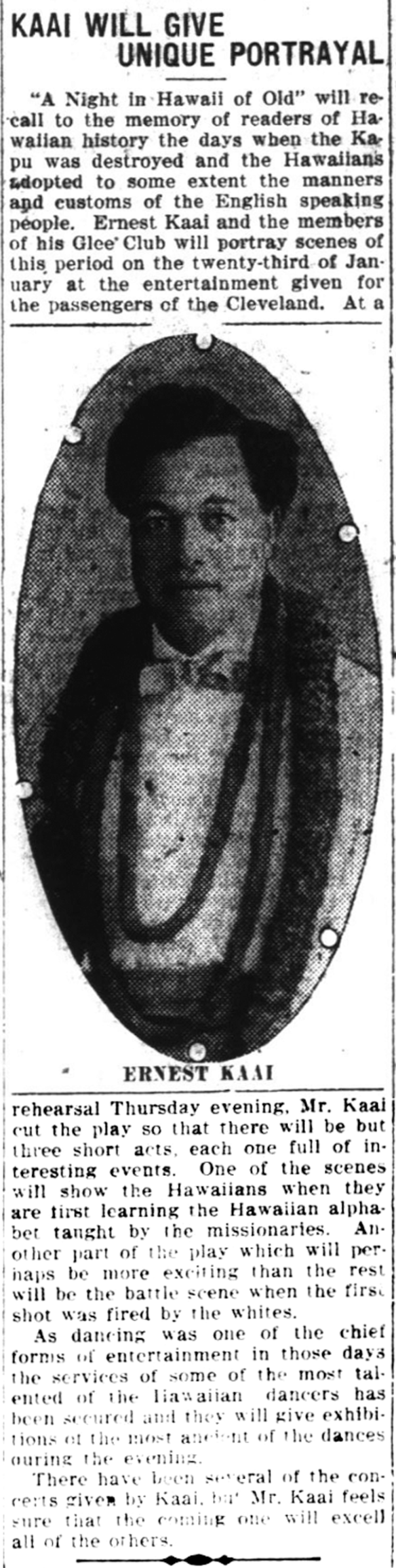
KAAI WILL GIVE UNIQUE PORTRAYAL

“A Night in Hawaii of Old” will recall to the memory of readers of Hawaiian history the days when the Kapu was destroyed and the Hawaiians adopted to some extent the manners and customs of the English speaking people. Ernest Kaai and the members of his Glee Club will portray scenes of this period on the twenty-third of January at the entertainment given for the passengers of the Cleveland. At a…

ERNEST KAAI

…rehearsal Thursday evening, Mr. Kaai cut the play so that there will be but three short acts, each one full of interesting events. One of the scenes will show the Hawaiians alphabet taught by the missionaries. Another part of the play which will perhaps be more exciting than the rest will  be the battle scene when the first shot was fired by the whites.

As dancing was one of the chief forms of entertainment in those days the services of some of the most talented of the Hawaiian dancers has been secured and they will give exhibitions of the most ancient of the dances during the evening.

There have been several of the concerts given by Kaai, but Mr. Kaai feels sure that the coming one will excell all of the others.

(Star-Bulletin, 1/20/1913, p. 12)

StarBulletin_1_20_1913_12.png

Honolulu Star-Bulletin, Volume XX, Number 6489, Page 12. January 20, 1913.

Thoughts for the upcoming Kamehameha Day, 1920.

THEY ARE TRUE HAWAIIANS BUT THEY CANNOT SING HAWAIIAN SONGS.

Mr. Editor of the Kuokoa Newspaper, Aloha oe:—Maybe at 3 o’clock or so in the morning of Friday, June 11, 1920, that being the birthday of the Nation Conqueror Kamehameha, there came to my home some singing boys, and this was something; it was a familiar thing where on holidays this and that person came around singing at houses lived in by Hawaiians.

Before the singers came, I got the idea that since these singers were coming to my home, I would get up and listen to the singing outside on the lanai like I was accustomed to in past years; it was not long before I heard strains of a guitar, and the singing started, but it was from my bedroom that I was listening. Continue reading

A mele ipo for Edward Abnel Keliiahonui Piikoi by King Kalakaua, 1871.

He ipo na Abenela Keliiahonui Piikoi.

Sweet Leda Lani ke Ala.

Aia la i Kemamo,
Kuu wai kihene lehua,
Wai auau a ka wahine,
No Ledalani ke ala.

Aia ilaila kuu liko,
Aia ilaila ka lehua,
Puia nae he moani,
Sweet Ledalani ke ala.

Ua like ka welona a ka la,
Ka mania i ka ili kai,
Me ka poli nahenahe o ka ipo,
O Ledalani, ke ala.

Aia ilaila kuu liko,
Aia ilaila ka halia,
Puia nae he moani,
Sweet Leda lani, ke ala. Continue reading

Opelu beaching?? 1865.

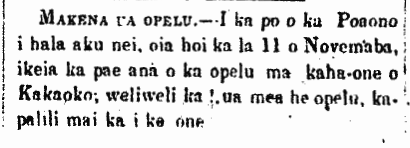
A Great Many Opelu.—At night on this past Saturday, that being the 11th of November, opelu were seen coming upon the sandy shore of Kakaako [? Kakaoko]; it was horrific! the opelu were flopping on the sand.

[I cannot recall this happening during modern times. Anyone ever see this happening?]

(Kuokoa, 11/18/1865, p. 2)

Kuokoa_11_18_1865_2.png

Ka Nupepa Kuokoa, Buke IV, Helu 46, Aoao 2. Novemaba 18, 1865.