Unknown's avatar

About nupepa

Just another place that posts random articles from the Hawaiian Newspapers! It would be awesome if this should become a space where open discussions happen on all topics written about in those papers!! And please note that these are definitely not polished translations, but are just drafts!!! [This blog is not affiliated with any organization and receives no funding. Statements made here should in now way be seen as a reflection on other organizations or people. All errors in interpretation are my own.]

Fun Star-Bulletin feature on paperboys, 1916.

ALERT STAR-BULLETIN NEWSBOYS—No. 1

SHIGETARO SARUHASHI.

Son of Mr. and Mrs. Saruhashi of Kalihi-uka. Shigetaro is 16 years old and a Hawaiian-born Japanese. He attends the Royal school and is in the 8th grade. “Chicken,” as he is familiarly known by his customers and fellow newsboys, is a good hustler, disposing of 125 Star-Bulletins each afternoon. He covers the corner of Hotel and Fort streets and along Hotel to River. He has been selling papers about five years and has built up quite a profitable business by his energetic work. He belongs to the Boy Scouts and is “right there” when duty calls.

(Star-Bulletin, 6/19/1916, p. 14)

StarBulletin_6_19_1916_14

Honolulu Star-Bulletin, Volume XXIII, Number 7456, Page 14. June 19, 1916.

Lai Toodle? 1878.

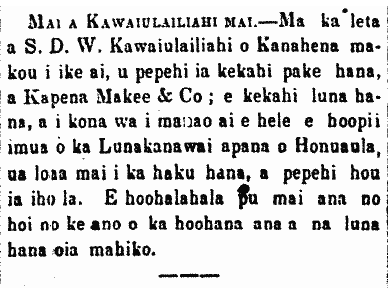
From Kawaiulailiahi.—In a letter from S. D. W. Kawaiulailiahi of Kanahena we saw that a Chinese laborer of the Captain Makee & Co. was beaten by a supervisor [luna hana], and when he decided to go to bring charges before the Judge of the Honuaula district, he was found by the boss [haku hana], and was beaten again. He will also complain about how the luna of that sugar plantation make them work.

(Kuokoa, 10/26/1878, p. 2)

Kuokoa_10_26_1878_2.png

Ka Nupepa Kuokoa, Buke XVII, Helu 43, Aoao 2. Okatoba 26, 1878.

Memorial Day advertisement, 1907.

Flowers for Memorial Day.

You can find Daisies, Marigolds [Hope Oioi],* Ferns, and many other varieties, for a very reasonable price at the Nursery of S. K. Nakapaahu (Hawaiian Nursery) mauka of Auwaiolimu. Therefore, don’t forget to visit to buy your flowers there for the coming Memorial Day [La Kau Pua].

*Marigolds are usually known by the more common “Okole Oioi”.

(Aloha Aina, 5/25/1907, p. 7)

AlohaAina_5_25_1907_7.png

Ke Aloha Aina, Buke XII, Helu 21, Aoao 7. Mei 25, 1907.

Kamehameha School graduation a hundred years ago, 1916.

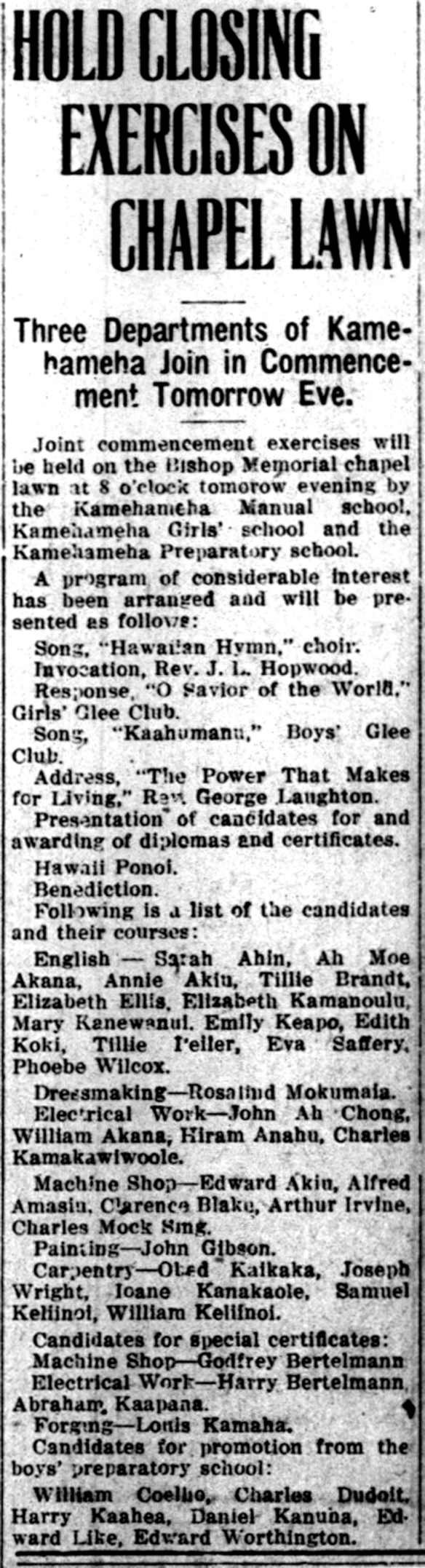
HOLD  CLOSING EXERCISES ON CHAPEL LAWN

Three Departments of Kamehameha Join in Commencement Tomorrow Eve.

Joint commencement exercises will be held on the Bishop Memorial chapel lawn at 8 o’clock tomorrow evening by the Kamehameha Manual school, Kamehameha Girls’ school and the Kamehameha Preparatory school.

Song, “Hawaiian Hymn,” choir.
Invocation, Rev. J. L. Hopwood.
Response, “O Savior of the World,” Girls’ Glee Club.
Song, “Kaahumanu,” Boys’ Glee Club.
Address, “The Power That Makes for Living,” Rev. George Laughton.
Presentation of candidates for and awarding of diplomas and certificates.
Hawaii Ponoi.
Benediction.

Following is a list of the candidates and their courses:

English—Sarah Ahin, Ah Moe Akana, Annie Akiu, Tillie Brandt, Elizabeth Ellis, Elizabeth Kamanoulu, Mary Kanewanui, Emily Keapo, Edith Koki, Tillie Peller, Eva Saffery, Phoebe Wilcox.

Dressmaking—Rosalind Mokumaia.

Electrical Work—John Ah Chong, William Akana, Hiram Anahu, Charles Kamakawiwoole.

 Machine Shop—Edward Akiu, Alfred Amasiu, Clarence Blake, Arthur Irvine, Charles Mock Sing.

Painting—John Gibson.

Carpentry—Obed Kaikaka, Joseph Wright, Ioane Kanakaole, Samuel Keliinoi, William Keliinoi.

Candidates for special certificates:

Machine Shop—Godfrey Bertelmann.

Electrical Work—Harry Bertelmann, Abraham Kaapana.

Forging—Louis Kamaha.

Candidates for promotion from the boys’ preparatory school:

William Coelho, Charles Dudoit, Harry Kaahea, Daniel Kanuha, Edward Like, Edward Worthington.

[Congratulations to the class of 2016! Make Pauahi proud!!]

(Star-Bulletin, 6/8/1916, p. 8)
HOLD CLOSING EXERCISES ON CHAPEL LAWN

Honolulu Star-Bulletin, Volume XXIII, Number 7537, Page 8. June 8, 1916.

Annie Freitas composition on trip to see Kapiliula, Maui, 1921.

KAPILIULA SONG

Ikemaka i ka nani o Kapiliula,
Hoohihi ka manao me ka makemake;
Ia wai kaulana o ka aina,
Makaikaiia e ka malihini.

Ua inu ia wai ono hu’ihu’i,
Ia wai kahe mai i ke kumupali;
O ka nee a ka ua me ka makani,
Mea ole nae ia i nei hookele.

Ilaila kamau kiaha bia,
Olu ai ka hele ana o ia kula loa;
Ua lei i ka pua a o ka lehua,
Ua ai i ka hua ohelo papa.

He nui na ono a o ia uka,
O ka lua leko me ka hoio;
Ku au mahalo aku o ka nani,
I ka papa auwai a ke aupuni.

Moani ke ala o ke kiele,
E kono mai ana ia’u e hoi;
Kau aku i ke kaa otomobile,
Olapa ka uwila i Kipahulu.

Aina a ka nani me ka maikai,
Kaulana i ka makani lawe huapala.

Kipa aku i ka hale kamaaina,
Ai i ka opae mahikihiki;
Ilaila hoohihi kahi manao,
I ka hanu aala o pua roselani.

E hoi kakou ua ahiahi,
E ike i ka wai a o Kumaka,
Ilaila makou miki wahi poi,
Ohua o ke kai ka’u i’a ia.

Ua lawa ka iini me ka makemake,
I ka ua Apuakea o Hana;
Hainaia mai ana ka puana,
E hoi ke aloha i Kapiliula.

Haina hou ia mai ka puana,
Malihini kaahele puni o Maui.

Composed by MISS ANNIE FREITAS.
1315 Miller St., Honolulu.

[Annie Freitas sounds like she had a really good time on this huakai!]

(Kuokoa, 6/3/1921, p. 3)

Kuokoa_6_3_1921_3

Ka Nupepa Kuokoa, Buke LIX, Helu 22, Aoao 3. Iune 3, 1921.

Fishing rights to Hamohamo leased by Auwae, 1895.

FISHING RESTRICTED

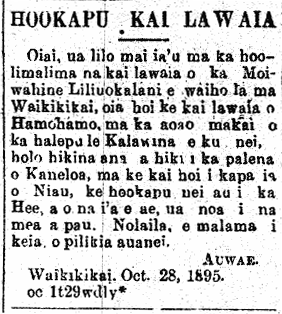
Whereas I have received the lease to the fishing rights for the seas of Queen Liliuokalani located at Waikiki Kai, that being the fishing area of Hamohamo on the makai side of where the Calvinist Church stands, then going east until the border of Kaneloa, to the seas called Niau, I therefore restrict Octopus [Hee]; but as for the other fish, they are open to all others. Therefore, abide by this or you will be in trouble.

Auwae.

Waikiki Kai, Oct. 28, 1895.

(Leo o ka Lahui, 12/13/1895, p. 4)

LOKL_12_13_1895_4.png

Ka Leo o ka Lahui, Buke II, Helu 1356, Aoao 4. Dekemaba 13, 1895.

Kapu on Queen Liliuokalani’s ocean at Hamohamo, 1906.

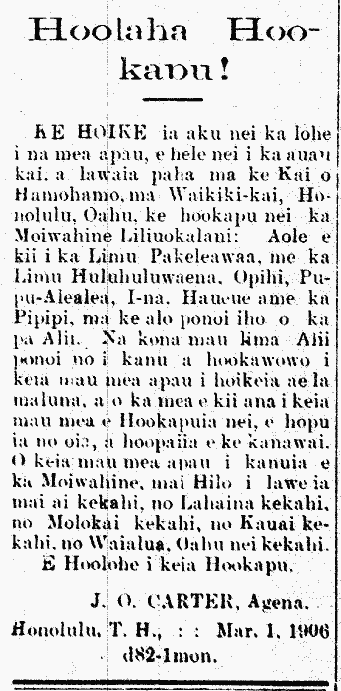
Proclamation of Prohibition!

ANNOUNCING so that all may hear who go swimming or fishing perhaps at the Sea of Hamohamo at Waikiki Kai, Honolulu, Oahu; Queen Liliuokalani prohibits: There is to be no collecting of Pakeleawaa Seaweed, and Huluhuluwaena Seaweed, Opihi, Alealea Shellfish, Ina, Haueue [Haukeuke], and Pipipi, facing the front of the Royal Yard [Pa Alii]. It was her very own Royal hands which planted and fostered all of those things mentioned above, and those who take these Restricted things will be arrested and punished by the law. All of these things planted by the Queen, some were brought from Hilo, and some from Lahaina, some from Molokai, some from Kauai, and some were from here in Waialua, Oahu.

Heed this Restriction.

J. O. Carter, Agent.

Honolulu, T. H., Mar. 1, 1906.

(Na’i Aupuni, 3/26/1906, p. 3)

NaiAupuni_3_26_1906_3.png

Ka Na’i Aupuni, Buke I, Helu 102, Aoao 3. Maraki 26, 1906.

All kinds of fishes washed ashore, 1879.

[Found under: “Na mea Hou ma Olowalu, me Ukumehame.”]

January 25. The was much water that covered over all of Olowalu, and the sugarcane acreage of the Olowalu Sugar Company, and nearly one hundred acres was covered with ʻaʻā lava and sand above; and the sleeping quarters of the workers was moved by the water, but it did not get washed away, and there were no injuries.

This is the news that I should tell you all; that is about all of the different fishes that came ashore; this did not happen in floods before; they were only a few fish; but during this flood, there were a lot of fishes that came on shore. These are the fishes that I saw, heepuloa, kala, aweoweo,
Continue reading

Huge octopus caught by Anina, 1908.

HUGE OCTOPUS CAUGHT AND BROUGHT TO LAND.

On Thursday afternoon at the pier on the makai end of Allen Street, a large octopus was caught on hook by a part-Chinese boy named Anina.

While he was fishing enjoyably, he felt the pull of something and he thought it was an ulua. It pulled at his line for a long time, and because he could not pull it up, he called some people to come and help him for he was very worried that he would be pulled under. He had no concern about the line because he was using very heavy line with a hook that would not break.

When several people arrived, he was helped at pulling it up to land. Continue reading

Octopus fishing and more described by Emma Metcalf Beckley, 1902.

HOW NATIVES ONCE FISHED

Women Got the Octopus With Spears.

The Hawaiians have five methods of fishing: by spearing, hand catching, baskets, hook and line, and with nets.

The Ia O is the spearing of fish and is of two kinds, below and above water. That below water is the most important, and is generally employed for the different kinds of rock fish. The spear used by the diver is a slender stick of from 6 to 7 feet in length made of very hard wood and sharply pointed at one end, but more tapering at the other. Since the possession of iron, spears are always tipped with it, but perfectly smooth, without hook or barb. Diving to a well-known station by a large coral rock or against the steep face of the reefs, the diver places himself in a half crouching position on his left foot, with his right foot free and extended behind, his left hand holding on to the rock to steady himself, watches and waits for the fish. Fish in only two positions are noticed by him, those passing before and parallel to him, and those coming straight towards his face. he always aims a little in advance, as, by the time the fish is struck, its motion has carried it so far forward that it will be hit on the gills or middle of the body and thus secured, but if the spear were aimed at the body it would be very apt to hit the tail, or pass behind. When the fish is hit, the force of the blow generally carries the spear right through to the hand, thus bringing the fish up to the lower part or handle of the spear, where it remains whilst the fisherman strikes rapidly at other fish in succession should they come in a huakai (train) as they usually do. Continue reading