Unknown's avatar

About nupepa

Just another place that posts random articles from the Hawaiian Newspapers! It would be awesome if this should become a space where open discussions happen on all topics written about in those papers!! And please note that these are definitely not polished translations, but are just drafts!!! [This blog is not affiliated with any organization and receives no funding. Statements made here should in now way be seen as a reflection on other organizations or people. All errors in interpretation are my own.]

Moo spotting, 1915.

A SEA SNAKE FOUND ON THE KOOLAU SIDE

According to many of this town who went to go see a moo found in the ocean one of the days last week for themselves, it was indeed a moo and not an eel, for it looked like a snake [moo nahesa], but the only difference was that it was a moo that lived in the ocean.

The length of this moo was thirty inches long; it had a colorful body with stripes near its tail; its head was like a snake seen in foreign lands on shore. Continue reading

Building for movies and entertainment to be built in Kalaupapa, 1915.

ANNOUNCEMENT

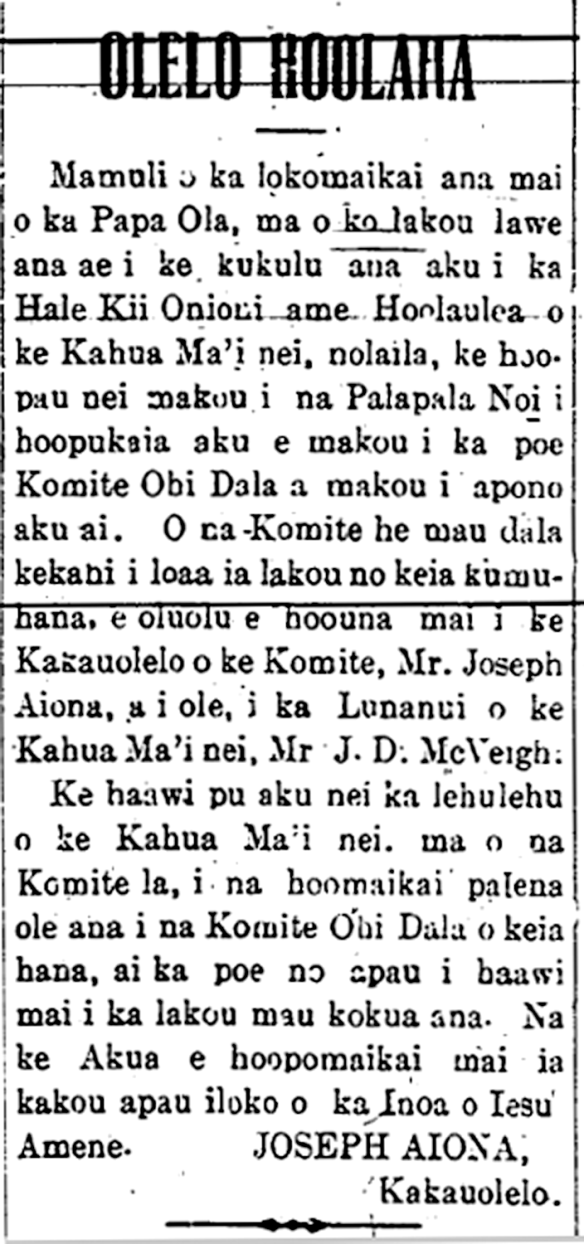
Because of the benevolence of the Board of Health [Papa Ola], by them taking up the building of a Movie and Entertainment House for the Patient Colony [Kahua Ma’i] here, we therefore revoke our Requests put out by us to the Fundraising Committees which were approved by us. As for the Committees that collected money for this endeavor, please send it to the Secretary of the Committee, Mr. Joseph Aiona, or to the Superintendent [Lunanui] of this Patient Colony, Mr. J. D. McVeigh.

By way of the Committee, the people of the Patient Colony send their boundless thanks to the Fundraising Committees [Komite Ohi Dala] for this work, and to all those who gave their donation. May God bless us all in the Name of Jesus, Amen.  JOSEPH AIONA,

Secretary.

(Hoku o Hawaii, 12/30/1915, p. 3)

OLELO HOOLAHA

Ka Hoku o Hawaii, Buke 10, Helu 30, Aoao 3. Dekemaba 30, 1915.

Royal Kawaihau Glee Club honors the Hawaiian Band, 1906.

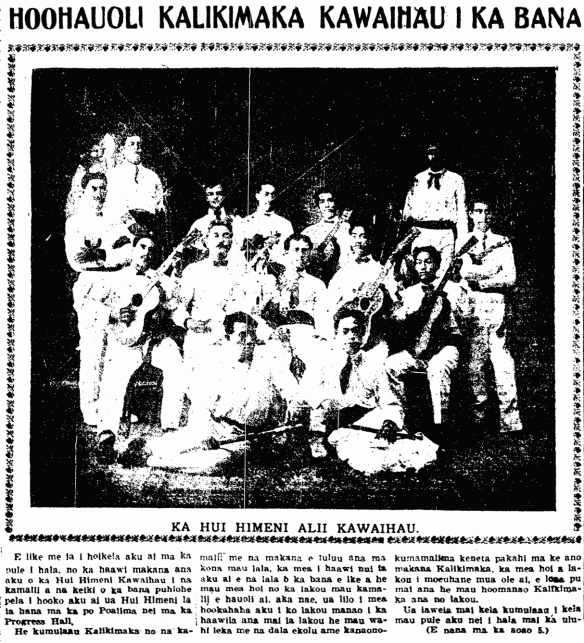
KAWAIHAU GIVES A MERRY CHRISTMAS TO THE BAND

KA HUI HIMENI ALII KAWAIHAU

Just as was announced last week that the Kawaihau Glee Club would give presents to the children of the band boys, that Glee Club did indeed do so on this past Friday night at Progress Hall.

There was a Christmas tree for the children with presents weighing down on its branches, which were given generously [for] the band members to see, things to give joy to their children; however, they were shocked by being each given envelopes with three dollars and sixty-five cents as a Christmas gift, something they did not bef0re dream of, that they too would receive Christmas presents.

This tree was brought some weeks ago from the…

(Kuokoa, 12/28/1906, p. 1)
HOOHAUOLI KALIKIMAKA KAWAIHAU I KA BANA

Ka Nupepa Kuokoa, Buke XLV, Helu 52, Aoao 1. Dekemaba 28, 1906.

…forests of Oregon, and it was right in the middle of the room where the tree was stood, with strings of tinsel glistening and candles shining on the branches swaying with snowballs filled with candy; and because of the low light in the room, the beauty of the festooned tree was clearly seen.

The Kawaihau Glee Club took their place atop the stage [awai], and there they opened with the song “Aloha oe,” and after they were done with that song, they played the “Kawaihau Waltz,” and that was when Santa Claus came in, that being O. Swain, and said that his sleigh was broken which was why the presents didn’t comewith him, but they were at the door, and some young singers brought the presents over to Santa Claus and he distributed them to the children and the room was just like a musical instrument shop with all the noise coming from the instruments of the children. Each of the children played trumpets like the Hawaiian Band (of Children).

The most amazing thing that night was the handing over of envelops to each of the band members with a present within, and after the presents were done being handed out, Mr. Naone stood representing the members of the Hawaiian Band [Bana Hawaii] and gave their thanks to Sam Nainoa and his fellow members of the Glee Club for their honoring them; it wasn’t just something surprising for them, but something that gave them joy.

Sam K. Nainoa responded from the Glee Club and was appreciative that what was planned went smoothly, and for him were given cheers of joy.

There was also a light meal set out for the families of the band members, and they ate their fill of that food, and those that desired to dance, they went at it; were it not for the sleepy children the activities of the night would not have let out so quickly.

Let it be recalled that the money used for this gift giving, that being the money that Mr. Nainoa and his Glee Club worked for by holding a dance at the Young Hotel to help the Hawaiian Band who was at Nevada. The profit from that activity was two hundred and thirty-one (231) dollars.

(Kuokoa, 12/28/1906, p. 5)
HOOHAUOLI KALIKIMAKA KAWAIHAU I KA BANA

Ka Nupepa Kuokoa, Buke XLV, Helu 52, Aoao 5. Dekemaba 28, 1906.

Death of K. Alapai of Honolii, 1915.

K. ALAPAI OF HONOLII HAS PASSED ON

This past week, death came and took away this old Kamaaina of Hilo, and his nature is well known to all the old timers of Hilo nei. He died at almost 95 years old. He was born at Pahoehoe near Paukaa, and moved and lived on the banks of the far side of Honolii; when there was no bridges on this stream, and when they first opened up the road, he took up the occupation of escorting people by Honolii Stream and escorting passengers by canoe, and after there were goats to transport people he at times helped pulling the passenger goats. When the many bridges of Honolii were built, he carried on his farming on the banks of that stream, and in his strong days, he sometimes worked in the sugar plantations while still living in the same place, and he was known by those who were familiar with him by the name “Alapai of Honolii” [Alapai o Honolii]. Continue reading

One big eel. 1931.

CAUGHT WAS A FORTY-TWO INCH LONG EEL

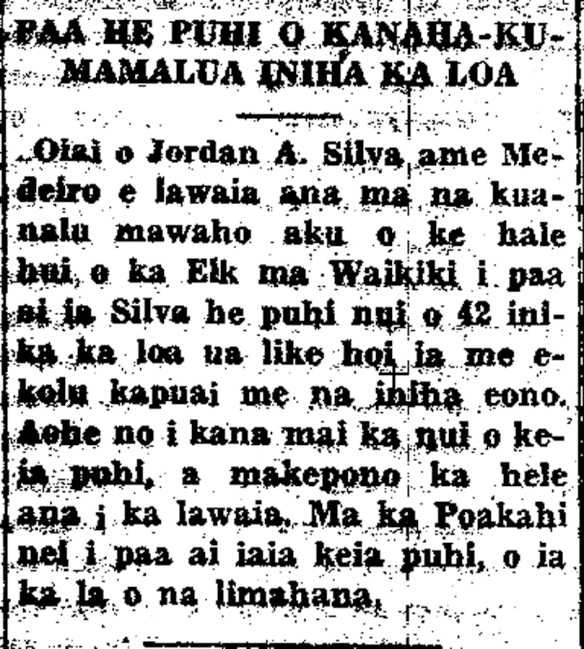
While Jordan A. Silva and Medeiro were fishing at the surf break behind the Elks Club building in Waikiki, Silva caught a 42 inch long eel, that is three feet and six inches long. This eel was huge, and it was worth going fishing. It was this Monday when he caught the eel, that being Labor Day [la o na limahana].

(Alakai o Hawaii, 9/17/1931, p. 3)

PAA HE PUHI O KANAHA-KUMAMALUA INIHA KA LOA

Ke Alakai o Hawaii, Buke 3, Helu 20, Aoao 3. Sepatemaba 17, 1931.

Acrostic Mele for the Home of Emma and Joseph Nawahi, Homelani, 1894.

HOME LANI.

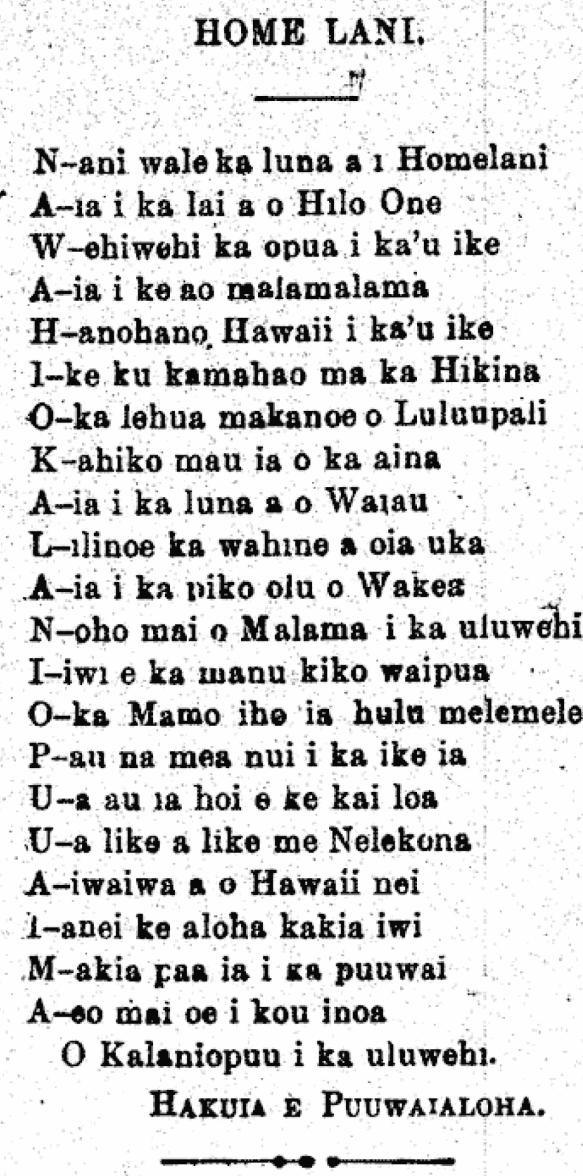
N—ani wale ka luna a i Homelani
A—ia i ka lai a o Hilo One
W—ehiwehi ka opua i ka’u ike
A—ia i ke ao malamalama
H—anohano Hawaii i ka’u ike
I—ke ku kamahao ma ka Hikina
O—ka lehua makanoe o Luluupali
K—ahiko mau ia o ka aina
A—ia i ka luna o Waiau
L—ilinoe ka wahine a oia uka
A—ia i ka piko olu o Wakea
N—oho mai o Malama i ka uluwehi
I—iwi e ka manu kiko waipua
O—ka Mamo iho la hulu melemele
P—au na mea nui i ka ike ia
U—a au ia hoi e ke kai loa
U—a like a like me Nelekona
A—iwaiwa a o Hawaii nei
I—anei ke aloha kakia iwi
M—akia paa ia i ka puuwai
A—eo mai oe i kou inoa
O Kalaniopuu i ka uluwehi.

Hakuia e Puuwaialoha.

[E o, e Hilo i ka ua Kanilehua! Does anyone know who Puuwaialoha is? This person was a composer of many a mele.]

(Leo o ka Lahui, 12/18/1894, p. 3)

HOME LANI.

Ka Leo o ka Lahui, Buke II, Helu 1080, Aoao 3. Dekemaba 18, 1894.

Death of Peleioholani Makainai, 1883.

[Found under: “NUHOU KULOKO.”]

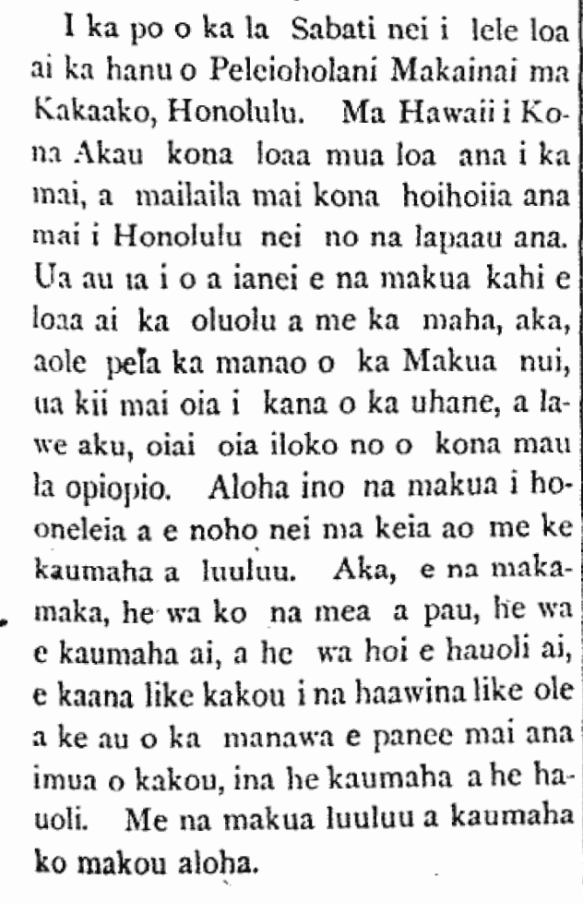
In the night of this past Sunday, the breath of Peleioholani Makainai left him forever at Kakaako, Honolulu. He first became ill on Hawaii at North Kona, and from there he was brought here to Honolulu to get treated. He was taken here and there by his parents to find comfort and relief, but that was not the intent of the great Father, for he fetched his, the spirit, and took it away, while he [Peleioholani] was in his youth. How sad for the parents who are left without, living in this world with sadness and sorrow. However, O Friends, there is a time for all things; a time to be sad and a time to be happy; let us share everything the currents of time bring before us whether it is sadness or happiness. Our aloha goes to the sad and bereaved parents.

(Kuokoa, 10/27/1883, p. 3)

I ka po o ka la Sabati nei...

Ka Nupepa Kuokoa, Buke XXII, Helu 43, Aoao 3. Okatoba 27, 1883.

Mongoose, “a general destroyer,” 1883.

[Found under: “EDITORIALS.”]

The Planters’ Monthly has lately been proposing the introduction of a little animals from India called the mongoose, as a destroyer of rats. He is a famous ratter, surpassing the cat or the ferret. He is described as a lively little urchin, about the size of a weasel, as having a snaky body, vicious looking claws, a sharp nose, a villanous eye and looks like “murder incarnate.” In speaking of his action in capturing rats, it is said that he crawls sinuously up to his victim until within easy distance for a rush, and then strikes with unerring aim, snapping the rat just at the base of the brain. The rat has not time even to squeak, so sudden and deadly is the onslaught. Wherever the rat can enter the mongoose can follow. Thus as a ratter this lively little Indian is incomparable, but the trouble is he will not confine his operations to what is deemed his legitimate business. Some writers have endeavored to save his credit as a poultry destroyer, but a naturalist, who has carefully observed his characteristics, says that he is a general destroyer, not only of everything under, but of many creatures over his size. When in a cage that sight of a small living creature made him frantic and whenever he escaped, as he sometimes did, he made a sensation in the poultry house. The mongoose is not content with maurauding forays in the yard, but he seems to pervade the house when domesticated. His manner for getting into objectionable nooks and holes is most perplexing, as for instance the leg of a pair of trousers or a skirt with the owner in them, quite come up to his views, as a desirable place for a roost or forage. The rat is unquestionably a great pest of the cane and rice planter and grain cultivator in all parts of the world. The rat pest was deemed so serious here some fifty years ago that an enlightened and enterprising Commisioner of the Hawaiian Government, sent in quest of Chinese coolies, deemed it a judicious venture in behalf of the agricultural interests of the Islands to procure a species of sanke famed as a destroyer of rats; but the Hawaiian people, whose sacred soil has been kept free from snakes and toads by some patron saint in influence to St. Patrick, conceived a holy terror of the snake, notwithstanding his possible utilities, and passed a decree that Hawaii would have no snake in her plantations. The destruction of rats in the cane-fields was hardly deemed a sufficient compensation to the Hawaiian mind for the probable presence every now and then of his snakeship in the thatch of the Hawaiian hale-pili. And we think that if the mongoose be as well understood as the snake, he will be as objectionable as the tempter of our first parents to the popular mind. This terrible Indian ferret is said to take a fancy to fasten on to lambs and suck away their very life-blood; and who knows if he may not ake a fancy once in a while to a baby in its cradle. Continue reading

Mongoose, where it all began, 1883.

[Found under: “NEWS OF THE WEEK.”]

Mr. W. H. Purvis, proprietor of the Pacific Sugar Mill and Plantation at Kukuihaele, Hawaii, who arrived in this city per Zealandia, after having completed a tour around the world, brings seven mongooses from India and Africa, and will introduce them on his place on Hawaii. Mr. Purvis has had an opportunity of observing just what the mongoose will do in its native home, and says that it will not molest poultry or come about the premises where people live to disturb anything, but has a perfectly insatiable appetite for killing rats. These are the first mongooses ever brought to these Islands and in all probability they will increase rapidly and prove very useful in destroying all kinds of small vermin.

(PCA, 9/29/1883, p. 5)

Mr. W. H. Purvis...

The Pacific Commercial Advertiser, Volume XXVIII, Number 14, Page 5.