Unknown's avatar

About nupepa

Just another place that posts random articles from the Hawaiian Newspapers! It would be awesome if this should become a space where open discussions happen on all topics written about in those papers!! And please note that these are definitely not polished translations, but are just drafts!!! [This blog is not affiliated with any organization and receives no funding. Statements made here should in now way be seen as a reflection on other organizations or people. All errors in interpretation are my own.]

Miss Kuaana Nathaniel starts a pa hula, 1945.

PA HULA

Miss Kuaana Nathaniel has begun a pa hula that is opened every Wednesday evenings beginning from 7:00 and ending at 8:00 in the evening.

She is a youth that is proficient in the Hawaiian hula, and should anyone desire their children to gain this knowledge, go and meet and talk with Kuaana Nathaniel on Alae Street on the premises of Halai.

(Hoku o Hawaii, 10/10/1945, p. 1)

PA HULA

Ka Hoku o Hawaii, Volume XL, Number 22, Aoao 1. Okatoba 10, 1945.

Mrs. Rose Kuamoo’s new studio, 1941.

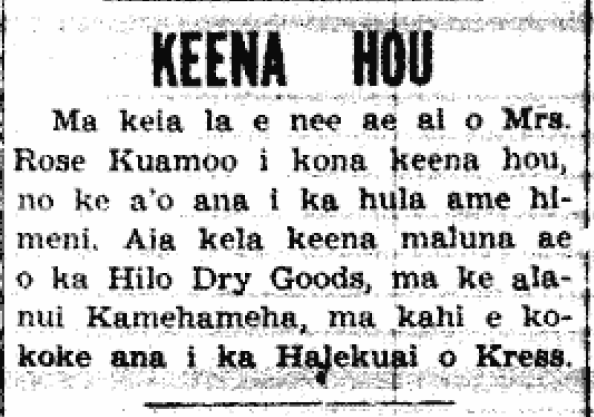
NEW STUDIO

Today, Mrs. Rose Kuamoo is moving to a new studio, to teach hula and song. The studio is above Hilo Dry Goods, on Kamehameha Avenue, near Kress Store.

(Hoku o Hawaii, 10/1/1941, p. 1)

KEENA HOU

Ka Hoku o Hawaii, Volume XXXVI, Number 23, Aoao 1. Okatoba 1, 1941.

The Queen visits Hilo, 1914.

QUEEN LILIUOKALANI

Queen Liliuokalani arrived here in Hilo in the afternoon of this past Sunday, and she is an honored guest of Mrs. Aima Nawahi these days. The Royal one of Hawaii is in good health. She will return to Honolulu the following Friday.

This Thursday, at 10 a. m. until 12 noon, our Queen graciously has granted loving audience with all those who go to see her at the home of Mrs. Aima Nawahi. The members of all the Hawaiian Associations of Hilo nei also want to see their beloved Queen. This audience is open to all the people here in Hilo. Continue reading →

Mrs. Emma Moniz opens hula studio, 1936.

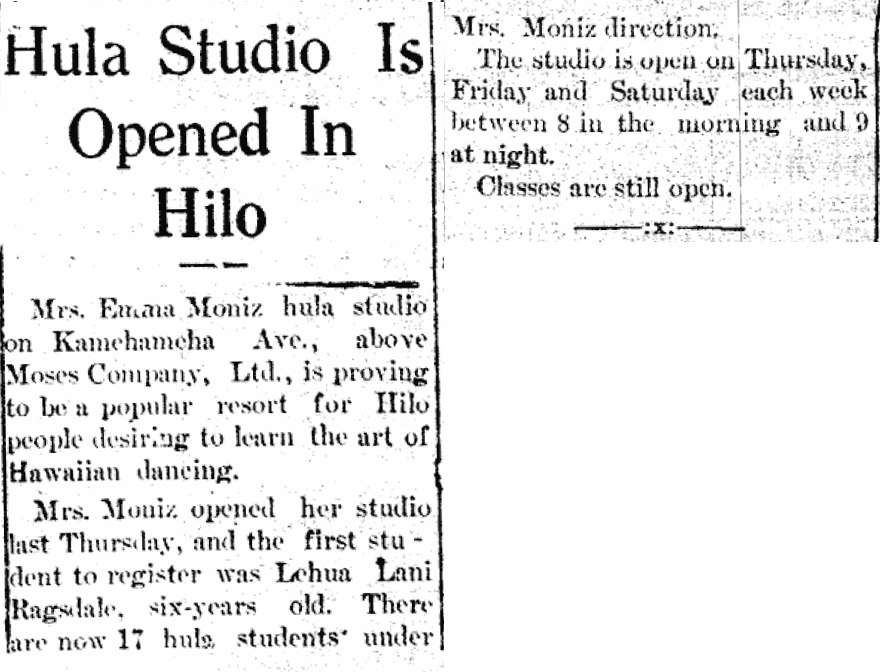
Hula Studio Is Opened In Hilo

Mrs. Emma Moniz hula studio on Kamehameha Ave., above Moses Company, Ltd., is proving to be a popular resort for Hilo people desiring to learn the art of Hawaiian dancing.

Mrs. Moniz opened her studio last Thursday, and the first student to register was Lehua Lani Ragsdale, six-years old. There are now 17 hula students under Mrs. Moniz direction.

The studio is open on Thursday, Friday and Saturday each week between 8 in the morning and 9 at night.

Classes are still open.

(Hoku o Hawaii, 7/1/1936, p. 1)

Hula Studio Is Opened In Hilo

Ka Hoku o Hawaii, Volume XXXI, Number 10, Aoao 1. July 1, 1936.

Hula in Hilo, 1914.

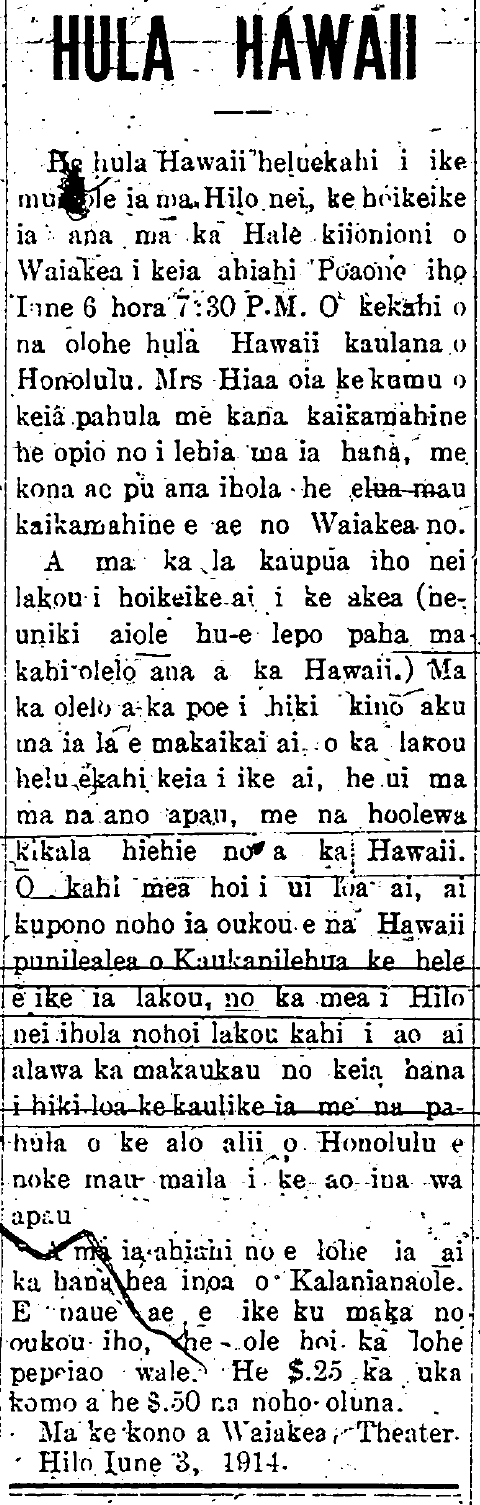
HAWAIIAN HULA

There will be first-class Hawaiian Hula which have never been seen before here in Hilo, being shown at the Waiakea Theater on the evening of this Saturday, June 6, at 7:30 P.M. One of the famous Hawaiian expert hula practitioners of Honolulu, Mrs. Hiaa, is the kumu of this hula troupe, along with her daughter, a girl that is skilled in the art; and she also has accepted two more girls from Waiakea.

And on this past Memorial Day [La Kaupua], they held a public show (called uniki or hu-e lepo perhaps in Hawaiian). According to those who were present on that day of the performance, it was the best that they had seen, and it was beautiful in all respects, with the elegant swaying of the hips of the Hawaiians. One of the most marvelous things and a reason for all of you fun-loving Hawaiians of the Kanilehua Rain to go and see them, is because they were trained until proficient in this skill right here in Hilo, and they can most definitely be compared to the troupes of the royal court of Honolulu who are continuously training.

And on that evening, you will hear the chanting of the name chant of Kalanianaole. Come down to witness for yourselves; just hearing about it is nothing. Entrance is $.25 and the upper level seats are $.50.

At the invitation of Waiakea Theater

Hilo, June 3, 1914.

(Hoku o Hawaii, 6/4/1914, p. 3)

HULA HAWAII

Ka Hoku o Hawaii, Buke 8, Helu 52, Aoao 3. Iune 4, 1914.

Paaiea Pond, part 3, from the pen of J. W. H. Isaac Kihe, 1914.

SOME STORIED LANDS OF KONA

Written for the Hoku o Hawaii by ka Ohu Haaheo i na Kuahiwi Ekolu¹

PAAIEA POND

Meeting with Kolomu’o and Pahinahina.

When the woman left that place at the seaside of Kaelehuluhulu, she arrived in the uplands of Keoneeli, a place that is renown to this day called Kepuhiapele [‘the scorching of Pele’], a heap of aa lava that is almost 200 Feet high, downside of the place where J. A. MaGuire [known also as Keoni Kaimana] is living.

When the woman arrived there, there were two girls named Kolomu’o and Pahinahina broiling breadfruit, while the parents were away farming. This was a huge town during those days, with many people living there. When the woman met up with the girls broiling ulu. The woman said, “The ulu that you are cooking is done.” One of the girls responded, “We are cooking ulu, but it is not totally done.”

The woman went on, “When you ulu is cooked, who will partake of it first?” “La’i, my god, will eat first.” “So La’i is a powerful akua?” “Yes, La’i is powerful.” The name of this girl was Kolomu’o, and the area beneath that scorching of Pele is famous to this day and called Kolomu’o, and famous too is the Opelu fishing shrine [Ko’a] at the beach of Kaupulehu.

Then the woman asked the other girl, Pahinahina, “And when your ulu is done, who is it for?” “It is for Pele Honuamea, my god.” “Then it is our ulu; your ulu is cooked, let the two of us partake in it.” Pahinahina agreed, and the ulu was peeled [makikoe²] and eaten up. Continue reading →

More on fishponds, 1901

FISH PONDS.

The most interesting of the fishery resources of the islands are the fish-ponds. This is the only place within the limits of the United States where they are found on such an immense scale and put to such general and beneficent use. The time of the building of many of these ponds goes back into the age of fable, the Hawaiians, for instance, attributing the construction of one of the most ancient, the deep-water fish-pond wall at the Huleia River on Kauai, to the Menehunes, a fabled race of dwarfs, distinguished for cunning industry and mechanical and engineering skill and intelligence. Many of the very old ponds are still in practical use and look as though they would last for centuries yet. As the ponds were originally owned by the kings and chiefs, it is very probable that most of them were built by the forced labor of the common people. There is a tradition amongst the natives that Loko Wekolo (Wekolo pond), on Pearl Harbor, Oahu, was built about 250 years ago, and that the natives formed a line from the shore to the mountain and passed the lava rock from hand to hand till it reached the shore where the building was going on without once toughing the ground in transit. As the distance is considerably over a mile, this speaks well for the density of the population at that time.

The ponds are found principally in the bays indenting the shores of the islands, the common method of construction having been to build a wall of lava rock across the narrowest part of the entrance to a small bay or bight of land and use the inclosed space for the pond. They were also built on the seashore itself, the wall in this case being run out from two points on the shore, some distance apart, in the shape of a half-circle. Most of the Molokai fish ponds were built in this manner. A few were constructed somewhat interior and these are filled by the fresh-water streams from the mountains or by tidal water from the sea carried to them by means of ditches. Most of the latter are on Oahu, near Honolulu. The Nomilo fish pond at Lawai, on Kauai, is formed from an old volcanic crater with an opening toward the sea, across which a wall has been built, and as the opening is below the surface of the sea the tide plays in and out when the gates are opened.

In the sea ponds the walls are about 5 feet in width and arc built somewhat loosely in order that the water can percolate freely. The interior ponds have dirt sides generally, although a few have rock walls covered with dirt, while others have rock walls backed with dirt. The sea ponds generally have sluice gates which can be raised or lowered, or else which open and close like a door. In the interior ponds there are usually two small bulkheads with a space about 8 feet square between them. Each of these has a small door which usually slides up or down. When the tide is coming in both doors are opened and the fish are allowed to go in freely. When the tide turns the doors are closed. When the owner wishes to remove any of the fish he generally opens the inner door when the tide is ebbing. The fish rush into the narrow space between the bulkheads, from which they are dipped out by means of hand dip nets. In the sea ponds the gate is opened when the tide is coming in and when it turns it is closed.

There is usually a small runway, built of two parallel rows of loosely piled stones from the gate to about 10 feet into the pond. As the fish congregate in this runway when the tide is going out, it is very easy to dip out the supply needed for market. Seines and gill nets are also swept around the inside of the ponds at times in taking fish from them, and as they are quite shallow this is done easily.

The sea ponds usually contain only the amaama, or mullet, and the awa. In the fresh and the brackish water ponds gold-fish, china-fish, oopu, opai [opae], carp, aholehole, and okuhekuhe are kept. Practically no attempt at fish-culture is made with these ponds. Besides the fish which come in through the open gates, the owner usually has men engaged at certain seasons of the year in catching young amaama and awa in the open sea and bays, and transporting them alive to the fish ponds. They are kept in the ponds until they attain a marketable size, and longer frequently if the prices quoted in the market are not satisfactory. They cost almost nothing to keep, as the fish find their own food in the sea ponds. It is supposed that they eat a fine moss which is quite common in the ponds.

There are probably not more than one-half the number of ponds in use to-day that there were thirty years ago. There are numerous reasons for this, the principal ones being as follows:

1. The native population is dying off rapidly, and where there were prosperous and populous villages in the early years of the last century there is practically a wilderness now. Owing to this depopulation there would be no sale for fish in the immediate neighborhood of the ponds there, the only place where it could be sold owing to the difficulty in transporting fish any distance without the use of ice, and the ponds would naturally be allowed to go to decay, the walls breaking down from the action of storms, and the sea filling them with sand when they are located on the immediate shore. This condition of affairs is especially prevalent on Molokai.

2. Two of the important crops of the islands are rice and taro. As both must be grown in a few inches of water, and are very profitable crops, a number of the interior ponds were turned into rice fields and taro patches. Oahu has shown the greatest changes in this regard.

3. On Hawaii ponds were filled up by the volcanic lava flows of 1801 and 1859. The Kamehameha fish pond, which was filled up in this manner in 1859, was said to have been the largest on the islands. Only traces of it are now to be found on the beach.

4. At Hilo, on Hawaii, some ponds, mostly quite small, are so filled with the water hyacinth that it is impossible to work them any more. This year a few of the best of these were cleaned out, but as there is very little money to be made out of them, and their ownership is in dispute, there is but little desire to do much to build them up.

5. Other ponds have been filled up to make way for building operations and for other purposes. This is especially true of ponds in and around Honolulu and Lahaina. There used to be a number of fish ponds on Lanai, but they have all been allowed to fall into decay.

A number of ponds are kept up by their owners merely as private preserves, as it were, the fish taken from them being either consumed by the owner’s household or given to friends. These are scattered all over the islands.

The following is a rough list of the fish ponds still in existence, or traces of which remain, together with their area and a statement so far as possible of their present condition. There is no great claim to accuracy in this list, as many of the ponds are in inaccessible regions of the islands, and in such cases the writer was obliged to depend upon others for reports as to their present condition:…

[For the rest of this report showing the locations, names, and sizes of the many loko i’a across the Hawaiian Islands, and fish produced at the time of the report, etc., etc., see: U. S. Commission of Fish and Fisheries, Part XXVII, Report of The Commissioner for the Year Ending June 30, 1901.

The fish pond report is a section of Commercial Fisheries of the Hawaiian Islands, by John N. Cobb, Agent of the United States Fishing Commission, which runs from page 381 to 499.

Also of interest (actually the whole report is interesting), is  Preliminary Report on an Investigation of the Fishes and Fisheries of the Hawaiian Islands, by David Starr Jordan and Barton Warren Evermann, which is found from page 353 to 380. ]

Paaiea Pond, part 2, from the pen of J. W. H. Isaac Kihe, 1914.

SOME STORIED LANDS OF KONA

Written for the Hoku o Hawaii by ka Ohu Haaheo i na Kuahiwi Ekolu¹

PAAIEA POND

The old woman replied. “I have come to the alii. I live in the uplands, and grew hungry for fish, so I got up and made the descent thinking that the Konohiki of the alii would be the friend here at the ocean side from whom I could receive something fishy to return upland with.

The Konohiki immediately answered. “Your trip will not be rewarded for the all the fish belongs to the alii.” “If I can’t have fish, then what about some palu?”² “There is no palu for you, it is for the alii. This is a work day for the alii; the people care for him, and I am placed here to oversee the wealth of the alii and the wealth of all of his dependents.”

“Both the Aku and the palu are kapu to the alii, as well as the amaama from the pond,” Kepaalani said, “they are restricted for the alii.” “If those are kapu, what about some small Aholehole or a little shrimp?” “Kahaha! Perhaps you can’t hear; all of those things are for the alii.” Continue reading →