Unknown's avatar

About nupepa

Just another place that posts random articles from the Hawaiian Newspapers! It would be awesome if this should become a space where open discussions happen on all topics written about in those papers!! And please note that these are definitely not polished translations, but are just drafts!!! [This blog is not affiliated with any organization and receives no funding. Statements made here should in now way be seen as a reflection on other organizations or people. All errors in interpretation are my own.]

Mary Mahiai passes away, 1913.

AGED HAWAIIAN PASSES BEYOND

Believed by many of the Hawaiians to be at least 110 years old, and having figured in a history which has been recounted from the Atlantic coast to the far east, Mary Mahiai died at her home on Vineyard street last Monday night, and was buried yesterday afternoon in the cemetery back of the asylum.

The aged Hawaiian was born on the island of Kauai during the period the reign of Kamehameha the Great, long before the first missionaries from New England arrived here, and at the age of seven years went out in a canoe with her uncle and five other men for the island of Molokai. A storm came up and the canoe was driven out of sight of land, and for ten days they drifted at the mercy of the elements without food or water. When nearly dead from hunger and thirst, a sail was sighted, and two boats appeared, the larger of which sent a boat out to take the occupants of the canoe aboard. They were treated kindly by the captain and soon learned that the vessel was bound for China. The little Hawaiian girl was given the task of caring for the captain’s daughter and the men put to work on the vessel. At one of the islands of the Ladrones the five men of the little party were put ashore at their request, and it was afterward earned that they were devoured by cannibals who were known to infest those islands. Mary Mahiai, with her uncle, remained on the vessel and were taken to China, where they were turned over to missionaries there. They remained there several years, during which time Mary’s uncle died. Mary was made nurse to one of the missionary’s children and soon after traveled to New York with her mistress. At the time of the gold rush to California Mary was in the employ of a missionary family named Bates, and in 1848 they set sail for the gold fields, via Cape Horn. They were many months reaching their destination on account of the fierce storms which swept that coast, finally reaching Monterey.

The party sailed for the Hawaiian islands a few years later, arriving in Honolulu in 1850, and Mary at once sent a letter to her friends, who had many years previous mourned her death, thinking that she had been drowned or eaten by sharks. Her friends came to Honolulu and her return was celebrated with a luau which lasted many days. Mary did not accompany her relatives back to Kauai, but remained in the employ of the Bates family, to whom she had become very much attached. Later, she married, her husband dying a few months later. Her second husband died of the smallpox and her third lived only a year after their marriage. She married for the fourth time and she and her husband lived happily for twenty years, he dying in the early part of the present century.

The interesting story of her life was told by her when she appeared before the United States senatorial commission on its visit to Honolulu in 1902. As she became old, Mary Mahiai lapsed into the easy Hawaiian life in her humble home on Vineyard street, where she would be often seen barefooted and clad in a holoku.

(Star-Bulletin, 1/8/1913, p. 4)

AGED HAWAIIAN PASSES BEYOND

Honolulu Star-Bulletin, Volume XX, Number 6479, Page 4. January 8, 1913.
Mary Mahiai, what a story! 1901.

MARY MAHIAI.

The picture above is of Mary Mahiai, a Hawaiian woman who is ninety years old or more. Last week, she was called to court over land that is being fought over. Here, her story was heard. Because of her good story and her long life, one of our writers went once again to ask her about her history. And this is it:

I don’t know when I was born, but I was born before the arrival of the missionaries. I was very small at that time, and maybe I was this tall. One day, we boarded a canoe, her Uncle and five others; they wanted to visit Molokai. They were caught up in a storm in the middle of the ocean, and blown outward; they did not eat for ten days and nights. Because I was so young, I cried a lot. I wanted to eat, and I was thirsty. We had nothing to eat, and had no water left. Water came in the waa, and some of us drank the bilge water. We were near crazy with hunger and thirst. We lost hope that we would live. One day we spotted a ship. We tried to get noticed. We were fetched and taken aboard the ship. My duty aboard the ship was to care for the children. The captain and his wife were kind. We landed at Lardone [??]. Five of them got off with the intent of living there. We heard that they were eaten after that by the people this place. My uncle and I went all the way to China. I cared for the baby some missionaries, Mr. and Mrs. Brown. Thereafter, my uncle died and I was left alone with those haole. I was the caretaker of the baby. I lived for perhaps six whole years in China. I travelled around many places. Later, Mrs. Brown died. I lived with Mr. and Mrs. Bates. After that he wanted to go to California to prospect for gold. We accompanied him on a boat, and saw Cape Horn [Kepahoni], that place famous for rough seas. I saw many lands. I lived for three months in the gold fields. I wanted very much to return to Hawaii. Afterwards, these haole agreed and we all left for Hawaii nei. When we arrived, I immediately wrote to my parents and younger siblings. They came to Honolulu at once. They believed that I had died earlier. My father died without me knowing him.

Continue reading →

Custom House, 1895.

Custom House of Honolulu.

We are adorning these columns of the Kuokoa with a picture of the grand Hale Oihana Dute of Honolulu nei, at the corner of Fort [Papu] and Allen [Alani] Streets. this building was built during the reign of Kamehameha IV., and it was added to at various times when it was found that it was not adequate for the incoming goods to be stored, so it has become very long and wide. This is the entrance [makaha] into the nation, where goods from foreign lands are stored, and duty is collected on taxable items, and not only that, the owners pay a fee for care of their goods in this building by the government. There is a big force of government employees in this bureau under the Department of Finance [Oihana Waiwai], starting with the collector-general and the deputy-collector, and down to the secretary and the storekeeper, guards, and so forth. The money expended to rebuild or perhaps extend this entrance comes from the revenues of the growing public funds due to the duties charged by this entity.

(Kuokoa, 3/16/1895, p. 2)

Ka Hale Oihana Dute o Honolulu.

Ka Nupepa Kuokoa, Buke XXXIV, Helu 11, Aoao 2. Maraki 16, 1895.

Washington Place, 1895.

The Residence of Wasinetona Hale.

We are putting before you the picture of Washington Place on Beritania Street, Honolulu, not because it was the storage for guns and weapons for Liliuokalani, but because it is a very old building constructed in Honolulu nei. The foundation of this house was began with coral blocks by the one called Isaac Adams, for the mother of Governor Dominis, while her husband, Dominis, was sailing as captain aboard a ship from Honolulu to…

WASINETONA HALE

…China, trading with places of the North and then returning to Honolulu. And being that Mrs. Dominis, who accompanied her husband, fancied living here in Honolulu, and building a home here to live in, and forever more leaving her own home in the state of Massachusetts, her husband agreed to her request. It was perhaps 1842 when the foundation was laid, but it was not completed until the beginning of 1846. And on August 5, 1846, Captain Dominis left again on a ship under his leadership, but after he left Honolulu for China, there was no word that his ship landed on any dry land until this day.

Continue reading →

Kuhio’s “Four Horsemen,” a translation from the time! 1939.

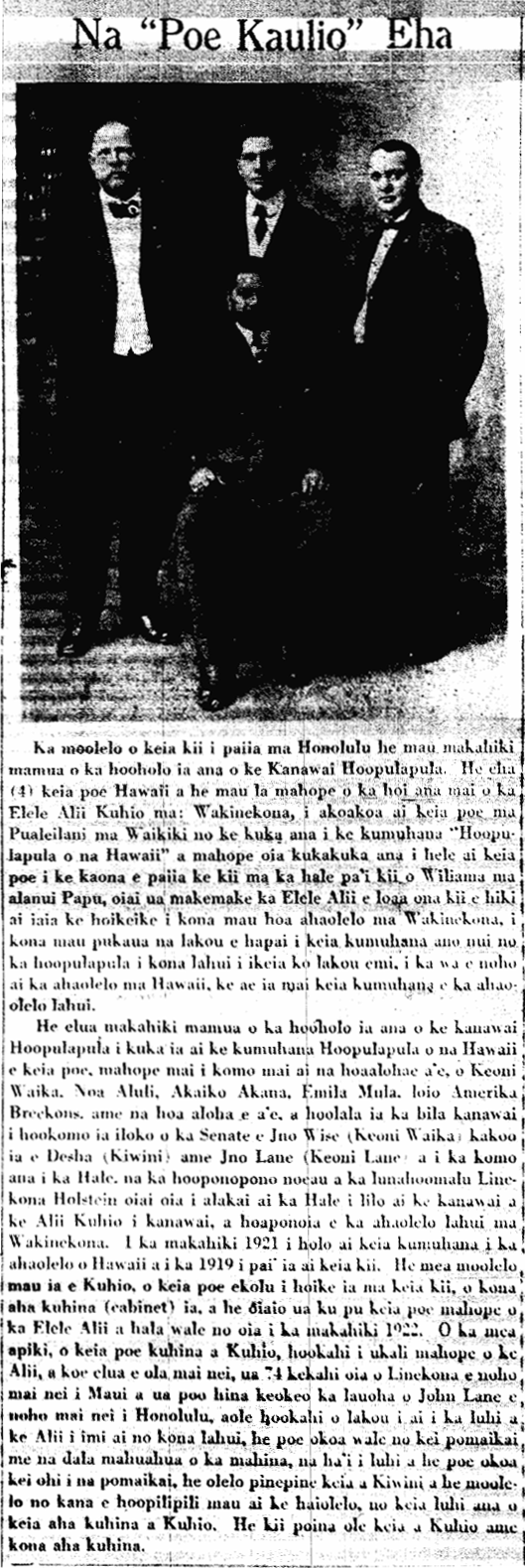
The Four Horsemen

The above picture was taken at Honolulu a few years before the passage of the Rehabilitation Law. There were four of these Hawaiians, and a few days after the return of the Delegate Prince Kuhio from Washington, assembled at Pualeilani at Waikiki to discuss the subject “Rehabilitation of the Hawaiians and after that discussion, these men went to town and had their picture taken at the William’s Gallery on Fort Street, as it was the Prince’s wish, so that he can show to his fellow congressmen at Washington his backers that brought up this important matter for rehabilitating its people, known to be decreasing, during the session of the Hawaii legislature, if the measure is allowed by congress. They are sitting. Prince Kuhio, standing, from left to right, Rev. S. L. Desha, Sr., John C. Lane and H. L. Holstein.

Continue reading →

Kuhio’s accomplishments did not come single-handedly, 1939.

Na “Poe Kaulio” Eha

Ka moolelo o keia kii i paiia ma Honolulu he mau makahiki mamua o ka hooholo ia ana o ke Kanawai Hoopulapula. He eha (4) keia poe Hawaii a he mau la mahope o ka hoi ana mai o ka Elele Alii Kuhio mai Wakinekona, i akoakoa ai keia poe ma Pualeilani ma Waikiki no ke kuka ana i ke kumuhana “Hoopulapula o na Hawaii” a mahope oia kukakuka ana i hele ai keia poe i ke kaona e paiia ke kii ma ka hale pa’i o Wiliama ma alanui Papu, oiai ua makemake ka Elele Alii e loaa ona kii e hiki ai iaia ke hoikeike i kona mau hoa ahaolelo ma Wakinekona, i kona mau pukaua na lakou e hapai i keia kumuhana ano nui no ka hoopulapula i kona lahui i ikeia ko lakou emi, i ka wa e noho ai ka ahaolelo ma Hawaii, ke ae ia mai keia kumuhana e ka ahaolelo lahui.

He elua makahaiki mamua o ka hooholo ia ana o ke kanawai Hoopulapula i kuka ia ai ke kumuhana Hoopulapula o na Hawaii e keia poe, mahope mai i komo mai ai na hoaalohae a’e, o Keoni Waika, Noa Aluli, Akaiko Akana, Emila Mula, loio Amerika Breckons, ame na hoa aloha e a’e, a hoolala ia ka bila kanawai i hookomo ia iloko o ka Senate e Jno Wise (Keoni Waika) kakoo ia e Desha (Kiwini) ame Jno Lane (Keoni Lane) a i ka komo ana i ka Hale, na ka hooponopono noeau a ka lunahoomalu Linekona Holstein oiai oia i alakai ai ka Hale i lilo ai ke kanawai a ke Alii Kuhio i kanawai, a hoaponoia e ka ahaolelo lahui ma Wakinekona. I ka makahiki 1921 i holo ai keia kumuhana i ka ahaolelo o Hawaii a i ka 1919 i pai ia ai keia kii. He mea moolelo mau ia e Kuhio, o keia poe ekolu i hoike ia ma keia kii, o kona aha kuhina (cabinet) ia, a he oiaio ua ku pu keia poe mahope o ka Elele Alii a hala wale no oia i ka makahiki 1922. O ka mea apiki, o keia poe kuhina a Kuhio, hookahi i ukali mahope o ke Alii, a koe elua e ola mai nei, ua 74 kekahi oia o Linekona e noho mai nei i Maui a ua poo hina keokeo ka lauoha o John Lane e noho mai nei i Honolulu, aole hookahi o lakou i ai i ka luhi a ke Alii i imi ai no kona lahui, he poe okoa wale no kei pomaikai me na dala mahuahua o ka mahina, na ha’i i luhi a he poe okoa kei ohi i na pomaikai, he olelo pinepine keia a Kiwini a he moolelo no kana e hoopilipili mau ai ke haiolelo, no keia luhi ana o keia aha kuhina a Kuhio. He kii poina ole keia a Kuhio ame kona aha kuhina.

[See the following post for an English translation done in the following issue of The Star of Hawaii!]

See here for a much clearer image from the Hawaii State Archives Digital Collection!!]

(Hoku o Hawaii, 4/26/1939, p. 1)

Na "Poe Kaulio" Eha

Ka Hoku o Hawaii, Volume XXXIII, Number 52, Aoao 1. Apelila 26, 1939.

Manoa Valley? 1914.

Portrait of Manoa Valley Presented to the Captain of the Steamship Manoa

[Most of this article including the image of the portrait is not recognizable. I can somewhat make out:

“In the afternoon of this past Tuesday, between the hours of three to five, …..  a great number of Honolulu’s people touring the Manoa, and during this tour, the captain of the Manoa, Henry F. Weeden, showed a portrait of the valley…”

Hopefully someday soon, there will be funding enough to rescan the Hawaiian-Language Newspapers so that they will be available as clear images.]

(Kuokoa, 4/3/1914, p. 3)

Ke Kii o ke Awawa o Manoa i Haawi Makanaia Aku i ke Kapena o ka Mokuahi Manoa

Ka Nupepa Kuokoa, Buke LII, Helu 14, Aoao 3. Aperila 3, 1914.

More on Kamehameha III 100th birthday memorial, 1914.

CENTENARY OF KAMEHAMEHA III IS MARKED WITH IMPRESSIVE SERVICE

Handsome Tablet Is Unveiled Accompanied by Sacred Chant of Loved King

The unveiling of a handsome tablet of Hawaiian lava granite, to the accompaniment of sacred chants composed a century ago, marked the 100th anniversary of the birth of Kauikeaouli, the third of the Kamehamehas, which yesterday afternoon was observed at old Kawaiahao church by the Daughters of Hawaii. It was a fitting memorial to that ruler who, known to his subjects as the beneficent king, gave to the inhabitants of these islands their first written constitution, and, to make the observance further complete, the tablet will be taken to Keauhou, Kona, where it will mark the birthplace of ka moi lokomaikai.

The historical structure of Kawaiahao, around which is woven innumerable tales dear to the heart of the kamaaina, was occupied by more than 2600 persons, the majority of whom were Hawaiian. The memorial tablet occupied the center of the platform, hidden from view by the royal standard of Liliuokalani and High Chiefess Elizabeth Kekaaniau Pratt, both lineal descendants of the Hawaiian King who was the founder of the Kamehameha dynasty. Feathered cloaks of almost priceless value draped the chairs in which they sat.

The strange, yet beautiful, setting doubtless was a perfect replica of a court scene in the days of the old regime when the Kamehameha held sway. The costuming of the participants was perfect, and there was presented a spectacle in which was brought out many ancient and rare relics which today are treasured by Honolulu families and which are seldom seen other than in private homes, where they are held almost sacred.

Attired in feather cloaks and helmets, High Chief Fred Kahapula Beckley and High Chief Albert Kalaninoanoa Hoapili, the spear and kahili bearers respectively, occupied places just back of the queen and High Chiefess Pratt, representing the figures which are seen on the royal Hawaiian coat-of-arms. Both are lineal descendants of chiefs of the court of Kamehameha I, High Chief Beckley being a descendant of Kameeiamoku, and High Chief Hoapili a descendant of Kamanawa, the royal kahili bearer. Boys from the Kamehameha school, to the number of 16, acted as court attendants and kahili bearers, and occupied places on either side of the court representatives. They were attired in feather capes and other accessories adopted by the Hawaiian warriors of other days. Above this gathering was suspended the royal standard of Kalakaua, as well as other Hawaiian flags, their colors blending in perfect harmony with the vivid green of the palms and ferns with which the nave was banked.

Continue reading →

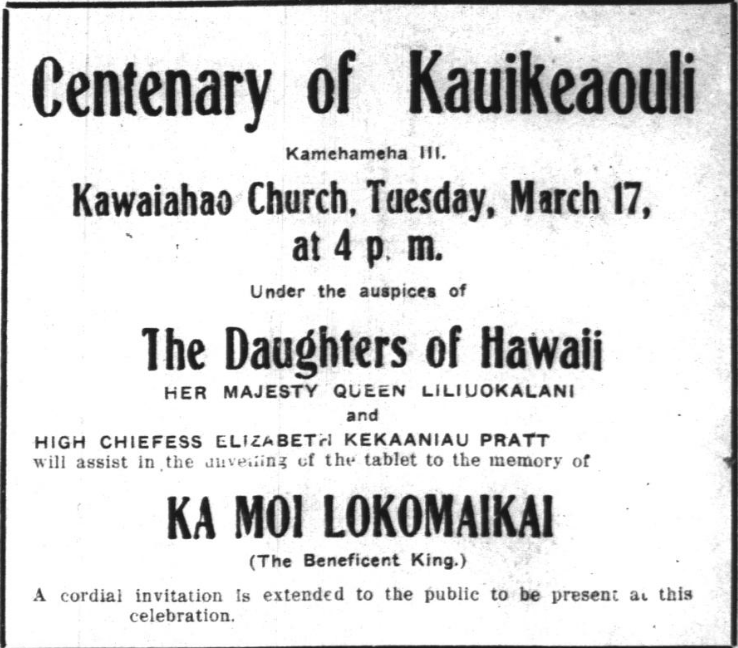
Public invitation to celebration of Centenary of Kauikeaouli, 1914.

Centenary of Kauikeaouli

Kamehameha III.

Kawaiahao Church, Tuesday, March 17,

at 4 p. m.

Under the auspices of

The Daughters of Hawaii

HER MAJESTY QUEEN LILIUOKALANI

and

HIGH CHIEFESS ELIZABETH KEKAANIAU PRATT

will assist in the unveiling of the tablet to the memory of

KA MOI LOKOMAIKAI

(The Beneficent King.)

A cordial invitation is extended to the public to be present at this celebration.

(Star Bulletin, 3/11/1914, p. 8)

Centenary of Kauikeaouli

Honolulu Star-Bulletin, Volume XXI, Number 6840, Page 8. March 11, 1914.