Unknown's avatar

About nupepa

Just another place that posts random articles from the Hawaiian Newspapers! It would be awesome if this should become a space where open discussions happen on all topics written about in those papers!! And please note that these are definitely not polished translations, but are just drafts!!! [This blog is not affiliated with any organization and receives no funding. Statements made here should in now way be seen as a reflection on other organizations or people. All errors in interpretation are my own.]

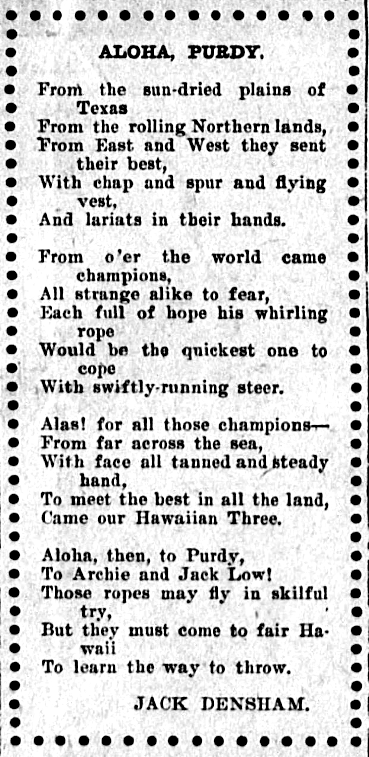
Mele and more for Ikua Purdy and the lads …in English, 1908.

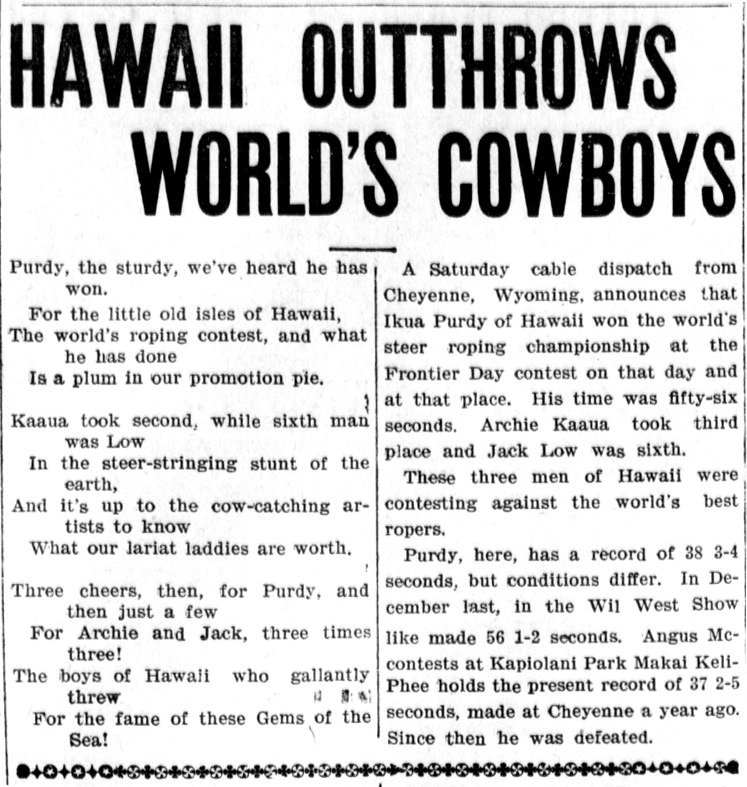
HAWAII OUTTHROWS WORLD’S COWBOYS

Purdy, the sturdy, we’ve heard he has won.
For the little old isles of Hawaii,
The world’s roping contest, and what he has done
Is a plum in our promotion pie.

Kaaua took second, while sixth man was Low
In the steer-stringing stunt of the earth,
And it’s up to the cow-catching artists to know
What our lariat laddies are worth.

Three cheers, then, for Purdy, and then just a few
For Archie and Jack, three times three!
The boys of Hawaii who gallantly threw
For the fame of these Gems of the Sea!

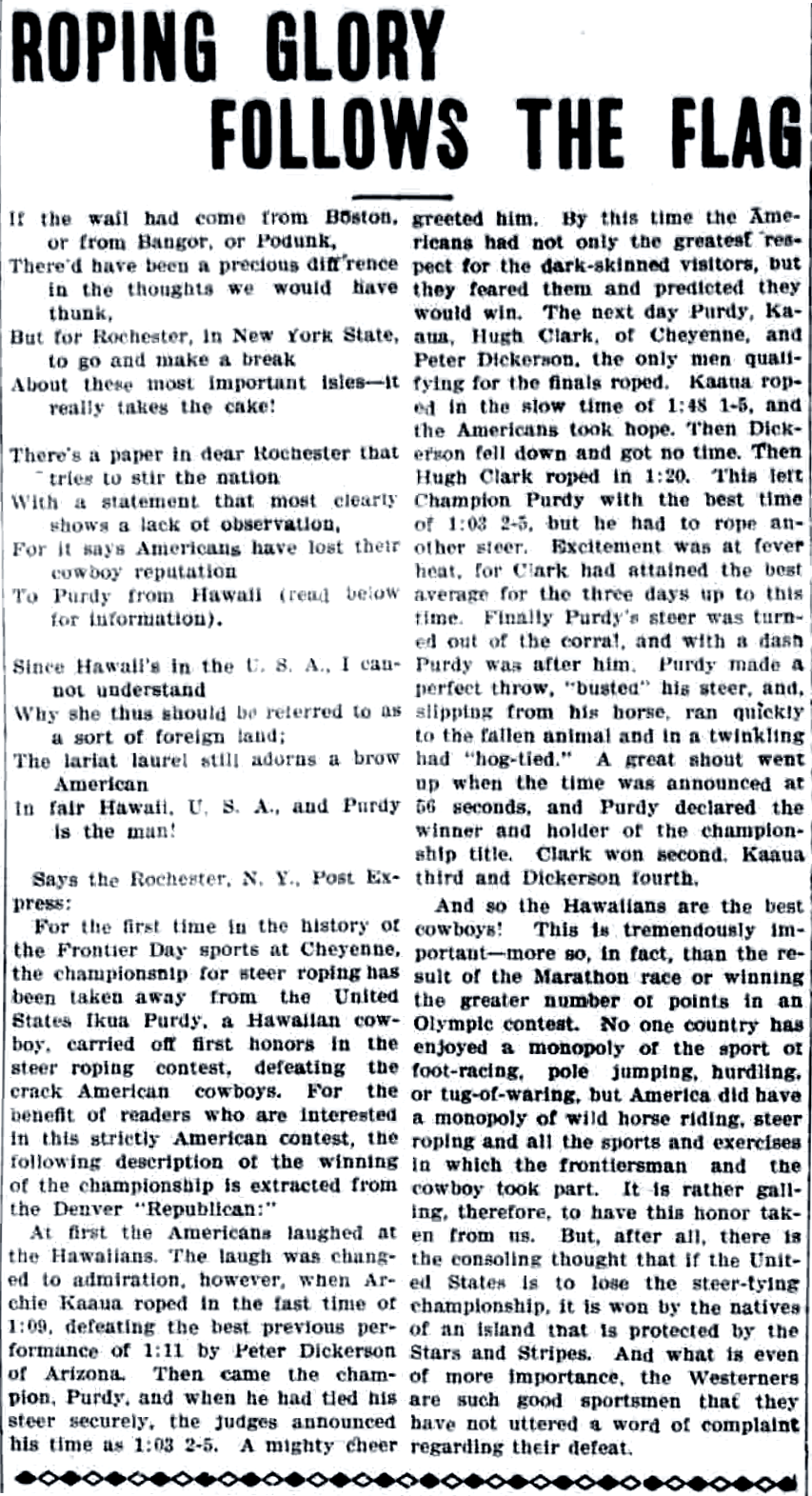
A Saturday cable dispatch from Cheyenne, Wyoming, announces that Ikua Purdy of Hawaii won the world’s steer roping championship at the Frontier Day contest on that day and at that place. His time was fifty-six seconds. Archie Kaaua took third place and Jack Low was sixth.

These three men of Hawaii were contesting against the world’s best ropers.

Purdy, here, has a record of 38 3-4 seconds, but conditions differ. In December last, in the Wild West Show [contests at Kapiolani Park Makai Keliilike made 56 1-2 seconds. Angus McPhee holds the present record of 37 2-5 seconds, made at Cheyenne a year ago. Since then he was defeated.

(Hawaiian Star, 8/28/1908, p. 6)

HAWAII OUTTHROWS WORLD'S COWBOYS

Hawaiian Star, Volume XVI, Number 5117, Page 6. August 24, 1908.

Ikua Purdy in the movies, 1908.

IKUA PURDY SHOWN IN MOVIES.

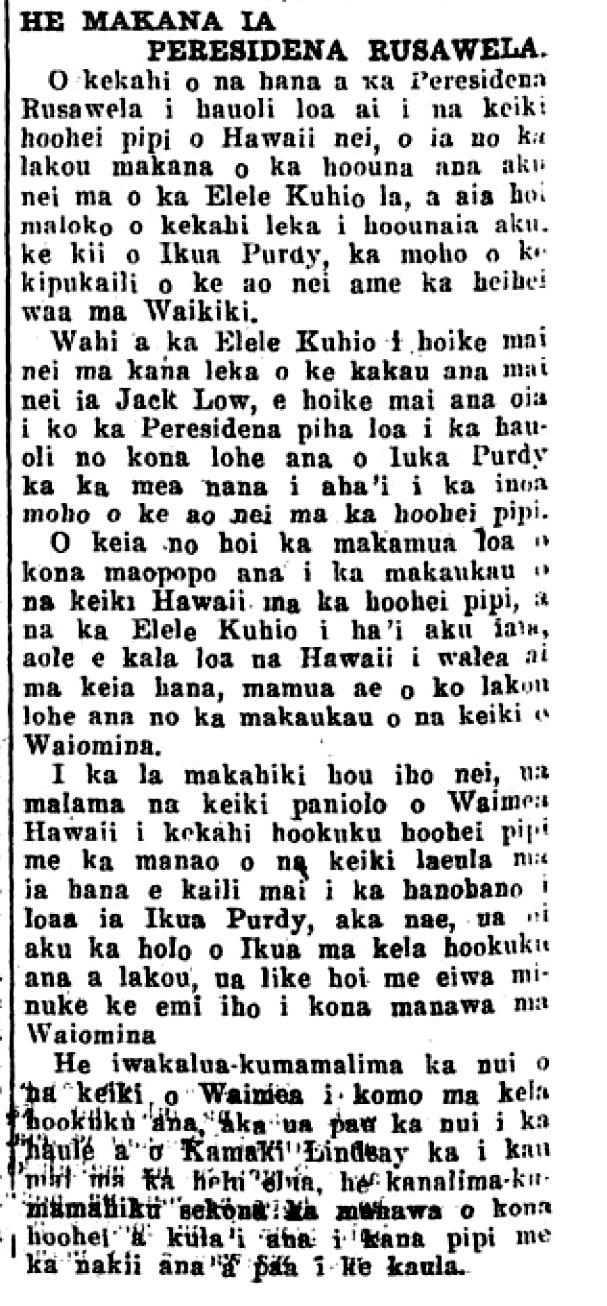
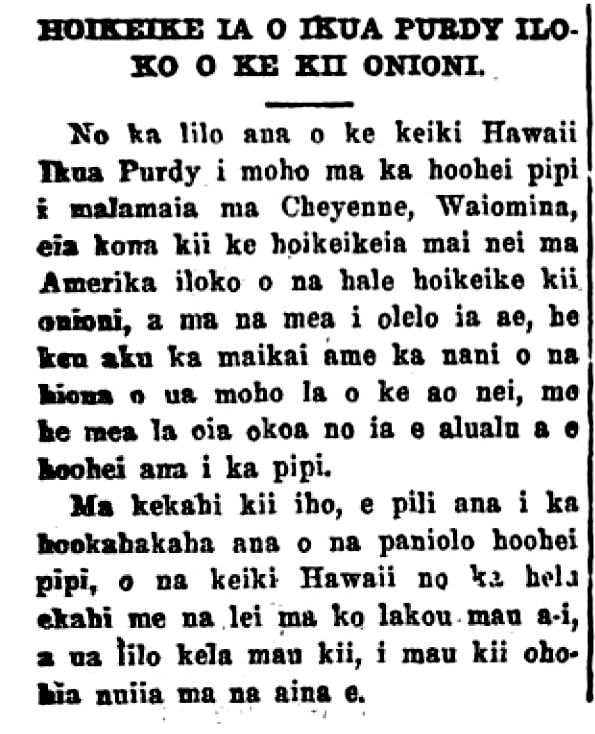
Because the Hawaiian boy Ikua Purdy became champion at the steer roping held at Cheyenne, Wyoming, his picture is being shown in America in movie theaters, and from what is being said, the images of that champion of the world being shown are truly fine and beautiful, as if it actually is him chasing and roping the steer.

In one of the scenes showing the parading of the steer-roping cowboys, the Hawaiian boys are the finest as they don lei about their necks; and these movies are becoming highly acclaimed in lands outside Hawaii.

(Kuokoa, 10/16/1908, p. 8)

HOIKEIKE IA O IKUA PURDY ILOKO O KE KII ONIONI.

Ka Nupepa Kuokoa, Buke XLIII, Helu 42, Aoao 8. Okatoba 16, 1908.

More on the famous paniolo of Waimea, 1908.

The Boys of Waimea are Victorious!

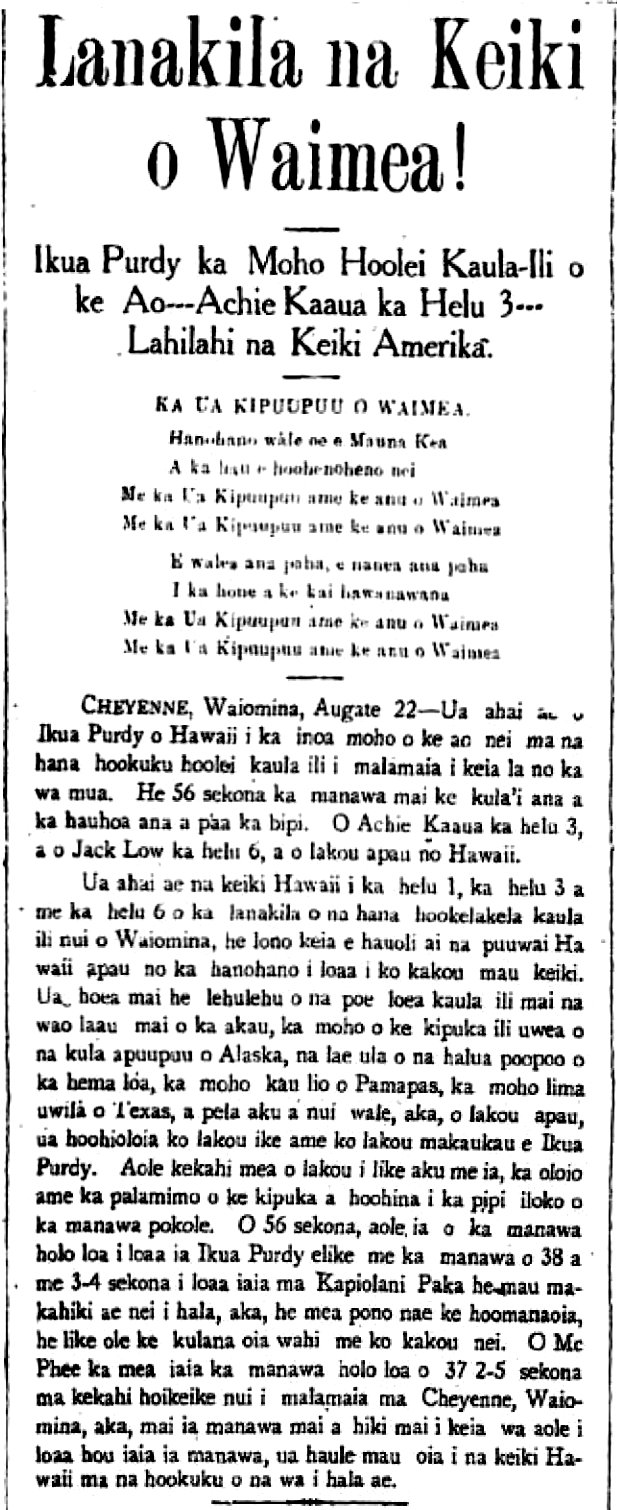
Ikua Purdy is the Champion Roper of the World—Archie Kaaua took 3rd—the American Boys are Weak¹.

KA UA KIPUUPUU O WAIMEA.

Hanohano wale no o Mauna Kea
A ka hau e hoohenoheno nei
Me ka Ua Kipuupuu ame ke anu o Waimea

E walea ana paha, e nanea ana paha
I ka hone a ke kai hawanawana
Me ka Ua Kipuupuu ame ke anu o Waimea

CHEYENNE, Wyoming, August 22—Ikua Purdy of Hawaii took the name of champion of the world in the roping contest held today for the first time. It took 56 seconds from the release of the steer until it was tied fast. Archie Kaaua [Achie Kaaua] took 3rd, and Jack Low took 6th, and they are all from Hawaii.

The Hawaiian boys took 1st, 3rd, and 6th places in the great contest of Wyoming; this is news which all Hawaiian hearts can be happy about, for the honor garnered by our boys. Many expert ropers showed up, from the forests of the north, the champion of the wire lasso of the rugged plains of Alaska, the experts from the furrowed lands of the far south, the champion rider of the Pampas, the lightning-handed champion of Texas, and so many more; however, all of their knowledge and preparation was overcome by Ikua Purdy. Not one of them was his match, with his swift and skilled lassoing and felling of the steer in short time. 56 seconds was not the fastest time made by Ikua Purdy like the 38 3/4 seconds he achieved at Kapiolani Park some years earlier, however, it should be kept in mind that the conditions there are not the same as ours. McPhee is the one with the fastest time, 37 2/5 seconds gotten at a big contest held in Cheyenne, Wyoming, but from that time to now, he did not make that time again; he was constantly defeated by the Hawaiian boys in contests after that.

THE KIPUUPUU RAIN OF WAIMEA.

Glorious is Mauna Kea
Graced with snow
With the Kipuupuu Rain and the cold of Waimea

Relaxing at ease
At the soft whispering sea
With the Kipuupuu Rain and the cold of Waimea

¹I’m not sure if “Lahilahi” here is referring to the American boys being “deflated”…

(Kuokoa Home Rula, 8/28/1908, p. 1)

Lanakila na Keiki o Waimea!

Kuokoa Home Rula, Buke VI, Helu 35, Aoao 1. Augate 28, 1908.

The fame of the Hawaiian paniolo reaches Wyoming, 1908.

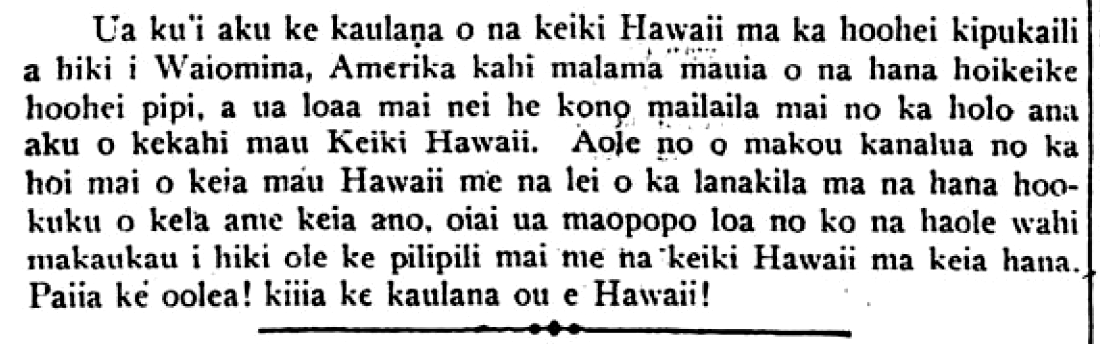
The fame of the Hawaiian boys in their lassoing has spread to Wyoming, America, where the steer roping contest is always held, and an invitation was received from there for some Hawaiian Boys to attend. We have no doubts that these Hawaiians will return adorned in victory in the various contests, being that it is clear that the little ability of the haole cannot match that of the Hawaiian boys in this skill. Paiia ke oolea!¹ O Hawaiians, go fetch your glory!

¹Is anyone familiar with the exclamation: “Pai ia ke oolea!”?

(Kuokoa, 6/5/1908, p. 4)

Ua kuʻi aku ke kaulana o na keiki Hawaii...

Ka Nupepa Kuokoa, Buke XLIII, Helu 23, Aoao 4. Iune 5, 1908.

Famed cowboy Ikuwa Purdy dies, 1945.

Ikuwa Purdy Passes

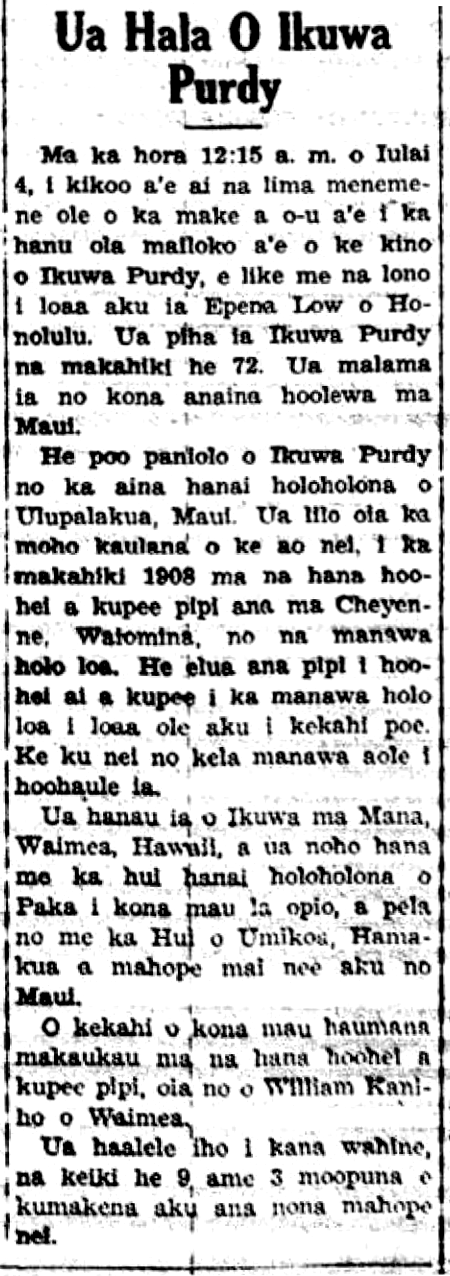
At 12:15 a. m. on July 4, the incompassionate hands of death reached out and plucked the life breath from the body of Ikuwa Purdy, as per the news received by Eben Low [Epena Low] of Honolulu. Ikuwa Purdy was 72 years old. His funeral will be held on Maui.

Ikuwa Purdy was the head cowboy at the ranch at Ulupalakua, Maui. He became the famous champion of the world in the year 1908 in roping and tying steer at Cheyenne, Wyoming [Waiomina], for speed. He roped and tied two steer at a record speed not achieved by anyone else. That record still stands and has not been broken.

Ikuwa was born in Mana, Waimea, Hawaii, and lived and worked at Parker Ranch [hui hanai holoholona o Paka] in his youth, and then with the Umikoa Ranch, Hamakua, and then he moved to Maui.

One of his proficient pupils at roping and tying cattle is William Kaniho of Waimea.

He left his wife, 9 children, and 3 grandchildren, behind grieving for him.

(Hoku o Hawaii, 7/18/1945, p. 2)

Ua Hala O Ikuwa Purdy

Ka Hoku o Hawaii, Volume XL, Number 12, Page 2. Iulai 18, 1945.

Kaulana no na paniolo pipi… 1905

THE THREE COWBOYS OF WAIMEA: WILLIE SPENCER, IKUA PURDY, AND ARCHIE KAAUA.

[Indeed famous are the cowboys
Attractive on their horses
They wear a lei and a large handkerchief
You admire them when you see them]

(Kuokoa, 11/10/1905, p. 3)

NA KEIKI PANIOLO EKOLU O WAIMEA...

Ka Nupepa Kuokoa, Buke XLIII, Helu 45, Aoao 3. Novemaba 10, 1905.

Still more on the Makee, the Malulani, and a reminder on naming, 1897.

[Found under: “ALL ALONG THE DOCKS”]

While leaving Kapaa at 2:30 Wednesday the James Makee was blown ashore. The W. G. Hall went to her assistance and, after lightering, the vessel was taken off three hours later. Part of the keel was torn off; two knees and one beam split; part of the anchor stock stuck through the vessel three feel below water. The Mikahala escorted the Makee to port.

[It is good to at least be aware that many times, Hawaiians called things (boat, for instance) a different name from what it was called in English. Here you see the W. G. Hall mentioned. It might sound more familiar to you as the Malulani.

Spelling is also varied in Hawaiian on occasion. You would expect in the Hawaiian-Language Newspapers, the James Makee to be written Kimo Maki (which it is at times), but it is also seen as Kimo Makee, James Maki, and James Makee as well! On a somewhat related note, Ena Road in Waikiki is not pronounced like “ena” as is so often heard today from the youngsters, but it is pronounced like “ina” and refers to the old-time Ing Family. So you will see in the Hawaiian-Language Newspapers, John Ena, John Ina, Keoni Ena, Keoni Ina…

I would like to see an easy online reference done for English/Hawaiian name variants done!]

(Hawaiian Star, 1/2/1897, p. 2)

While leaving Kapaa at 2:30...

The Hawaiian Star, Volume III, Number 1160, Page 2. January 2, 1897.

More on the Makee, 1897.

JAMES MAKEE AGROUND.

Accident to One of the Inter-Island Boats at Kapaa.

The James Makee met with a streak of misfortune on her last trip to Kauai. She was leaving Kapaa about 2:30 p. m. on Wednesday with 650 bags of sugar on board. The wind was blowing a perfect gale, and the Makee was blown upon the knuckle, sticking fast.

The W. G. Hall¹ came over from Koloa to the assistance of the Makee.

Capt. Peterson gave orders to have the sugar discharged. Something over 200 bags was put into the W. G. Hall and the rest was taken back to Kapaa.

The Makee had her stern lightened, and she swung around into deep water about 5 p. m. Five hours later she had all her cargo out, and she slid off with her keel very badly damaged.

The Makee left for Koloa at 8:30 a. m. on Thursday and arrived in Hanamaulu at 7:30 p. m. same day. Here she met the Mikahala and the two came to Honolulu together.

¹The W. G. Hall was also known as Malulani.

(Hawaiian Gazette, 1/5/1897, p. 5)

JAMES MAKEE AGROUND.

The Hawaiian Gazette, Volume XXXII, Number 2, Page 5. January 5, 1897.

Auhea iho nei la o Makee, A ka Malulani la e huli hele nei… 1897.

Kimo Maki Near Disaster.

Tuesday Night past, when the steamship James Makee was in Kapaa, Kauai, while the strong winds were blowing upon us and there as well, it was blown towards land while it attempted to head out to sea. It was stuck for two hours, and during this time, its cargo was unloaded, and the Malulani arrived to give assistance. Looking from the underside, it was seen that part of its keel [kila] was lost, two knees [kuli] and one beam [kua] at the stem were split, and there was a hole underneath, perhaps three feet below sea level at the base of the anchor. The Malulani accompanied it until arriving here in the morning of this past Friday. It will be placed atop the marine railway.

[I am guessing that this is the incident which inspired the famous composition still often heard today!]

(Makaainana, 1/4/1897, p. 8)

Kokoke e Poino ke Kimo Maki.

Ka Makaainana, Buke VII, Ano Hou—Helu 1. Aoao 8. Ianuari 4, 1897.

Updated Elepaio Story, 1894.

DON’T WORRY.

O Hawaiian people, don’t worry and don’t be uncertain. for we have publicly shown that there are three great powers of the world who have granted independence to us in 1843, that being France, Britain, and America.

But when our land was stolen and our beloved Queen was taken from her throne and our land stood bare without any beauty remaining,

During that time, we composed our protest, along with Queen Liliuokalani, and left if for America to make right; and it for this that we wait until today. But O Nation, do recall one of the famous stories of our beloved land, this being:

The bird called Elepaio called out loudly:

“O Io, O Io, I was hit by the rock of the man.”

Io answered, “Who was at fault?”

“I was wrong for pecking at the huewai of the man,” answered Elepaio.

“You are indeed at fault for puncturing the huewai of the man; let it be judged by the many birds,” was Io’s answer.

It was so, Elepaio was judged; he came upon Oo, and his answer was the same, that it be judged by the many birds.

Elepaio arrived before Pueonuiokona, and his answer was the same.

But Pueonuiokona went on to say, “Say Elepaio, I will call our many fellow birds to come together.”

In no time, all the birds came together, and Pueonuiokona revealed the reason for them being called to assemble, like this:

“Before me appeared your younger sibling with his protest, and when I heard correctly, I knew he was wrong, however, the best thing to do would be for us to send Iwa before the man to whom belonged the huewai that Elepaio pecked, and to tell him that Elepaio was guilty, and it is for him to set the punishment.”

And it was so, Iwa went to the place of the man to whom belonged the huewai, and told him of their decision; this is what the man said:

“You are forgiven, and don’t do anymore harmful acts.”

So we compare this story with the actions carried out upon us, and we see that they are exactly the same.

For America totally blames itself for the wrong done by Elepaio to our huewai.

But it is going around being judged by the many birds, and is currently in Europe.

So therefore, O Nation, we will receive a fair judgement from Iwa, the messenger that is being sent; and that will be when the dignity shall be awarded to our side through the judgement of the crimes carried out by Stevens Elepaio.

(Leo o ka Lahui, 10/11/1894, p. 2)

MAI HOPOHOPO OUKOU.

Ka Leo o ka Lahui, Buke II, Helu 1047, Aoao 2. Okatoba 11, 1894.