Primo Beer
QUEEN STREET
You only can get this treat here
All orders filled promptly; why don’t you give it a try.
(Hawaii Holomua, 12/4/1912, p. 3)
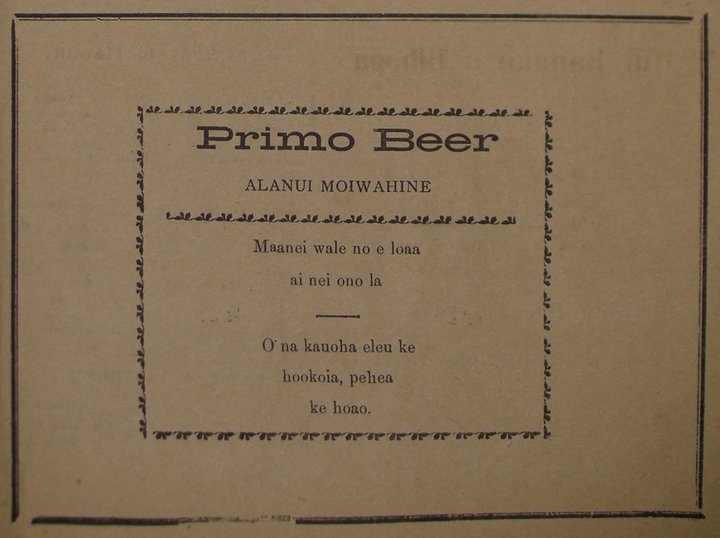
Hawaii Holomua, Buke ?, Helu ?, Aoao 3. Dekemaba 4, 1912.

QUEEN STREET
You only can get this treat here
All orders filled promptly; why don’t you give it a try.
(Hawaii Holomua, 12/4/1912, p. 3)
Hawaii Holomua, Buke ?, Helu ?, Aoao 3. Dekemaba 4, 1912.
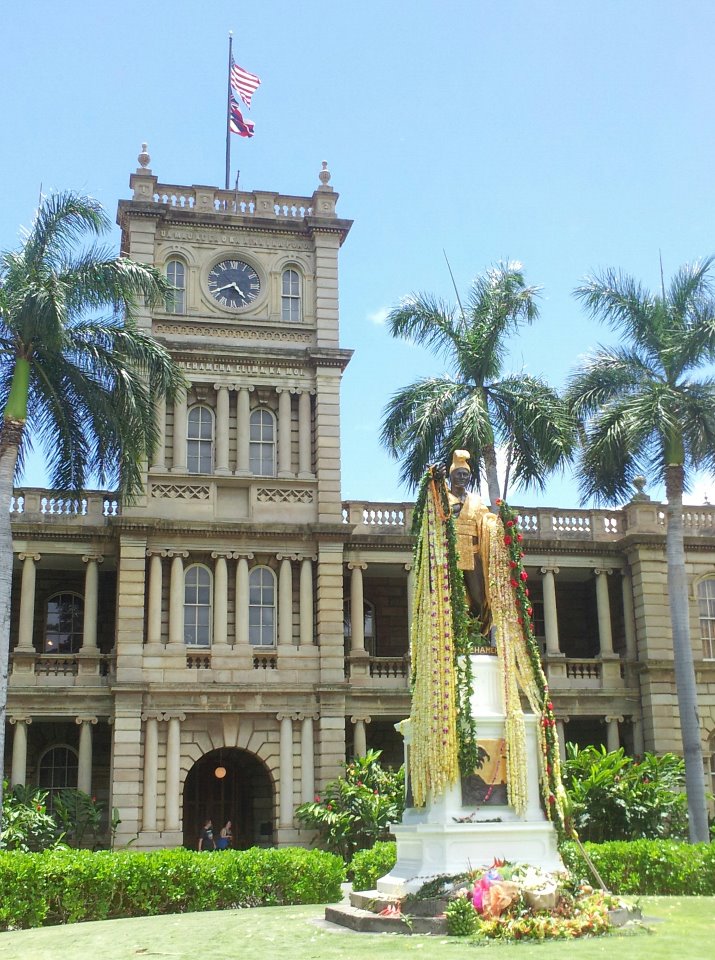
Kamehameha Statue. June 9, 2012.
All members of the Ahahui Kamehameha Division 1 are requested to assemble in the Building of the Secret Society, Odd Fellows, at 10 in the morning of this coming Sunday, June 9, 1912, to go on to pray in Kawaiahao Church, as is done in all past years; and they are also ordered to assemble within Kapiolani Hale at half past 8 on the morning of Tuesday, the 11th of June, 1912, to go and decorate the statue of Kamehameha I in front of the Government Building. Do not forget this order!
(Kuokoa, 6/7/1912, p. 8)
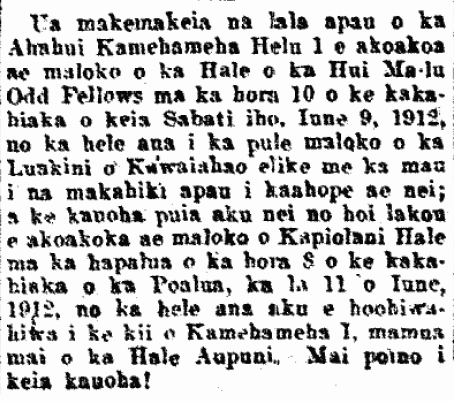
Ka Nupepa Kuokoa, Buke XLVIII, Helu 23, Aoao 8. Iune 7, 1912.
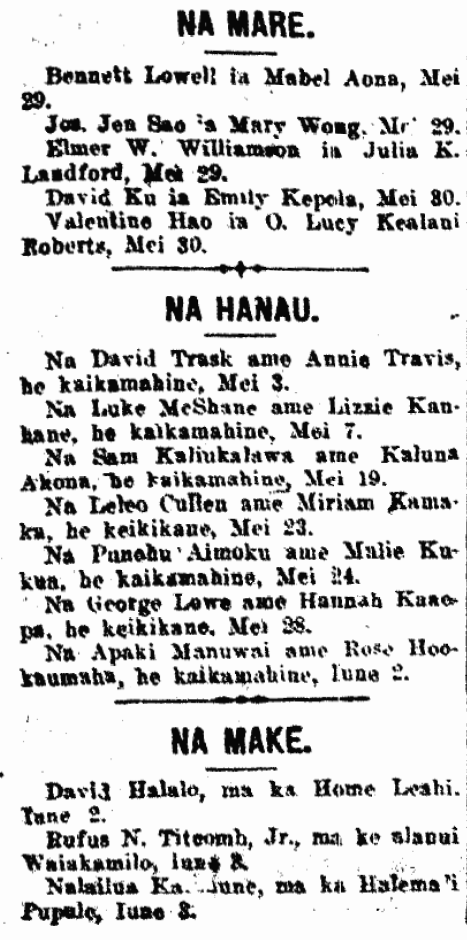
Bennett Lowell to Mabel Aona, May 29.
Joseph Jen Sao to Mary Wong, May 29.
Elmer W. Williamson to Julia K. Landford, May 29.
David Ku to Emily Kepola, May 30.
Valentine Hao to O. Lucy Kealani Roberts, May 30.
To David Trask and Annie Travis, a daughter, May 3.
To Luke McShane and Lizzie Kauhane, a daughter, May 7.
To Sam Kaliukalawa and Kaluna Akona, a daughter, May 19.
To Leleo Cullen and Miriam Kamaka, a son, May 23.
To Punohu Aimoku and Malie Kukua, a daughter, May 24.
To George Lowe and Hannah Kaaepa, a son, May 28.
To Apaki Manuwai and Rose Hookaumaha, a daughter, June 2.
David Halalo at Leahi Home, June 2.
Rufus N. Titcomb, Jr., on Waiakamilo Road, June 3.
Nalailua Ka[???]une, in the Insane Asylum, June 3.
[The last name is illegible but most likely if this page (and all of the rest of the newspapers) were re-photographed clearly, priceless information that we cannot see now will become clear! No one wants a bunch of @s in the middle of a kupuna’s name. There would be no way to find that name in a word search.]
(Kuokoa, 6/7/1912, p. 8)
Ka Nupepa Kuokoa, Buke XLVIII, Helu 23, Aoao 8. Iune 7, 1912.
On the 22nd of April, the King spoke at Lanakila Church in Hauula, and at the end of his royal speech, Keaunui brought his youngest daughter before the King; the King kissed the small girl, and the King asked, “Is this your daughter?” Keaunui said, “Yes, she is mine, her mother is over there, she is pregnant again.” The King responded, “When she gives birth, name the baby Kahooululahui,”¹ and the word of the King was agreed to. On the night of the 24th, when the King was in Ewa, at 2 o’clock at night, Mrs. Hellen K. Keaunui gave birth to a son, with J. L. Keaunui, and he was immediately named David Kahooululahui. He was the 13th of their children, they are just a small bit of the growing of the lahui; how blessed would be the nation if all the women from Hawaii to Kauai were like her.
¹”Hooulu Lahui” was Kalakaua’s famed motto, encouraging the increasing of the nation/race.
(Kuokoa, 5/9/1874, p. 2)

Ka Nupepa Kuokoa, Buke XIII, Helu 19, Aoao 2. Mei 9, 1874.
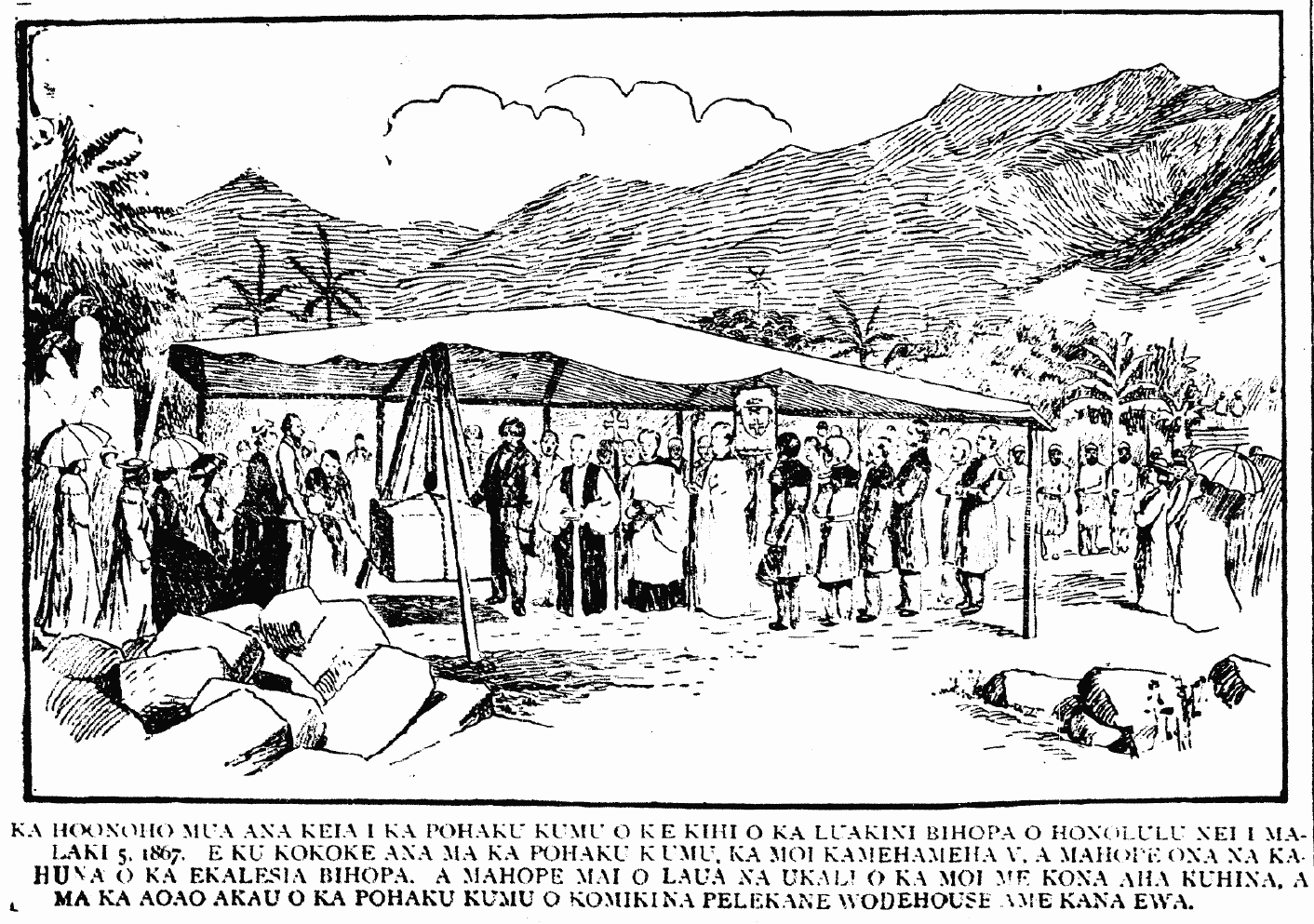
This is the first laying of the cornerstone of the Anglican Church of Honolulu, on March 5, 1867. Standing near the cornerstone is King Kamehameha V, and behind him are the priests of the Anglican Church. And behind those two are the attendants of the King and his Cabinet of Ministers, and to the right side of the cornerstone is the British Consul Wodehouse and his wife.
(Kuokoa, 11/30/1906, p. 2)
Ka Nupepa Kuokoa, Buke XLV, Helu 48, Aoao 2. Novemaba 30, 1906.
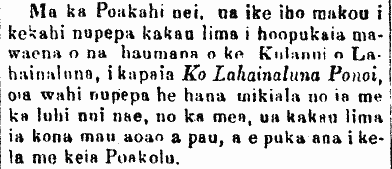
This Monday we saw a handwritten newspaper published amongst the students of the Lahainaluna College, called Ko Lahainaluna Ponoi; that paper is done promptly but with much effort, for each page is handwritten and it is published every Wednesday.
(Kuokoa, 9/12/1874, p. 3)
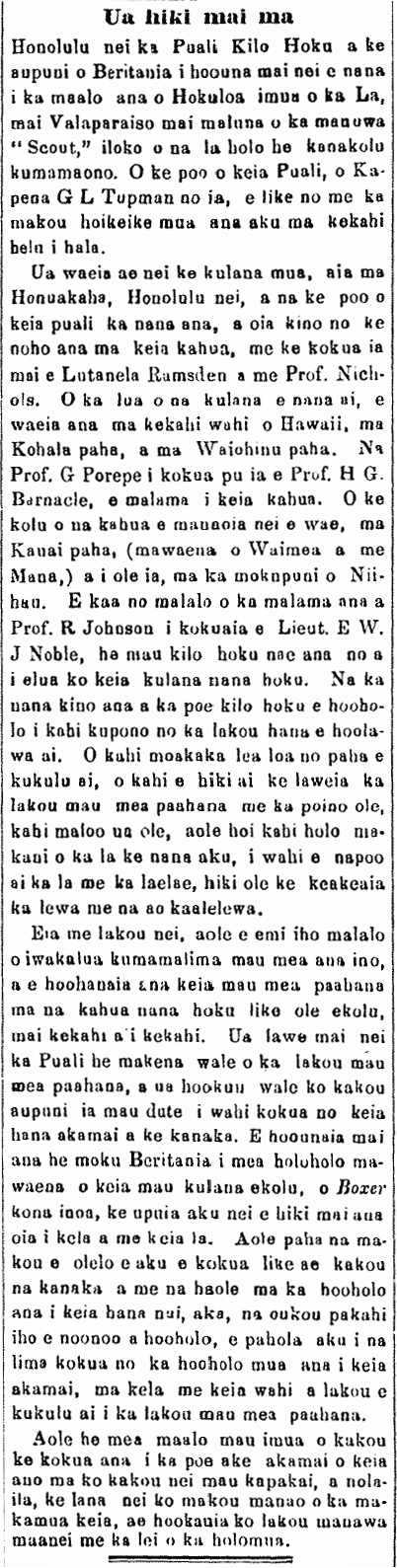
Honolulu, is the Astronomical Expedition sent by the British Empire to observe the transit of Venus in front of the Sun, from Valparaiso, aboard the warship “Scout,” in thirty-six days. The head of the Expedition is Captain G. L. Tupman, just as we explained in an earlier issue.
The first location was chosen at Honuakaha, Honolulu, and the head of this expedition will watch and it is he who will actually be at this location while being assisted by Lieutenant Ramsden and Prof. Nichols. The second location to observe from will be chosen from somewhere on Hawaii Island, perhaps in Kohala, or Waiohinu maybe. This place will be overseen by Prof. G. Porepe [Forbes] assisted by Prof. H. G. Barnacle. The third location under consideration is perhaps on Kauai (between Waimea and Mana), or on Niihau. This will be under the direction of Prof. R. Johnson assisted by Lieut. E. W. J. Noble, but this observation place will have two astronomers there. The observations of the astronomers will decide the right location suitable for their work. An area with great clarity will be built: somewhere that their instruments can easily be transported without being damaged, a place that is dry and without rain, and not somewhere that is seen to be windy during the day, a place that the sun goes down clearly, and the sky cannot be obstructed with drifting clouds.
With them are not less than twenty-five meteorologists [ana ino?] who will be put to work at each of the three observation areas. The Expedition brought along with them a great many workers, and our government has forgave those duties to help this scientific endeavor of man. A British vessel will be sent to travel between the three locations, named Boxer, and it is hoped that it will arrive everyday. It is not for us to say that we should all help, both Hawaiians and haole, to advance this great endeavor, but it is for each of you to think and decide to extend a helping hand to move forward this knowledge, at each of the locations where they set up their equipment.
It is not often that before us appears [opportunities] to assist scientists of this class in our shores, and therefore, we hope as this is the beginning, and that their time here will be adorned with the lei of progress.
(Kuokoa, 9/19/1874, p. 2)
Ka Nupepa Kuokoa, Buke XIII, Helu 38, Aoao 2. Sepatemaba 19e, 1874.
The British Man-of-war “Scout.”—On the evening of this Wednesday, this warship of the queen arrived with the expedition of the Group Observing the transit of Venus before the sun, after 36 days from Valparaiso. The reason for them not arriviving early as was planned was because the Observation Expedition did not arrive in Valparaiso before the date it was planned for them to leave there.
(Kuokoa, 9/14/1874, p. 3)
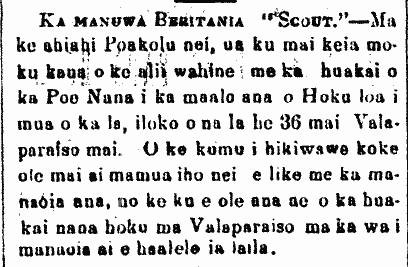
Ka Nupepa Kuokoa, Buke XIII, Helu 37, Aoao 3. Sepatemaba 12, 1874.
(Written for the Kuokoa)
The afternoon of this past Tuesday of this week, December 8th, was the day when Astronomers from times past and of these times believed that Venus [Hokuloa] would pass in front of the Sun, and it indeed did happen.
The Sun came out that morning shinning nicely, and its rays continued to shine forth with clarity until the second when Hokuloa’s was seen beginning to peep over at the edge of the sun. The heavens were clear and the floating clouds were banished away, with just one seen, the thick, black cloud surrounding the heavens.
Here are the places in Honolulu set aside by the people wanting to view the appearance of Hokuloa as it passed by: Honuakaha in Honolulu, the actual base of the Astronomers; the Government Surveying Office in the Government Building Aliiolani, for the Government Surveyor Laiana [C. J. Lyons]; the Labor Office, for David N. Flitner; Kapunahou [Punahou School], for the head of the Government Surveyors, W. D. Alekanedero [W. D. Alexander]; at Pawaa, for the Deputy Harbor Master of Honolulu, Captain Daniela [Daniel] Smith. And for the multitudes who just wanted a glimpse, they grabbed real telescopes and looked straight at the sun; and for those without telescopes, they grabbed shards of glass and placed them over candles until black, and then looked and could see.
From the base of the British Astronomers at Honuakaha, it was very calm, there were no one allowed entrance, there was no talking, no whispering, and nothing that would cause excitement was desired; a battalion of soldiers was sent to the observation area to guard their peace. The Astronomer Boys put their all into their work for which they were sent by the government at great expense. Not one of them has any complaints about Hawaii for they were provided and blessed with a totally clear sky, and perhaps we would not be mistaken to say that these astronomers were very lucky for getting this good day for which they will not forget Hawaii.
And by the kindness of the British Astronomers in Honolulu, we have these times below from various telescopes the Astronomers and others away from different places.
When Hokuloa was seen barely at the edge of the Sun, here are the different times of the British Astronomers:
Tupman, (Head Astronomer.) 3 [hr.], 7 [min.], 1 [sec.]
Noble, (Assistant Astronomer.) 3 [hr.], 7 [min.], 3 [sec.]
When Hokuloa began to clearly move into the face of the Sun, here are the various times from the Astronomers of Britain and those people from here:
Tupman, (Head Astronomer.) 3 [hr.], 35 [min.], 56 [sec.]
Noble, (Assistant.) 3 [hr.], 35 [min.], 54½ [sec.]
D. Smith (Of Hawaii.) 3 [hr.], 35 [min.], 54 [sec.]
C. J. Lyons (Of Hawaii.) 3 [hr.], 35 [min.], 54 [sec.]
D. N. Flitner (Of Hawaii.) 3 [hr.], 35 [min.], 58 [sec.]
The times seen by the last three were not taken into account by the Astronomers. However, there was not much difference between the times seen by the British Astronomers and our people keeping time. But it was surely a nice day for observing.
The slides taken were not as great as was hoped for, but they are indeed of much value.
(Kuokoa, 12/12/1874, p. 2)

Ka Nupepa Kuokoa, Buke XIII, Helu 50, Aoao 2. Dekemaba 12, 1874.

