More on the Makee, 1897.

JAMES MAKEE AGROUND.

Accident to One of the Inter-Island Boats at Kapaa.

The James Makee met with a streak of misfortune on her last trip to Kauai. She was leaving Kapaa about 2:30 p. m. on Wednesday with 650 bags of sugar on board. The wind was blowing a perfect gale, and the Makee was blown upon the knuckle, sticking fast.

The W. G. Hall¹ came over from Koloa to the assistance of the Makee.

Capt. Peterson gave orders to have the sugar discharged. Something over 200 bags was put into the W. G. Hall and the rest was taken back to Kapaa.

The Makee had her stern lightened, and she swung around into deep water about 5 p. m. Five hours later she had all her cargo out, and she slid off with her keel very badly damaged.

The Makee left for Koloa at 8:30 a. m. on Thursday and arrived in Hanamaulu at 7:30 p. m. same day. Here she met the Mikahala and the two came to Honolulu together.

¹The W. G. Hall was also known as Malulani.

(Hawaiian Gazette, 1/5/1897, p. 5)

JAMES MAKEE AGROUND.

The Hawaiian Gazette, Volume XXXII, Number 2, Page 5. January 5, 1897.

Auhea iho nei la o Makee, A ka Malulani la e huli hele nei… 1897.

Kimo Maki Near Disaster.

Tuesday Night past, when the steamship James Makee was in Kapaa, Kauai, while the strong winds were blowing upon us and there as well, it was blown towards land while it attempted to head out to sea. It was stuck for two hours, and during this time, its cargo was unloaded, and the Malulani arrived to give assistance. Looking from the underside, it was seen that part of its keel [kila] was lost, two knees [kuli] and one beam [kua] at the stem were split, and there was a hole underneath, perhaps three feet below sea level at the base of the anchor. The Malulani accompanied it until arriving here in the morning of this past Friday. It will be placed atop the marine railway.

[I am guessing that this is the incident which inspired the famous composition still often heard today!]

(Makaainana, 1/4/1897, p. 8)

Kokoke e Poino ke Kimo Maki.

Ka Makaainana, Buke VII, Ano Hou—Helu 1. Aoao 8. Ianuari 4, 1897.

A “fishing” accident, 1913.

MAIMED FROM AN EXPLOSION OF GIANT POWDER

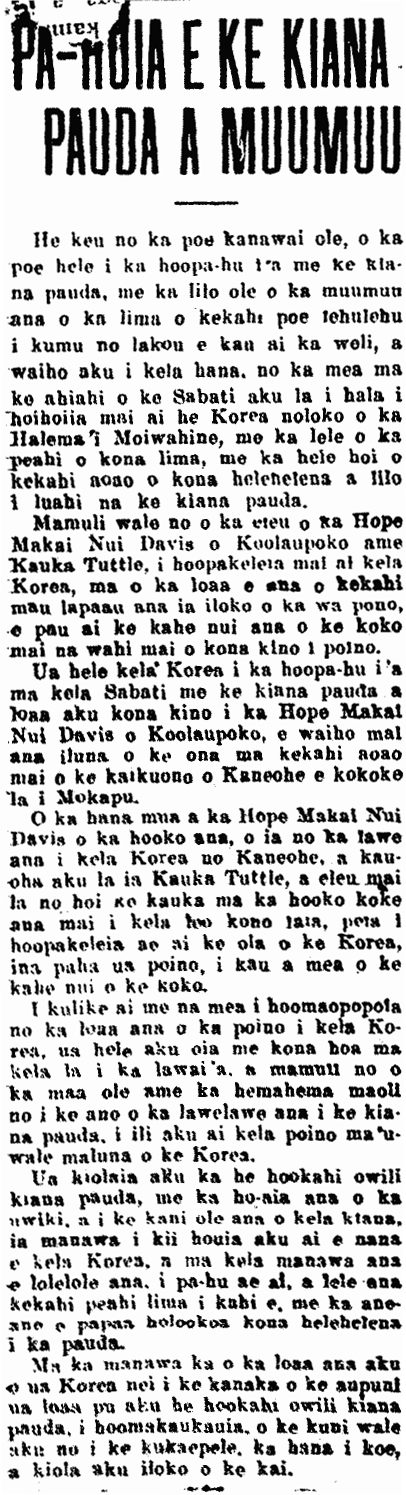
How reckless are the lawless, those who fish by setting off giant powder [kiana pauda] without fear resulting from the many people whose hands were maimed and without stopping this activity; because this past Sunday, a Korean was brought to the Queen’s Hospital with his hand blown off and a side of his face falling victim to the giant powder.

It was only because of the quick action taken by Deputy Sheriff [Hope Makai Nui] Davis of Koolaupoko and Dr. Tuttle that that Korean was saved by stopping the heavy bleeding from his injuries earlier in proper time.

That Korean went that Sunday to blast fish with giant power and his body was found by Deputy Sheriff Davis of Koolaupoko, he was lying on the sand on the side of Kaneohe Bay near Mokapu.

The first thing Deputy Sheriff Davis did was to bring that Korean to Kaneohe, and called for Dr. Tuttle; he hurried in answering to the call, and that is how the Korean’s life was spared; he was would have been in trouble because of the tremendous amount of bleeding.

According to what is understood about how that Korean received his injuries: he went with a friend that day to fish, and because he was not accustomed to and very inept at handling giant powder, that is how this senseless tragedy befell him.

A twist of giant powder was thrown after lighting the fuse, and because it did not go off, that Korean went to grab it and check it out, and while he was handling it, it exploded, and his had flew off, and almost his whole face was burnt by the powder.

When the government man found the Korean, found also was a twist of giant powder ready to ignite and throw into the ocean.

[Notice how the dash in the first word of the title, “pa-huia” signifies that the syllable after the dash is lengthened, and also how the passive “ia” is as usual, not set off—today therefore it would be written “pahū ʻia”

(Kuokoa, 3/21/1913, p. 1)

PA-HUIA E KE KIANA PAUDA A MUUMUU

Ka Nupepa Kuokoa, Buke VL, Helu 12, Aoao 1. Maraki 21, 1913.

The latest from Hana, Maui, 1877.

News from Hana.

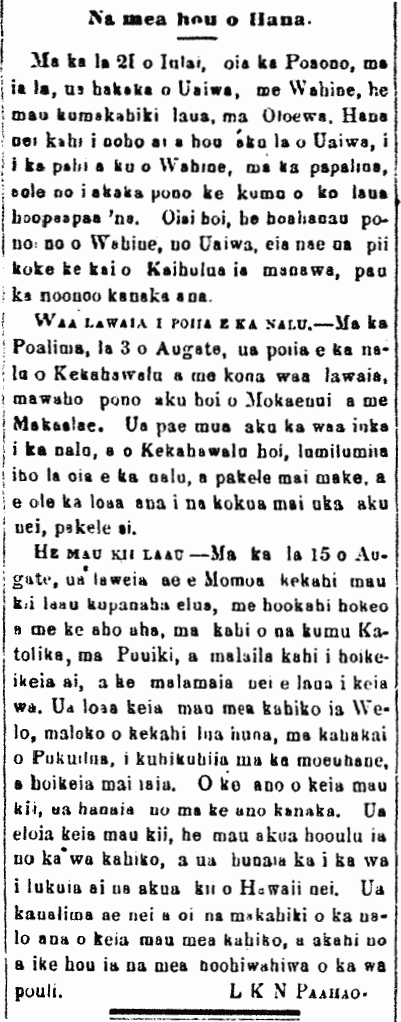
On the 21st of July, that being Saturday, on that day, Uaiwa fought with Wahine, both of them being contract laborers; they live at Oloewa, Hana, and Uaiwa stabbed Wahine with a knife in the cheek, and the reason for their quarrel is not known. Wahine is an actual cousin of Uaiwa, and here yet his temper soon flared up [pii koke ke kai o Kaihulua] and he lost his senses.

A fishing canoe pounded by a wave.—On Friday, the 3rd of August, Kekahawalu and his fishing canoe was hit by a wave right outside of Mokaenui and Makaalae. The canoe came ashore first carried by the waves, and as for Kekahawalu, he was pounded by the waves and escaped nearly dying; without receiving help from those on shore he would not have escaped.

Some wooden idols [kii laau].—On the 15th of August, brought by Momoa were a couple of amazing wooden images, along with one gourd calabash [hokeo] and some cordage [aho aha], to the Catholic teachers in Puuiki; there it was displayed, and the two of them are caring for them until this day. These old things were found by Welo in a hidden cave, seaside of Pukuilua, which was revealed to him in a dream, and was shown to him. The kii are made in the shape of people. It is said that these kii were procreative gods of the olden days, and were hidden away during the time that the god images of Hawaii nei were being destroyed. These old things have been hidden for fifty or more years, and it is the first time these revered things of the dark ages are being seen again.  L. K. N. Paahao.

(Kuokoa, 9/15/1877, p. 3)

Na mea hou o Hana.

Ka Nupepa Kuokoa, Buke XVI, Helu 37, Aoao 3. Sepatemaba 15, 1877.

Near tragedy caused by Kamehameha V’s deer, 1868.

[Found under: “LOCAL NEWS: Maui”]

Life saved from deer.—P. Kawelakawai of Kawela, Molokai wrote to us like this: On the 29th of April, I saw Kaukino, the one who barely survived. Here is the reason; one of the animals of our King, a deer set loose on his ranch, entered the sweet potato patch of at Kalamaula to eat the uala, and this man saw this and went to shoo it off; the animal rushed forward but he saw it coming, and it was but a few feet away and it caught him and thrust its antlers, whereupon he fell down, face thrown back. He was jabbed in the armpit, and the antler pierced through. His wife saw this happen and she brought him back to the houses and the man was very weak. We are relieved at the news following that letter that he has recovered.

[See earlier articles on the deer gifted to Kamehameha V. Deer imported from Japan in 1867. and Deer of Kamehameha V., 1867.]

(Kuokoa, 5/23/1868, p. 3)

Pakele ke ola i ke dia.

Ka Nupepa Kuokoa, Buke VII, Helu 21, Aoao 3. Mei 23, 1868.

Children rescued out at sea, 1924.

CHILDREN RESCUED FROM DEATH

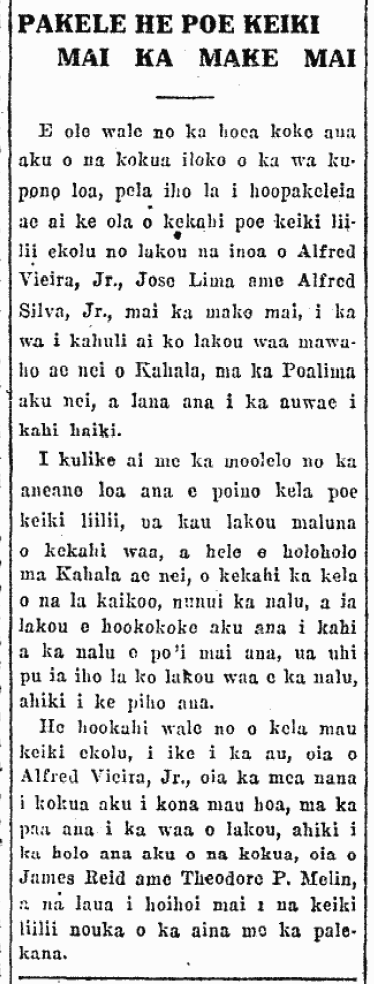
Because of the quick arrival of help at the right time, three small children were saved, named Alfred Vieira, Jr., Jose Lima, and Alfred Silva, Jr., from death, when their canoe overturned outside of Kahala, on this past Friday, and they were in dire straits.

According to the story of this near tragedy of the little children, they boarded a waa and travelled about Kahala; it was a day of rough seas and the waves were huge, and as they were approaching a crashing wave, their waa was covered over by the wave and went under.

There was but one of the three children who knew how to swim, that being Alfred Vieira, Jr., and he was the one who helped his two friends in holding on to their waa until help arrived: James Reid and Theodore P. Melin, who returned the little children to land safely.

[I wonder how this one act changed Hawaii’s future…]

(Kuokoa, 6/5/1924, p. 5)

PAKELE HE POE KEIKI MAI KA MAKE MAI

Ka Nupepa Kuokoa, Buke LXIII, Helu 23, Aoao 5. Iune 5, 1924.

Alligator loose?? 1928.

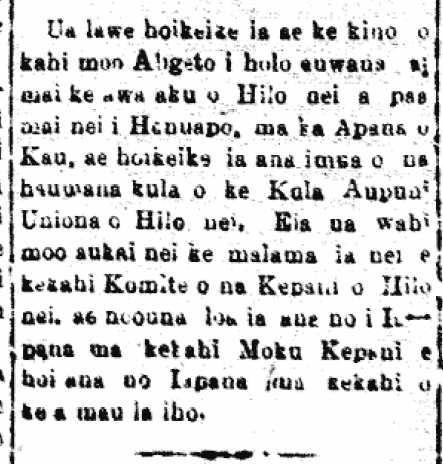
The body of an Alligator [moo Aligeto] that wandered from the port of Hilo and caught in Honuapo in Kau was taken to show before the school children of the Government School, Union, of Hilo nei. The sea navigating serpent is being cared for by a Japanese Committee of Hilo nei, and it will be sent all the way to Japan aboard a Japanese ship one of these upcoming days.

(Hoku o Hawaii, 1/10/1928, p. 2)

Ua lawe hoikeike ia ae ke kino o kahi moo Aligeto...

Ka Hoku o Hawaii, Buke XXI, Helu 32, Aoao 2. Ianuari 10, 1928.

POISONOUS SNAKE in Hawaii? 1912.

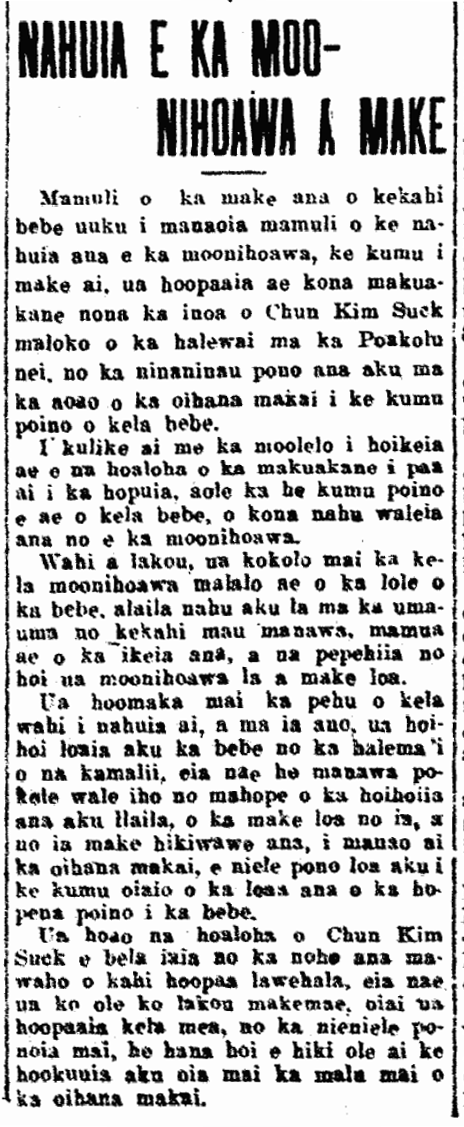
BITTEN BY A SNAKE AND DIED.

As a result of a small baby dying believed as a result of being bitten by a snake [moonihoawa], the parent, whose name is Chun Kim Suck was taken to jail on Wednesday to be questioned by the sheriff’s office as to the cause of the baby’s injuries.

According to statements of the friends of the father who was arrested, there was no other reason for the baby’s injuries other than that it was bitten by a snake.

According to them, the snake crawled beneath the clothing of the baby and then bit its chest several times before it was noticed, and then the snake was killed.

The bitten area began to swell at which point the baby was taken to the children’s hospital, however soon after being taken there, it died, and because of this quick death, the sheriff’s department decided to find the true cause of the tragic end of the baby.

Chun Kim Suck’s friends tried to bail him out of the hold for criminals, however, their wish was not granted because he is being held for interrogation, for which he cannot be released from the watch of the sheriff’s department.

(Kuokoa, 8/2/1912, p. 1)

NAHUIA E KA MOONIHOAWA A MAKE

Ka Nupepa Kuokoa, Buke XLVIII, Helu 31, Aoao 1. Augate 2, 1912.

English version of David Kanewanui’s Death Announcement, 1902.

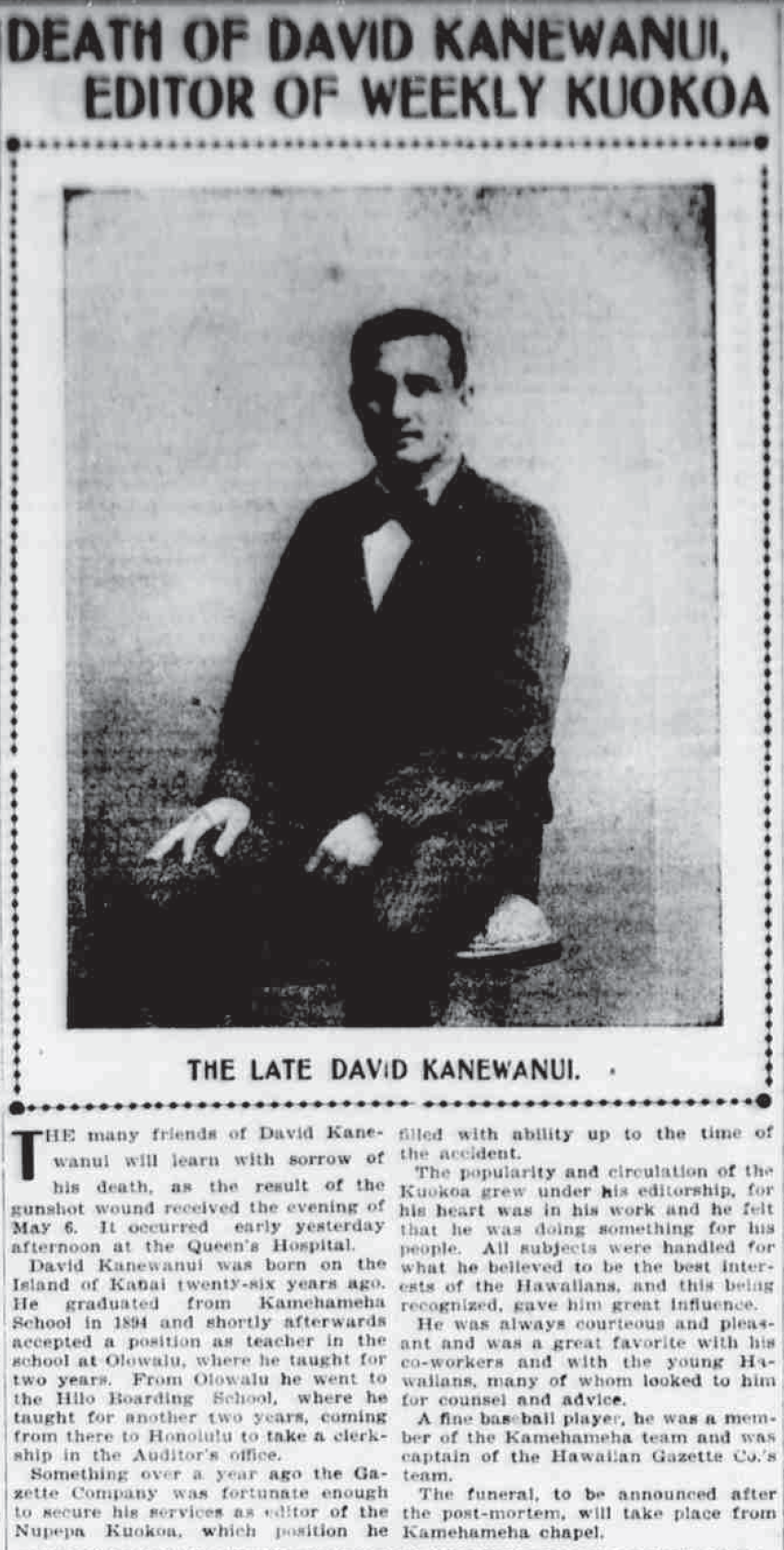
DEATH OF DAVID KANEWANUI, EDITOR OF WEEKLY KUOKOA

THE LATE DAVID KANEWANUI.

THE many friends of David Kanewanui will learn with sorrow of his death, as the result of the gunshot wound received the evening of May 6. It occured early yesterday afternoon at the Queen’s Hospital.

David Kanewanui was born on the Island of Kauai twenty-six years ago. He graduated from Kamehameha School in 1894 and shortly afterwards accepted a position as teacher in the school at Olowalu, where he taught for two years. From Olowalu he went to the Hilo Boarding School, where he taught for another two years, coming from there to Honolulu to take a clerkship in the Auditor’s office.

Something over a year ago the Gazette Company was fortunate enough to secure his services as editor of the Nupepa Kuokoa, which position he filled with ability up to the time of the accident.

The popularity and circulation of the Kuokoa grew under his editorship, for his heart was in his work and he felt that he was doing something for his people. All subjects were handled for what he believed to be the best interests of the Hawaiians, and this being recognized, gave him great influence.

He was always courteous and pleasant and was a great favorite with his co-workers and with the young Hawaiians, many of whom looked to him for counsel and advice.

A fine baseball player, he was a member of the Kamehameha team and was captain of the Hawaiian Gazette Co.’s team.

The funeral, to be announced after the post-mortem, will take place from Kamehameha chapel.

(Hawaiian Gazette, 5/23/1902, p. 5)

DEATH OF DAVID KANEWANUI, EDITOR OF WEEKLY KUOKOA

The Hawaiian Gazette, Volume XXXVII, Number 39, Page 5. May 23, 1902.

David Kanewanui did not return to the Kuokoa office ten days later. 1902.

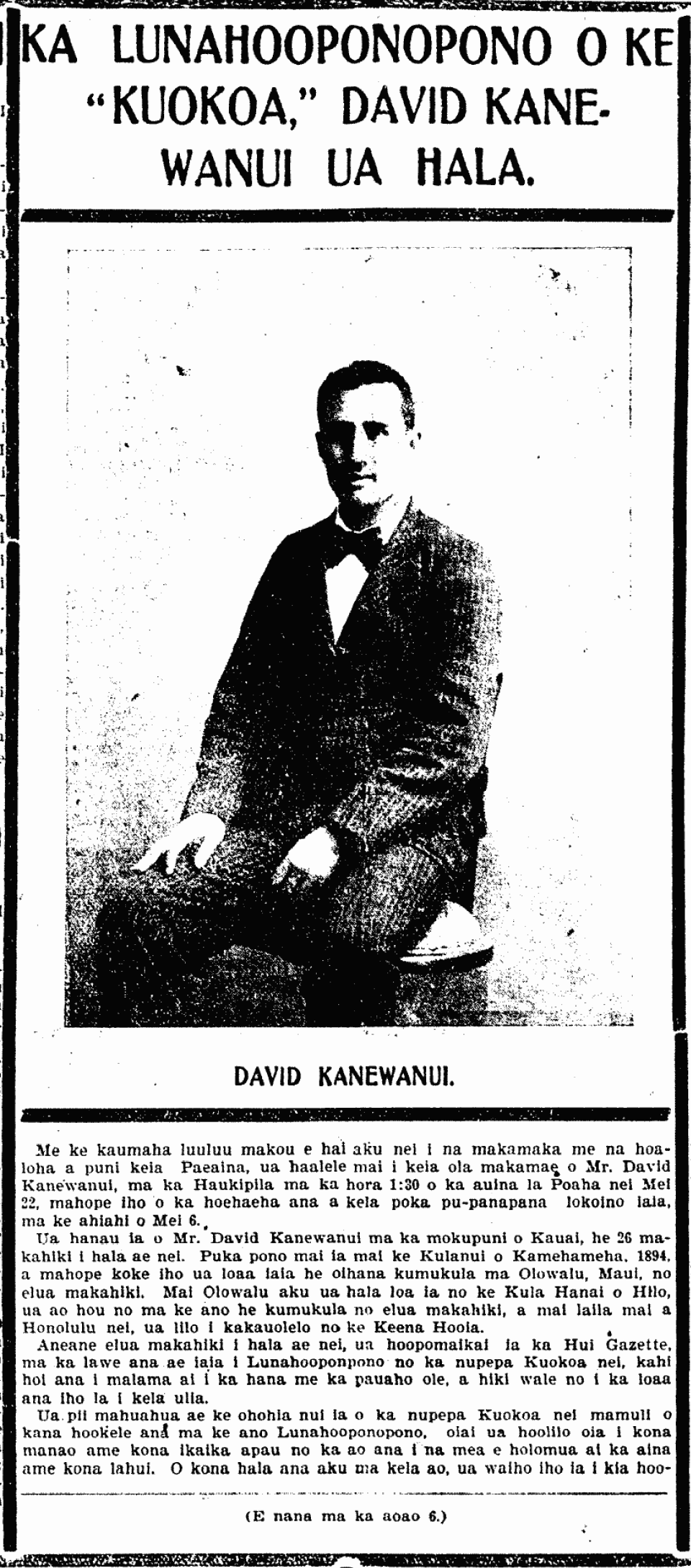
THE EDITOR OF THE “KUOKOA,” DAVID KANEWANUI HAS PASSED.

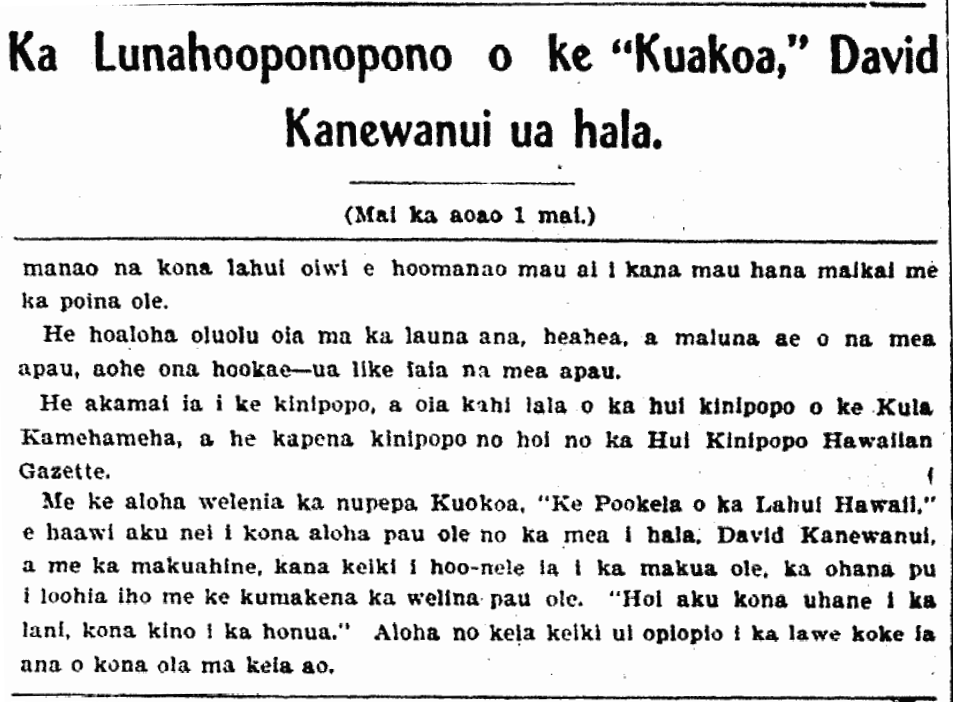
[For the translation of this article, see the following post, from the mirrored article appearing in The Hawaiian Gazette, 5/23/1902, p. 5. The last paragraph however does not appear in the English and reads:]

With feelings of anguish, the newspaper Kuokoa, “The Foremost of the Hawaiian People,” [“Ke Pookela o ka Lahui Hawaii”] offers its never-ending aloha to the one who passed, David Kanewanui; and to his mother, his children who are left without a parent, and to the family as well who are overcome with mourning, our never-ending love. “His soul returns to heaven, and his body to the earth.” Aloha to this youth whose life in this world was taken so early.

(Kuokoa, 5/23/1902, pp. 1 & 6)

KA LUNAHOOPONOPONO O KE "KUOKOA," DAVID KANEWANUI, UA HALA.

Ka Nupepa Kuokoa, Buke XL, Helu 21, Aoao 1. Mei 23, 1902.

Ka Lunahooponopono o ke "Kuakoa," David Kanewanui ua hala.

Ka Nupepa Kuokoa, Buke XL, Helu 21, Aoao 6. Mei 23, 1902.