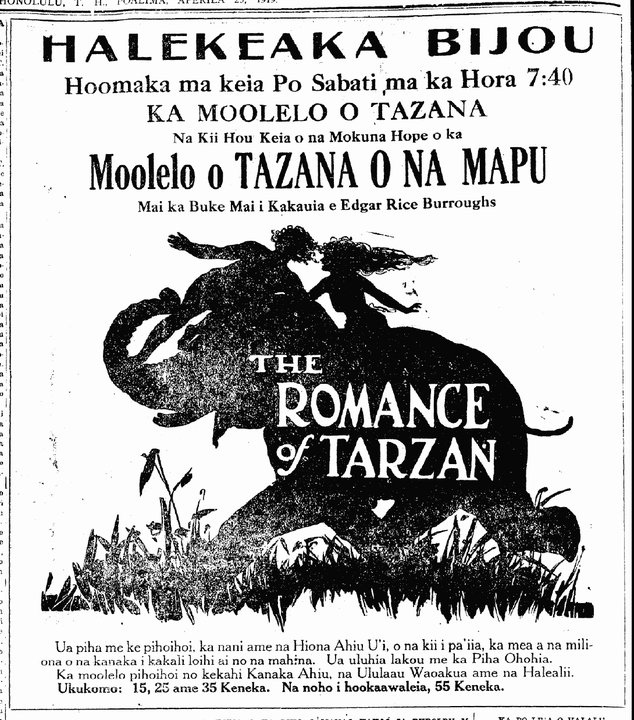
Tarzan ad, 1919.

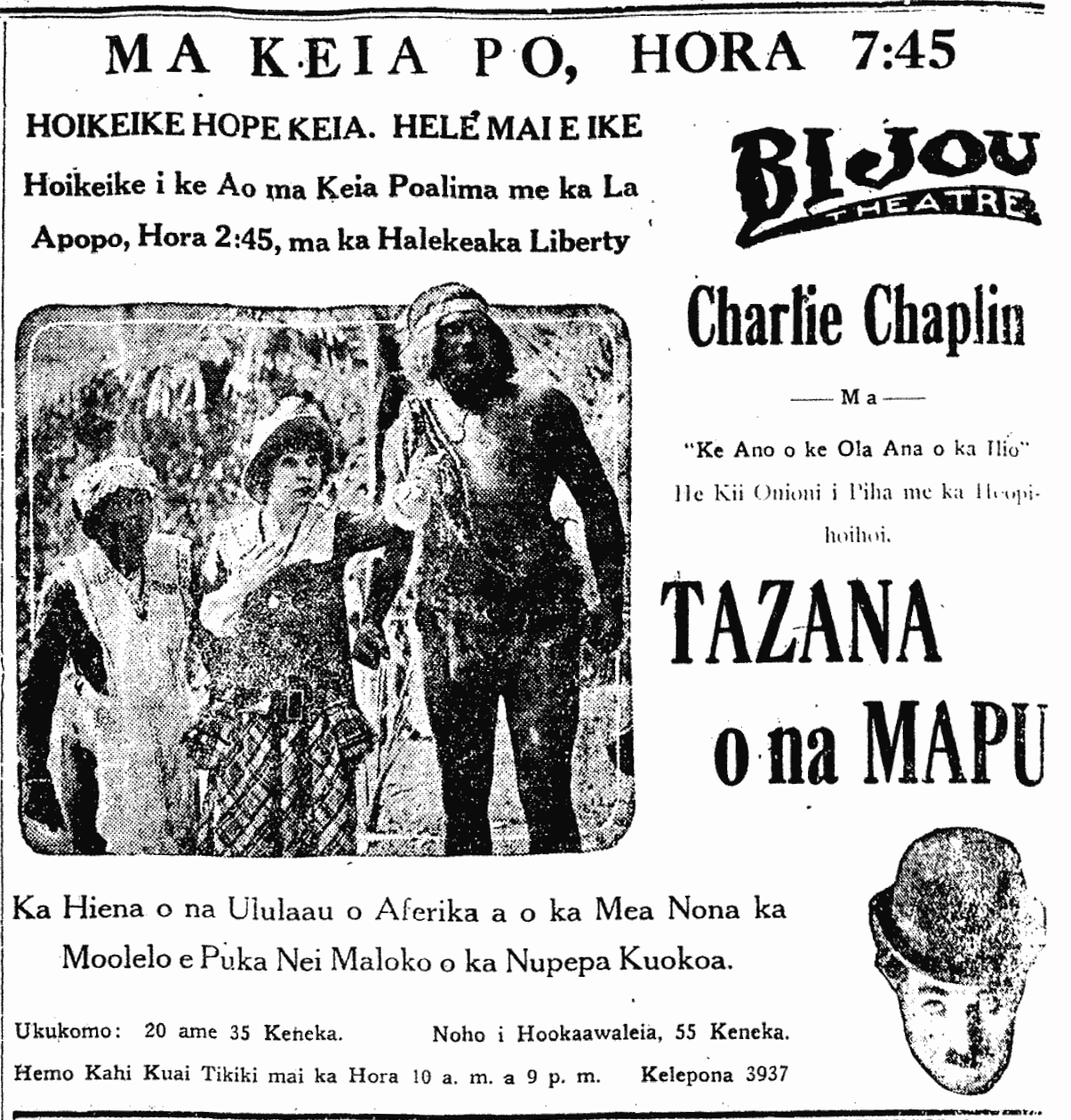
BIJOU THEATRE

Starting this Sunday Night at 7:40

THE STORY OF TARZAN

These are Pictures From the Last Chapters of the

Story of TARZAN OF THE APES

From the Book by Edgar Rice Burroughs

THE ROMANCE OF TARZAN

Filled with excitement, magnificence, and Wild Beauty; the images taken are what millions of people have been awaiting for months. They are overcome with total fascination.

The thrilling story of a Primitive Man, Jungle Wilds, and Palaces.

Entrance fee: 15, 25, and 35 Cents. Reserved seating: 55 Cents.

[Chronicling America does not have any Honolulu papers up yet for this year, so here is a similar ad printed in The Garden Island, 5/27/1919, p. 3.]

(Kuokoa 4/25/1919, p. 2)

HALEKEAKA BIJOU

Ka Nupepa Kuokoa, Buke LVII, Helu 17, Aoao 2. Aperila 25, 1919.

Tarzan and Chaplin! 1919.

TONIGHT, 7:45

THIS IS THE LAST SHOW, COME WATCH

Shown at Day on This Friday and Tomorrow,

2:45, at Liberty Theater

BIJOU THEATRE

Charlie Chaplin

—In—

“A Dog’s Life” [“Ke Ano o ke Ola Ana o ka Ilio”]

A Movie Full of Excitement.

TARZAN of the APES [TAZANA o na MAPU]

The Hyena of the Jungle of Africa and the One Whose Story is Being Run in the Kuokoa Newspaper.

Entrance: 20 and 35 Cents. Reserved Seats [Noho i Hookaawaleia], 55 Cents.

Ticket Box Open from the Hours of 10 a. m. to 9 p. m. Telephone 3937

[It is interesting to see that this ad is in Hawaiian, when the movies themselves were in English.]

(Kuokoa, 1/17/1919, p. 2)

MA KEIA PO, HORA 7:45

Ka Nupepa Kuokoa, Buke LVII, Helu 3, Aoao 2. Ianuari 17, 1919.

The new and improved St. Louis College, 1881.

THE COLLEGE
OF SAINT LOUIS
—and the—
COMMERCIAL AND BUSINESS ACADEMY
HONOLULU, OAHU, H. I.

This institution being remote from city allurements, is an acknowledged safeguard for morals—for salubrity of climate, is unrivalled. The buildings are large and commodious, while the grounds afford the pupils opportunities for healthful exercises.

Unremitting attention will be given to the intellectual and moral culture of the pupils. Non-Catholic pupils will be free to attend the religious exercises or not, according as their parents or guardians may desire.

Pupils are received at any time during the year. No reduction will be made from regular charges, except for absence caused by protracted illness.

No leave of absence during the scholastic year, except at the College vacations or by special permission.

Each pupil must on entering obtain one suit of uniform, which with all other necessary clothing, &c., &c., will be furnished at moderate cost by the College; but none of these will be provided by the College unless by special arrangement.

Payments are to be made quarterly, and invariably in advance.

The course of study is Classical, Scientific and Commercial; Latin, Greek, French, Spanish, German and Italian are taught.

Particular attention will be paid to the English Language in all its branches. Literature, Pure and Mixed Mathematics, History, Geography, Chemistry and Natural Philosophy, &c.

TERMS:

For Board, Lodging, Tuition and Washing, per Scholastic Year…$200.00

Entrance fee…10.00

Vacation at College…40.00

Music, vocal and instrumental, Drawing and Modern Languages—extras.

DAY PUPILS—Senior Class…$60.00

Junior Class…40.00

The Scholastic Year consists of two Sessions, each comprising a period of five months. The first session commences on the 20th of August; the second on the 20th of January.

For all further particulars, apply to

REV. W. J. LARKIN, President.

No. 73 Beretania St.

Evening School Department of St. Louis College.

The President has decided to include this branch in the curriculum of the College.

Its object is to afford all classes of the community the means of acquiring a theoretical and practical knowledge of all commercial and business transactions in daily use; and also to give an insight into the workings and applications of the different Trades, which it is so essential to do in these Islands.

The Theoretical Branch will be under the supervision of the President and Professors of the College. The Practical and most important Branch will be specially attended to by volunteers from the various master artizans among us, who have kindly and generously promised their services to this useful and valuable enterprise.

They will, alternately, devote half and hour each evening to the task of imparting knowledge to the students. All the implements necessary to each trade, and to Agriculture, will be furnished by the College.

Each master-artizan, while connected with the College, will be entitled to name one Free-Life-Scholarship to the privileges of this Evening School Department.

TERMS—Each student per week, 50 cts. The Evening School will open at 7 o’clock p. m.

(Elele Poakolu, 2/2/1881, p. 5)

KE KULA NUI O SANA LUI

Ka Elele Poakolu, Buke I, Helu 22, Aoao 5. Feberuari 2, 1881.

[This is an advertisement for the recently moved Saint Louis College, back in 1881. The English is taken from the English advertisement appearing on page 5 of the Hawaiian Gazette, 2/9/1881.

This Hawaiian ad appears in the newspaper Ka Elele Poakolu, which for some reason is not available online as of yet, even if it has been available on microfilm for years…]

Bound years of the Kuokoa for sale, 1865.

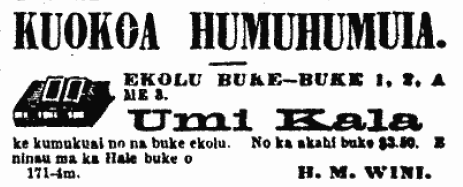
BOUND KUOKOA.

THREE BOOKS—VOLUMES 1, 2 AND 3.

Ten Dollars

is the price for the three books. For one book is $3.50. Inquire at the Book store of H. M. WHITNEY [H. M. WINI].

[For a fee, you could take your year of newspapers to be bound at the end of the year, or they would be sold bound like these Kuokoa. Thanks the this binding, we are left with many full sets of newspapers! However, when they microfilmed the bound newspapers years ago, many were so tightly sewn that the bound side of the pages are illegible because they fall in a shadow. Hopefully funding can be found to have these newspapers unbound by an expert so the pages can be photographed clearly!]

(Kuokoa, 3/16/1865, p. 3)

KUOKOA HUMUHUMUIA.

Ka Nupepa Kuokoa, Buke IV, Helu 11, Aoao 3. Maraki 16, 1865.

Hawaii’s Story by Hawaii’s Queen, in the Hawaiian Language, 1898.

WE WILL SATISFY.

Because we are constantly asked by our readers to print the story which our Queen wrote in Washington and that was just published in Boston, therefore, we are spreading the news to our readership that we will translate and print the story in the columns of the newspapers the daily and weekly Ke Aloha Aina, on the first week of this coming month for the benefit of our readers. Therefore, do take up Ke Aloha Aina so that you can see the one story written by Queen Liliuokalani and published in foreign lands, with statements full of sentiment and aloha dealing with Her overthrow. Aloha for Her.

(Aloha Aina, 3/19/1898, p. 5)

E HOOKO AKU ANA MAKOU.

Ke Aloha Aina, Buke IV, Helu 12, Aoao 5. Maraki 19, 1898.

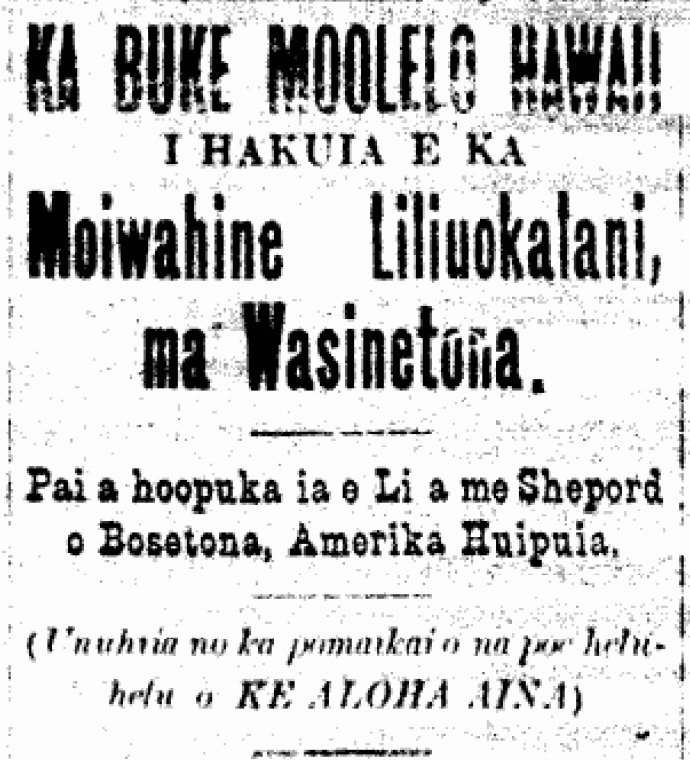
Here, by the way, is what the heading of that running column looked like:

HAWAIIAN HISTORY

WRITTEN BY

Queen Liliuokalani,

in Washington.

Published by Lee and Shepard

of Boston, United States of America.

(Translated for the benefit of the

readers of KE ALOHA AINA)

(Aloha Aina, 4/2/1898, p. 6)

KA BUKE MOOLELO HAWAII

Ke Aloha Aina, Buke IV, Helu 14, Aoao 6. Aperila 2, 1898.

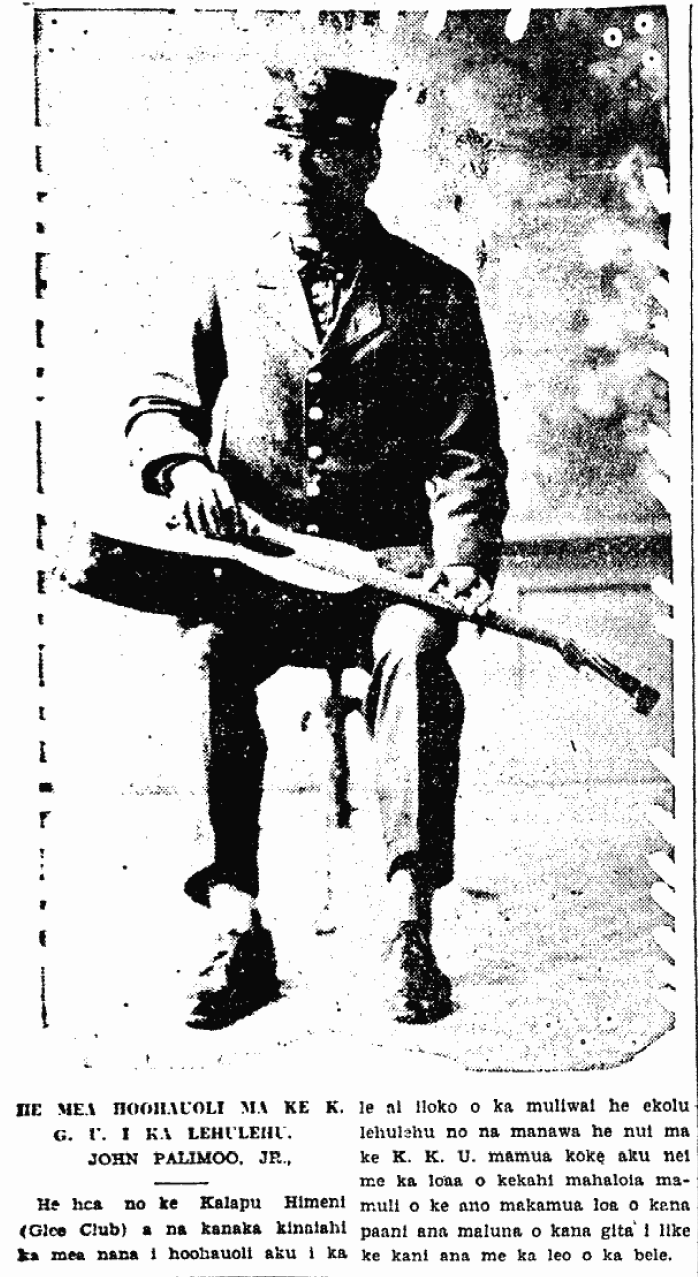
John Palimoo, Jr., steel guitarist on the radio, 1927.

ENTERTAINING THE MULTITUDES ON K. G. U., JOHN PALIMOO, JR.

He is a member of the Firemen’s Glee Club [Kalapu Himeni], the one who entertained the pubic many a time on K. K. U. [K. G. U.] recently, receiving acclaim because of his new way of playing on his guitar, making it sound like bells.

[Notice the first line on the right column. On occasion, there will be a misplaced line or section, especially in the later years of the newspapers, and the line that reads “le ai iloko o ka muliwai he ekolu” seems to be out of place.

Does anyone have any information on this steel guitar player, John Palimoo, Jr.?]

(Kuokoa, 9/8/1927, p.2)

HE MEA HOOHAUOLI MA KE K. G. U. I KA LEHULEHU, JOHN PALIMOO, JR.

Ka Nupepa Kuokoa, Buke LXVI, Helu 35, Aoao 2. Sepatemaba 8, 1927.

Hoku o Hawaii begins printing front page in English, 1936.

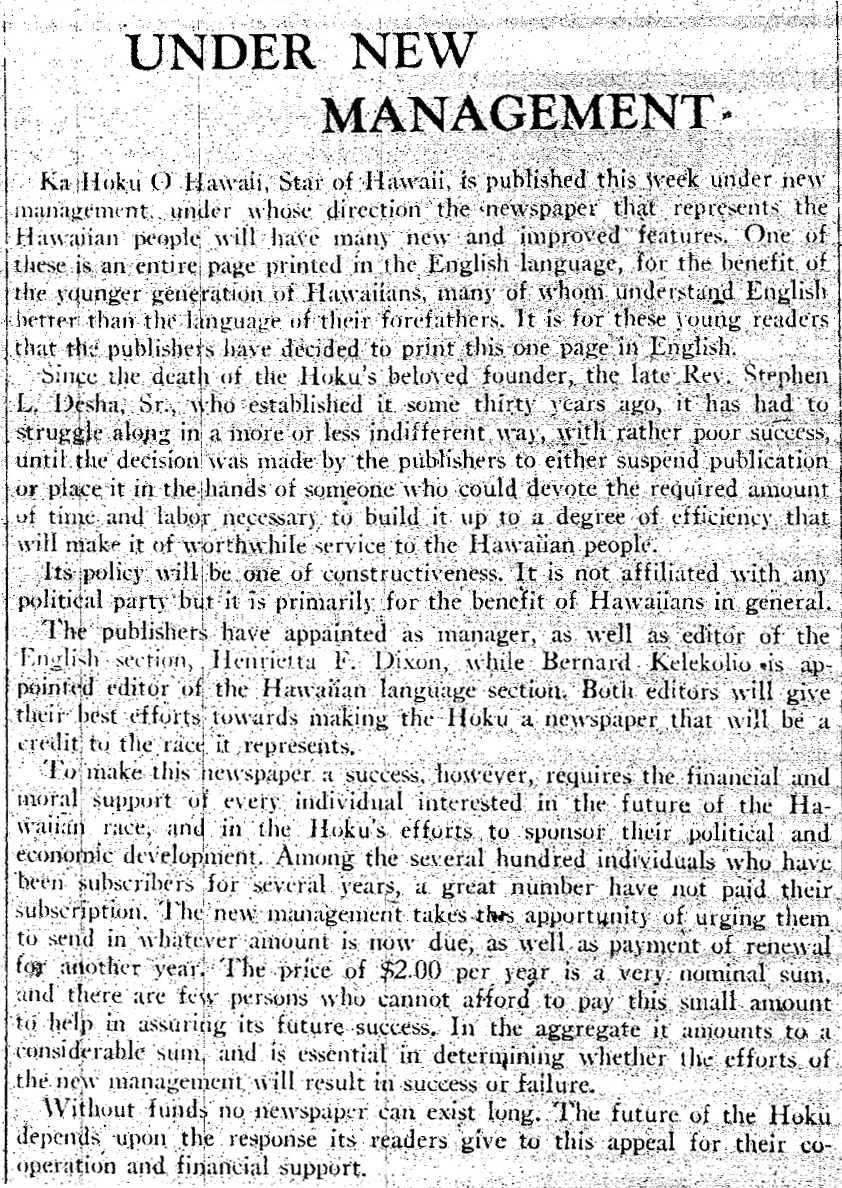
UNDER NEW MANAGEMENT

Ka Hoku o Hawaii, Star of Hawaii, is published this week under new management under whose direction the newspaper that represents the Hawaiian people will have many new and improved features. One of these is an entire page printed in the English language, for the benefit of the younger generation of Hawaiians, many of whom understand English better than the language of their forefathers. It is for these young readers that the publishers have decided to print this one page in English.

Since the death of the Hoku’s beloved founder, the late Rev. Stephen L. Desha, Sr., who established it some thirty years ago, it has had to struggle along in a more o less indifferent way, with rather poor success, until the decision was made by the publishers to either suspend publication or place it in the hands of someone who could devote the required amount of time and labor necessary to build it up to a degree of efficiency that will make it of worthwhile service to the Hawaiian people.

Its policy will be one of constructiveness. It is not affiliated with any political party but it is primarily for the benefit of Hawaiians in general.

The publishers have appainted as manager, as well as editor of the English section, Henrietta F. Dixon, while Bernard Kelekolio is appointed editor of the Hawaiian language section. Both editors will give their best efforts toward making the Hoku a newspaper that will be a credit to the race it represents.

To make this newspaper a success, however, requires the financial and moral support of every individual interested in the future of the Hawaiian race, and in the Hoku’s efforts to sponsor their political and economic development. Among the several hundred individuals who have been subscribers for several years, a great number have not paid their subscription. The new management takes this opportunity of urging them to send in whatever amount is now due, as well as payment of renewal for another year. The price of $2.00 per year is a very nominal sum, and there are few persons who cannot afford to pay this small amount to help in assuring its future success. In the aggregate it amounts to a considerable sum, and is essential in determining whether the efforts of the new management will result in success or failure.

Without funds no newspaper can exist long. The future of the Hoku depends upon the response its readers give to this appeal for their cooperation and financial support.

(Hoku o Hawaii, 2/4/1936, p. 1)

UNDER NEW MANAGEMENT

Ka Hoku o Hawaii, Volume XXVII, Number 31, Page 1. February 4, 1936.

More on the opening of KHBC, 1936.

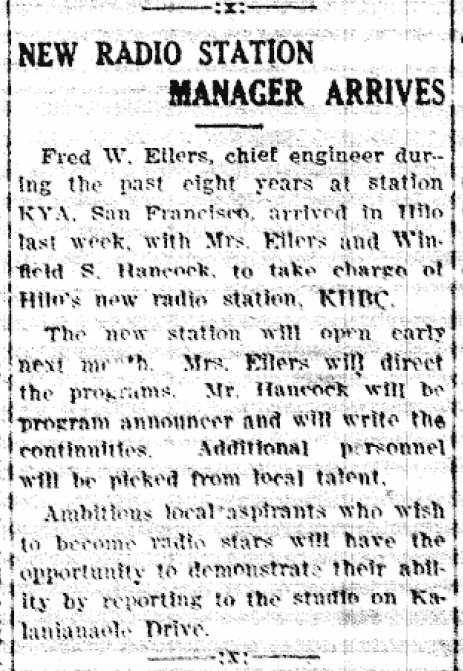
NEW RADIO STATION MANAGER ARRIVES

Fred W. Eilers, chief engineer during the past eight years at station KYA, San Francisco, arrived in Hilo last week, with Mrs. Eilers and Winfield S. Hancock, to take charge of Hilo’s new radio station, KHBC.

The new station will open early next month. Mrs. Eilers will direct the programs. Mr. Hancock will be program announcer and will write the continuities. Additional personnel will be picked from local talent.

Ambitious local aspirants who wish to become radio stars will have the opportunity to demonstrate their ability by reporting to the studio on Kalanianaole Drive.

[Starting on February 4, 1936, the front page of Hoku o Hawaii (published in Hilo), was printed in English, and the following three pages were in Hawaiian.]

(Hoku o Hawaii, 4/15/1936, p. 1)

NEW RADIO STATION MANAGER ARRIVES

Ka Hoku o Hawaii, Volume XXVII, Number 39, Page 1. April 15, 1936.

Beginning of KHBC, the famed radio station of Keaukaha, 1936.

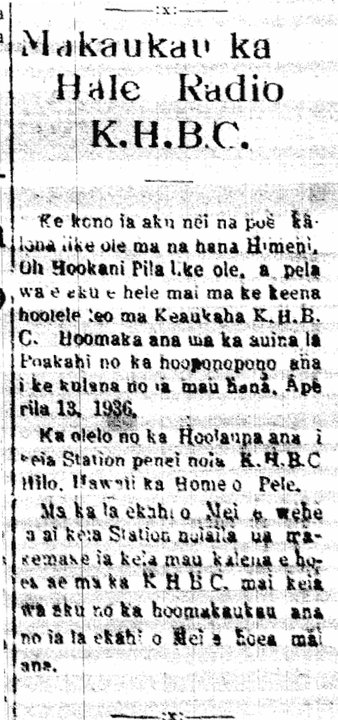
The Radio Station, K.H.B.C. is Ready

Everyone talented in everything from Singing, Oli, Playing Instruments any type, and so forth, are invited to come to the radio broadcast station office in Keaukaha, K. H. B. C. The preparations for this begins on the afternoon of Monday, April 13, 1936.

The Station introduction goes, “K.H.B.C., Hilo, Hawaii, the Home of Pele.”

This Station will open on the first of May, therefore, we want these talented people to come to K. H. B. C. from now forth to prepare for the approaching first day of May.

[Vickie Ii Rodrigues’ famous composition, still heard today, begins: “Aia i ka la’i, ulalaeho; O Keaukaha la, ulalaeho; K. H. B. C., ulalaeho; Ka home a’o Pele, ulalaeho!” (There in the calm, ulalaeho; Of Keaukaha, ulalaeho; Is K. H. B. C., ulalaeho; The home of Pele, ulalaeho!)

I still recall my mom, who was born and raised in Ninole, saying that she used to listen to that station…]

(Hoku o Hawaii, 4/15/1936, p. 2)

Makaukau ka Hale Radio K. H. B. C.

Ka Hoku o Hawaii, Volume XXVII, Number 39, Page 2. April 15, 1936.

Musical Group, The Bohling Sisters, 1940.

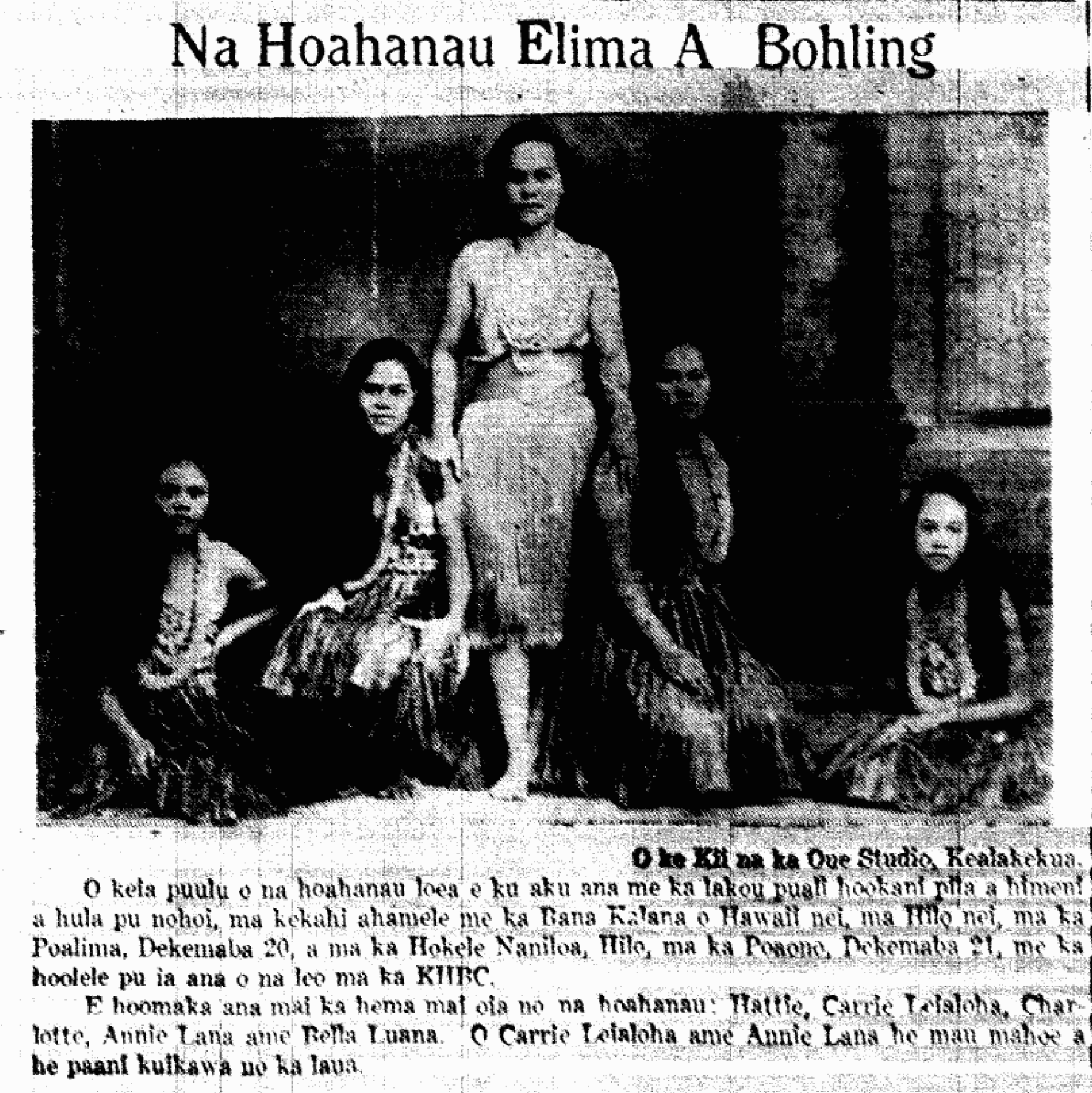
The Five Bohling Sisters

Photograph by Oue Studio, Kealakekua

This group of skilled sisters will appear with their musicians and sing and hula at a concert with the Hawaii County Band [Bana Kalana o Hawaii] on Friday, December 20th, and at the Naniloa Hotel, Hilo, on Saturday, December 21, while being broadcast on KHBC.

Beginning from the left are the sisters: Hattie, Carrie Leialoha, Charlotte, Annie Lana and Bella Luana. Carrie Leialoha and Annie Lana are twins and are playing special.

[Anyone have any information on this musical family? Charlotte Bohling wrote a regular column for the Hoku o Hawaii reporting the news from Kona.]

(Hoku o Hawaii, 12/11/1940, p. 1)

Na Hoahanau Elima A Bohling

Ka Hoku o Hawaii, Volume XXXV, Number 33, Page 1. Dekemaba 11, 1940