Princess Kaiulani protests, 1893.

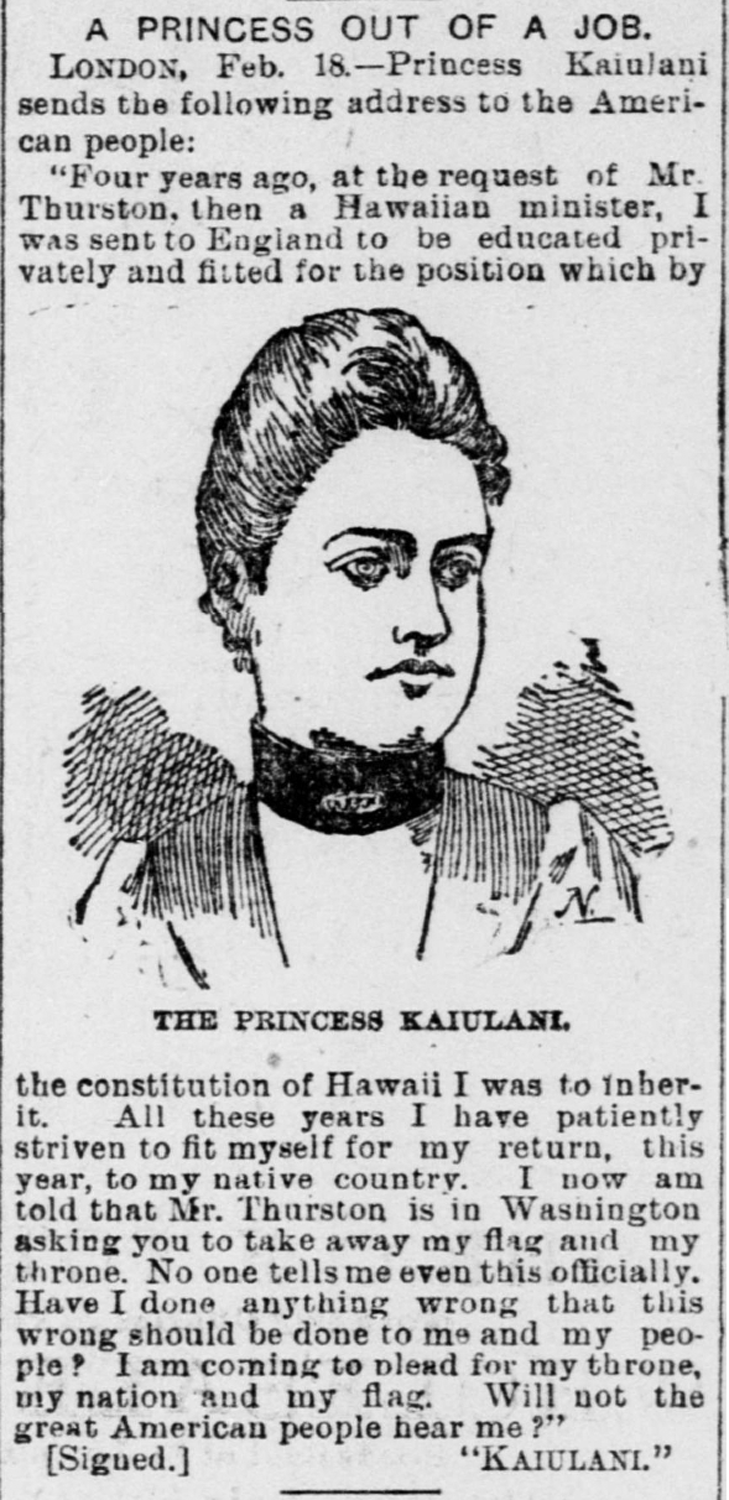
A PRINCESS OUT OF A JOB

London, Feb. 18.—Princess Kaiulani sends the following address to the American people:

“Four years ago, at the request of Mr. Thurston, then a Hawaiian minister, I was sent to England to be educated privately and fitted for the position which by…

THE PRINCESS KAIULANI.

…the constitution of Hawaii I was to inherit. All these years I have patiently striven to fit myself for my return, this year, to my native country. I now am told that Mr. Thurston is in Washington asking you to take away my flag and my throne. No one tells me even this officially. Have I done anything wrong that this wrong should be done to me and my people? I am coming to plead for my throne, my nation and my flag. Will not the great American people hear me?”

[Signed.] “Kaiulani.”

(Wichita Daily Eagle, 2/19/1893, p. 2)

THE PRINCESS OUT OF A JOB.

The Wichita Daily Eagle, Volume XVIII, Number 82, Page 2. February 19, 1893.

The 1874 speech of Leleiohoku at Kalaupapa, 1891.

THE SPEECH OF THE REGENT, PRINCE LELEIOHOKU, AT THE COLONY OF KALAUPAPA, MOLOKAI.

November 28, 1874.

O Citizens of the Alii, King Kalakaua I., a fraction of his people, aloha to you.

This was the day that we gained the independence of this our mother country, and it is a day for you, Hawaiian people, to rejoice.

In this rejoicing however, there is also something to be anguished and mournful about, for if you turn and look back, there is not your wife, or children, or your family, or the rest, if you are a man who was separated here by the government to come to Kalaupapa; auwe, this is something that pains his heart for his companion, his wife; and so too for the woman who grieves for her husband; and the parent who grieves for his child, and the child for his parent, and so forth.

O Makaainana of King Kalakaua I., living in this friendless land, you have but one friend, that being the protection of the government.

This painful burden that you have been stricken with does not come through the control of the child of man, but comes from God.

Therefore, all you makaainana who have aloha for your alii, I am one of your parents, but I am powerless to divert the power of the law, for I am but a student of the law; yet it pains me to see you, O Beloved makaainana; I first saw some of you turning your faces away from mine.

But should there be a time in the future, when the rule falls totally upon me, then that will be the time when I will search out and put my efforts into finding relief for all of us, but that lies in the hands of the one who created us.

Therefore, O Beloved makaainana, do forgive me, and may the power of the Lord help us all.

[You never know where you will find information. I have not been able to find mention of this speech by Leleiohoku in 1874, but 17 years later…]

(Leo o ka Lahui, 9/25/1891, p. 2)

KA HAIOLELO A KE KAHU AUPUNI, KE KEIKI ALII LELEIOHOKU...

Ka Leo o ka Lahui, Buke II, Helu 289, Aoao 2. Sepatemaba 25, 1891.

Leleiohoku, the Prince Regent, 1874.

THE FIRST PUBLIC SPEECH

By His Highness

THE ALII WILLIAM PITT LELEIOHOKU,

Before the Citizens at Ewa, Oahu.

[Ewa’s makaainana are surely very proud that they were victorious, hearing the words from His Highness, the Chief, and the Crowned Prince of the Nation, W. P. Leleiohoku, on Saturday, April 25, 1874. Because of the excellence of the content, and that this is the very first of his speeches, and because of the great desire and admiration for it, therefore, we are putting it before the public to admire it for themselves, to see the intelligent expression from the Young Prince. Ed.]

O Citizens:—My naau¹ is filled with joy to see upon your faces this day, a sign telling me that your loving hearts are encouraged by the astute remarks of our King spoken of in his royal address pertaining to one of the foundations of His Kingdom, that being

“The Increase of the Lahui.”

The is an important question which our King puts before you, and not just you, but before all of the citizens of His Kingdom from Hawaii to Kauai; it is a wide, deep, and lingering question. And this is the appropriate time for us to raise this question to consider it, being that the lahui continues to decrease, from the conditions as shown in the dark ages gone by.

As I speak on the subject of this question, let us look to the future, and consider the character of the One who asked this question, that being our current King. He did not simply take up [lawe kamako²] this endeavor, or do it on his own; he carefully considered it, trusting in your patience in helping Him in search out means to rejuvenate this lahui. Continue reading

Hana mourns the death of the Queen, 1917.

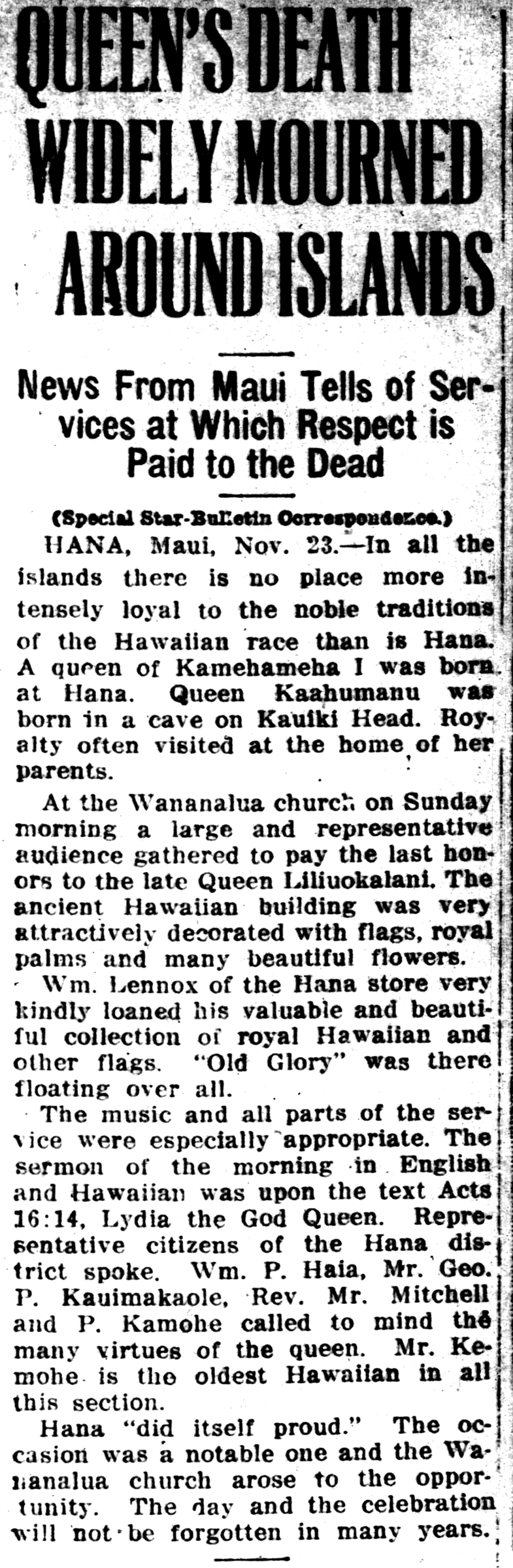
QUEEN’S DEATH WIDELY MOURNED AROUND ISLANDS

News From Maui Tells of Services at Which Respect is Paid to the Dead

(Special Star-Bulletin Correspondence.)

HANA, Maui, Nov. 23.—In all the islands there is no place more intensely loyal to the noble traditions of the Hawaiian race than in Hana. A queen of Kamehameha I was born at Hana. Queen Kaahumanu was born in a cave on Kauiki Head. Royalty often visited at the home of her parents.

At Wananalua church on Sunday morning a large and representative audience gathered to pay the last honors to the late Queen Liliuokalani. The ancient Hawaiian building was very attractively decorated with flags, royal palms and many beautiful flowers.

William Lennox of the Hana store very kindly loaned his valuable and beautiful collection of royal Hawaiian and other flags. “Old Glory” was there floating over all.

The music and all parts of the service were especially appropriate. The sermon of the morning in English and Hawaiian was upon the text Acts 16:14, Lydia the God Queen. Representative citizens of the Hana district spoke. William P. Haia, Mr. George P. Kauimakaole, Rev. Mr. Mitchell and P. Kamohe called to mind the many virtues of the queen. Mr. Kemohe is the oldest Hawaiian in all this section.

Hana “did itself proud.” The occasion was a notable one and the Wananalua church arose to the opportunity. The day and the celebration will not be forgotten in many years.

(Honolulu Star-Bulletin, 11/24/1917, p. 37)

QUEEN'S DEATH WIDELY MOURNED AROUND ISLANDS

Honolulu Star-Bulletin, Volume XXV, Number 7993, Page 37. November 24, 1917.

Wailuku memorial for Queen Liliuokalani, 1917.

[Found under: “QUEEN’S DEATH WIDELY MOURNED AROUND ISLANDS”]

WAILUKU, Maui, Nov. 23.—Most interesting services were held on Sunday in memory of Queen Liliuokalani. At the Church of the Good Shepherd at the usual hour of service, Rev. J. Charles Villiers preached a most interesting sermon, speaking of the good life of the queen and what she had done for her people and for Hawaii. There was a large and most appreciative audience.

At the Kaahumanu church there was also an unusually large audience, many coming from Waikapu, and the Japanese church in Wailuku, in honor of the queen. Revs. L. B. Kaumeheiwa and Rowland B. Dodge spoke upon the queen’s life and how much it meant that after the changes that had come in the government here the queen should have done so much to welcome and assist all the people of Hawaii irrespective of nationality.

References to the queen were also made in the Kahului Union chuch and the Makawao Union church by the pastors, though no special memorial services were held.

On Sunday evening at the Wailuku Union church, Rev. W. B. Coale of Lahaina, preached a strong sermon upon  “The Divine Silence.” He was listened to by a most appreciative audience.

(Honolulu Star-Bulletin, 11/24/1917, p. 37)

WAILUKU...

Honolulu Star-Bulletin, Volume XXV, Number 7993, Page 37. November 24, 1917.

Mele by Liliuonamoku Club, 1877.

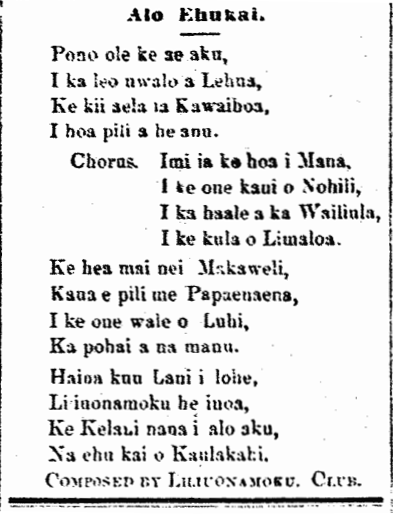
Alo Ehukai.

Pono ole ke ae aku,
I ka leo uwalo a Lehua,
Ke kii aela ia Kawaihoa,
I hoa pili a he anu.

Chorus. Imi ia ke hoa i Mana,
I ke one kani o Nohili,
I ka haale a ka Wailiula,
I ke kula o Limaloa.

Ke hea mai nei Makaweli,
Kaua e pili me Papaenaena,
I ke one wale o Luhi,
Ka pohai a na manu.

Haina kuu Lani i lohe,
Liliuonamoku he inoa,
Ke Kalani nana i alo aku,
Na ehu kai o Kaulakahi.

Composed by Liliuonamoku Club.

(Kuokoa, 11/24/1877, p. 4)

Alo Ehukai.

Ka Nupepa Kuokoa, Buke, XVI, Helu 47, Aoao 4. Novemaba 24, 1877.

Mele by Liliuonamoku Club, 1877.

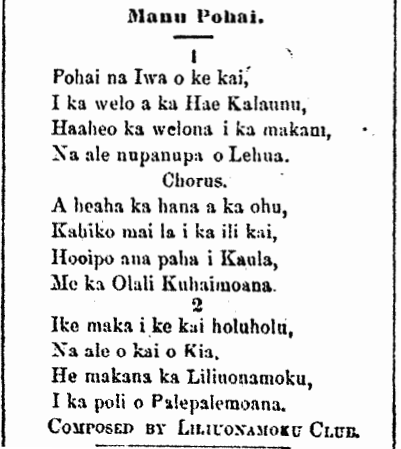
Manu Pohai.

1

Pohai na Iwa o ke kai,
I ka welo a ka Hae Kalaunu,
Haaheo ka welona i ka makani,
Na ale nupanupa o Lehua.

Chorus.

A heaha ka hana a ka ohu,
Kahiko mai la i ka ili kai,
Hooipo ana paha i Kaula,
Me ka Olali Kuhaimoana.

2

Ike maka i ke kai holuholu,
Na ale o kai o Kia,
He makana ka Liliuonamoku,
I ka poli o Palepalemoana.

Composed by Liliuonamoku Club.

(Kuokoa, 11/24/1877, p. 4)

Manu Pohai.

Ka Nupepa Kuokoa, Buke XVI, Helu 47, Aoao 4. Novemaba 24, 1877.

A name song for the new Princess Kaiulani, 1877.

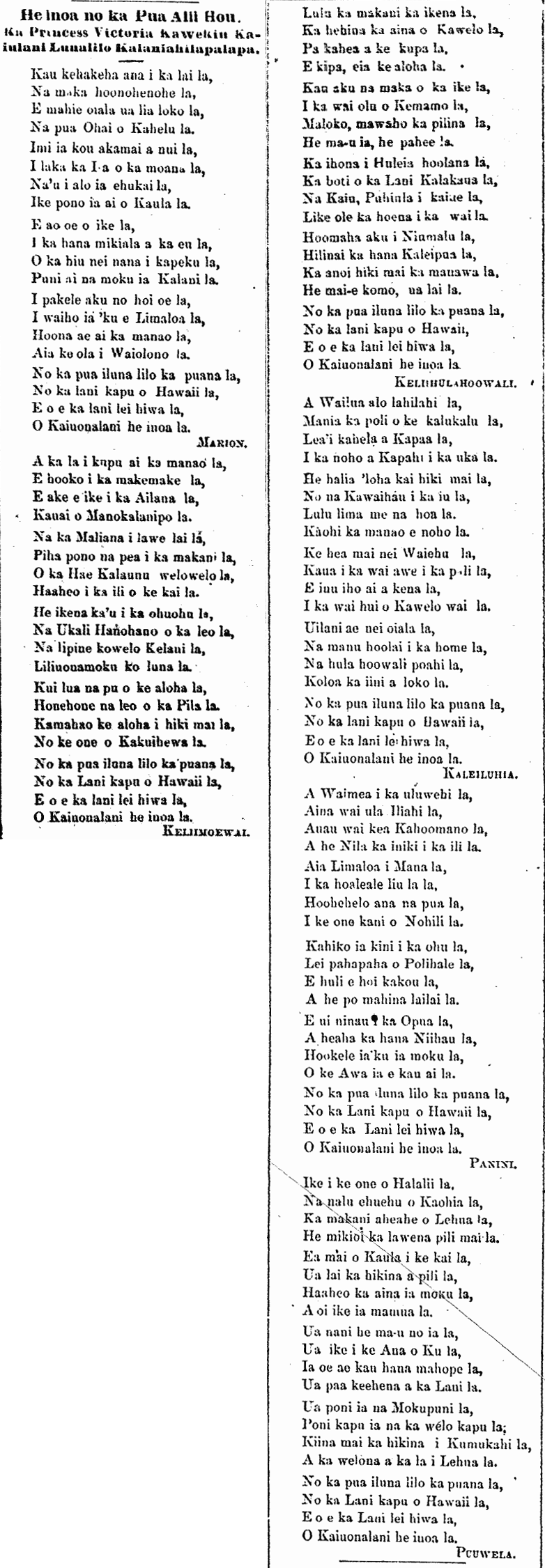
A Name Song For the New Royal Scion.

Princess Victoria Kawekiui Kaiulani Lunalilo Kalaniahilapalapa.

Kau kehakeha ana i ka lai la,
Na maka hoonohenohe la,
E mahie oiala ua lia loko la,
Na pua Ohai o Kahelu la.

Imi ia kou akamai a nui la,
I laka ka I-a o ka moana la,
Na’u i alo ia ehukai la,
Ike pono ia ai o Kaula la.

E ao oe o ike la,
I ka hana mikiala a ka eu la,
O ka hiu nei nana i kapeku la,
Puni ai na moku ia Kalani la.

I pakele aku no hoi oe la,
I waiho ia ‘ku e Limaloa la,
Hoona ae ai ka manao la,
Aia ke ola i Waiolono la.

No ka pua iluna lilo ka puana la,
No ka lani kapu o Hawaii la,
E o e ka lani lei hiwa la,
O Kaiulani he inoa la.

Marion.

A ka la i kupu ai ka manao la,
E hooko i ka makemake la,
E ake e ike i ka Ailana la,
Kauai o Manokalanipo la.

Na ka Maliana i lawe lai la,
Piha pono na pea i ka makani la,
O ka Hae Kalaunu welowelo la,
Haaheo i ka ili o ke kai la.

He ikena ka’u i ka ohuohu la,
Na Ukali Hanohano o ka leo la,
Na lipine kowelo Kelani la,
Liliuonamoku ko luna la.

Kui lua na pu o ke aloha la,
Honehone na leo o ka Pila la,
Kamahao ke aloha i hiki mai la,
No ke one o Kakuihewa la.

No ka pua iluna lilo ka puana la,
No ka Lani kapu o Hawaii la,
E o e ka lani lei hiwa la,
O Kaiuonalani he inoa la.

Keliimoewai.

Lulu ka makani ka ikena la,
Ka hehina ka aina o Kawelo la,
Pa kahea a ke kupa la,
E kipa, eia ke aloha la.

Kau aku na maka o ka ike la,
I ka wai olu o Kemamo la,
Maloko, mawaho ka pilina la,
He ma-u ia, he pahee la.

Ka ihona i Huleia hoolana la,
Ka boti o ka Lani Kalakaua la,
Na Kaiu, Puhiula i kaiue la,
Like ole ka hoena i ka wai la.

Hoomaka aku i Niumalu la,
Hilinai ka hana kaleipua la,
Ka anoi hiki mai ka manawa la,
He mai-e komo, ua lai la.

No ka pua iluna lilo ka puana la,
No ka lani kapu o Hawaii,
E o e ka lani lei hiwa la,
O Kaiuonalani he inoa la.

Keliihulahoowali.

A Wailua alo lahilahi la,
Mania ka poli o ke kalukalu la,
Lea’i kahela a Kapaa la,
I ka noho a Kapahi i ka uka la.

He halia ‘loha kai hiki mai la,
No na Kawaihau i ka iu la,
Lulu lima me na hoa la,
Kaohi ka manao e noho la.

Ke hea mai nei Waiehu la,
Kaua i ka wai awe i ka pali la,
E inu iho ai a kena la,
I ka wai hui o Kawelo wai la.

Uilani ae nei oiala la,
Na manu hoolai i ka home la,
Na hula hoowali poahi la,
Koloa ka iini a loko la.

No ka pua iluna lilo ka puana la,
No ka lani kapu o Hawaii la,
E o e ka lani leihiwa la,
O Kaiuonalani he inoa la.

Kaleiluhia.

A Waimea i ka uluwehi la,
Aina wai ula Iliahi la,
Auau wai kea Kahoomano la,
A he Nila ka iniki i ka ili la.

Aia Limaloa i Mana la,
I ka hoaleale liu la la,
Hoohehelo ana na pua la,
I ke one kani o Nohili la.

Kahiko ia kini i ka ohu la,
Lei pahapaha o Polihale la,
E huli e hoi kakou la,
A he po mahina lailai la.

E ui ninau i ka Opua la,
A heaha ka hana Niihau la,
Hookele ia’ku ia moku la,
O ke Awa ia e kau ai la.

No ka pua luna lilo ka puana la,
No ka Lani kapu o Hawaii la,
E o e ka Lani lei hiwa la,
O Kaiuonalani he inoa la.

Panini.

Ike i ke one o Halalii la,
Na nalu ehuehu o Kaohia la,
Ka makani aheahe o Lehua la,
He mikioi ka lawena pili mai la.

Ea mai o Kaula i ke kai la,
Ua lai ka hikina a pili la,
Haaheo ka aina ia moku la,
A oi ike ia mamua la.

Ua nani he ma-u no ia la,
Ua ike i ke Ana o Ku la,
Ia oe ae kau hana mahope la,
Ua paa keehena a ka Lani la.

Ua poni ia na Mokupuni la,
Poni kapu ia na ka welo kapu la,
Kiina mai ka hikina i Kumukahi la,
A ka welona a ka la i Lehua la.

No ka pua iluna lilo ka puana la,
No ka Lani kapu o Hawaii la,
E o e ka Lani lei hiwa la,
O Kaiuonalani he inoa la.

Puuwela.

[This mele inoa for Princess Kaiulani is also found under the title “He Inoa no Kaiulani” with the oki by the different composers found scattered in Ed. C. Holstein’s Ka Buke Mele o na Himeni Hawaii. There are variations between the two versions.]

(Kuokoa, 11/24/1877, p. 4)

He inoa no ka Pua Alii Hou.

Ka Nupepa Kuokoa, Buke XVI, Helu 47, Aoao 4. Novemaba 24, 1877.
Lunalilo Crypt, 1875.

[Found under: “Nu Hou Kuloko.”]

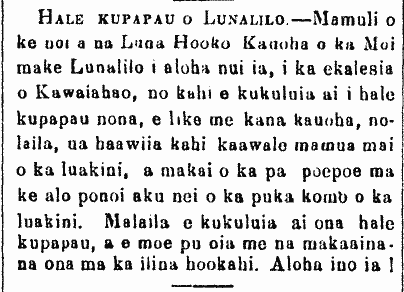
Crypt of Lunalilo.—Because of the request by the Executor of the Will of the Deceased dearly beloved King Lunalilo to Kawaiahao Church, for a place to build his crypt, as per his will, therefore, an open space in front of the church was given, makai of the circular yard right in front of the entrance to the church. There will be built his crypt and he will sleep there with his people in the same cemetery. How sad this is!

(Kuokoa, 9/19/1875, p. 2)

Hale Kupapau o Lunalilo.

Ka Nupepa Kuokoa, Buke XIII, Helu 38, Aoao 2. Sepatemaba 19, 1874.


Newly pardoned, 1891.

[Found under: “By Authority.”]

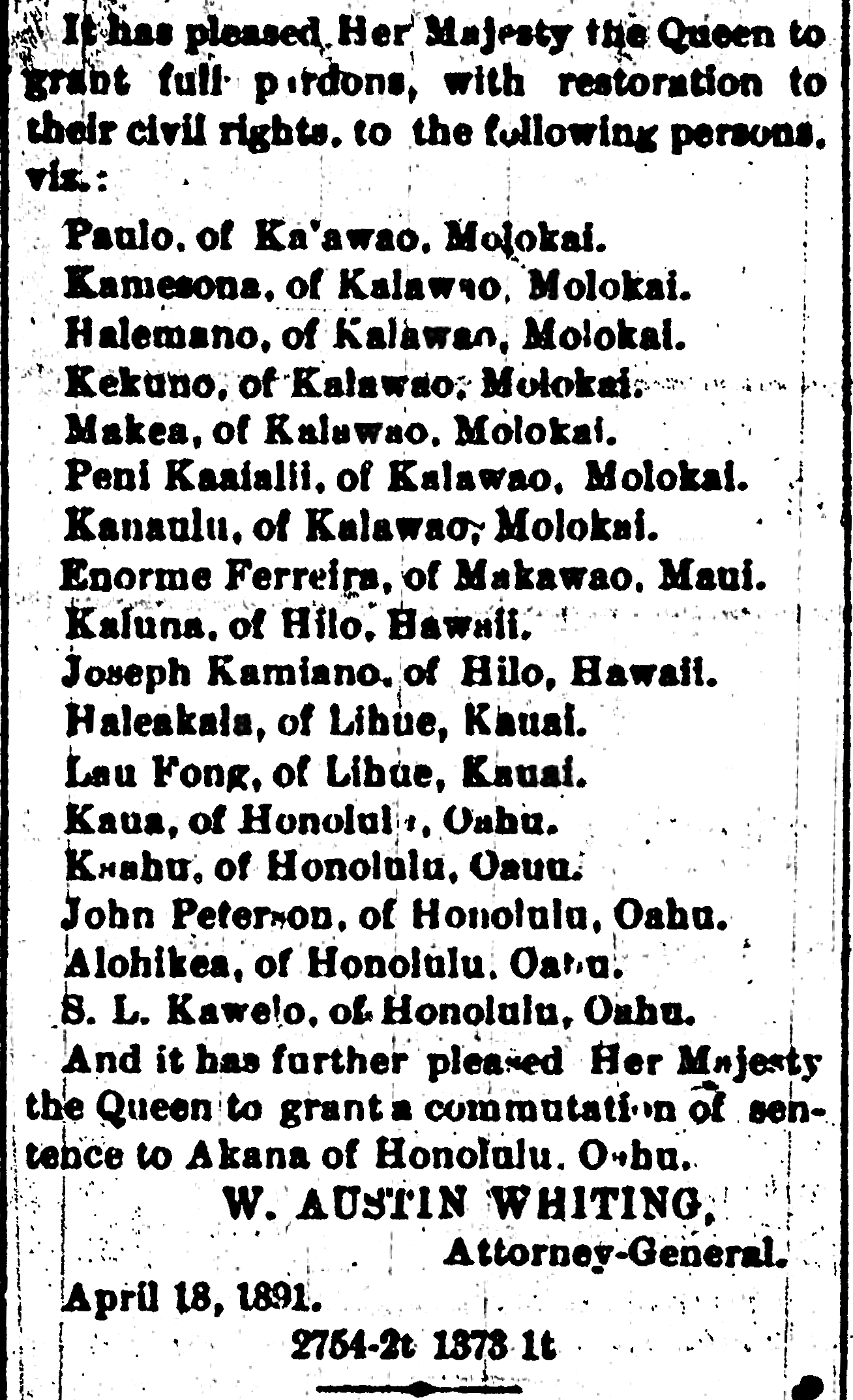
It has pleased Her Majesty the Queen to grand full pardons, with restoration to their civil rights, to the following persons, viz:

Paulo, of Kalawao, Molokai.
Kamesona, of Kalawao, Molokai.
Halemano, of Kalawao, Molokai.
Kekuno, of Kalawao, Molokai.
Makea, of Kalawao, Molokai.
Peni Kaaialii, of Kalawao, Molokai.
Kanaulu, of Kalawao, Molokai.
Enorme Ferreira, of Makawao, Maui.
Kaluna, of Hilo, Hawaii.
Joseph Kamiano, of Hilo, Hawaii.
Haleakala, of Lihue, Kauai.
Lau Fong, of Lihue, Kauai.
Kaua, of Honolulu, Oahu.
Kaahu, of Honolulu, Oahu.
John Peterson, of Honolulu, Oahu.
Alohikea, of Honolulu, Oahu.
S. L. Kawelo, of Honolulu, Oahu.

And it has further pleased Her Majesty the Queen to grant a commutation of sentence to Akana of Honolulu, Oahu.

W. AUSTIN WHITING,
Attorney-General.

April 18, 1891.

(Hawaiian Gazette, 5/5/1891, p. 4)

It has pleased Her Majesty the Queen...

Hawaiian Gazette, Volume XXVI, Number 18, Page 4. May 5, 1891.