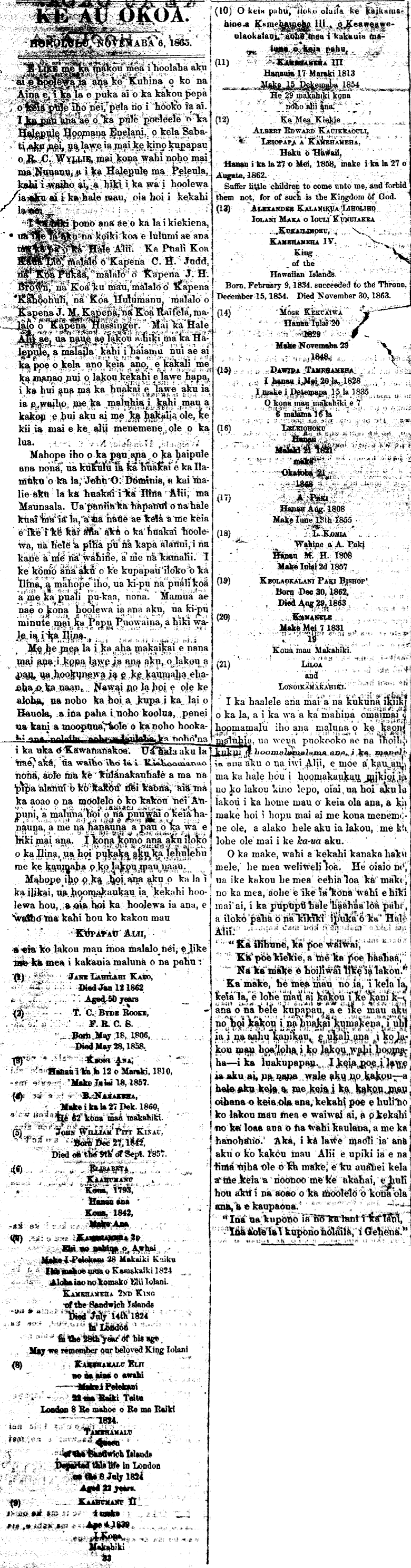
Independence Day, 1893.

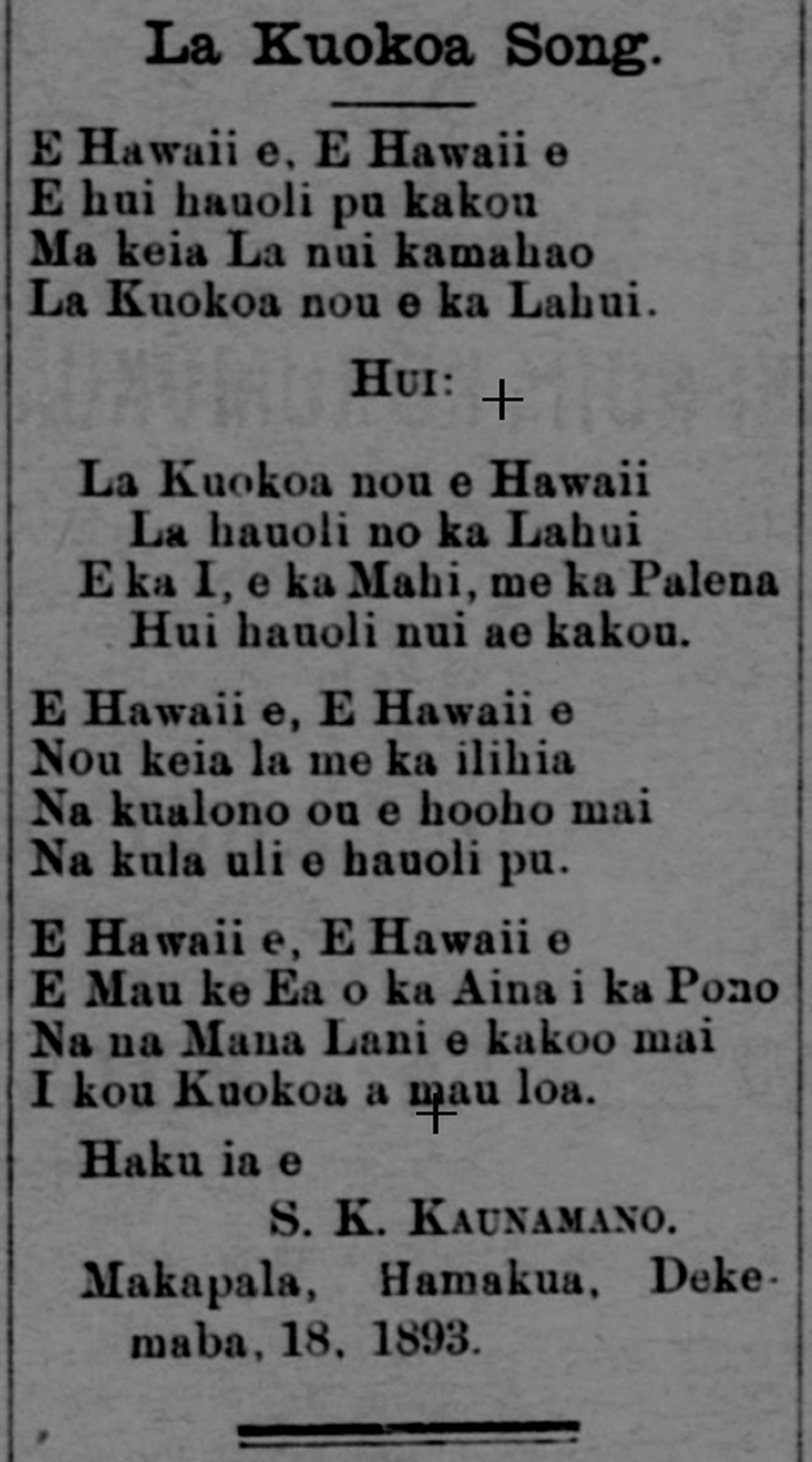
La Kuokoa Song.

E Hawaii e, E Hawaii e
E Hui hauoli pu kakou
Ma keia La nui kamahao
La Kuokoa nou e ka Lahui.

Hui:

La Kuokoa nou e Hawaii
La hauoli no ka Lahui
E ka I, e ka Mahi, me ka Palena
Hui hauoli nui ae kakou.

E Hawaii e, E Hawaii e
Nou keia la me ka ilihia
Na kualono ou e hooho mai
Na kula uli e hauoli pu.

E Hawaii e, E Hawaii e
E Mau ke Ea o ka Aina i ka Pono
Na na Mana Lani e kakoo mai
I kou Kuokoa a mau loa.

Haku ia e

S. K. Kaunamano.

Makapala, Hamakua, Dekemaba 18, 1893.

[Independence Day Song

O Hawaii, O Hawaii
Let us unite in happiness
On this great wonderful day
Independence Day for you, O Lahui.

Chorus:

Your Independence Day, O Hawaii
Joyous day for the Lahui
O I, O Mahi, and Palena
Let us unite in happiness.

O Hawaii, O Hawaii
This is your day, with reverence
May your mountain ridges cheer
May your verdant fields share in the gaiety.

O Hawaii, O Hawaii
May the Sovereignty of the Land be Forever in Righteousness
May the Heavenly Powers lend support
To your Independence for all times.

Composed by S. K. Kaunamano

Makapala, Hamakua, December 18, 1893.]

(Hawaii Holomua, 12/23/1893, p. 1)

La Kuokoa Song.

Hawaii Holomua, Buke I, Helu 14, Aoao 1. Dekemaba 23, 1893.


On Independence, 1893.

RESTORATION DAY.

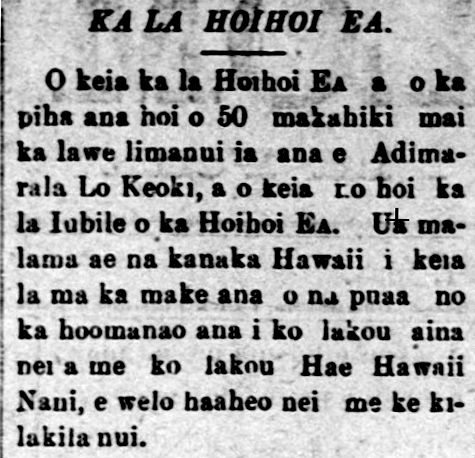
It is Restoration Day, and the 50th year since the forceful seizure by Admiral Lord George Paulet [Lo Keoki], and this is the Jubilee of the Restoration of our Independence. The Hawaiians are commemorating this day with the death of pigs to remember their land and their Beautiful Hawaiian Flag fluttering proudly with great majesty.

[Perhaps the reference to the death of pigs is related to the Hawaiian pronunciation of “P. G.”]

(Hawaii Holomua, 7/31/1893, p. 2)

KA LA HOIHOI EA.

Hawaii Holomua, Buke III, Helu 272, Aoao 2. Iulai 31, 1893.

The marriage of Kauikeaouli to Kalama Kapakuhaili, 1837.

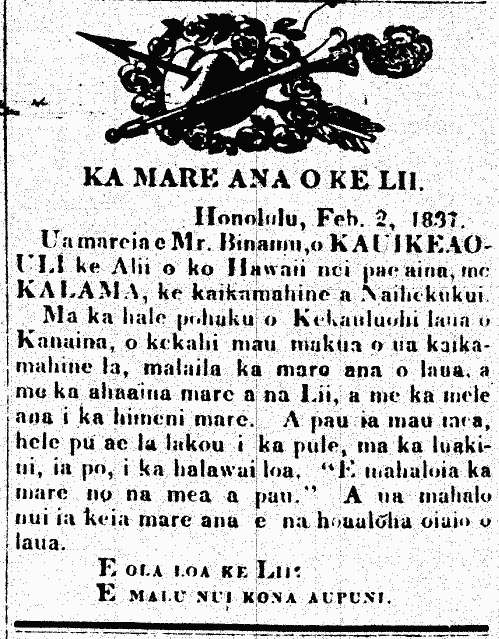
MARRIAGE OF THE KING.

Honolulu, Feb. 2, 1837.

KAUIKEAOULI the King of the Hawaiian archipelago and KALAMA, the daughter of Naihekukui was wed by Mr. Bingham [Binamu].

At the stone house of Kekauluohi and Kanaina, the aunty and uncle [makua] of that girl, is where their marriage took place, and the wedding reception of the Alii, and the singing of the marriage hymn. After that, they went to pray at the church that night at the great assembly. “Marriage is honourable in all.” And this marriage is greatly respected by their true friends.

Long live the King!

May his kingdom have great peace.

(Kumu Hawaii, 2/1/1837, p. 72)

KA MARE ANA O KE LII.

Ke Kumu Hawaii, Buke 2, Pepa 18, Aoao 72. Feberuari 1, 1837.

Political mele by Samuel Lia Kalainaina for Prince Kuhio, 1916.

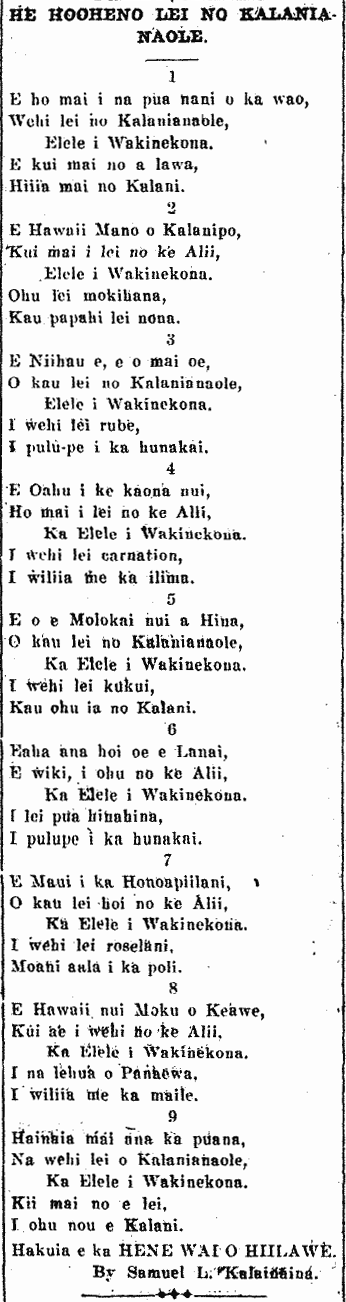
HE HOOHENO LEI NO KALANIANAOLE.

1

E ho mai i na pua nani o ka wao,
Wehi lei no Kalanianaole,
Elele i Wakinekona.
E kui mai no a lawa,
Hiiia mai no Kalani.

2

E Hawaii Mano o Kalanipo,
Kui mai i lei no ke Alii,
Elele i Wakinekona.
Ohu lei mokihana,
Kau papahi lei nona.

3

E Niihau e, e o mai oe,
O kau lei no Kalanianaole,
Elele i Wakinekona.
I wehi lei rube,
I pulu-pe i ka hunakai.

4

E Oahu i ke kaona nui,
Ho mai i lei no ke Alii,
Ka Elele i Wakinekona.
I wehi lei carnation,
I wiliia me ka ilima.

5

E o e Molokai nui a Hina,
O kau lei no Kalanianaole,
Ka Elele i Wakinekona.
I wehi lei kukui,
Kau ohu ia no Kalani.

6

Eaha ana hoi oe e Lanai,
E wiki, i ohu no ke Alii,
Ka Elele i Wakinekona.
I lei pua hinahina,
I pulupe i ka hunakai.

7

E Maui i ka Honoapiilani,
O kau lei hoi no ke Alii,
Ka Elele i Wakinekona.
I wehi lei roselani,
Moani aala i ka poli.

8

E Hawaii nui Moku o Keawe,
Kui ae i wehi no ke Alii,
Ka Elele i Wakinekona.
I na lehua o Panaewa,
I wiliia me ka maile.

9

Hainaia mai ana ka puana,
Na wehi lei o Kalanianaole,
Ka Elele i Wakinekona.
Kii mai no e lei,
I ohu nou e Kalani.

Hakuia e ka HENE WAI O HIILAWE.

By Samuel L. Kalainaina.

[A Lei of Affection for Kalanianaole.

1 Bring forth the beautiful flowers of the forests,
A lei to adorn Kalanianaole,
Representative to Washington.
String them and bind fast,
To be carried for the Heavenly One.

2 O Hawaii of Manokalanipo,
String a lei for the Alii,
Representative to Washington.
An adornment of mokihana lei
Your lei to honor him.

3 O Niihau, answer,
Your lei for Kalanianaole,
Representative to Washington.
An adornment of rubies,
Drenched by the sea spray.

4 O Oahu of the great town,
Bring forth a lei for the Alii,
Representative to Washington.
An adornment of carnation lei,
Entwined with ilima.

5 Answer, O Great Molokai of Hina,
Your lei for Kalanianaole,
Representative to Washington.
An decoration of kukui lei,
Your adornment for the Heavenly One.

6 What are you doing, O Lanai,
Be quick, for an adornment for the Alii,
Representative to Washington.
A hinahina blossom lei,
Drenched by the sea spray.

7 O Maui with the bays of Piilani,
Your lei for the Alii,
Representative to Washington.
An adornment of roselani lei,
Fragrantly wafting in the bosom.

8 O Great Hawaii, Island of Keawe,
String an adornment for the Alii,
Representative to Washinton.
The lehua of Panaewa,
Entwined with maile.

9 Let the story be told,
Kalanianaole’s lei of adornment,
Representative to Washington.
Come take and wear these lei,
As an adornment for you, O Kalani.

Composed by the HENE WAI O HIILAWE.

By Samuel L. Kalainaina.

I was reminded of this mele after watching the video documentary “Liʻa” by Eddie Kamae.]

(Kuokoa, 11/10/1916, p. 3)

HE HOOHENO LEI NO KALANIANAOLE.

Ka Nupepa Kuokoa, Buke LIV, Helu 45, Aoao 3. Novemaba 10, 1916.

Coconut grove of Kamehameha V at Kalamaula, Molokai, 1923.

[Found under: “NA ANOAI”]

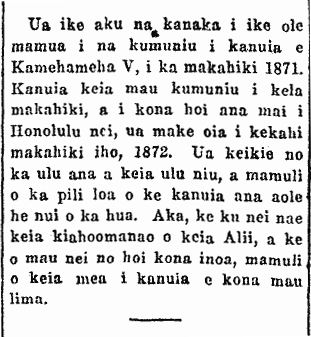
Those who did not know before of the coconut grove planted by Kamehameha V in 1871 now know. These coconut trees were planted that year, and when he returned here to Honolulu, he died a year later in 1872. This coconut grove has grown very tall, and because they were planted close together, there are not much fruit. But it stands as a monument to this Alii, and is called by his name because it was planted by his own hands.

[Check out Nanea Armstrong-Wassel’s post on more famous ulu niu!

It is also interesting to note that in the article “KA HUAKAI MAKAIKAI IA MOLOKAI” by W. J. Coelho, describing a trip around Molokai, found in Kuokoa, 7/6/1922, p. 3, it says:

I spoke of the coconut grove of Kamehameha V in Kalamaula. It is said that it was Kamehameha V who planted that coconut grove in 1864. The truth is that it was Meyer senior [Maea makua]—during the time of the King, Kamehameha IV who planted it. That was when Meyer married the mother of the Meyer family. When they were wed, they went upland of Kalae, and built a little house. It was a grass hut. Meyer began to work hard and peddled butter. After, Meyer was granted the care over the lands of Kamehameha IV, he planted coconuts by the beach, as a place to go for his lord the alii. It was Meyer who planted them, and not anyone else. Meyer himself told an important man of Honolulu, and it was from him I got this information.]

(Kuokoa, 4/26/1923, p. 2)

Ua ike aku na kanaka i ike ole mamua...

Ka Nupepa Kuokoa, Buke LXII, Helu 17, Aoao 2. Aperila 26, 1923.

Kamehameha Day proclaimed, 1871.

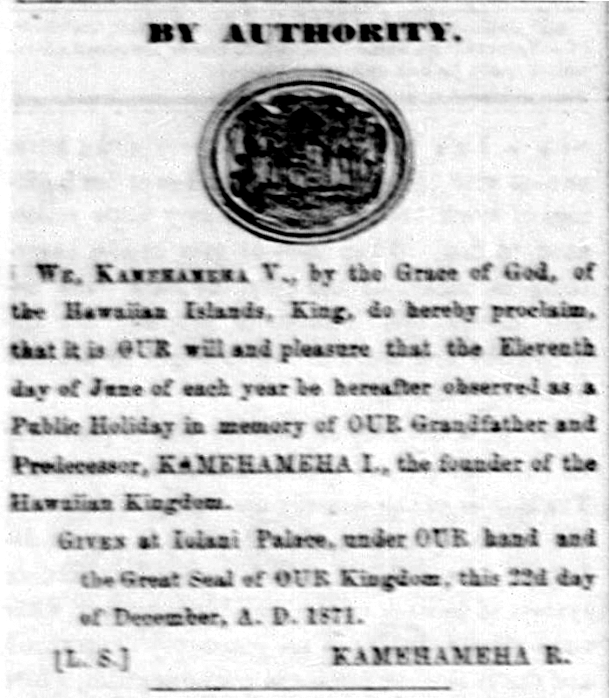
BY AUTHORITY.

We, Kamehameha V., by the Grace of God, of the Hawaiian Islands, King, do hereby proclaim, that it is OUR will and pleasure that the Eleventh day of June of each year be hereafter observed as a Public Holiday in memory of OUR Grandfather and Predecessor, KAMEHAMEHA I, the founder of the Hawaiian Kingdom.

Given at Iolani Palace, under OUR hand and the Great Seal of OUR Kingdom, this 22nd day of December, A. D. 1871.

[Legal Seal] KAMEHAMEHA R.

(Hawaiian Gazette, 12/27/1871, p. 2)

BY AUTHORITY.

Hawaiian Gazette, Volume VII, Number 50, Page 2. December 27, 1871.

The first Kamehameha Day, 1872.

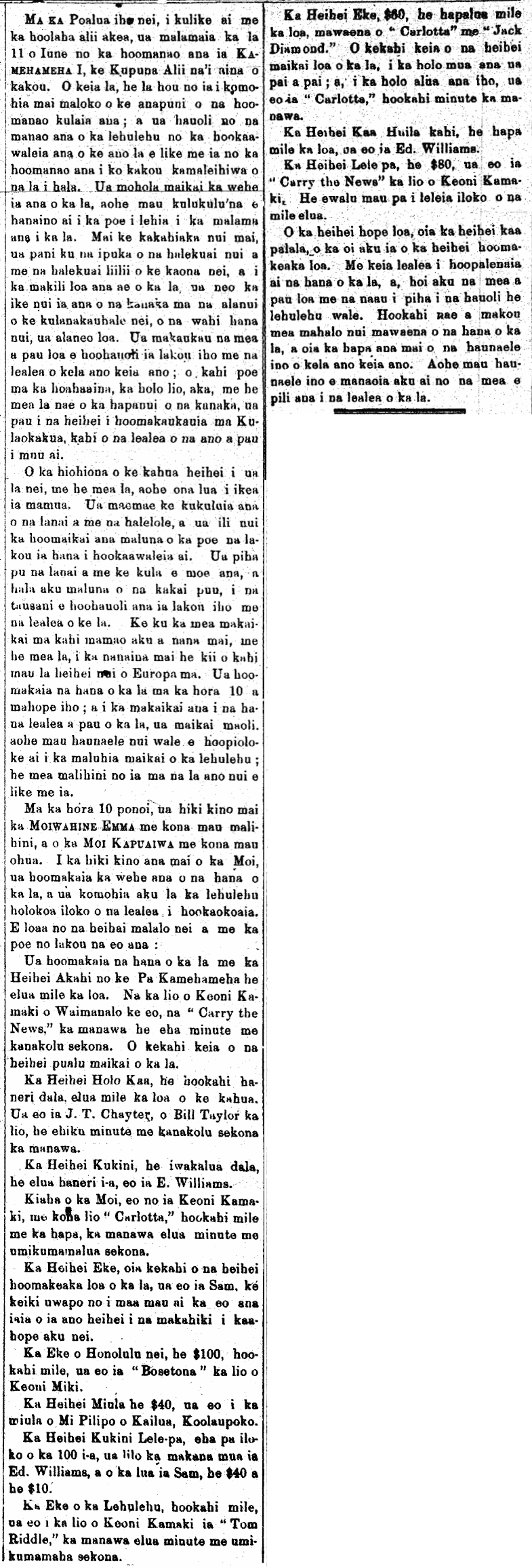
On this past Tuesday, in accordance with the royal proclamation, the 11th of June was celebrated as a day of remembrance of Kamehameha I, the Royal Ancestor who conquered our aina. This is a new day included in the circle of holidays, and the minds of the populace are happy about this type of day set aside to remember our cherished one of days gone by. The day dawned beautifully; there were no droplets to interfere with those who skillfully took care of the day. From early morning the doors of the shops of the town, both large and small, were shut. And when the sun came all the way out, there were not many people seen on the streets of town, and the great work places were deserted. All things meant to entertain themselves were prepared—some people made parties while others rode horses; however, it seemed as if most of the people were all at the races organized at Kulaokahua, the usual place for all types of entertainment.

The atmosphere of the race tracks that day seemed better than all previous days. Lanai and tents were set up impeccably, and those that undertook that task received much appreciation. The lanai, fields, and hills were filled with thousands who amused themselves with the events of the day. If an observer stood and watched from afar, it was as if he were seeing a picture of a race day somewhere like in Europe. The events of the day started at 10 or so, and after watching all the day’s activities, it was truly wonderful. There were no great commotions to disturb the peace among the crowd–this is something unfamiliar on special days like these.

At 10 o’clock sharp, Queen Emma arrived with her guests, and King Kapuaiwa with his entourage. At the appearance of the King, the activities of the day commenced, and all of the crowd joined in the gaieties that were set up. Below, you will find the races and those that won.

[Various horse races, winners, and prizes are listed.]

The final race, the wheelbarrow race was the most humorous. This entertainment marked the close of the festivities of the day. And everyone left with hearts filled with much glee. We are greatly pleased with one thing, and that is the decrease in the number of outbreaks of various sorts. There were no big riots thought to be related to the events of the day.

(Au Okoa, 6/13/1872, p. 2)

Ma ka Poalua iho nei...

Ke Au Okoa, Buke VIII, Helu 9, Aoao 2. Iune 13, 1872.

Maunaala, 1899.

ROYAL MAUSOLEUM

(THIS IMPOSING STRUCTURE STANDS ON AN ELEVATION PROMINENT IN THAT PORTION OF NUUANU CEMETERY ON THE WAIKIKI SIDE OF THE AVENUE. WITHIN WILL BE DEPOSITED THE REMAINS OF PRINCESS KAIULANI.)

WITHIN THE TOMB.

(This paper, February 16, 1891.)

On a beautiful lawn at the entrance of Nuuanu valley, overlooking this city, the harbor and ocean beyond, stands the Royal Mausoleum, erected by the Hawaiian Government, as the resting place of the remains of the Royal Family of Hawaii and a few of their greatest benefactors. It is built in the Gothic style of architecture, of concrete stone, with the lawn handsomely laid out with walks and studded with trees, the whole presenting from the avenue an attractive appearance. Continue reading

The Alii moved to Maunaala, 1865.

[Found under: “HUNAHUNA MEA HOU O HAWAII NEI.”]

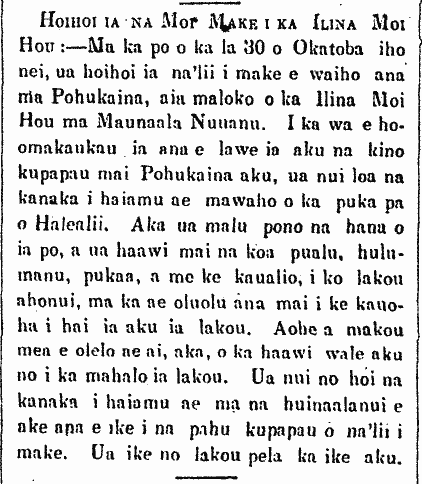
The Deceased Kings Taken to the New Royal Cemetery:—On this past 30th of October, the deceased alii who were at placed at Pohukaina were taken to the New Royal Cemetery at Maunaala, Nuuanu. When they were preparing to take the remains from Pohukaina, there were many people gathered outside the gates of the Palace grounds. But the activities that night were properly peaceful, and the volunteer [pualu], hulumanu, cannon, and calvary troops extended their patience. We have nothing to say but to give our thanks to them. There were many people gathered at the street crossings in hopes of seeing the coffins of the deceased alii. They knew that is how they would see them.

(Kuokoa, 11/4/1865, p. 2)

Hoihoi ia na Moi Make i ka Ilina Moi Hou.

Ka Nupepa Kuokoa, Buke IV, Helu 44, Aoao 2. Novemaba 4, 1865.

More on the transfer of the remains of the Alii to Maunaala, 1865.

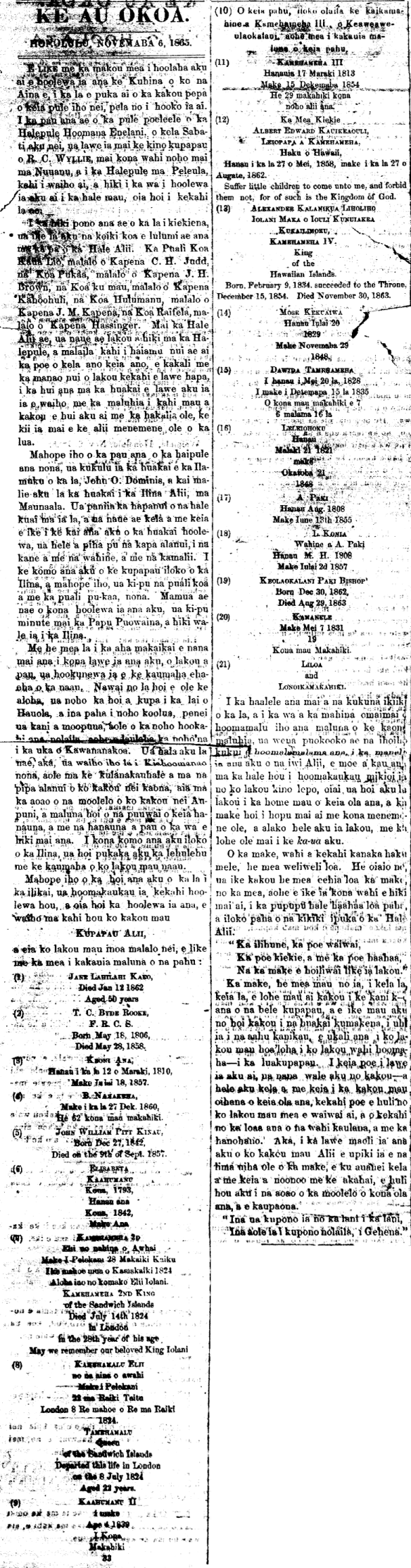
Just as we announced in last week’s issue of our paper, that there would be a funeral for the Minister of Foreign Affairs [Kuhina o ko na Aina e], it was indeed carried out. After the night prayer [pule poeleele] of the Anglican Church [Halepule Hoomana Enelani] was over, the body of R. C. Wyllie was taken from his residence at Nuuanu to the Church at Peleula, where it was left until the funeral procession to his permanent home, that being on a following day.

When the sun reached its heights, the military boys were seen crowded together in the grounds of the Palace. The Cavalry [Puali Koa Kaua Lio] under Captain C. H. Judd, the Artillery Division [? Koa Pukaa] under Captain J. H. Brown, the regular soldiers [? Koa ku mau] under Captain Kahoohuli, the Hulumanu Division [Koa Hulumanu] under Captain J. M. Kapena, the Rifle Squad [Koa Raifela] under Captain Hassinger. From the Palace, they moved on to the Church, and there many people of all sorts who waited with great hope that they would take part in the procession taking him to be left in peace where we all must go with no delay when fetched by the heartless ruler of the pit.

After the prayer for him was over, a procession was organized by the Marshall for the day, John O. Dominis, and the procession marched quietly to the Royal Cemetery at Maunaala. Most of the businesses were closed that day, and everyone went to watch the funeral procession; the sides of the streets were filled with men, women, and children. When the remains entered the Cemetery, and right after, the troops and the artillery division sounded their guns for him. However before his funeral, the Fort at Puowaina shot off minute guns until he was at the Cemetery.

It was as if while the group of onlookers watched him being taken away, all of the people were were reeling with painful sorrow in their hearts. Who would not be without aloha, for he lived until well known in the calm of Hauola, and should he have had a partner, he would have had many grandchildren, but he lived alone and did not multiply in the uplands of Kawananakoa. He has gone, but has left a Monument for himself, not in the city, or on the side of the streets of our town, but on the sides of the history of our Nation, and in the hearts of this generation, and all of the generations to come. When he entered the Tomb, the crowd scattered and went back with a heavy heart.

After the sun returned to the surface of the sea, another funeral was readied, and that funeral to move to a new place our

Alii’s Remains,

and here are their names below, as is written on their coffins:

(1) Jane Lahilahi Kaeo, Died Jan 12, 1862, Aged 50 years.

(2) T. C. Byde Rooke, F. R. C. S. Born May 18, 1806, Died May 28, 1858.

(3) Keoni Ana, Born on the 12th of March, 1810, Died July 18, 1857.

(4) B. Namakeha, Died 27 Dec. 1860, At 52 years of age.

(5) John William Pitt Kinau, Born Dec. 27, 1842, Died on the 9th of Sept. 1857.

(6) Elisabeta Kaahumanu, Born 1793, Died 1842.

(7) Kamehameha 2d, Elii no nahina o Awhai, Make i Pelekani 28 Makaiki Kaiku, I ke mahoe mua o Kamakaiki 1824, Aloha ino no komako Elii Iolani.
Kamehameha 2nd King of the Sandwich Islands, Died July 14th, 1824, In London, in the 28th year of his age, May we remember our beloved King Iolani.

(8) Kamehamalu Elii no na aina o awahi, Make i Pelekani, 22 ma Raiki Teitu, London 8 Re mahoe o Re ma Raiki 1824.
Tamehamalu, Queen of the Sandwich Islands, Departed this life in London on the 8 July 1824, Aged 22 years.

(9) Kaahumanu II died Apr. 4, 1839 in Her 33rd Year.

(10) In this casket is the daughter [? son] of Kamehameha III, Keaweaweulaokalani; there is nothing inscribed on the casket.

(11) Kamehameha III, born on the 17th of March 1813, Died 15th December 1854, He reigned for 29 years.

(12) His Highness, Albert Edward Kauikeaouli, Leiopapa a Kamehameha, Haku o Hawaii, Born on the 27th of May, 1858, died on the 27th of August, 1862. Suffer little children to come unto me, and forbid them not, for of such is the Kingdom of God.

(13) Alexander Kalanikua Liholiho, Iolani Maka o Iouli Kunuiakea, Kukailimoku, Kamehameha IV, King of the Hawaiian Islands. Born Feberuary 9, 1834, succeeded to the Throne, December 15, 1854. Died November 30, 1863.

(14) Mose Kekuaiwa, Born July 20, 1829, Died November 29, 1848.

(15) Davida Tamehameha, Born on May 20, 1828, Died December 15, 1835. He was 7 years, 6 months, and 16 days old.

(16) Leleiohoku, Born March 21, 1821, Died October 21, 1848.

(17) A. Paki, Born Aug. 1808, Died June 13th, 1855.

(18) L. Konia, Wife of A. Paki, Born 1808, Died July 2nd, 1857.

(19) Keolaokalani Paki Bishop, Born Dec. 30, 1862, Died Aug. 29, 1863.

(20) Kamanele, Died May 7, 1831, at 19 Years of Age.

(21) Liloa and Lonoikamakahiki.

When the stifling rays of the sun left, and when the dim moon shown over the peaceful town, the torches glowed red, lighting up the bones of the Alii as they were carried on palanquins [manele], to lie and be placed in the new building made with fine craftsmanship for their physical remains, for they returned to the eternal home of this life, death snatching without compassion, and dragged them off without a cry [?? ke ka-ua aku] being heard.

Death, according to one poet, is something terribly frightening. This is true; we understand that death is something very awesome, because it is not known where it will come, from the lowly hovel to perhaps at the door of the Palace.

“Ka ilihune, ka poe waiwai,
Ka poe kiekie, a me ka poe haahaa,
Na ka make e hoiliwai like ia lakou.”

[“The poor, the rich,
The high, and the low,
Death makes them all equal.”]

Death is something regular, everyday we hear the ringing of the funerary bells, and we always are witness to the funerary processions cloaked in mourning clothes, following after their friends to his resting place—the grave. As these people are taken away, we look—and each of them go to our occupations in this life; some look for their fortune, while other for fame, and glory. But when are Alii are taken away, trapped by the tireless hands of death, we all unassumingly consider, looking back upon the history of his life, and weigh.

“Ina ua kupono ia no ka lani i ka lani,
Ina aole ia i kupono nolaila, i Gehena.”

[“If befitting for heaven, then to heaven,
If not befitting for there, then to hell.”]

[See more on the Nanea Armstrong-Wassel’s instagram post here.]

(Au Okoa, 11/6/1865, p. 2)
E like me ka makou mea i hoolaha aku ai...

Ke Au Okoa, Buke I, Helu 29, Aoao 2. Novemaba 6, 1865.