More on Liliu’s 75th birthday, 1913.

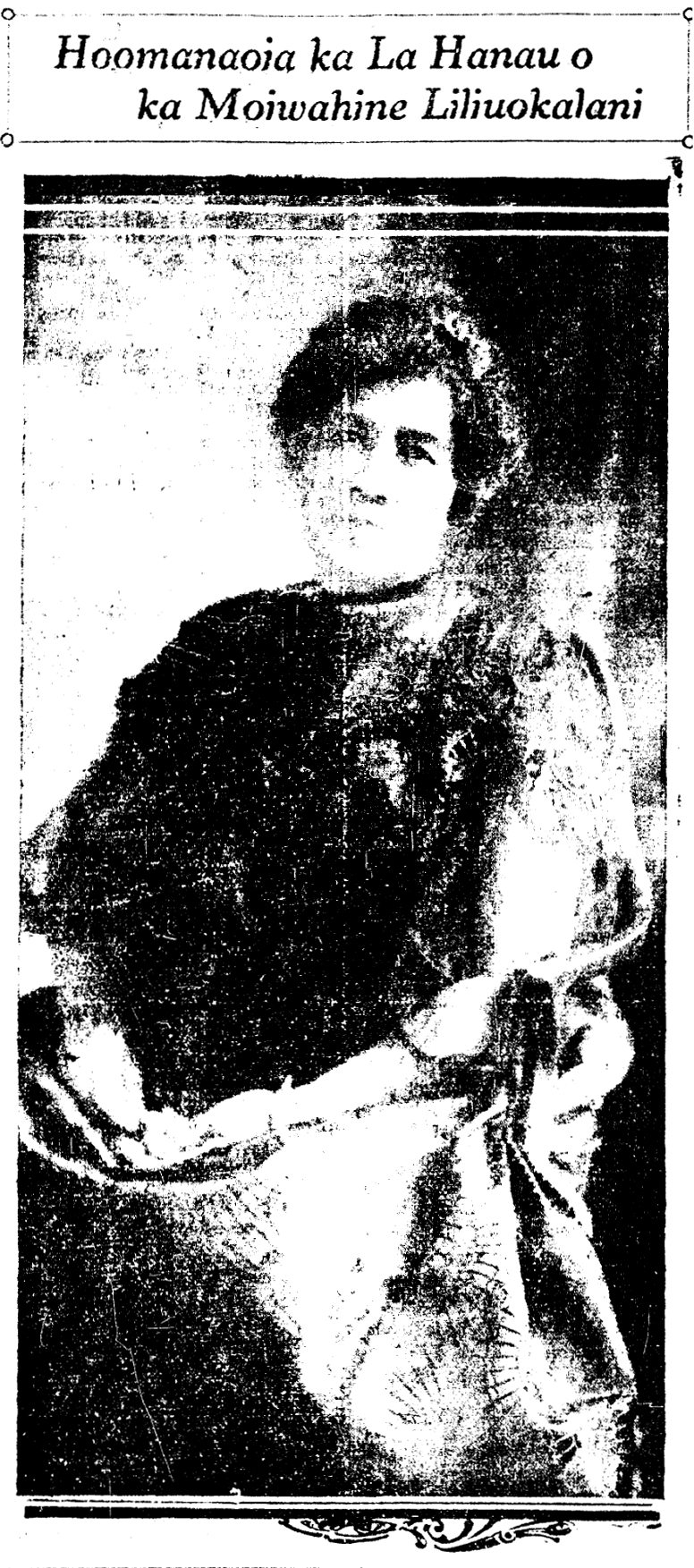
THE BIRTHDAY OF QUEEN LILIUOKALANI

This past Tuesday, the 2nd of September, was the birthday of Queen Liliuokalani; she has been living in this world 75 years, and she is the only reigning queen of Hawaii that has almost reached extreme age.

There was a royal audience that day as was done regularly in the years past, at her home at Washington Place [Wakinekona Hale], before noon; there were many friends and Hawaiian citizens of the queen who went to see her on that day. Princess Kawananakoa assisted her in welcoming the friends and citizens, and Colonel C. P. Iaukea introduced the friends before her, and Mr. E. K. Lilikalani escorted the malihini into the house.

The Royal Hawaiian Band [Bana Hawaii] was there entertaining the audience while they all were visiting the queen; there were many old songs, songs which the queen took great delight in while she reigned and mele that were sung in the days of King Kalakaua.

(Kuokoa, 9/5/1913, p. 2)

KA LA HANAU O KA MOIWAHINE LILIUOKALANI

Ka Nupepa Kuokoa, Buke LI, Helu 35, Aoao 2. Sepatemaba 5, 1913.

More celebrating of the Queen’s 74th birthday, 1912.

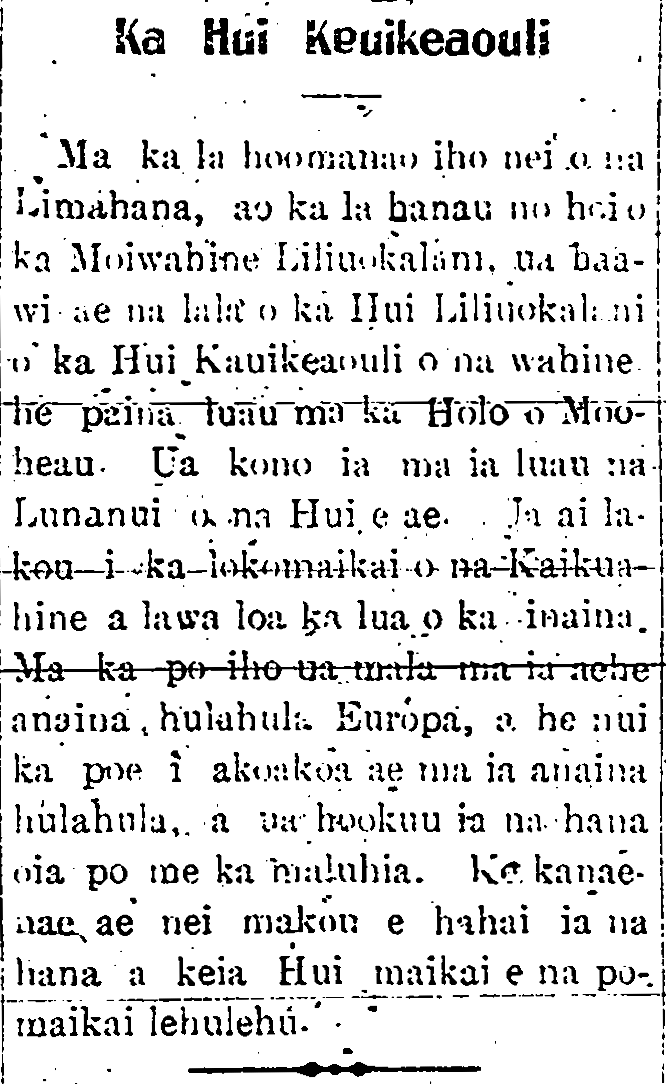
Kauikeaouli Society

On this past Labor Day, the birthday of Queen Liliuokalani, the members of the Liliuokalani Society and the women of the Kauikeaouli Society gave a luau at Mooheau Hall. Invited to that luau were the heads of the other Societies. They partook of the kindness of the Sisters until their stomachs were filled [ua lawa loa ka lua o ka inaina]. The following night, a European dance was held and many people assembled there, and the event that night was let out peacefully. We pray that the ways of this Society will be followed for the good of the public.

(Hoku o Hawaii, 9/5/1912, p. 3)

Ka Hui Kauikeaouli

Ka Hoku o Hawaii, Buke 7, Helu 14, Aoao 3. Sept. 5, 1912.

More on Liliu’s 73rd birthday celebration, 1911.

BIRTHDAY OF LILIUOKALANI

Honolulu, Sept. 2—The commemoration of Queen Liliuokalani’s birthday was held today, and according to what the Queen said to some of her friends:

“This is my seventy-third birthday, and i am in good health; i have left behind the disturbing things of this world in which we live, and have surrounded myself with many friends.”

The Queen’s health is fine indeed, and in the morning, the Band of the County [? Royal Hawaiian Band] arrived to play while she dined on breakfast until 10 a. m. Several associations arrived to giver their congratulations to the Alii; and at 11 o’clock, the procession of haole friends to see the Alii began, and this perhaps is the grandest royal audiences of haole giving their congratulations to the Queen.

The Queen was attired in a beautiful garments fitting of her stature, and attended by the Princess Kalanianaole and Mrs. Irene Holloway and Mrs. C. P. Iaukea. The place where the Queen sat was surrounded by many different kahili, and it was her steward, the Honorable C. P. Iaukea who introduced the many strangers. The Alii, the Queen, met each one who came to visit her and she placed a kind smile upon her Royal visage. When the writer for the Hoku [this newspaper, Hoku o Hawaii] appeared before the Alii, she immediately asked, “How are the famous lehua of the land, the lehua of Hilo; are the famous blossoms of the land still beautiful?”

The Queen wore a white lehua [lehua puakea] lei from Hilo, and on her Royal countenance was happiness. On that morning of her birthday, she presented the water leaping land of Waikahalulu as a Park for the public, and it will be administered for the benefit of the people.

The Hoku o Hawaii prays for the long life of the beloved Queen of Hawaii, and although she has no throne upon to rule, hers is the throne of aloha within the hearts of her loving people. May the Queen live in God.

[Unfortunately the issues of Hoku o Hawaii from 1906 to the early part of 1917 (including this article) are not available online! The more people talk about the importance of the information in the Hawaiian-Language Newspapers and the need to rescan those newspapers clearly and make them accurately searchable, the more chance there will be funding for it!]

(Hoku o Hawaii, 9/7/1911, p. 2)

LA HANAU O LILIUOKALANI.

Ka Hoku o Hawaii, Buke 6, Helu 18, Aoao 2. Sept. 7, 1911.

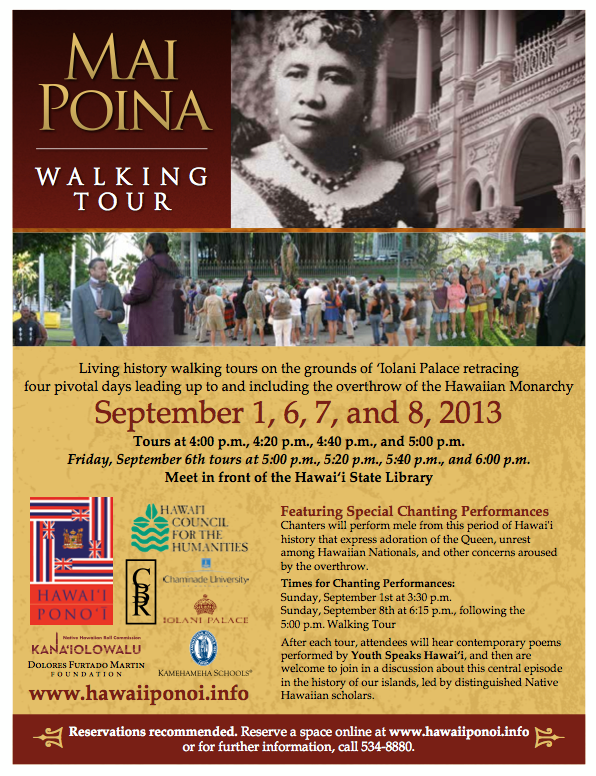
Don’t forget! The Queen’s 175th Birthday! 2013.

MAI POINA WALKING TOURS 2013!

Don’t Forget, if you are on Oahu nei, there are many events coming up to celebrate the memory of Queen Liliuokalani, like the Onipaa Celebration happening on the grounds of Iolani Palace on Sunday, September 1, from 10:00 a. m. to 3:00 p. m. Also there are the Mai Poina Walking Tours on the 1st, 6th, 7th, and 8th!

What about the rest of the islands? What are all of you up to?

Mai Poina 2013

Patriotic mele in English, 1893.

As Israel in ancient times sat weeping by the waters of Babylon listening to the plaintive songs which arose from their singers, so sits Hawaii in grief and mourning to-day and to Her our bard sings:

I had a dream, I saw a vision pass before me,
Long ages past arose in swift array,
Adown the stream of time my fleeting fancy bore me
From age to age unto the present day,
Far o’er the southern sea I saw brave ships a-sailing
From isle to isle, till at Hawaii’s shore
They touched, and soon with joy the natives came, them hailing
With pious awe, incarnate Gods of yore,
From all the land they flocked with speed to see the stranger,
Adoring gave their gifts both rich and rare,
But time brought fuller knowledge, knowledge brought its dangers
And Captain Cook’s life paid the forfeit there.
And down the stream still visions came a-floating;
Vancouver came unto this race so brave;
Restored the friendship Cook had lost; while noting
That Britain ne’er would hold them as her slave.
Still swept the vision on with flight so speedy;
One ship alone this time comes into view—
America’s gift unto these islands needy,
Peace, love, goodwill—and Christianity too.
Right lovingly was welcomed each new teacher,
The people flocked to hear good news so true,
That more and more it seemed to every preacher,
The harvest plenteous, but the laborers few.
And time flew by on wings. The isles grew fair, and fairer;
One Briton thought to seize them for his land,
But Britain’s Admiral, our independence bearer,
Restored the flag midst praise from every hand,
The years passed by. Through all the land there rose the steeple—
The preacher controlled all with kindly hand;
Give land and constitution to your people!
(O King! Give heed!) and God will bless your land.
Year followed year. Changed Kings and constitution.
The stranger increased: took mortgages on land:
Kept Hawaii’s daughters, sisters, wives in prostitution:
Spread poverty and vice around on ev’ry hand.
Still years rolled on. With sugar now grown wealthy,
The foreign Christians lifts his eye around,
And says: “For me no doubt the climate is most healthy,
“Tho’ poor and dying Hawaii’s native sons are found.
“Some seventy years ago we gave this land the Bible
“And tried to teach them then its use,
“(To say we’ve showed them poor examples is no libel)
“And fair exchange ‘t will be to cook their goose.
“Their cries for right and justice soon we’ll stifle:
“Take for ourselves this Paradise on earth.
“If they object, we’ll each one tap our rifle,
“And call for help upon our land of birth.
“Unfit to rule with all these years of training—
“(We’ll spread the lie around on every hand,)
“You’ll see they’ll let us do it, uncomplaining,
“For they have got our Bible, and so we’ll take their land.”
At this a noise awoke me, and in wonder
I saw the very instance of my dream.
Hawaii’s Queen and Natives were put under
To bolster up their money-getting scheme
And now forth from them goes across the waters
One last appeal for Justice and for Right.
Preserving peace, Hawaii’s gen’rous sons and daughters,
Before God’s throne on high, in prayer unite:
“Great God! the Judge of All! The records thou art keeping!
“Look down in mercy on our sad estate!
“Be kind unto us! Hear our voice of weeping!
“Till thou restore, grant us in peace to wait.
“And thou, great nation! home of truth and bravery!
“Freedom’s defender! we pray thee us O, hear!
“Restore our Queen and us; now, as in slavery,
“Held by usurper’s armed fear.
“Restore our rights and help us to maintain them!
“O let our prayer be crowned with success!
“Our conduct and your friendship will retain them,
“The God of nations will for ever bless.”

[This mele was probably composed by Kahikina Kelekona, J. G. M. Sheldon.

The image taken from the microfilm is hard to make out at the bottom. Hopefully there will be funding found to have the Hawaiian-Language Newspapers be unbound and rescanned clearly. How can you get to all the pearls stored in the newspapers if you can’t make out the words?]

(Hawaii Holomua, puka pule, 1/28/1893, p. 4)

As Israel in ancient times...

Hawaii Holomua (Puka Pule), Buke III, Helu 5, Aoao 4. Ianuari 28, 1893.

The Hawaiian Moses? 1893.

“THE MISTAKES OF MOSES.”

We refer, of course, to the Hawaiian political Moses, who has recently broken camp, and set the faithful in motion through sea, desert and wilderness to the Land of Promise, beyond the shadow of the Throne. Yes! We refer to the Hawaiian political Moses, but whether his other name is Dole or Thurston, has not, at this writing, fully transpired. Still, the doubt as to his other name is a merely nominal doubt, not affecting the merits of the case. And as the original state—man of that name was not gifted with immunity from error, so neither has the Hawaiian Moses, even during his very brief pilgrimage, avoided all mistakes. It should ever be the part of a friend to note his friends’ infirmities, and, by bringing them mildly to their authors’ notice, suggest their reform, or convey a warning against their repetition.

———

We are all aware of the high pressure of seeming necessity under which the present government was formed. We can therefore appreciate, to some extent, the causes of the neglect to observe, towards the numerous Native element, those marks of regard and confidence without which no government can hope to endure in Hawaii. We repeat, that the pressure of the occasion must be the excuse of the gentlemen at the head of the movement for their seemingly unfriendly, and even hostile attitude toward the entire Native race, in the ordering of early events under the new dispensation.

———

The exclusion of Hawaiians from a participation in the beneficent project not only seemed, but was, and is complete. There may have been, and no doubt were reasons, seemingly sound to those who adopted them, for such a course,—reasons of which the public cannot judge, because the public know them not. Yet it would seem that one of two propositions must be true; viz.: either the Hawaiians were needlessly, and, therefore, harshly excluded from such participation in the reforming of their own government, or else the entire race were deemed by the leaders to be unfit to participate in such an enterprise.

———

If the former of the above propositions be true, one would naturally expect the mistake to be rectified at the earliest opportunity. That it has not been rectified would seem to stamp it as having been no mistake, but a course deliberately adopted, for, note the opportunity to retrieve the error, (if error it had been thought to be) in the filling of the four vacancies in the Advisory Council, on the 21st inst. It was then, as seems to us, the manifest duty of the government to seek out and appoint to those vacancies, men of Hawaiian blood, whose brains, interests and loyalty to the new idea bespoke than as deserving of such honor and confidence.

———

The failure of the government to attempt to bring even one Hawaiian to a seat at the Council Board is susceptible of only one of two meanings:—1st, that no Hawaiian could be found possessing those qualifications, or, 2nd, that the government were determined to ignore and exclude them, in any event.

———

If such exclusion was premeditated and malicious, the less said of it the better, as it is self-condemnatory. If on the other hand, there be no native Hawaiian fit to occupy a seat in the government councils, with what degree of candor or confidence can the Provisional Government request of expect the United States to incorporate our country into itself? What a commentary upon that request is the action of the government itself, in thus excluding from their confidence the entire aboriginal race, more completely than the Mongolian is now excluded from the Union. Forty odd thousand Hawaiians on these shores, and not one, (in the opinion of the government,) entitled or qualified to have a voice in the government of his native land. What a text for the American enemies of annexation, and how they will use it!

(Liberal, 1/25/1893, p. 2)

"THE MISTAKES OF MOSES."

The Liberal, Volume I, Number 39, Page 2. January 25, 1893.

Annexation or not? 1893.

[Found under: “THIS AND THAT.”]

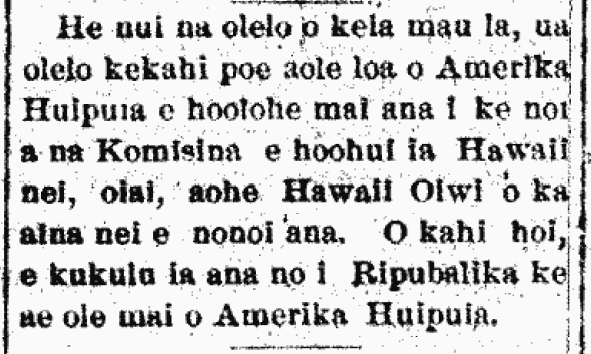
There is much talk these day; some say that there is no way that the United States of America will listen to the request of the Commission to annex Hawaii, being that there is no Native Hawaiian of the land asking for this. Some say that a Republic will be established if the U. S. doesn’t agree.

(Liberal, 1/25/1893, p. 4)

He nui na olelo o keia mau la...

The Liberal, Volume I, Number 39, Page 4. January 25, 1893.

C. C. Moreno on missionaries, 1893.

A Misunderstood People.

MORENO ON THE MISSIONARIES.

Editor Post: For several years your public-spirited paper has published correspondence and statements submitted by me about Hawaii in which was foreshadowed the present state of affairs. The revolution which has just taken place is the inevitable result of missionary rule; the long-standing and deep-rooted cause of the unrest.

The missionaries in Hawaii, as in China, Japan, and elsewhere, consider that country as their open hunting grounds, regardless of the rights, customs, wishes, and priviliges of the natives and of stipulations.

I positively know that the self-appointed four chiefs of the Provisional Government in the Hawaiian Islands and the five commissioners coming to Washington to negotiate a treaty of annexation are, without a single exception, missionariesʻ confederates. Not a single native Hawaiian is with them, therefore, they cannot be considered as the representatives of the Hawaiian nation, of which they are aliens and enemies, but only as the emissaries of one side (or of a higher), which is not the right side.

The truth about Hawaiian affairs has never reached the State Department and that is the reason why, in the department, the knife has always been taken by the blade instead of by the handle in dealing with the Hawaiian question.

The United States always sent third rate politicians as ministers and consult to Honolulu, hence the erroneous information about Hawaii. I have on the spot studied Hawaii and the Hawaiians, their troubles with the missionaries of all creeds, and when distant from the islands I have kept an uninterrupted correspondence with the leaders of the Hawaiian nation, such as the Hons. Wilcox, Bush, Testa, Kaai, Kapena, Kaunamano, Kimo Pelekane [James I. Dowsett], and others.

My views on the Hawaiian question I explained at length to President Hayes and Secretary of State Evarts, to President Cleveland and to Assistant Secretary of State Porter: later, to Senator Morgan and to Congressman McCreary, and these are the statesmen that ought to dispose of the Hawaiian question and render justice to the weak, ill-treated, honest, and generous Hawaiian people that have been continually misrepresented, misjudged, and grossly wronged.

In accordance with the good order of things the coming self-appointed and self-styled Hawaiian commissioners, with more appearance than substance, should not be received by the United States authorities, because their self-attributed mission to Washington is based only upon selfish and malignant motives.

This will be a good opportunity for the great people of the United States to show their sentiment for fair play and generosity toward the unfortunate, harmless, friendly, and oppressed Hawaiian people, worthy of sympathy and of help in this their hour of national distress.

Celco Cæsar Moreno.

(Liberal, 2/25/1893, p. 2)

A Misunderstood People.

The Liberal, Volume I, Number 48, Page 2. February 25, 1893.

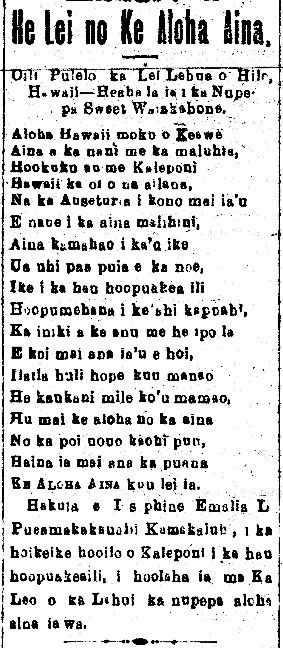
Sweet Emalia and “Moku o Keawe” redux, 1907.

A Lei of Patriotism.

The Lehua Garland of Hilo, Hawaii Rises in Triumph—What is that in the Newspaper, Sweet Waiakahone.

Aloha Hawaii moku o Keawe
Aina a ka nani me ka maluhia,
Hookuku au me Kaleponi
Hawaii ka oi o na ailana,
Na ka Auseturia i kono mai ia’u
E naue i ka aina malihini,
Aina kamahao i ka’u ike
Ua uhi paa puia e ka noe,
Ike i ka hau hoopuakea ili
Hoopumehana i ke ahi kapuahi,
Ka iniki a ke anu me he ipo la
E koi mai ana ia’u e hoi,
Ilaila huli hope kuu manao
He kaukani mile ko’u mamao,
Hu mai ke aloha no ka aina
No ka poi uouo kaohi puu,
Haina ia mai ana ka puana
Ke Aloha Aina kuu lei ia.

Composed by Iosephine Emalia L. Pueamakakaualii Kamakaluhi, at the California winter exhibition in the skin-whitening snow, published in Ka Leo o ka Lahui, the patriotic newspaper of the time.

[Sweet Emalia and her song of aloha aina which is still so famous today!]

(Aloha Aina, 10/26/1907, p. 8)

He Lei no Ke Aloha Aina.

Ke Aloha AIna, Buke XII, Helu 43, Aoao 8. Okatoba 26, 1907.