New library to open, 1913.

CEREMONY WILL OPEN PUBLIC LIBRARY

All Invited to Attend Special Program Tomorrow Afternoon

Governor Frear will be the first patron of the new Carnegie Library. He will receive Registration Card No. 1, and will be the first to enter the big building when it is formally thrown open to the public tomorrow afternoon.

Unique and appropriate exercises will characterize the formal opening of the library tomorrow. The program for the exercises was completed yesterday afternoon by A. Lewis, Jr., president of the board of library trustees, Secretary W. H. Babbitt and other members of the board. The splendid new building, made possible by Andrew Carnegie’s gift of $100,000, will be the scene of a notable gathering.

With Mr. Lewis and Governor Frear as the central figures in the ceremony, the program will begin at 3 o’clock, when the Royal Hawaiian Band, arranged for by Secretary Babbitt and Mayor Fern, begins an hour of music.

At four o’clock the ceremony proper will begin. Mr. Lewis will make a short address appropriate to the occasion and will then introduce Prof. M. M. Scott, principal of McKinley High School, who has been prominent in the work for the new library. Chairman Lewis will then, as president of the library board, give to Governor Frear Card No. 1. Then the chairman will unlock the big front doors of the building and will escort Governor Frear inside. According to the little ceremony arranged, the governor will then proceed to the central desk and will be met by Miss Edna I. Allyn, the librarian, who will issue to the executive the first book from the new institution.

As soon as the governor has entered, the public will follow, the entire library building being open to visitors, with the assistant librarians and employees detailed as escorts.

The Outdoor Circle of the Kilohana Club has furnished a number of beautiful palms and ferns with which the interior will be decorated.

Registration cards will be generally issued tomorrow and intending patrons of the library can sign the cards and be enrolled from four to six o’clock.

The new library, it is emphasized by the board of trustees, is absolutely free to everyone and books will be issued upon presentation of the properly signed registration card. There is also a traveling library feature, the committee on which is headed by Robbins B. Anderson.

[Tomorrow will be a hundred years since the library opened! See the many related activities going on in commemoration of this great historical event! It seems that the Royal Hawaiian Band will be there tomorrow morning to celebrate just as they did a hundred years ago!!

I am not sure why I could not find an article in the Hawaiian-Language Newspapers announcing this opening. But there is this from a couple of years later!]

(Honolulu Star-Bulletin, 1/31/1913, p. 1)

CEREMONY WILL OPEN PUBLIC LIBRARY

Honolulu Star-Bulletin, Volume XX, Number 6499, Page 1. January 31, 1913.

CEREMONY WILL OPEN LIBRARY

Honolulu Star-Bulletin, Volume XX, Number 6499, Page 4. January 31, 1913.

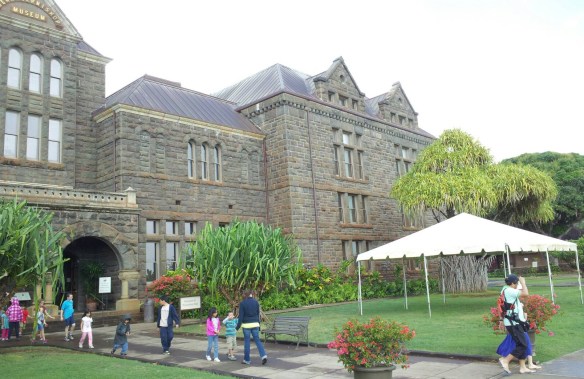
The Bernice Pauahi Bishop Museum, and the stone awa bowl, 1919.

SEEING ONCE AGAIN THE MUSEUM AT KAMEHAMEHA SCHOOL.

Twenty years or more has past since I first saw exhibits of the antiquities of Hawaii nei and the tiny islands of Polynesia that are stored in that building, and it is of great value to those who wish to see, and it is true, there are more things stored there from when I first saw it; and there were things which shocked me while other things made me sad.

When I arrived at the museum, it was already filled with foreigners and locals going upstairs and downstairs, and soldiers were the majority, from the military ships docked those days; officers as well as enlisted men returning and going back to the battlefield, they were awestruck; and being that there was only three hours allowed for going around, and while I looked, peeped, and peered here and there, I looked at my watch and more than an hour had past, and here I was on the first floor with so much more of the building to see; therefore, I tried to quicken my pace so that I see things; but if you intended to see everything, you would not be able to do that walking around the whole day because there are so many things that catch your attention and you’d spend some minutes looking at them; and because I wanted to read the explanations and all of the stories, minutes were spent there.

There were all types of fish, birds, and fruits, war implements of all sorts of that time, and they were amazing to see; plus the animals of the land and the sea, it was as if they were living.

On the second floor were the thrones of the beloved monarchs of Hawaii nei who passed, and it was painful in my gut to see this touching sight; and their portraits hung all about, looked as if they were watching you; yes, aloha, aloha for the chiefs of the land.

The time was going quickly, and I was intent on seeing everything, and yet the time was short.

With every step on the third floor, everything was fascinating to see, and looking blow, the winding stairs were just so beautiful and everything was kept so nicely. But amongst everything I saw, there were but two most important things: the first being the thrones and all of their belongings, and the second was a huge stone which weighed more or less a ton; when I entered and met the greeter, I was given a piece of tin stamped with a number, and was asked to leave my hat and coat, and then I stood at the base of the stairs thinking where should I go first; that is when I entered the room on the mauka side of the building, greatly delighted by everything until I reached the place where the great stone stood, and I was astonished at the look and appearance of this stone;  as if it was something I saw before, but when; that is what I thought to myself; and because I was very unclear about it, I looked here and there and I saw a haole sitting at a desk reading a book; I gave my aloha and he looked at me and asked if there was something he could do for me; I said yes, if he could explain to me the story of the stone.

“Yes,” he said, “that stone is the grinding stone of the Hawaiians in the old days; it was upon that stone that adzes were sharpened, and that is the reason for that smooth indentation on the top.”

While I was listening to the explanation of that fine friend, my eyes were set directly upon that stone, and that is when I saw the description printed below it; I immediately left him and I went to read, and I was shocked and for several minutes I stood there, astounded that I met up again with this rock after a span of 55 years gone by.

That label explained that this rock was sent from Kilauea, Kauai, when George R. Ewart was boss of the Kilauea sugar plantation, in 1897, and then I went and joined my friend, and told him the truth about that stone, and its name, and its function; it wasn’t a grindstone like what he believed; and as he heard my story he began to write.

Therefore my news loving friends, so that your confusion over this stone is put to an end, and for when you go to visit this building, you won’t fail to meet up with this rock, and you will have an understanding through this story I am revealing:

The name of this stone is Kanoa, and this was a awa bowl [Kanoa awa] for the alii of that time, and this is the reason why that depression was made right on the top, and there is a place between Kilauea and Pilaa called Kanoa until this day,  named for this stone; and from this spot, the sto0ne was taken away by the boss George R. Ewart when he was the head of that sugar plantation, and this place became the graveyard for the Portuguese, and a Catholic Church [Saint Sylvester Church] stands there until today near the government road.

It was 55 years ago that I first set my eyes on this stone, during those days when the land was forested, and beneath a pandanus tree was where this stone was placed; its height from the ground was perhaps a foot or so, and this Kanoa awa was crafted with great skill and at its side was the cup [apu], which was a smaller stone fashioned like an awa cup.

From what my kupuna told me, this Kanoa belonged to some chiefs and where the Kanoa was left was where a great house one stood, which was a place where the alii of the old times would enjoy themselves. And I was also informed of the alii to whom belonged the Kanoa; Kamoku was the man, and this is a hill that stands to this day in the middle of a field, and should a malihini go and see that Catholic church mentioned earlier, that place is Kanoa, and if you turn to look inland, about two miles away a hill stands like a heap of lava, and below all around it grow all sorts of plants, and from the middle until the top is pilipiliula grass, and today on its peak is a grove of tall pine trees planted after the owner of this land, Mr. C. Bertelman, died and his body was brought and buried some years ago; as for the chiefly woman, she was Kahili, and this is a land immediately seaward of this place, with a huge estuary where fishes of all types swim today.

Should the alii want to have fun, the chiefess went up with poi and fish, and Kamoku went down with the intoxicating awa of the uplands of Kahua-a, bundles of oopu fish, mokihana lei of Kahihikolo, dark shrimps [opae kuauli] of Kaluaokalani, and it was in this house that they would enjoy themselves with their people; that is the whole story dealing with this stone, a awa bowl for the chiefs.

If Mr. George R. Ewart had known of yet another stone that is in Kilauea in Kalihiwai, which rings like a bell, and it is rounded flat, and its sound can be heard for a mile or more if it is struck with a hammer or a rock in other times, and it was something played with by school children; then it would have probably been taken by Mr. Ewart to the museum to be viewed.

I give my appreciation to him being that in that year that this stone was sent, I was working at that sugar plantation, but I had no prior knowledge of this until I saw it once again in this museum.

With the Editor and the metal type setting boys go my valediction.

Me ka mahalo,

Charles K. Nawaiula.

Honolulu, Dec. 2, 1919.

(Kuokoa, 12/12/1919, p. 3)
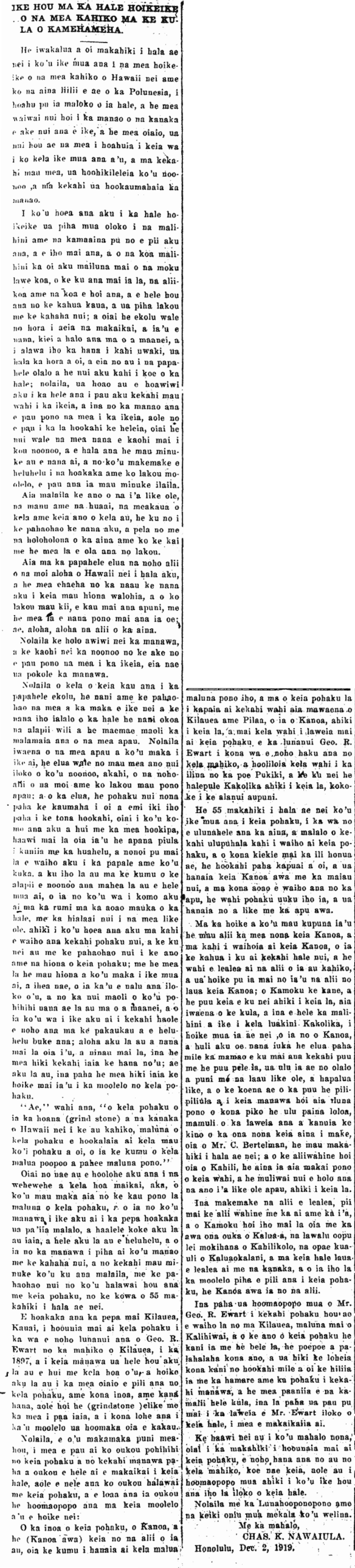
IKE HOU MA KA HALE HOIKEIKE O NA MEA KAHIKO MA KE KULA O KAMEHAMEHA.

Ka Nupepa Kuokoa, Buke LVII, Helu 50, Aoao 3. Dekemaba 12, 1919.The

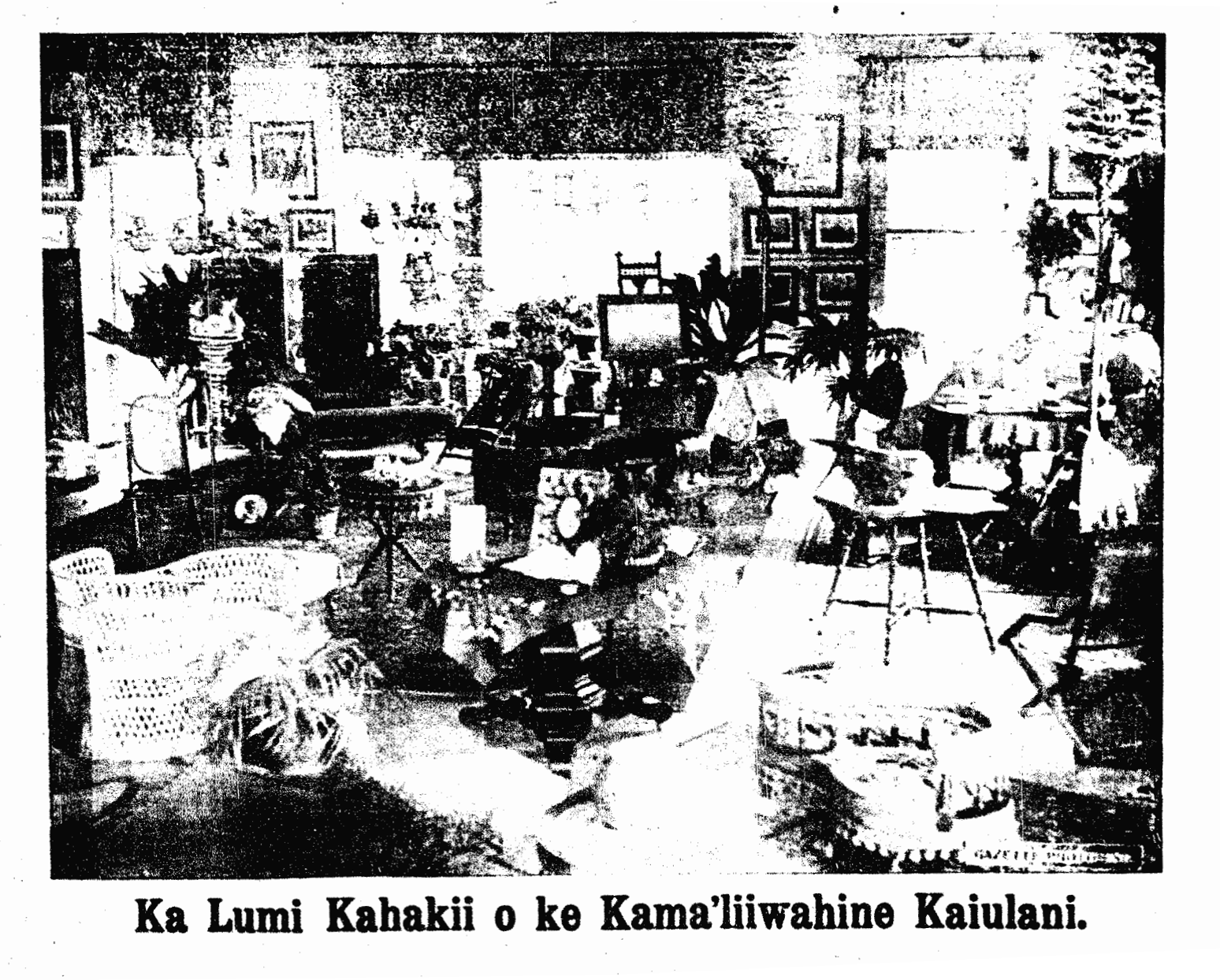
Looking back at Princess Kaiulani, 1904.

The Drawing Room [Lumi Kahakii] of Princess Kaiulani.

[Does anyone know where this room was? I am sure the original image in the newspaper is much more clear. This is yet another reason to reshoot the Hawaiian-Language Newspapers before it is too late and they crumble into pieces…]

Ka Lumi Kahakii o ke Kama'liiwahine Kaiulani.

Ka Nupepa Kuokoa, Buke XLII, Helu 18, Aoao 4. Aperila 29, 1904.

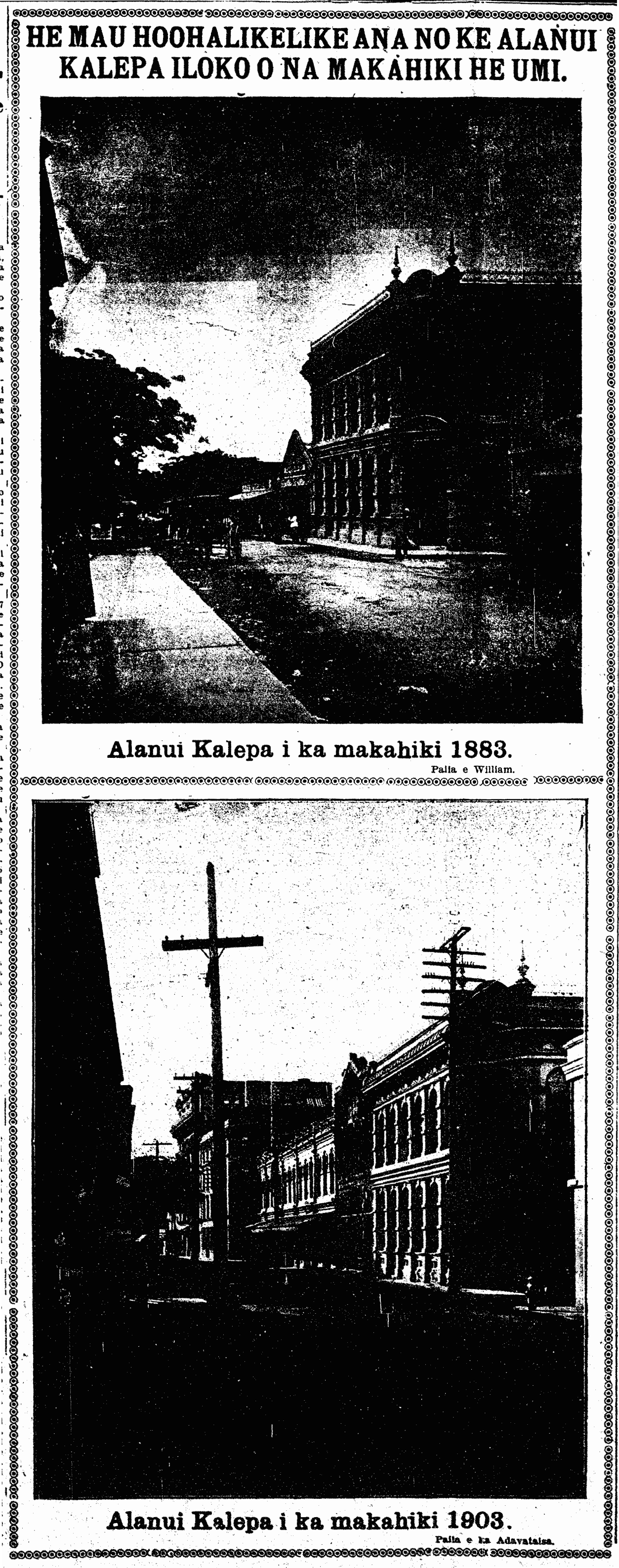
More images from the past, 1903.

A COMPARISON OF MERCHANT STREET BETWEEN TEN YEARS.

Merchant Street in 1883.

Photographed by Williams.

Merchant Street in 1903.

Photographed by the Advertiser [Adavataisa].

[I’m not sure if they meant to say “twenty years”, or if one of the pictures is mislabeled ten years off…]

(Kuokoa, 1/30/1903, p. 1)

HE MAU HOOHALIKELIKE ANA NO KE ALANUI KALEPA ILOKO O NA MAKAHIKI HE UMI.

Ka Nupepa Kuokoa, Buke XLI, Helu 5, Aoao 1. Ianuari 30, 1903.

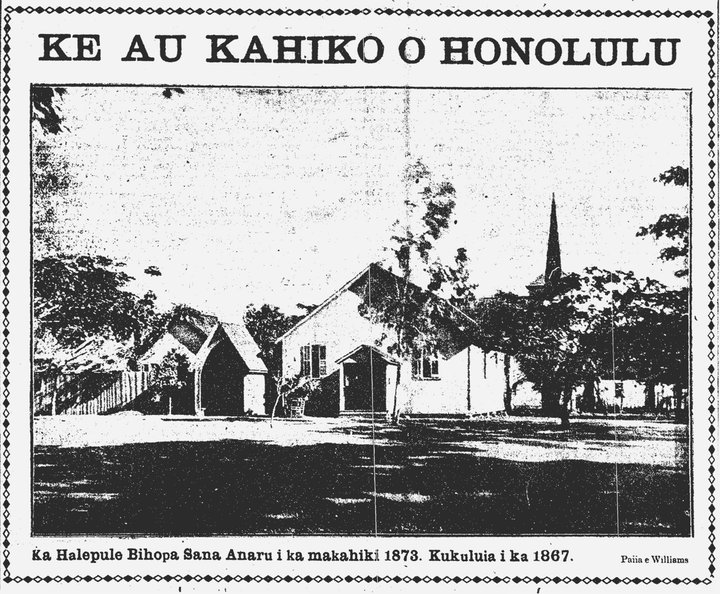
Pictures into the past, 1903.

THE DAYS OF YORE OF HONOLULU

The Anglican Church Saint Andrew’s [Sana Anaru] in the year 1873. Built in 1867.

Photograph by Williams.

[This is part of a series of pictures of old Honolulu that ran on the first page of the Kuokoa. From about 1900, pictures become an added feature of the papers. Paging through the papers, you never know what or who you will come across! (…even after the all of the pages become word searchable, until they find a way to indicate that there is an image of this or of that).

(Kuokoa, 3/6/1903, p. 1)

KE AU KAHIKO O HONOLULU

Ka Nupepa Kuokoa, Buke XLI, Helu 10, Aoao 1. Maraki 6, 1903.

Mahalo to Elinor Langer for her comment on trial of participants of the January 6, 1895 Counter Revolution. 1895.

Elinor Langer says:

And it was on January 17, 1895, the second anniversary, that the Republic opened the trials of the people arrested for “treason” in the revolt. Has anyone seen accounts in the Hawaiian papers about what happened on January 24, the day the Queen signed her forced abdication statement? According to “The Friend” (February 1, 1895) “On the 24th, while engaged in the trial of a company of natives, the Court was startled by the fall upon the table around which they sat of a massive bar of plaster from the lofty ceiling [of the Throne Room, where the trials were taking place.] The bar was nine feet long, forming part of a decorative panel. It fell upon the center of the table, precisely fitting the length of it. Col. Whiting had a narrow escape, his face being grazed, although protected by his military hat. The plaster had been loosened by a sharp shake of earthquake the night before.” The Queen signed the statement at 11 a.m. in the rooms directly above –perhaps even at the same time?

[See the original article, “The Story of the Insurrection” in The Friend, Volume 53, Number 2, Pages 9–11. February 1895.

Comment to Writing on the wall, 1894.]

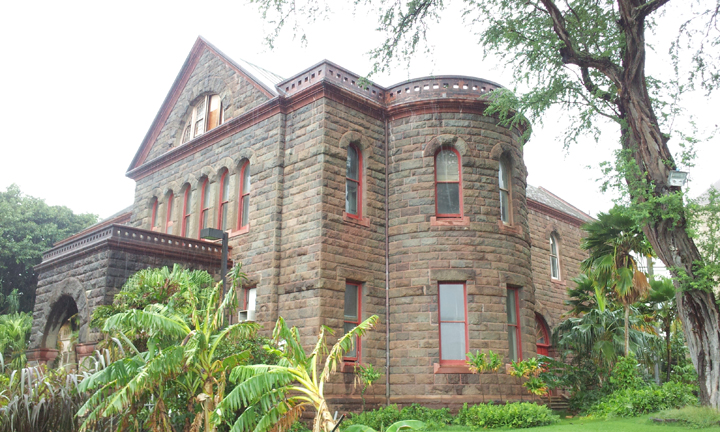
Bishop Hall as it stands today, 2013.

Here is Bishop Hall today on the campus of the Bernice Pauahi Bishop Museum. Although it is not open to the public, you still can see the beautiful stone facade! Please consider a membership at the Museum, and support a good cause. The Bishop Museum cares for one of the largest collections of Hawaiian-Language Newspapers in its archives!!

Bishop Hall 2013

Bishop Hall, Bernice Pauahi Bishop Museum, 2013.

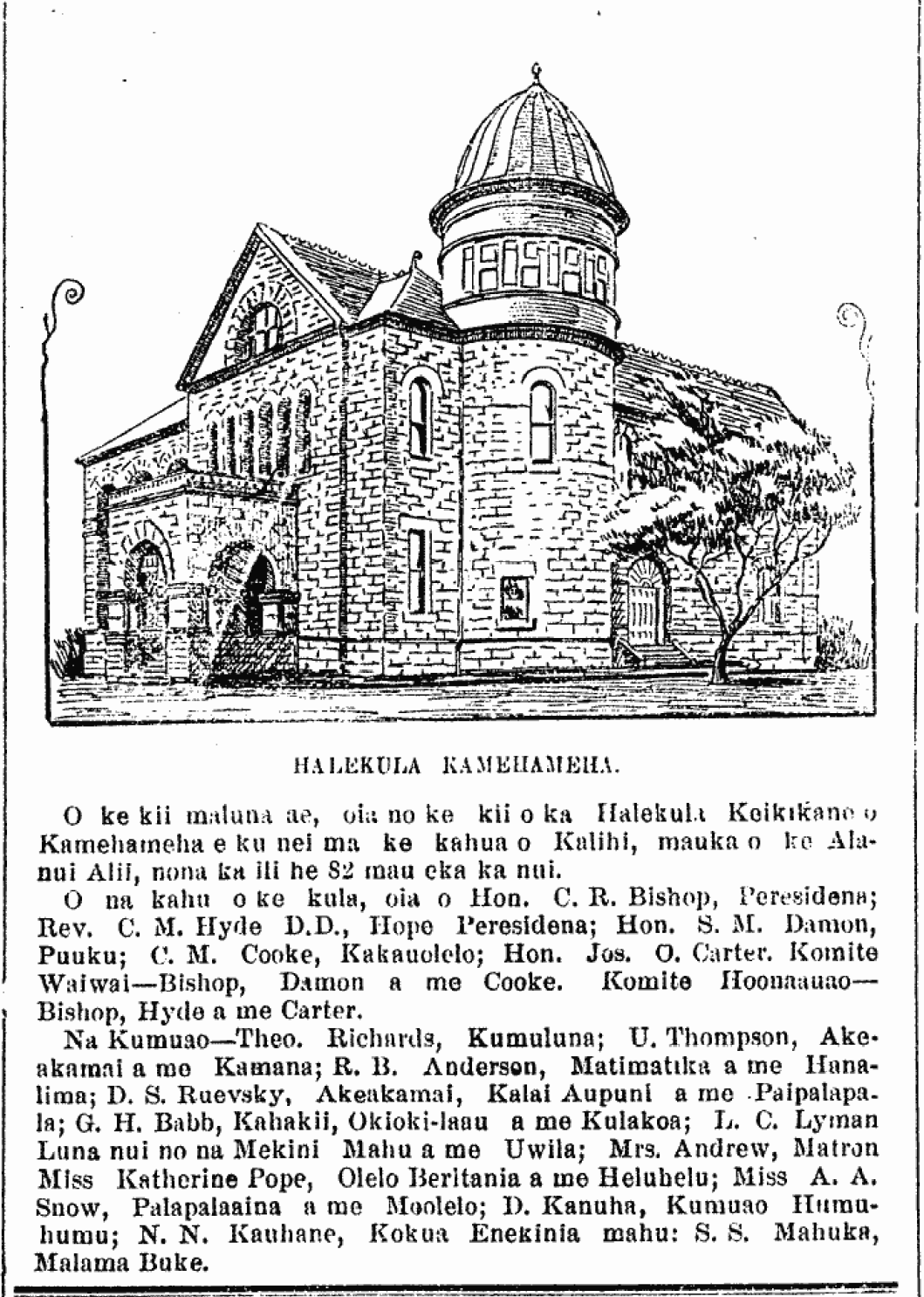
Kamehameha Boys’ School, Bishop Hall, 1894.

KAMEHAMEHA SCHOOLHOUSE.

The picture above is a picture of the Kamehameha Boys’ Schoolhouse, which stands on the grounds in Kalihi, upland of King Street [Alanui Alii], and its area is 82 acres.

The school supervisors are the Hon. C. R. Bishop, President; Rev. C. M. Hyde, D. D., Vice President; Hon. S. M. Damon, Treasurer; C. M. Cooke, Secretary; Hon. Joseph O. Carter. Financial Committee—Bishop, Damon, and Cooke. Education Committee—Bishop, Hyde, and Carter.

Instructors—Theodore Richards, Principal; U. Thompson, Science and Carpentry; R. B. Anderson, Mathematics and Manual Labor; D. S. Ruevsky, Science, Political Science, and Printing; G. H. Babb, Drawing, Wood Shop, and Military Education; L. C. Lyman, Head of the Steam and Electric Engines; Mrs. Andrews, Matron; Miss Katherine Pope, English Language and Reading; Miss A. A. Snow, Geography and History; D. Kanuha, Sewing Teacher; N. N. Kauhane, Assistant Steam Engineer; S. S. Mahuka, Librarian.

(Kuokoa, 6/2/1894, p. 1)

HALEKULA KAMEHAMEHA.

Ka Nupepa Kuokoa, Buke XXXIII, Helu 22, Aoao 1. Iune 2, 1894.

E o, e Kaleleonalani! Queen Emma and Kamehameha Schools, 1887.

KAMEHAMEHA SCHOOL.

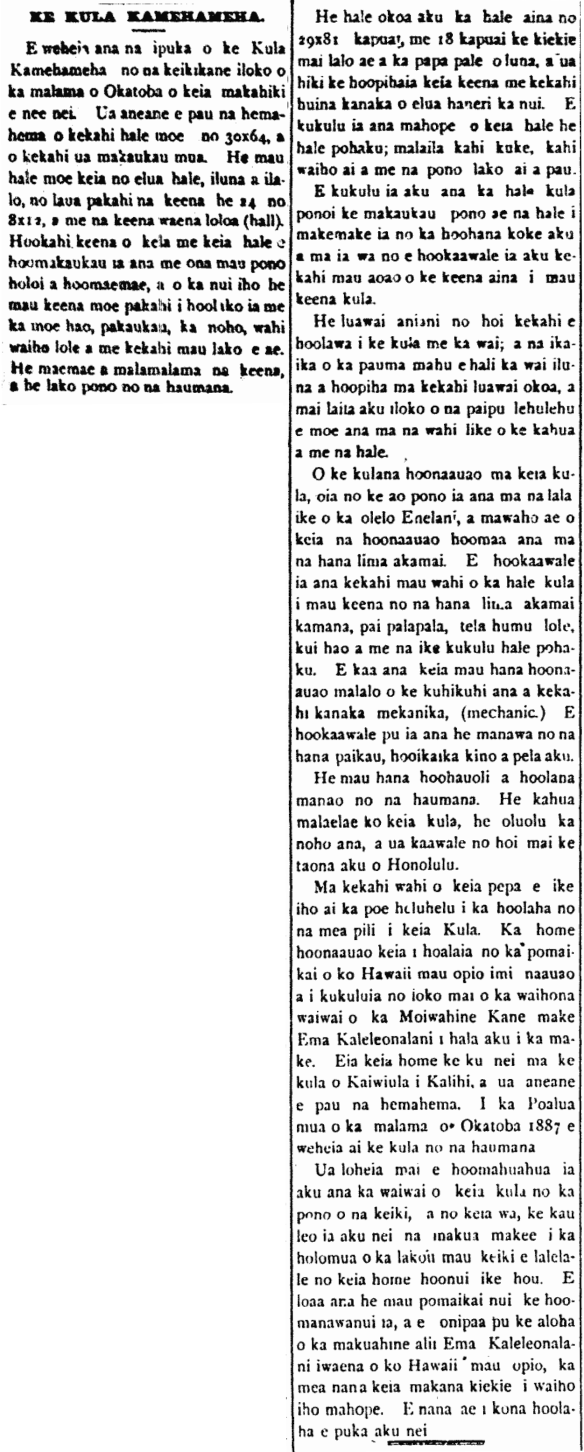
The gates of the Kamehameha School for boys will open in October of this current year. The imperfections of one of the dormitories of 30 x 64 [feet] are almost smoothed out, and another was complete before. These dormitories are two storied, bottom floor and top floor, and each of them have 24 rooms of 8 x 12, and a hallway [keena waena loloa]. One room of each house is furnished with facilities to wash up and clean, and the rest of the rooms are bedrooms, each being supplied with a iron bed, desk, chair, closet, and some other furnishings. The rooms are clean and lighted, and well-furnished for the student.

The dining hall of 29 x 81 feet is a separate building, and it is 18 feet from the bottom to the ceiling, and it will fit two-hundred people. A stone building will be built behind this, which will be the kitchen and and a place to store the food and all cookware and dinnerware.

A proper schoolhouse will be built after the buildings that are desired to be completed quickly are done, and in the meantime, parts of the dining hall will be set aside as school rooms.

A clear spring will supply the school with water and it is by steam pumps that the water will be brought up and filled into a separate water tank, and from there into many pipes laid all over the grounds and buildings.

The curriculum at this school teaches thoroughly the branches of the English language; and outside of that are the teaching of industrial arts. Some rooms of the school house will be set aside as rooms for carpentry, printing, tailoring, blacksmithing, and masonry. The instruction will take place under the direction of a mechanic [mekanika]. Some time will also be set aside for military drilling, physical development, and so forth.

There are fun and cheerful activities for the students. This school sits on a serene site, living there is pleasant, and it is separated from the town of Honolulu.

In a section of this paper, the reader will see the advertisement dealing with this School. This is the educating home established for the benefit of Hawaii’s children who seek education, and built by way of the estate of the late Dowager Queen Ema Kaleleonalani. This home stands in the plain of Kaiwiula in Kalihi, and it is near completion. On the first Tuesday of October 1887, this school will open to students.

It has been heard that the assets of the school will be increased for the good of the children, and for now, parents who want their children to progress forward are being urged to rush to this new home where knowledge is increased. Much benefits will be gained if patient and if the aloha of the royal parent Ema Kaleleonalani is held resolute as well by Hawaii’s children, the one who left this great gift behind. Look at its published notice.

[On this, the day after Queen Emma’s 177th birthday, i thought it would be a good thing  to look back at her role in the establishment of the Kamehameha Schools, a role which she is not recognized often for today.

Notice the difference between the article appearing in the May 24th edition of the Hawaiian Gazette, “The Kamehameha Schools.” (probably what the article is based upon) and this Hawaiian-Language article.]

(Kuokoa, 5/28/1887, p. 2)

KE KULA KAMEHAMEHA.

Ka Nupepa Kuokoa, Buke XXVI, Helu 22, Aoao 2. Mei 28, 1887.