Death Announcements and the importance of checking all available sources.—1912.

GEORGE NAALEHU SHAW PASSED AWAY.

Quickly, without any previous knowledge, George Naalehu Shaw left this life, that native son of the Paupili rain of Lahaina, at his home makai of Kakaako, at noontime on Wednesday. Before noon, he was preparing food for him and his wife. He did not reach the place to put the food, when he collapsed and lay on the floor. When the younger sister of his wife saw him lying there, she went to massage him and called out to Mrs. Shaw and others in the house who continued to massage him; but he passed on. He was not sickly, and was in town in the morning meeting with friends.

According to the doctors, he died of heart disease. He was 56 years old. Surviving him are his wife, children, an older brother, and sisters.

His body was carried from the mortuary of Manuel Silva to the cemetery of Kawaiahao yesterday evening.

Aloha to this brother of the land.

(Kuokoa Home Rula, 3/1/1912, p. 1)
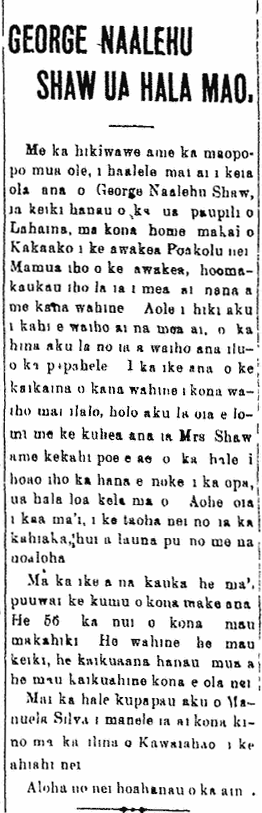
GEORGE NAALEHU SHAW UA HALA MAO.

Kuokoa Home Rula, Buke X, Helu 9, Aoao 1. Maraki 1, 1912.

[It is important to check all available sources and not just one! Look at this announcement of George N. Shaw’s death in Aloha Aina. Although it may seem short and uninformative, it adds to the information given above!]

George N. Shaw left this life on this past Wednesday; he is well known to Honolulu’s people as Keoki Pia [George Pia]. Aloha to that Hawaiian who has gone.

(Aloha Aina, 3/2/1912, p. 1)
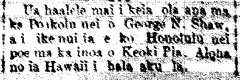
Ua haalele mai i keia ola ana...

Ke Aloha Aina, Buke XVI, Helu 9, Aoao 1. Maraki 2, 1912.

[Even the Vital Statistics column from the Kuokoa that we posted earlier this week, although just two lines, gives added information!]

Vital Statistics column from Kuokoa, 3/1/1912, p. 8.

[I just did a search for “George Shaw” in the Hawaii papers in 1912 on Chronicling America, but found nothing. This does NOT mean that there are no announcements there, because sometimes words and names come out garbled and are not findable using the word search. If you have the luxury of knowing when an event occurred, it is always best to do a manual search of the newspapers around that date!]

More music—Ernest Kaai, 1906.

ERNEST KAAI LEFT ON HIS MUSICAL TOUR OF KAUAI.

Last evening, Professor Ernest Kaai of the town of Honolulu nei left for the island of Kauai along with his fellow musicians to hold concerts in the places where they will visit, and they will not be left without being welcomed by the people of Kauai.

Travelling along with him are Mrs. Nane [Nani] Alapai, the singer of the Royal Hawaiian Band; Miss Keala; Mr. Holokahiki; and John Noble, Jr., a youth skilled on the flute [hoopiopio?]. They number five in total, and they are members of that band that is moving quickly through the places they visit.

After arriving on Kauai, Lihue is the first port where they stop, and it is there that they will hold their first concert tomorrow. After that, their tour will go all the way to Koloa where they will have a concert on the coming Monday, the 6th.

Then their musical tour will move on to Eleele, where they will have a musical assembly on the next Tuesday, the 7th. From there they will arrive at Waimea, and they will open another concert on Tuesday [Wednesday] the 8th. And then onto Makaweli where they will have another concert on the next day, the 9th.

Ernest Kaai and his band mates will spend a number of days on Kauai, and when they reach Makaweli, and hold a concert there on the day shown, it is then that they will know where their tour will move to next.

On this tour, Professor Kaai has time to give benefit concerts for good causes if it will be beneficial, but this all depends on the scheduling.

Mr. Kaai is a young Hawaiian that is well known in this town among the Hawaiians and among the haole that love playing music, for the regular job of that young man is teaching music. There are many haole women and haole men and Hawaiians as well who were taught by him and graduated in music.

[If this post looks familiar to some of you, it is because I posted it some time ago on the old Hoolaupai Facebook page. I found that it is not easy to find anything on that page, so started the blog at http://nupepa-hawaii.com, where it is a whole lot easier to find posts! So I will be on occasion reposting articles so that they will be findable in one location. They will all be under the category “Repost”.]

(Kuokoa, 8/3/1906, p. 8)

UA HALA AKU O ERNEST KAAI I KE KAAHELE HIMENI NO KAUAI.

Ka Nupepa Kuokoa, Buke XLV, Helu 31, Aoao 8. Augate 3, 1906.

Honolulu Glee Club, 1911.

THE SINGING GROUP, “HONOLULU GLEE CLUB” OF THE HAWAIIAN BOYS.

Led by Ah Choy Tim Sin.

Front row—R. K. Kumulala [Kumululu? Kumuliilii?], D. W. Waipa, Ah Choy Tim Sin, R. M. Kamaunu, F. W. Keao. Back row—S. Kanekoa, J. Kahikina.

This Singing Group will arrive in the districts of North Kohala, South Kohala, Hamakua, Hilo, and Puna, should they not meet with any troubles on their road. This group is under the direction of Ah Choy, a skilled youth [line hidden by fold].

[Line hidden by fold?] with the melodic flute, and included in this group is the skilled hands of Mr. Waipa, the prince of Kona and Kohala.

Therefore, rise, O Friends, join hands with the sweet beloved of Kohala and sing along to this song of aloha for his birth land:

“Maikai ka makani o Kohala,
I pa ia e ka Inuwai,
Ka wai no ia pono kaua,
Ka wai kaulana o ka aina,
He aloha, he aloha ka’u mea nui,
He makana, he makana na ka puuwai.”

Please fill their singing audience; they will arrive in North Kohala on August 5, 1911.

[This is one of many pages of the Hawaiian-Language Newspapers that are difficult to read because the image originally taken was not clean. These need to be reshot before it is too late. You can’t get much information from something that is illegible.]

(Kuokoa Home Rula, 7/28/1911, p. 1)

KA PUALI HIMENI "HONOLULU GLEE CLUB" O NA KEIKI HAWAII

Kuokoa Home Rula, Buke IX, Helu 30, Aoao 1. Iulai 28, 1911.

[Here is the same image found in the Evening Bulletin. Perhaps this is not such a great image, but it is way better than the one from Kuokoa Home Rula! And yet, the information given pales to what is found in the Hawaiian article…]

MEMBERS OF HONOLULU GLEE CLUB

Evening Bulletin, Number 4993, Page 8. August 1, 1911.

How sad it must be to be denied marriage to someone you love, 1902/2012.

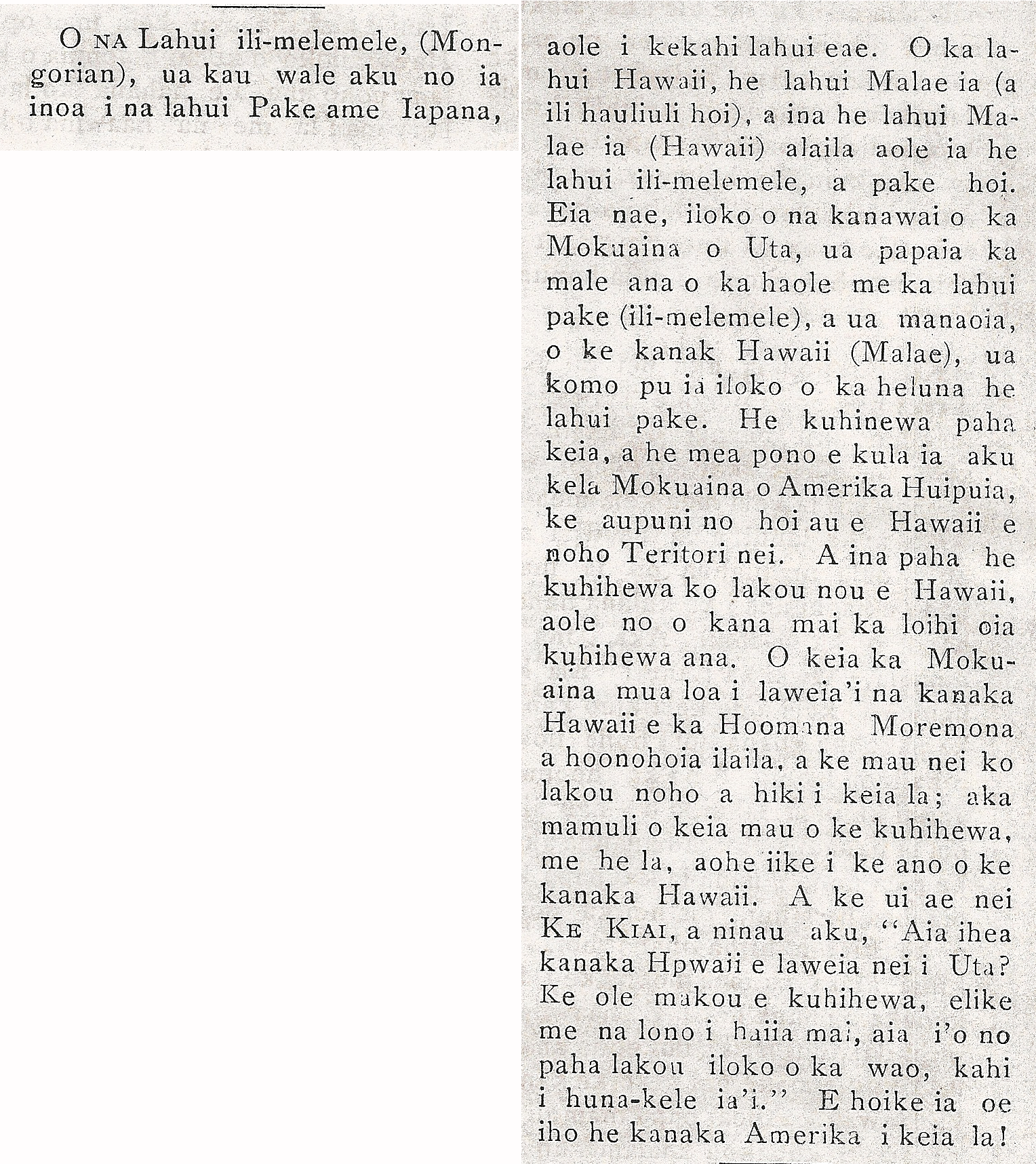
THE yellow-skinned races (Mongolian), include the Chinese and Japanese, and not other lahui. The Hawaiian Race is of the Malae race (the brown-skinned), and if the Hawaiians are Malae, then they are not yellow-skinned, or Chinese. And yet, under the law of the state o Utah, haole are not allowed to marry Chinese (yellow-skins), and it is believed that Hawaiians (Malae) are included amongst the Chinese. This is perhaps a mistake, and that state of the United States needs to be educated of the nation in which you live as a Territory. And if they are mistaken about you, O Hawaii, this error is incredibly long standing. This is the first state to which Hawaiians were brought by the Mormon Faith to live, and they are still there to this day; but because of this continued misunderstanding, it is as if they do not know the nature of Hawaiians. The Kiai questions and asks, “Where in Utah are Hawaiians being taken? If we are not mistaken, and according to what is reported, they are perhaps in the desert, where they are hidden away.” Reveal yourself to be an American today!

(Kiai, 9/11/1902, p. 1)

O NA Lahui ili-melemele...

Ke Kiai, Buke 1, Helu 3, Aoao 1. Sepatemaba 11, 1902.

More on pictures from the Hawaiian-Language Newspapers and why they need to be reshot. 2012.

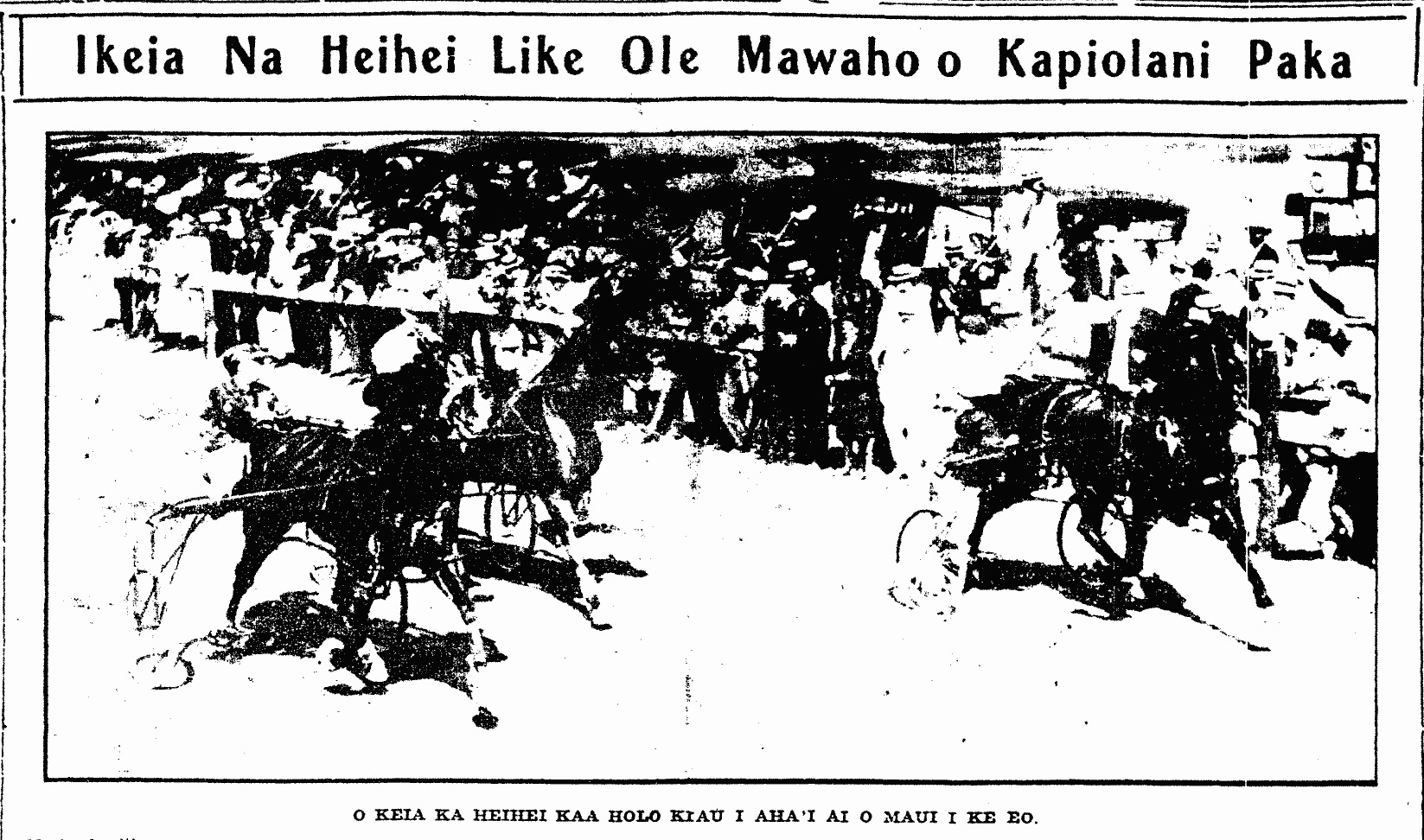
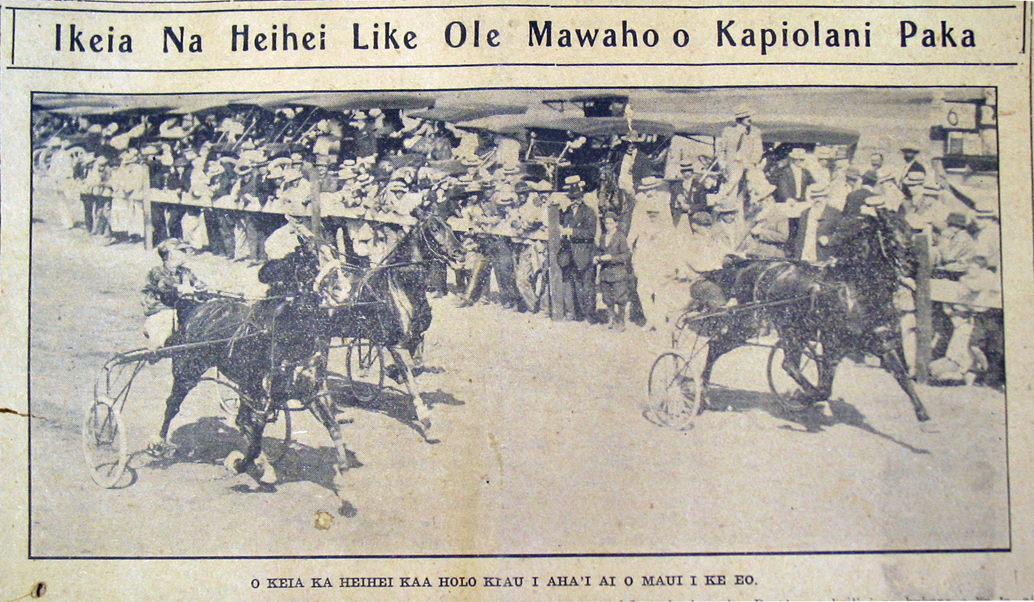
[After looking at that Kapiolani Park horse racing picture, you might be thinking, “Seen one horse race, seen them all…” But what about this!

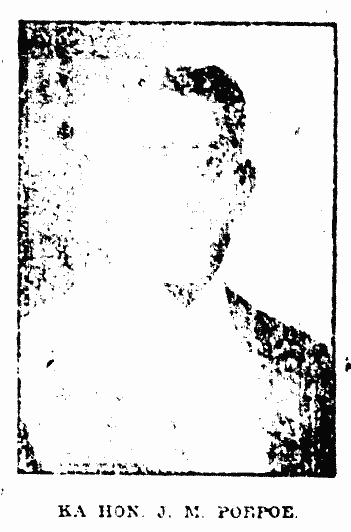
This here is perhaps the only image* known of Joseph Mokuohai Poepoe (patriot/historian/statesman/newspaper editor/lawyer/translator/storyteller…). It comes from his obituary printed in the newspaper Kuokoa.

This is the image you will see from the newspaper online:

KA HON J. M. POEPOE

Ka Nupepa Kuokoa, Buke LI, Helu 15, Aoao 1. Aperila 18, 1913.

Here is a photograph taken by that same amateur from the original newspaper. It isn’t the best of pictures, but at least you get an idea…]

KA HON. J. M. POEPOE.

Ka Nupepa Kuokoa, Buke LI, Helu 15, Aoao 1. Aperila 18, 1913.

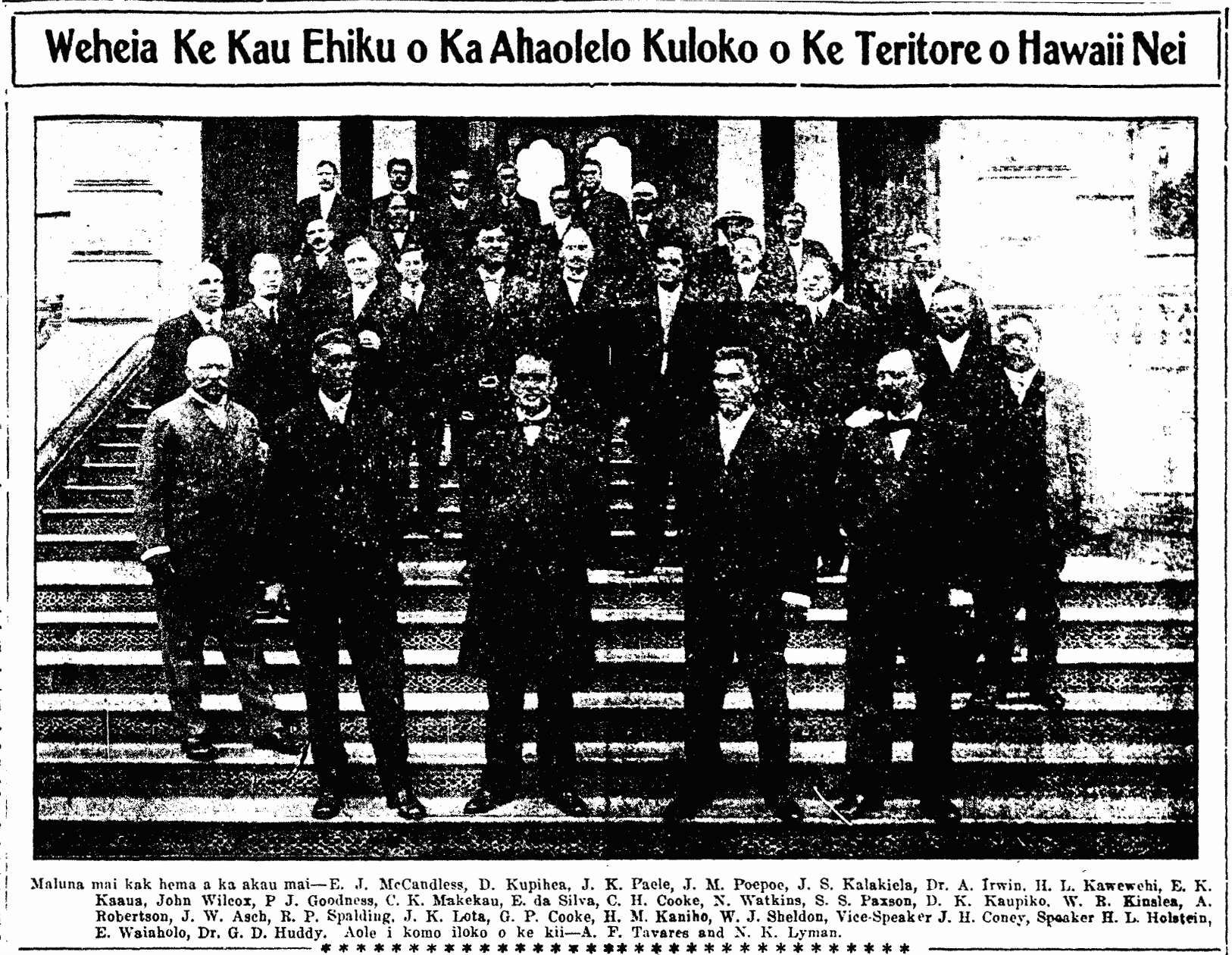
*There is one other image I found, but Poepoe is standing far in the back, and is hardly visible. It was taken at the opening of the Legislature (just a few months before he dies). Poepoe stands in the top row, 4th from the left. (This is the image you will find online.)

Weheia Ke Kau Ehiku o Ka Ahaolelo Kuloko o Ke Teritore o Hawaii Nei

Ka Nupepa Kuokoa, Buke L, Helu 8, Aoao 1. Feberuari 21, 1913.

Just another reason why the Hawaiian-Language Newspapers need to be reshot. 2012.

[Here is what the typical picture looks like from a Hawaiian-Language Newspaper when you see it online. This particular image is of the horse races at Kapiolani Park in 1913.]

Ikeia Na Heihei Like Ole Mawaho o Kapiolani Paka

Ka Nupepa Kuokoa, Buke XLIX, Helu 1, Aoao 1. Ianuari 3, 1913.

[However, that image taken by a total amateur with an average camera shot directly from the newspaper looks like this.]

Ikeia Na Heihei Like Ole Mawaho o Kapiolani Paka

Ka Nupepa Kuokoa, Buke XLIX, Helu 1, Aoao 1. Ianuari 3, 1913.

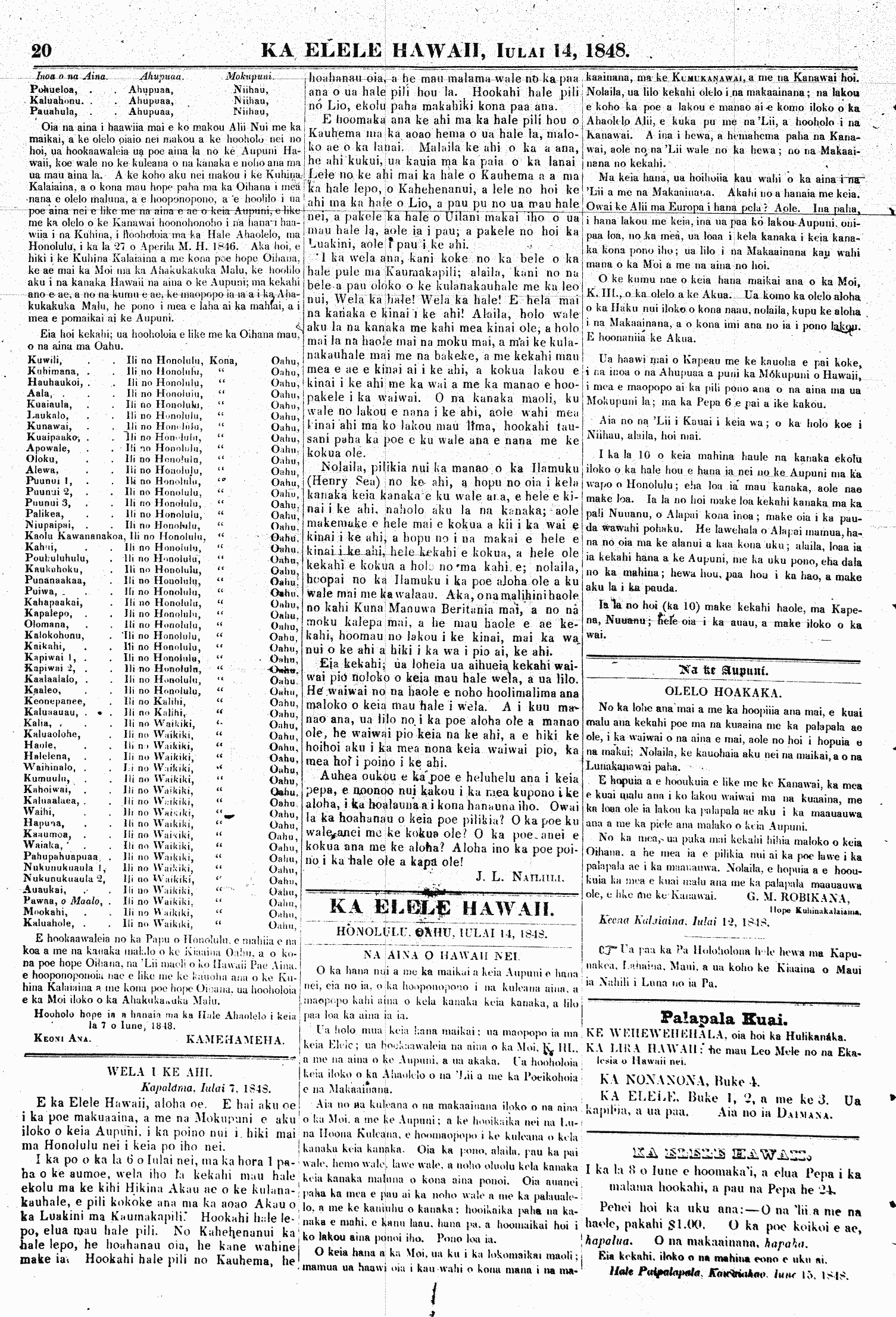
Personal Lands of Kamehameha III, and Government Lands, 1848.

By the Government.

A LAW FOR THE PERSONAL LANDS OF THE KING,
AND THE LANDS OF THE NATION.

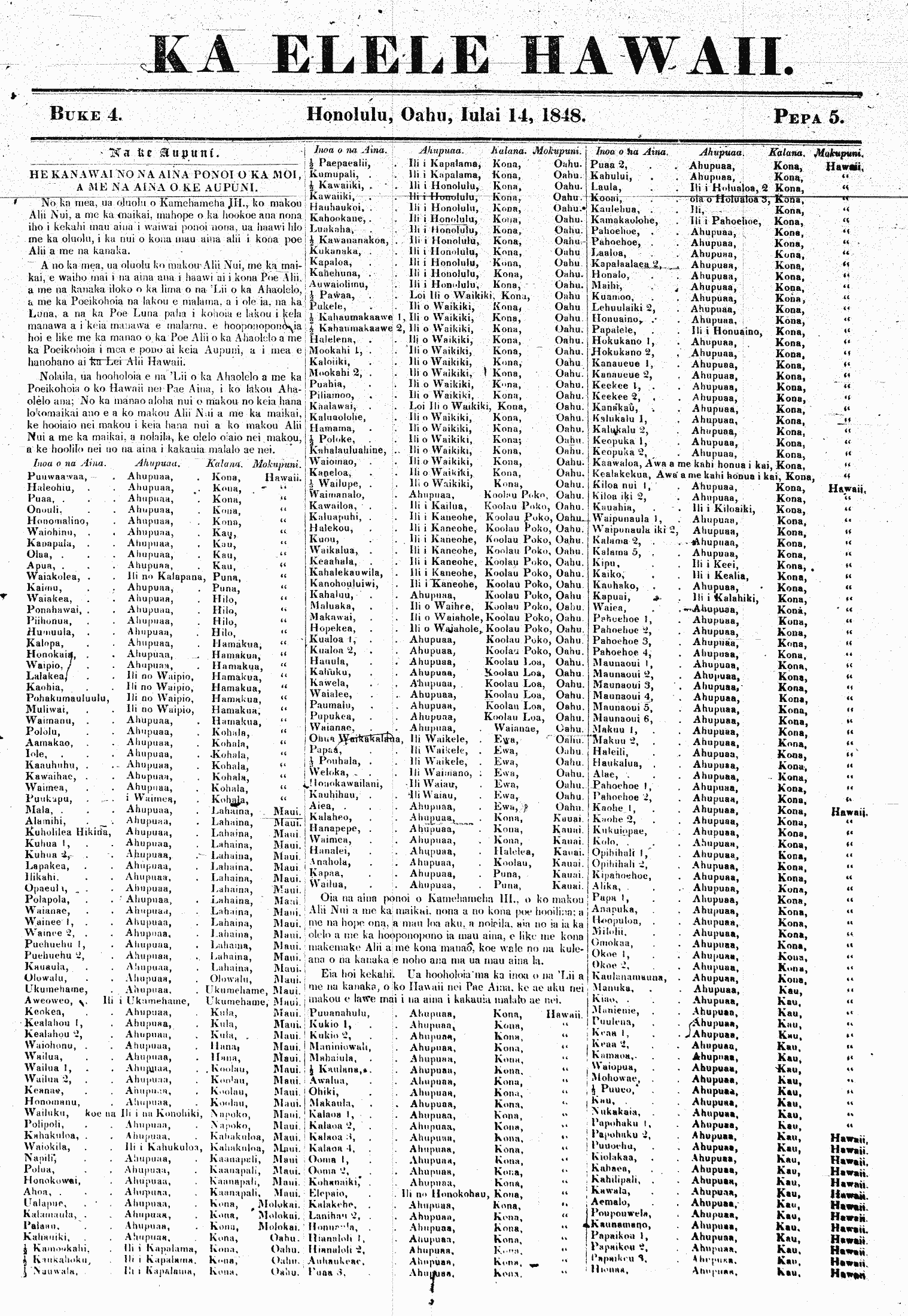
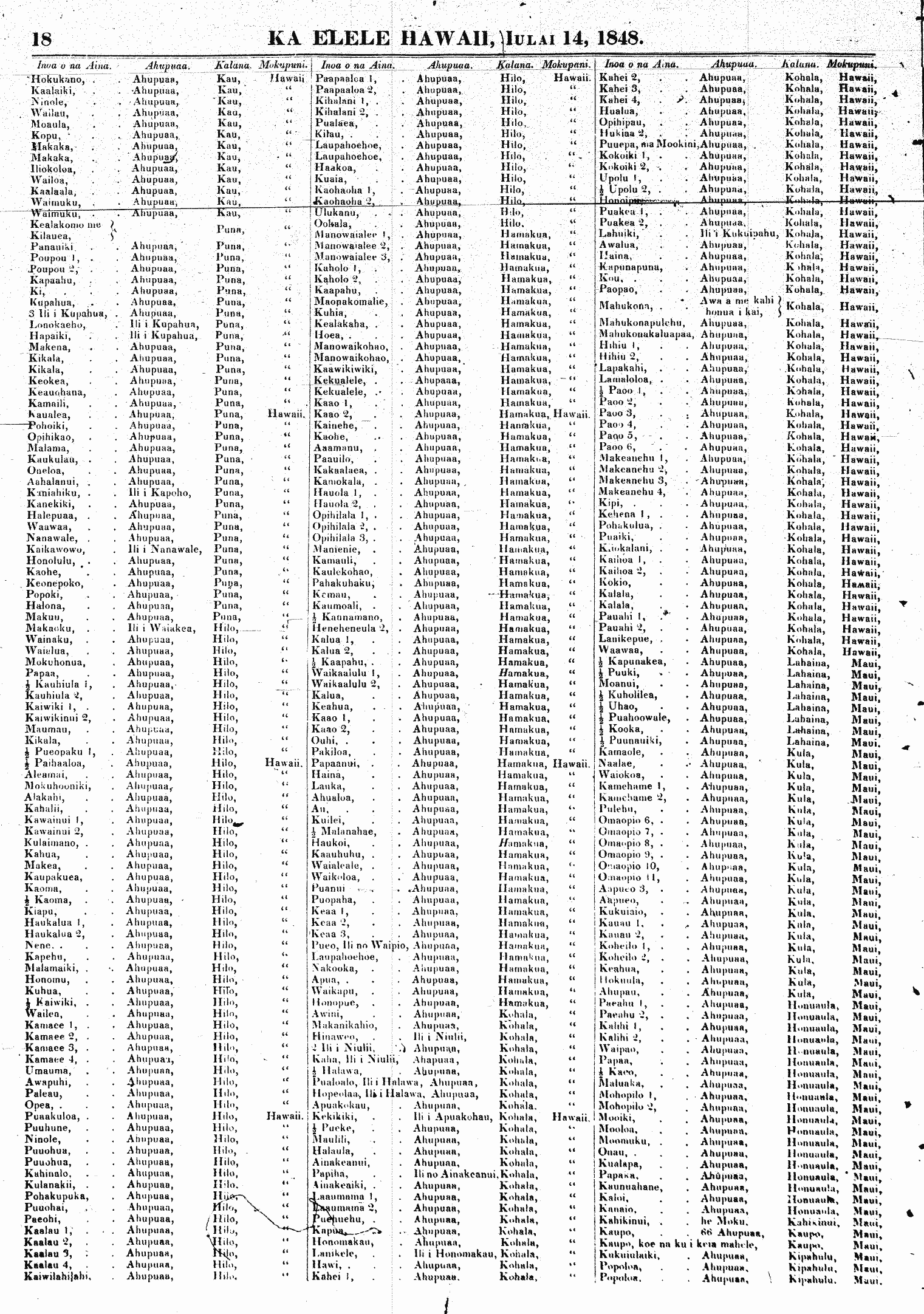
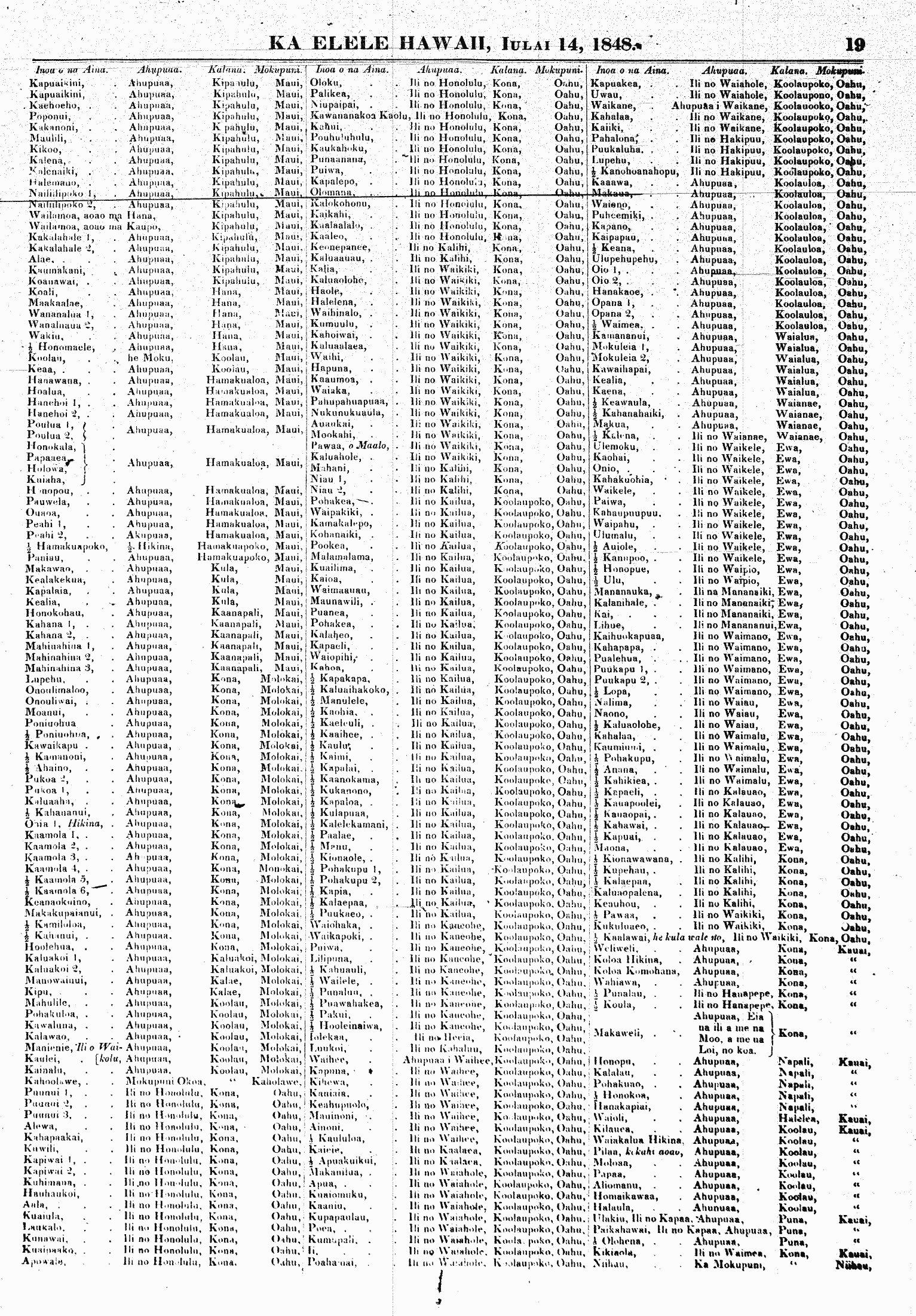
[Here is a newly passed law of the land appearing in the newspaper Elele Hawaii. One of the functions of the newspapers was to inform the nation’s citizens of new laws and proclamations from the government. This particular law establishes the Crown Lands (and Government Lands) which still holds much importance to this day.

For a translation see “A Supplement to the Statute Laws of His Majesty, Kamehameha III., King of the Hawaiian Islands, … 1848.” pp. 22–43.

What is also valuable about this listing is that it describes in 1848 what ahupuaa a certain land belonged to, and so forth.]

(Elele Hawaii, 7/14/1848, pp. 17–20.)

HE KANAWAI NO NA AINA PONOI O KA MOI, A ME NA AINA O KE AUPUNI.

Ka Elele Hawaii, Buke 4, Pepa 5, Aoao 17. Iulai 14, 1848.


HE KANAWAI NO NA AINA PONOI O KA MOI, A ME NA AINA O KE AUPUNI.

Ka Elele Hawaii, Buke 4, Pepa 5, Aoao 18. Iulai 14, 1848.

HE KANAWAI NO NA AINA PONOI O KA MOI, A ME NA AINA O KE AUPUNI.

Ka Elele Hawaii, Buke 4, Pepa 5, Aoao 19. Iulai 14, 1848.

HE KANAWAI NO NA AINA PONOI O KA MOI, A ME NA AINA O KE AUPUNI.

Ka Elele Hawaii, Buke 4, Pepa 5, Aoao 20. Iulai 14, 1848.

Less than a week before the new system at Bishop Museum Library and Archives kicks in!

“In alignment with Bishop Museum’s new strategic plan, the Library and Archives collections have been identified as an area of priority in the effort to develop increased access to Museum resources for our community. Effective March 1, 2012, the Library and Archives will temporarily suspend public reference hours and provide limited, by-appointment access to its collections. This temporary closure will allow staff the necessary time to support a museum and community effort to plan and implement a new model of operation for this area. “

Here is the link to the new form you must fill out and submit to make an appointment to request use of the Library and Archives.

Hawaiianized missionary name list, 1848.

NAMES OF THE MISSIONARIES.

Hawaiians are bad at pronouncing haole words, so they call the haole by names that they can pronounce. However, these names are not familiar to the newcomers; therefore, letters often fall to the side and do not arrive because the person to whom it is addressed is not known. In this manner, sometime earlier, a letter was addressed to Rev. R. Tinker, and this is what was written on the outside. Ia Tineka Amerikahuipuia [To Tineka, United States of America]. What Postmaster in America understands these words? So too of many who deliver letters here in Hawaii; those malihini form foreign lands who don’t know the missionaries’ Hawaiian names. Therefore, this document makes clear the real names of the missionaries living in this Archipelago.

Laimana, Rev. D. B. Lyman.

Koana, Rev. Titus Coan.

Parika, Rev. J. D. Paris.

Kine, Rev. H. Kinney.

Aiwa, Rev. Mar. Ives.

Pokue, Rev. J. F. Pogue.

Tatina, Rev. Asa Thurston.

Kauka Aneru, S. L. Andrews, M. D.

Laiana, Rev. Lorenzo Lyons.

Bona, Rev. E. Bond.

Kaahele, Rev. E. Whittlesey.

Gerina, Rev. J. S. Green.

Bele, Mr. E. Bailey.

Konede, Rev. D. T. Conde.

Okana, Miss M. Ogden.

Alekanedero, Rev. W. P. Alexander.

Aneru, Rev. C. B. Andrews.

Baluwina, Rev. D. Baldwin, M. D.

Hikikoke, Rev. H. R. Hitchcock.

Duaita, Rev. S. G. Dwight.

Berauna, Miss L. Brown.

Kalaka, Rev. E. W. Clark.

Kemita, Rev. Lowell Smith.

Limaikaika, Rev. R. Armstrong.

Kamalani, Mr. Levi Chamberlain.

Kasela, Mr. S. N. Castle.

Holo, Mr. E. O. Hall.

Laukeke, Mr. E. H. Rogers.

Kaimana, Mr. H. Dimond.

Kuke, Mr. A. S. Cooke.

Rikeke Wahine, Mrs. C. L. Richards.

Dole, Rev. D. Dole.

Rike, Mr. W. H. Rice.

Kemika, Miss M. M. Smith.

Aneru, Lunakanawai Rev. L. Andrews.

Hana, Rev. T. D. Hunt.

Demana, Rev. S. Damon.

Bihopa, Rev. A. Bishop.

Emekona, Rev. J. S. Emerson.

Kulika, Rev. P. J. Gulick.

Pareka, Rev. B. W. Parker.

Kauka Kemika, J. W. Smith, M. D.

Ioane, Rev. E. Johnson.

Wilikoke, Mr. A. Wilcox.

Rowela, Rev. G. B. Rowell.

Wini Wahine, Mrs. M. P. Whitney.

[This is definitely not a complete listing. One famous person not included for example is Gerrit P. Judd, who was called Dauta Iada and Kauka Iada, but mostly just Kauka. Also once again, there are often a variety of given names for a single person. Baldwin was not only called Baluwina, but Balawina, Ogden is not only Okana, but Ogana, etc.

This hopefully will help you when searching for missionaries, especially because they are often referred to only by their Hawaiian names in the newspapers (like Laiana in the earlier post about snow on Hualalai in 1862)!

There needs to be a more comprehensive listing (not only of missionary names but of all name variants) done and put somewhere online so that it is easily accessed!!

Also found: Ioane, Edward Johnson]

(Elele Hawaii, 10/9/1848, p. 36)

NA INOA O NA MISIONARI.

Ka Elele Hawaii, Buke 4, Pepa 9, Aoao 36. Okatoba 9, 1848.

J. K. Mokumaia and Keoni Paakaula, 1927.

One of the reasons i posted the return of the ahuula article is because it reminded me of another post just put up—Moanalua, then and now. 1922.

In the image of the Palace Guards from the day of the return of the feather cape, you can see J. K. Mokumaia in the middle of the front row, and John Paakaula, far right on the back row.

I am wondering if this is the same Keoni Paakaula, the kumu hula of Moanalua. He would in theory be 107 years old in this picture.

[It is always important to look up name variants when you are searching for people (and even places). Biblical names in Hawaiian also appear in English, like “Keoni” and “John”. Also, Biblical names are sometimes abbreviated, like “Jas.” for “James”… It would be very helpful if there was a list of names and their variants up online.]