More on Liliuokalani Educational Society, 1892.

[Found under: “HAWAII NEWS”]

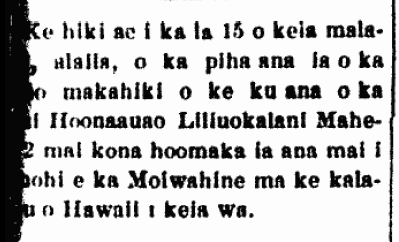
On the 15th of this month, it will be the [???] anniversary of the Hui Hoonaauao Liliuokalani, Mahele 2 [Liliuokalani Educational Society, Division 2] from its inception by the Queen of Hawaii at this time.

[This article in theory states the year that the Liliuokalani Educational Society, Division 2 begins, but that year is not visible. Here is another article which is cut off because of tight binding. It is a sad thing to have to randomly go back and flip through fragile newspaper pages just to find what a word or phrase is. And if a whole bunch of people need to find different things, the papers will deteriorate quickly, and soon, a good image will be impossible because the pages will be dust…]

(Kuokoa, 5/7/1892, p. 3)
Ke hiki ae i ka la 15...

Ka Nupepa Kuokoa, Buke XXXI, Helu 19, Aoao 3. Mei 7, 1892.

Liliuokalani Educational Society, 1890.

[Found under: “LOCAL & GENERAL NEWS”]

The First Division of the Liliuokalani Educational Society will meet at Washington Place, three [?] o’clock Monday afternoon.

[Granted, this is a single sentence, but there is not much known about the Liliuokalani Educational Society, and every little mention is important…

This newspaper is bilingual, Hawaiian and English, and is also called “The National Herald”. The images are not very clear, and the typescript as a result is riddled with “@”s, which indicate that the area is illegible. Hopefully they (and all of the other newspapers) can be re-shot so that there will be legible images—the information they hold is priceless!]

(Ahailono a ka Lahui, February 1, 1890, p. 5)

The First Division of the Liliuokalani Educational Society...

Ka Ahailono a ka Lahui, Volume 1, Number 20, Page 5. February 1, 1890.

The royal mausoleum converted into a chapel, 1922.

DEDICATED AS A CHAPEL

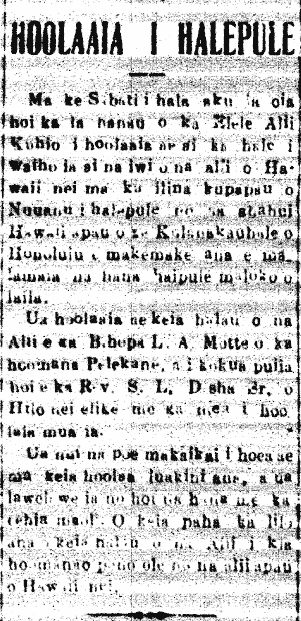
On this past Sunday, that being the birthday of the Royal Representative Kuhio, the mausoleum that holds the bones of the alii of Hawaii nei in the cemetery of Nuuanu was made into a chapel for all the Hawaiian societies of Honolulu who wish to hold services there.

This house of the Chiefs was consecrated by the Bishop L. A. Motte [John D. LaMothe] of the Anglican Church [hoomana Pelekane] and assisted by Rev. S. L. Desha, Sr. of Hilo, as was planned earlier.

There were many people who came to see the consecration, and the ceremony was done with much reverence. This will likely make this house of the Alii a unforgettable [?] monument to all the alii of Hawaii.

[Much of the Hilo newspaper, Hoku o Hawaii, is digitized badly, and can hardly be read. This particular article is one of the better ones. I hope all of the illegible articles are not important ones!]

(Hoku o Hawaii, 3/30/1922, p. 3)

HOOLAAIA I HALEPULE

Ka Hoku o Hawaii, Buke XV, Helu 44, Aoao 3. Maraki 30, 1922.

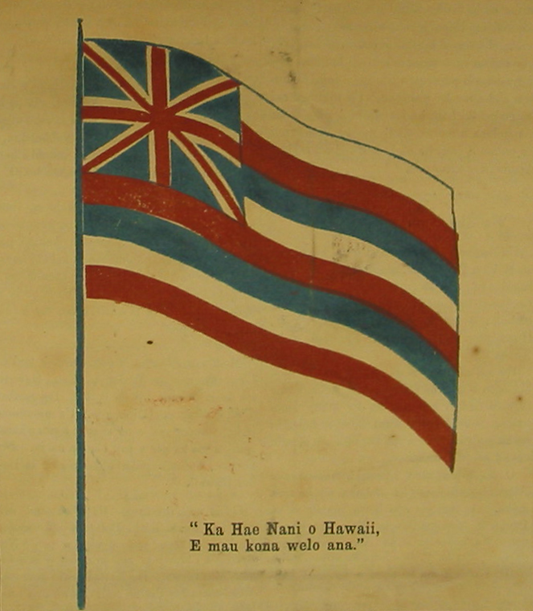
The Hawaiian Flag and James Auld and Capt. Alexander Adams…

It is interesting to note that newspaperman, James Auld, who was responsible for the Kuokoa 1/1/1862 color image of the Hawaiian Flag was the son of Andrew Auld, who arrived from Scotland in 1816. And that this Andrew Auld was apparently dear friends with none other than fellow Scot, Capt. Alexander Adams, who captained the Kaahumanu (formerly named Forrester) for Kamehameha I. Adams is traditionally credited for designing the the Hawaiian Flag.

[Andrew Auld and Alexander Adams lay side by side at Oahu Cemetery, their single gravestone reads: “Twa croanies frae the land of heather / Are sleepin’ here in death th’gether.”Two close friends from the land of heather (Scotland) are sleeping here in death together.

And James’ brother, William, who we spoke of earlier as the engraver of James’ wife’s (Uwinihepa’s) tombstone, was perhaps more importantly one of the four men sent to take the Anti-Annexation Petitions to Washington D. C. Oh! and William marries one of the daughters of Capt. Alexander Adams, Mary (9/21/1859). Both James and William seem to also go by the last name Andrew/Andrews.]

The Hawaiian Flag—a closeup. 1862.

“The Beautiful Flag of Hawaii,
Let it forever wave.”

[The image of the Hawaiian Flag as it appeared to the readers of the Kuokoa in 1862! (Courtesy of the library/archives at the Bishop Museum.)

The Library and Archives at the Museum holds so much priceless information! They need more funding to do important things!!]

"Ka Hae Nani o Hawaii...

Ka Nupepa Kuokoa, Buke I, Helu 6, Aoao 1. Ianuari 1, 1862.

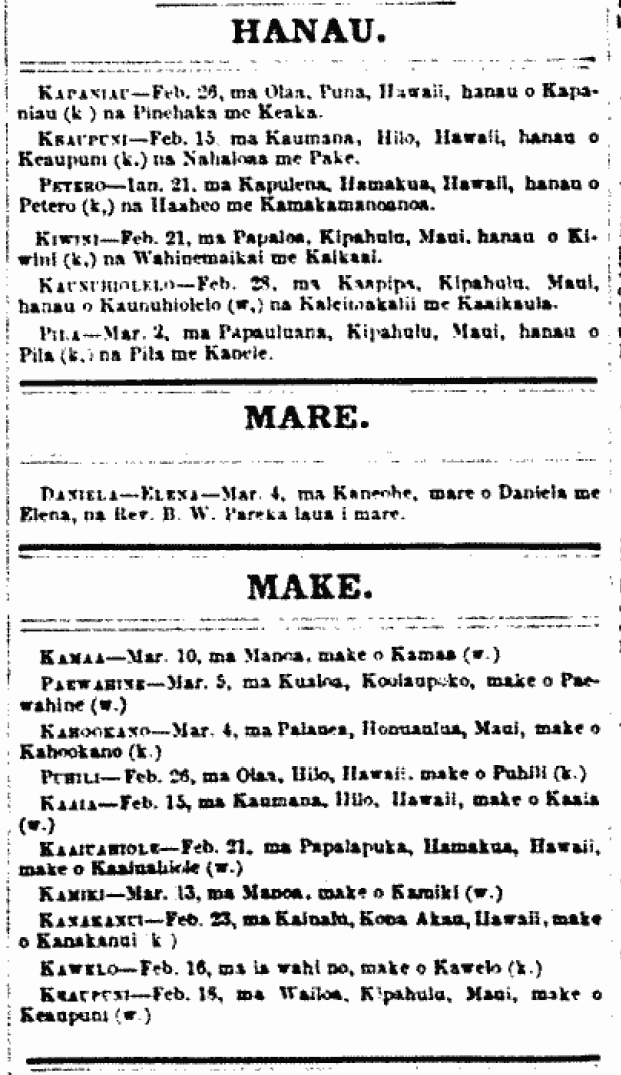
Vital Statistics. 1862.

BIRTHS.

Kapaniau—Feb. 26, at Olaa, Puna, Hawaii, Kapaniau (m) was born to Pinehaka and Keaka.
Keaupuni—Feb. 15, at Kaumana, Hilo, Hawaii, Keaupuni (m) was born to Nahaloaa and Pake.
Petero—Jan. 21, at Kapulena, Hamakua, Hawaii, Petero (m) was born to Haaheo and Kamakamanoanoa.
Kiwini—Feb. 21, at Papaloa, Kipahulu, Maui, Kiwini (m) was born to Wahinemaikai and Kaikaai.
Kaunuhiolelo—Feb. 28, at Kaapipa, Kipahulu, Maui, Kaunuhiolelo (f) was born to Kaleimakalii and Kaaikaula.
Pila—Mar. 2, at Papauluana, Kipahulu, Maui, Pila (m) was born to Pila and Kanele.

MARRIAGES.

Daniela—Elena—Mar. 4, at Kaneohe, Daniela married Elena; the two were wed by Rev. B. W. Parker.

DEATHS.

Kamaa—Mar. 10, at Manoa, Kamaa (f) died.
Paewahine—Mar. 5, at Kualoa, Koolaupoko, Paewahine (f) died.
Kahookano—Mar. 4, at Palanea, Honuaulua [Honuaula], Maui, Kahookano (m) died.
Puhili—Feb. 26, at Olaa, Hilo, Hawaii, Puhili (m) died.
Kaaia—Feb. 15, at Kaumana, Hilo, Hawaii, Kaaia (f) died.
Kaaiuahiole—Feb. 21, at Papalapuka, Hamakua, Hawaii, Kaaiuahiole (f) died.
Kamiki—Mar. 13, at Manoa, Kamiki (f) died.
Kanakanui—Feb. 23, at Kainalu, North Kona, Hawaii, Kanakanui (m) died.
Kawelo—Feb. 16, from the same place, Kawelo (m) died.
Keaupuni—Feb. 18, at Wailoa, Kipahulu, Maui, Keaupuni (f) died.

[Notice how this vital statistics column is not the same as the one appearing in the earlier post of Hoku o ka Pakipika which comes out at the same time…]

(Kuokoa, 3/15/1862, p. 3)

HANAU. / MARE. / MAKE.

Ka Nupepa Kuokoa, Buke I, Helu 16, Aoao 3. Maraki 15, 1862.

True Hawaiian? 1893.

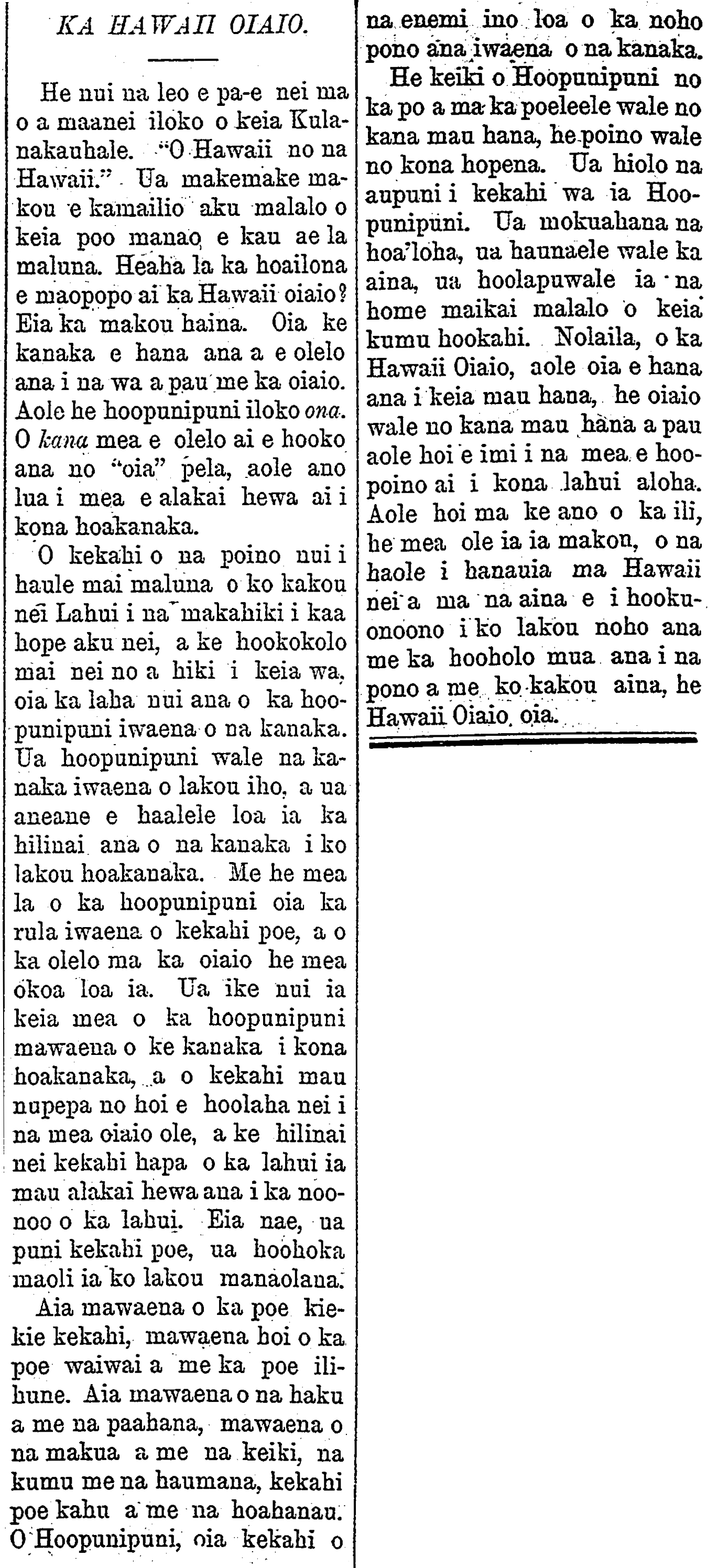
True Hawaiian.

There are many voices ringing out here and there in this Town. “Hawaii for Hawaiians.” We wish to discuss the topic above. What in the world are the signs that distinguish a true Hawaiian? This is our answer. It is a person who acts and speaks at all times in truth. He has no falsehood within him. What he says, he follows through on, and does not speak to mislead his fellow man.

One of the great misfortune which fell upon our Lahui these past years, and creeps on to the present, is the rampant promulgation of lies amongst the people. People tell falsehoods amongst themselves, and it is almost to the point where people have lost faith their fellow man. It is as if lying is the norm with some people, and telling the truth is something terribly odd. This telling of falsehoods is often seen among people to his fellow man, and some newspapers are spreading things that are not true; and a part of the lahui believes this misleading of the minds of the lahui. And still some people were taken by it, and their hopes dashed.

Amongst the prominent people, amongst the rich and the poor. Amongst the bosses and the laborers, amongst the parents and the children, the instructors and students, some pastors and church members. Falsehood is the most vile enemy of righteous living amongst people.

Falsehood is the spawn of night, and it only works in darkness, and misfortune is its outcome. During some ages, nations have fallen to Falsehood. Friends have been torn apart, the land grew tumultuous, and good homes became retched, all because of this one reason. Therefore, the True Hawaiian does not act in such a manner, he only acts truthfully, and he does not seek to cause harm his own beloved lahui. It is not skin color, that means nothing to us; those haole born in Hawaii nei  and elsewhere who prosper while moving well-being and our land forward, he is a True Hawaiian.

[Notice that this editorial came out soon after the overthrow, and was in response to the many articles anticipating the return of the crown.

There were many types of Hawaiian-Language Newspaper owners and editors as well, and it is important to understand the slant of a paper when reading its articles. It is important also to remember that a newspaper might not always have the same goals and objectives throughout its existence, especially if its leadership changes. J. U. Kawainui was editor and J. K. Iosepa was assistant editor of the Daily Kuokoa when this article appeared.

This is one of those papers that are not available online yet (images or text). Also, they are not available at the usual places on microfilm. Hopefully they will be made available soon!]

(Nupepa Puka La Kuokoa me Ko Hawaii Paeaina i Huiia, 3/9/1893, p. 2)

KA HAWAII OIAIO.

Nupepa Puka La Kuokoa me Ko Hawaii Paeaina i Huiia, Buke I, Helu 28, Aoao 2. Maraki 9, 1893.

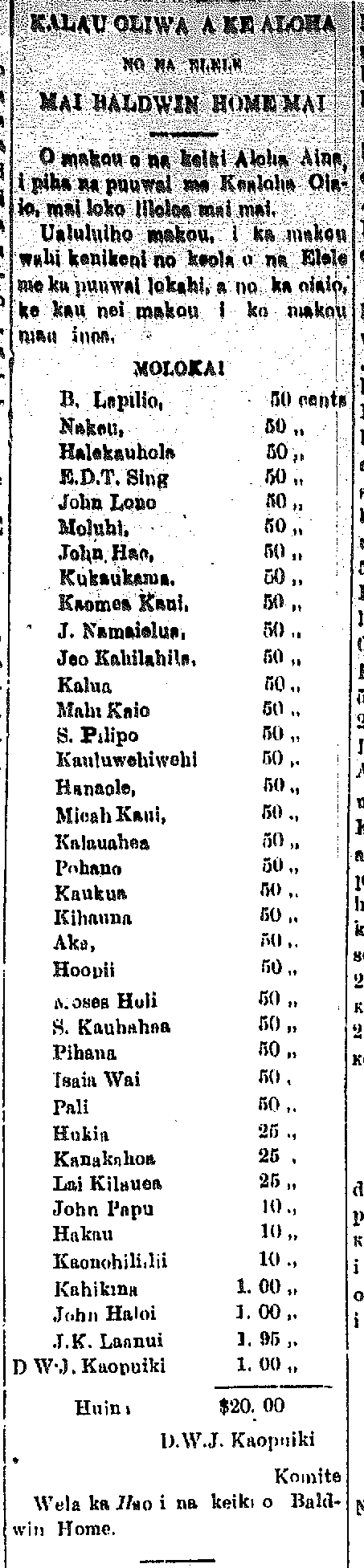
Donations for the commission carrying the anti-annexation petitions to America, 1898.

OLIVE LEAVES OF ALOHA

FOR THE REPRESENTATIVES

FROM BALDWIN HOME

We are the Aloha Aina boys whose hearts are full of true aloha from deep within.

We are donating our few cents for the well-being of the Representatives with unified hearts and to attest to this, we affix our names.

MOLOKAI.

B. Lapilio, 50 cents

Nakeu, 50 ”

Halekauhola, 50 ”

E. D. T. Sing, 50 ”

John Lono, 50 ”

Moluhi, 50 ”

John Hao, 50 ”

Kukaukama, 50 ”

Kaomea Kaui, 50 ”

J. Namaielua, 50 ”

Jeo Kahilahila, 50 ”

Kalua, 50 ”

Mahi Kaio, 50 ”

S. Pilipo, 50 ”

Kauluwehiwehi, 50 ”

Hanaole, 50 ”

Micah Kaui, 50 ”

Kalauahea, 50 ”

Pohano, 50 ”

Kaukua, 50 ”

Kihauna, 50 ”

Ake, 50 ”

Hoopii, 50 ”

Moses Holi, 50 ”

S. Kauhahaa, 50 ”

Pihana, 50 ”

Isaia Wai, 50 ”

Pali, 50 ”

Hukia, 25 ”

Kanakahoa, 25 ”

Lai Kilauea, 25 ”

John Papu, 10 ”

Hakau, 10 ”

Kaonohiliilii, 10 ”

Kahikina, 1.00 ”

John Haloi, 1.00 ”

J. K. Laanui, 1.95 ”

D. W. J. Kaopuiki, 1.00 ”

Total: $20.00

D. W. J. Kaopuiki

Committee.

The boys of Baldwin Home are speedy.

[The newspaper Ka Loea Kalaiaina (and many other Hawaiian-Language Newspapers) are for some reason still not available online in searchable text form or even in image form. This is unfortunate, for although most people are familiar with the anti-annexation petitions (“Kū‘ē Petitions”), many have not seen the many lists of donations collected from all over the islands for the expenses of the commission carrying the petition to Washington D. C.

This particular list of donors and donations are from Kalawao! These patients were forced to live isolated from mainstream society, and yet they remained staunch patriots!!

This image is difficult to read, and I hope that clear images of these pages will be made, so if they are typed out to be word-searchable online, people will be able to find their kupuna—it will be near impossible to find a name if there is an “@” somewhere within it…]

(Loea Kalaiaina, 3/14/1898, p. 3)

KALAU OLIWA A KE ALOHA

Ka Loea Kalaiaina, Buke II, Helu 11, Aoao 3. Maraki 14, 1898.

Election season, 1912.

LINEKONA THE REPRESENTATIVE FOR THE WELL-BEING OF HAWAII.

Lincoln is the Morning Star,
The shining lantern,
Appointed by you, O Heavenly Powers,
Assisted by the Trinity.

Rise, O people of Hawaii,
The descendants of the I and the Mahi,
One in heart until victorious,
From Hawaii to Niihau.

Heard across the Islands,
Here is the one who will save the Lahui,
The eagle* will make right,
The Equal Rights of the land.

Let the story be told,
Lincoln the Representative for the Well-Being of Hawaii.

Composed by

George Kelii,

Honolulu, February 29, 1912.

*The eagle is used to represent the United States.

[Back in the day, there were many mele composed to support candidates. This one is for Lincoln Loy McCandless, who is famous for drilling for water here, and thus is also known as Likana or Linekona Eliwai (water driller). He will also be seen referred to as Lina (from Link).]

(Aloha Aina, 3/2/1912, p. 1)

LINEKONA KA ELELE OLA HAWAII.

Ke Aloha Aina, Buke XVI, Helu 9, Aoao 1. Maraki 2, 1912.