50 Years of the Anglican Church in Hawaii, 1912.

A JUBILEE CELEBRATION.

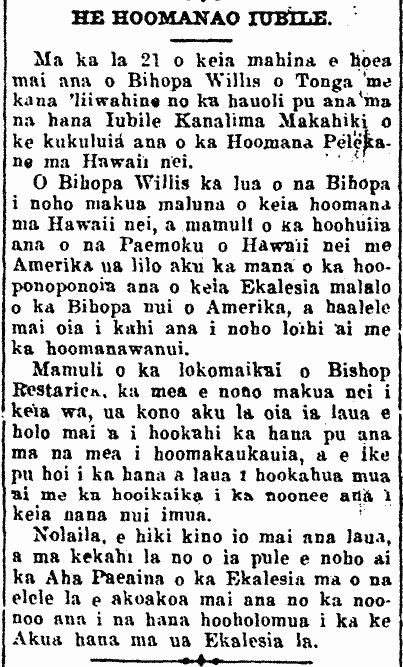
On the 21st of this month, Bishop Willis of Tonga will arrive along with his queen, to join in rejoicing over the Fiftieth Year Jubilee since the establishment of the Anglican Faith here in Hawaii.

Bishop Willis is the second Bishop who headed this faith in Hawaii nei, and as a result of Hawaii being annexed to America, the administration of the Church has transferred to the Bishop of America and he left the position he held for a long time with patience.

Because of the kindness of Bishop Restarick, who is currently the head, he invited the two of them to come and to perform together in the ceremonies prepared, and to witness the works that they established, putting much effort into moving these great endeavors forward.

Therefore, they will indeed arrive, and on one of the days of that week, the Church Convention of the Islands will be held with representatives coming together to consider ways to advance the works of God through this Faith.

[That makes this year 150 years!]

(Kuokoa, 5/10/1912, p. 8)

HE HOOMANAO IUBILE.

Ka Nupepa Kuokoa, Buke XLVIII, Helu 19, Aoao 8. Mei 10, 1912.

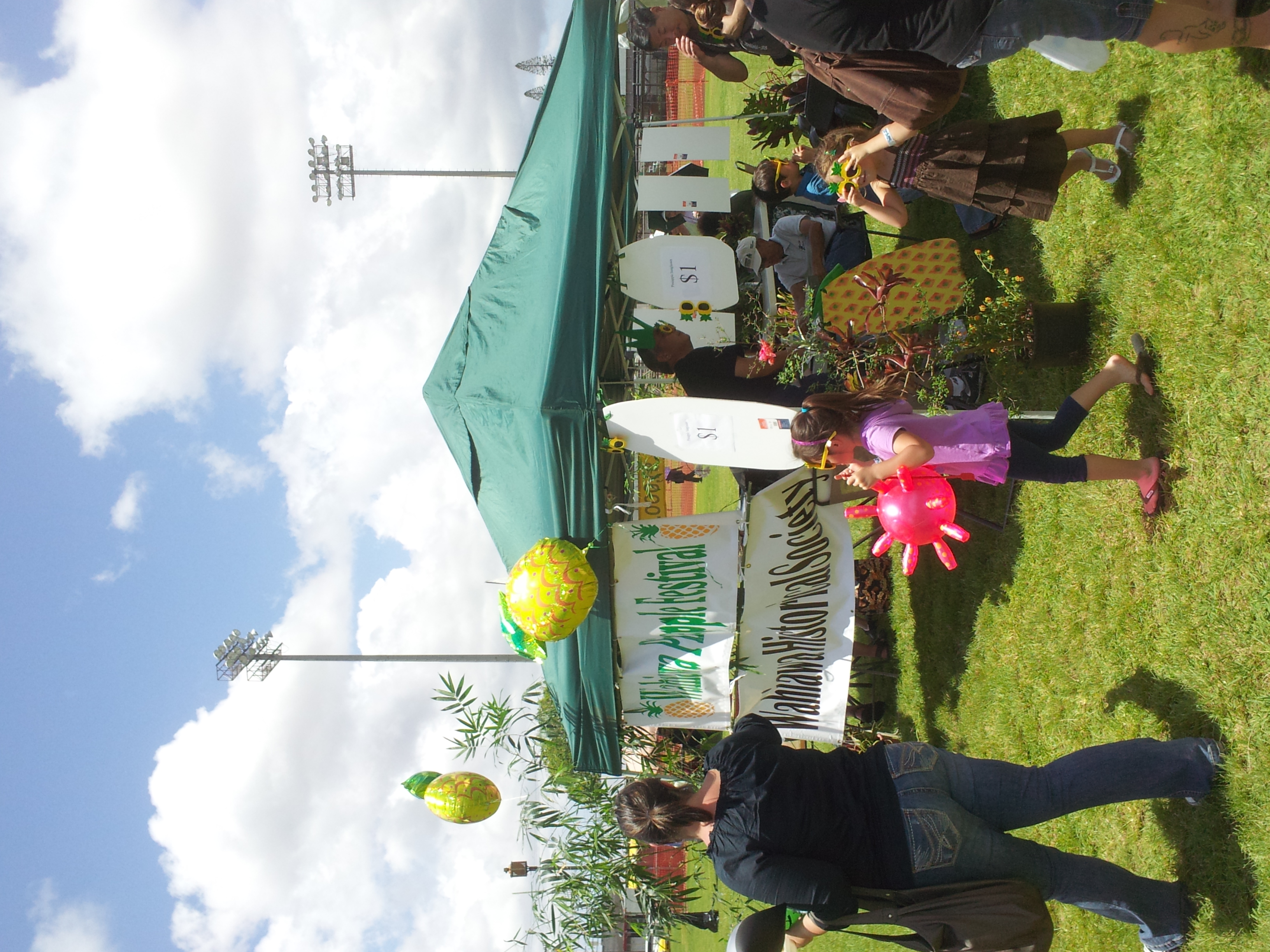
Wahiawa Pineapple Festival, 2012.

Don’t forget to check out the Pineapple Festival going on right now at Fred Wright Park!

10 a. m. to 8 p. m.!!

For more information, see:

Wahiawa Pineapple Festival

Pineapple Festival

Pineapple Festival

Wahiawa Historical Society

Wahiawa Historical Society

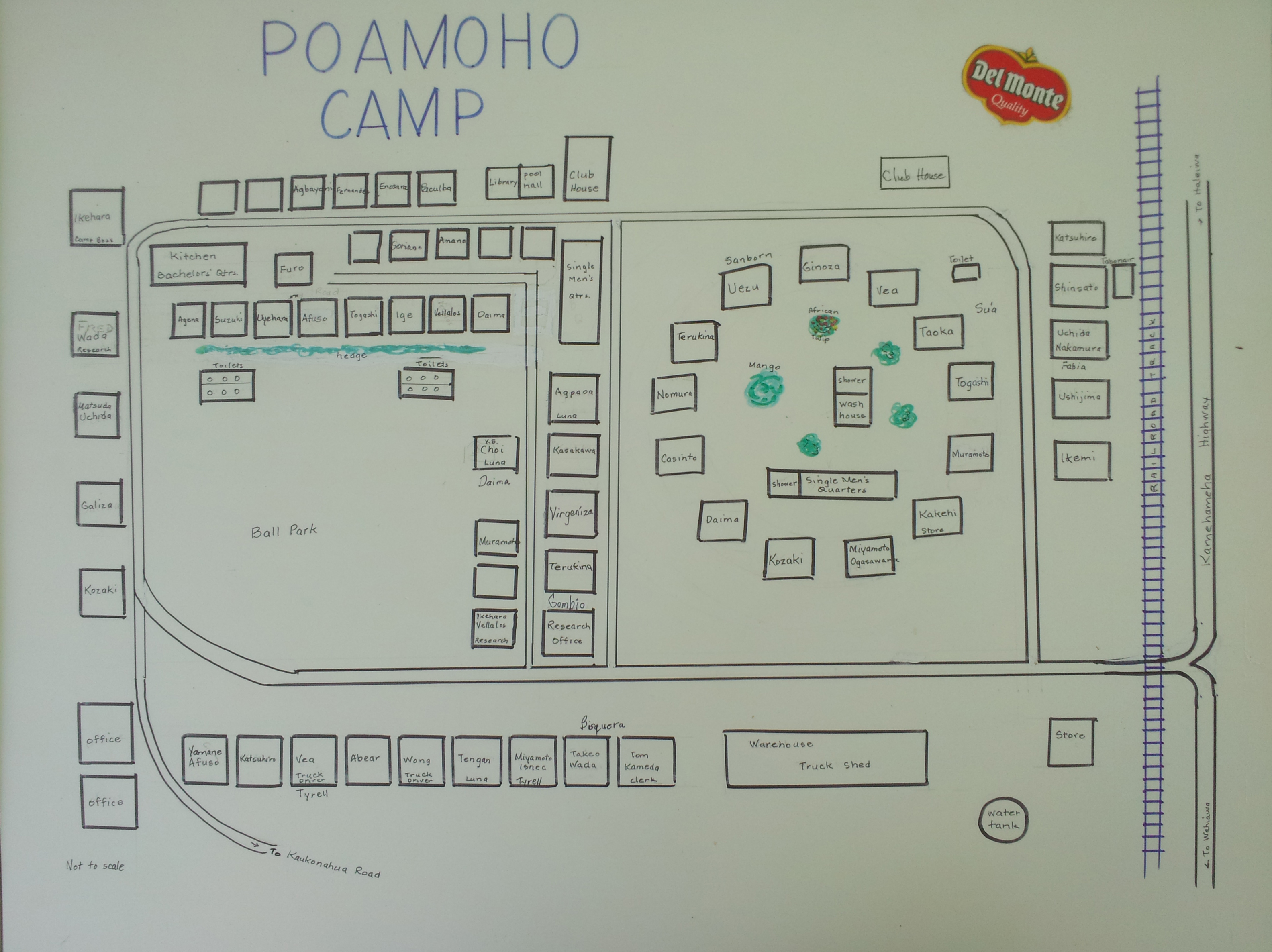
Poamoho Camp Map

Poamoho Camp Map

Another Wooden Kii found, 1868.

Akua Kii of Kalia.

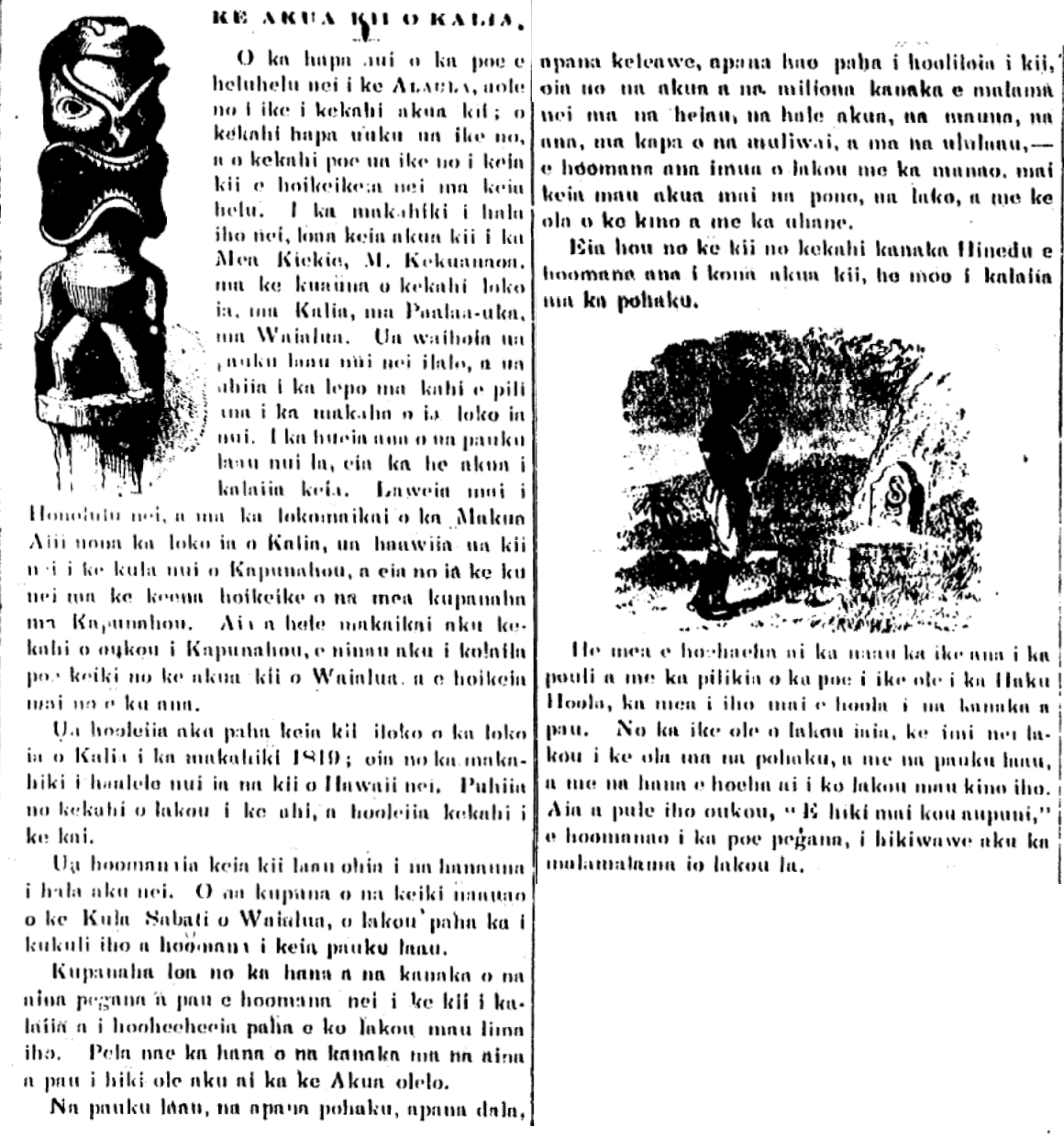
Most of the people reading Ke Alaula have not seen an akua kii, but a small fraction have seen one, and some of you saw this image that is shown here in this issue. Last year, this god idol was found by the Honorable M. Kekuanaoa on the banks of a fish pond at Kalia in Paalaa Uka in Waialua. That large piece of wood was set down and covered with soil near the sluice gate of that large fish pond. When that big piece of wood was unearthed, lo and behold, it was a carved god. It was brought to Honolulu nei, and through the goodwill of the Alii Elder who owns Kalia fishpond, that kii was given to the college of Kapunahou [Punahou], and there it stands in the exhibition room of curiosities at Kapunahou. When some of you go to visit Kapunahou, ask the children there about the kii from Waialua, and it will be shown to you where it stands.

This kii was probably thrown into the pond of Kalia in the year 1819; that is the year when there was the kii of Hawaii nei were greatly abandoned. Some of them were burnt in fire and some were thrown into the sea.

These ohia wood images were worshiped by previous generations. The kupuna of the educated children of Waialua Sunday School were probably those that knelt down and worshiped this piece of wood.

How astonishing are the actions of the people of all of the pagan lands, who worship idols that are carved or molded by their own hands. That is how all lands are where the word of God has not reached.

Pieces of wood, fragments of rock, chunks of silver, chunks of metal, or perhaps chunks of iron turned into images—those are the gods cared for by millions of people, in heiau, houses of god, mountains, caves, banks of rivers, and in forests; they worship before them thinking that from these gods come well being, wealth, and life in body and spirit.

Here also is a picture of a Hindu man worshiping his godly image; it is a snake carved into a rock.

This is something that pains the heart to see the darkness and trouble of those that don’t know of the God the Savior, the one who came down to save all man. Because they don’t know him, they seek salvation from rocks and pieces of wood and from actions that hurt their very own bodies. When you pray, “Thy kingdom come,” remember the pagans so that the light reaches them quickly.

[Could this Akua Kii be the one now at the Bishop Museum which was found in Waialua and presented to Punahou?]

(Alaula, 1/1868, p. 39)

KE AKUA KII O KALIA.

Ke Alaula, Buke II, Helu 10, Aoao 39. Ianuari, 1868.

We still haven’t learned today what they knew a hundred years ago?

Remember the article on snakes we posted just a couple of weeks ago? Out today is a current related article…

How sad is it when Hawaii already had the answer a hundred years ago, that today, the State of Hawaii doesn’t think keeping alien pests out of Hawaii is important enough to fund! See this article out today by Audrey McAvoy: Alien pests risk fewer inspectors upon entry.

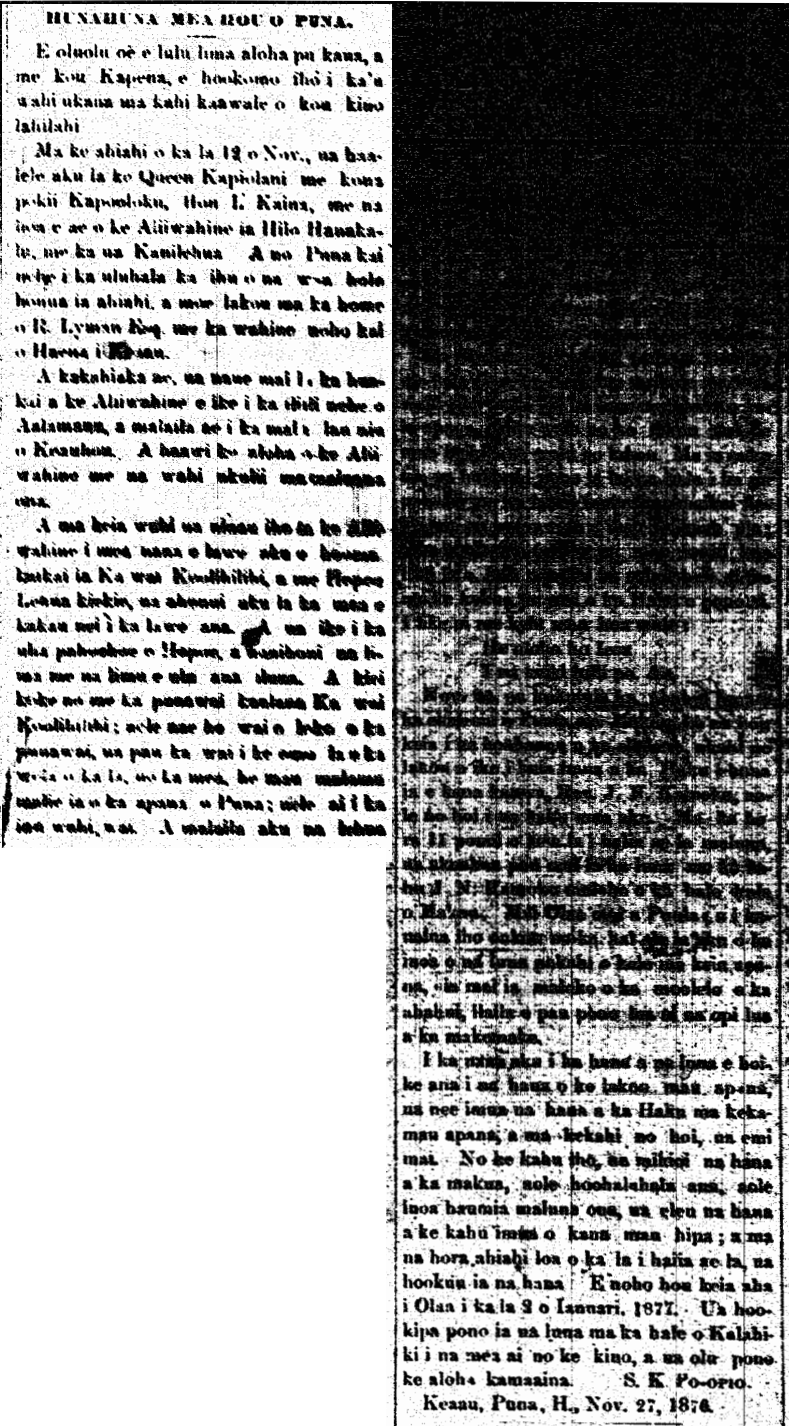
Here you’d be looking at a long strings of @@@@@@@@@ instead of information on Queen Kapiolani and Puna. 1876.

NEWS ITEMS FROM PUNA.

Please let us shake hands, your Captain and I, and insert my small contribution in an empty space of your delicate body.

On the evening of the 12th of Nov., Queen Kapiolani and her younger sister Kapooloku, Hon. L. Kaina, and the other companions of the Queen left Hilo Hanakahi and the Kanilehua rain. And the land travelling canoes that evening were pointed towards the seas of the rustling pandanus groves, and they reposed at the home of R. Lyman, Esq., along with the woman who lives in the sea of Haena in Keaau.

And the next morning, the entourage of the Queen travelled on to see the sounding pebbles of Aalamanu, and from there, to Keauhou and the shelter of coconut fronds. And aloha was shown between the Queen and her humble subjects.

And here the Queen asked for someone to take them to see the Waikoolihilihi and and the tall Hopoe Lehua, and the writer of this article patiently took them. We saw the hollow pahoehoe [uha pahoehoe?] of Hopoe, and inhaled the lima [?] and the seaweed growing upon it. And we soon looked upon the famous pool Ka Wai Koolihilihi; but there was no water in the pool as it was sucked up by the heat of the sun, for it has been months of nice weather here in Puna; there was no water to drink. There too were the lehua @@@@
@@@@@@@@@@@@@@@@@@@@@@@@@@@@@@@@@@@@@@
@@@@@@@@@@@@@@@@@@@@@@@@@@@@@@@@@@@@@@
@@@@@@@@@@@@@@@@@@@@@@@@@@@@@@@@@@@@@@
@@@@@@@@@@@@@@@@@@@@@@@@@@@@@@@@@@@@@@
@@@@@@@@@@@@@@@@@@@@@@@@@@@@@@@@@@@@@@
@@@@@@@@@@@@@@@@@@@@@@@@@@@@@@@@@@@@@@
@@@@@@@@@@@@@@@@@@@@@@@@@@@@@@@@@@@@@@
@@@@@@@@@@@@@@@@@@@@@@@@@@@@@@@@@@@@@@
@@@@@@@@@@@@@@@@@@@@@@@@@@@@@@@@@@@@@@
@@@@@@@@@@@@@@@@@@@@@@@@@@@@@@@@@@@@@@

@@@@@@@@@@@

@@@@@@@@@@@

@@@@@@@@@@@@@@@@@@@@@@@@@@@@@@@@@@@@@@
@@@@@@@@@@@@@@@@@@@@@@@@@@@@@@@@@@@@@@
@@@@@@@@@@@@@@@@@@@@@@@@@@@@@@@@@@@@@@
@@@@@@@@@@@@@@@@@@@@@@@@@@@@@@@@@@@@@@
@@@@@@@@@@@@@@@@@@@@@@@@@@@@@@@@@@@@@@
@@@@@@@@@@@@@@@@@@@@@@@@@@@@@@@@@@@@@@

When you look at the works reported by the church officials accomplished in their districts, the work of the Lord has progressed in some places but regressed in others. As for the pastor himself, the father’s work has been deft, there is nothing to fault, there is no obscene names to apply, his actions before his flock has been lively; and during the late evening hours of the day mentioned above, the meeting was adjourned. This group will meet again at Olaa on the 2nd of January, 1877. The church officials were hosted well at the home of Kalahiki with food for the body, and the aloha given by the locals was splendid. S. K. Po-opio

Keaau, Puna, H., Nov. 27, 1876.

[This paper was not typed from the unclear images available online, but from the originals. So luckily, all of those @@@@@@@@@@ portions have been transcribed and are available online. Still, it would still be worth getting the best images even of these pages, so that the typescript can be compared to the original for questionable phrases.

Now consider all of thousands of pages of newspaper with bad images that are being typescripted today. Now is the time to take clear images of them. Before typescripts are done. Why do double or triple the work? And perhaps more important, why risk having the pages touched again and again by people wanting to know what this @@@@ and that @@@@ are… Once the papers fall apart, it will be too late.]

(Lahui Hawaii, 12/21/1876, p. 2)

HUNAHUNA MEA HOU O PUNA.

Ka Lahui Hawaii, Buke II, Helu 52, Aoao 2. Dekemaba 21, 1876

Speaking of immigration… 2012.

Tradition and Transition: Stories of Hawai‘i Immigrants

Tradition and Transition

Fall 2011 – Summer 2013

Castle Hall’s second floor gallery features special treasured stories in focus cases, a timeline of Hawaiian history, video stations, and significant artifacts and document to relay the history of Japanese in Hawai‘i.

Inspiring stories abound when the discussion centers on the challenges faced by immigrants coming to a new homeland. Tradition and Transition, Stories of Hawai‘i Immigrants presents these and celebrates the diversity brought by all ethnic groups who contribute to the economic strength and cultural multiplicity of Hawai‘i.

Tradition and Transition, Stories of Hawai‘i’s Immigrants celebrates the stories of challenge and victory, tales of hardship matched with those of success. It is a story that focuses on the strength of human spirit and the power of change.

For children, a Pā‘ani Place is forfor kids to learn about multi-ethnic playthings and pastimes.

The hallway adjacent to the main exhibition gallery is Ho‘olaule‘a Hall, filled with large photomurals, hanging celebratory items, and smaller exhibit cases that focus on multiethnic celebrations.

At the end of the Ho‘olaule‘a Hall, will be Ho‘okipa Parlor, a recreation of the interior of a plantation home living room, welcoming visitors who wish to sit a while and browse books on various local ethnic traditions or watch some old news reels of plantation-era Hawai‘i.

Tradition and Transition: Stories of Hawai‘i’s Immigrants is funded by generous gifts from the Atsuhiko & Ina Goodwin Tateuchi Foundation and Hawai‘i Imin Shiryō Hozon Kai.

Tateuchi Foundation

[Don’t forget to check out this ongoing exhibit at the Bishop Museum! The description is taken from the Bishop Museum page.]


Bathing Pool of Kamehameha V on Molokai filled in? 1922.

Honolulu, Apr. 4. George P. Cooke reported that a Hawaiian of Molokai recalls [???] the large bathing pool of King Kamehameha V, while the king was living in Kaunakahakai, and this pool is filled with dirt now; and that Hawaiian recalls some springs near that pool of Kamehameha V. There are reservoirs being dug in the area near where that man spoke of, and [???]; the water from these places is well suited for the growing crops. There is a water pump pumping [??] thousand gallons of water every 24 hours. This is a great help [?] to Molokai.

[More potentially @-filled information …]

(Hoku o Hawaii, 4/6/1922, p. 3)

Honolulu, Apr. 4...

Ka Hoku o Hawaii, Buke XV, Helu 45, Aoao 3, Aperila 6, 1922.

Night fishing violations, 1932.

There were many who were arrested by the Fishing Warden; these were people who had no rights to fish as per the Law dealing with people who are not natives [citizens?] of Hawaii.

They are allowed to fish at night, only if they get a license, which can be used for a year.

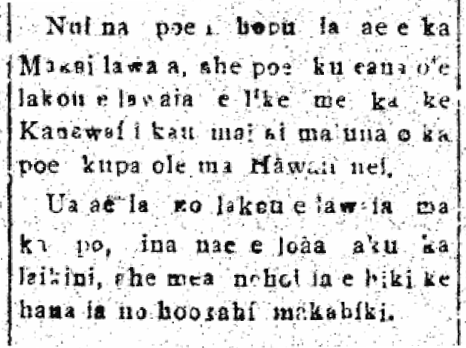
[I wonder if this gets typescripted by someone who has no Hawaiian language knowledge, if any of the key words will be found doing a word search (lawaia, kanawai, …) Or, will it look more like this:

Nui na poe i hoou la ae e ka Makai lawa a, ahe poe ku eana o’e lakou e la@aia e like me ka ke Kauewai i kau mai ai ma una o ka poe kupa ole ma Hawaii nei.

Ua ae la eo lakau e law@ia ma ka po, ina nac e loaa aku ka laikini, ahe mca nohoi ia e @iki ke haua ia no hookahi makahiki.

This is actually one of the articles that aren’t as bad as many…]

(Hoku o Hawaii, 4/5/1932, p. 3)

Nui na poe i hopu ia...

Ka Hoku o Hawaii, Buke XXV, Helu 43, Aoao 3. Aperila 5, 1932.

Heiau descriptions, lost for now, 1883.

SOME HEIAU OF OLD.

Earlier, some old temples of Hawaii were introduced: their description, and where they stand.

There are a number of old heiau standing in North Kohala. Mokini [Mookini] is the name of one of them in Kohala Waho, standing atop a flat base in Puuepa; it is a beautiful structure.

This heiau, according to its history, was built by the many and multitudes of gods and the menehune, that according to the natives who live there; the stones used to build it are from Pololu, and the menehune stood in a line all the way to Pololu; this heiau was built at night.

It faces the southwest, facing directly at the point of Upolu; some parts of the front enclosure have fallen, [???] are at the northwest, this heiau stands alone in a bare area, the land is level, and it has stood for centuries.

The second heiau is [Muleiula?], this heiau is located [???] Awaeli, its base is very flat like that of the earlier one, so too is the base of this one.

This heiau was erected by Hua, the one for whom is said, “The bones of Hua are dried in the sun,” [???] this heiau when he went [???] in the cliffs of Pololu, and [???] is called the cliffs of Kamakaohua.

The third heiau is named [Ku???], it is at [Maka???]; this heiau is very near to [???] at the harbor of Keokea; this heiau is like the earlier ones spoken of before, the purpose of this heiau was for agriculture, according to its history.

These heiau [???] multitudes of idol gods worshiped by the people of old, and they believed there was no other god.

In these modern days, [???] who are worshiping the idol gods of the old days? Here [???] children of men [???] in [???] and those hearts are full of idolatry.

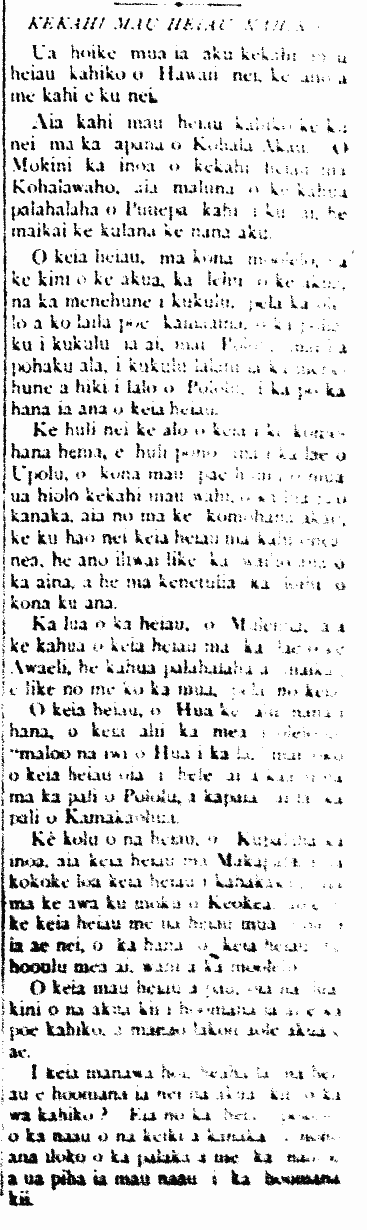
[There are so many articles like these that are partially or totally illegible without going back to the original newspapers.

If made “word searchable” as is:

Ke kolu o na heiau, o Ku@@@@ ka inoa, aia keia heiau ma Maka@@@@@@@@ kokoke loa keia heiau i kanaka@@@@@@@@ ma ke awa ku moku o Keokea @@@@@@@@ ke keia heiau me na @@@@@ mua @@@@@@@ ia ae nei, o ka hana o keia heiau @@@@@ hooulu mea ai, wahi a ka moolelo.

The most logical thing to do would be to take new and clear images of the papers all together, so that each time someone is interested in a partial article like this one, they will not need to flip through the fragile originals just so they can see one page.]

(Kuokoa, 11/4/1883, p. 1)
KEKAHI MAU HEIAU KAHIKO.

Ka Nupepa Kuokoa, Buke XXII, Helu 44, Aoao 1. Novemaba 4, 1883.

Crown Lands and Government Lands, 1896.

GOVERNMENT LANDS.

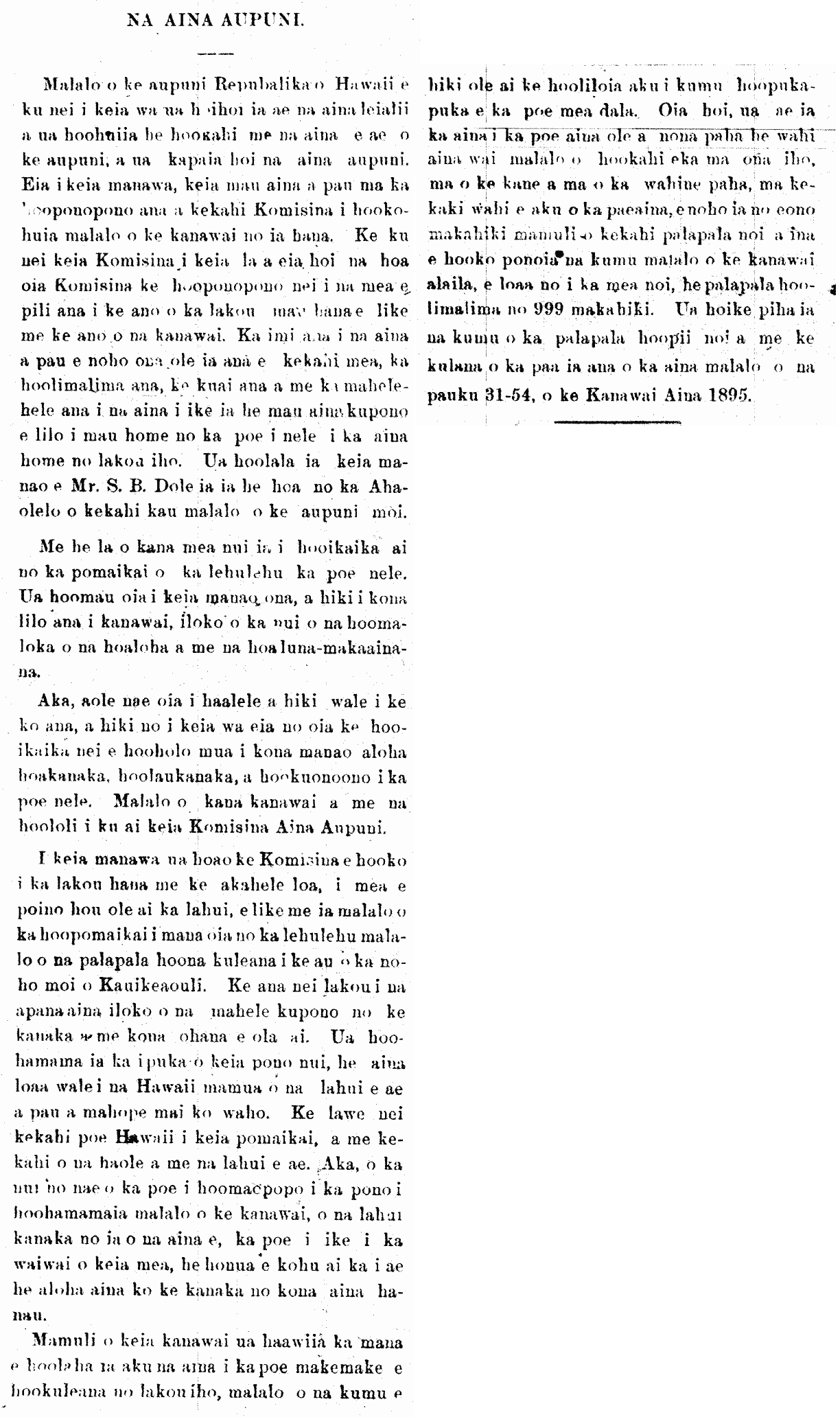
Under the Republic of Hawaii that stands now, the crown lands have been returned and added with the other lands of the government, and are referred to as government lands. Currently, the entirety of these lands are under the authority of a Commission appointed for that purpose under the law. The Commission is active today and its members are putting into order matters that pertain to their duties as per the laws. The finding of all lands that are not to be owned by someone, as well as the leasing, selling, and dividing of lands that are recognized as lands fitting to be homes for people without homesteads for themselves. This idea was devised by Mr. S. B. Dole while he was a member of the Legislature for a session under the monarchy.

It seems that this was what he focused on, for the good of those without. He kept at this idea until it became law, amidst much skepticism by friends and fellow representatives.

But he did not relent until he succeeded, and now he is working to move forward his loving idea for his fellow man, to increase, and to make prosperous, the poor people. Under his law and its revisions, this Government Lands Commission was created.

At this time, the Commission is trying to carefully carry out their duties so that the lahui will not once again be hurt like under the benefits intended for the masses with the quiet land titles in the time of Kauikeaouli’s rule. They are surveying parcels from areas suited for a man and his family to live. The doors to this great right is opened and Hawaiians will receive land before all other ethnicities and then thereafter those from the outside. There are some Hawaiians taking advantage of this opportunity, along with some haole and other ethnicities. But the majority of those that know of the good offered up by this law are the people of foreign lands, the ones who know the value of land for which one is able to say that he is patriotic to the land of his birth.

By this law, power is give to advertise land to those who claim land for themselves, under the condition that they cannot use it for profit. The land is available to those without land or those with wetlands of less than an acre under his name, or under the husband or wife in some other area of the archipelago; they will live on the land for six years after the request for land and should they meet the qualifications under the law, the applicant will receive a lease or 999 years. The requirements for the application and stipulations of the lease are shown in full in sections 31–54 of the Land Act of 1895.

[Just as it is today, it was back then. Different newspapers and sources had different stances. It is perhaps not best thing to base your opinions on a single article or the words of a single person. It is important to try and see all that was written and handed down in other ways (for ink and paper is not necessarily the best way that information is passed down), and then decide what you think on the subject…

Oh, and see here for the Land Act of 1895.]

(Oiaio Puka La, 4/3/1896, p. 2)

NA AINA AUPUNI.

Ka Oiaio Puka La, Buke I, Helu 67, Aoao 2. Aperila 3, 1896.