Speaking of Kamehameha Schools and the 125th year anniversary, take a look at this nice collection of Kamehameha related images put up online by KS!
More on Kamehameha Schools and 125th year anniversary, 2012.
4

Speaking of Kamehameha Schools and the 125th year anniversary, take a look at this nice collection of Kamehameha related images put up online by KS!
For the twenty-fifth time, the Kamehameha Schools held a luau on the night of last Saturday, and a great number of Kamehameha Schools graduates: boys with their wives, and so too girls with their husbands; and it was a time for the old people to get acquainted with the new, and a time to rejoice, and to listen to the speeches prepared, and the main thing was the feasting on tables weighted down with foods prepared by the students of the school.
In attendance were the teachers of the schools, some of the trustees, and a few invited malihini; they ate heartily, and there was leftover for those who prepared it [?], and everyone went home at the proper time with pleasant thoughts on what was seen that night.
After stomachs [ka lua o ka inaina] were filled, everyone enjoyed some songs from the boys of Kamehameha, and also from the girls, and the Honolulu band, then the speeches of the night were heard.
From the school, President Horne gave the first speech, that is, he gave his thanks for the gathering of the students on that night, which was something that the school was happy about, that the students of Kamehameha always come back to see the school which educated them.
According to him, in learning from the students how they are living, that being not going into debt; each of them are have still gone in debt; they are indebted to the Kamehameha School, and the benevolence of Bernice Bishop, the one who founded this school.
Following him, Faxon Bishop was called, and he explained the falsity of what he heard about the lack of advancement of those who graduated from the school.
There have been many things which he has heard about the children of Kamehameha after they leave the school, and to put an end to his misconceptions, he instructed the principal, Mr. Horne, to supply him with the roster of all students who graduated from the school, along with their occupations; and when he saw the list, he exclaimed about the falsehood of all that he had heard.
From amongst the 261 students who graduated from the school, he separated them into their current occupations, along with those deceased and those whose occupations are not known. These are the students of Kamehameha by their different occupations which benefits their lives as well as that of their families.
From within the great number of children who graduated, 63 of them are working in skilled labor; 50 are in secretarial, bookkeeping, or office work; 20 have deceased; 18 are in the teaching profession; 17 farmers; 10 in singing; 9 in the postal service; 7 with the street cars; 7 in the police force; 6 of them are ranked deputy sheriff; 6 are architects [kahakii]; 6 at the custom house [kukeawa]; 4 in roadwork; 3 in the army or navy; 3 drivers; 2 in law school; 2 newspaper editors; 2 stevedores; 2 in the board of health; 2 are day laborers [limahana hana la]; 2 are ticket agents; 1 is the head of the jail; 1 undertaker; 1 bank employee; 1 pastor; 1 lighthouse keeper; 1 head of a store; 1 at Kalihi Camp; and as for those whose occupations are unknown, there are 4.
By this list of occupations of the children, he said that there is absolutely no school known which have graduates that have progressed in this manner, which contradicts the truth of what he heard.
At the close of his speech, one of the old graduates of the school was called up, Deputy Sheriff Oscar Cox of Waialua, and it was he that instructed the trustees that they also should look after the welfare of all of the students of Kamehameha who graduate.
There are two major points he spoke of on that night pertaining to the progress of the school, that being the trustees acceptance of the importance of paying heed to the longevity of the tenure of the teachers within the school, and to not have them just stay for a short period and return to America, followed by the arrival of new teachers; that just leads to the the children not having a unified education. The other point was the importance of paying attention to the children when they leave the school.
He encouraged the youths living in this town now to return to and to live in the country, for according to him, there are many jobs in the sugar plantations, and should there be boys going back to Waialua, he believes he will be able to assist them in finding proper work by talking with the people in the sugar plantations.
He pointed out to the board of trustees that there is much land all over, and should the trustees care for the well being of the youths of Kamehameha, then it is of great importance that they give out those many acres of land to those youths going into farming, raising livestock, or other endeavors that will benefit them, along with granting them a sum of money for their use; and in that way, according to him, if there was this assistance, he would leave his government position and start working where he would gain an independent livelihood, and he would be able to care for and educate his children.
There was much appreciation for the Mr. Cox’s speech amongst his fellow schoolmates, as they continued to clap, however the thoughts of the trustees have yet to be seen.
From what was said about the luau that was held, it was a party leaving everyone gratified.
[A hundred years later, as Kamehameha Schools is celebrating its 125th year anniversary, this is something perhaps to look back to and to think about today and tomorrow…]
(Kuokoa 6/14/1912, p. 4)

Ka Nupepa Kuokoa, Buke XLVIII, Helu 24, Aoao 4. Iune 14, 1912.
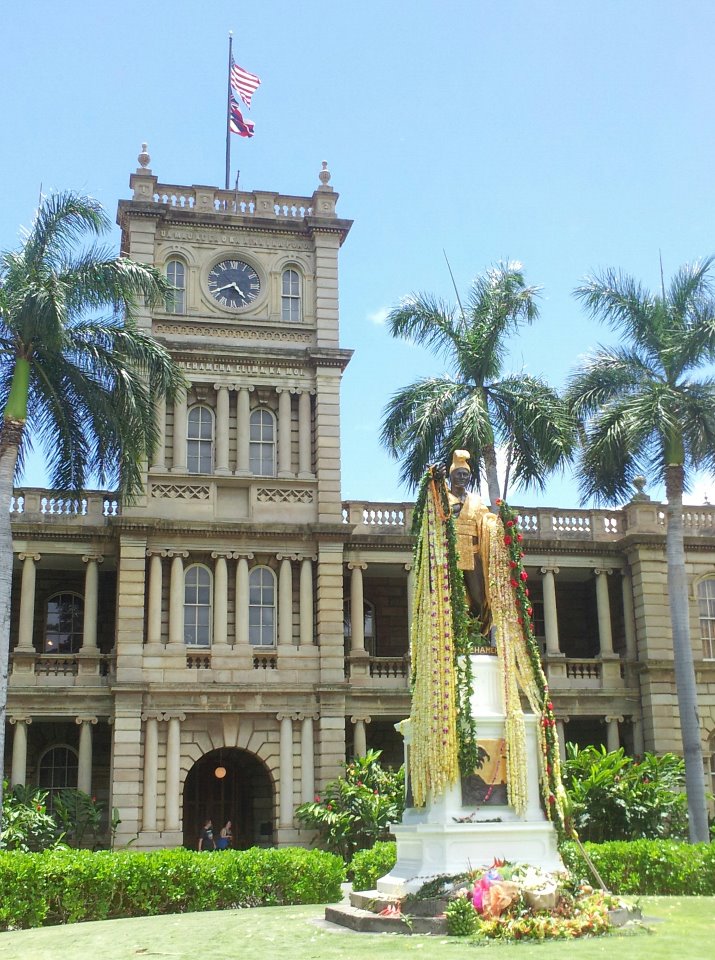
Kamehameha Statue. June 9, 2012.
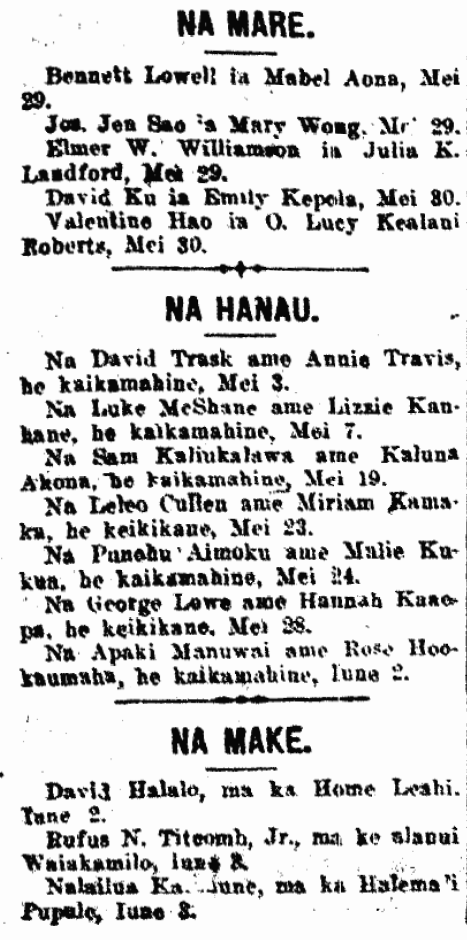
Bennett Lowell to Mabel Aona, May 29.
Joseph Jen Sao to Mary Wong, May 29.
Elmer W. Williamson to Julia K. Landford, May 29.
David Ku to Emily Kepola, May 30.
Valentine Hao to O. Lucy Kealani Roberts, May 30.
To David Trask and Annie Travis, a daughter, May 3.
To Luke McShane and Lizzie Kauhane, a daughter, May 7.
To Sam Kaliukalawa and Kaluna Akona, a daughter, May 19.
To Leleo Cullen and Miriam Kamaka, a son, May 23.
To Punohu Aimoku and Malie Kukua, a daughter, May 24.
To George Lowe and Hannah Kaaepa, a son, May 28.
To Apaki Manuwai and Rose Hookaumaha, a daughter, June 2.
David Halalo at Leahi Home, June 2.
Rufus N. Titcomb, Jr., on Waiakamilo Road, June 3.
Nalailua Ka[???]une, in the Insane Asylum, June 3.
[The last name is illegible but most likely if this page (and all of the rest of the newspapers) were re-photographed clearly, priceless information that we cannot see now will become clear! No one wants a bunch of @s in the middle of a kupuna’s name. There would be no way to find that name in a word search.]
(Kuokoa, 6/7/1912, p. 8)
Ka Nupepa Kuokoa, Buke XLVIII, Helu 23, Aoao 8. Iune 7, 1912.
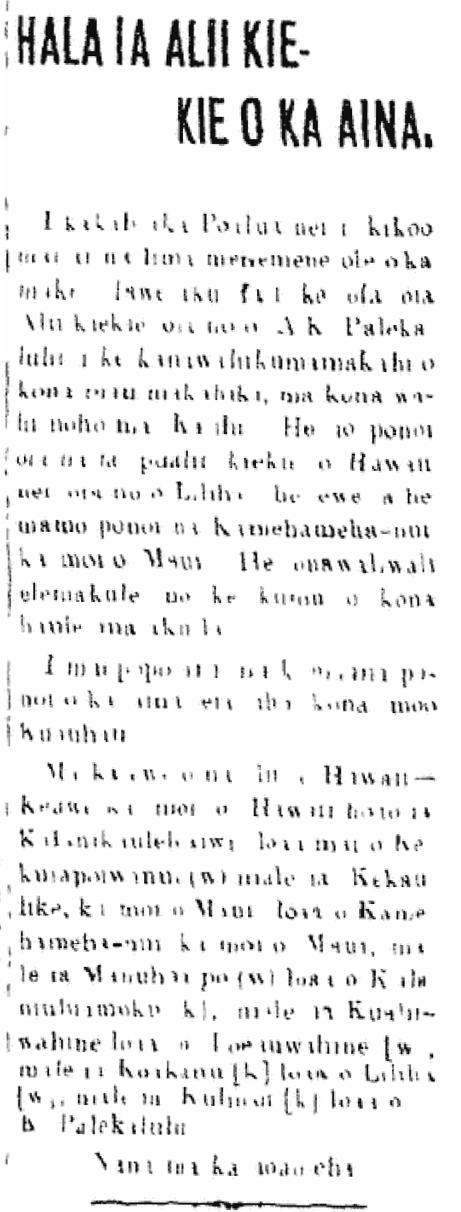
On Tuesday morning the merciless hand of death stretched out and took the life of that high chief, A. K. Palekaluhi at eighty-one years of life, at his residence in Kalihi. He is a true high chiefly descendant of Hawaii, of Liliha, who is of the lineage and a descendant of Kamehameha Nui, the king of Maui. His died because of the infirmities of old age.
To understand @@@@@, here is his genealogy.
In the lineage of the alii of Hawaii—Keawe, the king of Hawaii wed with Kalanikauleleiaiwi and born was Kekuiapoiwanui (f) who married [male] Kekaulike (m), the king of Maui, and born was Kamehameha Nui, the king of Maui, who married Manuhaaipo (f) and born was Kalaniuluamoku (m), who married Kualiiwahine and born was Loeauwahine (f), who married Koakanu (m) and born was Liliha (w) who married Kulinui (m) and born was A. K. Palekaluhi.
See page four.
[If you look below, most of this first column is hard to decipher, and much of the volunteer input would have likely been @@@@@ @@@@@. Hopefully people will think seriously about how much priceless information will be lost if the original newspapers are not clearly photographed before typescripts are done.]
(Kuokoa Home Rula, 5/31/1912, p. 1)
Kuokoa Home Rula, Buke X, Helu 22, Aoao 1. Mei 31, 1912.
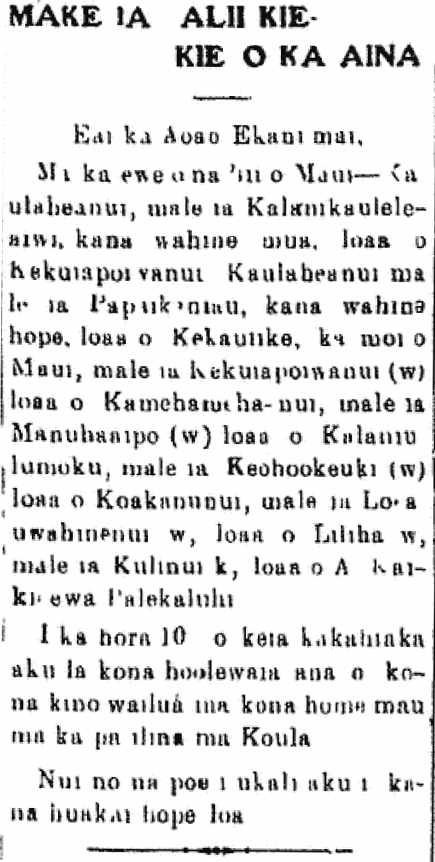
From Page One.
In the lineage of the alii of Maui—Kaulaheanui married Kalanikauleleaiwi, his first wife, and born was Kekuiapoiwanui. Kaulaheanui married Papaikaniau, his following wife, and born was Kekaulike, the king of Maui, who married Kekuiapoiwanui (f), and born was Kamehameha Nui, who married Manuhaaipo (f) and born was Kalaniulumoku who married Keohookeuki (f), born was Koakanunui who married Loeauwahinenui (f), and born was Liliha (f), who married Kulinui (m), and born was A. Kaikioewa Palekaluhi.
At 10 o’clock this morning, was the funeral over his remains at his eternal home at the cemetery at Koula.
There were many people who joined his last procession.
[It is interesting to see how different newspapers have different information in their coverage of the same event!]
(Kuokoa Home Rula, 5/31/1912, p. 4)
Kuokoa Home Rula, Buke X, Helu 22, Aoao 4. Mei 31, 1912.
This is a cool site mentioned in the Star Advertiser on the 20th of this month. Not only can you find old Hawaii-Language Newspapers, but all sorts of historical images and more!
University of Hawaii Virtual Museum.
For instance, here are some images from the Hawaiian & Pacific Images Collection at UHM.
Fire Insurance Maps give a good picture of the layout of streets and buildings through time!
And there are other random yet cool images, like these relating to the steamship Malolo that gets mentioned often in the later Hawaiian-Language Newspapers!
Ken Bennett in no way embarrassed Hawaii. Ken Bennett just embarrassed himself.
O Kuokoa Newspaper, Aloha to you:—Please extend your patience and allow me space in one of your columns for my parcel of my parent in my youth, and perhaps many of our friends will see it, and our companions in the Lord living from where the sun rises at Kumukahi all the way to where it shimmers into the sea of Lehua.
Pauli Kaoleiokukaiakauilani Hosea Iwiula was born in Kamoiliili¹, Oahu, on the 26th of June, 1862, from the loins of Iwiula (m) and Kapolei (f); according to the history of Iwiula, he was a descendant of the chiefly family of Kamalalawalu of Maui, and of kaukau alii rank in the court of the fathers of kings [Makualii, Makua Alii], Kekuanaoa and Kanaina, and the monarchs of the time; and the line related to Pauahi Kaoleioku Hosea Iwiula’s mother, that being Kapolei, she was closely related to the chiefly blood of Kekaulike Nui of Molokai, and being that Molokai is where Kapolei (f) was born, it is believed by the locals here in Kamoiliili that Hosea Iwiula is a chief for whom this eulogy is for.
While Kapolei was young, following the death of Kahuloa, her first husband, she married the aforementioned Iwiula. At that time, Kapolei’s was regularly a singing teacher for the young chiefly women of those days. And Kamoiliili’s handsome prince and gentleman of the time was Pauli Kaoleioku, the first born of the alii Haumea of the serene lands of Ehu, the land where water lies in the face of the cloud banks [epithets for Kona, Hawaii]. And as what happens when people grow up, there is a craving for the great fish that passes before one’s eyes, and that is perhaps why Kapolei and Pauli Kaoleioku were mixed up together, and Hosea was conceived, a son from the loins of Kapolei, and thus Hosea Iwiula was said to be a child of Pauli, and an alii.
During the days when we lived as man and wife, he became a parent to me, and so also me for him. My dear husband was very skilled in singing, and it was he who always lead the Sunday School classes of Kamoiliili for almost thirty or more years, and he was the elder [luna kahiko] of the Kamoiliili Church for almost twenty-four years and also is a long-time member of the Kawaiahao Church, then he left that position in the hands of Hiram Kaaha who is still there now. Hosea was a member of the leaders of Kawaiahao Church from his branch church of Kamoiliili. During the days when he was the leader of the Sunday School for Kaawili, he assisted his Sunday School students immensely, by clothing them with their uniforms, shoes and hats; he helped the children a lot.
I was joined with him on the 16th of January, 1882, at Kamoiliili, and we had ten children, and six of them are still living: one daughter and five sons; and four of them have gone before and he has gone in search to be with them.
On Tuesday, the 25th of January, he went to Kauai for the building of the home of Sam Kaeo, the Kauai county attorney, which he would be painting; and in the last week of December, the 29th, he returned to Kamoiliili, and joined in to lead the Sunday School class of Kamoiliili at the last quarterly congregational convention of 1911, and on January 25, he went back to Nawiliwili where his job was, and there after a few weeks began a sickness in his body, and it progressed until he passed from me in that unfamiliar land, on April 29, 1912, and he and I travelled over the great Kaieie Channel for here in Honolulu aboard the Malulani on the 30th of April, and my beloved lei, my husband was left at the funeral home of M. E. Silva, and on the following Thursday, he was carried to Kamoiliili, and within this church where the two of us along with the friends of this place would always gather to worship God, his funeral service was held and he was returned to the place of all men, and the saying was fulfilled: “Man goes to his eternal home, and the spirit returns to its maker.” For “He gave and He hath taken away, blessed be the name of Jehovah.”
O Lililehua Rain of Palolo, you shall no more buffet the cheeks of my beloved; and you as well, O Kuahine Rain which treads upon the fringes of the lehua of Manoa, you will no more soak him and his lashes; O Royal Capitol of Honolulu, he shall not see your fairness; and O Shores which I was with my beloved, your rocky banks will never again be glided over by his loving feet, and O Seas of Kaalawai and Keauau where me and my loving husband were as one, you will not see him again passing by with me.
Alas, there is only love for my husband of my youth, my parent of my uneducated days. I am yours, O My Beloved, that did [lueuele?], wandering the streets in tears.
Me with sorrow,
MRS. RAHELA [Rachael] HOSEA.
Kamoiliili, May 11, 1912.
¹Kamoiliili is known today generally as Moiliili.
[I have found no other usages of the word “lueuele”. Unless the newspapers are accurately typescripted, we won’t know if lueuele is a typo, or if it is indeed a word. The more examples of usages and context found, the clearer the meaning of the word will be. Does the acceptance of inaccurate typing indicate that these words are not important?]
(Kuokoa, 5/17/1912, p. 4)

Ka Nupepa Kuokoa, Buke XLVIII, Helu 20, Aoao 4. Mei 17, 1912.
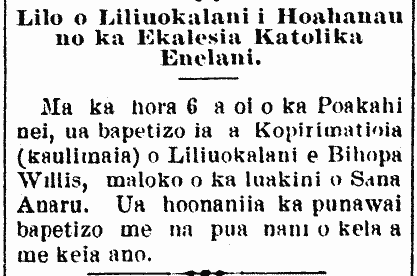
At 6 o’clock or so on this Monday, Liliuokalani was baptized and there was a laying on of hands (Kopirimatio) by Bishop Willis, in St. Andrew’s Cathedral. The font was festooned with flowers of all sorts.
[We found this small mention about Liliuokalani’s baptism because of response by Corrine Chun Fujimoto on yesterday’s post about the Anglican Church in Hawaii!
Also, can help me with the word that “Kopirimatio” comes from?]
(Kuokoa, 5/22/1896, p. 2)
Ka Nupepa Kuokoa, Buke XXXV, Helu 21, Aoao 2. Mei 22, 1896.
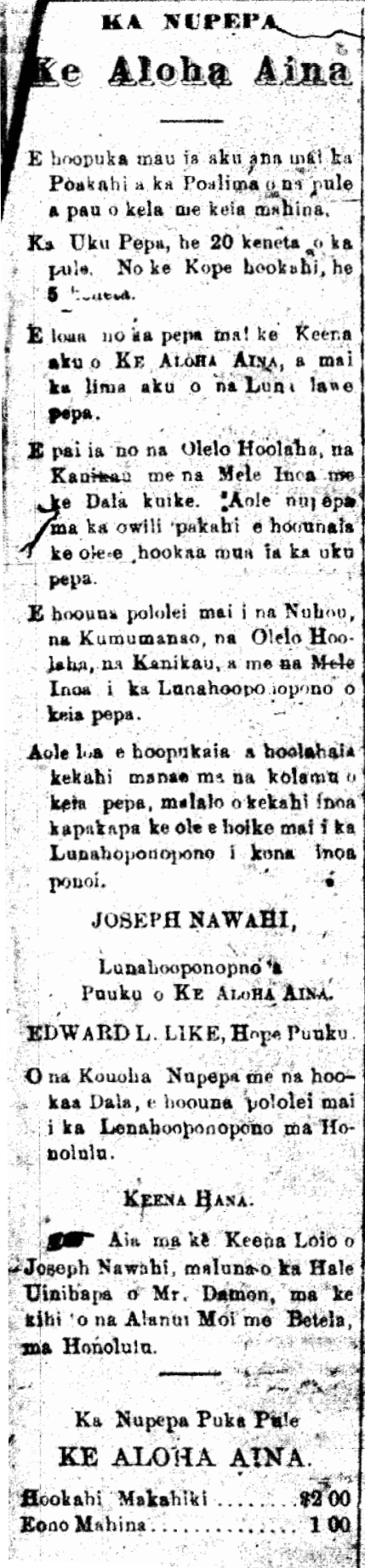
It will be published regularly from Monday to Friday of every week of each month.
The Subscription is 20 cents a week. For a single copy is 5 cents.
The paper can be obtained from the Office of Ke Aloha Aina, and also from the Supervisors of distribution.
Announcements, Kanikau [dirges], and Mele Inoa [name chants] will be printed upon receipt of payment. Not a single paper will be sent without the subscription being paid.
Send News, Topics, Announcements, Kanikau and Mele Inoa directly to the Editor of this paper.
No ideas will be printed or disseminated within the columns of this paper under a pen name should his true name not be divulged to the Editor.
JOSEPH NAWAHI,
Editor and
Treasurer of Ke Aloha Aina.
EDWARD L. Like, Vice-Treasurer.
Subscriptions and payments are to be sent directly to the Editor in Honolulu.
Business Office.
At the Law Office of Joseph Nawahi, above the Brick Building of Mr. Damon, on the corner of King Street and Bethel, in Honolulu.
The Weekly Newspaper
KE ALOHA AINA.
One Year . . . . . $2.00
Six Months . . . . . 1.00
[This appears on the very first issue of the paper, on the first column of the first page.
I am posting this in response to a question from Meleanna Aluli Meyer, which is in turn responding to one of my first posts. You would imagine that Ke Aloha Aina was based in Hilo, but we can see here that it was indeed based out of Honolulu nei.]
(Aloha Aina, 5/25/1895, p. 1)
Ke Aloha Aina, Buke I, Helu 1, Aoao 1. Mei 25, 1895.

