Tragic follow up to Emalia Kaihumua, 1906.

BEAT HIS WIFE AND THE WIFE WAS AFFLICTED BY THE SEPARATING DISEASE.

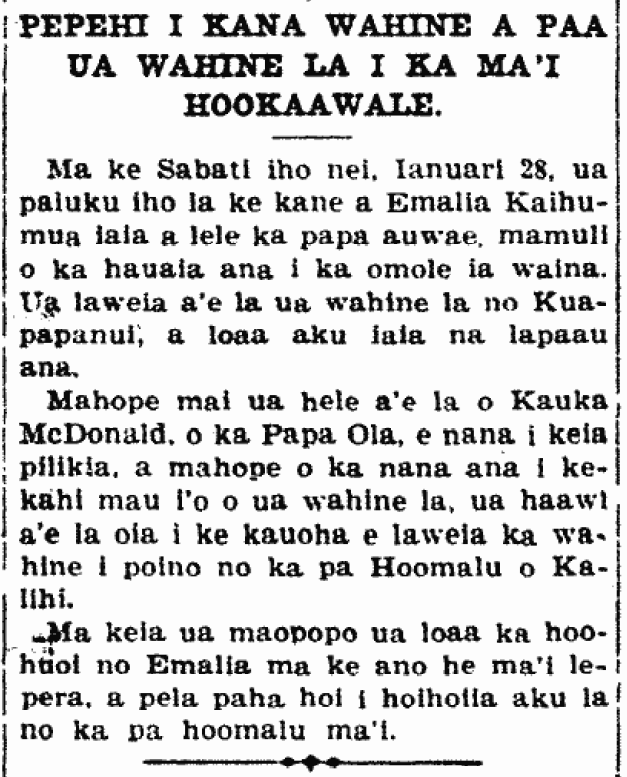
This past Sunday, January 28th, the husband of Emalia Kaihumua beat her and her jaw was dislocated, because she was struck with a wine bottle. That woman was taken to Kuapapanui, and tended to.

Later, Dr. McDonald of the Board of Health came and examined the injury, and after his examination of some of the flesh of that woman, he gave orders to have the injured woman to the Quarantine Station in Kalihi.

From this it is understood that Emalia is suspected of having leprosy, and that is possibly why she was taken to the quarantine area of the sick.

(Kuokoa, 2/2/1906, p. 4)

PEPEHI I KANA WAHINE A PAA UA WAHINE LA I KA MA'I HOOKAAWALE.

Ka Nupepa Kuokoa, Buke XLIV, Helu 5, Aoao 4. Feberuari 2, 1906.

Sweet Emalia out and about, 1901.

[Found under: “LOCAL ‘HAWKSHAWS’ OWN UP IDENTITY … Sweet Emalia Denied the Oft-Repeated Impeachment]

“Sweet Emalia” was brought before the bar of justice to answer to the charge of being drunk. The fair defendant denied the soft impeachment, meanwhile shedding a copious flow of tears. Emalia was given a reprimand and discharged.

[Yes, Emalia Kaihumua made it out from the insane asylum!]

(Honolulu Republican, 6/2/1901, p. 1)

"Sweet Emalia" was brought...

The Honolulu Republican, Volume II, Number 305, Page 1. June 2, 1901.

More on Emalia Kaihumua out and about, 1901.

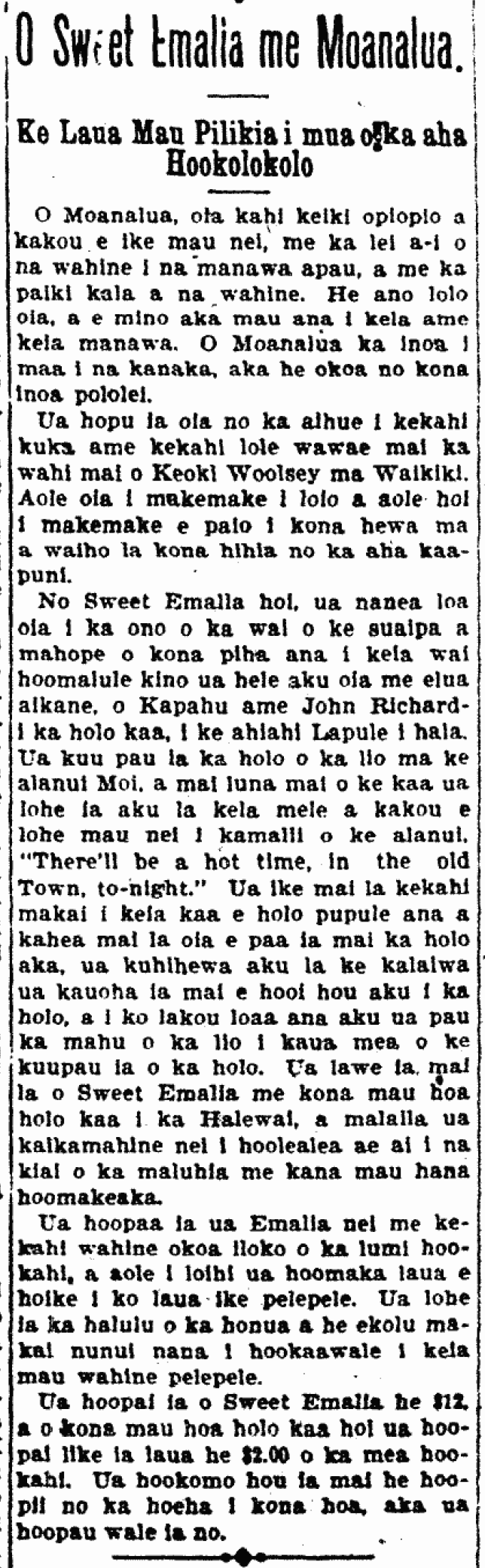
Sweet Emalia and Moanalua.

Their Problems Before the Court

Moanalua is a youth that we often see with a woman’s necklace all the time, and a women’s pocketbook. He is somewhat feeble-minded, and is always smiling. Moanalua is the name that people know him by, but his real name is something else.

He was arrested for stealing a suit and a pair of slacks from Keoki Woolsey’s place in Waikiki. He did not want a lawyer, and did not want to contest his guilt, and his case is left for the circuit court.

As for Sweet Emalia, she was enjoying the tasty water, swipe [suaipa], and after being filled with this intoxicating liquid, she went along with the two aikane, Kapahu and John Richard [?] on a car ride, in the evening of this past Sunday. The horse was exerted as they sped along King Street, and from the car came that song often heard from children on the streets, “There’ll be a hot time, in the old town, tonight.” This car was seen by a policeman as it sped on crazily, and he called out to stop, but the driver misheard and thought he was being told to speed up; and when the were caught, all the steam was exhausted from the horse resulting from it being run hard. Sweet Emalia and her riding companions were taken to jail [Halewai], and there she entertained the peace officers with her funny antics.

That Emalia was detained with another woman in a single room, and it wasn’t long when they began to display their skill in boxing. The rumbling of the earth was heard, and it was three large officers that separated the two women fighters.

Sweet Emalia was fined $12, and her fellow joy riders were each fined $2.00. Another suit was filed for injuring her companion, but it was dismissed.

(Kuokoa, 10/4/1901, p. 5)

O Sweet Emalia me Moanalua.

Ka Nupepa Kuokoa, Buke XXXIX, Helu 14, Aoao 5. Okatoba 4, 1901.

Runaways from Kalawao, 1875.

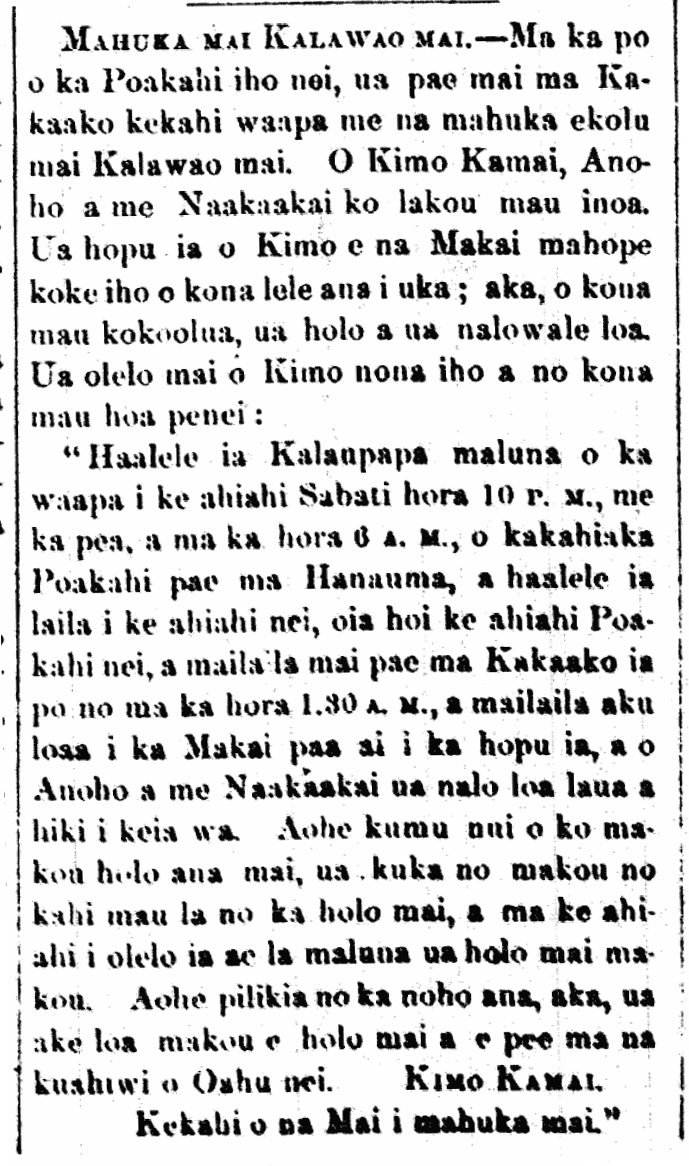
Escaped from Kalawao.—During the night of this past Monday, a skiff landed at Kakaako with three escapees from Kalawao. Their names are Kimo Kamai, Anoho, and Naakaakai. Kimo was captured by the Officers soon after he came ashore; however, his two companions ran and disappeared. Kimo said of himself and his companions:¹

“We left Kalaupapa aboard the skiff in the evening of Sunday, at the hour of 10 p. m., with a sail, and at 6 a. m., in the morning of Monday, we landed at Hanauma, and left there this past evening, that being the evening of this Monday, and from there landed at Kakaako that night at 1:30 a. m., and from there I was caught and detained by the Officer, while Anoho and Naakaakai escaped until the present. There was no big reason for us coming; we spoke for a number of days about coming, and on the evening mentioned above, we set sail. There is no difficulties in the way of life, but we really wanted to come here and hide in the mountains of Oahu nei. KIMO KAMAI.

One of the Patients who escaped.”

¹It is interesting the word here used for companion was “kokoolua” instead of “kokookolu”.

(Lahui Hawaii, 7/29/1875, p. 3)

Mahuka mai Kalawao mai.

Ka Lahui Hawaii, Buke I, Helu 31, Aoao 3. Iulai 29, 1875.

A “fishing” accident, 1913.

MAIMED FROM AN EXPLOSION OF GIANT POWDER

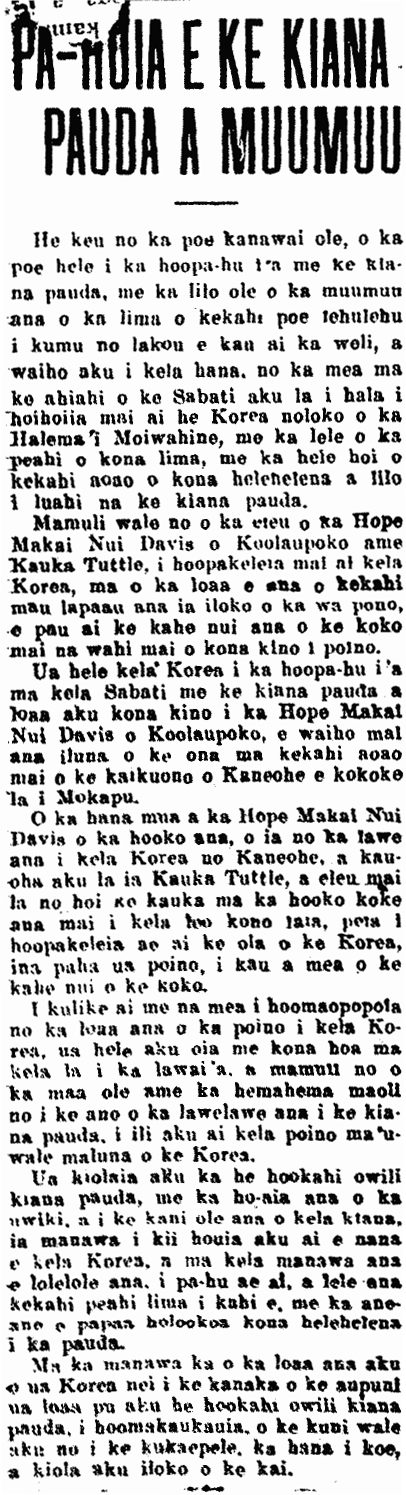
How reckless are the lawless, those who fish by setting off giant powder [kiana pauda] without fear resulting from the many people whose hands were maimed and without stopping this activity; because this past Sunday, a Korean was brought to the Queen’s Hospital with his hand blown off and a side of his face falling victim to the giant powder.

It was only because of the quick action taken by Deputy Sheriff [Hope Makai Nui] Davis of Koolaupoko and Dr. Tuttle that that Korean was saved by stopping the heavy bleeding from his injuries earlier in proper time.

That Korean went that Sunday to blast fish with giant power and his body was found by Deputy Sheriff Davis of Koolaupoko, he was lying on the sand on the side of Kaneohe Bay near Mokapu.

The first thing Deputy Sheriff Davis did was to bring that Korean to Kaneohe, and called for Dr. Tuttle; he hurried in answering to the call, and that is how the Korean’s life was spared; he was would have been in trouble because of the tremendous amount of bleeding.

According to what is understood about how that Korean received his injuries: he went with a friend that day to fish, and because he was not accustomed to and very inept at handling giant powder, that is how this senseless tragedy befell him.

A twist of giant powder was thrown after lighting the fuse, and because it did not go off, that Korean went to grab it and check it out, and while he was handling it, it exploded, and his had flew off, and almost his whole face was burnt by the powder.

When the government man found the Korean, found also was a twist of giant powder ready to ignite and throw into the ocean.

[Notice how the dash in the first word of the title, “pa-huia” signifies that the syllable after the dash is lengthened, and also how the passive “ia” is as usual, not set off—today therefore it would be written “pahū ʻia”

(Kuokoa, 3/21/1913, p. 1)

PA-HUIA E KE KIANA PAUDA A MUUMUU

Ka Nupepa Kuokoa, Buke VL, Helu 12, Aoao 1. Maraki 21, 1913.

The latest from Hana, Maui, 1877.

News from Hana.

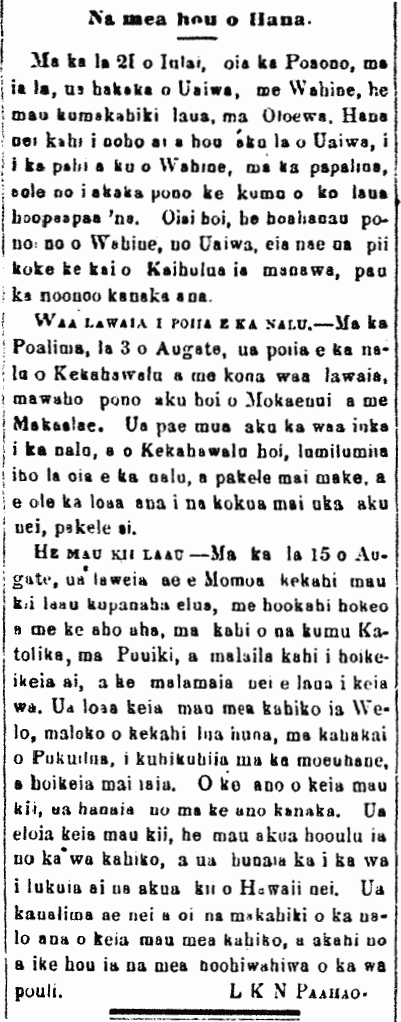
On the 21st of July, that being Saturday, on that day, Uaiwa fought with Wahine, both of them being contract laborers; they live at Oloewa, Hana, and Uaiwa stabbed Wahine with a knife in the cheek, and the reason for their quarrel is not known. Wahine is an actual cousin of Uaiwa, and here yet his temper soon flared up [pii koke ke kai o Kaihulua] and he lost his senses.

A fishing canoe pounded by a wave.—On Friday, the 3rd of August, Kekahawalu and his fishing canoe was hit by a wave right outside of Mokaenui and Makaalae. The canoe came ashore first carried by the waves, and as for Kekahawalu, he was pounded by the waves and escaped nearly dying; without receiving help from those on shore he would not have escaped.

Some wooden idols [kii laau].—On the 15th of August, brought by Momoa were a couple of amazing wooden images, along with one gourd calabash [hokeo] and some cordage [aho aha], to the Catholic teachers in Puuiki; there it was displayed, and the two of them are caring for them until this day. These old things were found by Welo in a hidden cave, seaside of Pukuilua, which was revealed to him in a dream, and was shown to him. The kii are made in the shape of people. It is said that these kii were procreative gods of the olden days, and were hidden away during the time that the god images of Hawaii nei were being destroyed. These old things have been hidden for fifty or more years, and it is the first time these revered things of the dark ages are being seen again.  L. K. N. Paahao.

(Kuokoa, 9/15/1877, p. 3)

Na mea hou o Hana.

Ka Nupepa Kuokoa, Buke XVI, Helu 37, Aoao 3. Sepatemaba 15, 1877.

James Kaulia injured, 1899.

James Kaulia Injured

BY HENRY VIDA AND JACK GIBSON.

Aboard the Steamer Australia is Where This Evil Act Was Done.

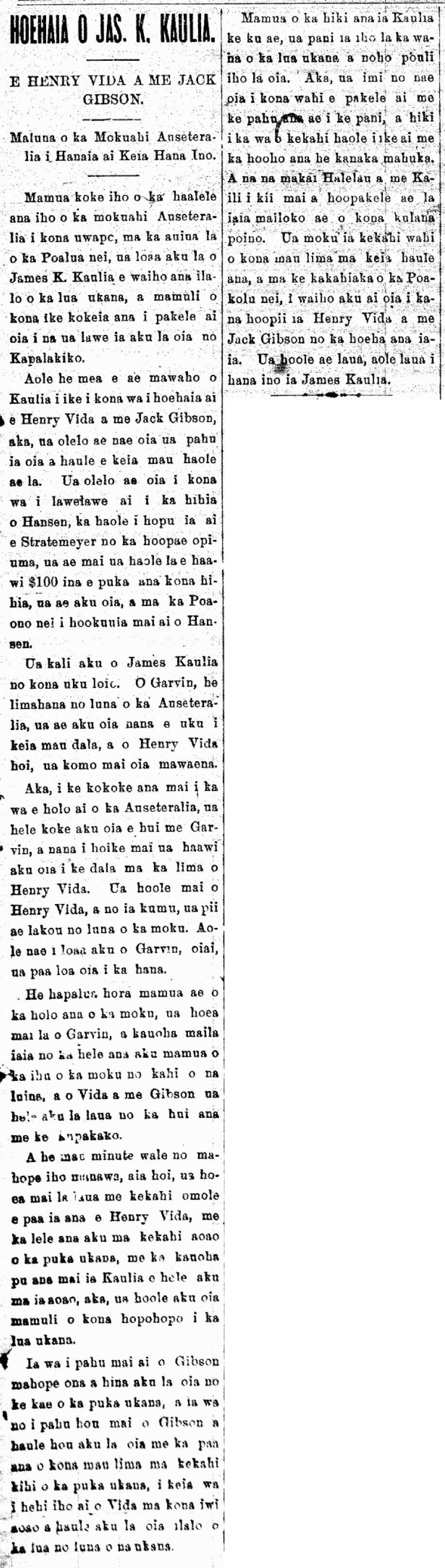
Right before the Steamship Australia [Auseteralia] left its mooring, on the evening of this Tuesday, James K. Kaulia was found left below in the storage hold, and because he was found quickly that he was saved, lest he have been taken to San Francisco.

There was no one else other than Kaulia who witnessed him being hurt by Henry Vida and Jack Gibson, but he stated that he was shoved by these haole men and fell. He says that when he took the case of Hansen, the haole that was arrested by Stratemeyer for importing opium, that haole agreed to pay $100 if his charges were overturned, he [Kaulia] agreed, and this Saturday, Hansen was set free.

James Kaulia waited for his lawyer fees. Garvin, a worker aboard the Australia agreed that he’d pay the money, and Henry Vida stood as an intermediary.

But when it grew near to the time when the Australia was to leave, he went to go see Garvin, who told him that he gave the money in the hands of Henry Vida. Henry Vida denied this, and for this reason they all went aboard the ship. Garvin however was not found, for he was busy working.

Half and hour prior to the ship’s departure, Garvin appeared, and he told him [Kaulia] to go up front to the prow, where the sailors were; and as for Vida and Gibson, they went to meet with the purser.

And just a few minutes after that, the two of them suddenly showed with a jug being held by Henry Vida; and they jumped to one side of the opening of the storage, while telling Kaulia to come over to that side, but he refused because he was hesitant about the storage hold.

That was when Gibson pushed him from behind and he fell on the side of the door to the storage, at which point Gibson shoved him again and he fell once more, his hands grabbing on to a corner of the door; then Vida stomped on his ribs and he fell into the room on top of the baggage.

Before Kaulia was able to stand, the entrance to the storage was shut, and he sat there in the dark. However, he sought a way for him to get out, pounding at the door until he was found by a haole who exclaimed that there was a runaway. And officers Halelau and Kaili came to rescue him from his precarious situation. Some parts of his arms were broken when he fell, and in the morning of this Wednesday, he filed a suit against Henry Vida and Jack Gibson for injuring him. The two of them deny harming James Kaulia.

(Aloha Aina, 2/25/1899, p. 2)
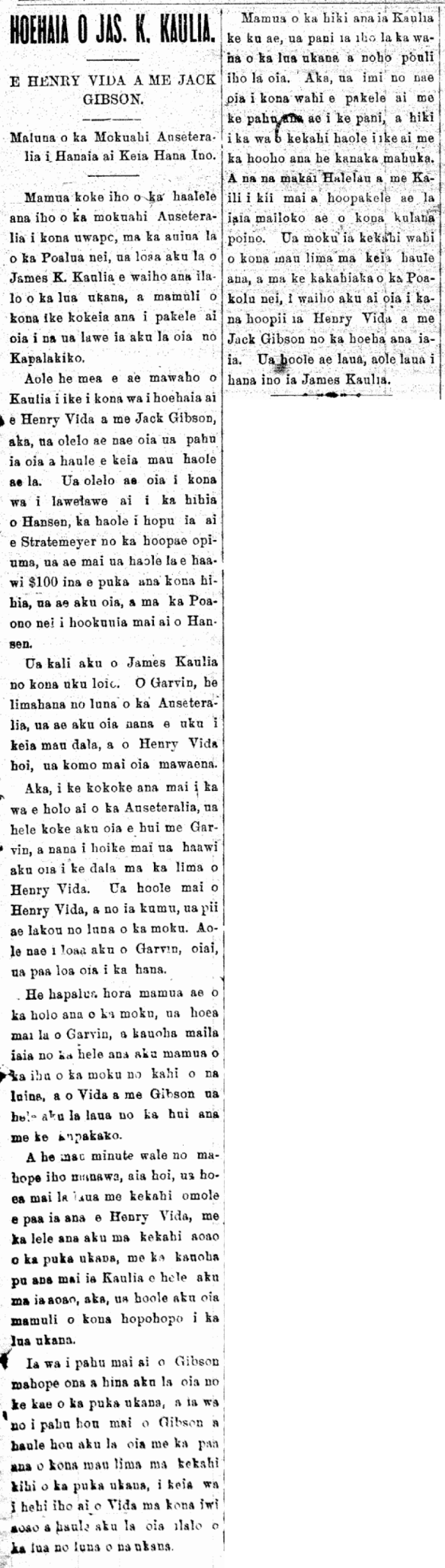
HOEHAIA O JAS. K. KAULIA.

Ke Aloha Aina, Buke V, Helu 8, Aoao 3. Feberuari 25, 1899.

Stolen turtle net of Tai On Aina, 1933.

Turtle Net is Lost

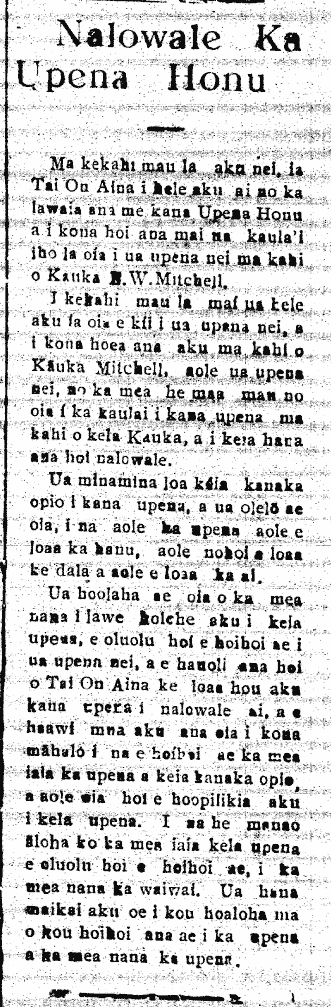
Several days ago, Tai On Aina went to fish with his Turtle Net, and upon his return, he left his net to dry by Dr. E. W. Mitchell’s [the first initial is not clear] place.

Some days later, he went to fetch the net, but when he arrived at Dr. Mitchell’s, there was no net; he was accustomed to drying his net by that doctor’s place, but this time it disappeared.

This young man is at a lost over his net, and he said that without his net, he can’t catch turtles, and thus can’t make money and then can’t get food.

He announced to the one who mischievously took the net, if he could kindly return this net, which would make Tai On Aina happy to get his lost net back; and he offers his thanks in advance should that person who has the net of this young man returns it without damaging it. Should that person who has the net has some aloha, please return it to whom the property belongs. You will be doing a good deed to your friend by returning the net to the one it belongs to.

(Hoku o Hawaii, 2/14/1933, p. 3)

Nalowale Ka Upena Honu

Ka Hoku o Hawaii, Buke XXVI, Helu 37, Aoao 3. Feberuari 14, 1933.

More from Puheemiki on C. Strawn in Kalawao, 1883.

THE NEWS OF KALAWAO

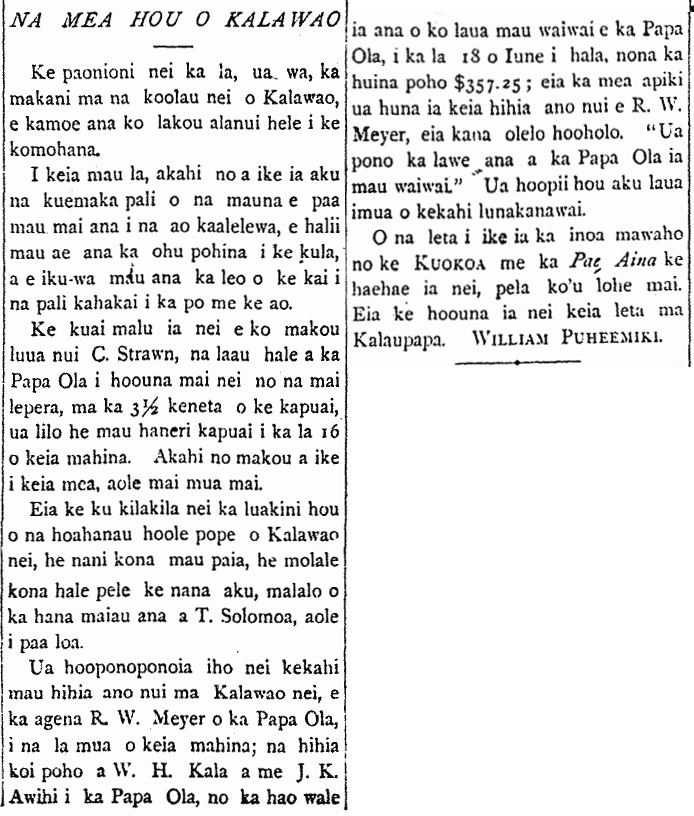
The sun is shining; this wind is howling in the Koolau of Kalawao; their path lies to the west.

These days, it is the first time the brows of the cliffs of the mountains have been sighted, which are constantly blocked by floating clouds; the fields are constantly covered by gray mist; and the voice of the ocean constantly roars in the sea cliffs both night and day.

Our superintendent, C. Strawn, is secretly selling the house lumber that the Board of Health sent for the patients, at 3½ cents per yard, and hundreds of yards were sold on the 16th of this month. We just found out about this, we didn’t know from earlier.

The new church of the protestant brethren of Kalawao stands proudly, her walls are beautiful, and her bell tower is stands unobstructed; this was done skillfully under T. Solomoa [T. Solomona], but it is not completed.

Some major problems here in Kalawao were remedied by the agent of the Board of Health, R. W. Meyer, earlier this month; the claim for damages by W. H. Kala and J. K. Awihi against the Board of Health, for the seizing of their property by the Board of Health on the 18th of this past June, totaling $357.25; here is the deceitful thing: this important claim was hidden away by R. W. Meyer, and this was his decision. “The Board of Health was justified in the seizing of this property.” They two of them filed suit once again before a judge.”

Letters seen addressed outside to the Kuokoa or the Pae Aina¹ are torn apart; that is what I hear. This letter is being sent at Kalaupapa.  William Puheemiki.

[Does anyone know which Protestant church in Kalawao this would be being built in 1883?]

¹Ko Hawaii Pae Aina

(Kuokoa, 8/25/1883, p. 3)

NA MEA HOU O KALAWAO

Ka Nupepa Kuokoa, Buke XXII, Helu 34, Aoao 3. Augate 25, 1883.

Smuggled goods, 1912.

SMUGGLED GOODS AUCTIONED OFF

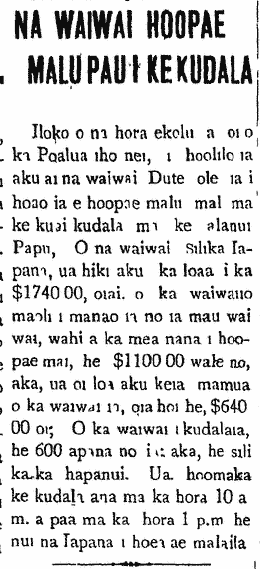
In three hours or so this past Tuesday, items attempted to be smuggled in without paying Duty were auctioned off on Fort Street. Japanese Silk goods made $1,740.00 whereas the actual value of the items is believed to be only $1,100.00 according to the person who imported them; and so it was much more than the real value, being that it was $640.00. There were 600 items that were auctioned and the majority was silk goods. The auction began at 10 a. m. and closed at 1 p. m.; there were many Japanese who showed up.

(Kuokoa Home Rula, 12/19/1912, p. 1)

NA WAIWAI HOOPAE MALU PAU I KE KUDALA

Kuokoa Home Rula, Buke X, Helu 51, Aoao 1. Dekemaba 19, 1912.