1836, the beginnings of sericulture on Kauai. 1843.

SILK. NUMBER 2.

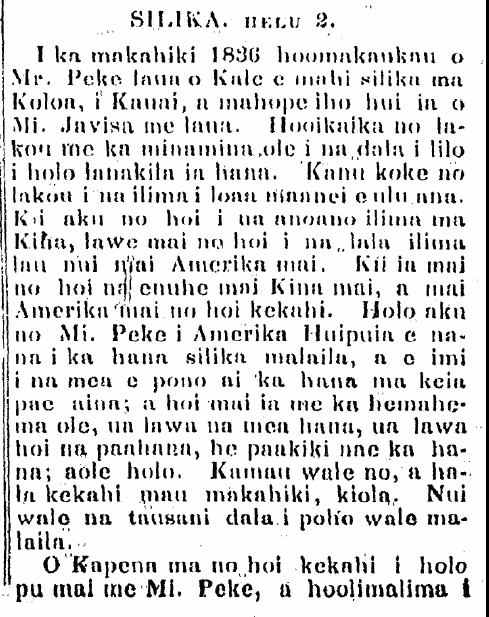
In the year 1836, Mr. Peke and Kale made ready to farm silk [silika] in Koloa, Kauai, and afterwards the two were joined by Mr. Jarvis [Mi. Javisa]. They put much effort into this without caring about money spent to make it a success. They immediately planted ilima found growing here. They went to get ilima [? mulberry] seeds from China and brought back branches of the ilima lau nui from America. Mr. Peke went to the United States of America to see silk production there, and to find what it took to raise them in this archipelago; he returned without anything lacking, with the necessary gear, and sufficient workers, but the work was difficult and did not move forward. They kept at it, and some years went by, and they gave up. Many thousands of dollars was wasted on it.

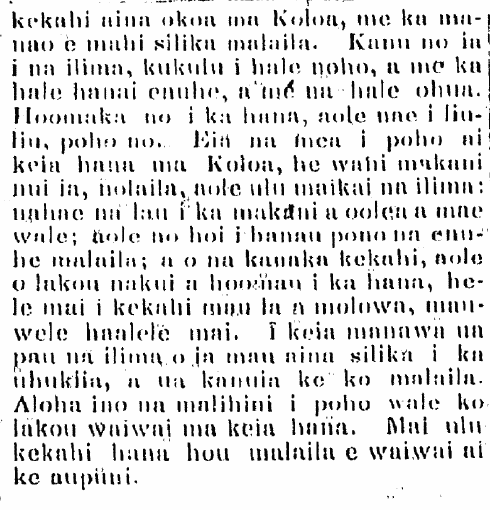
Kapena and others also came with Mr. Peke, and leased other lands in Koloa, with thoughts of raising silk there. He planted ilima, built a residence, a building to raise the worms, and a house for the workers. They began the work, but in not much time, it was a bust. Here are the reasons that it was a waste of time in Koloa: there is a strong wind so the ilima does not grow well as the leaves are torn in the strong wind and wilt, the worms don’t grow well there; and the people also, they are not eager and do not keep at the work; they come some days and slack off, are lazy and leave. Today, the ilima of those silk lands are all pulled out and sugar is planted there. So sad for those foreigners who wasted their money in this endeavor. A new enterprise almost started there to make the nation rich.

(Nonanona, 1/3/1843, p. 78)

SILIKA. HELU 2.

Ka Nonanona, Buke 2, Pepa 16, Aoao 78, Ianuari 3, 1843.

(Nonanona, 1/3/1843, p. 79)

...kekahi aina okoa ma Koloa...

Ka Nonanona, Buke 2, Pepa 16, Aoao 79. Ianuari 3, 1843.

More on rubber cultivation in Hawaii nei. 1907.

A RUBBER ASSOCIATION TO BE ESTABLISHED ON MAUI.

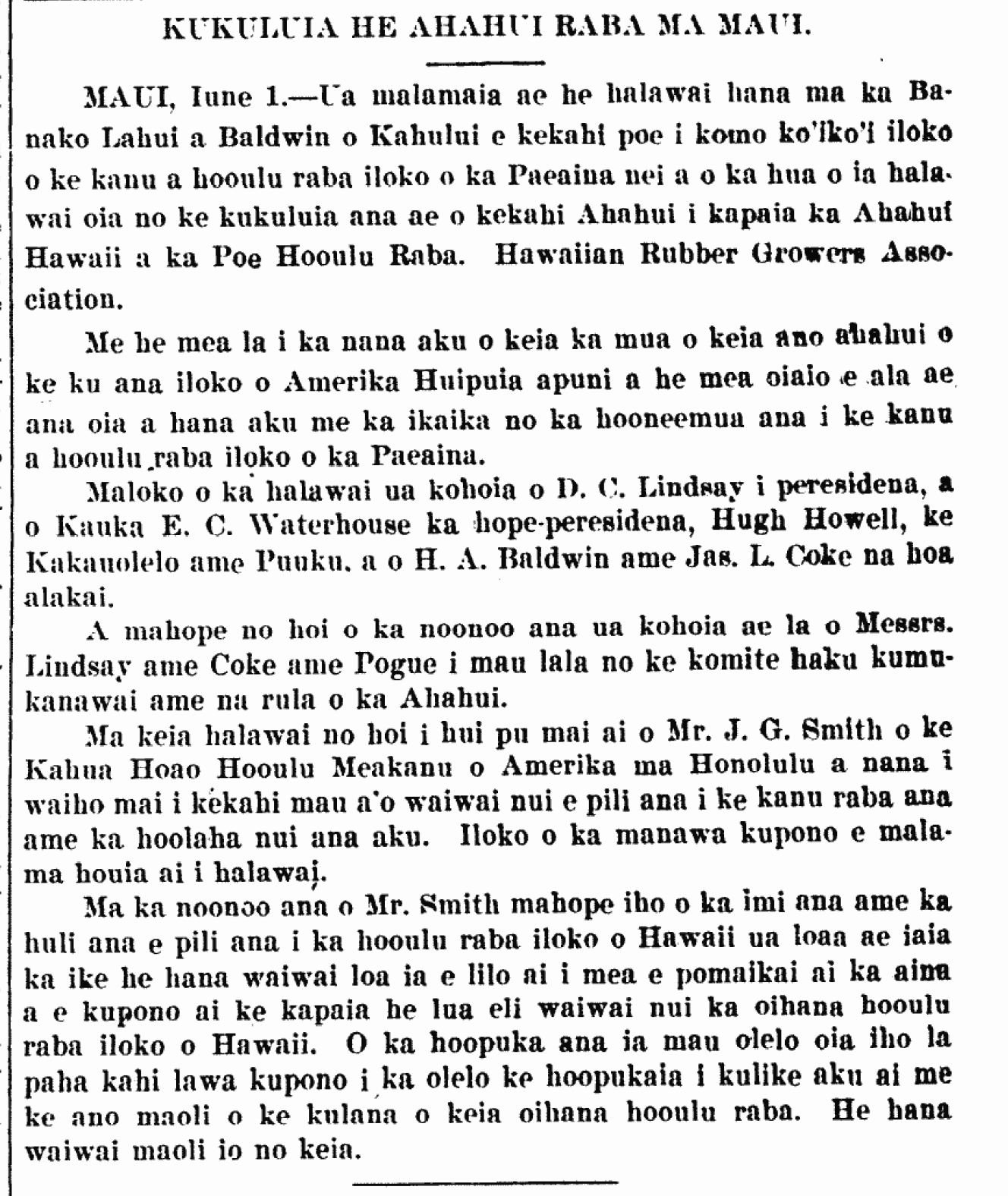
MAUI. June 1.—A business meeting was held at the Kahului Baldwin National Bank [Banako Lahui a Baldwin o Kahului] by people seriously planting and raising rubber [raba] in this Archipelago, and the outcome of the meeting was the establishment of an Association called “Ka Ahahui Hawaii a ka Poe Hooulu Raba [Hawaiian Rubber Growers’ Association]”.

It seems that when looking at this, this is the first association of its kind established in the whole of the United States of America, and it is a fact that it will start and strive to push forward the planting and growing of rubber in the Archipelago.

In the meeting, D. C. Lindsay was chosen as president, and Doctor E. C. Waterhouse as vice president, Hugh Howell, the Secretary and Treasurer, and H. A. Baldwin and James L. Coke as fellow advisors.

And after consideration, Messrs. Lindsay and Coke and Pogue were chosen as members of the committee to draft bylaws and rules for the Association.

Also at this meeting was Mr. J. G. Smith of the American Agricultural Experiment Station [Kahua Hoao Houlu Meakanu o Amerika] in Honolulu and he gave some valuable advice relating to the planting and the wide distribution of rubber. At a proper time, another meeting will be held.

In the thoughts of Mr. Smith, after he searched and investigated about growing rubber in Hawaii, he found that it is a very valuable endeavor that will bring good fortune to the land and it is well that the growing of rubber in Hawaii be called a rich mine. This declaration was perhaps enough of a statement befitting the importance of this effort to raise rubber. This is a truly lucrative endeavor.

(Kuokoa, 6/7/1907, p. 5)

KUKULUIA HE AHAHUI RABA MA MAUI.

Ka Nupepa Kuokoa, Buke XLII, Helu 23, Aoao 5, Iune 7, 1907.

Rubber cultivation on Maui, 1906.

RUBBER PLANTS GROWING PROFUSELY IN THE RUBBER PLANTATION OF NAHIKU.

[The picture seems to be signed F. T. P. Waterhouse. Hopefully the newspapers will be rescanned clearly soon, so that not only text can be read clearly, but pictures like this can be seen clearly!]

(Kuokoa, 12/7/1906, p. 6)

NA LAAU RABA E ULU NUI NEI  MA KA MAHI RABA O NAHIKU.

Ka Nupepa Kuokoa, Buke XLV, Helu 49, Aoao 6. Dekemaba 7, 1906.

Tobacco grown in Hawaii, 1863.

[Found under: “NEWS OF HAWAII NEI.”]

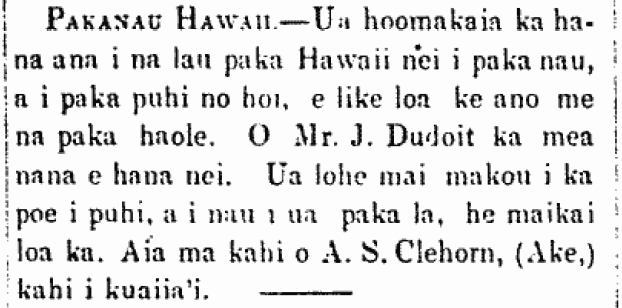
Chewing Tobacco.—Hawaiian tobacco leaves are have begun to be made into chewing tobacco and smoking tobacco as well, just like foreign tobacco. Mr. J. Dudoit is the one undertaking this. We have but heard from those who smoke tobacco and chew tobacco that it is excellent. It is available for purchase at the store of A. S. Cleghorn [Ake].

(Kuokoa, 8/22/1863, p. 2.)

Pakanau Hawaii.

Ka Nupepa Kuokoa, Buke II, Helu 34, Aoao 2. Augate 22, 1863.

Cotton grown in Hawaii, 1863.

[Found under: “NEWS OF HAWAII NEI.”]

Growing well.—We have seen the cotton plantation at Mililani, of the Honorable John Ii [Ioane Ii]; and we are in admiration at how well it is growing. What about us, O Friends? Shouldn’t we emulate the efforts of the Honorable One? We must follow the good example put before us and plant our land with cotton, that thing which will make us rich.

(Kuokoa, 8/22/1863, p. 2)

Maikai ka ulu ana.

Ka Nupepa Kuokoa, Buke II, Helu 34, Aoao 2. Augate 22, 1863.

Rice cultivation in Hana, Maui, 1862.

[Found under: “NEWS OF HAWAII NEI.”]

RICE.—We are overjoyed to see that rice is planted by one of our friends, S. Kamakahiki, in Hana, East Maui; there is a lot of grain and it is of good quality; why O Friends, are you dallying on planting this good source of money? We are amazed at the small number of people undertaking the growing of rice in Hana, for this is how it is, according to the letter of S. Kamakahiki, like this:

“I am the only one growing Rice here in Hana; I am harvesting the Rice and storing it at my house; I am filled with joy that I have found this good occupation.”

(Kuokoa, 2/15/1862, p. 2)

Raiki.

Ka Nupepa Kuokoa, Buke I, helu 12, Aoao 2. Feberuari, 15, 1862.

Manuel Cladeira, master gardener, 1913.

TALLEST SUGARCANE KNOWN.

The tallest sugarcane thought to be growing in Hawaii, and perhaps the whole world, is the cane planted by Mr. Manuela Caldeira in the uplands of Pauoa; it’s height reaches about thirty feet, without it losing any of its growing vigor.

The reason for it growing so tall is because of the skill of the one growing it, and he is someone Pauoa’s people speak often of for his knowledge in growing all sorts of plants, and making them fruit profusely when it is time for them to fruit.

The sugarcane was planted twenty months ago, while being cared for as the one who planted them only knows how, and it grew from when it was small until now where it has some ninety-five nodes; and as its growing strength has not abated, it is believed that this cane will reach over a hundred nodes.

It isn’t for just that cane that the Portuguese man has found fame for planting, but for all the things he plants, because when they fruit, it is very abundant, and the fruiting happens quickly.

From a single mango tree that was planted, gotten are three types of mangoes, and at times one mango will weigh almost two pounds.

As for plants grown for the beauty of its flowers, red flowers and white ones bloom on a single tree.

(Kuokoa, 2/14/1913, p. 6)

HE KO LOIHI LOA I IKEIA.

Ka Nupepa Kuokoa, Buke XLIX, Helu 7, Aoao 6. Feberuari 14, 1913.

Alika, South Kona, 1886.

The story of how Alika was named.

Alika was a man and Hina was his wahine, and their occupation was farming. Before they would begin farming, they would vow that should their crops mature, they would consume it along with Pele, the god. But when the crops reached maturity, the two of them didn’t carry out their promise, and the day that they ate of their crops, that was when they soon died.

This is how it happened: Hina urged Alika to eat sweet potato, and so Alika went to dig up some, and after finding some, he baked it in the umu¹ until done and then they ate it all; then the forest began to speak as if it were a man, echoing all about them. During which time, the man soon thought of their vow. Alika said to Hina, “We will die because of you,” and before he was done speaking, lava soon flamed forth and they perished.

And it is for this man that this land is called by that name until this day; if you look at the aftermath of the lava, in this area, the burnt homes of Kaupo stand jagged because of the spreading flames²; the land is horrid in appearance in every way; but the kamaaina love it here, and it is only the malihini who disparage it.

Pohakuekaha was the aikane of Alika and Ko-aka; Kiapea was the woman of all of them; they died and their bodies transformed into rocks; Pohakuekaha is a stone that is visited often by malihini who are in the area.

The amazing thing about this rock is that if the visitor climbs atop of the rock and throws pebbles into the sea, the sea will turn rough, but not in any other area, just right there.

As for Ko-aka, if the sea is calm right above it, during low tide, this is a sign that will be rough seas; this rock is now located in down in the deep, while Pohakuekaha is on the sand.

These things above deal with the story of this land as was heard by Kahinalua, the kamaaina of this place.

Yours truly,

M. K. KIAMOKU

Alika, S. Kona, Hawaii.

¹Umu is another word for imu, the underground oven (as in the name, Kaumualii).

²I am not sure if this is a reference to the actual place called Kaupo in South Kona, or to the famous saying “Kū ke ʻā i ka hale o Kaupō” from the story of Pāmano…

(Kuokoa, 8/7/1886, p. 3)

Ka moolelo i loaa ai ka inoa Alika.

Ka Nupepa Kuokoa, Buke XXV, Helu 32, Aoao 3. Augate 7, 1886.

If everyone took care of their kuleana instead of looking for the easiest way out of it… 1899/2012.

THE OLD FARMING MEN

AND THE

OLD FISHERMEN

In times long ago, there lived in Kapalilua, South Kona, Hawaii, four old men; two of them were farmers and the other two were fishermen; the farmers would always supply the fishermen with their vegetable foods, and so too the fishermen would provide for the farmers, and so they shared for a long time.

One day when the fishermen were returning and almost ready to land, they saw the farmers coming down to the plains with a basket of sweet potato; one fisherman said to the other, there are those farmers who gorge on fish. It would be good if we acted cunningly to those old farmers so that those old men don’t get our fish.

So let’s hide the fish under the fish trap [ie] and place the leftover bait [poo maunu] on top, and when they approach the canoe, we’ll say, “O Farmers, we’ve got a problem, we’ve no fish, only the leftover bait;” the two fishermen decided to carry out this treacherous idea.

When they got to the beach, there stood the elderly farmers. The fishermen said in a smooth [nalali ?] voice, “O Farmers, we’ve got a problem, there’s no fish on this canoe, we’ve just turned back for today, with just the leftover bait for this day;” the fishermen opened the cover of the trap [hinai] and said to the farmers, “this is the remaining bait, and so it that,” and so forth, and the farmers were left disappointed.

It was a rule for fishermen not to give away the leftover bait to others; it was something that the fishermen ate. And so that day, the farmers went without fish and ate only some taro [kuala] without any fish, while the fishermen had their vegetable food and fish as they laughed; so it went the next day; the farmers were left without fish because of the actions of the fishermen.

On another day, while the farmers were headed up to their fields, they arrived at a resting point where they took a break, and one said to the other, “Hey, listen to this, we are being troubled by the fishermen.” “Yes, the fishermen are troublesome.”

“Today, let us act wisely; let’s go upland for sweet potato for us to eat, and when we descend, let’s stick in the vines growing from broken pieces of sweet potato [ohulu] and when we get to the shore, and the fishermen return, let’s say, ‘You fishermen have a problem; we only have broken bits of potato [ku-oo] to eat;’ then they’ll eat their fish without vegetable, and we’ll have our vegetable without fish; we will not die, it is they that will die.”

The two of them went into the uplands and got their food, and commenced breaking and crumbling up the uala; they then walked down and when they came to the harbor where the fishermen came ashore, they landed and said, “You two are in a bind again, O Farmers; we only have leftover bait.”  The Farmers replied, “Yeah, should you two fishermen have nothing, that is a problem for us, and we have nothing.”

Then, the old farmers said, “That goes for us as well, we kept searching our patch, and there was no whole potatoes, just pieces. So you fishermen are in trouble, there are only pieces;” showing them, “Look, these are only pieces, those are pieces,” and so forth.

So the fishermen went home and ate their fish without vegetable, and the farmers ate their vegetable without fish, but the farmers were satisfied.

That night, the fishermen went fishing for aweoweo, and while they fished, one said to the other, “We are being troubled by the farmers; it is certain that we cannot live if we just have fish to eat;” the other agreed, “Yes, those old men are so crafty, yes, they are so clever.”

“So the right thing for us to do is to fish, and when we’re done, we come back and kill those old men.”

The place these fishermen were talking was outside of Olelomoana, and while these old fishermen were talking, the plot of the fishermen was heard by the farmers in the upland. At that, the farmers crawled that night from Olelomoana until Kolo, and that is why those places are called Olelomoana [Ocean Talking] and Kolo [Crawl], being that there was talking at Olelomoana and there was crawling to Kolo.

Kapalilua was the only name before, but because of these old men, those places are named these names until this day, and the Honorable W. C. Achi is the owner of those amazing land sections [Ahupuaa]. And so it is said that the fishermen were troubled by the farmers because of the mischief they did to the other.

Kailua Baka Ona

(Lahui Hawaii, 9/16/1899, p. 2)
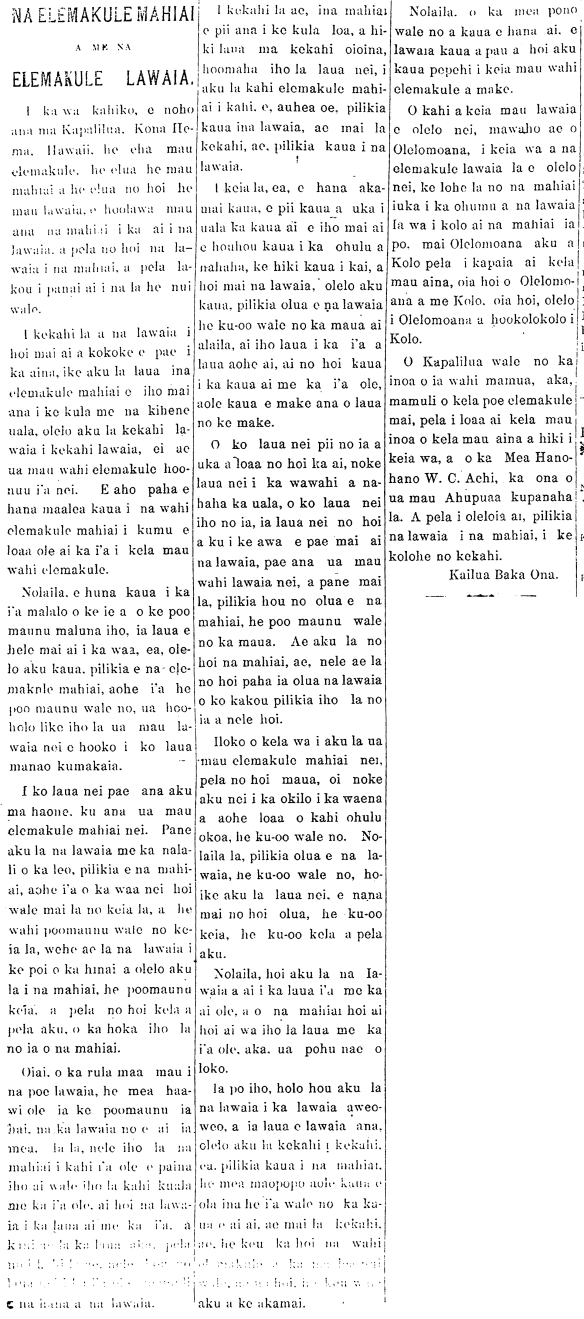
NA ELEMAKULE MAHIAI a me na ELEMAKULE LAWAIA.

Ka Lahui Hawaii, Buke 1, Helu 34, Aoao 2. Sepatemaba 16, 1899.

Food Exports, 1890.

[Found under: “HAWAII NEWS”]

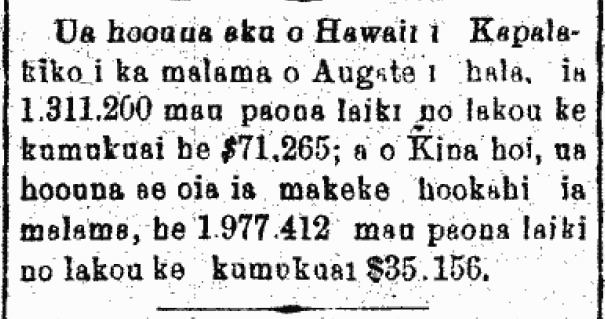
Hawaii exported to San Francisco in the month of this past August, 1,311,200 pounds of rice at the price of $71,265; and China exported to the same market in that month, 1,977,412 pounds of rice at the price of $35,156.

[What a different world we live in where we import most of our food…]

(Ko Hawaii Pae Aina, 10/18/1890, p. 2)

Ua hoouna aku o Hawaii i Kapalakiko...

Ko Hawaii Pae Aina, Buke XIII, Helu 42, Aoao 2. Okatoba 18, 1890.