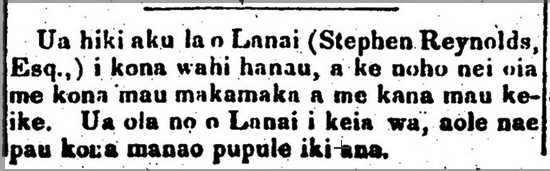
This letter to the editor of the Nuhou is interesting in so many ways. 1873.

NOT GOOD.

When I saw the newspaper Nuhou Hawaii; I was greatly gladdened to see it. When I took a close look, I was very happy. I talked with my wife, “Hey, this paper, Nuhou Hawaii, it is very good for us to subscribe to this paper.” Please don’t be upset at my bad writing. Gibson, I have much appreciation for you; at your great strength in saying that they should not give Puuloa [Pearl Harbor]. I talk in Chinese; all of Honolulu is appreciative of you. Continue reading

Mary Jane Fayerweather Montano’s story continued, 1923.

DRAMA OF OLD HAWAII MADE PICTURESQUE

(Continued from Page 1)

Booth’s dancing hall. The schoolhouse had a cross on the front. From 9 to 12, noon, we had book studies, and from 1 to 4 p. m. we did fancy work in which or teacher was an expert. I was very fond of fancy work and finished my first piece to hang in my guardian’s hall. The picture was of a lamb lying down, holding a flag, with clouds below and sun rays around its head. The picture was large. Continue reading

Stephen Reynolds was in Honolulu while Kamehameha II lived there, 1868.

[Found under: “KA MOOLELO O NA KAMEHAMEHA.”]

When King Liholiho resided in Honolulu, there was an increase of haole living in Honolulu at that time; some were of high standing, some were ship captains, some were traders, and some had shops. The haole living there at the time were: Jones Aluli, Mister Parker [Mikapako], Stephen Reynolds [Lanai], Continue reading

Warning, 1898.

An Object-Lesson for the Hawaiians

In the debate in the Senate on Hawaiian annexation, Senator Tillman of South Carolina, let unnumbered cats out of innumerable bags. He spoke of the way in which the people of the Southern States established “a white man’s government” after the war, of the opposition of the Republican party to the  methods by which that government was established, and wanted to know if the Republican party was not backing up a similar “white man’s government” Continue reading

J. H. Kanepuu the traditionalist, 1970.

Hawaiian Math

By Russell and Peg Apple

BY THE MID 1800s, the Hawaiian people were betwixt and between two cultures. There was the pull and the momentum of the old—the traditional Hawaiian; and the lure and exhortations of the new—a New England brand of Western.

And the Hawaiians were aware of the situation. They were not above pointing out to each other the conflicts they met in their everyday life.

One who did so was a man from Palolo, a Mr. J. H. Kanepuu. He wrote in the Hawaiian language newspaper Ke Au Okoa, and on Jan. 21, 1867, saw the need to call attention to two counting systems that existed side by side.

KANEPUU NOTED the conflict in the markets where Hawaiians bought and sold. There was a generation gap in methods of enumeration. Most of the fishermen and farmers who sold in the markets were old men who counted by the Hawaiian method. Those who bought were younger folks who counted by the haole system. Few knew both well.

The momentum and practices of the past fixed the habit patterns of the fishermen who caught flying fish, mullet, mackerel and milkfish for the Honolulu markets. They either sold their catch themselves, or it was sold by family members of the same generation. They counted Hawaiian style.

Those who bought counted haole style. They had been to the mission and public schools. They knew how to count by tens, from one on up into the tens of thousands. Each had ten fingers, including thumbs, to help.

BUT THE Hawaiian system was based on the numeral four, not the decimal system. Hawaiians had four fingers on each hand to help in counting.

Both the old timers and the younger Hawaiians spoke Hawaiian fluently. But the haole terms had been translated into Hawaiian and taught to the people who went to school, along with the counting-by-tens method. It was the same sort of confusion which occurs today when a nation switches from pounds-shillings-and-pence to a coinage based on the decimal system. Or when a student who learned his work in inches, feet, yards and miles tries to deal with millimeters, centimeters, meters kilometers. Misunderstandings and confusion result.

LOT KAMEHAMEHA, later to rule as Kamehameha V, was educated by Christian missionaries and was versed in the Western system. Kanepuu wrote that when he was still Prince Lot, he received a gift of fish at his house in Honolulu. This was sometime in the early 1800s, before Lot Kamehameha was crowned.

The men who brought the fish used the old system, the Prince only understood the new.

“How much fish?” asked the prince.

“One lau and nine kaau,” answered the Hawaiian servant who delivered the fish, a gift from chief Kuhia.

THIS ANSWER distressed Lot Kamehameha and he alsmost became angry. On seeing this, the Hawaiian switched to the new system. Continue reading

A Hawaiian Co-Op, 1918.

KA “HUI LOKAHI O NA HAWAII” KAUPALENAIA.

These passing day, Hawaiians like Mayor Joseph J. Fern, David Kalauokalani, Samuel C. Dwight, James L. Holt, Hon. William P. Jarrett, Hon. C. P. Iaukea and a number of other Hawaiians are joining together to establish a company that will deal in the sale of poi, beef, salmon, dried fish, and so forth; with the intent to help Hawaiians in all ways that will lessen their household expenses; because it is very clear these days that because the poi factory of Kalihi is not making poi now, the current poi manufacturers are greatly raising the price of poi to five cents per pound; this is a price not seen in the past ten years or more; so too with the price of beef; the Chinese are buying very fine beef from the company of C. J. Waller [Wala], but the Chinese are charging Hawaiians 35 cents per p0und; it is an exorbitant price which has never been seen before; and it is heard from the talk of the Chinese that they will raise the price of poi once again to 6 cents a pound; it was this that encouraged the Hawaiians to establish a company that could hold back the severe increasing of the prices of our foods, O Hawaiians, by the Chinese.

The establishing of a company amongst Hawaiians is important and crucial; but if we Hawaiians do not implement an endeavor that will help ourselves, there will  be no one else who will help us.

If we turn back and look at the history of Hawaii nei, we will see that the dissension amongst us Hawaiians was what wrenched away small businesses from us Hawaiians as well as all the other endeavors. Continue reading

Hasn’t the time come that Hawaiians try to help in the economic endeavors of their own people? 1914.

Announcement

KA HUI KUAI POI O KALIHI (“KALIHI TARO AND LAND CO., LTD.”)

To those who read this.

With aloha:—Whereas all of the shares of the Company named above has been acquired by W. C. Achi and some Hawaiians, and being that they are the only Hawaiians carrying out the growing of taro and the selling of poi, the food of our kupuna and makua; therefore, they humbly ask you, O Hawaiians, that you give them your assistance, by you buying your poi from their group.

The production of the poi at their poi factory is truly sanitary, and your orders will be filled with great haste.

Hasn’t the time come that Hawaiians try to help in the economic endeavors of their own people? Continue reading