I hewa no ia oe la, i kou awihi maka ana mai! 1911.

FAULTED FOR WINKING.

Because the Hawaiian musicians who are in Denver continuously wink at the haole women who frequently dine in the hotel which hired the boys to sing regularly, and most of the women are smitten and are truly entranced by some of the boys, therefore there have been many a complaint to the police about them, to the point where the hotel was ordered to immediately stop contracting those musicians.

When the women and their companions arrive at the hotel, the musicians are always singing songs about women, and therefore some of the women are delighted at this, and the boys are constantly winking.

As they are always seen doing this, there has been numerous complaints to the police department demanding that the hotel throw out the band; the hotel agreed, but only after their contract to sing and play music there was over.

The kinds of songs were not complained about, nor how they sang; only one thing was the cause of the complaints, that being the constant winking of the boys to the women, for by doing this, there have been singers who have married girls of high-class families.

[…pii e ke kai i kumu pali!]

(Kuokoa, 2/17/1911, p. 6)

HOOHALAHALAIA NO KA AWIHI MAKA.

Ka Nupepa Kuokoa, Buke XLVII, Helu 7, Aoao 6. Feberuari 17, 1911.

Hawaiians deported from Samoa, 1891.

Hawaiians From Samoa

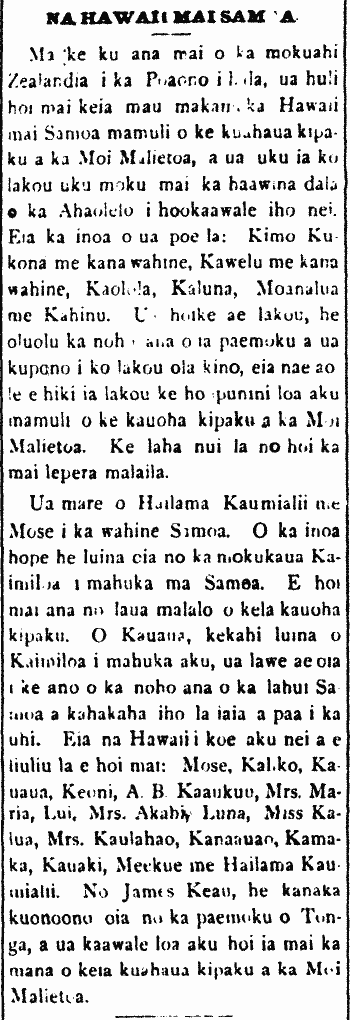
Aboard the steamship Zealandia which landed this past Saturday, these Hawaiian friends came back from Samoa due to the deportation proclamation by King Malietoa, and their passage was paid for by funds from the Legislature which was set aside. Here are their names: Kimo Kukona and wife, Kawelu and wife, Kaolola, Kaluna, Moanalua, and Kahinu. They said that life in those islands was comfortable, and suitable for the health, but they could not stay long because of King Malietoa’s deportation order. There is much leprosy spreading there.

Hairama Kaumialii and Mose wed Samoan wives. The latter named is a sailor on the Kaimiloa who abandoned ship at Samoa. They both will return under the deportation law. Kauaua, a sailor from the Kaimiloa who fled, assimilated to the Samoan way of life, and is covered in a tattoo. These are the Hawaiians who remained and are preparing to return: Mose, Kaliko, Kauaua, Keoni, A. B. Kaaukuu, Mrs. Maria, Lui, Mrs. Akahi, Luna, Miss Kalua, Mrs. Kaulahao, Kanaauao, Kamaka, Kauaki, Meekue, and Hailama Kaumialii. As for James Keau, he is well off, living in the islands of Tonga, and is far from the authority of this expulsion order by King Malietoa.

[If some of my posts look familiar to some of you, they are being reposted from my old Hoolaupai Facebook page. They cannot be easily found on that page, and that was one of the major reasons for starting this one. Here at least i can do tags and categories, and hopefully that makes them easier to find. Google also does a pretty good job of making them searchable!]

(Kuokoa, 1/17/1891, p. 2)

NA HAWAII MAI SAMOA

Ka Nupepa Kuokoa, Buke XXX, Helu 3, Aoao 2. Ianuari 17, 1891.

A Hawaiian dies far away from home, 1917.

Passed Away.

It was from the steamer Ventura that news was heard of the passing of a Hawaiian mother well known by those of Hilo and Honolulu, that being Mrs. Meleana Keomailani Kenuwe, and her bones will be left in foreign lands where she lived for a long time, for 17 or more years. She left her beloved community of her homeland in 1888 to go live with her daughters, Jessie Kamokukaha Wilson and Mrs. Mary Kinoole Shotlz. Her sons-in-law worked planting fruits in the county of Santa Clara, an area in California that is fifty miles from San Francisco. She was born in Honolulu in 1829, and died at 76 years old. Mrs. Caroline Paakaiulaula Bush of this town is her younger sister, and here also is her son Alfred Kapahukapu Kenway. She has ten surviving grandchildren and ten great-grandchildren. How sad for that beloved mother who has passed; she is a native and well-acquainted with living in the Lanipili rains of Hilo. When her daughters were young, she was a travel companion of the Lady Treasurer of this Aloha Aina newspaper [Emma Nawahi], and she was a favorite in the bosom of that beloved lady who has passed on. Aloha no. That path which she has taken is one we must all take. The Aloha Aina shares in the sorrow of the family of that beloved mother who has gone.

[It is good to note that sometimes there is the same Hawaiianization for different haole names. When one hears Kenuwe, we would usually think Greenwell, but here we see that it is what Hawaiians called Kenway.

It is also good to remember that there are at times more than one Hawaiianization for a single haole name.]

(Aloha Aina, 7/8/1905, p. 5)

O Mrs. Meleana Kenuwe Ua Hala.

Ke Aloha Aina, Buke XI, Helu 27, Aoao 5. Iulai 8, 1905.

Death of Mary Ann Kaaumokulani Kinoole Pitman Ailau, 1905.

DIED.

AILAU—In Hilo, Hawaii. February 11, 1905. Mrs. Mary Ann Kaaumokulani Kinoole Pitman Ailau, daughter of the High Chiefess Kinoole and the late Benjamin Pitman, and widow of John Keakaokalani Ailau, aged 67 years.

Mrs. Ailau was known from one end of the group to the other, and in Boston and many of the Atlantic watering places.

She was born at Hilo 67 years ago, and with the exception of a number of years spent in Boston and New England completing her education, she always resided in the islands. She was a daughter of Benjamin Pitman a capitalist, who resided both in Hilo and Honolulu. The Pitman home was at the corner of Alakea and Beretania streets, on the site now occupied by the C. Q. Yee Hop building.

The Pitmans came here from Boston, where they were well connected. Mrs. Ailau’s father-in-law also resided here for a number of years. Her father married the High Chiefess Kinoole, daughter of the High Chief Hoolulu. Continue reading

Hawaiian returns home to Hilo after living in Boston for 50 years, 1917.

RETURNED ONCE AGAIN TO THE LAND OF HIS BIRTH

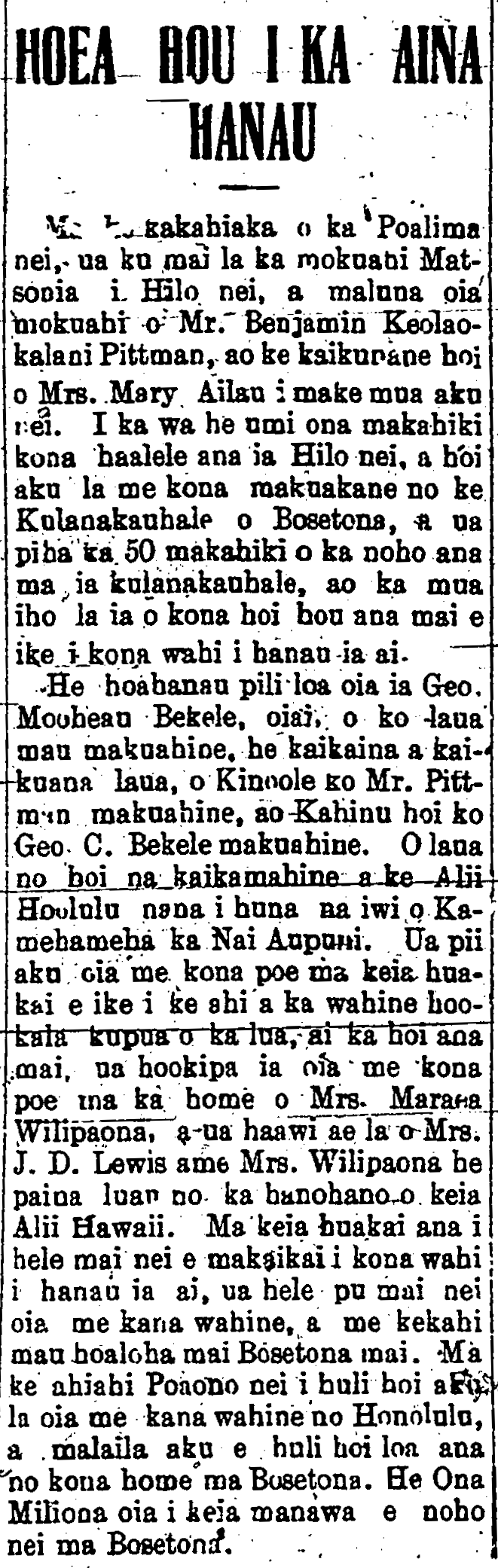
In the morning of last Friday, the steamship Matsonia docked in Hilo nei, and aboard the ship was Mr. Benjamin Keolaokalani Pitman [Pittman], the brother of the recently deceased Mrs. Mary Ailau. He left left Hilo when he was 10 years old, and went back with his father to the city of Boston, and he has lived there for a full 50 years, and this is the first time he has returned to see the place where he was born.

He is a direct cousin to George Mooheau Beckley, as their mothers were sisters; Kinoole is Mr. Pitman’s mother, and Kahinu is George C. Beckley’s. The two of them were daughters of the Alii Hoolulu who hid the bones of Kamehameha Ka Na’i Aupuni. He [Pittman] went with his people on a tour to see the fire of the enchanting woman of the pit, and on their return, they were entertained at the home of Mrs. Maraea Wilipaona [? Mrs. Maria Wilfong], and Mrs. J. D. Lewis and Mrs. Wilfong put on a luau to honor this Hawaiian Alii. On this trip of his to his homeland, accompanying him were his wife and some friends from Boston. On Saturday evening, he and his wife left for Honolulu, and from their they will return to his home in Boston. He is now a Millionaire living in Boston.

[Unfortunately, the digital images of the Hoku o Hawaii newspaper are only available online from 5/31/1917, and so the issue in which this story appears is not available yet (along with the ten years of newspapers that come before it).]

(Hoku o Hawaii, 2/8/1917, p. 2)

HOEA HOU I KA AINA HANAU.

Ka Hoku o Hawaii, Buke 11, Helu 37, Aoao 2.

Hawaiian boys headed to China to play music, 1916.

[Found under: “LOCAL AND GENERAL”]

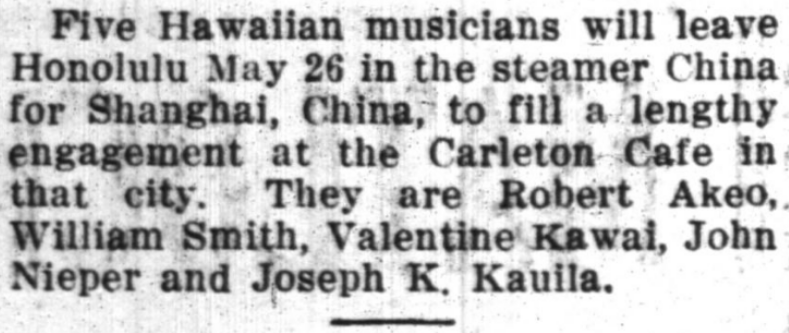
Five Hawaiian musicians will leave Honolulu May 26 in the steamer China for Shanghai, China, to fill a lengthy engagement at the Carleton Cafe in that city. They are Robert Akeo, William Smith, Valentine Kawai, John Nieper and Joseph K. Kauila.

(Honolulu Star-Bulletin, 5/9/1916, p. 3)

Five Hawaiian musicians...

Honolulu Star-Bulletin, Volume XXIII, Number 7511, Page 3. May 9, 1916.

Hawaiians singing in far away China, 1917.

THERE IS GREAT DELIGHT IN HAWAIIAN MUSIC IN CHINA.

In a letter written by Robert Akeo, a Hawaiian boy who travelled to Shanghai, China, with his companions to sing under contract, it is seen that there is much admiration for Hawaiian music in China, because their contract to play there was over long ago, and yet, they are constantly being asked to satisfy the desires of those people for Hawaiian music and hula.

It seems in order to fulfill the wishes of Shanghai’s people for hula, one of the boys was made into a woman by putting on women’s clothing, and he would dance with one of his fellow boys, while the rest of them play music, and they sing and dance at the same time.

There are some thousands of people in Shanghai who have no knowledge of Honolulu, but after hearing the singing voices, and seeing the act of those young ones, the desire to come visit Honolulu and see the Paradise of the Pacific grew within them.

(Kuokoa, 2/2/1917, p. 8)

NUI KA HIALAAIIA O NA MELE HAWAII MA KINA.

Ka Nupepa Kuokoa, Buke LV, Helu 5, Aoao 8. Feberuari 2, 1917.

Hawaiian Music, an editorial, 1911.

How Hawaiian Music is Being Misconstrued!

Perhaps the thoughts of the Kuokoa may not be the same as those of others about the way Hawaiian music is being sung these days, but because we hold dear listening to the beauty and the sweet sounds along with the joy of the voices, therefore the Kuokoa takes up this matter.

It is not something that we Hawaiians should criticize, that singing is something we are proud of, and something that makes this race famous all around the world, by tourists who visit Hawaii nei and hear us singing our enjoyable and entertaining songs, as well as by singing groups being seen travelling about America.

If we were to turn back in time, to many years past, when the Kawaihau Glee Club and many other groups were famous for singing, we will see when comparing them to those performing today, the differences between them; our admiration will be taken by the singing of the old days, which many groups in some places around Hawaii nei still practice that way of singing Hawaiian songs.

Our Hawaiian mele are composed with their many kaona, and it is by how they are sung, if it is not made clear by the lyrics, that give appreciation and admiration to the listener, from Hawaiians to those that don’t know our language, because it is only through the melody of the song that that listener is entertained.

These days however, our singers are following haole style singing; and when songs that we are used to hearing along with their tunes which fill us with energy and enthrallment are changed, when listening to that it is like ridicule, for we are not used to hearing that kind of melody, and Hawaiian songs are not famous for that style of singing.

Our people, from the men to the women are talented with fine singing voices; it is a talent not widely spread amongst other people of the world, but it is not by the the way some people now are singing, but by singing songs as they were sung in years past.

Perhaps the vibrato and the slow and drawn out of singing matches haole songs of this age, but by changing the way Hawaiian songs are sung in this way, we at the Kuokoa are not mistaken when we say that it is insulting to the listener.

We don’t wish to call this person or that one not a good singers, but should we want our goal to be to preserve this fame through song, there is only one arena for us to stand before the other races, that is through expressing what God has given to every Hawaiian man and woman, without mimicking or emulating what other people are doing; lest what is seen by us as good becomes something that is not good.

We have nothing to say to those who are studying music in books; that will be a great benefit to some, but the good seen in one aspect will not get better by changing another aspect; so it is with our Hawaiian music, by changing how they are sung, it will not make them better.

Each and every Hawaiian is the true witness, and they are the perfect judge to weigh what we now discuss, not to criticize or to assail upon someone with words of persecution, but for our affection of the grandeur and true beauty of Hawaiian mele which each and every one of us all love and cherish.

[On a somewhat related topic about tradition and kuleana and mele, there is a very thought-provoking essay for composers and non-composers alike, by Kainani Kahaunaele, printed in The Value of Hawaii 2: Ancestral Roots, Oceanic Visions, just recently out. In fact, if you haven’t got your copy yet, there are many stories by a wide range of writers in there that we should look at, and perhaps the many moolelo within the collection will then push us into thinking what we ourselves feel the value of Hawaii nei is and where we should be headed and what it is we need to do to get us there.]

(Kuokoa, 9/8/1911, p. 4)

PEHEA E HOOHEPAIA MAI NEI NA HIMENI HAWAII!

Ka Nupepa Kuokoa, Buke XLVII, Helu 36, Aoao 4. Sepatemaba 8, 1911.

Charles Nakao, survivor of the Aztec, writes home to Hawaii, 1917.

HAWAIIAN SURVIVOR OF AZTEC TELLS HIS STORY IN LETTER TO THE STAR-BULLETIN

A MESSAGE from a Hawaiian survivor of the steamship Aztec, sunk by a German submarine, came to the Star-Bulletin in yesterday’s mail from Brooklyn, New York.

Charles Nakao in a letter to this paper tells how some of his comrades were lost in trying to launch a lifeboat, and of the suffering of those on the wintry sea. Five Hawaiians were among those who perished, and a few weeks ago the legislature held a public memorial in their honor.

The letter says:

“Brooklyn, New York, April 26, 1917.

“Dear Sir: I, Chas. Nakao, was one of the members of the crew of the S. S. Aztec which was the first American vessel armed with two three-inch guns. Number of crew was 49, including 12 navy gunners and an officer of the U. S. S. Dolphin. We sailed from New York March 18, 1917, and were torpedoed by a submarine April 1, 1917, Sunday night, at 9:30 o’clock, off the coast of France. It was very stormy weather, the seas were about 30 feet in height and the current from English channel was running about 7 miles an hour. It were dark hail storm and were impossible to launch any lifeboat over the weather side. Seven of the crew got excited and try to launch the boat No. 2, which were on the weather side they were all smashed between the life boat and the ship side one of the boys were from Honolulu, Ekela Kaohi, the other were Chinese boy from Puna Pahoa Henry Look. No. 3 boat there were Hail Rice of Honolulu, Chas. Pumoku, Julian Makama of Honolulu, one from Tahiti Islands, John Davis. I were on board the No. 1 boat which I suppose to be the gunners’ boat. There were 19 of the crew on board. The vessel had sunk within 15 minutes it took 9 minutes because we were away from the ship side. After we were probably about 100 yards away some one gave four long blasts. Nobody knows how it happened. After four hours and a half in lifeboats on the high seas and hail storms and rain and darkness we were sighted by a French patrol boat. We had signaled to the boat with flashlights. They got full speed away from us. The second one had passed by and we lighted a torch and they came and picked us up. The temperature of the water was 40 degrees and I didn’t have any shoes or hat on. I was frozen and could hardly speak for about two hours after we got picked up. It was 1:30 o’clock in the early Monday…

Charles Nakao, survivor of the torpedoed Aztec

…morning and we had looked around for about 18 hours for the other boat. There were know sign whatsoever. So we landed at Brest, France, the American consul came and met us at the dock and over 6 hundred Frenchmen were treated fine. I got warm and were send to Brest hospital. From Brest we were send to Bourdeaux, France, about 48 hours ride train.

“We got on board the S. S. La Tourine, the French passenger boat from Bourdeaux, and we got back to New York safe.

“I remain yours truly,

CHAS. NAKAO,

Waiakea, Hilo, Hawaii.

“If any of boys’ family wants to get any information about the clothes or anything else please sent me your address and I will try my best to send it over. This is my address: Chas. Nakao, 324-32th street, Brooklyn, New York.

“P. S.—Thinking our Queen for her kindly remembrance to us boys off the ill-fated S. S. Aztec.

“Yours sincerely,

“C. N.”

[This article seems to be summarized in the Kuokoa of Iune 1, 1917, p. 5]

(Honolulu Star-Bulletin, 5/9/1917, p. 1)

HAWAIIAN SURVIVOR OF AZTEC TELLS HIS STORY IN LETTER TO THE STAR-BULLETIN

Honolulu Star-Bulletin, Volume XXIV, Number 7822, Page 1. May 9, 1917.

Hawaiian men aboard the Aztec, 1917.

Cables Names of Men Aboard Aztec

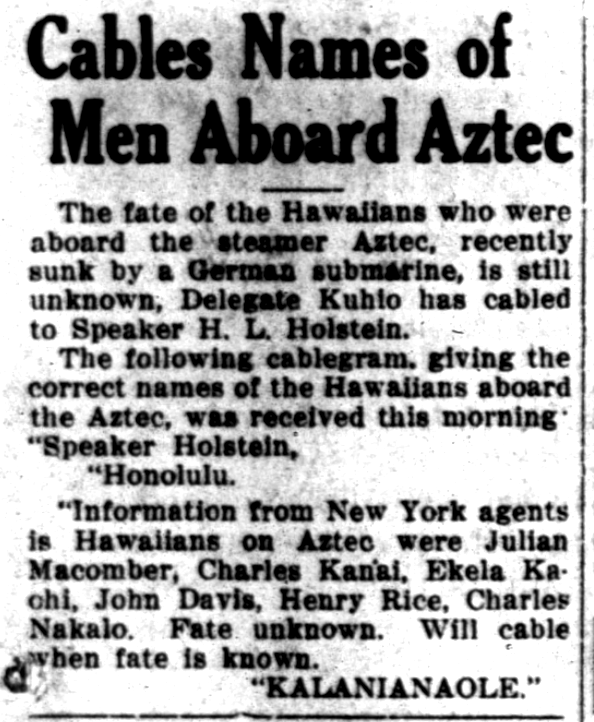
The fate of the Hawaiians who were aboard the steamer Aztec, recently sunk by a German submarine, is still unknown, Delegate Kuhio has cabled to Speaker H. L. Holstein.

The following cablegram, giving the correct names of the Hawaiians aboard the Aztec, was received this morning.

“Speaker Holstein,

“Honolulu.

“Information from New York agents is Hawaiians on Aztec were Julian Macomber, Charles Kanai, Ekela Kaohi, John Davis, Henry Rice, Charles Nakalo. Fate unkonwn. Will cable when fate is known.

“KALANIANAOLE.”

(Honolulu Star-Bulletin, 4/5/1917, p. 1)

Cables Names of Men Aboard Aztec

Honolulu Star-Bulletin, Volume XXIV, Number 7793, Page 1. April 5, 1917.